1-1
What Is Strategy andWhat Is Strategy and
Why Is It Important?Why Is It Important?
11
Chapter
Screen graphics created by:
Jana F. Kuzmicki, Ph.D.
Troy State University-Florida and Western Region
““Without a strategy theWithout a strategy the
organization is like a shiporganization is like a ship
without a rudder.”without a rudder.”
Joel Ross and Michael Kami
1-3
Chapter RoadmapChapter Roadmap
 What Is Strategy?
 Identifying a Company’s Strategy
 Strategy and the Quest for Competitive Advantage
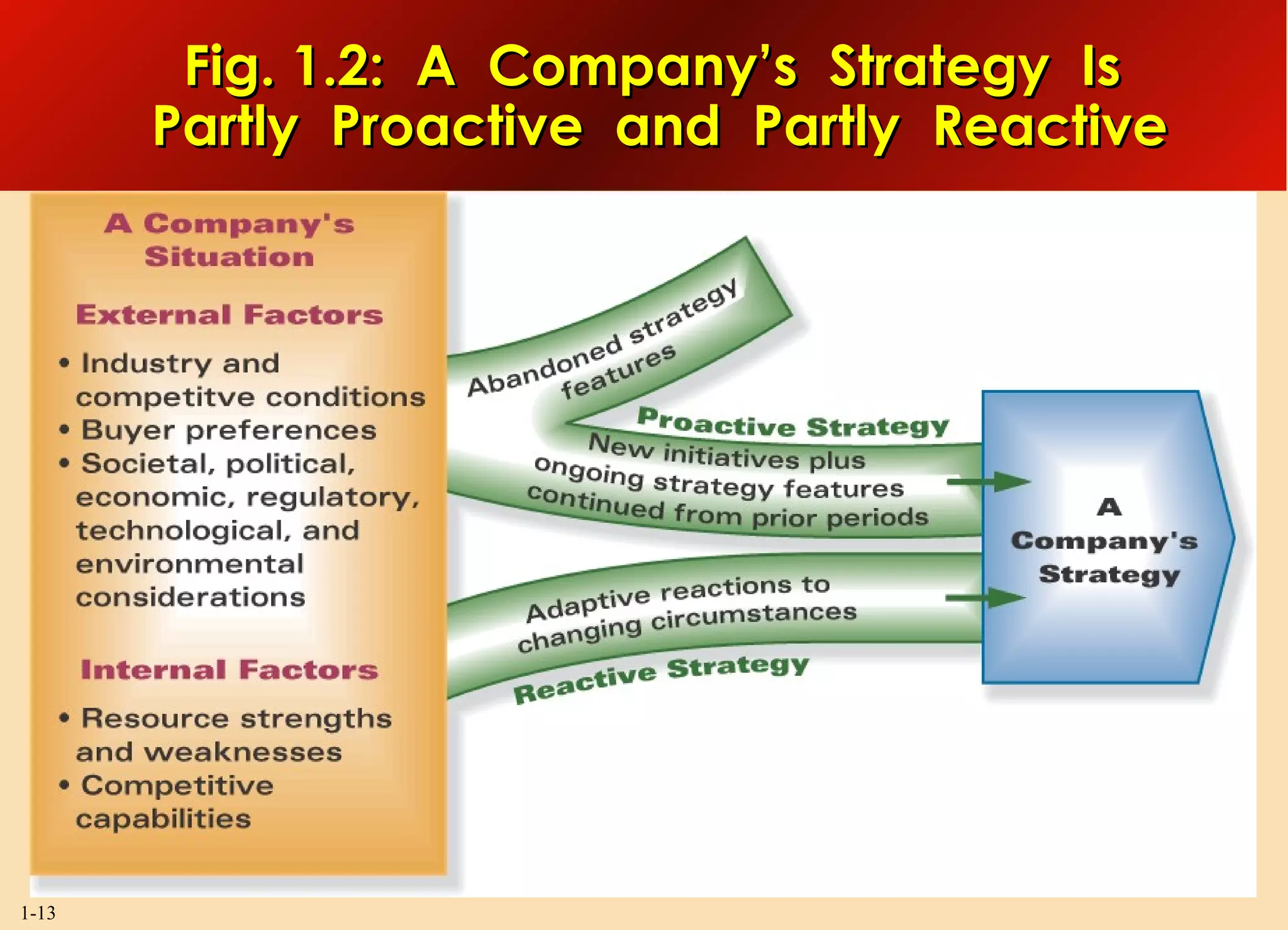
 Strategy Is Partly Proactive and Partly Reactive
 Strategy and Ethics: Passing the Test of Moral Scrutiny
 The Relationship Between a Company’s Strategy and Its
Business Model
 What Makes a Strategy a Winner?
 Why Are Crafting and Executing Strategy Important?
1-4
Thinking Strategically:Thinking Strategically:
The Three Big Strategic QuestionsThe Three Big Strategic Questions
1. Where are we now?
2. Where do we want to go?
 Business(es) to be in and market positions to stake out
 Buyer needs and groups to serve
 Outcomes to achieve
3. How will we get there?
 A company’s answer to “how
will we get there?” is its strategy
1-5
What Is Strategy?What Is Strategy?
 Consists of the combination of competitive moves and
business approaches used by managers to run the company
 Management’s “game plan” to
 Attract and please customers
 Stake out a market position
 Compete successfully
 Grow the business
 Achieve targeted objectives
1-6
 How to please customers
 How to respond to changing
market conditions
 How to outcompete rivals
 How to grow the business
 How to manage each functional piece of the business and
develop needed organizational capabilities
 How to achieve strategic and financial objectives
Strategy
is HOW
to . . .
TheThe HowsHows ThatThat
Define a Firm's StrategyDefine a Firm's Strategy
1-7
What Are a Company’sWhat Are a Company’s
Strategic Choices?Strategic Choices?
 Trial-and-error organizational learning about
 What has worked and
 What has not worked
 Management’s appetite for taking risks
 Managerial analysis and strategic thinking about how best to
proceed, given prevailing circumstances
Strategic choices are based on . . .
1-8
Key Elements:Key Elements:
Southwest Airlines’ StrategySouthwest Airlines’ Strategy
 Grow the business by gradually adding more flights on existing
routes and initiating service to new airports
 Make friendly service a company trademark
 Maintain an aircraft fleet of only Boeing 737s
 Encourage customers to make reservations and purchase tickets at
the company’s Web site
 Avoid flying into congested airports
 Employ a point-to-point route system
 Economize on
 Amount of time it takes terminal personnel to check passengers
in and on-load passengers
 Costs
1-9
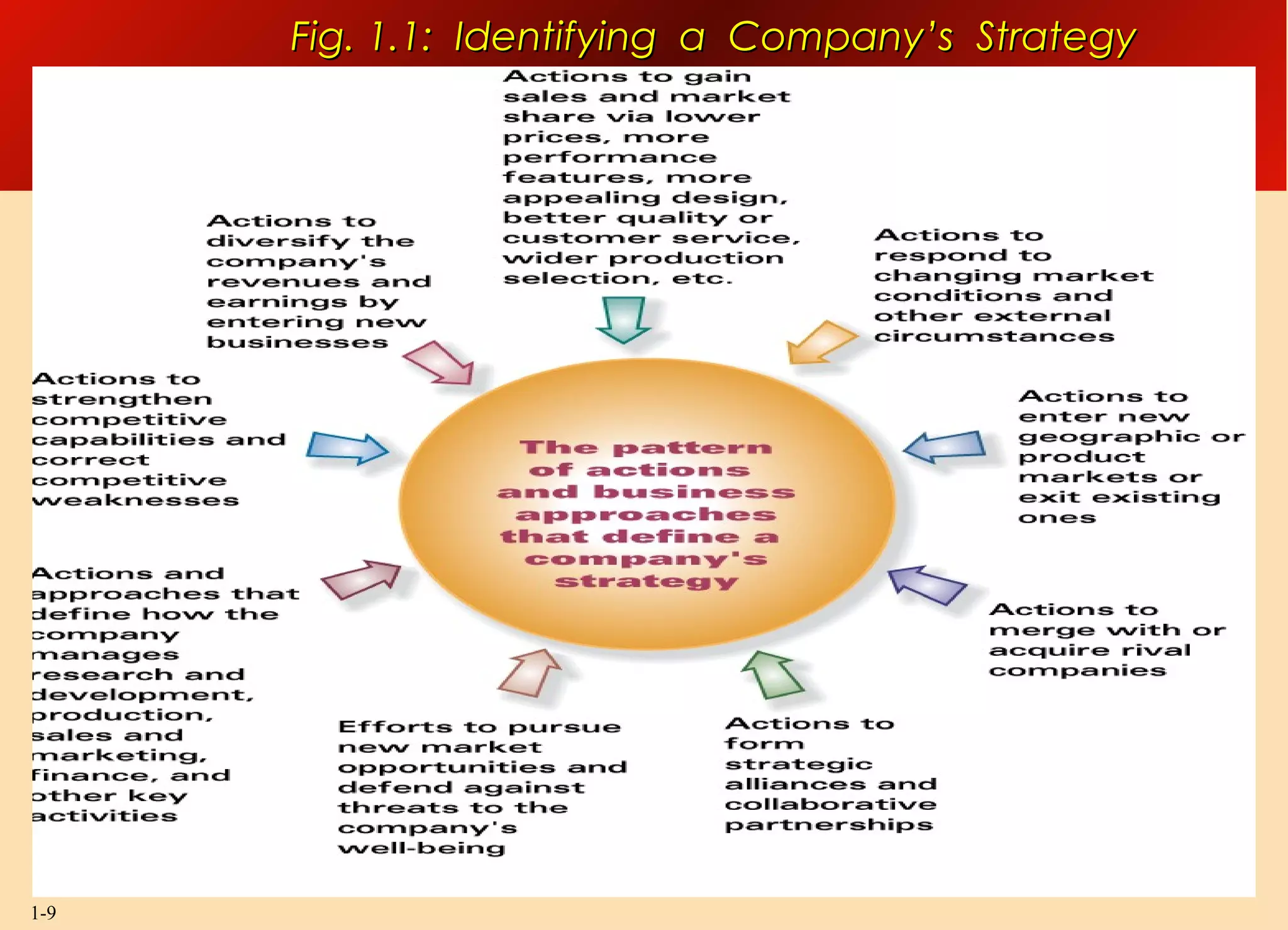
Fig. 1.1: Identifying a Company’s StrategyFig. 1.1: Identifying a Company’s Strategy
1-10
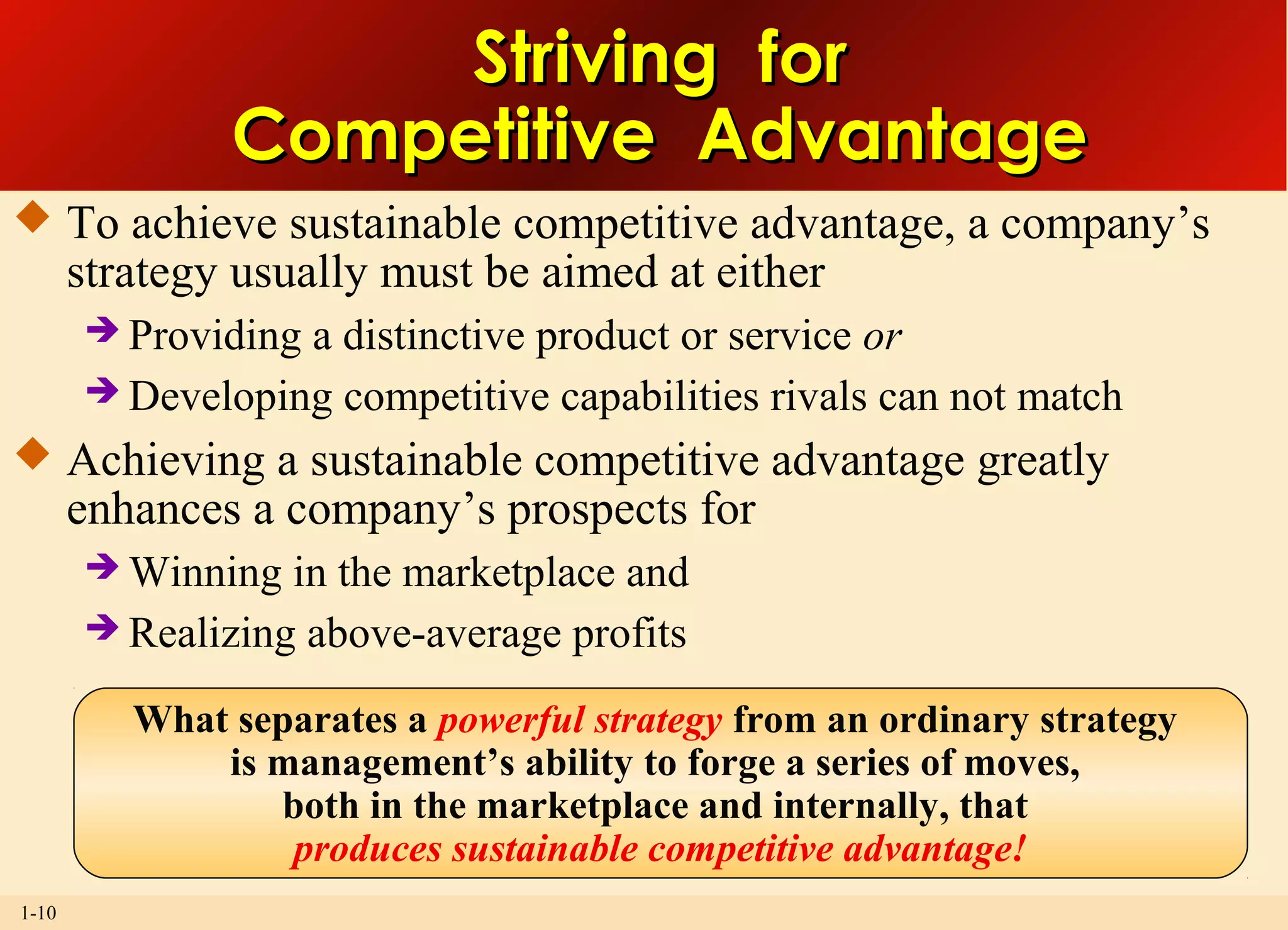
Striving forStriving for
Competitive AdvantageCompetitive Advantage
 To achieve sustainable competitive advantage, a company’s
strategy usually must be aimed at either
 Providing a distinctive product or service or
 Developing competitive capabilities rivals can not match
 Achieving a sustainable competitive advantage greatly
enhances a company’s prospects for
 Winning in the marketplace and
 Realizing above-average profits
What separates a powerful strategy from an ordinary strategy
is management’s ability to forge a series of moves,
both in the marketplace and internally, that
produces sustainable competitive advantage!
1-11
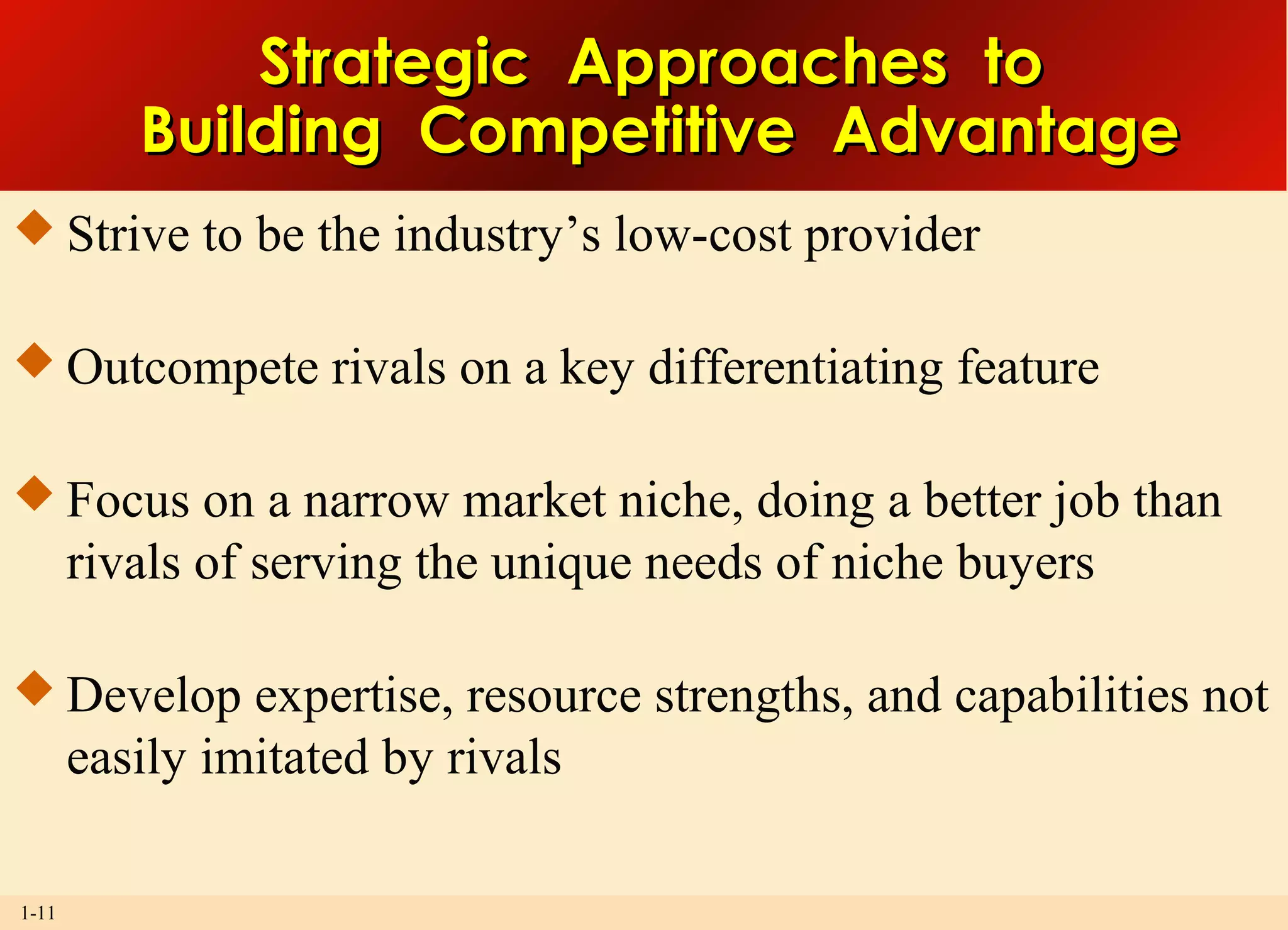
Strategic Approaches toStrategic Approaches to
Building Competitive AdvantageBuilding Competitive Advantage
 Strive to be the industry’s low-cost provider
 Outcompete rivals on a key differentiating feature
 Focus on a narrow market niche, doing a better job than
rivals of serving the unique needs of niche buyers
 Develop expertise, resource strengths, and capabilities not
easily imitated by rivals
1-12
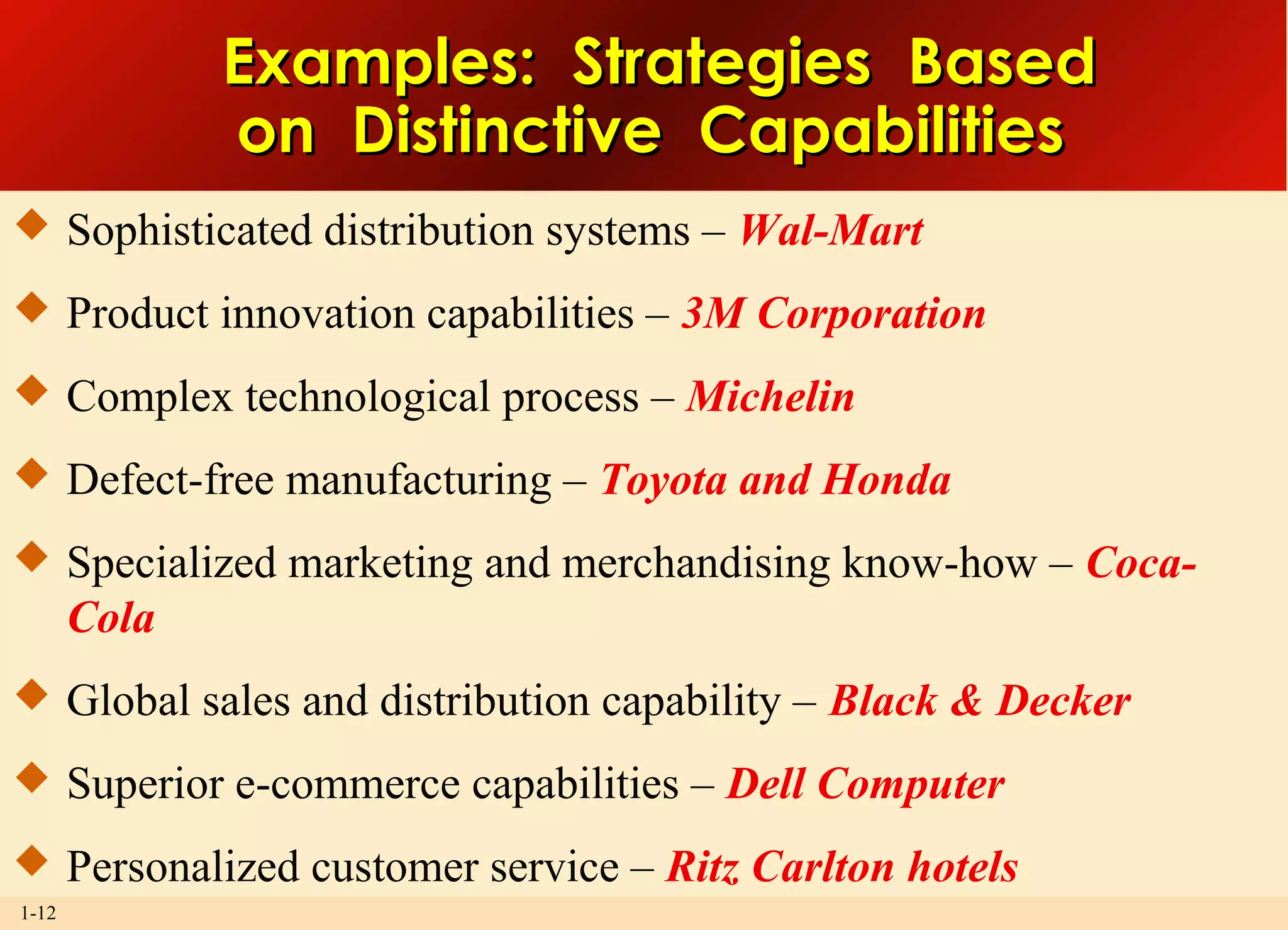
Examples: Strategies BasedExamples: Strategies Based
on Distinctive Capabilitieson Distinctive Capabilities
 Sophisticated distribution systems – Wal-Mart
 Product innovation capabilities – 3M Corporation
 Complex technological process – Michelin
 Defect-free manufacturing – Toyota and Honda
 Specialized marketing and merchandising know-how – Coca-
Cola
 Global sales and distribution capability – Black & Decker
 Superior e-commerce capabilities – Dell Computer
 Personalized customer service – Ritz Carlton hotels
1-13
Fig. 1.2: A Company’s Strategy IsFig. 1.2: A Company’s Strategy Is
Partly Proactive and Partly ReactivePartly Proactive and Partly Reactive
1-14
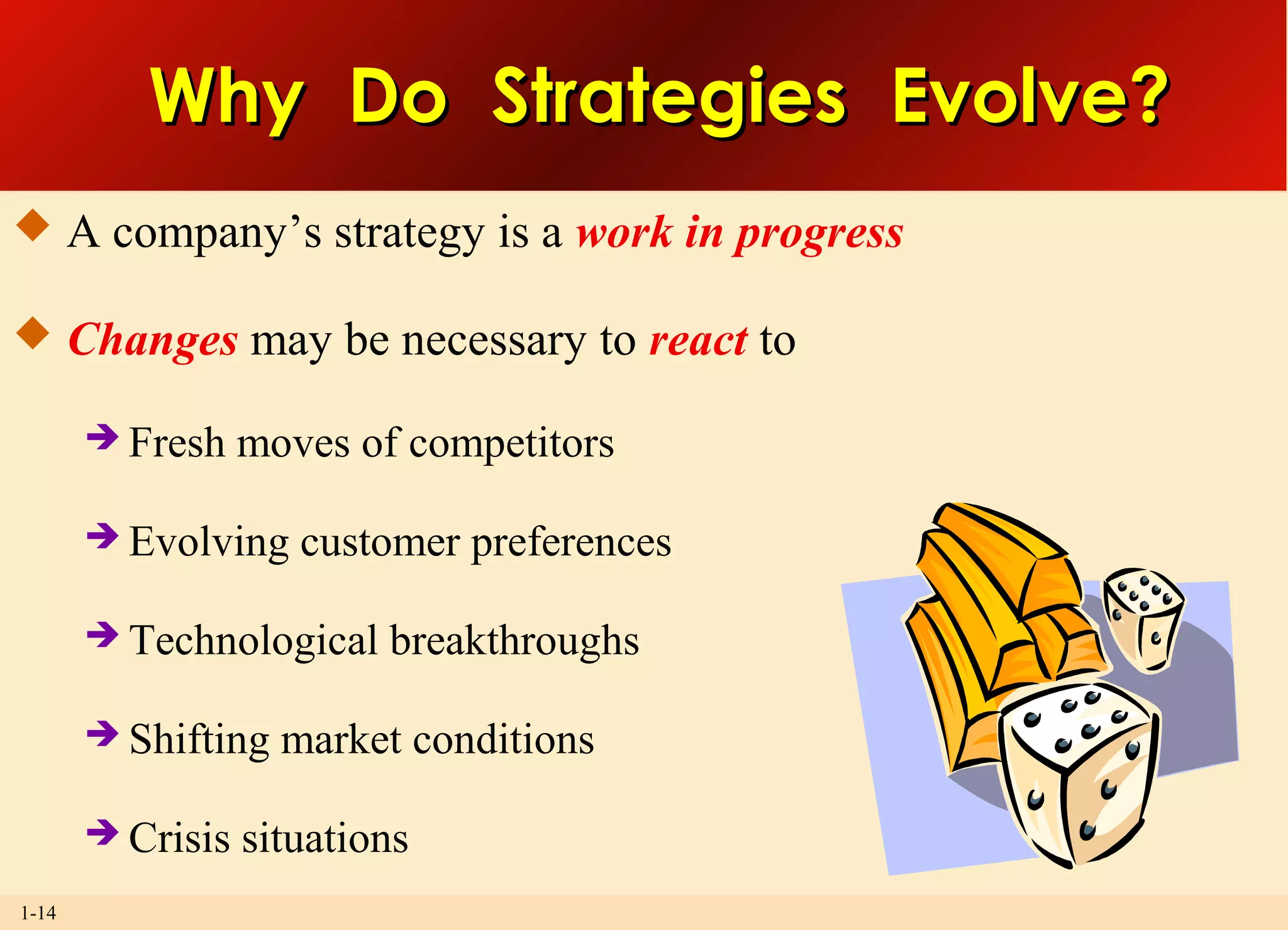
 A company’s strategy is a work in progress
 Changes may be necessary to react to
 Fresh moves of competitors
 Evolving customer preferences
 Technological breakthroughs
 Shifting market conditions
 Crisis situations
Why Do Strategies Evolve?Why Do Strategies Evolve?
1-15
Crafting Strategy Is anCrafting Strategy Is an
Exercise in EntrepreneurshipExercise in Entrepreneurship
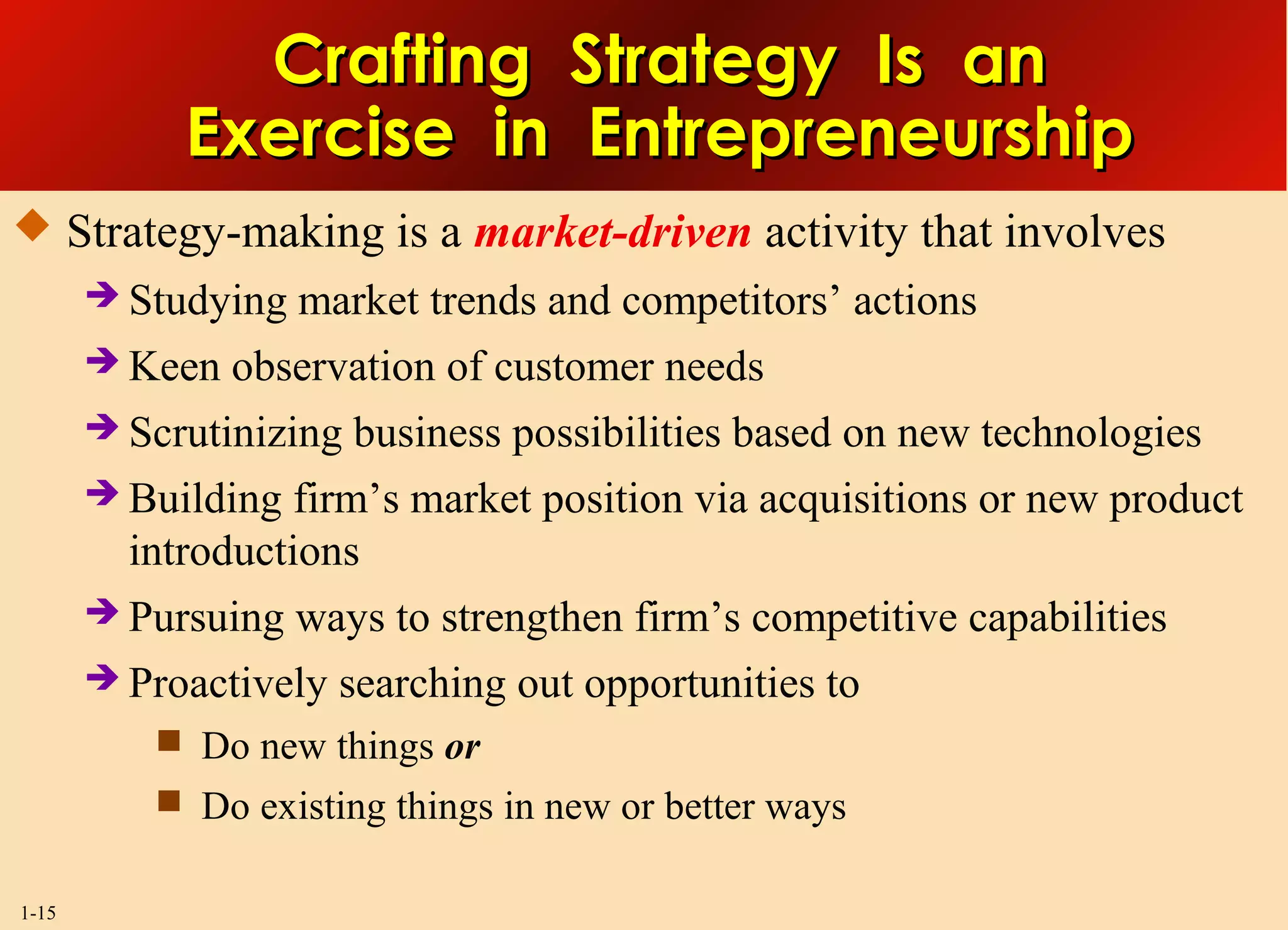
 Strategy-making is a market-driven activity that involves
 Studying market trends and competitors’ actions
 Keen observation of customer needs
 Scrutinizing business possibilities based on new technologies
 Building firm’s market position via acquisitions or new product
introductions
 Pursuing ways to strengthen firm’s competitive capabilities
 Proactively searching out opportunities to
 Do new things or
 Do existing things in new or better ways
1-16
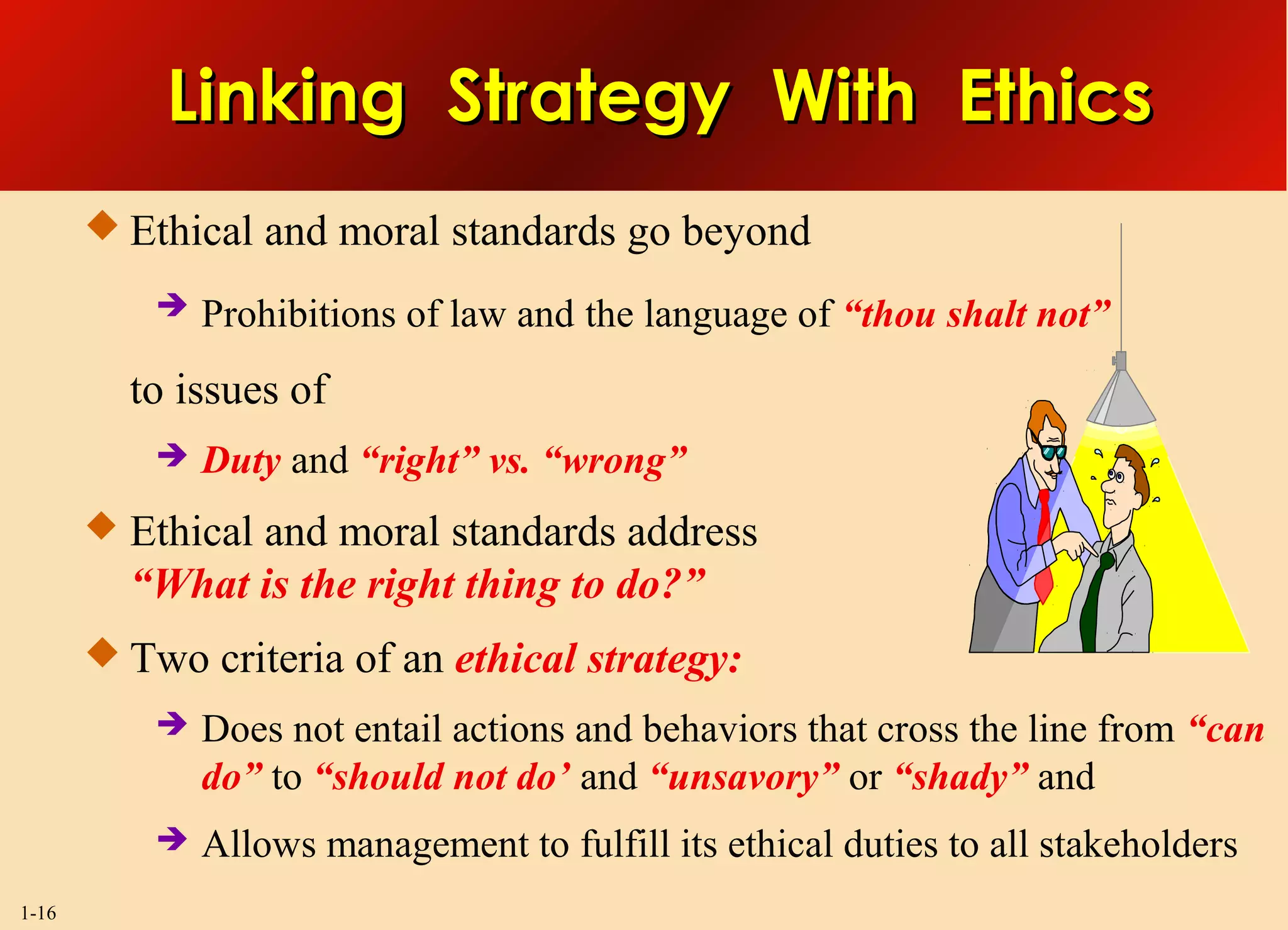
 Ethical and moral standards go beyond
 Prohibitions of law and the language of “thou shalt not”
to issues of
 Duty and “right” vs. “wrong”
 Ethical and moral standards address
“What is the right thing to do?”
 Two criteria of an ethical strategy:
 Does not entail actions and behaviors that cross the line from “can
do” to “should not do’ and “unsavory” or “shady” and
 Allows management to fulfill its ethical duties to all stakeholders
Linking Strategy With EthicsLinking Strategy With Ethics
1-17
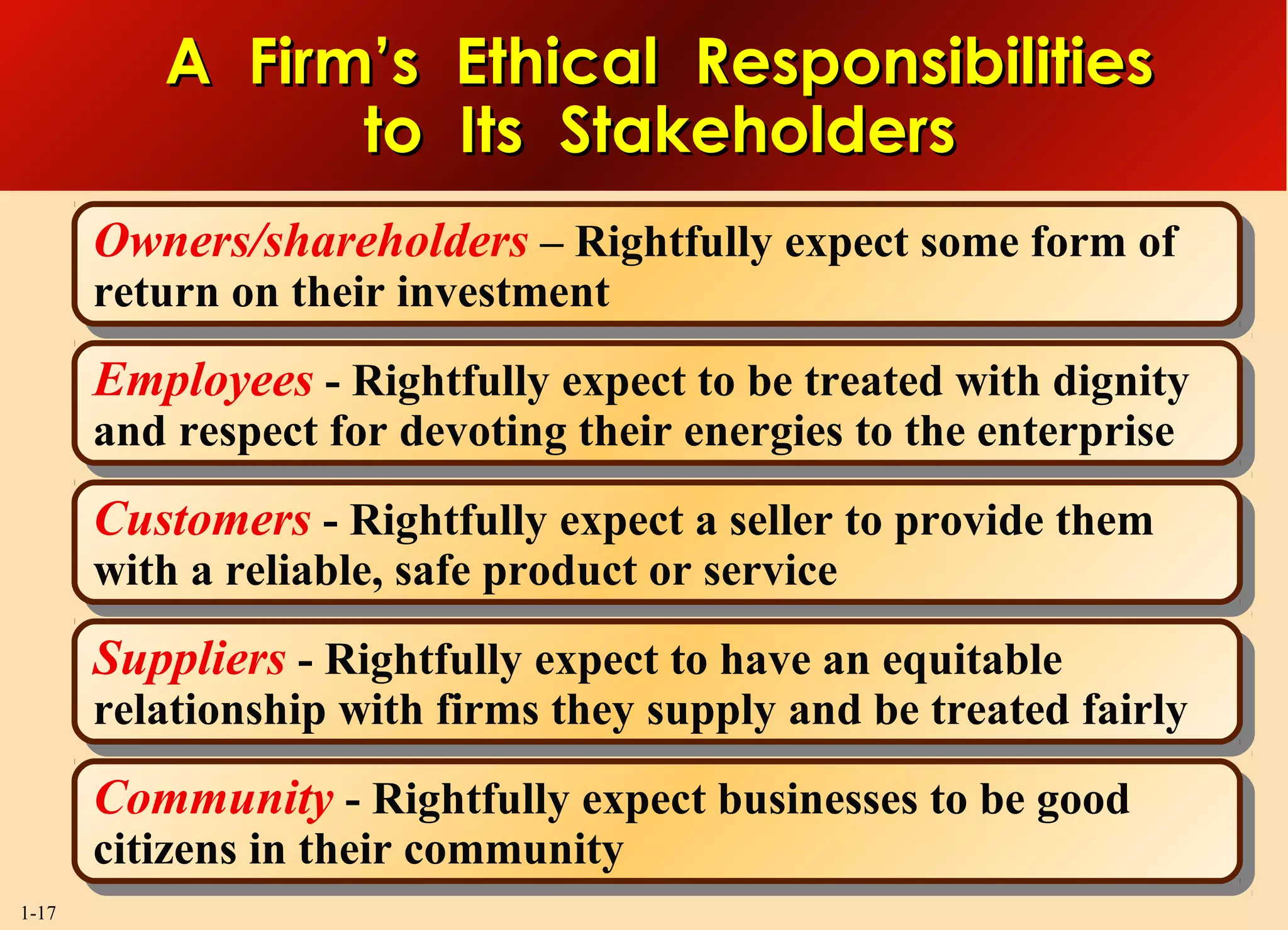
A Firm’s Ethical ResponsibilitiesA Firm’s Ethical Responsibilities
to Its Stakeholdersto Its Stakeholders
Owners/shareholders – Rightfully expect some form of
return on their investment
Owners/shareholders – Rightfully expect some form of
return on their investment
Employees - Rightfully expect to be treated with dignity
and respect for devoting their energies to the enterprise
Employees - Rightfully expect to be treated with dignity
and respect for devoting their energies to the enterprise
Customers - Rightfully expect a seller to provide them
with a reliable, safe product or service
Customers - Rightfully expect a seller to provide them
with a reliable, safe product or service
Suppliers - Rightfully expect to have an equitable
relationship with firms they supply and be treated fairly
Suppliers - Rightfully expect to have an equitable
relationship with firms they supply and be treated fairly
Community - Rightfully expect businesses to be good
citizens in their community
Community - Rightfully expect businesses to be good
citizens in their community
1-18
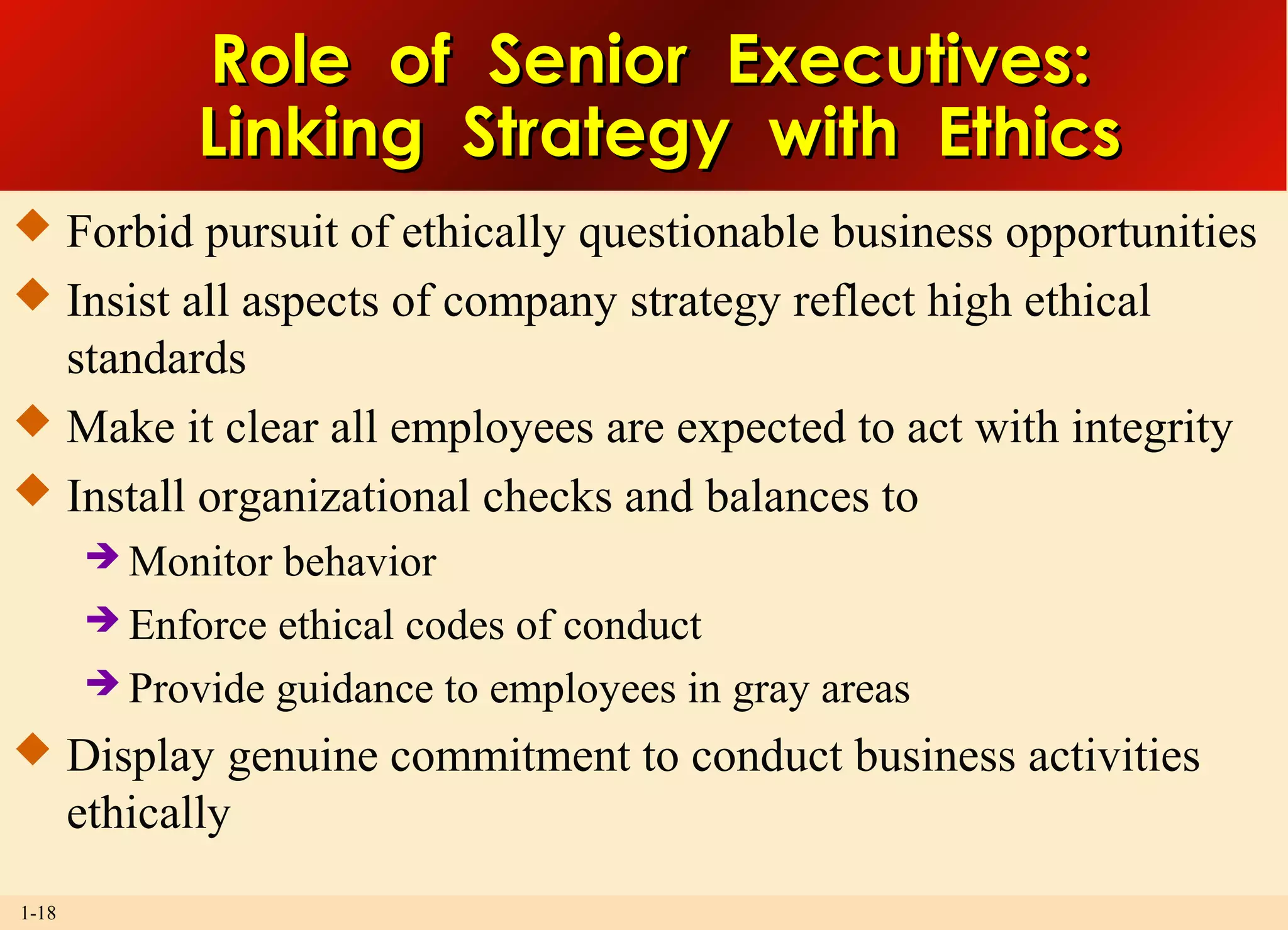
Role of Senior Executives:Role of Senior Executives:
Linking Strategy with EthicsLinking Strategy with Ethics
 Forbid pursuit of ethically questionable business opportunities
 Insist all aspects of company strategy reflect high ethical
standards
 Make it clear all employees are expected to act with integrity
 Install organizational checks and balances to
 Monitor behavior
 Enforce ethical codes of conduct
 Provide guidance to employees in gray areas
 Display genuine commitment to conduct business activities
ethically
1-19
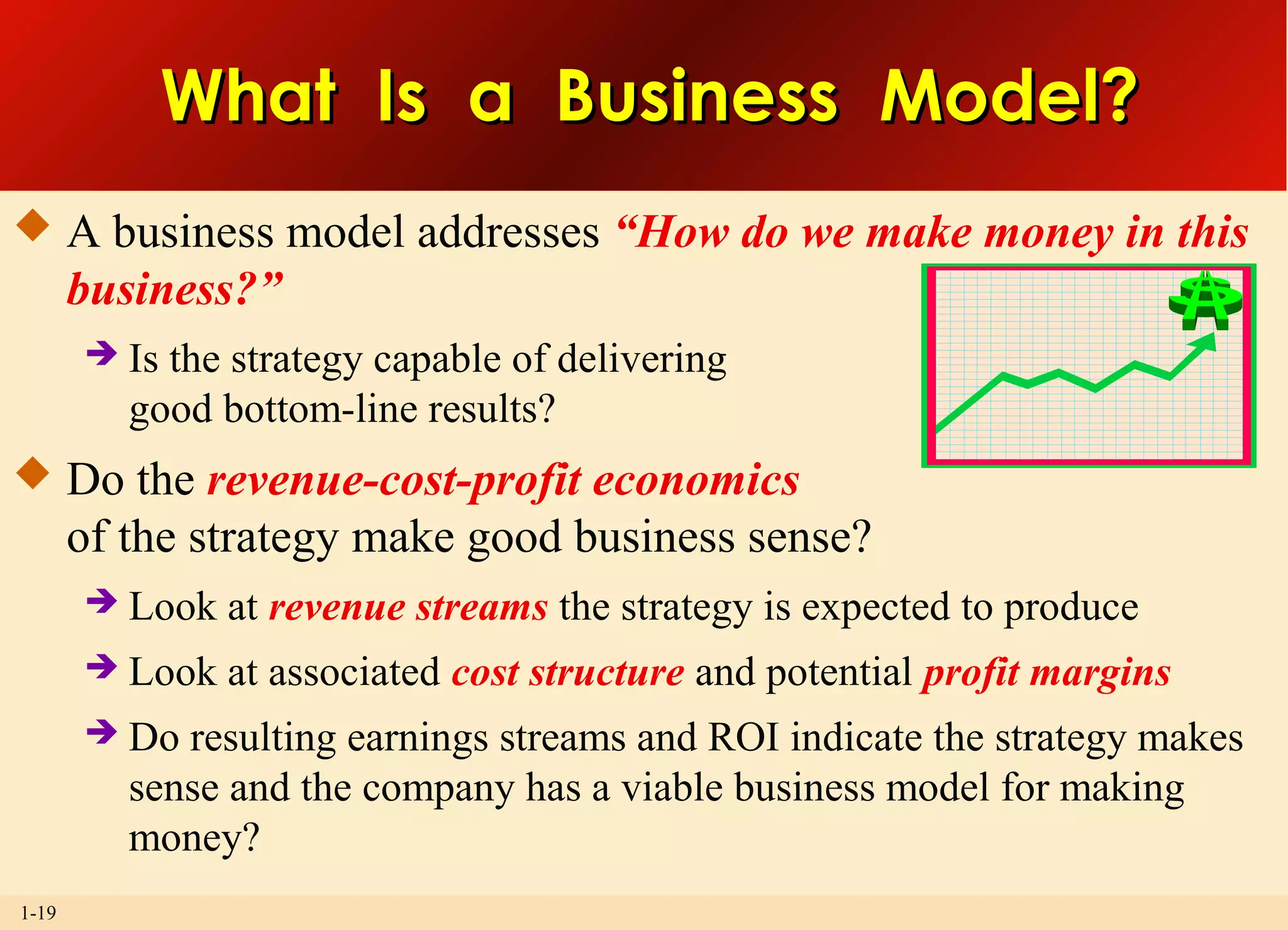
What Is a Business Model?What Is a Business Model?
 A business model addresses “How do we make money in this
business?”
 Is the strategy capable of delivering
good bottom-line results?
 Do the revenue-cost-profit economics
of the strategy make good business sense?
 Look at revenue streams the strategy is expected to produce
 Look at associated cost structure and potential profit margins
 Do resulting earnings streams and ROI indicate the strategy makes
sense and the company has a viable business model for making
money?
1-20
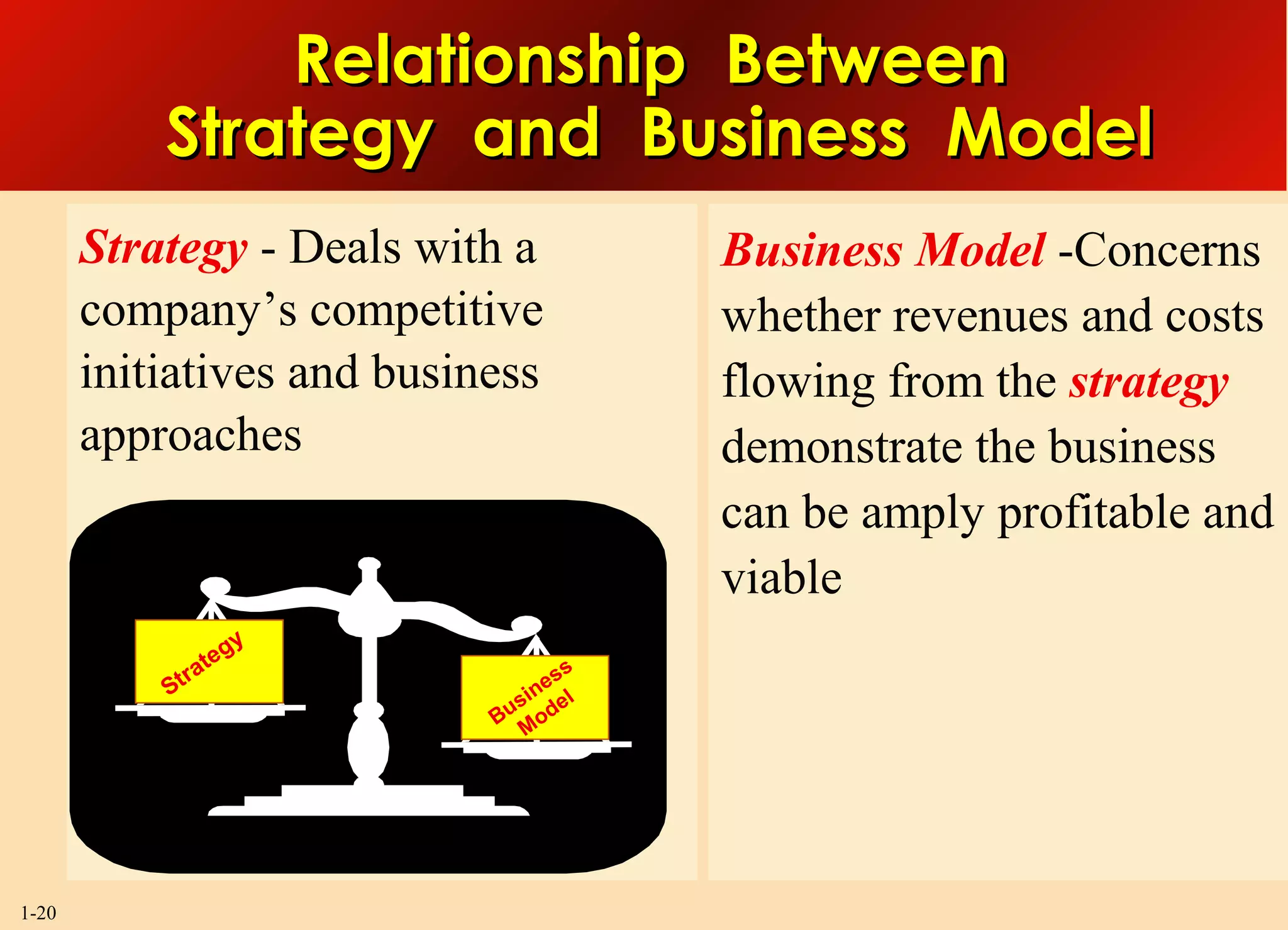
Strategy - Deals with a
company’s competitive
initiatives and business
approaches
Business Model -Concerns
whether revenues and costs
flowing from the strategy
demonstrate the business
can be amply profitable and
viable
Strategy
Business
Model
Relationship BetweenRelationship Between
Strategy and Business ModelStrategy and Business Model
1-21
Microsoft’sMicrosoft’s
Business ModelBusiness Model
Employ a cadre of highly skilled programmers to develop
proprietary code; keep source code hidden from users
Employ a cadre of highly skilled programmers to develop
proprietary code; keep source code hidden from users
Sell resulting OS and software packages to PC makers and
users at relatively attractive prices and achieve large unit
sales
Sell resulting OS and software packages to PC makers and
users at relatively attractive prices and achieve large unit
sales
Most costs in developing software are fixed; variable costs
are small - once breakeven volume is reached, revenues
from additional sales are almost pure profit
Most costs in developing software are fixed; variable costs
are small - once breakeven volume is reached, revenues
from additional sales are almost pure profit
Provide technical support to users at no costProvide technical support to users at no cost
1-22
Redhat Linux’sRedhat Linux’s
Business ModelBusiness Model
Rely on collaborative efforts of volunteer programmers to create the
software
Rely on collaborative efforts of volunteer programmers to create the
software
Add value to free, downloadable version of Linux by offering users Red
Hat Linux systems containing upgraded and tested features
Add value to free, downloadable version of Linux by offering users Red
Hat Linux systems containing upgraded and tested features
Charge a modest fee to those preferring to subscribe to Red Hat Linux
version
Charge a modest fee to those preferring to subscribe to Red Hat Linux
version
Release updated versions of Red Hat Linux every 4-6 months to small
users and every 12-18 months to corporate users
Release updated versions of Red Hat Linux every 4-6 months to small
users and every 12-18 months to corporate users
Make source code open and available to all usersMake source code open and available to all users
Make money by providing fees-based training, consulting, support,
engineering, and content management services
Make money by providing fees-based training, consulting, support,
engineering, and content management services
1-23
Tests of a Winning StrategyTests of a Winning Strategy
GOODNESS OF FIT TEST
 How well does strategy fit
the firm’s situation?
COMPETITIVE ADVANTAGE TEST
 Does strategy lead to sustainable
competitive advantage?
PERFORMANCE TEST
 Does strategy boost firm performance?
1-24
Other Criteria for JudgingOther Criteria for Judging
the Merits of a Strategythe Merits of a Strategy
 Internal consistency and unity among all pieces of the strategy
 Degree of risk the strategy poses as compared to alternative
strategies
 Degree to which the strategy is flexible and adaptable to
changing circumstances
While these criteria are relevant, they seldom override
the importance of the three tests of a winning strategy!
1-25
Why Is Strategy Important?Why Is Strategy Important?
A compelling need exists for managers to proactively
shape how a firm’s business
will be conducted
A strategy-focused firm is more likely
to be a strong bottom-line performer
than one that views strategy as secondary
1-26
Good Strategy + Good StrategyGood Strategy + Good Strategy
Execution = Good ManagementExecution = Good Management
 Crafting and executing strategy are core management functions
 Among all things managers do, nothing affects a company’s ultimate
success or failure more fundamentally than how well its management
team
 Charts the company’s direction,
 Develops competitively effective strategic moves and business
approaches, and
 Pursues what needs to be done internally to produce good day-in/day-
out strategy execution
Excellent execution of an excellent strategy is the best
test of managerial excellence -- and the most reliable
recipe for winning in the marketplace!

What is strategy and why important

  • 1.
    1-1 What Is StrategyandWhat Is Strategy and Why Is It Important?Why Is It Important? 11 Chapter Screen graphics created by: Jana F. Kuzmicki, Ph.D. Troy State University-Florida and Western Region
  • 2.
    ““Without a strategytheWithout a strategy the organization is like a shiporganization is like a ship without a rudder.”without a rudder.” Joel Ross and Michael Kami
  • 3.
    1-3 Chapter RoadmapChapter Roadmap What Is Strategy?  Identifying a Company’s Strategy  Strategy and the Quest for Competitive Advantage  Strategy Is Partly Proactive and Partly Reactive  Strategy and Ethics: Passing the Test of Moral Scrutiny  The Relationship Between a Company’s Strategy and Its Business Model  What Makes a Strategy a Winner?  Why Are Crafting and Executing Strategy Important?
  • 4.
    1-4 Thinking Strategically:Thinking Strategically: TheThree Big Strategic QuestionsThe Three Big Strategic Questions 1. Where are we now? 2. Where do we want to go?  Business(es) to be in and market positions to stake out  Buyer needs and groups to serve  Outcomes to achieve 3. How will we get there?  A company’s answer to “how will we get there?” is its strategy
  • 5.
    1-5 What Is Strategy?WhatIs Strategy?  Consists of the combination of competitive moves and business approaches used by managers to run the company  Management’s “game plan” to  Attract and please customers  Stake out a market position  Compete successfully  Grow the business  Achieve targeted objectives
  • 6.
    1-6  How toplease customers  How to respond to changing market conditions  How to outcompete rivals  How to grow the business  How to manage each functional piece of the business and develop needed organizational capabilities  How to achieve strategic and financial objectives Strategy is HOW to . . . TheThe HowsHows ThatThat Define a Firm's StrategyDefine a Firm's Strategy
  • 7.
    1-7 What Are aCompany’sWhat Are a Company’s Strategic Choices?Strategic Choices?  Trial-and-error organizational learning about  What has worked and  What has not worked  Management’s appetite for taking risks  Managerial analysis and strategic thinking about how best to proceed, given prevailing circumstances Strategic choices are based on . . .
  • 8.
    1-8 Key Elements:Key Elements: SouthwestAirlines’ StrategySouthwest Airlines’ Strategy  Grow the business by gradually adding more flights on existing routes and initiating service to new airports  Make friendly service a company trademark  Maintain an aircraft fleet of only Boeing 737s  Encourage customers to make reservations and purchase tickets at the company’s Web site  Avoid flying into congested airports  Employ a point-to-point route system  Economize on  Amount of time it takes terminal personnel to check passengers in and on-load passengers  Costs
  • 9.
    1-9 Fig. 1.1: Identifyinga Company’s StrategyFig. 1.1: Identifying a Company’s Strategy
  • 10.
    1-10 Striving forStriving for CompetitiveAdvantageCompetitive Advantage  To achieve sustainable competitive advantage, a company’s strategy usually must be aimed at either  Providing a distinctive product or service or  Developing competitive capabilities rivals can not match  Achieving a sustainable competitive advantage greatly enhances a company’s prospects for  Winning in the marketplace and  Realizing above-average profits What separates a powerful strategy from an ordinary strategy is management’s ability to forge a series of moves, both in the marketplace and internally, that produces sustainable competitive advantage!
  • 11.
    1-11 Strategic Approaches toStrategicApproaches to Building Competitive AdvantageBuilding Competitive Advantage  Strive to be the industry’s low-cost provider  Outcompete rivals on a key differentiating feature  Focus on a narrow market niche, doing a better job than rivals of serving the unique needs of niche buyers  Develop expertise, resource strengths, and capabilities not easily imitated by rivals
  • 12.
    1-12 Examples: Strategies BasedExamples:Strategies Based on Distinctive Capabilitieson Distinctive Capabilities  Sophisticated distribution systems – Wal-Mart  Product innovation capabilities – 3M Corporation  Complex technological process – Michelin  Defect-free manufacturing – Toyota and Honda  Specialized marketing and merchandising know-how – Coca- Cola  Global sales and distribution capability – Black & Decker  Superior e-commerce capabilities – Dell Computer  Personalized customer service – Ritz Carlton hotels
  • 13.
    1-13 Fig. 1.2: ACompany’s Strategy IsFig. 1.2: A Company’s Strategy Is Partly Proactive and Partly ReactivePartly Proactive and Partly Reactive
  • 14.
    1-14  A company’sstrategy is a work in progress  Changes may be necessary to react to  Fresh moves of competitors  Evolving customer preferences  Technological breakthroughs  Shifting market conditions  Crisis situations Why Do Strategies Evolve?Why Do Strategies Evolve?
  • 15.
    1-15 Crafting Strategy IsanCrafting Strategy Is an Exercise in EntrepreneurshipExercise in Entrepreneurship  Strategy-making is a market-driven activity that involves  Studying market trends and competitors’ actions  Keen observation of customer needs  Scrutinizing business possibilities based on new technologies  Building firm’s market position via acquisitions or new product introductions  Pursuing ways to strengthen firm’s competitive capabilities  Proactively searching out opportunities to  Do new things or  Do existing things in new or better ways
  • 16.
    1-16  Ethical andmoral standards go beyond  Prohibitions of law and the language of “thou shalt not” to issues of  Duty and “right” vs. “wrong”  Ethical and moral standards address “What is the right thing to do?”  Two criteria of an ethical strategy:  Does not entail actions and behaviors that cross the line from “can do” to “should not do’ and “unsavory” or “shady” and  Allows management to fulfill its ethical duties to all stakeholders Linking Strategy With EthicsLinking Strategy With Ethics
  • 17.
    1-17 A Firm’s EthicalResponsibilitiesA Firm’s Ethical Responsibilities to Its Stakeholdersto Its Stakeholders Owners/shareholders – Rightfully expect some form of return on their investment Owners/shareholders – Rightfully expect some form of return on their investment Employees - Rightfully expect to be treated with dignity and respect for devoting their energies to the enterprise Employees - Rightfully expect to be treated with dignity and respect for devoting their energies to the enterprise Customers - Rightfully expect a seller to provide them with a reliable, safe product or service Customers - Rightfully expect a seller to provide them with a reliable, safe product or service Suppliers - Rightfully expect to have an equitable relationship with firms they supply and be treated fairly Suppliers - Rightfully expect to have an equitable relationship with firms they supply and be treated fairly Community - Rightfully expect businesses to be good citizens in their community Community - Rightfully expect businesses to be good citizens in their community
  • 18.
    1-18 Role of SeniorExecutives:Role of Senior Executives: Linking Strategy with EthicsLinking Strategy with Ethics  Forbid pursuit of ethically questionable business opportunities  Insist all aspects of company strategy reflect high ethical standards  Make it clear all employees are expected to act with integrity  Install organizational checks and balances to  Monitor behavior  Enforce ethical codes of conduct  Provide guidance to employees in gray areas  Display genuine commitment to conduct business activities ethically
  • 19.
    1-19 What Is aBusiness Model?What Is a Business Model?  A business model addresses “How do we make money in this business?”  Is the strategy capable of delivering good bottom-line results?  Do the revenue-cost-profit economics of the strategy make good business sense?  Look at revenue streams the strategy is expected to produce  Look at associated cost structure and potential profit margins  Do resulting earnings streams and ROI indicate the strategy makes sense and the company has a viable business model for making money?
  • 20.
    1-20 Strategy - Dealswith a company’s competitive initiatives and business approaches Business Model -Concerns whether revenues and costs flowing from the strategy demonstrate the business can be amply profitable and viable Strategy Business Model Relationship BetweenRelationship Between Strategy and Business ModelStrategy and Business Model
  • 21.
    1-21 Microsoft’sMicrosoft’s Business ModelBusiness Model Employa cadre of highly skilled programmers to develop proprietary code; keep source code hidden from users Employ a cadre of highly skilled programmers to develop proprietary code; keep source code hidden from users Sell resulting OS and software packages to PC makers and users at relatively attractive prices and achieve large unit sales Sell resulting OS and software packages to PC makers and users at relatively attractive prices and achieve large unit sales Most costs in developing software are fixed; variable costs are small - once breakeven volume is reached, revenues from additional sales are almost pure profit Most costs in developing software are fixed; variable costs are small - once breakeven volume is reached, revenues from additional sales are almost pure profit Provide technical support to users at no costProvide technical support to users at no cost
  • 22.
    1-22 Redhat Linux’sRedhat Linux’s BusinessModelBusiness Model Rely on collaborative efforts of volunteer programmers to create the software Rely on collaborative efforts of volunteer programmers to create the software Add value to free, downloadable version of Linux by offering users Red Hat Linux systems containing upgraded and tested features Add value to free, downloadable version of Linux by offering users Red Hat Linux systems containing upgraded and tested features Charge a modest fee to those preferring to subscribe to Red Hat Linux version Charge a modest fee to those preferring to subscribe to Red Hat Linux version Release updated versions of Red Hat Linux every 4-6 months to small users and every 12-18 months to corporate users Release updated versions of Red Hat Linux every 4-6 months to small users and every 12-18 months to corporate users Make source code open and available to all usersMake source code open and available to all users Make money by providing fees-based training, consulting, support, engineering, and content management services Make money by providing fees-based training, consulting, support, engineering, and content management services
  • 23.
    1-23 Tests of aWinning StrategyTests of a Winning Strategy GOODNESS OF FIT TEST  How well does strategy fit the firm’s situation? COMPETITIVE ADVANTAGE TEST  Does strategy lead to sustainable competitive advantage? PERFORMANCE TEST  Does strategy boost firm performance?
  • 24.
    1-24 Other Criteria forJudgingOther Criteria for Judging the Merits of a Strategythe Merits of a Strategy  Internal consistency and unity among all pieces of the strategy  Degree of risk the strategy poses as compared to alternative strategies  Degree to which the strategy is flexible and adaptable to changing circumstances While these criteria are relevant, they seldom override the importance of the three tests of a winning strategy!
  • 25.
    1-25 Why Is StrategyImportant?Why Is Strategy Important? A compelling need exists for managers to proactively shape how a firm’s business will be conducted A strategy-focused firm is more likely to be a strong bottom-line performer than one that views strategy as secondary
  • 26.
    1-26 Good Strategy +Good StrategyGood Strategy + Good Strategy Execution = Good ManagementExecution = Good Management  Crafting and executing strategy are core management functions  Among all things managers do, nothing affects a company’s ultimate success or failure more fundamentally than how well its management team  Charts the company’s direction,  Develops competitively effective strategic moves and business approaches, and  Pursues what needs to be done internally to produce good day-in/day- out strategy execution Excellent execution of an excellent strategy is the best test of managerial excellence -- and the most reliable recipe for winning in the marketplace!