Ethnocentric Approach
Strategic decisions are made at headquarters
and all key positions in domestic and foreign
countries are held by headquarter employees.
The Ethnocentric approach entails the notion
that home country attitudes, management
style, knowledge, evaluation criteria and
managers are better than anything that the
host country can provide.
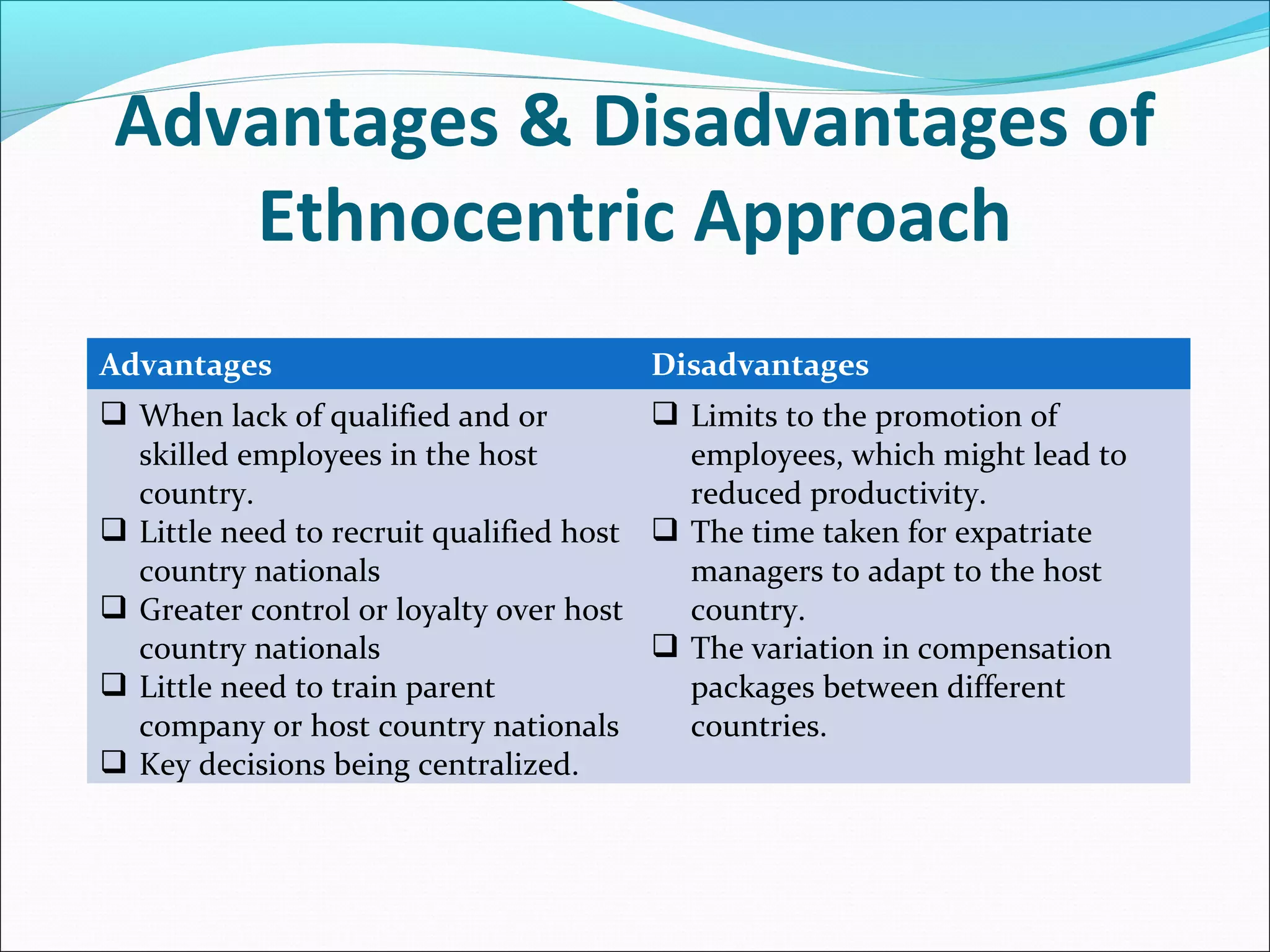
Advantages & Disadvantages of
Ethnocentric Approach
Advantages Disadvantages
 When lack of qualified and or
skilled employees in the host
country.
 Little need to recruit qualified host
country nationals
 Greater control or loyalty over host
country nationals
 Little need to train parent
company or host country nationals
 Key decisions being centralized.
 Limits to the promotion of
employees, which might lead to
reduced productivity.
 The time taken for expatriate
managers to adapt to the host
country.
 The variation in compensation
packages between different
countries.
Polycentric Approach
An approach where by each subsidiary is treated
as a distinct national entity with some authority
in the decision making process.
These subsidiaries are usually managed by
locals, who are seldom promoted to
headquarters.
Advantages and disadvantages of
Polycentric Approach
Advantages Disadvantages
 Employing host country nationals
eliminates language barriers.
 Avoids adjustments issues for
expatriates.
 There is no need for expensive
cultural and language training.
 Less expensive to employ a host
country national
 Avoid the turnover of key personnel.
 Parent headquarter is isolated from
the foreign subsidiaries.
 Host country managers have limited
opportunities for promotion because
they do not gain experience in foreign
countries.
Regiocentric Approach
An approach that reflects the geographic
strategy and structure of a multinational
organization, with more managers in the pool
from which to draw talent.
It allows the movement of staff within the
geographic operations of a multicultural
operations and offers the opportunity for
development of management succession
programs.
Advantages and disadvantages of
Regiocentric Approach
Advantages Disadvantages
 There is an interaction between
regional and subsidiary executives.
 A sense of understanding for local
conditions
 The ability of a multinational to
move from an ethnocentric or
polycentric approach to a
regiocentric approach.
 This can constrain an organization
from globalization.
 Usually employees are promoted
to regional headquarters and not
to parent headquarters.
Geocentric Approach
In this approach the multinational
corporation (MNC) is taking a global
approach to its operations.
Each subsidiary makes a contribution
because of its unique competencies.
Advantages and disadvantages of
Geocentric Approach
Advantages Disadvantages
 MNC develops a pool of labour that
can be employed globally in the
organization.
 It has no problem with the
isolation of employees.
 Capable managers can adopt to
different cultures.
 Host country usually want their
local nationals employed and could
therefore use immigration controls
to put pressure on the parent or
home company to employ locals.
 Certain immigration
documentation is time consuming.
 It can be expensive to implement
owing to increased training and
relocation costs.
Thank You
Subscribe & Share our channel on YouTube
https://www.youtube.com/watch?v=cwSGFti2QbE

International HRM – Staffing Approaches

  • 2.
    Ethnocentric Approach Strategic decisionsare made at headquarters and all key positions in domestic and foreign countries are held by headquarter employees. The Ethnocentric approach entails the notion that home country attitudes, management style, knowledge, evaluation criteria and managers are better than anything that the host country can provide.
  • 3.
    Advantages & Disadvantagesof Ethnocentric Approach Advantages Disadvantages  When lack of qualified and or skilled employees in the host country.  Little need to recruit qualified host country nationals  Greater control or loyalty over host country nationals  Little need to train parent company or host country nationals  Key decisions being centralized.  Limits to the promotion of employees, which might lead to reduced productivity.  The time taken for expatriate managers to adapt to the host country.  The variation in compensation packages between different countries.
  • 4.
    Polycentric Approach An approachwhere by each subsidiary is treated as a distinct national entity with some authority in the decision making process. These subsidiaries are usually managed by locals, who are seldom promoted to headquarters.
  • 5.
    Advantages and disadvantagesof Polycentric Approach Advantages Disadvantages  Employing host country nationals eliminates language barriers.  Avoids adjustments issues for expatriates.  There is no need for expensive cultural and language training.  Less expensive to employ a host country national  Avoid the turnover of key personnel.  Parent headquarter is isolated from the foreign subsidiaries.  Host country managers have limited opportunities for promotion because they do not gain experience in foreign countries.
  • 6.
    Regiocentric Approach An approachthat reflects the geographic strategy and structure of a multinational organization, with more managers in the pool from which to draw talent. It allows the movement of staff within the geographic operations of a multicultural operations and offers the opportunity for development of management succession programs.
  • 7.
    Advantages and disadvantagesof Regiocentric Approach Advantages Disadvantages  There is an interaction between regional and subsidiary executives.  A sense of understanding for local conditions  The ability of a multinational to move from an ethnocentric or polycentric approach to a regiocentric approach.  This can constrain an organization from globalization.  Usually employees are promoted to regional headquarters and not to parent headquarters.
  • 8.
    Geocentric Approach In thisapproach the multinational corporation (MNC) is taking a global approach to its operations. Each subsidiary makes a contribution because of its unique competencies.
  • 9.
    Advantages and disadvantagesof Geocentric Approach Advantages Disadvantages  MNC develops a pool of labour that can be employed globally in the organization.  It has no problem with the isolation of employees.  Capable managers can adopt to different cultures.  Host country usually want their local nationals employed and could therefore use immigration controls to put pressure on the parent or home company to employ locals.  Certain immigration documentation is time consuming.  It can be expensive to implement owing to increased training and relocation costs.
  • 10.
    Thank You Subscribe &Share our channel on YouTube https://www.youtube.com/watch?v=cwSGFti2QbE