Strategic Management 
The Strategy Concept 
Dr. B. K. Mukherjee 1
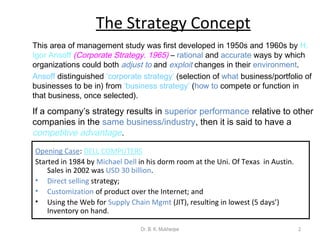
The Strategy Concept 
This area of management study was first developed in 1950s and 1960s by H. 
Igor Ansoff (Corporate Strategy. 1965) – rational and accurate ways by which 
organizations could both adjust to and exploit changes in their environment. 
Ansoff distinguished ‘corporate strategy’ (selection of what business/portfolio of 
businesses to be in) from ‘business strategy’ (how to compete or function in 
that business, once selected). 
If a company’s strategy results in superior performance relative to other 
companies in the same business/industry, then it is said to have a 
competitive advantage. 
Opening Case: DELL COMPUTERS 
Started in 1984 by Michael Dell in his dorm room at the Uni. Of Texas in Austin. 
Sales in 2002 was USD 30 billion. 
• Direct selling strategy; 
• Customization of product over the Internet; and 
• Using the Web for Supply Chain Mgmt (JIT), resulting in lowest (5 days’) 
Inventory on hand. 
Dr. B. K. Mukherjee 2
Competitive Advantage 
Major authority currently is Prof. Michael E. 
Porter of Harvard Business School 
(‘Competitive Strategy: Techniques for 
Analyzing Industries and Competitors’, 1980) 
.According to Porter, competitive advantage 
grows fundamentally out of value a firm is 
able to create for its buyers that exceeds the 
firm’s cost of creating it. Value 
(Benefits/Cost)is what buyers are willing to 
pay, and superior value stems from offering 
lower prices than competitors for equivalent 
benefits or providing unique benefits that 
more than offset a higher price. 
Today, every enterprise operates in a complex 
business environment, hence Strategy must 
necessarily change over time to fit the 
prevalent environmental conditions. 
However, to remain competitive, companies 
must focus on 
• a) Core competence, 
• b) Synergy, and 
• c) Value creation. 
Dr. B. K. Mukherjee 3
Core Competence 
Core competence: a business activity that an organization does 
particularly well in comparison to its competitors – should be 
1) Distinctive – only for me / non-duplicable / based on culture (herbal 
- Dabur), relationship (ICICI Bank), etc. 
2) Reproducible – in terms of Technology, Value (VFM), etc. 
SOME EXAMPLES OF CORE COMPETENCE 
 BRITANNIA INDUSTRIES – real expertise lies in handling 
perishable goods. However, AMUL is one step ahead of Britannia in 
the value chain because of its own milk-producing unit. 
 HINDUSTAN LEVER LTD.– Distribution of FMCGs, Toiletries, Food 
products, etc.- vast and efficient distribution network – long shelf life. 
 LARSEN & TOUBRO LTD – Engineering, Design and 
fabrication/erection of complex plants/infrastructure projects, incl. 
Nuclear reactors. 
 TOYOTA MOTORS, JAPAN : The Japanese have further 
promulgated this view by developing the “Five Zeros” and “Seven 
Wastes” concepts. Actually, Toyota’s core-competence lies not in 
making and selling cars, but in following the 5-zeros and 7-wastes 
strategies. 
Dr. B. K. Mukherjee 4
Toyota’s 5-zeros strategy 
 FIVE ZEROS STRATEGY: 
1. Zero Customer feedback time – continuous 
customer feedback after sale. 
2. Zero Product improvement time – ongoing 
R&D activities, prompt introduction of improved 
variants. 
3. Zero Purchase time – JIT system, reduced 
inventory, lower costs. 
4. Zero Set-up time – Flexible design of tools, 
jigs, robotics, processes. 
5. Zero Defect – Frequent inspections, In-process 
QC, Flawless finish. 
Dr. B. K. Mukherjee 5
Toyota’s 7-wastes strategy 
SEVEN WASTES TO BE AVOIDED: 
1. Waste of time on hand (i.e, waiting time) – because 
men, m/c, raw materials, stocks are waiting, by proper planning 
and scheduling. 
2. Waste in Transportation – by planned logistics and 
Dr. B. K. Mukherjee 6 
material movements. 
3. Waste in over-productions – by proper production 
planning and estimations. 
4. Waste in stocks-on-hand – by effective sales 
forecasts. 
5. Waste in Processing – efficient use of technology. 
6. Waste in movement – by detailed Work-study. 
7. Waste in making defective products – state of mind
Core (Internal) Competences [Chaston] 
Clearly defined Market Opportunity 
Adoption of appropriate Market Positioning 
Formal Plan to exploit identified opportunity 
Strategic 
Competences 
Financial Resources capable of 
supporting Plan Resource Competences 
Organizational competences 
Dr. B. K. Mukherjee 7 
INNOVATION 
Effective or 
requiring 
improvement? 
WORKFORCE 
Appropriate 
structure, 
motivated and 
competent or 
requiring 
Improvement? 
PRODUCTIVITY 
Adequate, 
supported by 
ongoing invest-ment 
in Techno-logy 
or requiring 
improvement 
QUALITY 
Adequate and 
regularly 
assessed or 
requiring 
improvement? 
SYSTEMS 
Information 
flows permit 
rapid problem 
resolution or 
requiring 
Improvement?
Core (Internal) Competences 
• STRATEGIC COMPETENCE: Complacency is dangerous in a world full of competition. An 
organization’s strategic competence can be evaluated by testing whether the strategies are 
distinctive, appropriate, usable, measurable and sustainable. 
• FINANCIAL RESOURCE COMPETENCE: may be achieved by way of conservative financial 
management rather than ambitious over-expansion through cavalier acquisitions of 
competitors’ businesses. 
• INNOVATION: To prosper and grow all organizations need to continually innovate and 
improve their products and process technologies (eg. 3M) 
• WORKFORCE: HRM practices within the organization often play a decisive role, because a 
motivated and appropriately structured workforce can contribute significantly towards 
building market competitiveness. 
• QUALITY: In the 1970s, countries like Japan and Korea were able to penetrate global 
markets solely on the basis of superior quality of their products (concepts like TQM, Kaizen, 
etc). Over the years, it has been clearly demonstrated that companies whose products are 
perceived to be of a higher quality will enjoy higher profits and a larger market share. 
• PRODUCTIVITY (measured as level of value-added activities per employee per number of 
hours worked): The secret of Japanese competitiveness lies in adoption of concepts such as 
lean production, concurrent engineering and JIT, thereby making them world leaders and, 
at the same time, generating very healthy profits. 
• INFORMATION SYSTEMS: The advent of low-cost, extremely powerful computers offers 
opportunities through which to develop integrated Mgmt Information Systems. 
Dr. B. K. Mukherjee 8
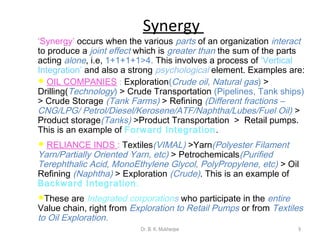
Synergy 
‘Synergy’ occurs when the various parts of an organization interact 
to produce a joint effect which is greater than the sum of the parts 
acting alone, i.e, 1+1+1+1>4. This involves a process of ‘Vertical 
Integration’ and also a strong psychological element. Examples are: 
 OIL COMPANIES : Exploration(Crude oil, Natural gas) > 
Drilling(Technology) > Crude Transportation (Pipelines, Tank ships) 
> Crude Storage (Tank Farms) > Refining (Different fractions – 
CNG/LPG/ Petrol/Diesel/Kerosene/ATF/Naphtha/Lubes/Fuel Oil) > 
Product storage(Tanks) >Product Transportation > Retail pumps. 
This is an example of Forward Integration. 
 RELIANCE INDS : Textiles(VIMAL) >Yarn(Polyester Filament 
Yarn/Partially Oriented Yarn, etc) > Petrochemicals(Purified 
Terephthalic Acid, MonoEthylene Glycol, PolyPropylene, etc) > Oil 
Refining (Naphtha) > Exploration (Crude). This is an example of 
Backward Integration. 
These are Integrated corporations who participate in the entire 
Value chain, right from Exploration to Retail Pumps or from Textiles 
to Oil Exploration. 
Dr. B. K. Mukherjee 9
Value Creation & Value Delivery 
 ‘Value’ can be defined as the perception of benefits received 
against price paid by the customer, hence the term,”Value for 
money”. Value must be greater than the cost of resources for the 
business to be profitable. 
 The task of any business is to deliver customer value at a profit. 
 Traditional view was that a firm makes something and then sells it. 
The economy is marked by shortages and customers are not fussy 
about quality, features or style (eg. Henry Ford’s Model-T). 
 However, this view will not hold in more competitive economies 
where people face abundant choices. The smart competitor must 
design and deliver offerings for well-defined target markets. 
 This places Market at the beginning of the planning process and 
companies now have to develop a proper ‘Value-creation & Value-delivery’ 
sequence in order to remain competitive. 
Dr. B. K. Mukherjee 10
Value Creation & Delivery (contd.) 
Traditional Physical process sequence 
Design the product 
Procure materials 
Price the product 
Sell the product 
Dr. B. K. Mukherjee 11 
1.Make the product 
Make/manufacture the product 
2.Sell the product Advertise / Promote 
Distribute 
Service after sales
Value creation & Value delivery 
(contd) 
Value Creation & Delivery sequence 
Customer Segmentation 
Focus Target audience 
Position the value 
Product/Service developmt 
Price 
2. Create the value Procurement/sourcing 
Manufacturing 
Sales force 
Sales Promotion 
Dr. B. K. Mukherjee 12 
1. Select the value 
(“Homework” by Co.) 
Distribution 
3. Communicate the 
value Sales process 
Advertising 
Servicing 
S-T-P 
Strategic Mktg 
Tactical 
Mktg.
Emergent strategies: The case of 
Honda 
According to Henry Mintzberg, emergent strategies are the unplanned 
responses to unforeseen circumstances, often arising from autonomous 
action by individual managers or from serendipitous discoveries or 
events. Mintzberg maintains that emergent strategies are often 
successful and may be more appropriate than intended strategies. 
In 1959, Honda Motor Co. decided to enter the U.S. motorcycle market. A 
number of Honda executives arrived in Los Angeles from Japan to 
establish the U.S. operation. Their original aim (intended strategy) was 
to focus on selling 250-cc and 350-cc machines to confirmed 
motorcycle enthusiasts rather than the 50-cc Honda Cubs, which were 
a big hit in Japan. Their instinct told them that the Honda-50s were not 
suitable for the U.S. market where everything was bigger and more 
luxurious than Japan (eg, Harley-Davidsons, big sedans, etc). 
However, sales of the 250-cc and 350-cc bikes were sluggish, and the 
bikes themselves were plagued by mechanical problems. It looked like 
Honda’s strategy was going to fail. 
At the same time, the Japanese executives who were using the Honda-50s 
to run errands around Los Angeles were attracting a lot of attention. 
Dr. B. K. Mukherjee 13
The case of Honda (contd.) 
One day they got a call from Sears, Roebuck who wanted to sell 
the 50-cc bikes to a broad market of Americans who were not 
necessarily already motorcycle enthusiasts. The Honda 
executives were initially hesitant to sell the small bikes for fear 
of alienating serious bikers, who might then associate Honda 
with “wimpy” machines. In the end, they were pushed into doing 
so by the failure of he 250-cc and 350-cc models. 
Honda had thus stumbled onto a previously untouched market 
segment that was to prove huge: the average American who 
had never owned a motorbike. 
Honda had also found an untried channel of distribution: general 
retailers rather than specialty motorbike stores. By 1964, nearly 
one out of every two motorcycles sold in the United States was 
a Honda. 
In this case, the company’s meticulously planned intended strategy 
was a near disaster. What ultimately worked was the emergent 
strategy, not through planning but through unplanned action in 
response to unforeseen circumstances. 
Dr. B. K. Mukherjee 14
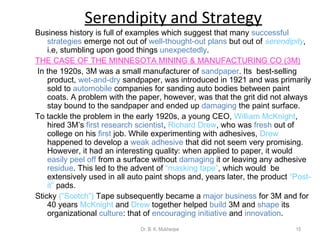
Serendipity and Strategy 
Business history is full of examples which suggest that many successful 
strategies emerge not out of well-thought-out plans but out of serendipity, 
i.e, stumbling upon good things unexpectedly. 
THE CASE OF THE MINNESOTA MINING & MANUFACTURING CO (3M) 
In the 1920s, 3M was a small manufacturer of sandpaper. Its best-selling 
product, wet-and-dry sandpaper, was introduced in 1921 and was primarily 
sold to automobile companies for sanding auto bodies between paint 
coats. A problem with the paper, however, was that the grit did not always 
stay bound to the sandpaper and ended up damaging the paint surface. 
To tackle the problem in the early 1920s, a young CEO, William McKnight, 
hired 3M’s first research scientist, Richard Drew, who was fresh out of 
college on his first job. While experimenting with adhesives, Drew 
happened to develop a weak adhesive that did not seem very promising. 
However, it had an interesting quality: when applied to paper, it would 
easily peel off from a surface without damaging it or leaving any adhesive 
residue. This led to the advent of “masking tape”, which would be 
extensively used in all auto paint shops and, years later, the product “Post-it” 
pads. 
Sticky (“Scotch”) Tape subsequently became a major business for 3M and for 
40 years McKnight and Drew together helped build 3M and shape its 
organizational culture: that of encouraging initiative and innovation. 
Dr. B. K. Mukherjee 15
Serendipity and Strategy (contd.) 
Another such example happened in the 1960s. At that time, 3M 
was producing fluorocarbons for the air-conditioning industry. 
One day a researcher working with fluorocarbons in a 3M lab 
spilled some of the liquid on her shoes. Later that day when she 
spilled coffee on her shoes, she was surprised to notice that the 
coffee formed into little beads of liquid and ran off the shoes 
without leaving any stain. 
Further research led to the development of ‘Scotch Guard’, a 
fluorocarbon-based product for protecting fabrics from liquid 
stains. Subsequently, Scotch Guard became one of 3M’s most 
profitable products and took the company into the fabric 
protection business, an area it had never planned to enter. 
But some companies have missed out on profitable serendipitous 
opportunities because of strategic myopia. A century ago, the 
telegraph company Western Union turned down an opportunity 
to purchase the rights to an invention made by Alexander 
Graham Bell. 
The invention was the telephone, a technology that subsequently 
made the telegraph obsolete. 
Dr. B. K. Mukherjee 16

2. strategy concept

  • 1.
    Strategic Management TheStrategy Concept Dr. B. K. Mukherjee 1
  • 2.
    The Strategy Concept This area of management study was first developed in 1950s and 1960s by H. Igor Ansoff (Corporate Strategy. 1965) – rational and accurate ways by which organizations could both adjust to and exploit changes in their environment. Ansoff distinguished ‘corporate strategy’ (selection of what business/portfolio of businesses to be in) from ‘business strategy’ (how to compete or function in that business, once selected). If a company’s strategy results in superior performance relative to other companies in the same business/industry, then it is said to have a competitive advantage. Opening Case: DELL COMPUTERS Started in 1984 by Michael Dell in his dorm room at the Uni. Of Texas in Austin. Sales in 2002 was USD 30 billion. • Direct selling strategy; • Customization of product over the Internet; and • Using the Web for Supply Chain Mgmt (JIT), resulting in lowest (5 days’) Inventory on hand. Dr. B. K. Mukherjee 2
  • 3.
    Competitive Advantage Majorauthority currently is Prof. Michael E. Porter of Harvard Business School (‘Competitive Strategy: Techniques for Analyzing Industries and Competitors’, 1980) .According to Porter, competitive advantage grows fundamentally out of value a firm is able to create for its buyers that exceeds the firm’s cost of creating it. Value (Benefits/Cost)is what buyers are willing to pay, and superior value stems from offering lower prices than competitors for equivalent benefits or providing unique benefits that more than offset a higher price. Today, every enterprise operates in a complex business environment, hence Strategy must necessarily change over time to fit the prevalent environmental conditions. However, to remain competitive, companies must focus on • a) Core competence, • b) Synergy, and • c) Value creation. Dr. B. K. Mukherjee 3
  • 4.
    Core Competence Corecompetence: a business activity that an organization does particularly well in comparison to its competitors – should be 1) Distinctive – only for me / non-duplicable / based on culture (herbal - Dabur), relationship (ICICI Bank), etc. 2) Reproducible – in terms of Technology, Value (VFM), etc. SOME EXAMPLES OF CORE COMPETENCE  BRITANNIA INDUSTRIES – real expertise lies in handling perishable goods. However, AMUL is one step ahead of Britannia in the value chain because of its own milk-producing unit.  HINDUSTAN LEVER LTD.– Distribution of FMCGs, Toiletries, Food products, etc.- vast and efficient distribution network – long shelf life.  LARSEN & TOUBRO LTD – Engineering, Design and fabrication/erection of complex plants/infrastructure projects, incl. Nuclear reactors.  TOYOTA MOTORS, JAPAN : The Japanese have further promulgated this view by developing the “Five Zeros” and “Seven Wastes” concepts. Actually, Toyota’s core-competence lies not in making and selling cars, but in following the 5-zeros and 7-wastes strategies. Dr. B. K. Mukherjee 4
  • 5.
    Toyota’s 5-zeros strategy  FIVE ZEROS STRATEGY: 1. Zero Customer feedback time – continuous customer feedback after sale. 2. Zero Product improvement time – ongoing R&D activities, prompt introduction of improved variants. 3. Zero Purchase time – JIT system, reduced inventory, lower costs. 4. Zero Set-up time – Flexible design of tools, jigs, robotics, processes. 5. Zero Defect – Frequent inspections, In-process QC, Flawless finish. Dr. B. K. Mukherjee 5
  • 6.
    Toyota’s 7-wastes strategy SEVEN WASTES TO BE AVOIDED: 1. Waste of time on hand (i.e, waiting time) – because men, m/c, raw materials, stocks are waiting, by proper planning and scheduling. 2. Waste in Transportation – by planned logistics and Dr. B. K. Mukherjee 6 material movements. 3. Waste in over-productions – by proper production planning and estimations. 4. Waste in stocks-on-hand – by effective sales forecasts. 5. Waste in Processing – efficient use of technology. 6. Waste in movement – by detailed Work-study. 7. Waste in making defective products – state of mind
  • 7.
    Core (Internal) Competences[Chaston] Clearly defined Market Opportunity Adoption of appropriate Market Positioning Formal Plan to exploit identified opportunity Strategic Competences Financial Resources capable of supporting Plan Resource Competences Organizational competences Dr. B. K. Mukherjee 7 INNOVATION Effective or requiring improvement? WORKFORCE Appropriate structure, motivated and competent or requiring Improvement? PRODUCTIVITY Adequate, supported by ongoing invest-ment in Techno-logy or requiring improvement QUALITY Adequate and regularly assessed or requiring improvement? SYSTEMS Information flows permit rapid problem resolution or requiring Improvement?
  • 8.
    Core (Internal) Competences • STRATEGIC COMPETENCE: Complacency is dangerous in a world full of competition. An organization’s strategic competence can be evaluated by testing whether the strategies are distinctive, appropriate, usable, measurable and sustainable. • FINANCIAL RESOURCE COMPETENCE: may be achieved by way of conservative financial management rather than ambitious over-expansion through cavalier acquisitions of competitors’ businesses. • INNOVATION: To prosper and grow all organizations need to continually innovate and improve their products and process technologies (eg. 3M) • WORKFORCE: HRM practices within the organization often play a decisive role, because a motivated and appropriately structured workforce can contribute significantly towards building market competitiveness. • QUALITY: In the 1970s, countries like Japan and Korea were able to penetrate global markets solely on the basis of superior quality of their products (concepts like TQM, Kaizen, etc). Over the years, it has been clearly demonstrated that companies whose products are perceived to be of a higher quality will enjoy higher profits and a larger market share. • PRODUCTIVITY (measured as level of value-added activities per employee per number of hours worked): The secret of Japanese competitiveness lies in adoption of concepts such as lean production, concurrent engineering and JIT, thereby making them world leaders and, at the same time, generating very healthy profits. • INFORMATION SYSTEMS: The advent of low-cost, extremely powerful computers offers opportunities through which to develop integrated Mgmt Information Systems. Dr. B. K. Mukherjee 8
  • 9.
    Synergy ‘Synergy’ occurswhen the various parts of an organization interact to produce a joint effect which is greater than the sum of the parts acting alone, i.e, 1+1+1+1>4. This involves a process of ‘Vertical Integration’ and also a strong psychological element. Examples are:  OIL COMPANIES : Exploration(Crude oil, Natural gas) > Drilling(Technology) > Crude Transportation (Pipelines, Tank ships) > Crude Storage (Tank Farms) > Refining (Different fractions – CNG/LPG/ Petrol/Diesel/Kerosene/ATF/Naphtha/Lubes/Fuel Oil) > Product storage(Tanks) >Product Transportation > Retail pumps. This is an example of Forward Integration.  RELIANCE INDS : Textiles(VIMAL) >Yarn(Polyester Filament Yarn/Partially Oriented Yarn, etc) > Petrochemicals(Purified Terephthalic Acid, MonoEthylene Glycol, PolyPropylene, etc) > Oil Refining (Naphtha) > Exploration (Crude). This is an example of Backward Integration. These are Integrated corporations who participate in the entire Value chain, right from Exploration to Retail Pumps or from Textiles to Oil Exploration. Dr. B. K. Mukherjee 9
  • 10.
    Value Creation &Value Delivery  ‘Value’ can be defined as the perception of benefits received against price paid by the customer, hence the term,”Value for money”. Value must be greater than the cost of resources for the business to be profitable.  The task of any business is to deliver customer value at a profit.  Traditional view was that a firm makes something and then sells it. The economy is marked by shortages and customers are not fussy about quality, features or style (eg. Henry Ford’s Model-T).  However, this view will not hold in more competitive economies where people face abundant choices. The smart competitor must design and deliver offerings for well-defined target markets.  This places Market at the beginning of the planning process and companies now have to develop a proper ‘Value-creation & Value-delivery’ sequence in order to remain competitive. Dr. B. K. Mukherjee 10
  • 11.
    Value Creation &Delivery (contd.) Traditional Physical process sequence Design the product Procure materials Price the product Sell the product Dr. B. K. Mukherjee 11 1.Make the product Make/manufacture the product 2.Sell the product Advertise / Promote Distribute Service after sales
  • 12.
    Value creation &Value delivery (contd) Value Creation & Delivery sequence Customer Segmentation Focus Target audience Position the value Product/Service developmt Price 2. Create the value Procurement/sourcing Manufacturing Sales force Sales Promotion Dr. B. K. Mukherjee 12 1. Select the value (“Homework” by Co.) Distribution 3. Communicate the value Sales process Advertising Servicing S-T-P Strategic Mktg Tactical Mktg.
  • 13.
    Emergent strategies: Thecase of Honda According to Henry Mintzberg, emergent strategies are the unplanned responses to unforeseen circumstances, often arising from autonomous action by individual managers or from serendipitous discoveries or events. Mintzberg maintains that emergent strategies are often successful and may be more appropriate than intended strategies. In 1959, Honda Motor Co. decided to enter the U.S. motorcycle market. A number of Honda executives arrived in Los Angeles from Japan to establish the U.S. operation. Their original aim (intended strategy) was to focus on selling 250-cc and 350-cc machines to confirmed motorcycle enthusiasts rather than the 50-cc Honda Cubs, which were a big hit in Japan. Their instinct told them that the Honda-50s were not suitable for the U.S. market where everything was bigger and more luxurious than Japan (eg, Harley-Davidsons, big sedans, etc). However, sales of the 250-cc and 350-cc bikes were sluggish, and the bikes themselves were plagued by mechanical problems. It looked like Honda’s strategy was going to fail. At the same time, the Japanese executives who were using the Honda-50s to run errands around Los Angeles were attracting a lot of attention. Dr. B. K. Mukherjee 13
  • 14.
    The case ofHonda (contd.) One day they got a call from Sears, Roebuck who wanted to sell the 50-cc bikes to a broad market of Americans who were not necessarily already motorcycle enthusiasts. The Honda executives were initially hesitant to sell the small bikes for fear of alienating serious bikers, who might then associate Honda with “wimpy” machines. In the end, they were pushed into doing so by the failure of he 250-cc and 350-cc models. Honda had thus stumbled onto a previously untouched market segment that was to prove huge: the average American who had never owned a motorbike. Honda had also found an untried channel of distribution: general retailers rather than specialty motorbike stores. By 1964, nearly one out of every two motorcycles sold in the United States was a Honda. In this case, the company’s meticulously planned intended strategy was a near disaster. What ultimately worked was the emergent strategy, not through planning but through unplanned action in response to unforeseen circumstances. Dr. B. K. Mukherjee 14
  • 15.
    Serendipity and Strategy Business history is full of examples which suggest that many successful strategies emerge not out of well-thought-out plans but out of serendipity, i.e, stumbling upon good things unexpectedly. THE CASE OF THE MINNESOTA MINING & MANUFACTURING CO (3M) In the 1920s, 3M was a small manufacturer of sandpaper. Its best-selling product, wet-and-dry sandpaper, was introduced in 1921 and was primarily sold to automobile companies for sanding auto bodies between paint coats. A problem with the paper, however, was that the grit did not always stay bound to the sandpaper and ended up damaging the paint surface. To tackle the problem in the early 1920s, a young CEO, William McKnight, hired 3M’s first research scientist, Richard Drew, who was fresh out of college on his first job. While experimenting with adhesives, Drew happened to develop a weak adhesive that did not seem very promising. However, it had an interesting quality: when applied to paper, it would easily peel off from a surface without damaging it or leaving any adhesive residue. This led to the advent of “masking tape”, which would be extensively used in all auto paint shops and, years later, the product “Post-it” pads. Sticky (“Scotch”) Tape subsequently became a major business for 3M and for 40 years McKnight and Drew together helped build 3M and shape its organizational culture: that of encouraging initiative and innovation. Dr. B. K. Mukherjee 15
  • 16.
    Serendipity and Strategy(contd.) Another such example happened in the 1960s. At that time, 3M was producing fluorocarbons for the air-conditioning industry. One day a researcher working with fluorocarbons in a 3M lab spilled some of the liquid on her shoes. Later that day when she spilled coffee on her shoes, she was surprised to notice that the coffee formed into little beads of liquid and ran off the shoes without leaving any stain. Further research led to the development of ‘Scotch Guard’, a fluorocarbon-based product for protecting fabrics from liquid stains. Subsequently, Scotch Guard became one of 3M’s most profitable products and took the company into the fabric protection business, an area it had never planned to enter. But some companies have missed out on profitable serendipitous opportunities because of strategic myopia. A century ago, the telegraph company Western Union turned down an opportunity to purchase the rights to an invention made by Alexander Graham Bell. The invention was the telephone, a technology that subsequently made the telegraph obsolete. Dr. B. K. Mukherjee 16