Industry
Analysis
 » Farah Sulaimani Madam
Industry Analysis
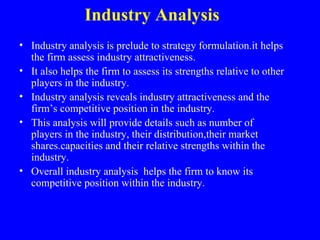
• Industry analysis is prelude to strategy formulation.it helps
  the firm assess industry attractiveness.
• It also helps the firm to assess its strengths relative to other
  players in the industry.
• Industry analysis reveals industry attractiveness and the
  firm’s competitive position in the industry.
• This analysis will provide details such as number of
  players in the industry, their distribution,their market
  shares.capacities and their relative strengths within the
  industry.
• Overall industry analysis helps the firm to know its
  competitive position within the industry.
Industry Settings
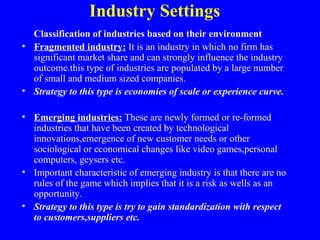
  Classification of industries based on their environment
• Fragmented industry: It is an industry in which no firm has
  significant market share and can strongly influence the industry
  outcome.this type of industries are populated by a large number
  of small and medium sized companies.
• Strategy to this type is economies of scale or experience curve.

• Emerging industries: These are newly formed or re-formed
  industries that have been created by technological
  innovations,emergence of new customer needs or other
  sociological or economical changes like video games,personal
  computers, geysers etc.
• Important characteristic of emerging industry is that there are no
  rules of the game which implies that it is a risk as wells as an
  opportunity.
• Strategy to this type is try to gain standardization with respect
  to customers,suppliers etc.
Industry Settings
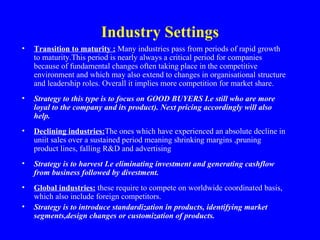
•   Transition to maturity : Many industries pass from periods of rapid growth
    to maturity.This period is nearly always a critical period for companies
    because of fundamental changes often taking place in the competitive
    environment and which may also extend to changes in organisational structure
    and leadership roles. Overall it implies more competition for market share.
•   Strategy to this type is to focus on GOOD BUYERS I.e still who are more
    loyal to the company and its product). Next pricing accordingly will also
    help.
•   Declining industries:The ones which have experienced an absolute decline in
    uniit sales over a sustained period meaning shrinking margins ,pruning
    product lines, falling R&D and advertising
•   Strategy is to harvest I.e eliminating investment and generating cashflow
    from business followed by divestment.
•   Global industries: these require to compete on worldwide coordinated basis,
    which also include foreign competitors.
•   Strategy is to introduce standardization in products, identifying market
    segments,design changes or customization of products.
Industry attractiveness
• The growth potential and the profitability are the two
  major determinants of industry attractiveness.

• The firm has to assess the industry attractiveness and make
  up its mind on industries in which it should enter and the
  ones it should avoid. The firm needs to find out :
       Is it a growing industry?
       Or is it a stagnant industry?

• If growing then the pace of growth;limits to growth
  Whether it is profitable?- highly profitable?or medium ?or
  low?
Barriers in the Industry


• A firm has to either build such barriers or
  break them, depending on wheather it is
  already a player in the industry trying to
  prevent the entry of others or is a new
  entrant.
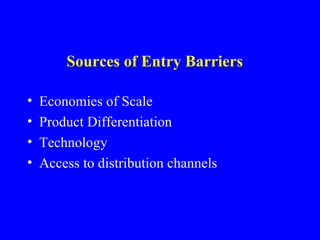
Sources of Entry Barriers

•   Economies of Scale
•   Product Differentiation
•   Technology
•   Access to distribution channels
Firm’s competitive position
Knowing One’s competitors and one’s own position relative
    to competition is critical to effective strategy.
The task of strategy is to find a favorable and profitable
    competitive position within the industry,a position that the
    firm can defend best,a position the firm can sustain,against
    the forces that shape competition in the industry.
By analyzing the competition the can identify areas of
    advantage and disadvantage
It can launch more precise attacks on competitors and also
    prepare stronger defences against the attack.
To sum up the stronger competitive position of the firm
    within the industry, more is the profitability.

Industry analysis

  • 1.
  • 2.
    Industry Analysis • Industryanalysis is prelude to strategy formulation.it helps the firm assess industry attractiveness. • It also helps the firm to assess its strengths relative to other players in the industry. • Industry analysis reveals industry attractiveness and the firm’s competitive position in the industry. • This analysis will provide details such as number of players in the industry, their distribution,their market shares.capacities and their relative strengths within the industry. • Overall industry analysis helps the firm to know its competitive position within the industry.
  • 3.
    Industry Settings Classification of industries based on their environment • Fragmented industry: It is an industry in which no firm has significant market share and can strongly influence the industry outcome.this type of industries are populated by a large number of small and medium sized companies. • Strategy to this type is economies of scale or experience curve. • Emerging industries: These are newly formed or re-formed industries that have been created by technological innovations,emergence of new customer needs or other sociological or economical changes like video games,personal computers, geysers etc. • Important characteristic of emerging industry is that there are no rules of the game which implies that it is a risk as wells as an opportunity. • Strategy to this type is try to gain standardization with respect to customers,suppliers etc.
  • 4.
    Industry Settings • Transition to maturity : Many industries pass from periods of rapid growth to maturity.This period is nearly always a critical period for companies because of fundamental changes often taking place in the competitive environment and which may also extend to changes in organisational structure and leadership roles. Overall it implies more competition for market share. • Strategy to this type is to focus on GOOD BUYERS I.e still who are more loyal to the company and its product). Next pricing accordingly will also help. • Declining industries:The ones which have experienced an absolute decline in uniit sales over a sustained period meaning shrinking margins ,pruning product lines, falling R&D and advertising • Strategy is to harvest I.e eliminating investment and generating cashflow from business followed by divestment. • Global industries: these require to compete on worldwide coordinated basis, which also include foreign competitors. • Strategy is to introduce standardization in products, identifying market segments,design changes or customization of products.
  • 5.
    Industry attractiveness • Thegrowth potential and the profitability are the two major determinants of industry attractiveness. • The firm has to assess the industry attractiveness and make up its mind on industries in which it should enter and the ones it should avoid. The firm needs to find out : Is it a growing industry? Or is it a stagnant industry? • If growing then the pace of growth;limits to growth Whether it is profitable?- highly profitable?or medium ?or low?
  • 6.
    Barriers in theIndustry • A firm has to either build such barriers or break them, depending on wheather it is already a player in the industry trying to prevent the entry of others or is a new entrant.
  • 7.
    Sources of EntryBarriers • Economies of Scale • Product Differentiation • Technology • Access to distribution channels
  • 8.
    Firm’s competitive position KnowingOne’s competitors and one’s own position relative to competition is critical to effective strategy. The task of strategy is to find a favorable and profitable competitive position within the industry,a position that the firm can defend best,a position the firm can sustain,against the forces that shape competition in the industry. By analyzing the competition the can identify areas of advantage and disadvantage It can launch more precise attacks on competitors and also prepare stronger defences against the attack. To sum up the stronger competitive position of the firm within the industry, more is the profitability.