Strategic Management 
Environmental Analysis
The Micro and Macro Environments 
Internal 
Environment 
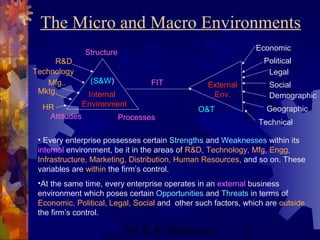
• Every enterprise possesses certain Strengths and Weaknesses within its 
internal environment, be it in the areas of R&D, Technology, Mfg, Engg, 
Infrastructure, Marketing, Distribution, Human Resources, and so on. These 
variables are within the firm’s control. 
•At the same time, every enterprise operates in an external business 
environment which poses certain Opportunities and Threats in terms of 
Economic, Political, Legal, Social and other such factors, which are outside 
the firm’s control. 
Dr. B. K. Mukherjee 2 
Technology 
Structure 
Attitudes Processes 
External 
Env. 
FIT 
R&D 
Mktg. 
HR 
(S&W) 
O&T 
Economic 
Political 
Legal 
Social 
Demographic 
Geographic 
Technical 
Mfg..
Environmental Analysis 
THE EXTERNAL (MACRO) ENVIRONMENT 
All managers, whether they operate in a business, a Govt. agency, a 
church/religious orgn., a charitable foundation or a university, must 
Dr. B. K. Mukherjee 3 
identify 
evaluate 
react to 
the forces external to the enterprise that may affect its 
operations, i.e, pose OPPORTUNITIES and THREATS. 
Hence, forecasting and anticipating changes is important. Environments 
may be classified as: 
1. ECONOMIC ENV: is of the greatest importance to all types of organized 
enterprise. In addition to such things as Inflation, Budgetary deficit, 
Monetary Policy, Bank Rate, Compulsory Reserve Ratio, etc.it includes 
a) Capital, in most cases, is a scarce resource. All kinds of operations 
are dependent on the availability and prices of the required capital items 
(Machinery/Buildings/Inventories of goods/Office eqpmt./Tools/Cash, 
etc.) Many of these items may be controlled by the Govt. 
b) Labour : Availability (qualified personnel), Quality (trained and willing 
workers) and Price (USA v/s Europe v/s Asia) of labour is important.
Environmental Analysis (contd.2) 
c) Price levels : Inflation not only upsets businesses but also has highly 
disturbing influences on every kind of orgn. through its effects on 
costs of labour, material and other items. 
d) Productivity : is extremely important in addition to availability and price. 
In USA, prody. Is particularly strong in farming. Japan and China 
have very high levels of prody. in manufacturing businesses. 
Productivity is partly dependent on the state of technology. 
e) Entrepreneurship : An Entrepreneur is usually regarded as one who 
- sees a business opportunity; 
- obtains the needed resources; 
- knows how to put together an operation successfully; and 
- has the willingness to take a personal risk of success or failure. 
2. TECHNOLOGICAL ENVIRONMENT : “Technology” may be regarded 
as the sum total of the knowledge we have of ways of doing things, 
including inventions, innovations and techniques. 
Business must of necessity keep abreast of latest technology to 
survive in today’s competitive environment. Staffing and Leadership 
in an organization also vary with the level of technology. 
Dr. B. K. Mukherjee 4
Environmental Analysis (contd.3) 
3. LEGAL ENV : Complex of laws, regulations and court decisions – 
Managers are expected to know the legal implications and 
requirements applicable to their actions. Hence, need for expert legal 
advice at all times. Laws may also create Opportunities and Threats. 
PRIOR TO 1991, industries were regulated under Industrial Dev.& 
Regulation Act, 1951. Later, licensing system was abolished and 
MRTPA came into the picture. This was then replaced by the 
Consumer Protection Act, 1986 which provided 
i) right to choice, 
ii) right to safety, 
iii) right to information, 
iv) right to be heard, and 
v) right to privacy – resale price maintenance not allowed. 
TRADE RELATED INTELLECTUAL PROPERTY RIGHTS (TRIPR) : 
covers intellectual properties, copyrights, patents, trademarks, etc. 
which are assuming increasing importance, especially in the post- 
WTO regime. 
Dr. B. K. Mukherjee 5
Environmental Analysis (contd.4) 
a) Patents Act : Patent is an exclusive document or legal protection 
given for an invention of a product or process. All categories except a 
few will get a Patent whose life is 14 years, but for Pharma and Agro-based 
industries it is 4 years. This may be an Opportunity for some 
and Threat for others. 
b) Copyrights Act : Legal protection is given for a work of creative art 
or literature, commercial exploitation of which is prevented. Its life 
lasts to 60 years after the death of its creator. 
c) Trade & Merchandise Act : Trademark is a legal protection for 
brand (logo, letter, name, slogan, etc), commercial exploitation of 
which is prevented. There is no life of trademarks. Sometimes, a 
product gets associated with its trademark, rather than its generic 
name – ultimate proof of success (eg.,Dalda, Xerox, Tempo). 
4. LABOUR ENV : The labour climate, militancy and attitude varies from 
region to region (eg, Mumbai, Gujarat, Punjab, Tamilnadu, W.Bengal, 
Kerala, Kashmir, Goa). Also, labour laws play a role, eg. (a) number 
of members in a trade union, (b) political leaders heading a trade 
union. 
Dr. B. K. Mukherjee 6
Environmental Analysis (contd.5) 
5. SOCIO-CULTURAL/DEMOGRAPHIC ENV : 
a) Cultural perceptions/Social norms : National holidays, level of 
corruption, advertising standards, public morals, etc. 
b) Language connotations : differ from country to country, eg: 
Chevrolet – ‘NOVA’ (No-va = “Does not go” in Spanish); 
GM – “Body by Fisher” (connotation of Dead body in some languages); 
PEPSI – “Come alive” (“Rise from the Dead”, in Chinese). 
c) Demographic factors : i) earlier joint families, now nuclear families; 
ii) More and more working women; 
iii) move toward metro-centric lifestyle, etc. 
6. COMPETITIVE ENV : governed by the Porter’s Five-forces Model, i.e, 
threats from present rivals, suppliers, consumers, new entrants and 
substitutes. 
7. ECOLOGICAL ENV : Environmental Safety awareness and conformity, 
Greenhouse Gas emissions, Ozone depletion, Env. Management 
Systems, Environmental Laws, etc. 
Dr. B. K. Mukherjee 7
Environmental Analysis (contd.6) 
8. ETHICAL ENV : 
 ‘Ethics’ are sets of generally accepted and practiced standards of 
personal conduct. Often ethical standards are enacted into laws, but 
not all can be codified. 
 Ethical standards vary with people’s culture and sense of values and 
from nation to nation or from society to society (Eg, election donations, 
payoffs, profiteering, etc.). 
9. CORPORATE SOCIAL RESPONSIBILITY: 
 In recent years, there has been an increasing growth of strong social 
beliefs pertaining to a better quality of life, for an environment cleansed 
of water and air pollution, decent housing, safe streets, efficient 
transportation and better health, educational and cultural facilities. 
 A society, awakened and vocal with respect to the urgency of social 
problems, is asking the managers of all kinds of organizations, 
particularly those at the top, what they are doing to discharge their 
social responsibilities and why they are not doing more (eg, Mithi River 
Development Project in Mumbai). 
Dr. B. K. Mukherjee 8

4. env. analysis

  • 1.
  • 2.
    The Micro andMacro Environments Internal Environment • Every enterprise possesses certain Strengths and Weaknesses within its internal environment, be it in the areas of R&D, Technology, Mfg, Engg, Infrastructure, Marketing, Distribution, Human Resources, and so on. These variables are within the firm’s control. •At the same time, every enterprise operates in an external business environment which poses certain Opportunities and Threats in terms of Economic, Political, Legal, Social and other such factors, which are outside the firm’s control. Dr. B. K. Mukherjee 2 Technology Structure Attitudes Processes External Env. FIT R&D Mktg. HR (S&W) O&T Economic Political Legal Social Demographic Geographic Technical Mfg..
  • 3.
    Environmental Analysis THEEXTERNAL (MACRO) ENVIRONMENT All managers, whether they operate in a business, a Govt. agency, a church/religious orgn., a charitable foundation or a university, must Dr. B. K. Mukherjee 3 identify evaluate react to the forces external to the enterprise that may affect its operations, i.e, pose OPPORTUNITIES and THREATS. Hence, forecasting and anticipating changes is important. Environments may be classified as: 1. ECONOMIC ENV: is of the greatest importance to all types of organized enterprise. In addition to such things as Inflation, Budgetary deficit, Monetary Policy, Bank Rate, Compulsory Reserve Ratio, etc.it includes a) Capital, in most cases, is a scarce resource. All kinds of operations are dependent on the availability and prices of the required capital items (Machinery/Buildings/Inventories of goods/Office eqpmt./Tools/Cash, etc.) Many of these items may be controlled by the Govt. b) Labour : Availability (qualified personnel), Quality (trained and willing workers) and Price (USA v/s Europe v/s Asia) of labour is important.
  • 4.
    Environmental Analysis (contd.2) c) Price levels : Inflation not only upsets businesses but also has highly disturbing influences on every kind of orgn. through its effects on costs of labour, material and other items. d) Productivity : is extremely important in addition to availability and price. In USA, prody. Is particularly strong in farming. Japan and China have very high levels of prody. in manufacturing businesses. Productivity is partly dependent on the state of technology. e) Entrepreneurship : An Entrepreneur is usually regarded as one who - sees a business opportunity; - obtains the needed resources; - knows how to put together an operation successfully; and - has the willingness to take a personal risk of success or failure. 2. TECHNOLOGICAL ENVIRONMENT : “Technology” may be regarded as the sum total of the knowledge we have of ways of doing things, including inventions, innovations and techniques. Business must of necessity keep abreast of latest technology to survive in today’s competitive environment. Staffing and Leadership in an organization also vary with the level of technology. Dr. B. K. Mukherjee 4
  • 5.
    Environmental Analysis (contd.3) 3. LEGAL ENV : Complex of laws, regulations and court decisions – Managers are expected to know the legal implications and requirements applicable to their actions. Hence, need for expert legal advice at all times. Laws may also create Opportunities and Threats. PRIOR TO 1991, industries were regulated under Industrial Dev.& Regulation Act, 1951. Later, licensing system was abolished and MRTPA came into the picture. This was then replaced by the Consumer Protection Act, 1986 which provided i) right to choice, ii) right to safety, iii) right to information, iv) right to be heard, and v) right to privacy – resale price maintenance not allowed. TRADE RELATED INTELLECTUAL PROPERTY RIGHTS (TRIPR) : covers intellectual properties, copyrights, patents, trademarks, etc. which are assuming increasing importance, especially in the post- WTO regime. Dr. B. K. Mukherjee 5
  • 6.
    Environmental Analysis (contd.4) a) Patents Act : Patent is an exclusive document or legal protection given for an invention of a product or process. All categories except a few will get a Patent whose life is 14 years, but for Pharma and Agro-based industries it is 4 years. This may be an Opportunity for some and Threat for others. b) Copyrights Act : Legal protection is given for a work of creative art or literature, commercial exploitation of which is prevented. Its life lasts to 60 years after the death of its creator. c) Trade & Merchandise Act : Trademark is a legal protection for brand (logo, letter, name, slogan, etc), commercial exploitation of which is prevented. There is no life of trademarks. Sometimes, a product gets associated with its trademark, rather than its generic name – ultimate proof of success (eg.,Dalda, Xerox, Tempo). 4. LABOUR ENV : The labour climate, militancy and attitude varies from region to region (eg, Mumbai, Gujarat, Punjab, Tamilnadu, W.Bengal, Kerala, Kashmir, Goa). Also, labour laws play a role, eg. (a) number of members in a trade union, (b) political leaders heading a trade union. Dr. B. K. Mukherjee 6
  • 7.
    Environmental Analysis (contd.5) 5. SOCIO-CULTURAL/DEMOGRAPHIC ENV : a) Cultural perceptions/Social norms : National holidays, level of corruption, advertising standards, public morals, etc. b) Language connotations : differ from country to country, eg: Chevrolet – ‘NOVA’ (No-va = “Does not go” in Spanish); GM – “Body by Fisher” (connotation of Dead body in some languages); PEPSI – “Come alive” (“Rise from the Dead”, in Chinese). c) Demographic factors : i) earlier joint families, now nuclear families; ii) More and more working women; iii) move toward metro-centric lifestyle, etc. 6. COMPETITIVE ENV : governed by the Porter’s Five-forces Model, i.e, threats from present rivals, suppliers, consumers, new entrants and substitutes. 7. ECOLOGICAL ENV : Environmental Safety awareness and conformity, Greenhouse Gas emissions, Ozone depletion, Env. Management Systems, Environmental Laws, etc. Dr. B. K. Mukherjee 7
  • 8.
    Environmental Analysis (contd.6) 8. ETHICAL ENV :  ‘Ethics’ are sets of generally accepted and practiced standards of personal conduct. Often ethical standards are enacted into laws, but not all can be codified.  Ethical standards vary with people’s culture and sense of values and from nation to nation or from society to society (Eg, election donations, payoffs, profiteering, etc.). 9. CORPORATE SOCIAL RESPONSIBILITY:  In recent years, there has been an increasing growth of strong social beliefs pertaining to a better quality of life, for an environment cleansed of water and air pollution, decent housing, safe streets, efficient transportation and better health, educational and cultural facilities.  A society, awakened and vocal with respect to the urgency of social problems, is asking the managers of all kinds of organizations, particularly those at the top, what they are doing to discharge their social responsibilities and why they are not doing more (eg, Mithi River Development Project in Mumbai). Dr. B. K. Mukherjee 8