Social Psychology Social Thinking 2008 Lecturer: James Neill
Lecture Web Page http://ucspace.canberra.edu.au/display/7125/Lecture+Social+Thinking Readings Ch05 Social Cognition Ch07 Attitudes, Beliefs, and Consistency Ch13 Social Influence and Persuasion
Overview Social thinking Attitudes Influence & persuasion
Social Thinking  =  Social Cognition
Part 1: Social thinking overview Thinking Perception Attributions Heuristics, Errors and Biases
Social thinking Social psychology was initially influenced by  behaviourism . (1930’s-1950’s) By the 1970’s, cognitive psychology lead to greater investigation of  social thinking and feeling .
Social perception
Social perception Refers to how people: form impressions of, &  make inferences about  other people.
“ Whilst part of what we perceive comes through our senses from the object before us, another part (and it may be the larger part) always comes out of our own mind.” William James
Social perception Communication Verbal and non-verbal Impression formation & management How do we form initial social impressions? e.g., social categories, stereotypes, schemas & scripts Attribution theory How we form integrated (deeper) social impressions based on observed behaviour?
Duplex mind Automatic fast approximate best-guess effortless unconscious  Conscious slow deliberate considered effortful conscious
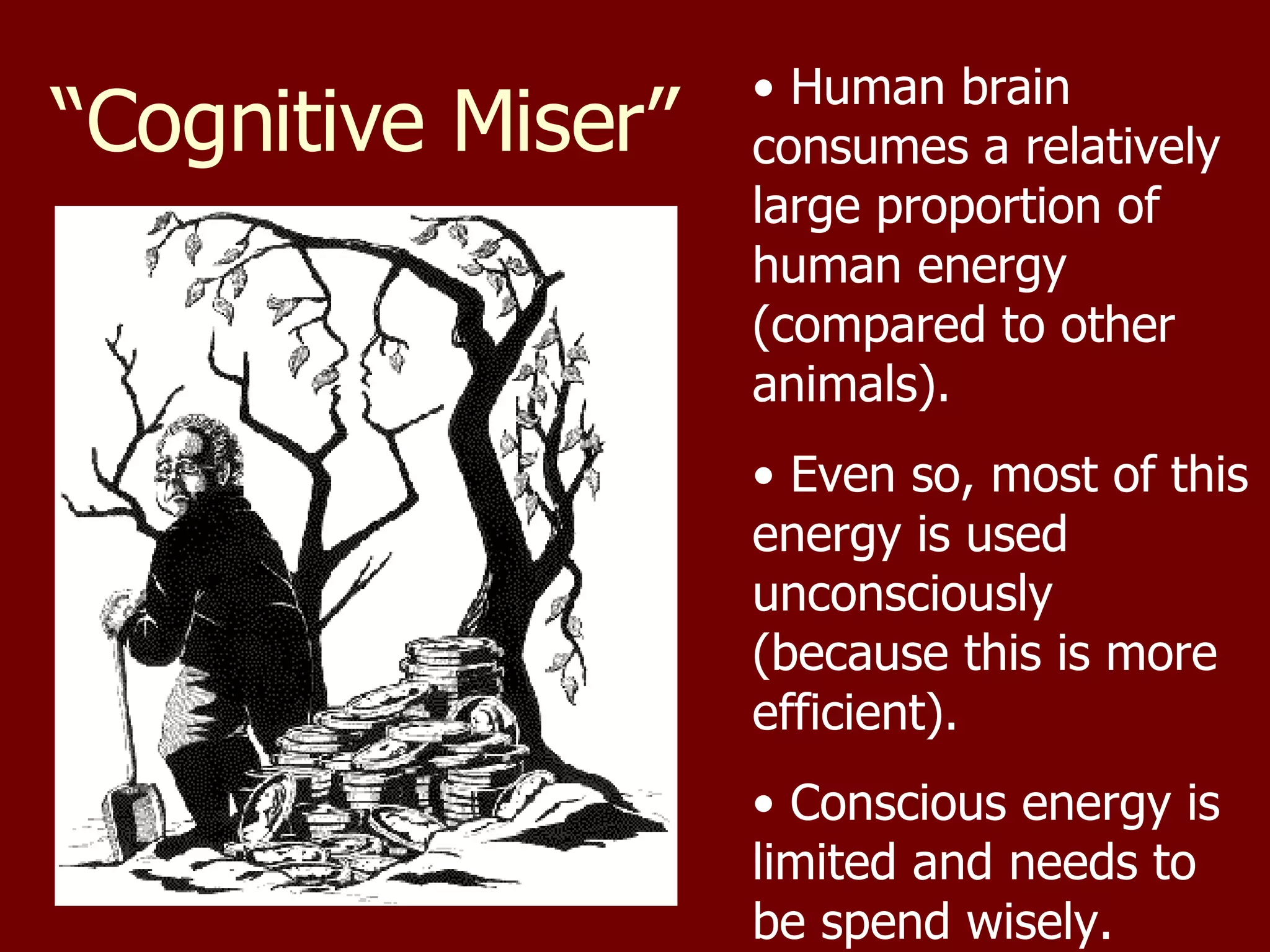
“ Cognitive Miser” Human brain consumes a relatively large proportion of human energy (compared to other animals). Even so, most of this energy is used unconsciously (because this is more efficient). Conscious energy is limited and needs to be spend wisely.
Cognitive miser “ There is ample evidence that when people’s capacity for thinking is already preoccupied, they take even more shortcuts to reduce further need for thought”
Knowledge structures “ Automatic thinking requires little effort because it relies on knowledge structures”, e.g., Schemas Scripts Stereotypes “ We reduce…complex and detailed realities to simple images that can be stored and recalled.”
Schemas Stored and automatically accessible information about a concept, its attributes, & its relationships to other concepts. From the Greek word "σχήμα" (skhēma), which means  shape  or more generally  plan .
Schemas: The good Effective tool for understanding the world. Through use of schemata, most everyday situations do not require effortful thought.
Schemas: The bad Influences & hampers uptake of new information ( proactive interference ), such as when situations are inconsistent with stereotypes.
 
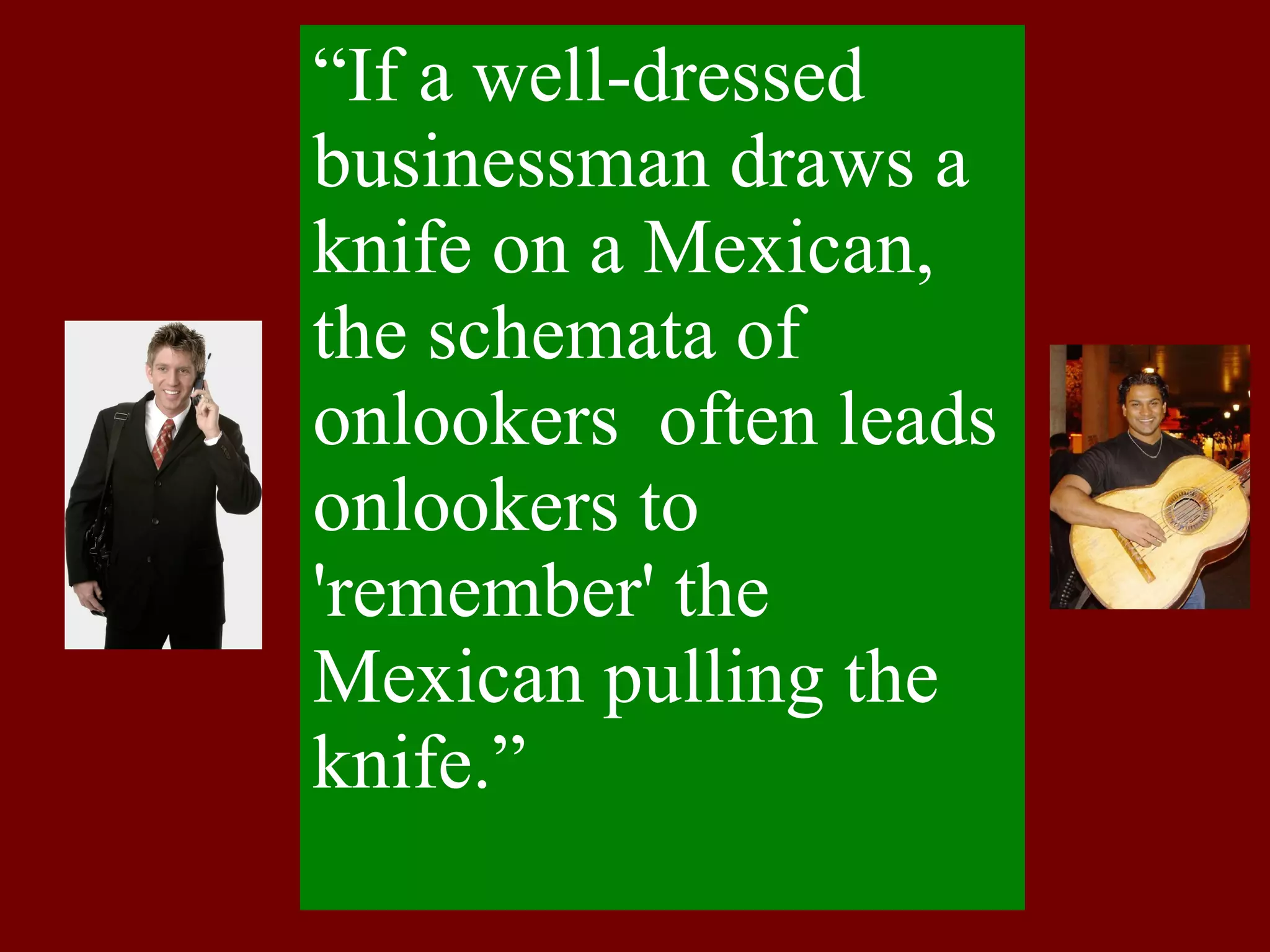
“ If a well-dressed businessman draws a knife on a Mexican, the schemata of onlookers  often leads onlookers to 'remember' the Mexican pulling the  knife.”
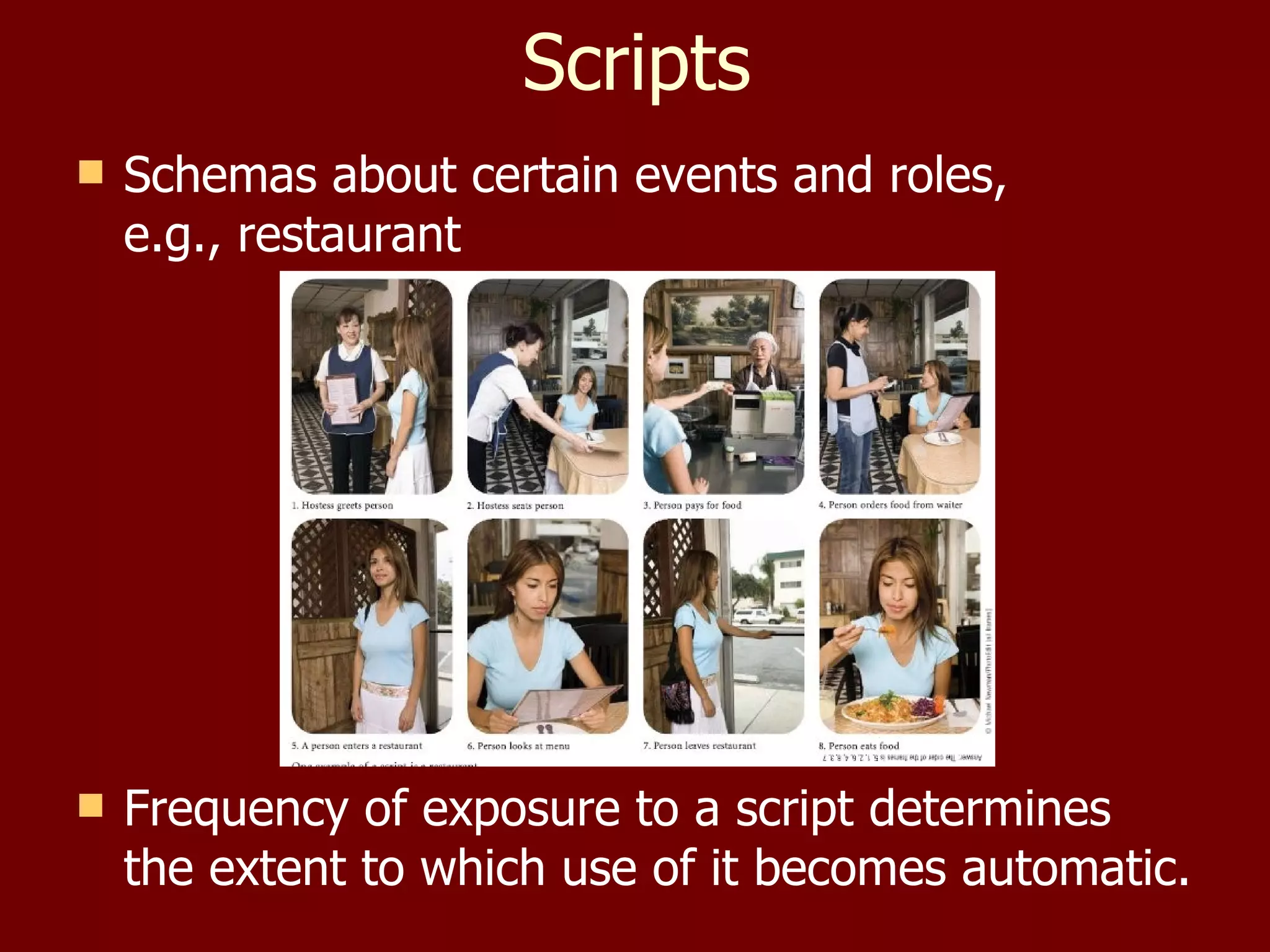
Scripts Schemas about certain events and roles,  e.g., restaurant Frequency of exposure to a script determines the extent to which use of it becomes automatic.
Priming Activating a concept in the mind: Influences subsequent thinking  May trigger automatic processes e.g., 1 st  year medical students who begin to think they and other people they know are suffering from serious illness.
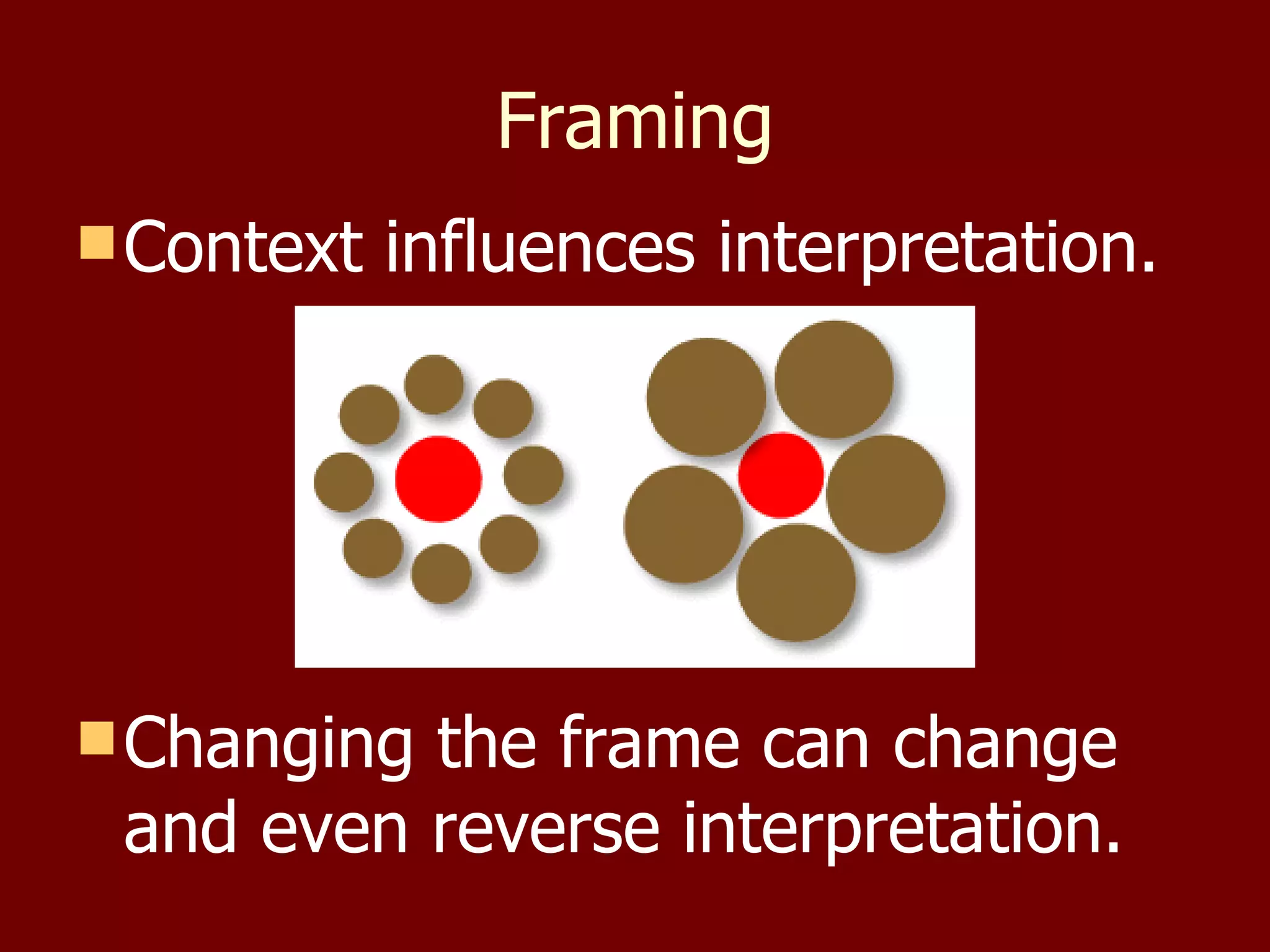
Framing Context influences interpretation. Changing the frame can change and even reverse interpretation.
Framing
Typical vs. unusual events Events consistent with expectations, norms, schemas, scripts, etc.  don’t tend to elicit the desire to explain . Unusual events motivate us to find explanatory causes  for the behaviour in order to regain a sense of control and predictability.
Attributions
“ The causes of events always interest us more than the events themselves” - Cicero
“ Happy is he who has been able to perceive the causes of things” - Virgil
Why do we make attributions? Sense of cognitive control. To predict the future. To respond appropriately.
Attribution Theory “… deals with how the  social perceiver  uses information to arrive at  causal explanations  for events”
Theories of attribution Heider(1958):  ‘Naïve Scientist’ Jones & Davis (1965):  Correspondent Inference Theory Kelley (1967, 1973):  Covariation Theory Weiner (1979, 1985):  Internal / External + Stable / Unstable
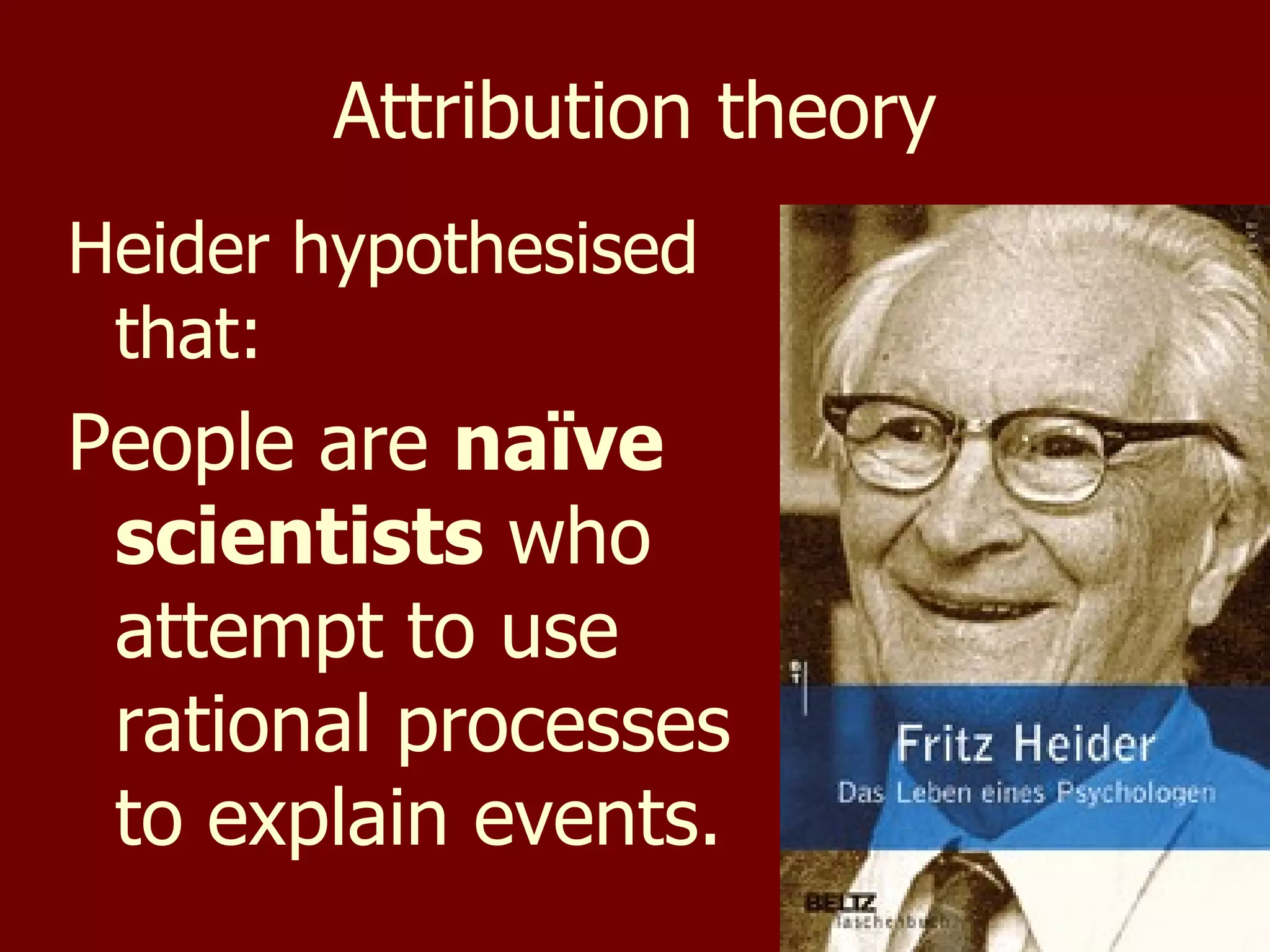
Attribution theory Heider hypothesised that: People are  naïve scientists  who attempt to use rational processes to explain events.
Attribution theory People perceive behaviour as being  caused . People give causal attributions  (even to inanimate objects!). Both disposition & situation can cause behaviour.
Attribution theory 4 Causes of behaviour are seen as  inside  (internal) or  outside  (external) a person. Internal External Causes
Attribution theory We generally assume that people choose to behave the way they do,  i.e.,  there is a tendency to make  internal  attributions .
 
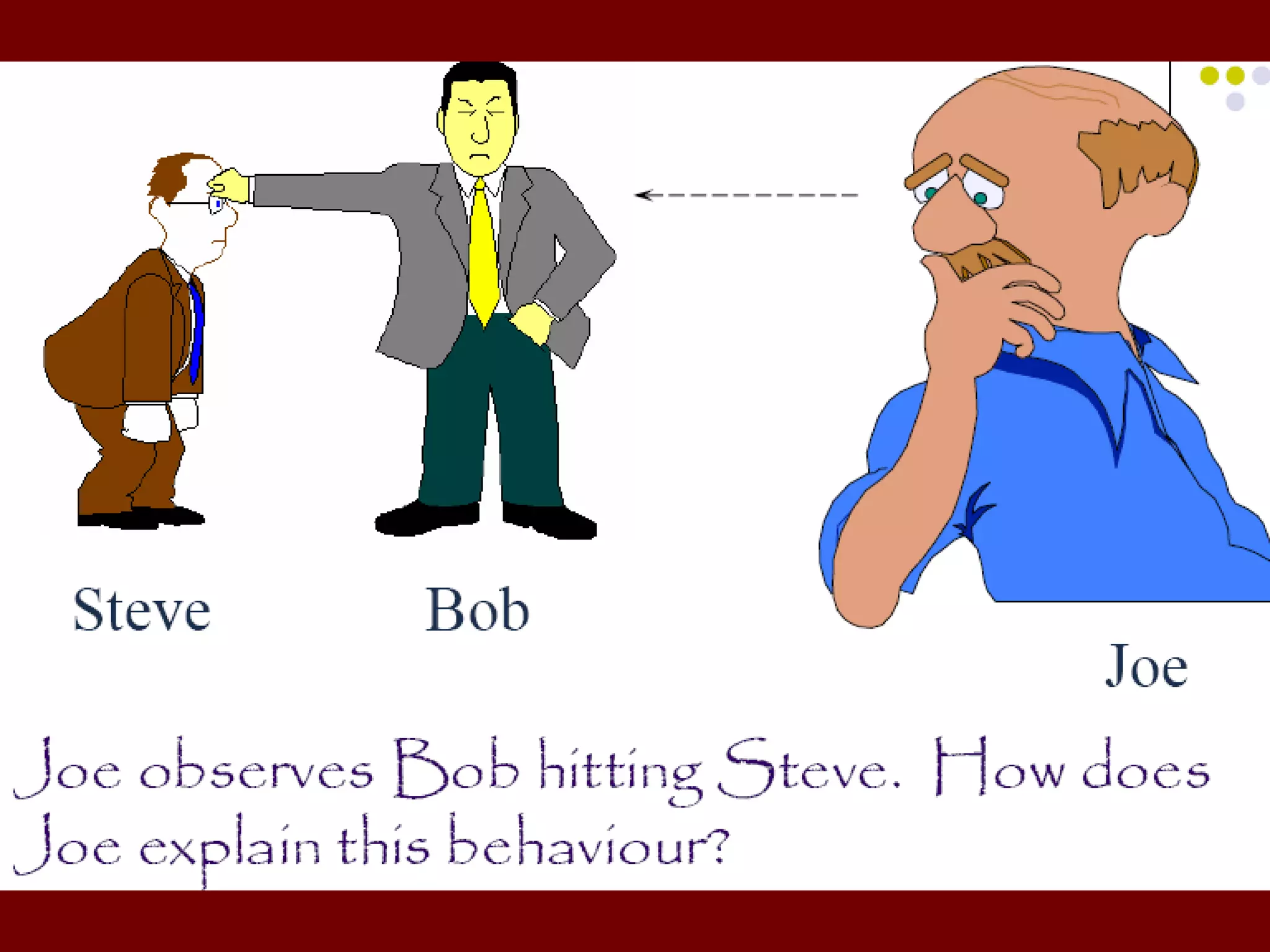
Internal attribution ‘ Bob is a jerk!’ ‘ Bob is short-tempered!’ ‘ Bob likes to beat people up!’
External attribution ‘ Steve just told Bob that he is having an affair w/ Bob’s wife.’ ‘ Steve paid Bob $100 to give him a black eye.’ ‘ Bob tripped on a cord and accidentally hit Steve when he lost his balance.’
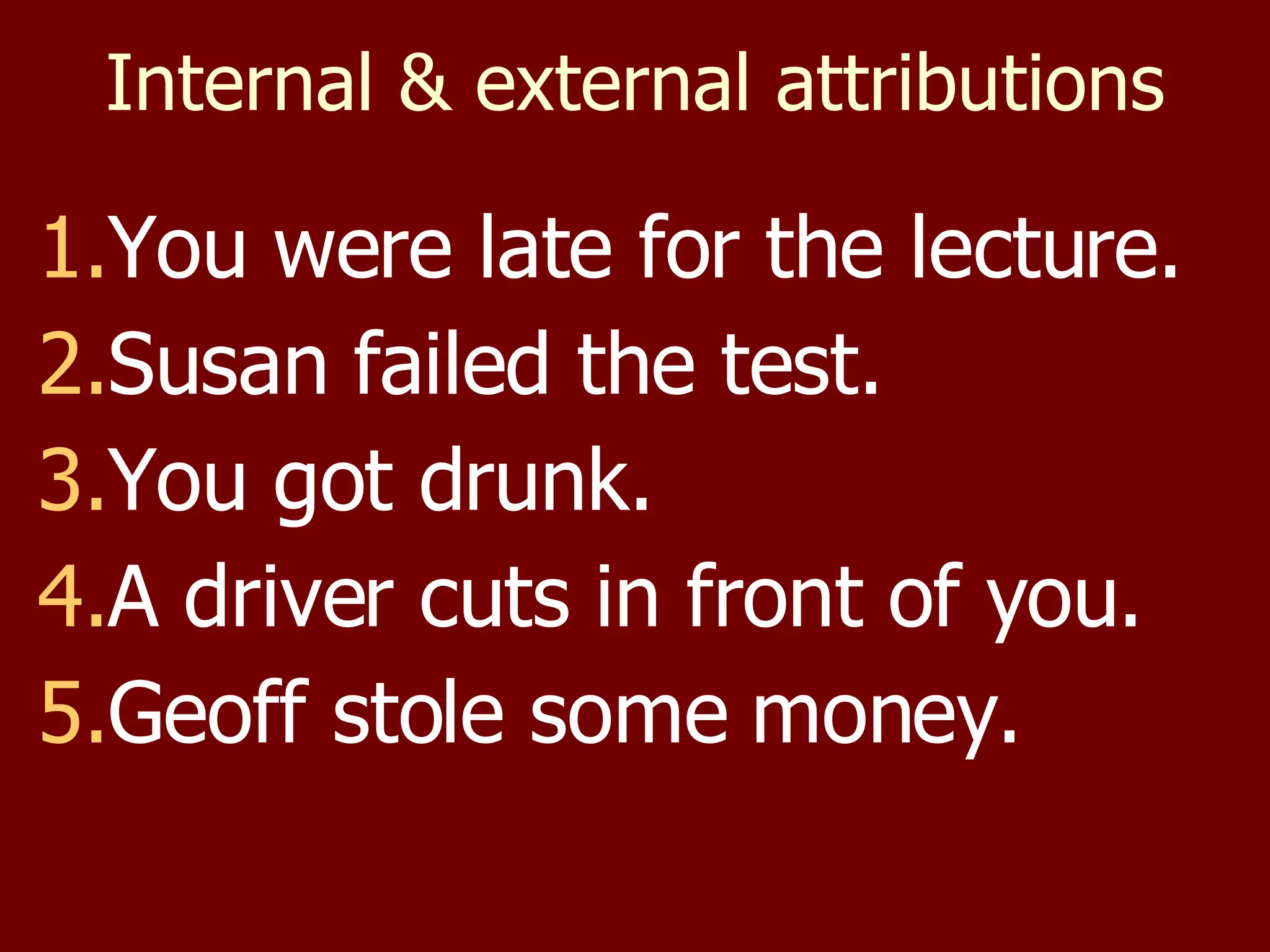
Internal & external attributions You were late for the lecture. Susan failed the test. You got drunk. A driver cuts in front of you. Geoff stole some money.
Correspondent Inference Theory
Correspondent Inference Theory   We tend to assume that:  Observed behaviour and the intentions that produced it correspond to stable underlying qualities within the  actor . Actors behave wilfully. (Jones & Davis 1965)
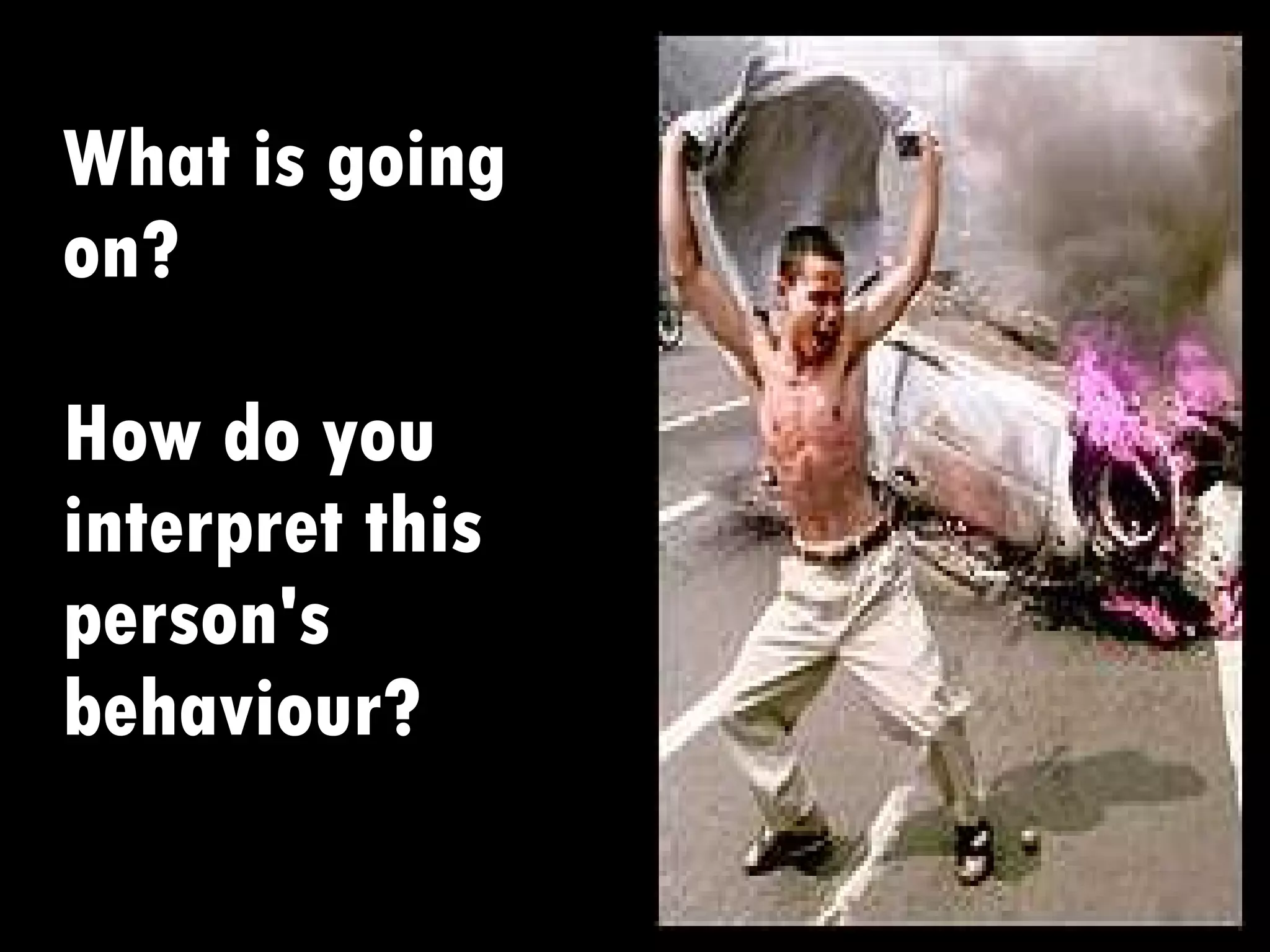
What is going on? How do you interpret this person's behaviour?
Correspondent Inference Theory   A  correspondent inference  (CI) is made when a behavior is believed to correspond to a person's internal beliefs.
Correspondent Inference Theory   We are likely to make a  CI  when we perceive that the behaviour:  was freely chosen. was intended. had noncommon consequences.  was low in social desirability.
Correspondent Inference Theory   We are likely to make an  external attribution  when we perceive that the behaviour:  was not freely chosen. was unintended. had common consequences.  was high in social desirability.
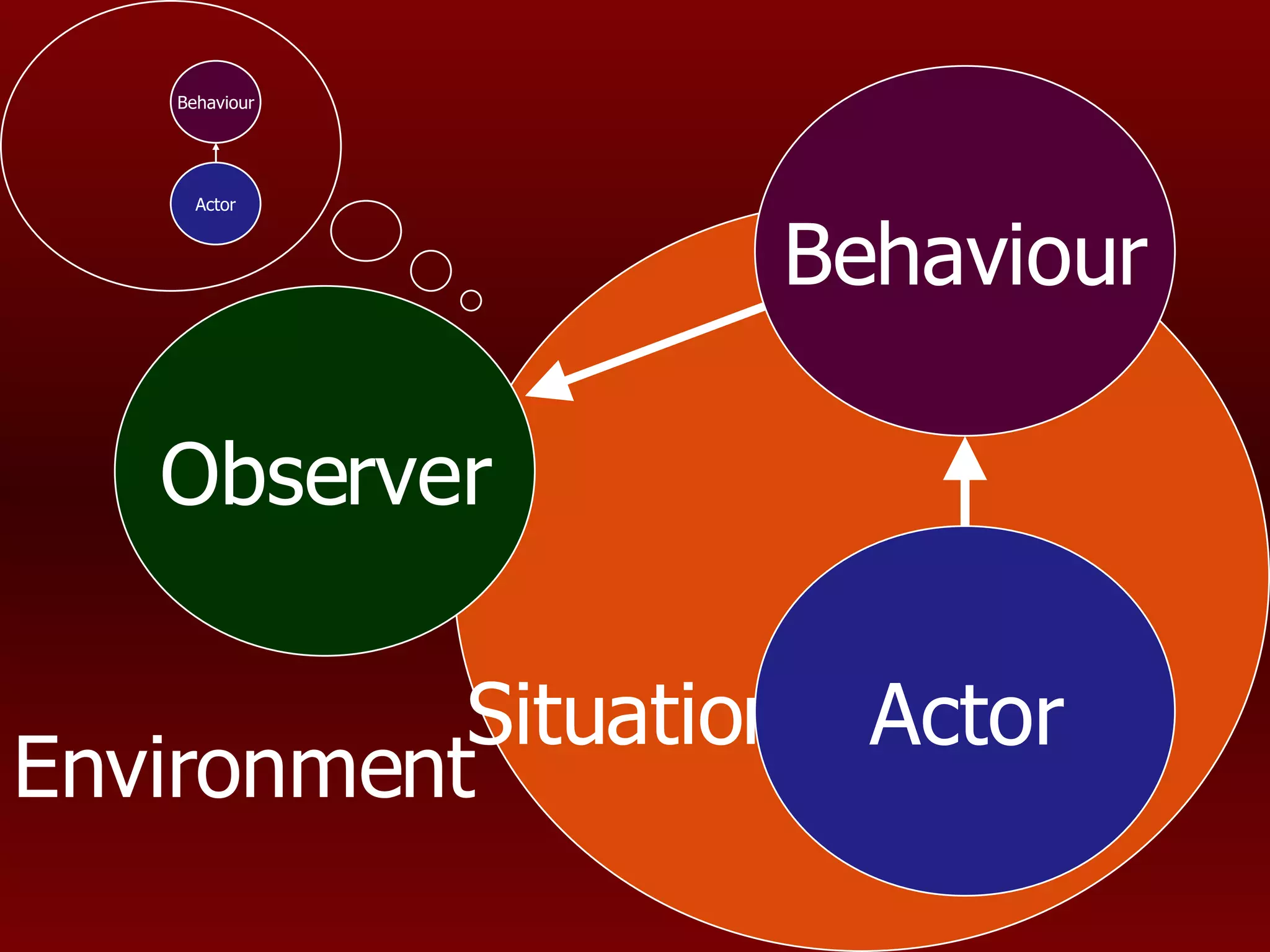
Correspondence Bias   Occurs when we make an internal attribution when there are external forces that could have caused the behavior. i.e., tendency to  overestimate the role of internal factors  & underestimate the role of external factors.
Correspondence Bias “… the  tendency to draw inferences about a person’s unique and enduring dispositions from behaviors  that can be…explained by the situations in which they occur.”
Correspondence Bias Also known as: Fundamental Attribution Error Overattribution Effect
Observer Behaviour Actor Environment Situation Behaviour Actor
Fundamental Attribution Error Tendency to attribute others’ behaviour to enduring dispositions (e.g., attitudes, personality traits) because of both: Underestimation of the influence of situational factors. Overestimation of the influence of dispositional factors.
Fundamental Attribution Error Four possible explanations: Behavior is more noticeable than situational factors. Insignificant weight is assigned to situational factors. People are cognitive misers. Richer trait-like language to explain behavior.
Fundamental Attribution Error Gilbert’s (1989) two-stage theory:
Spontaneous & Deliberative Attributions: Example Observed Behaviour Person running out of a bank  with crash helmet  on, jumps on bike & rides away Spontaneous Because just robbed bank Deliberative Noticed traffic warden booking others. Bike on double yellow Lines – avoid  ticket Cognitive effort low Cognitive effort high
Cross-cultural Variations in Attributional Bias
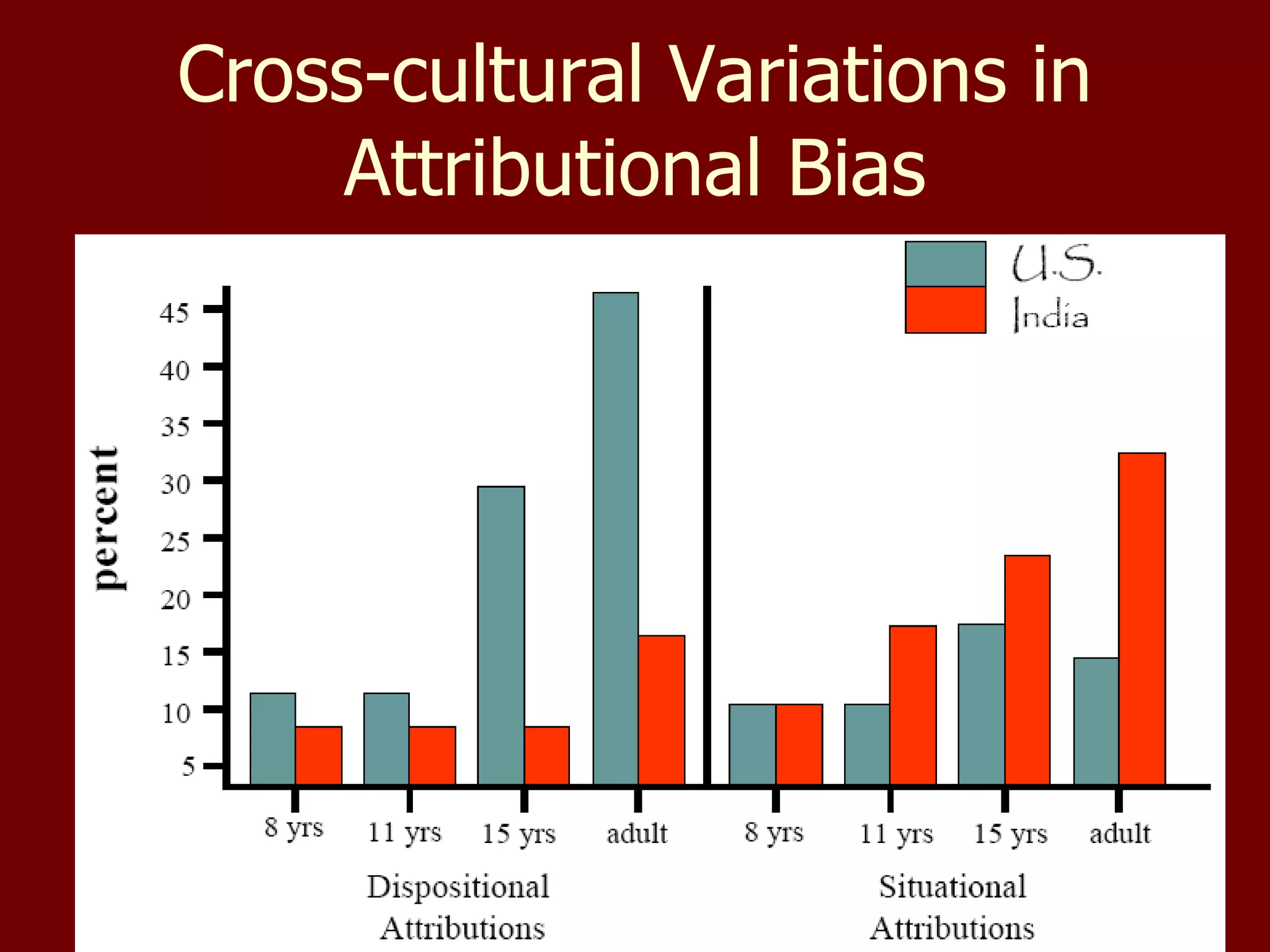
Cross-cultural Variations in Attributional Bias Interpretation: Americans far more likely to explain events in terms of traits than are Indians Indians far more likely to explain events in terms of context that are Americans Cultural differences increase with age Socialisation plays a role in attribution heuristics
Kelley’s Covariation Model
Kelley’s Covariation Model (1967, 1972) Attributions based on 3 kinds of info, which represent the degree to which: Consensus … other actors  perform the same behavior with the same object. E.g.,  High Consensus - Everyone hits Steve
Kelley’s Covariation Model (1967, 1972) Consistency …the actor performs that same behavior toward an object on  different occasions . E.g., High Consistency - Bob always hits Steve
Kelley’s Covariation Model (1967, 1972) Distinctiveness …the actor performs  different behaviors  with different targets. E.g., High Distinctiveness - Bob doesn’t hit anyone else; he only hits  Steve
Kelley’s Attribution Model: External High Consensus (Everyone hits Steve) High Consistency (Bob always hits Steve) High Distinctiveness (Bob only hits Steve)
Kelley’s Attribution Model: Internal Low Consensus (Only Bob hits Steve) High Consistency (Bob always hits Steve) Low Distinctiveness (Bob hits everyone)
Errors in Attribution
Errors in Attribution Difficult to discern the cause of behaviour, therefore we use shortcuts or heuristics. This leads to errors and biases such as: Fundamental Attribution Error Actor-Observer Bias Self-serving Bias Ultimate Attribution Error False Consensus Effect
Actor-Observer Bias
Actor/Observer Bias “ there is a pervasive tendency for actors to attribute their actions to situational requirements, whereas observers tend to attribute the same actions to stable personal dispositions”
Actor/Observer Bias Informational Explanation : We know more about own past behaviour and its variability across situations (availability heuristic) Perceptual Explanation : As an actor, one cannot see one’s self behaving, thus own behaviour is not salient & attention focused on situation Cultural Explanation : A socialised bias which is more true n Western cultures
Self-Serving Bias
Self-serving bias Tendency to attribute: Personal success    Internal Personal failure    External Other’s success    External Other’s failure    Internal
Self-serving bias Taking credit for success = Self-enhancing bias Denying responsibility for failure =  Self-protecting bias
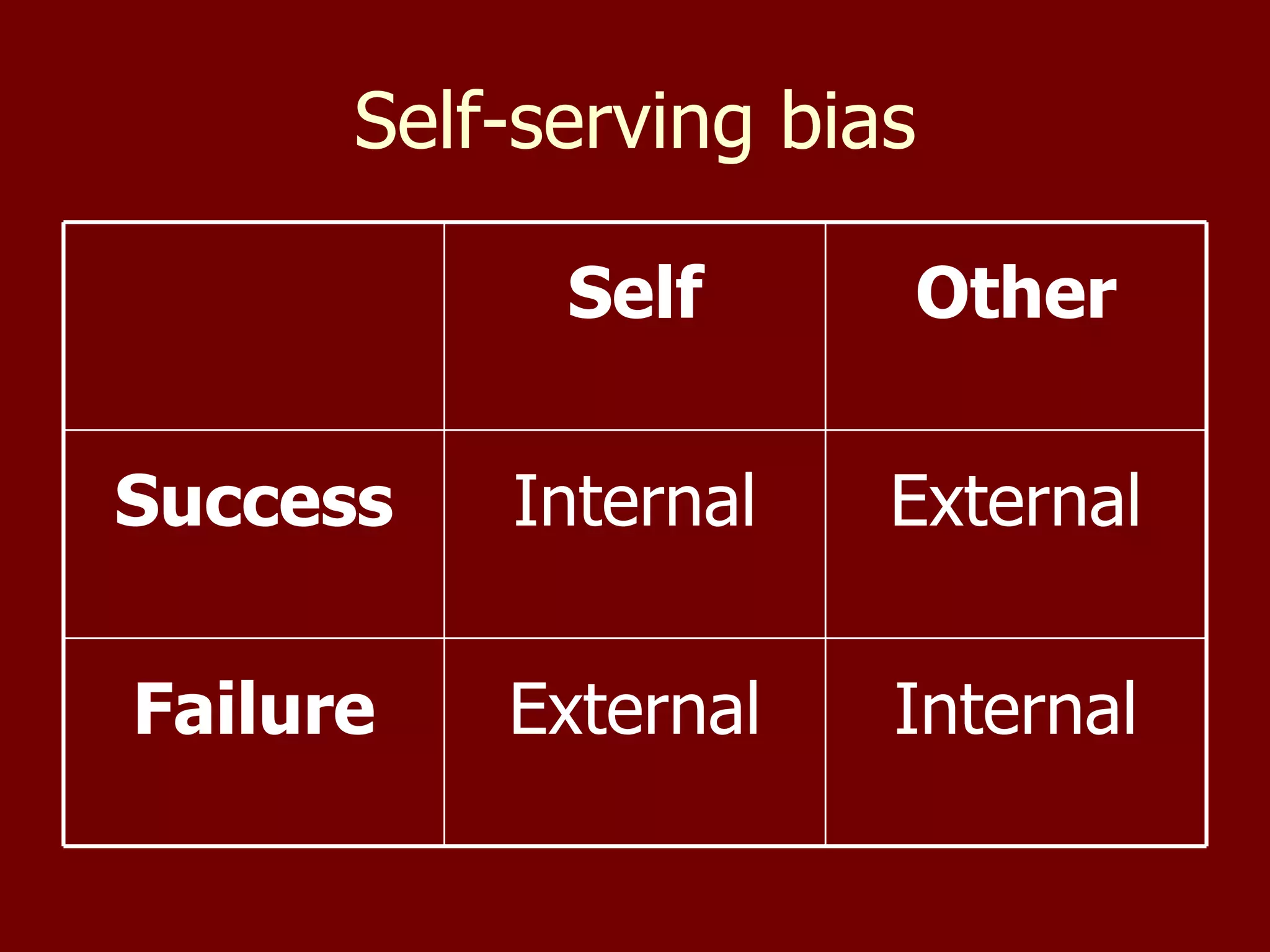
Self-serving bias Internal External Failure External Internal Success Other Self
Self-serving bias Motivational : Self-esteem maintenance. Social : Self-presentation and impression formation. Cultural :  Effects are less prevalent in Eastern/Collectivistic cultures
Ultimate  Attribution  Error
Ultimate Attribution Error FAE applied to in- and out- groups, i.e.,  Bias towards  internal attributions for in-group success and external attributions for in-group failures Opposite for out-groups
Attribution Summary Naïve scientists Cognitive misers Correspondent inference Fundamental Attribution error Actor-observer bias Self-serving bias Effects are not universal Heuristics, c ognitive biases & errors (textbook)
Ch7 Attitudes, Beliefs, & Consistency
Chapter 7 - Attitudes, Beliefs, and Consistency What Are Attitudes and Why Do People Have Them? How Attitudes Are Formed Consistency Do Attitudes Really Predict Behaviour? Beliefs and Believing
Attitudes and Beliefs Attitudes Global evaluations (like or dislike) toward some object or issue Beliefs Information about something; facts or opinions
Why People Have Attitudes Help us deal with complex world Initial evaluations are immediate and unconscious Helpful in making choices
Dual Attitudes Implicit attitude Automatic evaluative response Explicit attitude Conscious evaluative response Some attitudes are not shared with others We may not be aware of all our own attitudes
Implicit Association Test (IAT) Measures implicit attitudes Those we are unwilling or unable to report Attitudes about  stigma tised groups Easier pairings (faster) are interpreted as being more strongly in memory than more difficult pairings (slower).
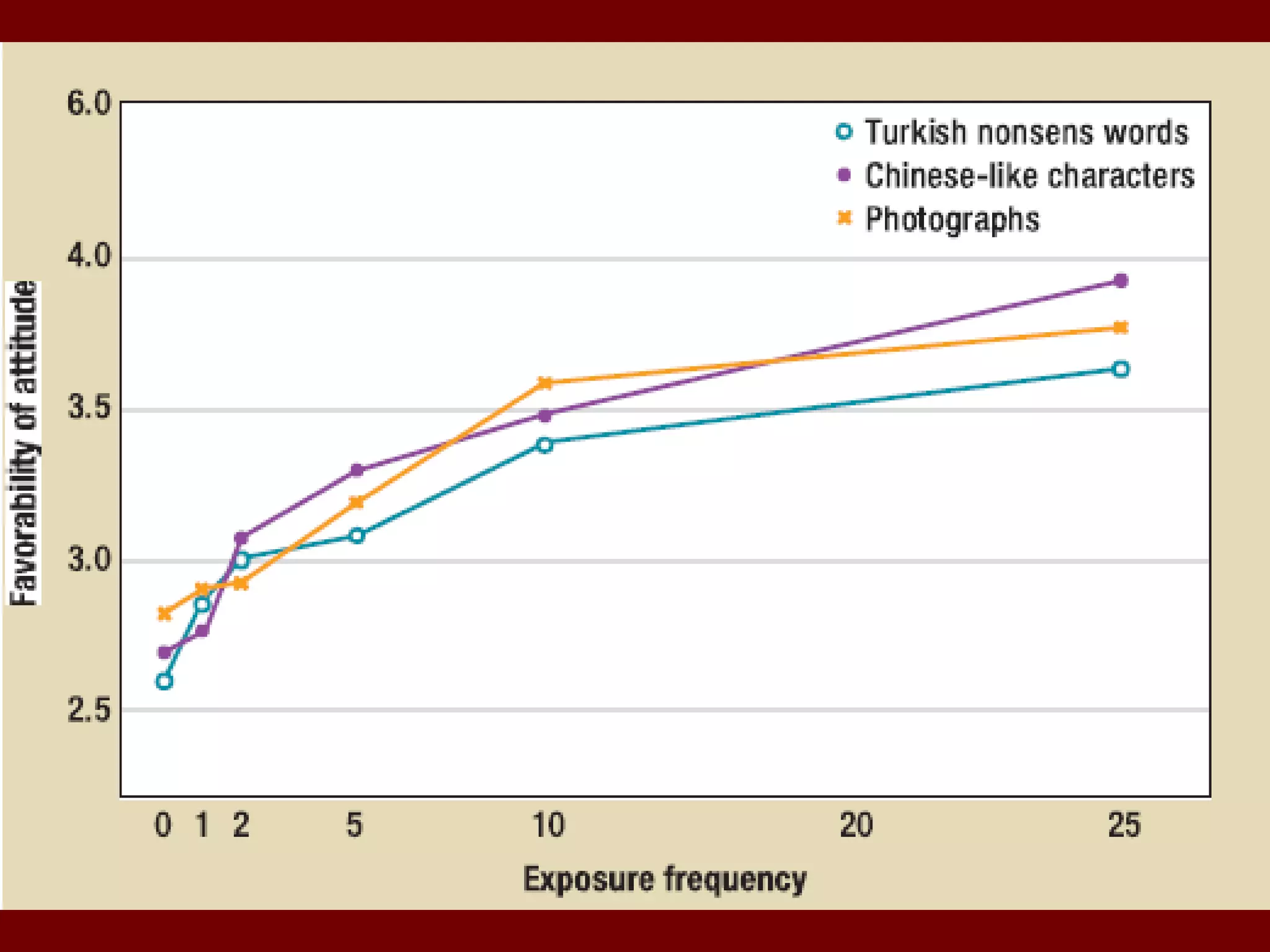
Mere-exposure effect Tendency for people to come to like things  simply because they see or encounter them repeatedly   Stimuli may be presented at subliminal level Exception - If you dislike something initially, repeated exposure will not change that attitude Zajonc (1968)
 
Classical conditioning A type of learning in which, through repeated pairings, a neutral stimulus comes to evoke a conditioned response. Can help in formation of both explicit and implicit attitudes.
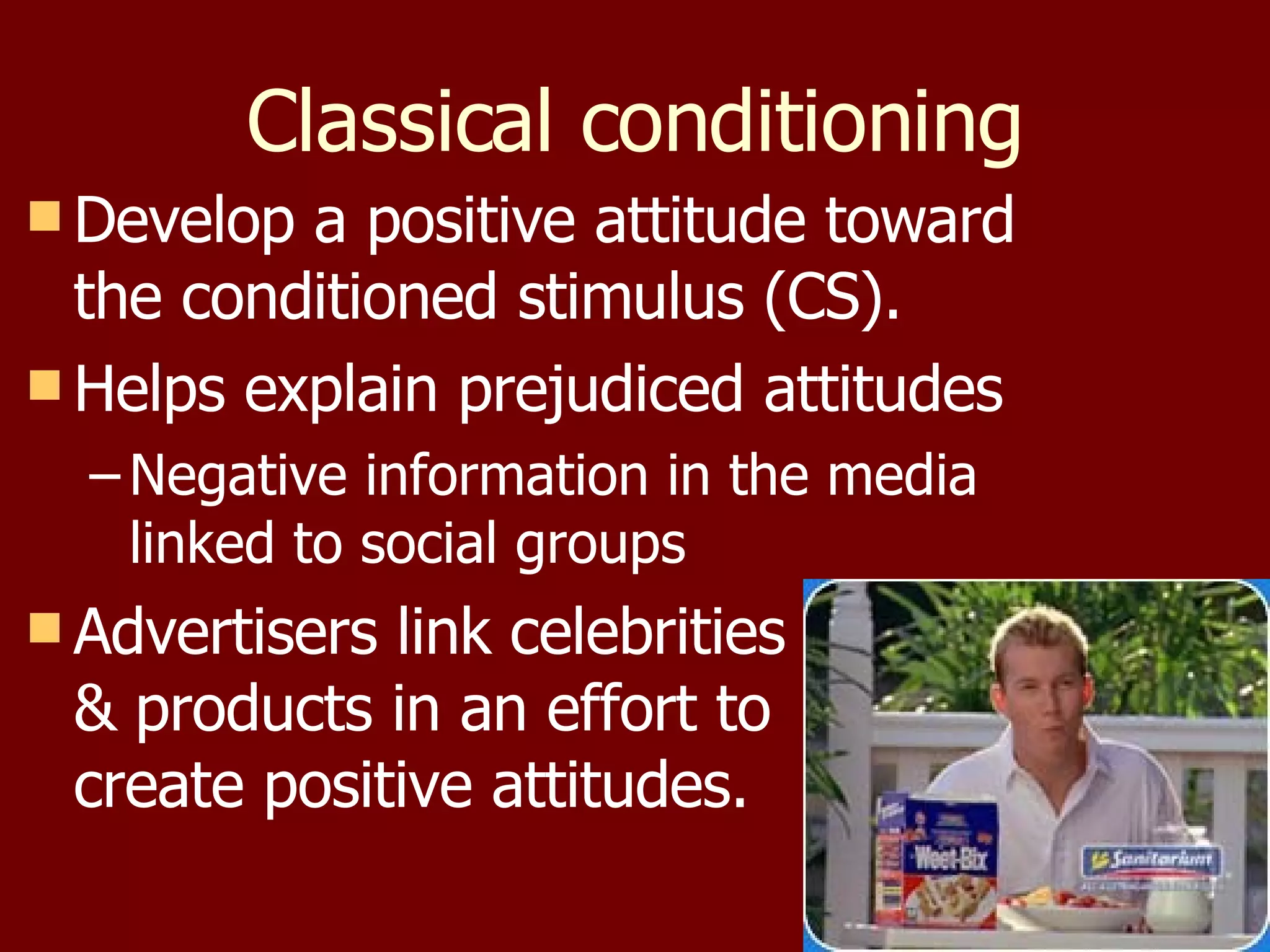
Classical conditioning Develop a positive attitude toward the conditioned stimulus (CS). Helps explain prejudiced attitudes Negative information in the media linked to social groups Advertisers link celebrities & products in an effort to create positive attitudes.
Operant conditioning A type of learning in which people are more likely to repeat behaviors that have been rewarded and less likely to repeat behaviors that have been punished. -> Development of a positive attitude toward the object/behaviour being reinforced.
Social learning People are more likely to imitate behaviors if they have seen others rewarded for performing them, and less likely to imitate behaviors if they have seen others punished for performing them. -> We learn which attitudes are acceptable through observation
Polarisation Attitudes tend to become more extreme as we think about them Especially true in strong initial attitude Evaluate evidence in a biased manner Accept evidence that confirms attitude Accept evidence from ingroup members
 
Consistency Commonalities in theories about consistency Specify conditions required for consistency and inconsistency Assume inconsistency is unpleasant Specify conditions required to restore consistency
Heider's balance theory A motivational theory of attitude change proposed by Fritz Heider P-O-X Theory Person – Other Person – Attitude Object Weigh effects of all potential results, and the one requiring the least amount of effort will be the likely outcome.
Balance Theory Individuals prefer balanced to unbalanced  Unbalanced – motivated to change
Critique of Balance Theory Assumes symmetry of relationships Doesn’t consider strength of relationships Only accommodates situations involving three elements
Cognitive Dissonance Theory Cognitive dissonance refers to unpleasant state when attitude and behavior are inconsistent Causes people to rationalise their behaviour and bring their attitude into line with actions Festinger & Carlson (1959)
Cognitive Dissonance Theory Effort Justification  (Aronson & Mills, 1959) People seek to justify and rationalize any suffering or effort they have made Greater choice is necessary for dissonance Dissonance is marked by unpleasant arousal
Cognitive Dissonance Theory While people have desire to be consistent in their own private mind, they have stronger desire to be viewed consistent by others Self-presentation plays a role in cognitive dissonance
Consistency Drive for consistency   Rooted in our biology Strengthened by learning and socialisation Consistency involves both automatic and conscious parts of the mind
Do Attitudes Really Predict Behaviour?
Attacking Attitudes A – B Problem Inconsistency between attitude (A) and behavior (B) Link between attitudes and behavior is weak
Defending Attitudes Predictions of behaviour based on attitudes is best when Attitude measures are very specific Behaviours are aggregated over time and situations Attitudes are consciously prominent and influence thought regarding the choice Attitudes come to mind easil y
Ch13 Social Influence & Persuasion
Social Influence efforts by an individual or group to change the attitudes,  behaviour or beliefs of others.
Social Influence Questions How can you get others to do what you want them to do? Would you obey an order that you disagreed with? Why do we often go along with the majority/group?
Influence and Persuasion 2 types of social influence Techniques Persuasion Resisting persuasion
Related Concepts Compliance  Conformity Norms Membership group vs. Reference group Prototypicality  Salience  Depersonalisation
Normative Social Influence Going along with the crowd to be liked Asch (1955): Conformity increases as group size increases Dissension reduces conformity Deviating from the group Social rejection
 
 
Informational Social Influence Going along with the crowd because you believe the crowd  knows more than you do . More likely when: Ambiguous situation Crisis situation
Two Types of Social Influence Normative influence  ->   public compliance Inner belief that the group is wrong Informational influence  ->   private acceptance Genuine inner belief that others are right
Referent informational influence (Turner, 1991) Based upon social identity theory. Look to in-group for relevant norms Influenced by in-group (not out-group) members – therefore conform with in-group members. One influence process rather than two.
Factors that influence conformity Friendship / Liking / Ingratiation Feelings of incompetence / insecurity Cultural bias towards conformity Need for individuation Group size (3 to 5 max) Unanimity (e.g., Allen & Levine, 1971)
Group cohesiveness Prior commitment to response Self-presentation Need for personal control Gender Factors that influence conformity
Some criticisms of conformity research ‘ Conformity bias’ - ignores role of minorities Asch’s studies can be interpreted as minority influence  (Moscovici & Faucheux, 1972)
Techniques  of Social Influence
Techniques of Social Influence Foot-in-the-Door Technique Start with small request -> build to  larger request Low-ball Technique Start with low-cost request -> later reveal the hidden costs Both based on principles of  commitment and consistency
Techniques of Social Influence Bait-and-Switch Technique Draw people in with an attractive offer that is not available and then switch to a less attractive offer that is available Based on principle of  commitment and consistency
Techniques of Social Influence Labeling Technique Label an individual and then make a request consistent with that label Based on  commitment and consistency Legitimisation-of-Paltry-Favours Technique “ Even a penny would help” Make a small amount acceptable
Techniques Based on Reciprocation Door-in-the-face Technique Start with an inflated request -> retreat to a smaller one that appears to be a concession Does not work if the first request is viewed as unreasonable Does not work if requests are made by different people
Techniques Based on Reciprocation That’s-Not-All Technique Begin with inflated request -> add to the deal by offering a bonus or discount
Techniques Based on  Scarcity Rare opportunities are more valuable than plentiful ones Scarcity heuristic in decision making Psychological reactance When personal freedoms are threatened, we experience this unpleasant emotional response
Techniques Based on Capturing  and Disrupting Attention Pique Technique Capture people’s attention by making a novel request Disrupt-Then-Reframe Technique Introduce an unexpected element that disrupts critical thinking -> reframe the message in a positive light
Minority Influence
Minority influence Numerical or power minority can disproportionately change/influence the attitudes/behaviour of the majority. 3 possible influence processes (Moscovici). In addition: Normalisation  – compromise leading to convergence. Innovation  – minority creates conflict in order to influence majority.
Models of minority influence Genetic model of minority influence  (Moscovici) Social conflict between minority & majority can bring changes in attitudes/behaviour of majority. People are motivated to avoid or resolve conflict. Amount of influence minority has depends on behavioural style.
Behavioral Style Factors Consistency among the minority ( e.g., Moscovici, Lage & Naffrechoux, 1969 – blue-green studies). Amount of investment. Autonomy. Rigidity / flexibility.
Majority face minority (confederates) on a colour perception task – have to decide if the colour of slides is blue or green. The minority either consistently or inconsistently called the blue slides ‘green’. More conformity when the minority was consistent versus inconsistent.
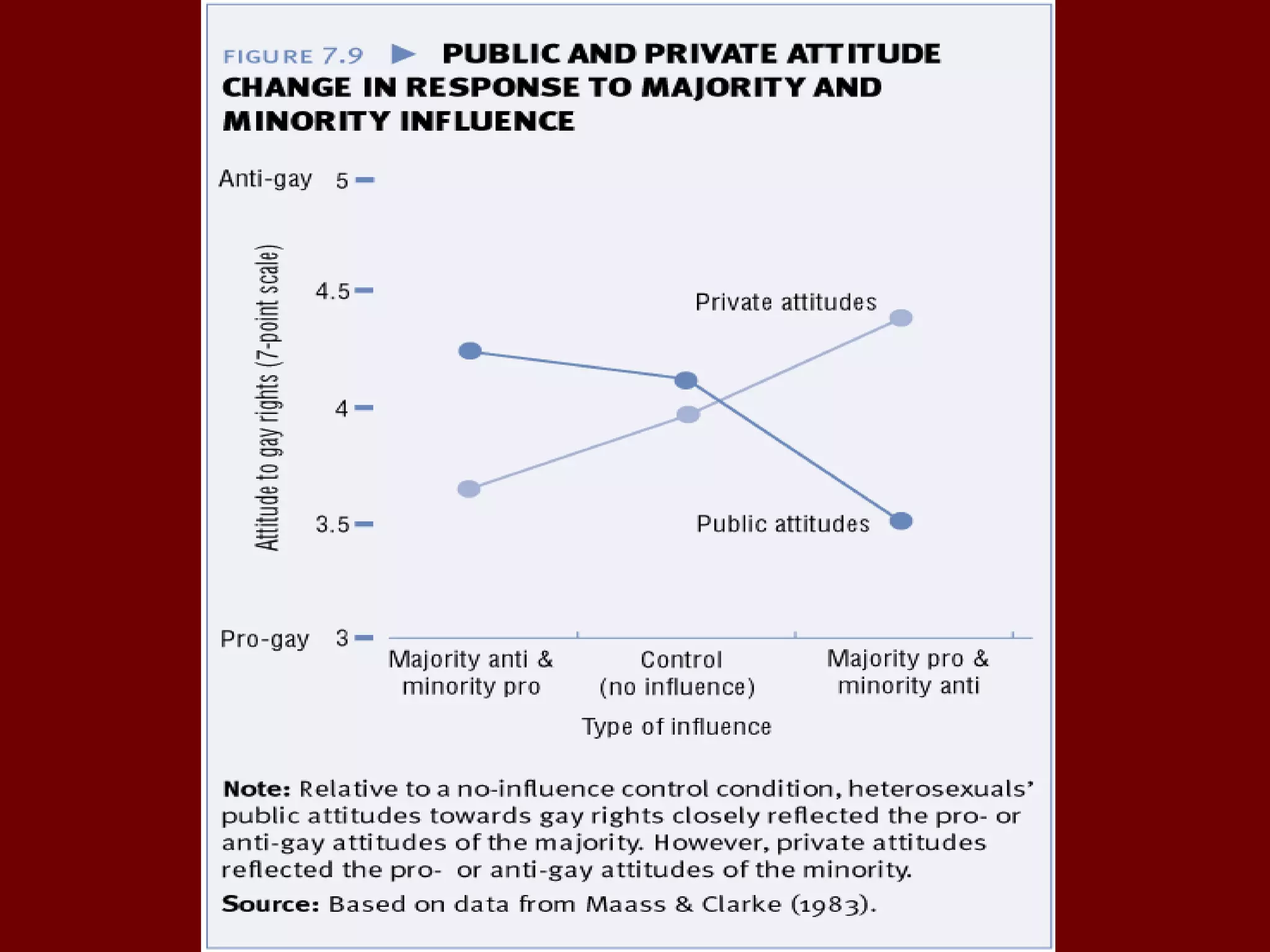
Conversion theory  (Moscovici, 1980) Distinction between minority conversion & majority compliance Majority influence -> public compliance Majority views accepted with little cognitive processing Minority influence -> private conversion Minority views produce deeper cognitive processing
 
Social impact theory  (Latane, 1981) Social influence depends upon  numbers, strength & immediacy  ( impact ). Generally majorities have more impact (influence) than minorities. Individual impact decreases as number of influencing persons increases. Unitary process of social influence.
Social Impact Theory
Persuasion
Persuasion Attempt to change a person’s mind Three components of persuasion Who –  Source of the message Say What –  Actual message To Whom –  Audience
Who: The Source Source credibility Expertise and trustworthiness Sleeper effect – over time, people separate the message from the messenger  Source likability Similarity and physical attractiveness
Say What: The Message Reason vs. Emotion People in a good mood – more responsive to persuasive messages Moderate fear appeals – most persuasive
Say What: The Message Stealing Thunder Revealing potentially incriminating evidence to negate its importance Source appears more honest and credible
Say What: The Message Repetition If neutral or positive response initially, repeated exposure = persuasive message Advertisement wear-out Repetition with variety
To Whom: The Audience Moderately intelligent are easiest to persuade High in need for cognition are more persuaded by strong arguments  Attitudes are more resistant to change High in public self-consciousness are more persuaded by name brand and styles
To Whom: The Audience Impressionable years  hypothesis Middle age people most resistant to persuasion Attitudes formed in young adulthood remain fairly stable over time Messages  consistent with cultural values  are more persuasive
To Whom: The Audience “ Overheard” messages  are more persuasive Product placements Distraction   Effective if the message is weak Less effective with a strong message
Two Routes to Persuasion Elaboration likelihood model Heuristic/systematic model Both propose  automatic and conscious processing  are involved in persuasion
Two Routes to Persuasion Central route Involves conscious processing Careful and thoughtful consideration Peripheral route Involves automatic processing Influenced by some simple cue
Elaboration Likelihood Model Motivation to process message Personal relevance Need for cognition Ability to process Distractions Knowledge
Elaboration Likelihood Model Type of cognitive processing Quality of the arguments Initial attitude Peripheral cues Speaker credibility  Reaction of others External rewards
Alpha and Omega Strategies Alpha strategies Persuade by increasing approach forces Omega strategies Persuade by decreasing avoidance forces When approach forces are greater than avoidance forces – movement toward goal
Alpha Strategies Make messages more persuasive Strong arguments that compel action Add  incentives Increase  source credibility Provide  consensus information
Omega Strategies Sidestep resistance Redefine  the relationship Depersonalize  the interaction Minimize  the request Use  comparison  that makes original offer look more attractive Push the choice into the future
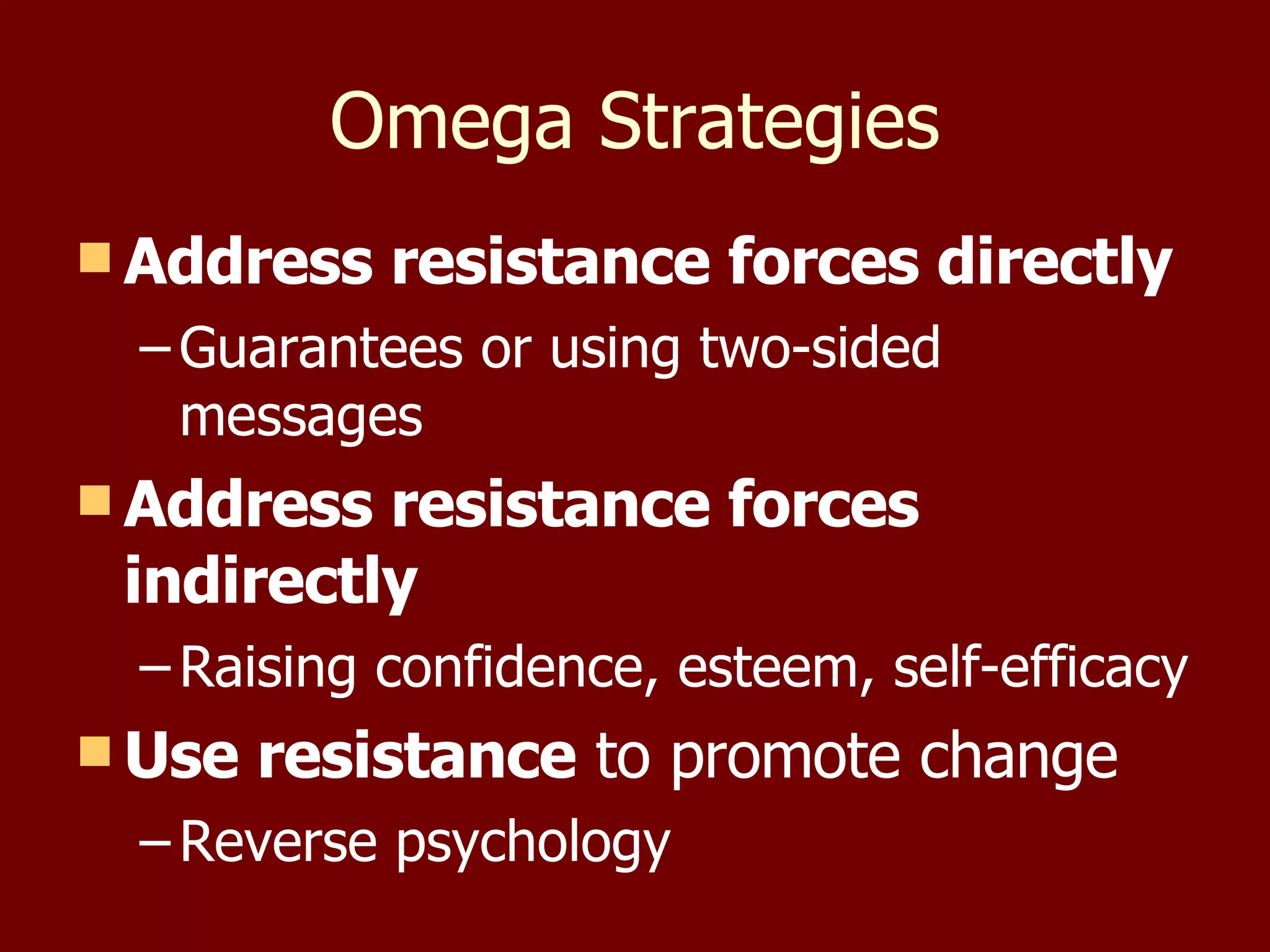
Omega Strategies Address resistance forces directly Guarantees or using two-sided messages Address resistance forces indirectly Raising confidence, esteem, self-efficacy Use resistance  to promote change Reverse psychology
Resisting Persuasion Attitude Inoculation When people resist persuasion, they become more confident in their initial attitudes Advance warning Less persuaded by it Boomerang effect Reduce cognitive energy Sleep deprivation and use of music
Defenses Against Techniques Commitment & Consistency Reexamine the sense of obligation Reciprocation Evaluate favors or concessions to avoid guilt over lack of reciprocity
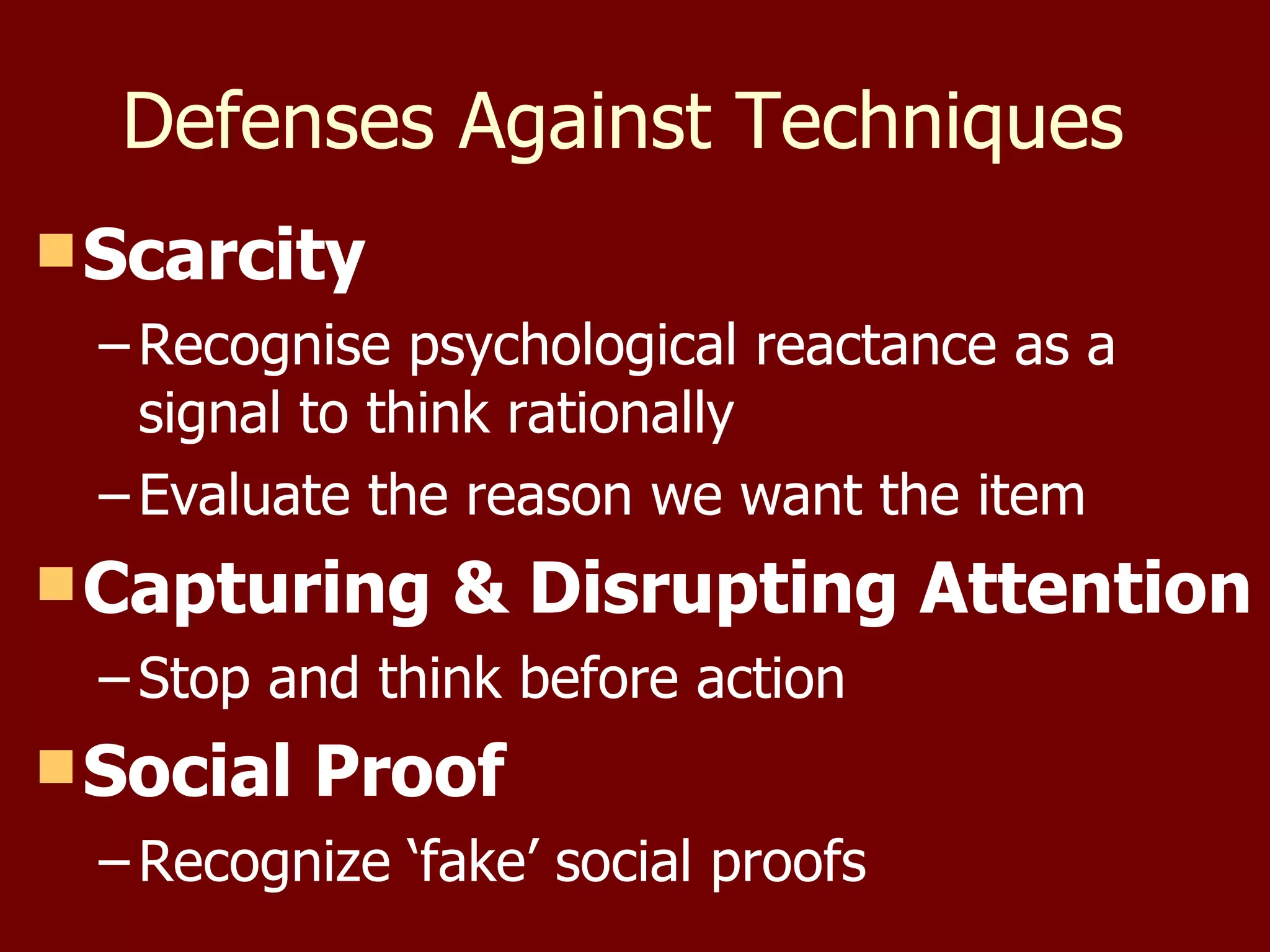
Defenses Against Techniques  Scarcity Recognise psychological reactance as a signal to think rationally Evaluate the reason we want the item Capturing & Disrupting Attention Stop and think before action Social Proof Recognize ‘fake’ social proofs
Conclusions Various tactics are used to gain compliance ‘ Ordinary’ people obey given the right circumstances Conformity - dual-process or single process?

Social Thinking

  • 1.
    Social Psychology SocialThinking 2008 Lecturer: James Neill
  • 2.
    Lecture Web Pagehttp://ucspace.canberra.edu.au/display/7125/Lecture+Social+Thinking Readings Ch05 Social Cognition Ch07 Attitudes, Beliefs, and Consistency Ch13 Social Influence and Persuasion
  • 3.
    Overview Social thinkingAttitudes Influence & persuasion
  • 4.
    Social Thinking = Social Cognition
  • 5.
    Part 1: Socialthinking overview Thinking Perception Attributions Heuristics, Errors and Biases
  • 6.
    Social thinking Socialpsychology was initially influenced by behaviourism . (1930’s-1950’s) By the 1970’s, cognitive psychology lead to greater investigation of social thinking and feeling .
  • 7.
  • 8.
    Social perception Refersto how people: form impressions of, & make inferences about other people.
  • 9.
    “ Whilst partof what we perceive comes through our senses from the object before us, another part (and it may be the larger part) always comes out of our own mind.” William James
  • 10.
    Social perception CommunicationVerbal and non-verbal Impression formation & management How do we form initial social impressions? e.g., social categories, stereotypes, schemas & scripts Attribution theory How we form integrated (deeper) social impressions based on observed behaviour?
  • 11.
    Duplex mind Automaticfast approximate best-guess effortless unconscious Conscious slow deliberate considered effortful conscious
  • 12.
    “ Cognitive Miser”Human brain consumes a relatively large proportion of human energy (compared to other animals). Even so, most of this energy is used unconsciously (because this is more efficient). Conscious energy is limited and needs to be spend wisely.
  • 13.
    Cognitive miser “There is ample evidence that when people’s capacity for thinking is already preoccupied, they take even more shortcuts to reduce further need for thought”
  • 14.
    Knowledge structures “Automatic thinking requires little effort because it relies on knowledge structures”, e.g., Schemas Scripts Stereotypes “ We reduce…complex and detailed realities to simple images that can be stored and recalled.”
  • 15.
    Schemas Stored andautomatically accessible information about a concept, its attributes, & its relationships to other concepts. From the Greek word "σχήμα" (skhēma), which means shape or more generally plan .
  • 16.
    Schemas: The goodEffective tool for understanding the world. Through use of schemata, most everyday situations do not require effortful thought.
  • 17.
    Schemas: The badInfluences & hampers uptake of new information ( proactive interference ), such as when situations are inconsistent with stereotypes.
  • 18.
  • 19.
    “ If awell-dressed businessman draws a knife on a Mexican, the schemata of onlookers often leads onlookers to 'remember' the Mexican pulling the knife.”
  • 20.
    Scripts Schemas aboutcertain events and roles, e.g., restaurant Frequency of exposure to a script determines the extent to which use of it becomes automatic.
  • 21.
    Priming Activating aconcept in the mind: Influences subsequent thinking May trigger automatic processes e.g., 1 st year medical students who begin to think they and other people they know are suffering from serious illness.
  • 22.
    Framing Context influencesinterpretation. Changing the frame can change and even reverse interpretation.
  • 23.
  • 24.
    Typical vs. unusualevents Events consistent with expectations, norms, schemas, scripts, etc. don’t tend to elicit the desire to explain . Unusual events motivate us to find explanatory causes for the behaviour in order to regain a sense of control and predictability.
  • 25.
  • 26.
    “ The causesof events always interest us more than the events themselves” - Cicero
  • 27.
    “ Happy ishe who has been able to perceive the causes of things” - Virgil
  • 28.
    Why do wemake attributions? Sense of cognitive control. To predict the future. To respond appropriately.
  • 29.
    Attribution Theory “…deals with how the social perceiver uses information to arrive at causal explanations for events”
  • 30.
    Theories of attributionHeider(1958): ‘Naïve Scientist’ Jones & Davis (1965): Correspondent Inference Theory Kelley (1967, 1973): Covariation Theory Weiner (1979, 1985): Internal / External + Stable / Unstable
  • 31.
    Attribution theory Heiderhypothesised that: People are naïve scientists who attempt to use rational processes to explain events.
  • 32.
    Attribution theory Peopleperceive behaviour as being caused . People give causal attributions (even to inanimate objects!). Both disposition & situation can cause behaviour.
  • 33.
    Attribution theory 4Causes of behaviour are seen as inside (internal) or outside (external) a person. Internal External Causes
  • 34.
    Attribution theory Wegenerally assume that people choose to behave the way they do, i.e., there is a tendency to make internal attributions .
  • 35.
  • 36.
    Internal attribution ‘Bob is a jerk!’ ‘ Bob is short-tempered!’ ‘ Bob likes to beat people up!’
  • 37.
    External attribution ‘Steve just told Bob that he is having an affair w/ Bob’s wife.’ ‘ Steve paid Bob $100 to give him a black eye.’ ‘ Bob tripped on a cord and accidentally hit Steve when he lost his balance.’
  • 38.
    Internal & externalattributions You were late for the lecture. Susan failed the test. You got drunk. A driver cuts in front of you. Geoff stole some money.
  • 39.
  • 40.
    Correspondent Inference Theory We tend to assume that: Observed behaviour and the intentions that produced it correspond to stable underlying qualities within the actor . Actors behave wilfully. (Jones & Davis 1965)
  • 41.
    What is goingon? How do you interpret this person's behaviour?
  • 42.
    Correspondent Inference Theory A correspondent inference (CI) is made when a behavior is believed to correspond to a person's internal beliefs.
  • 43.
    Correspondent Inference Theory We are likely to make a CI when we perceive that the behaviour: was freely chosen. was intended. had noncommon consequences. was low in social desirability.
  • 44.
    Correspondent Inference Theory We are likely to make an external attribution when we perceive that the behaviour: was not freely chosen. was unintended. had common consequences. was high in social desirability.
  • 45.
    Correspondence Bias Occurs when we make an internal attribution when there are external forces that could have caused the behavior. i.e., tendency to overestimate the role of internal factors & underestimate the role of external factors.
  • 46.
    Correspondence Bias “…the tendency to draw inferences about a person’s unique and enduring dispositions from behaviors that can be…explained by the situations in which they occur.”
  • 47.
    Correspondence Bias Alsoknown as: Fundamental Attribution Error Overattribution Effect
  • 48.
    Observer Behaviour ActorEnvironment Situation Behaviour Actor
  • 49.
    Fundamental Attribution ErrorTendency to attribute others’ behaviour to enduring dispositions (e.g., attitudes, personality traits) because of both: Underestimation of the influence of situational factors. Overestimation of the influence of dispositional factors.
  • 50.
    Fundamental Attribution ErrorFour possible explanations: Behavior is more noticeable than situational factors. Insignificant weight is assigned to situational factors. People are cognitive misers. Richer trait-like language to explain behavior.
  • 51.
    Fundamental Attribution ErrorGilbert’s (1989) two-stage theory:
  • 52.
    Spontaneous & DeliberativeAttributions: Example Observed Behaviour Person running out of a bank with crash helmet on, jumps on bike & rides away Spontaneous Because just robbed bank Deliberative Noticed traffic warden booking others. Bike on double yellow Lines – avoid ticket Cognitive effort low Cognitive effort high
  • 53.
    Cross-cultural Variations inAttributional Bias
  • 54.
    Cross-cultural Variations inAttributional Bias Interpretation: Americans far more likely to explain events in terms of traits than are Indians Indians far more likely to explain events in terms of context that are Americans Cultural differences increase with age Socialisation plays a role in attribution heuristics
  • 55.
  • 56.
    Kelley’s Covariation Model(1967, 1972) Attributions based on 3 kinds of info, which represent the degree to which: Consensus … other actors perform the same behavior with the same object. E.g., High Consensus - Everyone hits Steve
  • 57.
    Kelley’s Covariation Model(1967, 1972) Consistency …the actor performs that same behavior toward an object on different occasions . E.g., High Consistency - Bob always hits Steve
  • 58.
    Kelley’s Covariation Model(1967, 1972) Distinctiveness …the actor performs different behaviors with different targets. E.g., High Distinctiveness - Bob doesn’t hit anyone else; he only hits Steve
  • 59.
    Kelley’s Attribution Model:External High Consensus (Everyone hits Steve) High Consistency (Bob always hits Steve) High Distinctiveness (Bob only hits Steve)
  • 60.
    Kelley’s Attribution Model:Internal Low Consensus (Only Bob hits Steve) High Consistency (Bob always hits Steve) Low Distinctiveness (Bob hits everyone)
  • 61.
  • 62.
    Errors in AttributionDifficult to discern the cause of behaviour, therefore we use shortcuts or heuristics. This leads to errors and biases such as: Fundamental Attribution Error Actor-Observer Bias Self-serving Bias Ultimate Attribution Error False Consensus Effect
  • 63.
  • 64.
    Actor/Observer Bias “there is a pervasive tendency for actors to attribute their actions to situational requirements, whereas observers tend to attribute the same actions to stable personal dispositions”
  • 65.
    Actor/Observer Bias InformationalExplanation : We know more about own past behaviour and its variability across situations (availability heuristic) Perceptual Explanation : As an actor, one cannot see one’s self behaving, thus own behaviour is not salient & attention focused on situation Cultural Explanation : A socialised bias which is more true n Western cultures
  • 66.
  • 67.
    Self-serving bias Tendencyto attribute: Personal success  Internal Personal failure  External Other’s success  External Other’s failure  Internal
  • 68.
    Self-serving bias Takingcredit for success = Self-enhancing bias Denying responsibility for failure = Self-protecting bias
  • 69.
    Self-serving bias InternalExternal Failure External Internal Success Other Self
  • 70.
    Self-serving bias Motivational: Self-esteem maintenance. Social : Self-presentation and impression formation. Cultural : Effects are less prevalent in Eastern/Collectivistic cultures
  • 71.
  • 72.
    Ultimate Attribution ErrorFAE applied to in- and out- groups, i.e., Bias towards internal attributions for in-group success and external attributions for in-group failures Opposite for out-groups
  • 73.
    Attribution Summary Naïvescientists Cognitive misers Correspondent inference Fundamental Attribution error Actor-observer bias Self-serving bias Effects are not universal Heuristics, c ognitive biases & errors (textbook)
  • 74.
  • 75.
    Chapter 7 -Attitudes, Beliefs, and Consistency What Are Attitudes and Why Do People Have Them? How Attitudes Are Formed Consistency Do Attitudes Really Predict Behaviour? Beliefs and Believing
  • 76.
    Attitudes and BeliefsAttitudes Global evaluations (like or dislike) toward some object or issue Beliefs Information about something; facts or opinions
  • 77.
    Why People HaveAttitudes Help us deal with complex world Initial evaluations are immediate and unconscious Helpful in making choices
  • 78.
    Dual Attitudes Implicitattitude Automatic evaluative response Explicit attitude Conscious evaluative response Some attitudes are not shared with others We may not be aware of all our own attitudes
  • 79.
    Implicit Association Test(IAT) Measures implicit attitudes Those we are unwilling or unable to report Attitudes about stigma tised groups Easier pairings (faster) are interpreted as being more strongly in memory than more difficult pairings (slower).
  • 80.
    Mere-exposure effect Tendencyfor people to come to like things simply because they see or encounter them repeatedly Stimuli may be presented at subliminal level Exception - If you dislike something initially, repeated exposure will not change that attitude Zajonc (1968)
  • 81.
  • 82.
    Classical conditioning Atype of learning in which, through repeated pairings, a neutral stimulus comes to evoke a conditioned response. Can help in formation of both explicit and implicit attitudes.
  • 83.
    Classical conditioning Developa positive attitude toward the conditioned stimulus (CS). Helps explain prejudiced attitudes Negative information in the media linked to social groups Advertisers link celebrities & products in an effort to create positive attitudes.
  • 84.
    Operant conditioning Atype of learning in which people are more likely to repeat behaviors that have been rewarded and less likely to repeat behaviors that have been punished. -> Development of a positive attitude toward the object/behaviour being reinforced.
  • 85.
    Social learning Peopleare more likely to imitate behaviors if they have seen others rewarded for performing them, and less likely to imitate behaviors if they have seen others punished for performing them. -> We learn which attitudes are acceptable through observation
  • 86.
    Polarisation Attitudes tendto become more extreme as we think about them Especially true in strong initial attitude Evaluate evidence in a biased manner Accept evidence that confirms attitude Accept evidence from ingroup members
  • 87.
  • 88.
    Consistency Commonalities intheories about consistency Specify conditions required for consistency and inconsistency Assume inconsistency is unpleasant Specify conditions required to restore consistency
  • 89.
    Heider's balance theoryA motivational theory of attitude change proposed by Fritz Heider P-O-X Theory Person – Other Person – Attitude Object Weigh effects of all potential results, and the one requiring the least amount of effort will be the likely outcome.
  • 90.
    Balance Theory Individualsprefer balanced to unbalanced Unbalanced – motivated to change
  • 91.
    Critique of BalanceTheory Assumes symmetry of relationships Doesn’t consider strength of relationships Only accommodates situations involving three elements
  • 92.
    Cognitive Dissonance TheoryCognitive dissonance refers to unpleasant state when attitude and behavior are inconsistent Causes people to rationalise their behaviour and bring their attitude into line with actions Festinger & Carlson (1959)
  • 93.
    Cognitive Dissonance TheoryEffort Justification (Aronson & Mills, 1959) People seek to justify and rationalize any suffering or effort they have made Greater choice is necessary for dissonance Dissonance is marked by unpleasant arousal
  • 94.
    Cognitive Dissonance TheoryWhile people have desire to be consistent in their own private mind, they have stronger desire to be viewed consistent by others Self-presentation plays a role in cognitive dissonance
  • 95.
    Consistency Drive forconsistency Rooted in our biology Strengthened by learning and socialisation Consistency involves both automatic and conscious parts of the mind
  • 96.
    Do Attitudes ReallyPredict Behaviour?
  • 97.
    Attacking Attitudes A– B Problem Inconsistency between attitude (A) and behavior (B) Link between attitudes and behavior is weak
  • 98.
    Defending Attitudes Predictionsof behaviour based on attitudes is best when Attitude measures are very specific Behaviours are aggregated over time and situations Attitudes are consciously prominent and influence thought regarding the choice Attitudes come to mind easil y
  • 99.
  • 100.
    Social Influence effortsby an individual or group to change the attitudes, behaviour or beliefs of others.
  • 101.
    Social Influence QuestionsHow can you get others to do what you want them to do? Would you obey an order that you disagreed with? Why do we often go along with the majority/group?
  • 102.
    Influence and Persuasion2 types of social influence Techniques Persuasion Resisting persuasion
  • 103.
    Related Concepts Compliance Conformity Norms Membership group vs. Reference group Prototypicality Salience Depersonalisation
  • 104.
    Normative Social InfluenceGoing along with the crowd to be liked Asch (1955): Conformity increases as group size increases Dissension reduces conformity Deviating from the group Social rejection
  • 105.
  • 106.
  • 107.
    Informational Social InfluenceGoing along with the crowd because you believe the crowd knows more than you do . More likely when: Ambiguous situation Crisis situation
  • 108.
    Two Types ofSocial Influence Normative influence -> public compliance Inner belief that the group is wrong Informational influence -> private acceptance Genuine inner belief that others are right
  • 109.
    Referent informational influence(Turner, 1991) Based upon social identity theory. Look to in-group for relevant norms Influenced by in-group (not out-group) members – therefore conform with in-group members. One influence process rather than two.
  • 110.
    Factors that influenceconformity Friendship / Liking / Ingratiation Feelings of incompetence / insecurity Cultural bias towards conformity Need for individuation Group size (3 to 5 max) Unanimity (e.g., Allen & Levine, 1971)
  • 111.
    Group cohesiveness Priorcommitment to response Self-presentation Need for personal control Gender Factors that influence conformity
  • 112.
    Some criticisms ofconformity research ‘ Conformity bias’ - ignores role of minorities Asch’s studies can be interpreted as minority influence (Moscovici & Faucheux, 1972)
  • 113.
    Techniques ofSocial Influence
  • 114.
    Techniques of SocialInfluence Foot-in-the-Door Technique Start with small request -> build to larger request Low-ball Technique Start with low-cost request -> later reveal the hidden costs Both based on principles of commitment and consistency
  • 115.
    Techniques of SocialInfluence Bait-and-Switch Technique Draw people in with an attractive offer that is not available and then switch to a less attractive offer that is available Based on principle of commitment and consistency
  • 116.
    Techniques of SocialInfluence Labeling Technique Label an individual and then make a request consistent with that label Based on commitment and consistency Legitimisation-of-Paltry-Favours Technique “ Even a penny would help” Make a small amount acceptable
  • 117.
    Techniques Based onReciprocation Door-in-the-face Technique Start with an inflated request -> retreat to a smaller one that appears to be a concession Does not work if the first request is viewed as unreasonable Does not work if requests are made by different people
  • 118.
    Techniques Based onReciprocation That’s-Not-All Technique Begin with inflated request -> add to the deal by offering a bonus or discount
  • 119.
    Techniques Based on Scarcity Rare opportunities are more valuable than plentiful ones Scarcity heuristic in decision making Psychological reactance When personal freedoms are threatened, we experience this unpleasant emotional response
  • 120.
    Techniques Based onCapturing and Disrupting Attention Pique Technique Capture people’s attention by making a novel request Disrupt-Then-Reframe Technique Introduce an unexpected element that disrupts critical thinking -> reframe the message in a positive light
  • 121.
  • 122.
    Minority influence Numericalor power minority can disproportionately change/influence the attitudes/behaviour of the majority. 3 possible influence processes (Moscovici). In addition: Normalisation – compromise leading to convergence. Innovation – minority creates conflict in order to influence majority.
  • 123.
    Models of minorityinfluence Genetic model of minority influence (Moscovici) Social conflict between minority & majority can bring changes in attitudes/behaviour of majority. People are motivated to avoid or resolve conflict. Amount of influence minority has depends on behavioural style.
  • 124.
    Behavioral Style FactorsConsistency among the minority ( e.g., Moscovici, Lage & Naffrechoux, 1969 – blue-green studies). Amount of investment. Autonomy. Rigidity / flexibility.
  • 125.
    Majority face minority(confederates) on a colour perception task – have to decide if the colour of slides is blue or green. The minority either consistently or inconsistently called the blue slides ‘green’. More conformity when the minority was consistent versus inconsistent.
  • 126.
    Conversion theory (Moscovici, 1980) Distinction between minority conversion & majority compliance Majority influence -> public compliance Majority views accepted with little cognitive processing Minority influence -> private conversion Minority views produce deeper cognitive processing
  • 127.
  • 128.
    Social impact theory (Latane, 1981) Social influence depends upon numbers, strength & immediacy ( impact ). Generally majorities have more impact (influence) than minorities. Individual impact decreases as number of influencing persons increases. Unitary process of social influence.
  • 129.
  • 130.
  • 131.
    Persuasion Attempt tochange a person’s mind Three components of persuasion Who – Source of the message Say What – Actual message To Whom – Audience
  • 132.
    Who: The SourceSource credibility Expertise and trustworthiness Sleeper effect – over time, people separate the message from the messenger Source likability Similarity and physical attractiveness
  • 133.
    Say What: TheMessage Reason vs. Emotion People in a good mood – more responsive to persuasive messages Moderate fear appeals – most persuasive
  • 134.
    Say What: TheMessage Stealing Thunder Revealing potentially incriminating evidence to negate its importance Source appears more honest and credible
  • 135.
    Say What: TheMessage Repetition If neutral or positive response initially, repeated exposure = persuasive message Advertisement wear-out Repetition with variety
  • 136.
    To Whom: TheAudience Moderately intelligent are easiest to persuade High in need for cognition are more persuaded by strong arguments Attitudes are more resistant to change High in public self-consciousness are more persuaded by name brand and styles
  • 137.
    To Whom: TheAudience Impressionable years hypothesis Middle age people most resistant to persuasion Attitudes formed in young adulthood remain fairly stable over time Messages consistent with cultural values are more persuasive
  • 138.
    To Whom: TheAudience “ Overheard” messages are more persuasive Product placements Distraction Effective if the message is weak Less effective with a strong message
  • 139.
    Two Routes toPersuasion Elaboration likelihood model Heuristic/systematic model Both propose automatic and conscious processing are involved in persuasion
  • 140.
    Two Routes toPersuasion Central route Involves conscious processing Careful and thoughtful consideration Peripheral route Involves automatic processing Influenced by some simple cue
  • 141.
    Elaboration Likelihood ModelMotivation to process message Personal relevance Need for cognition Ability to process Distractions Knowledge
  • 142.
    Elaboration Likelihood ModelType of cognitive processing Quality of the arguments Initial attitude Peripheral cues Speaker credibility Reaction of others External rewards
  • 143.
    Alpha and OmegaStrategies Alpha strategies Persuade by increasing approach forces Omega strategies Persuade by decreasing avoidance forces When approach forces are greater than avoidance forces – movement toward goal
  • 144.
    Alpha Strategies Makemessages more persuasive Strong arguments that compel action Add incentives Increase source credibility Provide consensus information
  • 145.
    Omega Strategies Sidestepresistance Redefine the relationship Depersonalize the interaction Minimize the request Use comparison that makes original offer look more attractive Push the choice into the future
  • 146.
    Omega Strategies Addressresistance forces directly Guarantees or using two-sided messages Address resistance forces indirectly Raising confidence, esteem, self-efficacy Use resistance to promote change Reverse psychology
  • 147.
    Resisting Persuasion AttitudeInoculation When people resist persuasion, they become more confident in their initial attitudes Advance warning Less persuaded by it Boomerang effect Reduce cognitive energy Sleep deprivation and use of music
  • 148.
    Defenses Against TechniquesCommitment & Consistency Reexamine the sense of obligation Reciprocation Evaluate favors or concessions to avoid guilt over lack of reciprocity
  • 149.
    Defenses Against Techniques Scarcity Recognise psychological reactance as a signal to think rationally Evaluate the reason we want the item Capturing & Disrupting Attention Stop and think before action Social Proof Recognize ‘fake’ social proofs
  • 150.
    Conclusions Various tacticsare used to gain compliance ‘ Ordinary’ people obey given the right circumstances Conformity - dual-process or single process?

Editor's Notes

  • #2 The aim of this lecture is to introduce and discuss theories and research about social thinking, including social perception, attributions, and social behaviour. Image source: Unknown