Conformity and Obedience
Chapter VI
Learning outline:
What is conformity?
What are the classic conformity and
obedience studies?
What predicts conformity?
Why conform?
Who conforms?
Do we ever want to be different?
What is Conformity?
 A change in behavior or belief as the result of
real or imagined group pressure.
Varieties of Conformity

(Neil et al.,2000)
1. Compliance
2. Obedience
3. Acceptance
Compliance
 Conformity that
involves publicly
acting in accord with
an implied or explicit
request while
privately
disagreeing.
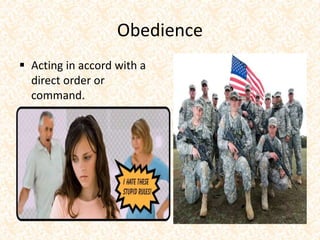
Obedience
 Acting in accord with a
direct order or
command.
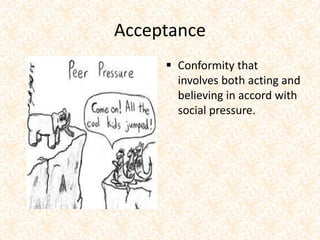
Acceptance
 Conformity that
involves both acting and
believing in accord with
social pressure.
Classic Conformity and Obedience
studies
1. Sherif’s Studies of Norm Formation
2. Asch’s Studies of Group Pressure
3. Milgram’s Obedience Experiments
Sherif’s Studies of Norm Formation
 Participants in Sherif’s darkened-room
autokinetic experiments faced an ambiguous
reality.
Sherif’s Studies of Norm Formation
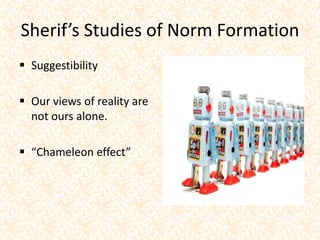
 Suggestibility
 Our views of reality are
not ours alone.
 “Chameleon effect”
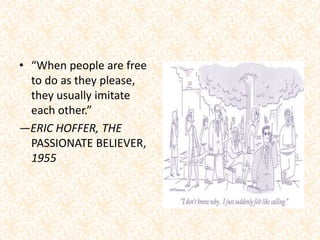
• “When people are free
to do as they please,
they usually imitate
each other.”
—ERIC HOFFER, THE
PASSIONATE BELIEVER,
1955
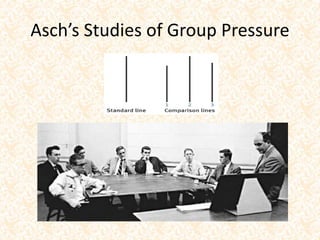
Asch’s Studies of Group Pressure
 Epistemological dilemma: “What is true? Is it
what my peers tell me or what my eyes tell
me?”
 Ethical note: Professional ethics usually dictate
explaining the experiment.
Milgram’s Obedience Experiments
 Milgram’s (1965, 1974) experiments tested
what happens when the demands of authority
clash with the demands of conscience.
 These have become social psychology’s most
famous and controversial experiments.
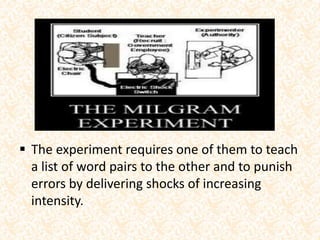
 The experiment requires one of them to teach
a list of word pairs to the other and to punish
errors by delivering shocks of increasing
intensity.
What Breeds Obedience?
Four factors that determined obedience were:
1.The victim’s emotional distance,
2. The authority’s closeness and legitimacy,
3. Whether or not the authority was part of a
respected institution,
4. The liberating effects of a disobedient
fellow participant.
Imagine you had the power to prevent either a
tsunami that would kill 25,000 people on the
planet’s other side, a crash that would kill 250
people at your local airport, or a car accident
that would kill a close friend. Which would you
prevent?
Victim’s distance
 When the victim was
remote and the
“teachers” heard no
complaints, nearly all
obeyed calmly to the
end.
 “Distance negates
responsibility.”
—GUY DAVENPORT
CLOSENESS AND LEGITIMACY OF THE
AUTHORITY
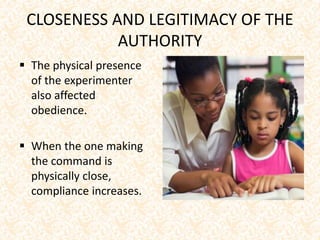
 The physical presence
of the experimenter
also affected
obedience.
 When the one making
the command is
physically close,
compliance increases.
INSTITUTIONAL AUTHORITY
• In everyday life, too,
authorities backed by
institutions wield social
power.
THE LIBERATING EFFECTS OF GROUP
INFLUENCE
• Perhaps you can recall a time you felt
justifiably angry at an unfair teacher but you
hesitated to object. Then one or two other
students spoke up about the unfair practices,
and you followed their example, which had a
liberating effect.
BEHAVIOR AND ATTITUDES
 Attitudes fail to determine behavior when
external influences override inner convictions.
 When responding alone, Asch’s participants
nearly always gave the correct answer.
 It was another matter when they stood alone
against a group.
 The most terrible evil evolves from a sequence
of small evils.
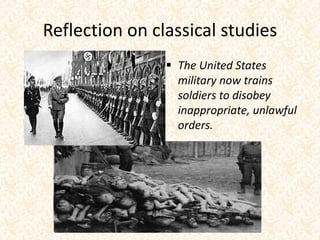
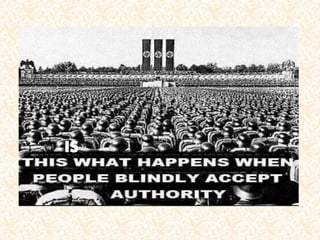
Reflection on classical studies
 The United States
military now trains
soldiers to disobey
inappropriate, unlawful
orders.
Ervin Stuab (2003)
 “Human beings have the capacity to come to
experience killing other people as nothing
extraordinary”.
 But humans also have a capacity for heroism.
THE POWER
OF THE SITUATION
Imagine violating some minor norms:
1. Standing up in the middle of a class;
2. Singing out loud in a restaurant
3. Playing golf in a suit.
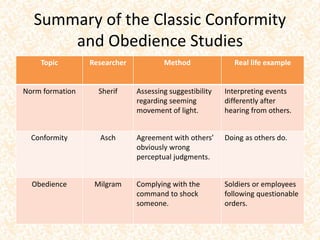
Summary of the Classic Conformity
and Obedience Studies
Topic Researcher Method Real life example
Norm formation Sherif Assessing suggestibility
regarding seeming
movement of light.
Interpreting events
differently after
hearing from others.
Conformity Asch Agreement with others’
obviously wrong
perceptual judgments.
Doing as others do.
Obedience Milgram Complying with the
command to shock
someone.
Soldiers or employees
following questionable
orders.
Next….
WHAT’S PREDICTS CONFORMITY?
1. Group size
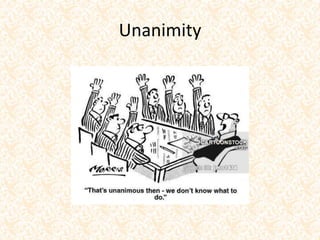
2. Unanimity
3. Cohesion
4. Status
5. Public Response
6. Prior Commitment
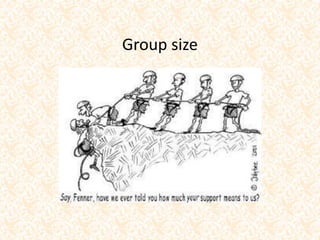
Group size
Unanimity
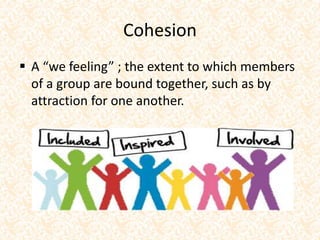
Cohesion
 A “we feeling” ; the extent to which members
of a group are bound together, such as by
attraction for one another.
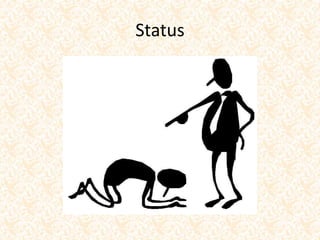
Status
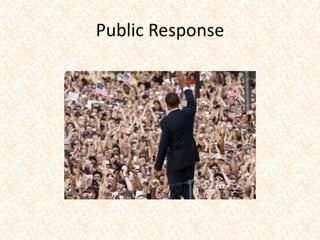
Public Response
Prior Commitment
 Once they commit themselves to a
position, people seldom yield to social
pressure
WHY CONFORM?
Normative influence
 Conformity based on a person’s desire to fulfill
others’ expectations, often to gain
acceptance.
 It is “going along with the crowd”
 It will lead to compliance especially for people
who have recently seen others ridiculed, or
who are seeking to climb a status ladder.
Informational Influence
 Conformity occurring when people accept
evidence about reality provided by other
people.
 It leads people to privately accept others’
influence.
WHO CONFORMS?
Personality
 Personality scores were poor predictors of
individuals’ behavior.
 It also predicts behavior better when social
influences are weak.
Culture
Social Roles
 Social roles allow some freedom of
interpretation to those who act theme out,
but some aspects of any role must be
performed.
 Roles have powerful effects. As you
internalize the role, self-consciousness
subsided. What felt awkward now feels
genuine.
DO WE EVER WANT TO BE
DIFFERENT?
Reactance
 A motive to protect or restore one’s sense of
freedom. Reactance arises when someone
threatens our freedom of actions.
 The theory of psychological reactance– that
people act to protect their sense of freedom–
is supported by experiments showing that
attempts to restrict a person’s freedom often
produce an anti-conformity “boomerang
effect”.
Asserting Uniqueness
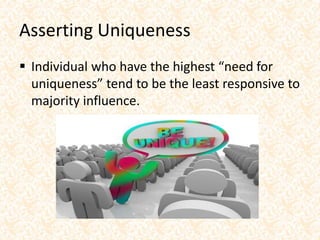
 Individual who have the highest “need for
uniqueness” tend to be the least responsive to
majority influence.
END!!!!!!!!

Conformity and Obedience

  • 1.
  • 2.
    Learning outline: What isconformity? What are the classic conformity and obedience studies? What predicts conformity? Why conform? Who conforms? Do we ever want to be different?
  • 3.
    What is Conformity? A change in behavior or belief as the result of real or imagined group pressure.
  • 5.
    Varieties of Conformity (Neilet al.,2000) 1. Compliance 2. Obedience 3. Acceptance
  • 6.
    Compliance  Conformity that involvespublicly acting in accord with an implied or explicit request while privately disagreeing.
  • 7.
    Obedience  Acting inaccord with a direct order or command.
  • 8.
    Acceptance  Conformity that involvesboth acting and believing in accord with social pressure.
  • 9.
    Classic Conformity andObedience studies 1. Sherif’s Studies of Norm Formation 2. Asch’s Studies of Group Pressure 3. Milgram’s Obedience Experiments
  • 10.
    Sherif’s Studies ofNorm Formation  Participants in Sherif’s darkened-room autokinetic experiments faced an ambiguous reality.
  • 11.
    Sherif’s Studies ofNorm Formation  Suggestibility  Our views of reality are not ours alone.  “Chameleon effect”
  • 12.
    • “When peopleare free to do as they please, they usually imitate each other.” —ERIC HOFFER, THE PASSIONATE BELIEVER, 1955
  • 13.
    Asch’s Studies ofGroup Pressure
  • 14.
    Asch’s Studies ofGroup Pressure  Epistemological dilemma: “What is true? Is it what my peers tell me or what my eyes tell me?”  Ethical note: Professional ethics usually dictate explaining the experiment.
  • 15.
    Milgram’s Obedience Experiments Milgram’s (1965, 1974) experiments tested what happens when the demands of authority clash with the demands of conscience.  These have become social psychology’s most famous and controversial experiments.
  • 16.
     The experimentrequires one of them to teach a list of word pairs to the other and to punish errors by delivering shocks of increasing intensity.
  • 17.
    What Breeds Obedience? Fourfactors that determined obedience were: 1.The victim’s emotional distance, 2. The authority’s closeness and legitimacy, 3. Whether or not the authority was part of a respected institution, 4. The liberating effects of a disobedient fellow participant.
  • 18.
    Imagine you hadthe power to prevent either a tsunami that would kill 25,000 people on the planet’s other side, a crash that would kill 250 people at your local airport, or a car accident that would kill a close friend. Which would you prevent?
  • 19.
    Victim’s distance  Whenthe victim was remote and the “teachers” heard no complaints, nearly all obeyed calmly to the end.  “Distance negates responsibility.” —GUY DAVENPORT
  • 20.
    CLOSENESS AND LEGITIMACYOF THE AUTHORITY  The physical presence of the experimenter also affected obedience.  When the one making the command is physically close, compliance increases.
  • 21.
    INSTITUTIONAL AUTHORITY • Ineveryday life, too, authorities backed by institutions wield social power.
  • 22.
    THE LIBERATING EFFECTSOF GROUP INFLUENCE • Perhaps you can recall a time you felt justifiably angry at an unfair teacher but you hesitated to object. Then one or two other students spoke up about the unfair practices, and you followed their example, which had a liberating effect.
  • 23.
    BEHAVIOR AND ATTITUDES Attitudes fail to determine behavior when external influences override inner convictions.  When responding alone, Asch’s participants nearly always gave the correct answer.  It was another matter when they stood alone against a group.
  • 24.
     The mostterrible evil evolves from a sequence of small evils.
  • 25.
    Reflection on classicalstudies  The United States military now trains soldiers to disobey inappropriate, unlawful orders.
  • 27.
    Ervin Stuab (2003) “Human beings have the capacity to come to experience killing other people as nothing extraordinary”.  But humans also have a capacity for heroism.
  • 28.
    THE POWER OF THESITUATION Imagine violating some minor norms: 1. Standing up in the middle of a class; 2. Singing out loud in a restaurant 3. Playing golf in a suit.
  • 29.
    Summary of theClassic Conformity and Obedience Studies Topic Researcher Method Real life example Norm formation Sherif Assessing suggestibility regarding seeming movement of light. Interpreting events differently after hearing from others. Conformity Asch Agreement with others’ obviously wrong perceptual judgments. Doing as others do. Obedience Milgram Complying with the command to shock someone. Soldiers or employees following questionable orders.
  • 30.
  • 31.
    WHAT’S PREDICTS CONFORMITY? 1.Group size 2. Unanimity 3. Cohesion 4. Status 5. Public Response 6. Prior Commitment
  • 32.
  • 33.
  • 34.
    Cohesion  A “wefeeling” ; the extent to which members of a group are bound together, such as by attraction for one another.
  • 35.
  • 36.
  • 37.
    Prior Commitment  Oncethey commit themselves to a position, people seldom yield to social pressure
  • 38.
  • 39.
    Normative influence  Conformitybased on a person’s desire to fulfill others’ expectations, often to gain acceptance.  It is “going along with the crowd”  It will lead to compliance especially for people who have recently seen others ridiculed, or who are seeking to climb a status ladder.
  • 40.
    Informational Influence  Conformityoccurring when people accept evidence about reality provided by other people.  It leads people to privately accept others’ influence.
  • 41.
  • 42.
    Personality  Personality scoreswere poor predictors of individuals’ behavior.  It also predicts behavior better when social influences are weak.
  • 43.
  • 44.
    Social Roles  Socialroles allow some freedom of interpretation to those who act theme out, but some aspects of any role must be performed.  Roles have powerful effects. As you internalize the role, self-consciousness subsided. What felt awkward now feels genuine.
  • 45.
    DO WE EVERWANT TO BE DIFFERENT?
  • 46.
    Reactance  A motiveto protect or restore one’s sense of freedom. Reactance arises when someone threatens our freedom of actions.  The theory of psychological reactance– that people act to protect their sense of freedom– is supported by experiments showing that attempts to restrict a person’s freedom often produce an anti-conformity “boomerang effect”.
  • 47.
    Asserting Uniqueness  Individualwho have the highest “need for uniqueness” tend to be the least responsive to majority influence.
  • 48.