LEARNING,
PERCEPTION, AND
ATTRIBUTION
LEARNING
◈ Acquiring a complex set of sophisticated skills is a result of change that
comes from learning. An understanding of how people learn is very
important because it will help people explain and predict behavior.
◈ Learning may be defined as a relatively permanent change in behavior
or knowledge due to experience.
◈ When a person behaves differently from what he previously did, it can
be said that there is change in the person’s behavior.
WHAT IS LEARNING
◈ A change in behavior happens due to any or both of the following:
1. Learning; or
2. Other causes such as drugs, injury, disease and maturation.**
◈ Behavioral change starts with the mind when it accepts new
knowledge. Sometimes, the mind “orders” the body to show some
signs of behavior that is different from the previous one. Sometimes the
mind is just plain contented with the new knowledge and do not make
attempts to “order” the body to show some outward manifestations of
behavior change.**
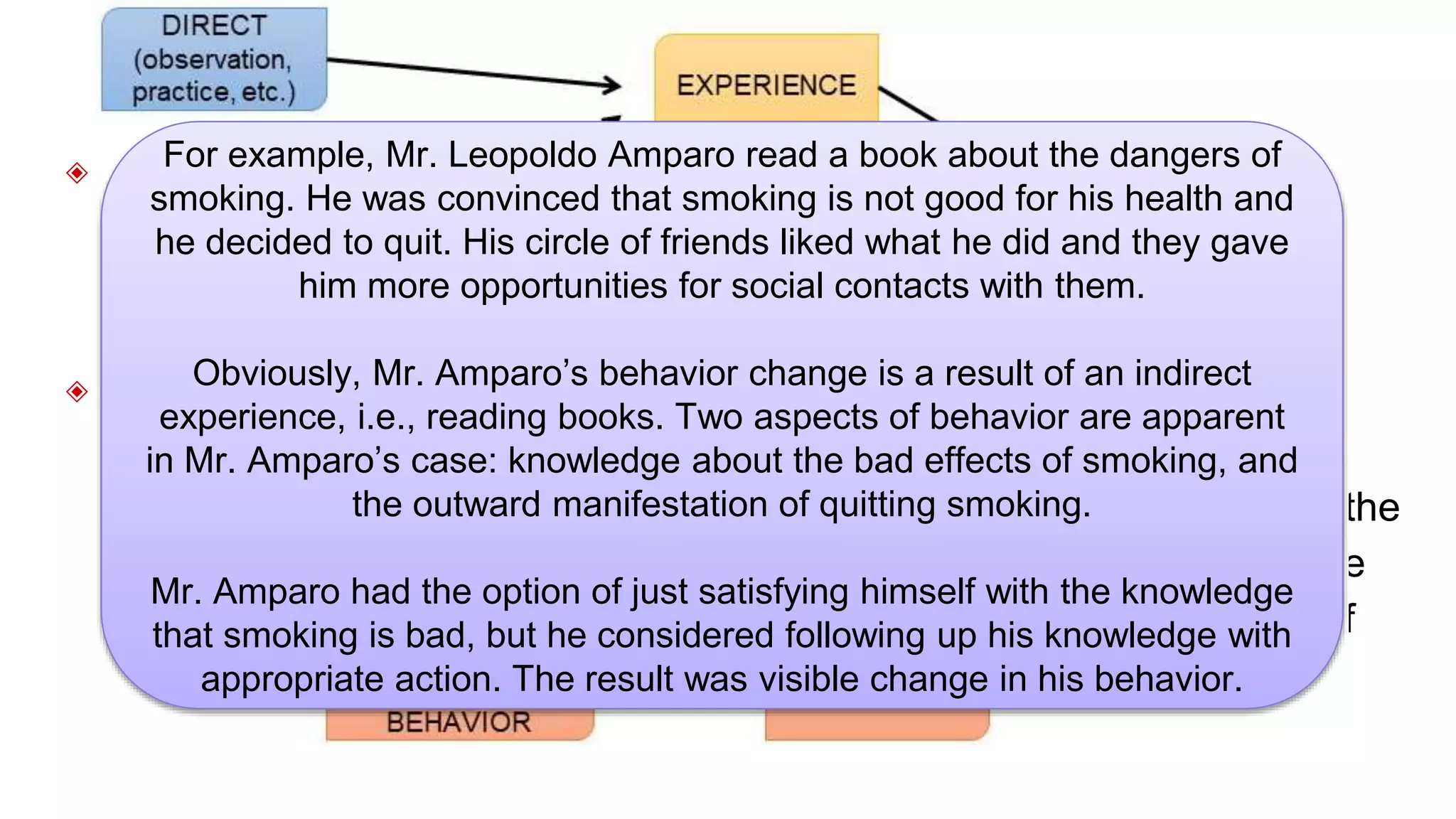
For example, Mr. Leopoldo Amparo read a book about the dangers of
smoking. He was convinced that smoking is not good for his health and
he decided to quit. His circle of friends liked what he did and they gave
him more opportunities for social contacts with them.
Obviously, Mr. Amparo’s behavior change is a result of an indirect
experience, i.e., reading books. Two aspects of behavior are apparent
in Mr. Amparo’s case: knowledge about the bad effects of smoking, and
the outward manifestation of quitting smoking.
Mr. Amparo had the option of just satisfying himself with the knowledge
that smoking is bad, but he considered following up his knowledge with
appropriate action. The result was visible change in his behavior.
THEORIES OF LEARNING
◈ Eminent researchers have developed theories that help explain the
learning process. These theories consist of classical conditioning,
operant conditioning and social learning.
◈ Classical conditioning may be defined as “a type of learning in which a
stimulus acquires the capacity to evoke a response that was originally
evoked by another stimulus.**
1. Classical Conditioning
Example of classical conditioning:
It was one Monday morning in a typical factory when
Mr. Honesto Lumauig was called by the manager to
the office and he was asked why his last week’s
output was very low. All throughout the interview,
Mr. Lumauig felt nervous and very uncomfortable.
Seven days later, and it was Monday morning again
and Honesto begins to felt nervous and
uncomfortable. He can hardly concentrate on his
job.
2. Operant Conditioning
◈ Operant conditioning may be defined as “a type of learning where
people learn to repeat behaviors that bring them pleasurable outcomes
and to avoid behaviors that lead to uncomfortable outcomes.
◈ For instance, if an employee receives cash rewards every time he
exceed his assigned targets, it is very likely that he will repeat such
behavior.
◈ Social learning may be defined as “the process of serving the behavior
of others, recognizing its consequences, and altering behavior as a
result. One of the ways by which people learn is through social
contacts with other people.**
3. Social Learning
Example of Social learning:
An employee pays much attention to his boss, a
highly successful person, whenever he speaks or
just plain moving around the office. The brief
encounters with the boss gave the employee the
opportunity to understand and apply some ideas
shared by the superior. For example is watching the
boss perform the right way to communicate with
customers.
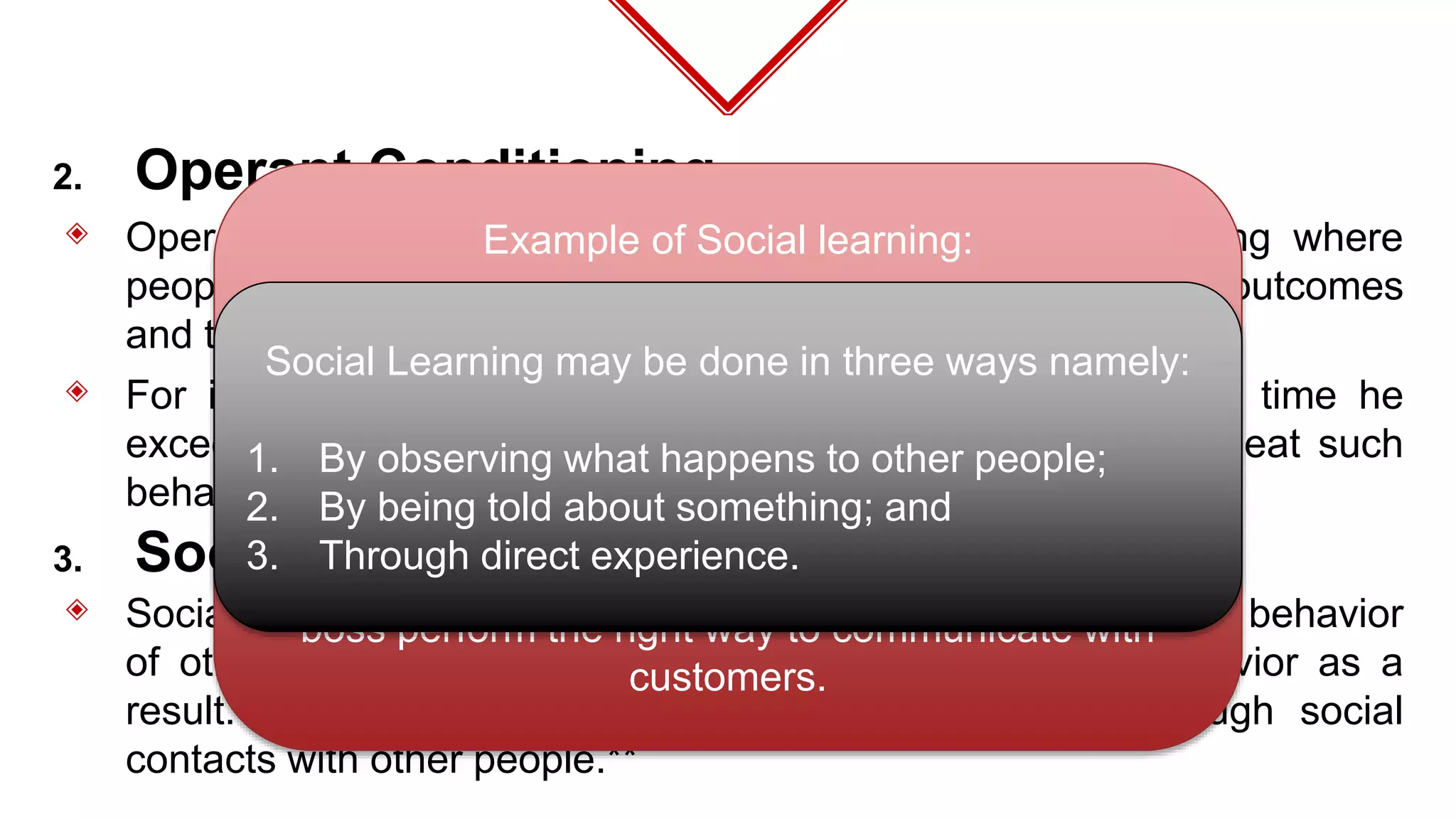
Social Learning may be done in three ways namely:
1. By observing what happens to other people;
2. By being told about something; and
3. Through direct experience.
Factors Influencing Perception
PERCEPTION
◈ Perception may be defined as “the process by which people select,
organize, interpret, retrieve, and respond to information from their
environment.**
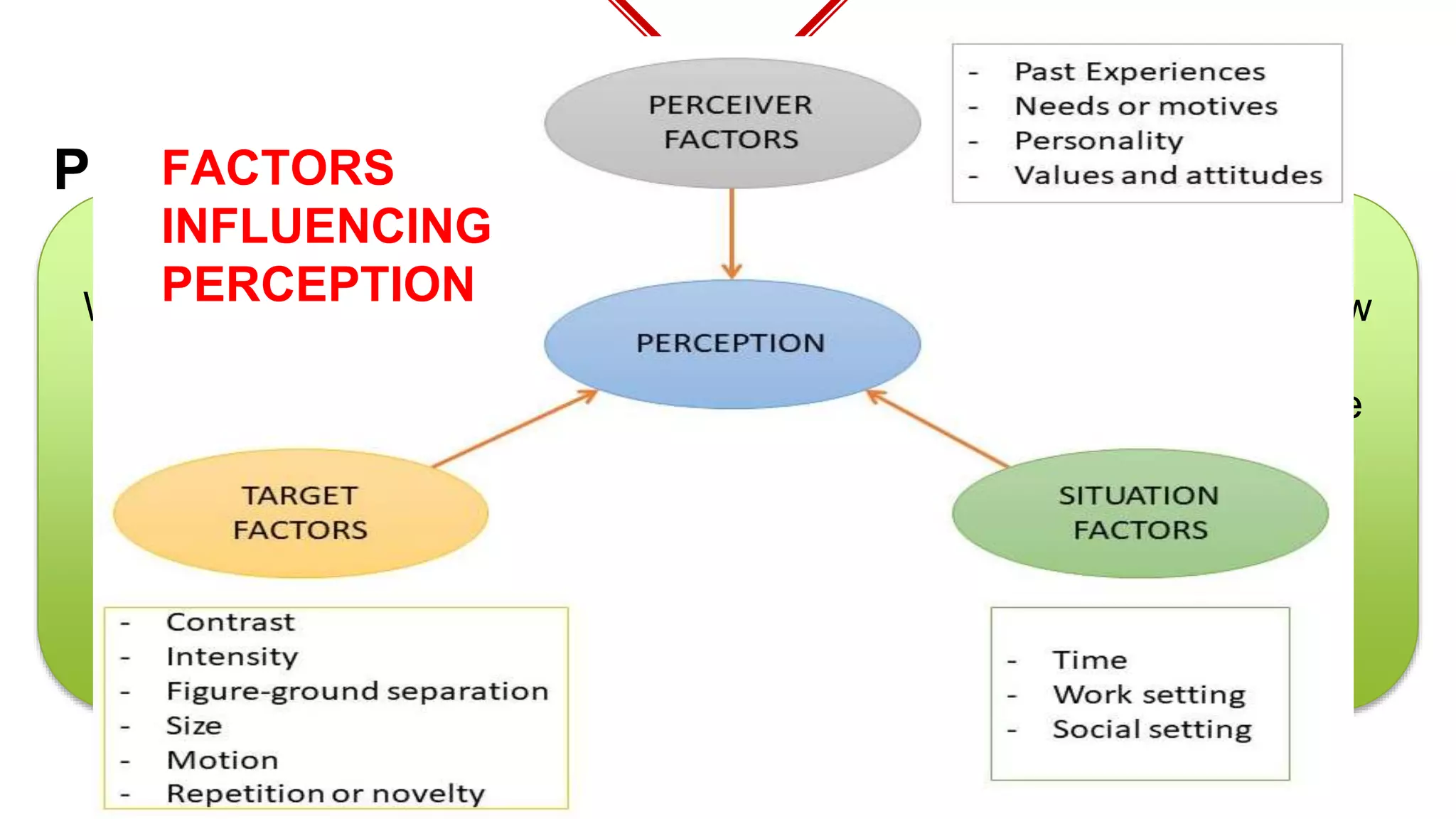
◈ Perception is influenced by the characteristics of the following:
1. The perceiver
2. The target
3. The situation**
When an accident happened in the workplace, two persons actually saw
it. Later, when both were asked to provide details about the accident,
their statements differ in several aspects. How may this discrepancy be
explained?
THE ANSWER IS: DIFFERENT PERCEPTIONS OF THE SAME
EVENT.
THE PROCESS OF PERCEPTION
FACTORS
INFLUENCING
PERCEPTION
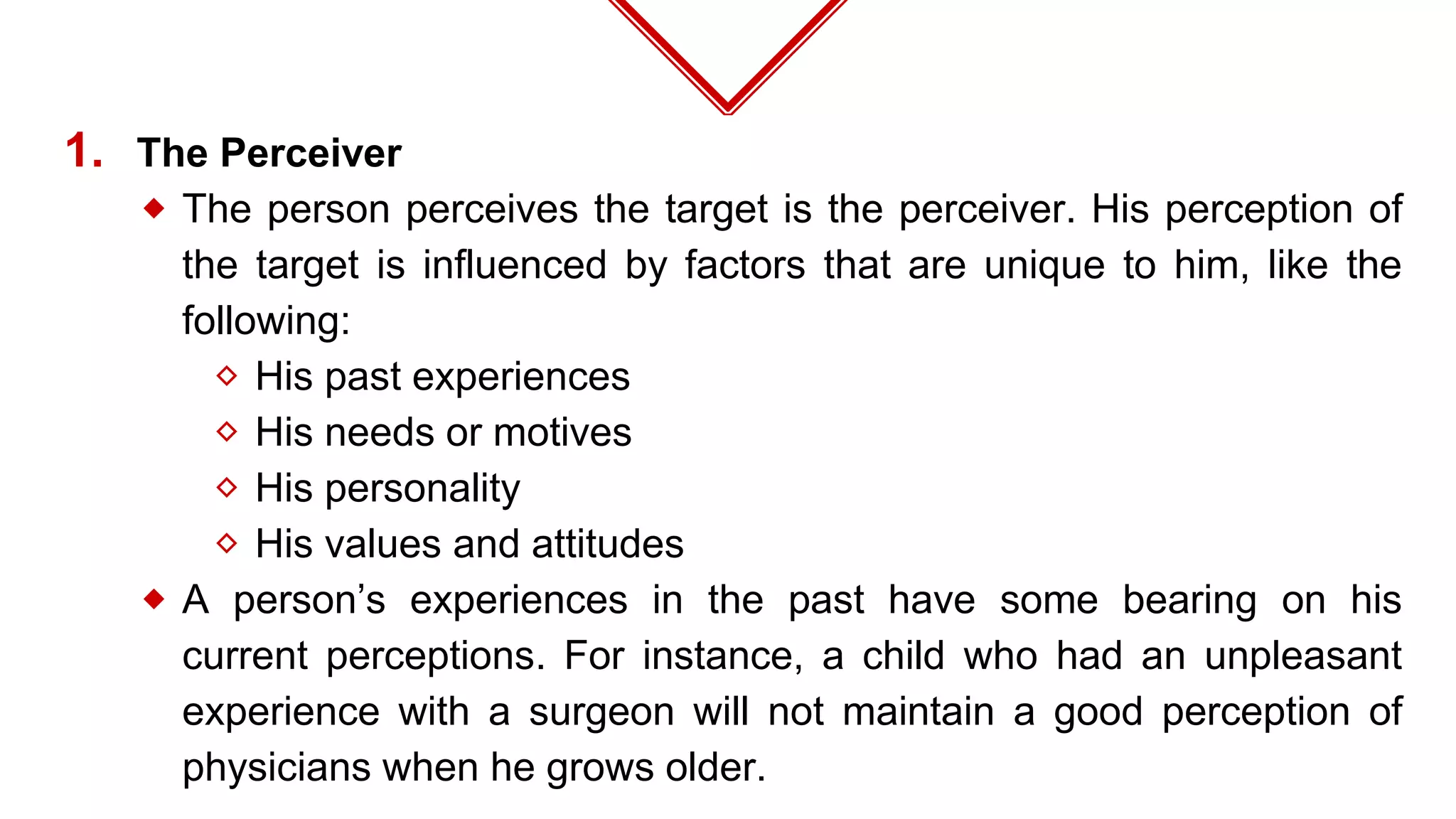
1. The Perceiver
⬥ The person perceives the target is the perceiver. His perception of
the target is influenced by factors that are unique to him, like the
following:
⬦ His past experiences
⬦ His needs or motives
⬦ His personality
⬦ His values and attitudes
⬥ A person’s experiences in the past have some bearing on his
current perceptions. For instance, a child who had an unpleasant
experience with a surgeon will not maintain a good perception of
physicians when he grows older.
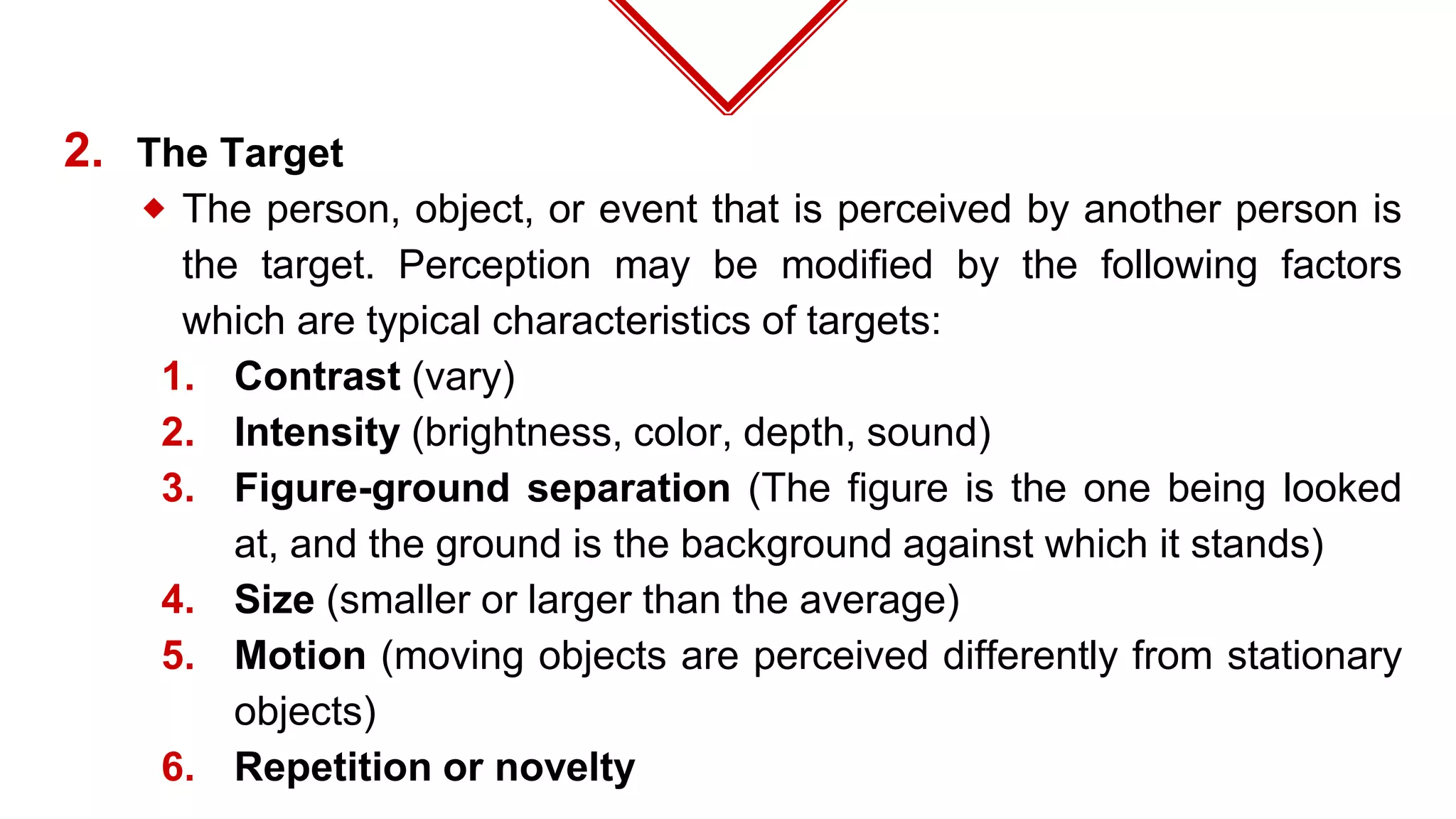
2. The Target
⬥ The person, object, or event that is perceived by another person is
the target. Perception may be modified by the following factors
which are typical characteristics of targets:
1. Contrast (vary)
2. Intensity (brightness, color, depth, sound)
3. Figure-ground separation (The figure is the one being looked
at, and the ground is the background against which it stands)
4. Size (smaller or larger than the average)
5. Motion (moving objects are perceived differently from stationary
objects)
6. Repetition or novelty
3. The Situation
⬥ The perception is also affected by the surrounding environment.**
The situational factors that affect perception are: time, work setting,
and social setting.
⬥ As people’s moods vary from time to time, perception also varies
depending on the time the perception is made.
⬥ Workplaces differ from one another. As such, perception also differs
from workplace to workplace.**
⬥ The social setting is also a factor in perception.**
Example of perception affected by surroundings:
For example, a person who is enjoying a meal with
tribal people in the hinterlands may be well
received even if he uses his bare hands. He will be
perceived differently when he does the same in the
dining halls of the privileged class in the city.
Example of perception affected by workplaces:
For example, the playing of soft music may be
perceived favorably in a certain workplace but
differently regarded in another workplace.
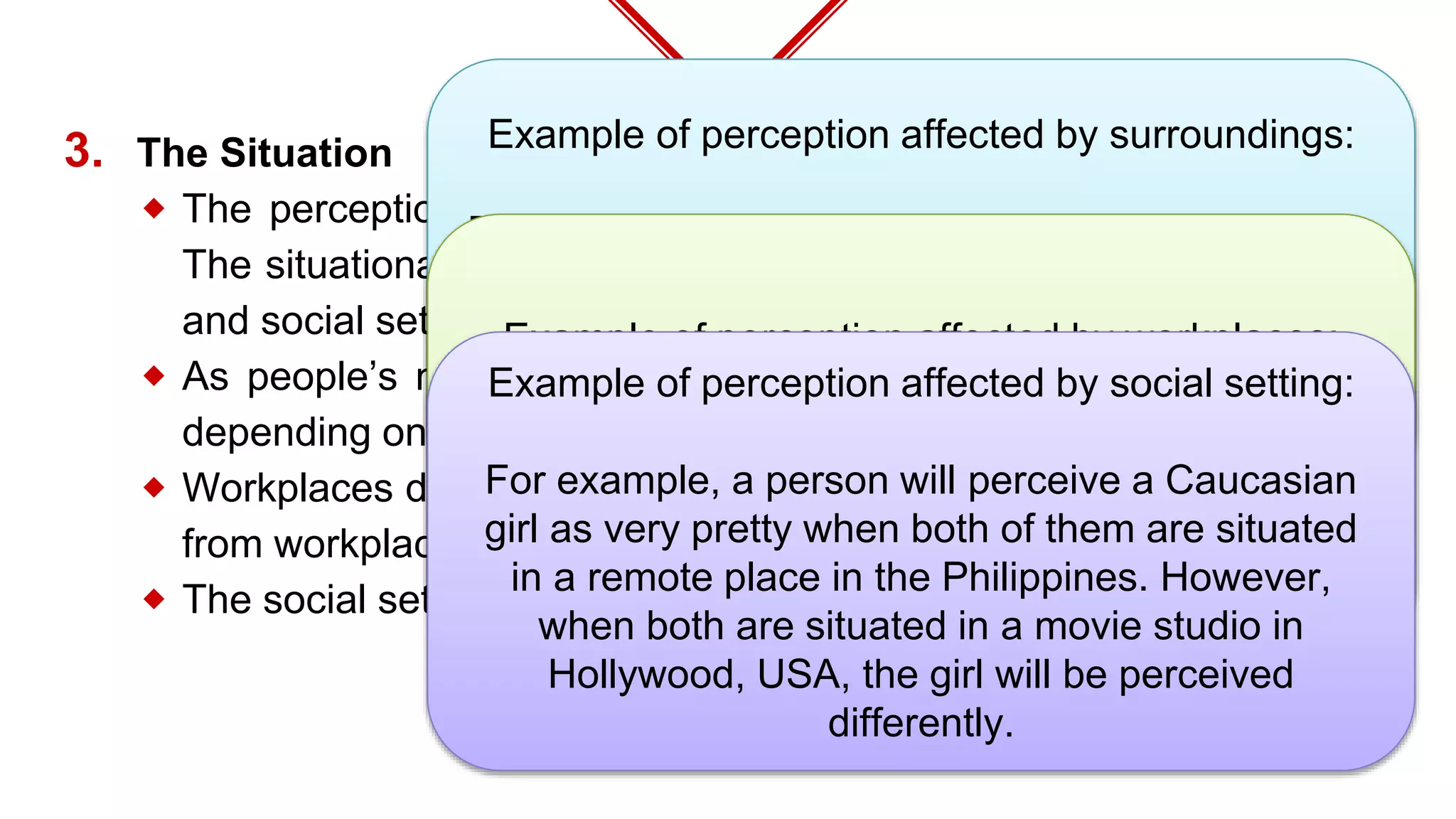
Example of perception affected by social setting:
For example, a person will perceive a Caucasian
girl as very pretty when both of them are situated
in a remote place in the Philippines. However,
when both are situated in a movie studio in
Hollywood, USA, the girl will be perceived
differently.
Common Attribution Errors
ATTRIBUTION
◈ Attribution Theory is the process by which people ascribe
causes to the behavior they perceive.**
◈ When people make attempts to determine the causes of
other people’s behavior, errors commonly happen. These
errors may be classified into the following types:
1. The fundamental attribution errors; and
2. The self-serving bias.
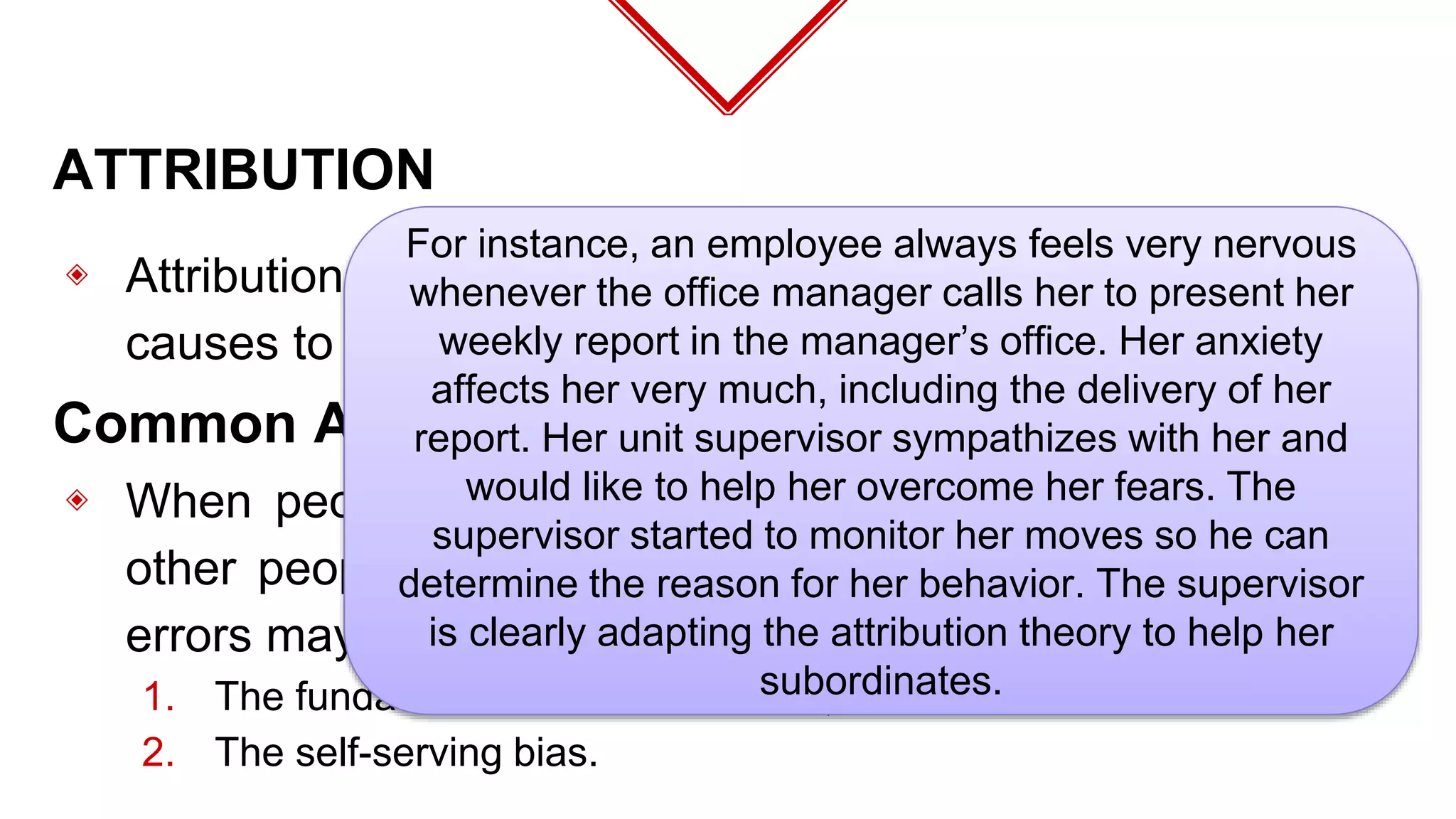
For instance, an employee always feels very nervous
whenever the office manager calls her to present her
weekly report in the manager’s office. Her anxiety
affects her very much, including the delivery of her
report. Her unit supervisor sympathizes with her and
would like to help her overcome her fears. The
supervisor started to monitor her moves so he can
determine the reason for her behavior. The supervisor
is clearly adapting the attribution theory to help her
subordinates.
1. Fundamental attribution errors – refer to the tendency to
underestimate the influence of external factors and overestimate
the influence of internal or personal factors in the behavior of
others.**
2. Self-serving bias – is that type of attribution error whereby people
tend to attribute their achievements to their good inner qualities,
whereas they attribute their failures to adverse factors within the
environment.**
For instance, the area manager of a retailing firm
blames one of the store managers for failing to
attract a sufficient number of customers rather
than the poor location of the store.
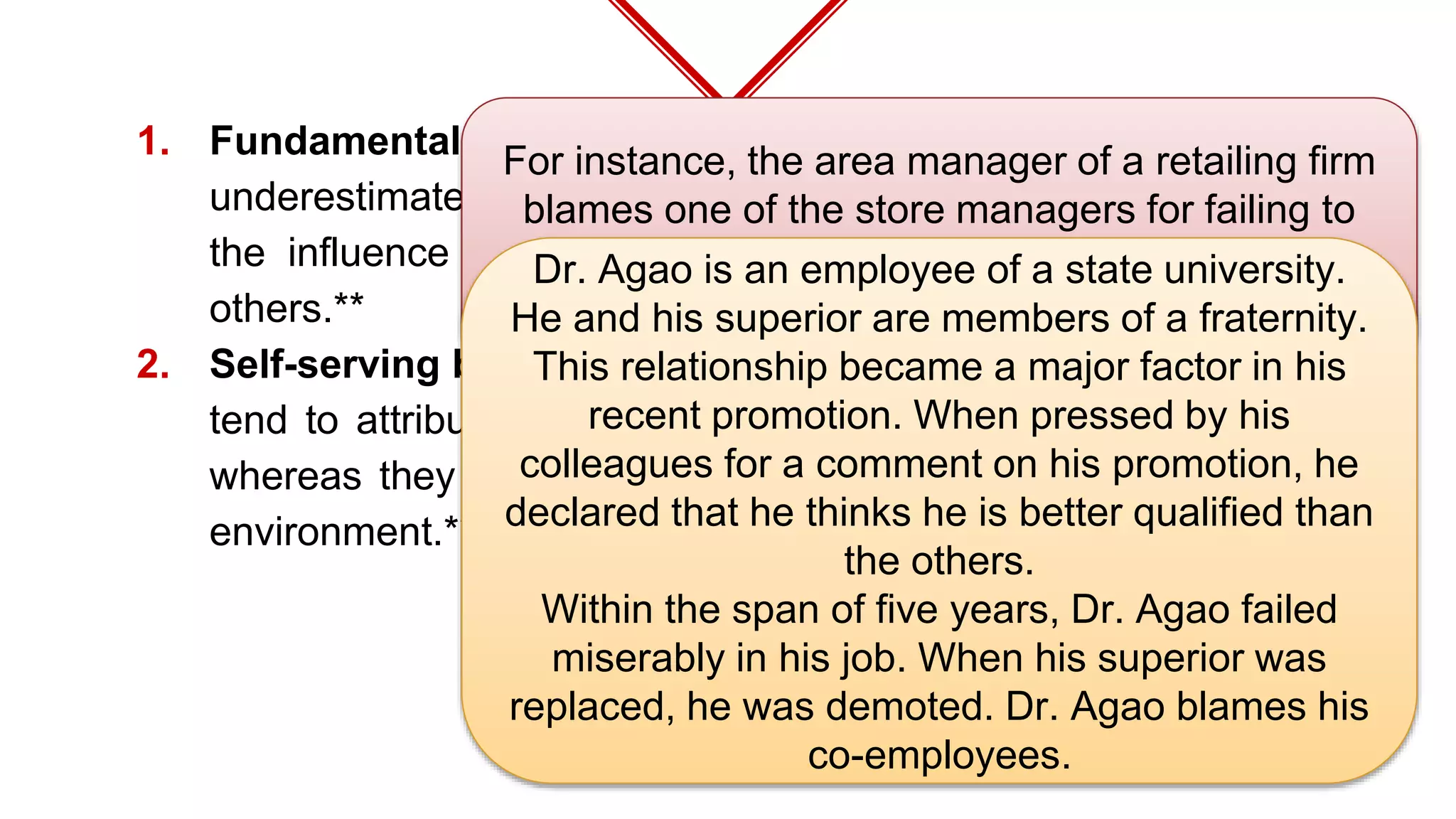
Dr. Agao is an employee of a state university.
He and his superior are members of a fraternity.
This relationship became a major factor in his
recent promotion. When pressed by his
colleagues for a comment on his promotion, he
declared that he thinks he is better qualified than
the others.
Within the span of five years, Dr. Agao failed
miserably in his job. When his superior was
replaced, he was demoted. Dr. Agao blames his
co-employees.
Factors that Influence Attribution
1. Distinctiveness – refers to the consideration given to how consistent
a person’s behavior is across different situations.**
2. Consensus – this refers to the likelihood that all those facing the
same situation will have similar responses.**
3. Consistency - this refers to the measure of whether an individual
responds the same way across time.**
Mr. Nick Cargada was recently hired by the university as driver. When he was
asked to deliver a letter to someone in a nearby barangay, he used the
school’s motorcycle. Along the way, he hit a stray dog.
The next day, he was ordered to fetch five professors who attended a seminar
in a nearby town. This time, he used the school’s newly purchased van. On the
way back, he hit a carabao resting on the right side of the road.
On the third day, he was directed to transport 50 student athletes to participate
in a competition at a nearby province. The university bus was filled to capacity
when he started driving. The bus was not yet ten kilometers from the university
when it bumped an old man along the road.
Mr. Cargada’s performance was declared disgusting and his co-employees
attributed it to an internal caus, i.e. his personality.
For instance, if Mr. Ocleng and the other five employees in his unit failed to
arrive in time, Mr. Ocleng’s late arrival will be attributed to an external factor.
For example, Mr. Ocleng’s performance in his previous assignments was
declared unsatisfactory. First, when he was given the job as records clerk in
the registrar’s office of the university, he made a considerable number of
wrong entries in the students’ records. Second, when he was assigned as
typist in the accounting office, he made incorrect entries in a number of
checks he was processing. Third, when he was transferred to the supply
office as inventory clerk, he failed to record a number of incoming stocks.**
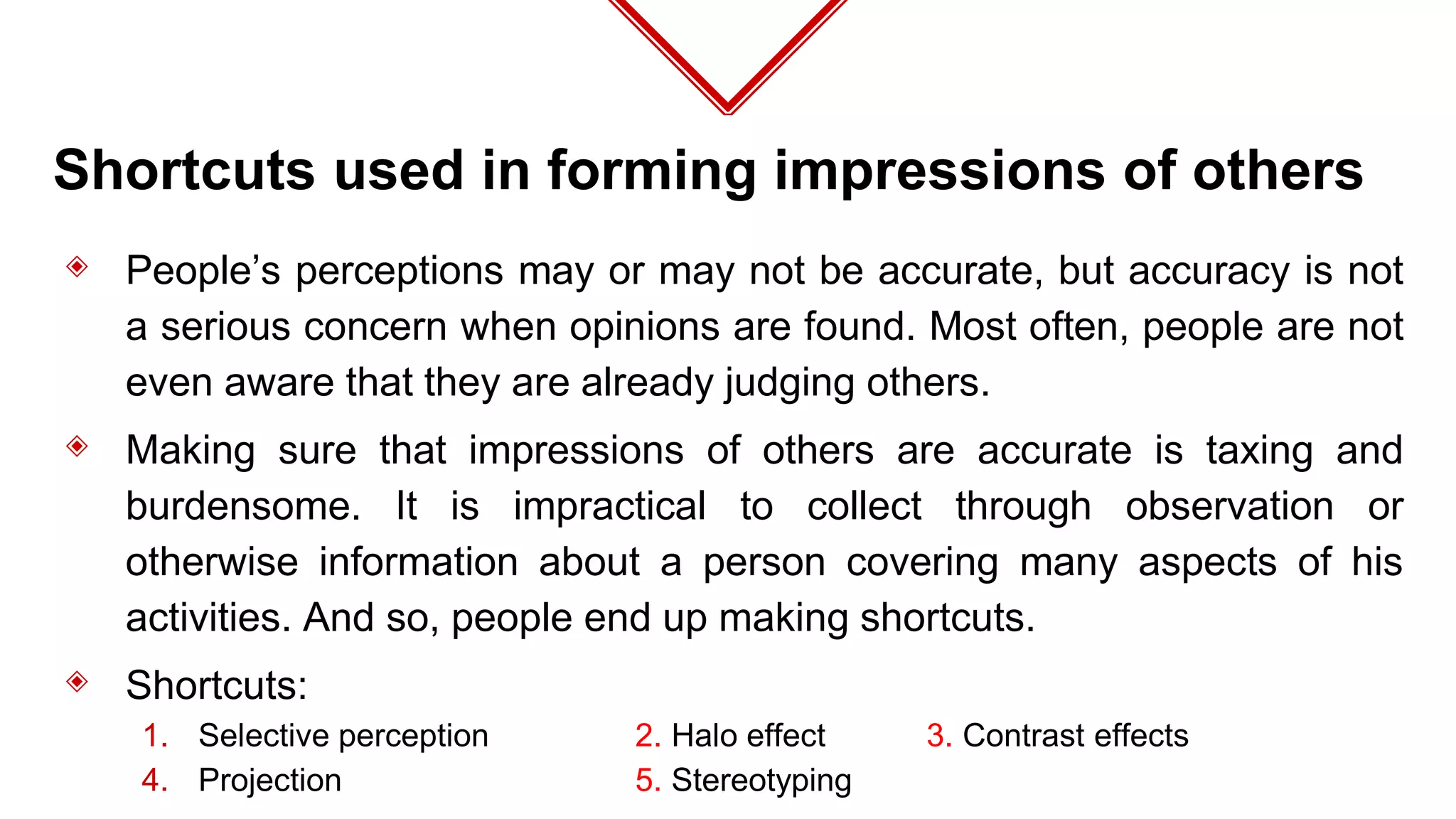
Shortcuts used in forming impressions of others
◈ People’s perceptions may or may not be accurate, but accuracy is not
a serious concern when opinions are found. Most often, people are not
even aware that they are already judging others.
◈ Making sure that impressions of others are accurate is taxing and
burdensome. It is impractical to collect through observation or
otherwise information about a person covering many aspects of his
activities. And so, people end up making shortcuts.
◈ Shortcuts:
1. Selective perception 2. Halo effect 3. Contrast effects
4. Projection 5. Stereotyping
1. Selective perception happens when a person selectively interprets
what he sees on the basis of his interests, backgrounds, experience,
and attitudes.
⬦ “When Mr. Jose was a teenager, he mugged by dark-skinned
persons. When he grew older, he found it difficult to relate with co-
employees who are dark-skinned. His past experience would not
allow him to make a positive impression of those kinds of people.”
2. Halo Effect occurs when one attribute of a person or situation is used
to develop an overall impression of the person or situation.
⬦ For instance, a brilliant criminal lawyer may also be perceived by
many to be also brilliant when he engage in selling real estate.
⬦ Halo refers to that ring of light just above the head of a saint as we
see it in pictures or paintings. The “halo” signifies that everything
about the saint is holy.
⬦ A person’s outstanding achievement in one area may serve as his
“halo” and he may be perceived as outstanding in other endeavors
as well but it is not always right. A person who is good at selling
must not be perceived outright as also good in training.. Even if the
perception process is slow, it is still wrong if it is tainted with the
halo effect.
3. Contrast Effects
⬦ Contrast effects may be defined as evaluations of a person’s
characteristics that are affected by comparisons with other people
recently encountered who rank higher or lower on the same
characteristics.**
⬦ A beautiful lady may be declared as the third prettiest in a certain
place, but she could be number one in another place.
⬦ A job applicant may be rated very well in an interview because
mediocre applicants were interviewed before him. The same
applicant may be rated “poor” when he is preceded by bright ones
in the interview.
4. Projection
⬦ Projection is attributing one’s own thoughts, feelings, or motives
to another. It is likely to occur in the interpretation stage of
perception.**
5. Stereotyping
⬥ Stereotyping refers to judging someone on the basis of one’s
perception of the group to which that person belongs.**
For example, the manager who is motivated to work mainly by the pay he
collects each fortnight. He thinks that his subordinates share the same
motivation, so whenever he had the chance to talk with his boss, he
mentions the need to increase the salaries of people working in his unit. The
manager is actually projecting his needs to his subordinates and his actions
are inappropriate. His subordinate really need the money but not as the
main reason for working.
For instance, a manager may think that older people are no longer
productive. Based on that belief, he declined the job application of a 60 year
old person. The basis for the decision is unfair because he thinks that the
applicant is a stereotype of what he believes. It may be true that many older
people are no longer fir to work, but not all of them. The hiring of older
persons by big retailing firms to entertain customers is proof of the ability of
some older persons.
◈ end~

LEARNING, PERCEPTION AND ATTRIBUTION

  • 1.
  • 2.
    LEARNING ◈ Acquiring acomplex set of sophisticated skills is a result of change that comes from learning. An understanding of how people learn is very important because it will help people explain and predict behavior. ◈ Learning may be defined as a relatively permanent change in behavior or knowledge due to experience. ◈ When a person behaves differently from what he previously did, it can be said that there is change in the person’s behavior. WHAT IS LEARNING
  • 3.
    ◈ A changein behavior happens due to any or both of the following: 1. Learning; or 2. Other causes such as drugs, injury, disease and maturation.** ◈ Behavioral change starts with the mind when it accepts new knowledge. Sometimes, the mind “orders” the body to show some signs of behavior that is different from the previous one. Sometimes the mind is just plain contented with the new knowledge and do not make attempts to “order” the body to show some outward manifestations of behavior change.** For example, Mr. Leopoldo Amparo read a book about the dangers of smoking. He was convinced that smoking is not good for his health and he decided to quit. His circle of friends liked what he did and they gave him more opportunities for social contacts with them. Obviously, Mr. Amparo’s behavior change is a result of an indirect experience, i.e., reading books. Two aspects of behavior are apparent in Mr. Amparo’s case: knowledge about the bad effects of smoking, and the outward manifestation of quitting smoking. Mr. Amparo had the option of just satisfying himself with the knowledge that smoking is bad, but he considered following up his knowledge with appropriate action. The result was visible change in his behavior.
  • 4.
    THEORIES OF LEARNING ◈Eminent researchers have developed theories that help explain the learning process. These theories consist of classical conditioning, operant conditioning and social learning. ◈ Classical conditioning may be defined as “a type of learning in which a stimulus acquires the capacity to evoke a response that was originally evoked by another stimulus.** 1. Classical Conditioning Example of classical conditioning: It was one Monday morning in a typical factory when Mr. Honesto Lumauig was called by the manager to the office and he was asked why his last week’s output was very low. All throughout the interview, Mr. Lumauig felt nervous and very uncomfortable. Seven days later, and it was Monday morning again and Honesto begins to felt nervous and uncomfortable. He can hardly concentrate on his job.
  • 5.
    2. Operant Conditioning ◈Operant conditioning may be defined as “a type of learning where people learn to repeat behaviors that bring them pleasurable outcomes and to avoid behaviors that lead to uncomfortable outcomes. ◈ For instance, if an employee receives cash rewards every time he exceed his assigned targets, it is very likely that he will repeat such behavior. ◈ Social learning may be defined as “the process of serving the behavior of others, recognizing its consequences, and altering behavior as a result. One of the ways by which people learn is through social contacts with other people.** 3. Social Learning Example of Social learning: An employee pays much attention to his boss, a highly successful person, whenever he speaks or just plain moving around the office. The brief encounters with the boss gave the employee the opportunity to understand and apply some ideas shared by the superior. For example is watching the boss perform the right way to communicate with customers. Social Learning may be done in three ways namely: 1. By observing what happens to other people; 2. By being told about something; and 3. Through direct experience.
  • 6.
    Factors Influencing Perception PERCEPTION ◈Perception may be defined as “the process by which people select, organize, interpret, retrieve, and respond to information from their environment.** ◈ Perception is influenced by the characteristics of the following: 1. The perceiver 2. The target 3. The situation** When an accident happened in the workplace, two persons actually saw it. Later, when both were asked to provide details about the accident, their statements differ in several aspects. How may this discrepancy be explained? THE ANSWER IS: DIFFERENT PERCEPTIONS OF THE SAME EVENT. THE PROCESS OF PERCEPTION FACTORS INFLUENCING PERCEPTION
  • 7.
    1. The Perceiver ⬥The person perceives the target is the perceiver. His perception of the target is influenced by factors that are unique to him, like the following: ⬦ His past experiences ⬦ His needs or motives ⬦ His personality ⬦ His values and attitudes ⬥ A person’s experiences in the past have some bearing on his current perceptions. For instance, a child who had an unpleasant experience with a surgeon will not maintain a good perception of physicians when he grows older.
  • 8.
    2. The Target ⬥The person, object, or event that is perceived by another person is the target. Perception may be modified by the following factors which are typical characteristics of targets: 1. Contrast (vary) 2. Intensity (brightness, color, depth, sound) 3. Figure-ground separation (The figure is the one being looked at, and the ground is the background against which it stands) 4. Size (smaller or larger than the average) 5. Motion (moving objects are perceived differently from stationary objects) 6. Repetition or novelty
  • 9.
    3. The Situation ⬥The perception is also affected by the surrounding environment.** The situational factors that affect perception are: time, work setting, and social setting. ⬥ As people’s moods vary from time to time, perception also varies depending on the time the perception is made. ⬥ Workplaces differ from one another. As such, perception also differs from workplace to workplace.** ⬥ The social setting is also a factor in perception.** Example of perception affected by surroundings: For example, a person who is enjoying a meal with tribal people in the hinterlands may be well received even if he uses his bare hands. He will be perceived differently when he does the same in the dining halls of the privileged class in the city. Example of perception affected by workplaces: For example, the playing of soft music may be perceived favorably in a certain workplace but differently regarded in another workplace. Example of perception affected by social setting: For example, a person will perceive a Caucasian girl as very pretty when both of them are situated in a remote place in the Philippines. However, when both are situated in a movie studio in Hollywood, USA, the girl will be perceived differently.
  • 10.
    Common Attribution Errors ATTRIBUTION ◈Attribution Theory is the process by which people ascribe causes to the behavior they perceive.** ◈ When people make attempts to determine the causes of other people’s behavior, errors commonly happen. These errors may be classified into the following types: 1. The fundamental attribution errors; and 2. The self-serving bias. For instance, an employee always feels very nervous whenever the office manager calls her to present her weekly report in the manager’s office. Her anxiety affects her very much, including the delivery of her report. Her unit supervisor sympathizes with her and would like to help her overcome her fears. The supervisor started to monitor her moves so he can determine the reason for her behavior. The supervisor is clearly adapting the attribution theory to help her subordinates.
  • 11.
    1. Fundamental attributionerrors – refer to the tendency to underestimate the influence of external factors and overestimate the influence of internal or personal factors in the behavior of others.** 2. Self-serving bias – is that type of attribution error whereby people tend to attribute their achievements to their good inner qualities, whereas they attribute their failures to adverse factors within the environment.** For instance, the area manager of a retailing firm blames one of the store managers for failing to attract a sufficient number of customers rather than the poor location of the store. Dr. Agao is an employee of a state university. He and his superior are members of a fraternity. This relationship became a major factor in his recent promotion. When pressed by his colleagues for a comment on his promotion, he declared that he thinks he is better qualified than the others. Within the span of five years, Dr. Agao failed miserably in his job. When his superior was replaced, he was demoted. Dr. Agao blames his co-employees.
  • 12.
    Factors that InfluenceAttribution 1. Distinctiveness – refers to the consideration given to how consistent a person’s behavior is across different situations.** 2. Consensus – this refers to the likelihood that all those facing the same situation will have similar responses.** 3. Consistency - this refers to the measure of whether an individual responds the same way across time.** Mr. Nick Cargada was recently hired by the university as driver. When he was asked to deliver a letter to someone in a nearby barangay, he used the school’s motorcycle. Along the way, he hit a stray dog. The next day, he was ordered to fetch five professors who attended a seminar in a nearby town. This time, he used the school’s newly purchased van. On the way back, he hit a carabao resting on the right side of the road. On the third day, he was directed to transport 50 student athletes to participate in a competition at a nearby province. The university bus was filled to capacity when he started driving. The bus was not yet ten kilometers from the university when it bumped an old man along the road. Mr. Cargada’s performance was declared disgusting and his co-employees attributed it to an internal caus, i.e. his personality. For instance, if Mr. Ocleng and the other five employees in his unit failed to arrive in time, Mr. Ocleng’s late arrival will be attributed to an external factor. For example, Mr. Ocleng’s performance in his previous assignments was declared unsatisfactory. First, when he was given the job as records clerk in the registrar’s office of the university, he made a considerable number of wrong entries in the students’ records. Second, when he was assigned as typist in the accounting office, he made incorrect entries in a number of checks he was processing. Third, when he was transferred to the supply office as inventory clerk, he failed to record a number of incoming stocks.**
  • 13.
    Shortcuts used informing impressions of others ◈ People’s perceptions may or may not be accurate, but accuracy is not a serious concern when opinions are found. Most often, people are not even aware that they are already judging others. ◈ Making sure that impressions of others are accurate is taxing and burdensome. It is impractical to collect through observation or otherwise information about a person covering many aspects of his activities. And so, people end up making shortcuts. ◈ Shortcuts: 1. Selective perception 2. Halo effect 3. Contrast effects 4. Projection 5. Stereotyping
  • 14.
    1. Selective perceptionhappens when a person selectively interprets what he sees on the basis of his interests, backgrounds, experience, and attitudes. ⬦ “When Mr. Jose was a teenager, he mugged by dark-skinned persons. When he grew older, he found it difficult to relate with co- employees who are dark-skinned. His past experience would not allow him to make a positive impression of those kinds of people.” 2. Halo Effect occurs when one attribute of a person or situation is used to develop an overall impression of the person or situation. ⬦ For instance, a brilliant criminal lawyer may also be perceived by many to be also brilliant when he engage in selling real estate.
  • 15.
    ⬦ Halo refersto that ring of light just above the head of a saint as we see it in pictures or paintings. The “halo” signifies that everything about the saint is holy. ⬦ A person’s outstanding achievement in one area may serve as his “halo” and he may be perceived as outstanding in other endeavors as well but it is not always right. A person who is good at selling must not be perceived outright as also good in training.. Even if the perception process is slow, it is still wrong if it is tainted with the halo effect.
  • 16.
    3. Contrast Effects ⬦Contrast effects may be defined as evaluations of a person’s characteristics that are affected by comparisons with other people recently encountered who rank higher or lower on the same characteristics.** ⬦ A beautiful lady may be declared as the third prettiest in a certain place, but she could be number one in another place. ⬦ A job applicant may be rated very well in an interview because mediocre applicants were interviewed before him. The same applicant may be rated “poor” when he is preceded by bright ones in the interview.
  • 17.
    4. Projection ⬦ Projectionis attributing one’s own thoughts, feelings, or motives to another. It is likely to occur in the interpretation stage of perception.** 5. Stereotyping ⬥ Stereotyping refers to judging someone on the basis of one’s perception of the group to which that person belongs.** For example, the manager who is motivated to work mainly by the pay he collects each fortnight. He thinks that his subordinates share the same motivation, so whenever he had the chance to talk with his boss, he mentions the need to increase the salaries of people working in his unit. The manager is actually projecting his needs to his subordinates and his actions are inappropriate. His subordinate really need the money but not as the main reason for working. For instance, a manager may think that older people are no longer productive. Based on that belief, he declined the job application of a 60 year old person. The basis for the decision is unfair because he thinks that the applicant is a stereotype of what he believes. It may be true that many older people are no longer fir to work, but not all of them. The hiring of older persons by big retailing firms to entertain customers is proof of the ability of some older persons.
  • 18.

Editor's Notes

  • #2 Managers of organizations are expected to achieve the goal set forth by higher authorities. The individual workers, in turn, are expected by their respected managers to perform and achieve certain goals assigned to them. However, managers and individual workers operate in environments where other people can seriously affect their own individual performances. This reality brings out in the open the need to understand why people behave as they do. Dealing more effectively with people requires knowledge of the relevant aspects of behavioral change, specifically learning, perception and attribution.
  • #5 In this case, the “original stimulus” is the Monday morning when Honesto was confronted by the boss. Honesto’s “response” was that he felt nervous and uncomfortable. Any Monday is a “neutral stimulus”, but it becomes a “conditioned stimulus” when paired with the original stimulus. When confronted with a “conditioned stimulus”, Honesto reacts with a “conditioned response”, i.e. he feels nervous and very uncomfortable.
  • #7 After the answer.. When a situation happens, it will be difficult for the decision maker to make an accurate evaluation of what really transpired, and the quality of his decision is affected. This underscores the importance of knowing the various concepts and theories ascribed to perception.
  • #9 For instance, when a boy is seen with five girls, perception will be different than when he is with five boys. For instance, a person will be seen differently when the illumination is different from the usual one, say from an incandescent bulb (white) to a bright blue fluorescent bulb (very bright color). A singer who is well by an appropriated by the audience because his voice is projected well by an appropriate sound system. He will not be so regarded when he uses a poor device. For instance, you saw your best friend speak before a crowd on two occasions: one is when he delivered his piece in an oratorical contest in school and second, when he was speaking before a crowd of rallies situated near Malacanang. Your perception of your friend on those two occasions will differ, thanks to the differences in the nature of the backgrounds. It is expected that the farmer who harvested a mango fruit twice the size of the average mango will handle the fruit with a little more concern. Size matters even in the placement of company personnel. For example, a housewife who is doing her routine buying in the market perceives fish that is aggressively jumping is more fresh than the other that is alive but is barely moving. For example, when a person is repeatedly exposed to a particular music, that person gets used to it and chances are, he becomes fond of it. When love at first sight does not work, familiarity may do the trick.
  • #10 Caucasian – white-skinned girl, of European origin
  • #11 Ascribe – lay and put down
  • #13 Incoming stocks…. Based on Mr. Ocleng’s behavior in the example, he was declared a consistent incompetent by his superiors.
  • #14 Others….. From whatever reason, we form impressions of others. Those impressions constitute a database in our minds that we later use as aides in making decisions concerning others. Example, Andres will not confide secrets to Pedro if Andres consider Pedro as a gossip.
  • #17 Characteristics…. Contrasting situations may lead to inaccurate evaluation of a person’s character and ability. Mediocre – of moderate or low quality, value ability or performance