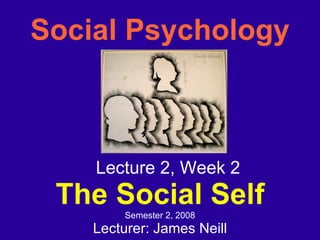
Social Psychology Lecture 2, Week 2 The Social Self Semester 2, 2008 Lecturer: James Neill
Overview What is the “self”? What is the “social self”? Self-constructs Evolutionary functions Adaptational functions Self-complexity Social comparison Social feedback Strategic self-presentation Self-monitoring Self-regulation
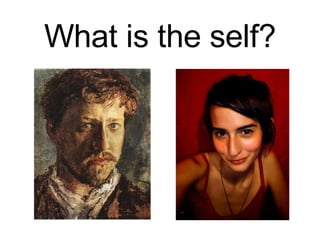
What is the self?
 
What is “self”? Describe yourself   e.g.,  “ I am…” statements What do I promote? What do I defend? Usually includes social roles  e.g., Gender, ethnicity Social identity Group memberships
 
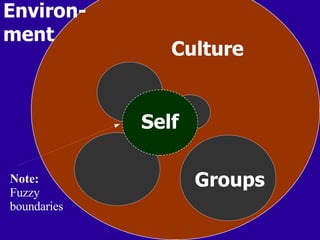
Note:  Fuzzy boundaries Self Groups Culture Environ-ment
What is the “self”? Many, varied theories about the  purpose  and  function  of the ‘self’ –  e.g., in arts, philosophy, science,  culture, religion, and through history.
What is the “self”? Psychologically... collection of cognitively-held beliefs that a person possesses about themselves.
What is the “self”? However… “ Self” seems to extend beyond the  physical self (body), to include  psychologically meaningful personal possessions and personal space.
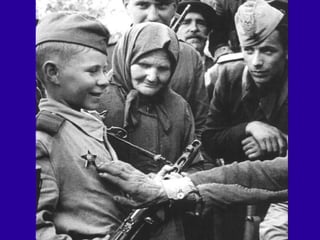
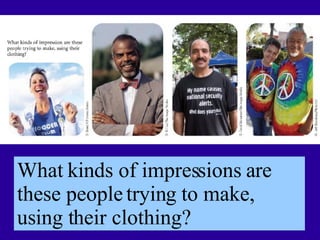
What kinds of impressions are these people trying to make, using their clothing?
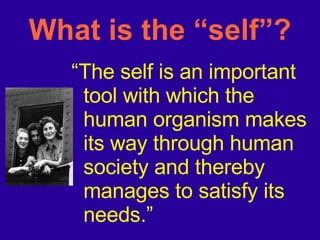
What is the “self”? “ The self is an important tool with which the human organism makes its way through human society and thereby manages to satisfy its needs.”
What is the “self”?  Traditionally, “self” was seen as representing stable, genetically determined “character” – or later, “personality”.
What is the “self”? More recently, “self” was understood to evolve during a lifetime,  i.e. Partly stable, partly changing.
What is the “self”? Most recently, “self” has been further complexified and increasingly seen as: Dynamic & changeable  Multiple / Plural  Hierarchical Situationally & cognitively influenced Culturally constructed
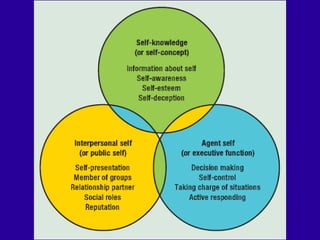
What is the “self”? The psychological self includes: Attitudes Cognitions Emotions Group Memberships (Social Identity) Ideal / Imagined Selves Memories Possessions Self-Beliefs Self-Concepts Self-Images Social Roles
What is the “self”? To determine “What is self”, use diagnostic clues: Who am I? What are you prepared to defend?
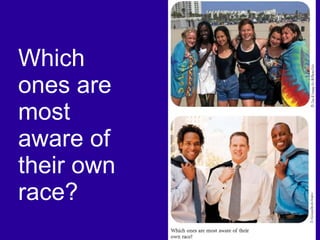
Fluctuating Image(s) of Self Phenomenal self (Working self-concept) Unusual aspects about you become prominent Being lone member of some category Heightens self-awareness Can impair performance
Which ones are most aware of their own race?
What is the “social self”? Humans are gregarious, group-based creatures. A significant portion of our ‘self’ and its ‘behaviour’ is socially directed and influenced.
What is the “social self”? Some argue that ‘self’ is entirely a function of the environment. e.g., “Self” as a construct of post-industrial, capitalist society and political systems which promote self-identity and choice-making, and then markets to the “self”.
What is the “social self”? Interpersonal self  or s ocial self part of self that engages face-to-face, in relation with others. Social roles  ->  Social identity  or  Societal self can include ethnicity, gender, age, place of residence or any other social categorization that helps characterize a person’s identity.
Purpose of the self Gain social acceptance Play social roles Society creates and defines roles Individual seeks and adopts them
Self-Constructs (Operationalization) Self-Esteem Self-Concept Self-Efficacy Self-Congruence illustrate how social psychologists study people’s selves, in cognitive, affective, and behavioral terms.
Self-esteem Global feelings of self-worth Value placed in & degree of liking of self.  Often based on and closely related to social comparisons. (e.g., too thin, too fat) People are motivated to see their self as worthy/worthwhile (Fiske, 2004).
Self-esteem High Self-Esteem Positive views Low Self-Esteem Absence of strong positive views
Self-esteem Healthy to have a slightly inflated sense of self value (Taylor). Self-esteem serves as a sociometer for one’s standing in a group (Fiske, 2004).  Self-esteem has been overemphasized in Western society, to the detriment of actual skill (Baumeister)
Basking and blasting Group membership may enhance positive feelings about self (Cialdini et.al, 1976) Basking - Linking oneself to winners Blasting - Criticizing a rival group People show a stronger tendency to blast (negative) than bask (positive)
Basking and blasting Loyal fans experience changes in their own confidence level based on the success or failure of their team Losing had a stronger effect than winning
Low self-esteem Research on low self-esteem Do not want to fail Self-concept confusion Focus on self-protection More prone to emotional highs and lows Myth of low-self esteem in United States
Distorted perceptions of nondepressed Positive illusions Overestimate good qualities Underestimate faults Overestimate control over events Unrealistically optimistic
Self-deception strategies Self Serving Bias More skeptical of bad feedback Junk Mail Theory of Self-Deception Comparisons with those slightly worse Skew impressions of others to highlight own good traits as unusual
Benefits of high self-esteem Initiative  Confidence you can do the right thing More adventurous in activities Feels good Helps one to overcome bad feelings If they fail, more likely to try again
Why do we care about self-esteem? Sociometer theory Self-esteem is a measure of social acceptability Self-esteem feels good Theory of terror management
Negative aspects of  high self-esteem Narcissism Subset of high self-esteem Tend to be more aggressive and violent Higher prejudice Tend to think their group is better
Pursuit of self-esteem May have harmful consequences Can compromise pursuit of competence Impairs autonomy Pressure to meet expectations of others Weakens individual intrinsic motivation Impairs learning Can damage relationships Can be harmful to health
Self-presentation Behaviors that convey an image to others Public esteem More important than private self-esteem Public behaviour Acting for the audience
Functions of self-presentation Social acceptance Increase chance of acceptance and maintain place within the group Claiming identity Social validation of claims to identity
Good self-presentation Demonstrate positive traits Behave with consideration of audience Tradeoff Tendency toward favorable presentation Modesty More prevalent in long-term relationships Risky behaviors
Self-concept Cognitive representations of the self.   Now commonly seen as a set of multi-dimensional and hierarchically organized domains of self-concept, e.g., Physical Self-Concept Academic Self-Concept Social Self-Concept Same-Sex Relations Opposite-Sex Relations Parent Relations, etc. Top-down vs. bottom-up debate
Self-efficacy Belief in one’s capacity to succeed at a given task. e.g. Public Speaking Self-Efficacy Bandura recommended specific rather than general measures of Self-efficacy.
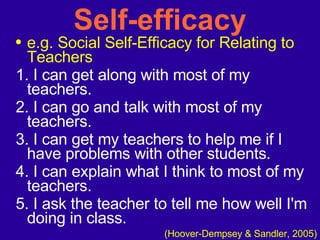
Self-efficacy e.g. Social Self-Efficacy for Relating to Teachers 1. I can get along with most of my teachers. 2. I can go and talk with most of my teachers. 3. I can get my teachers to help me if I have problems with other students. 4. I can explain what I think to most of my teachers. 5. I ask the teacher to tell me how well I'm doing in class. (Hoover-Dempsey & Sandler, 2005)
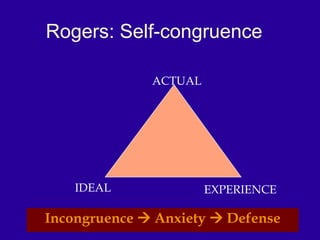
Rogers: Self-congruence Incongruence    Anxiety    Defense ACTUAL IDEAL EXPERIENCE
Self has evolutionary functions Self-bias   e.g., access to resources Self-organization / Self-complexity e.g., adaptability & self-insight/self-control Self-promotion  e.g., for increased likelihood of mating Social comparison   e.g., motivation to improve Social control e.g., storage of social norms and rules
Self has adaptational functions “ People’s selves allow them to  regulate their own behavior , an advantage for both self and group.”
Self has adaptational functions “ The self can serve various social psychological functions; having a self is not only knowing where your skin ends, but also  how to get along in a group .” (Fiske, 2004, p. 176)
Self-complexity People generally see themselves as more complex and others as less complex.
Self-complexity There are individual variations in self-complexity, with self-complexity being advantageous  e.g., less depressed, better able to handle stress, etc.
Self-complexity … includes having multiple possible selves.
Social comparison Everyone uses social comparison to: Understand how they are doing (through comparison with similar others) Feel better (through downward comparison) To improve (through upward comparison)
Social feedback Symbolic interactionism:  All self perceptions are based on one’s history of social interactions.
Social feedback Reflected appraisal:  One’s sense of self is based on how one perceives that others perceives one.
Social feedback Spotlight effect : People tend to think other people notice and evaluate them more than they actually do.
Social feedback Transparency Effect : People tend to think that their inner self ‘leaks out’ and is more obvious than it really is.
Self-discrepancies Actual-Ideal -> Promotion Focus (failure -> Depression) Ideal-Ought -> Prevention Focus (failure -> Anxiety)
Self-discrepancies Self-evaluation maintenance theory More relevant the comparison, the more threat Closer the person is, the more emotion (+ve or –ve)
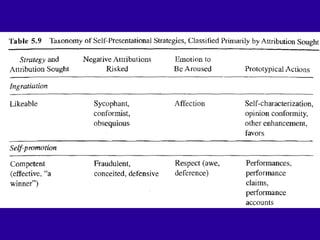
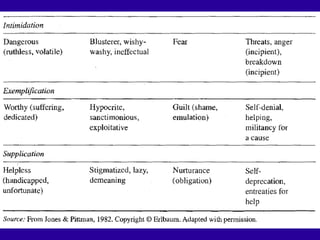
Strategic self-presentation Ingratiation (being liked) Self-Promotion (being competent) Intimidation (being in control) Exemplification (Worthy, saintly) Supplication (Helpless)
 
 
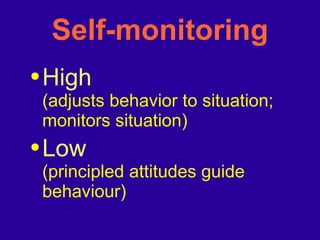
Self-monitoring High (adjusts behavior to situation; monitors situation) Low (principled attitudes guide behaviour)
Self-regulation Monitoring and controlling self-presentation and behavior uses up valuable self-regulatory resources.
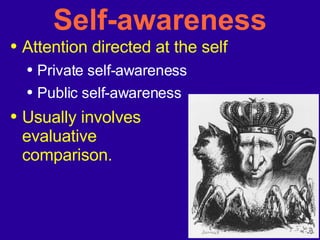
Self-awareness Attention directed at the self Private self-awareness Public self-awareness Usually involves evaluative comparison.
Self-awareness In general, people spend little time actually thinking about themselves. (but a lot of time is spent thinking about self-presentation and self-preservation)
Self-awareness Certain situations  (e.g., mirrors, cameras, audiences, self-development exercises, increase self-awareness) Individual differences in self-consciousness
Self compared to standards Concepts of how things might possibly be Ideals, norms, expectations, moral principles, laws, past experiences Around age 2, begin use of standards Beginning of self-awareness
Self-awareness and behaviour Self-awareness  Improves behaviour Enables people to be more socially desirable
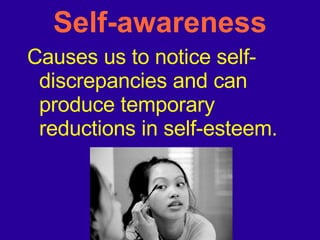
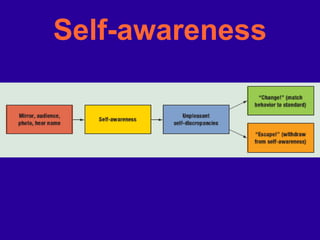
Self-awareness Causes us to notice self-discrepancies and can produce temporary reductions in self-esteem.
Self-awareness To cope, we either adjust our behavior to meet our standards or withdraw from self-focusing situations. e.g., watch TV, play sport, alcohol, suicide.
Self-awareness
Purpose of self-awareness Self-regulation Adopt the perspective of other people Manage behavior in pursuit of goals
Why people seek self-knowledge Appraisal motive Looking for the truth about oneself Self-enhancement Motive Looking for flattering things about self Consistency motive Looking for confirmation about current belief about self
When motives compete Appraisal motive Weakest motive Self-enhancement motive Strongest motive (emotional appeal) Consistency motive Second preference (cognitive appeal)
Self-knowledge and the duplex mind Automatic egotism Automatic, self-enhancing Modesty Conscious, deliberate control
Self and information processing Self-reference Effect Information bearing on self is processed more deeply and remembered better Endowment effect Items gain in value to the person who owns them
Can self-concept change? Self-concept tends to be consistent with public self: People expect you to stay the same Changing social environment may change inner self Convince others that you have changed Allow others to see your changed behavior Memory shifts to fit new self-concept.
References Fiske, S. T. (2004).  The self: Social to the core .  In S. T. Fiske (2004).  Social beings: A core motives approach to social psychology.  (Ch 5, pp. 169 – 214). Hoboken, NJ: John Wiley. Hoover-Dempsey, K.V., & Sandler, H.M. (2005).  Final Performance Report for OERI Grant # R305T010673: The Social Context of Parental Involvement: A Path to Enhanced Achievement.  Presented to Project Monitor, Institute of Education Sciences, U.S. Department of Education, March 22, 2005.
Open Office Impress This presentation was made using Open Office Impress. Free and open source software. http://www.openoffice.org/product/impress.html

Social Self

  • 1.
    Social Psychology Lecture2, Week 2 The Social Self Semester 2, 2008 Lecturer: James Neill
  • 2.
    Overview What isthe “self”? What is the “social self”? Self-constructs Evolutionary functions Adaptational functions Self-complexity Social comparison Social feedback Strategic self-presentation Self-monitoring Self-regulation
  • 3.
  • 4.
  • 5.
    What is “self”?Describe yourself e.g., “ I am…” statements What do I promote? What do I defend? Usually includes social roles e.g., Gender, ethnicity Social identity Group memberships
  • 6.
  • 7.
    Note: Fuzzyboundaries Self Groups Culture Environ-ment
  • 8.
    What is the“self”? Many, varied theories about the purpose and function of the ‘self’ – e.g., in arts, philosophy, science, culture, religion, and through history.
  • 9.
    What is the“self”? Psychologically... collection of cognitively-held beliefs that a person possesses about themselves.
  • 10.
    What is the“self”? However… “ Self” seems to extend beyond the physical self (body), to include psychologically meaningful personal possessions and personal space.
  • 11.
    What kinds ofimpressions are these people trying to make, using their clothing?
  • 12.
    What is the“self”? “ The self is an important tool with which the human organism makes its way through human society and thereby manages to satisfy its needs.”
  • 13.
    What is the“self”? Traditionally, “self” was seen as representing stable, genetically determined “character” – or later, “personality”.
  • 14.
    What is the“self”? More recently, “self” was understood to evolve during a lifetime, i.e. Partly stable, partly changing.
  • 15.
    What is the“self”? Most recently, “self” has been further complexified and increasingly seen as: Dynamic & changeable Multiple / Plural Hierarchical Situationally & cognitively influenced Culturally constructed
  • 16.
    What is the“self”? The psychological self includes: Attitudes Cognitions Emotions Group Memberships (Social Identity) Ideal / Imagined Selves Memories Possessions Self-Beliefs Self-Concepts Self-Images Social Roles
  • 17.
    What is the“self”? To determine “What is self”, use diagnostic clues: Who am I? What are you prepared to defend?
  • 18.
    Fluctuating Image(s) ofSelf Phenomenal self (Working self-concept) Unusual aspects about you become prominent Being lone member of some category Heightens self-awareness Can impair performance
  • 19.
    Which ones aremost aware of their own race?
  • 20.
    What is the“social self”? Humans are gregarious, group-based creatures. A significant portion of our ‘self’ and its ‘behaviour’ is socially directed and influenced.
  • 21.
    What is the“social self”? Some argue that ‘self’ is entirely a function of the environment. e.g., “Self” as a construct of post-industrial, capitalist society and political systems which promote self-identity and choice-making, and then markets to the “self”.
  • 22.
    What is the“social self”? Interpersonal self or s ocial self part of self that engages face-to-face, in relation with others. Social roles -> Social identity or Societal self can include ethnicity, gender, age, place of residence or any other social categorization that helps characterize a person’s identity.
  • 23.
    Purpose of theself Gain social acceptance Play social roles Society creates and defines roles Individual seeks and adopts them
  • 24.
    Self-Constructs (Operationalization) Self-EsteemSelf-Concept Self-Efficacy Self-Congruence illustrate how social psychologists study people’s selves, in cognitive, affective, and behavioral terms.
  • 25.
    Self-esteem Global feelingsof self-worth Value placed in & degree of liking of self. Often based on and closely related to social comparisons. (e.g., too thin, too fat) People are motivated to see their self as worthy/worthwhile (Fiske, 2004).
  • 26.
    Self-esteem High Self-EsteemPositive views Low Self-Esteem Absence of strong positive views
  • 27.
    Self-esteem Healthy tohave a slightly inflated sense of self value (Taylor). Self-esteem serves as a sociometer for one’s standing in a group (Fiske, 2004). Self-esteem has been overemphasized in Western society, to the detriment of actual skill (Baumeister)
  • 28.
    Basking and blastingGroup membership may enhance positive feelings about self (Cialdini et.al, 1976) Basking - Linking oneself to winners Blasting - Criticizing a rival group People show a stronger tendency to blast (negative) than bask (positive)
  • 29.
    Basking and blastingLoyal fans experience changes in their own confidence level based on the success or failure of their team Losing had a stronger effect than winning
  • 30.
    Low self-esteem Researchon low self-esteem Do not want to fail Self-concept confusion Focus on self-protection More prone to emotional highs and lows Myth of low-self esteem in United States
  • 31.
    Distorted perceptions ofnondepressed Positive illusions Overestimate good qualities Underestimate faults Overestimate control over events Unrealistically optimistic
  • 32.
    Self-deception strategies SelfServing Bias More skeptical of bad feedback Junk Mail Theory of Self-Deception Comparisons with those slightly worse Skew impressions of others to highlight own good traits as unusual
  • 33.
    Benefits of highself-esteem Initiative Confidence you can do the right thing More adventurous in activities Feels good Helps one to overcome bad feelings If they fail, more likely to try again
  • 34.
    Why do wecare about self-esteem? Sociometer theory Self-esteem is a measure of social acceptability Self-esteem feels good Theory of terror management
  • 35.
    Negative aspects of high self-esteem Narcissism Subset of high self-esteem Tend to be more aggressive and violent Higher prejudice Tend to think their group is better
  • 36.
    Pursuit of self-esteemMay have harmful consequences Can compromise pursuit of competence Impairs autonomy Pressure to meet expectations of others Weakens individual intrinsic motivation Impairs learning Can damage relationships Can be harmful to health
  • 37.
    Self-presentation Behaviors thatconvey an image to others Public esteem More important than private self-esteem Public behaviour Acting for the audience
  • 38.
    Functions of self-presentationSocial acceptance Increase chance of acceptance and maintain place within the group Claiming identity Social validation of claims to identity
  • 39.
    Good self-presentation Demonstratepositive traits Behave with consideration of audience Tradeoff Tendency toward favorable presentation Modesty More prevalent in long-term relationships Risky behaviors
  • 40.
    Self-concept Cognitive representationsof the self. Now commonly seen as a set of multi-dimensional and hierarchically organized domains of self-concept, e.g., Physical Self-Concept Academic Self-Concept Social Self-Concept Same-Sex Relations Opposite-Sex Relations Parent Relations, etc. Top-down vs. bottom-up debate
  • 41.
    Self-efficacy Belief inone’s capacity to succeed at a given task. e.g. Public Speaking Self-Efficacy Bandura recommended specific rather than general measures of Self-efficacy.
  • 42.
    Self-efficacy e.g. SocialSelf-Efficacy for Relating to Teachers 1. I can get along with most of my teachers. 2. I can go and talk with most of my teachers. 3. I can get my teachers to help me if I have problems with other students. 4. I can explain what I think to most of my teachers. 5. I ask the teacher to tell me how well I'm doing in class. (Hoover-Dempsey & Sandler, 2005)
  • 43.
    Rogers: Self-congruence Incongruence  Anxiety  Defense ACTUAL IDEAL EXPERIENCE
  • 44.
    Self has evolutionaryfunctions Self-bias e.g., access to resources Self-organization / Self-complexity e.g., adaptability & self-insight/self-control Self-promotion e.g., for increased likelihood of mating Social comparison e.g., motivation to improve Social control e.g., storage of social norms and rules
  • 45.
    Self has evolutionaryfunctions Self-bias e.g., access to resources Self-organization / Self-complexity e.g., adaptability & self-insight/self-control Self-promotion e.g., for increased likelihood of mating Social comparison e.g., motivation to improve Social control e.g., storage of social norms and rules
  • 46.
    Self has adaptationalfunctions “ People’s selves allow them to regulate their own behavior , an advantage for both self and group.”
  • 47.
    Self has adaptationalfunctions “ The self can serve various social psychological functions; having a self is not only knowing where your skin ends, but also how to get along in a group .” (Fiske, 2004, p. 176)
  • 48.
    Self-complexity People generallysee themselves as more complex and others as less complex.
  • 49.
    Self-complexity There areindividual variations in self-complexity, with self-complexity being advantageous e.g., less depressed, better able to handle stress, etc.
  • 50.
    Self-complexity … includeshaving multiple possible selves.
  • 51.
    Social comparison Everyoneuses social comparison to: Understand how they are doing (through comparison with similar others) Feel better (through downward comparison) To improve (through upward comparison)
  • 52.
    Social feedback Symbolicinteractionism: All self perceptions are based on one’s history of social interactions.
  • 53.
    Social feedback Reflectedappraisal: One’s sense of self is based on how one perceives that others perceives one.
  • 54.
    Social feedback Spotlighteffect : People tend to think other people notice and evaluate them more than they actually do.
  • 55.
    Social feedback TransparencyEffect : People tend to think that their inner self ‘leaks out’ and is more obvious than it really is.
  • 56.
    Self-discrepancies Actual-Ideal ->Promotion Focus (failure -> Depression) Ideal-Ought -> Prevention Focus (failure -> Anxiety)
  • 57.
    Self-discrepancies Self-evaluation maintenancetheory More relevant the comparison, the more threat Closer the person is, the more emotion (+ve or –ve)
  • 58.
    Strategic self-presentation Ingratiation(being liked) Self-Promotion (being competent) Intimidation (being in control) Exemplification (Worthy, saintly) Supplication (Helpless)
  • 59.
  • 60.
  • 61.
    Self-monitoring High (adjustsbehavior to situation; monitors situation) Low (principled attitudes guide behaviour)
  • 62.
    Self-regulation Monitoring andcontrolling self-presentation and behavior uses up valuable self-regulatory resources.
  • 63.
    Self-awareness Attention directedat the self Private self-awareness Public self-awareness Usually involves evaluative comparison.
  • 64.
    Self-awareness In general,people spend little time actually thinking about themselves. (but a lot of time is spent thinking about self-presentation and self-preservation)
  • 65.
    Self-awareness Certain situations (e.g., mirrors, cameras, audiences, self-development exercises, increase self-awareness) Individual differences in self-consciousness
  • 66.
    Self compared tostandards Concepts of how things might possibly be Ideals, norms, expectations, moral principles, laws, past experiences Around age 2, begin use of standards Beginning of self-awareness
  • 67.
    Self-awareness and behaviourSelf-awareness Improves behaviour Enables people to be more socially desirable
  • 68.
    Self-awareness Causes usto notice self-discrepancies and can produce temporary reductions in self-esteem.
  • 69.
    Self-awareness To cope,we either adjust our behavior to meet our standards or withdraw from self-focusing situations. e.g., watch TV, play sport, alcohol, suicide.
  • 70.
  • 71.
    Purpose of self-awarenessSelf-regulation Adopt the perspective of other people Manage behavior in pursuit of goals
  • 72.
    Why people seekself-knowledge Appraisal motive Looking for the truth about oneself Self-enhancement Motive Looking for flattering things about self Consistency motive Looking for confirmation about current belief about self
  • 73.
    When motives competeAppraisal motive Weakest motive Self-enhancement motive Strongest motive (emotional appeal) Consistency motive Second preference (cognitive appeal)
  • 74.
    Self-knowledge and theduplex mind Automatic egotism Automatic, self-enhancing Modesty Conscious, deliberate control
  • 75.
    Self and informationprocessing Self-reference Effect Information bearing on self is processed more deeply and remembered better Endowment effect Items gain in value to the person who owns them
  • 76.
    Can self-concept change?Self-concept tends to be consistent with public self: People expect you to stay the same Changing social environment may change inner self Convince others that you have changed Allow others to see your changed behavior Memory shifts to fit new self-concept.
  • 77.
    References Fiske, S.T. (2004). The self: Social to the core . In S. T. Fiske (2004). Social beings: A core motives approach to social psychology. (Ch 5, pp. 169 – 214). Hoboken, NJ: John Wiley. Hoover-Dempsey, K.V., & Sandler, H.M. (2005). Final Performance Report for OERI Grant # R305T010673: The Social Context of Parental Involvement: A Path to Enhanced Achievement. Presented to Project Monitor, Institute of Education Sciences, U.S. Department of Education, March 22, 2005.
  • 78.
    Open Office ImpressThis presentation was made using Open Office Impress. Free and open source software. http://www.openoffice.org/product/impress.html

Editor's Notes

  • #2 Image source: http://commons.wikimedia.org/wiki/Image:Oberlin-Famille.jpg (Public domain) 29 July, 2008, 11:30-13:30, 2B11 7125-6666 Social Psychology / G Centre for Applied Psyhology Faculty of Health University of Canberra Bruce, ACT 2601, Australia ph: +61 2 6201 2536 [email_address] http://ucspace.canberra.edu.au/display/7125/Lecture+Social+Self The aim of this lecture is to provide an overview of social aspects and functions of the human self.