

Jitendra Kumar
College of Fisheries, Mangalore
 RFLP technology
• Isolating DNA
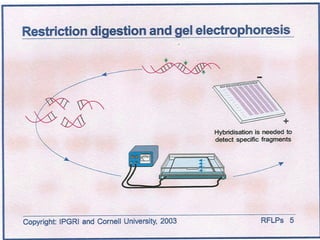
• Restriction digestion and gel electrophoresis
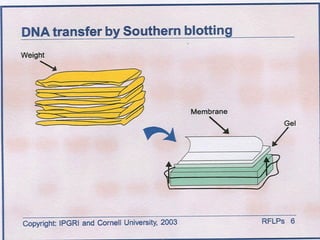
• DNA transfer by southern blotting
 DNA hybridigestion
 Equipment
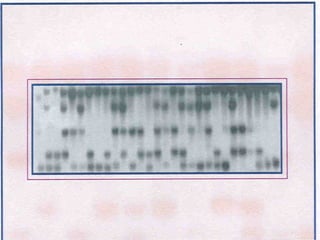
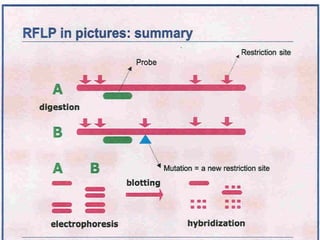
 RFLP technology in pictures
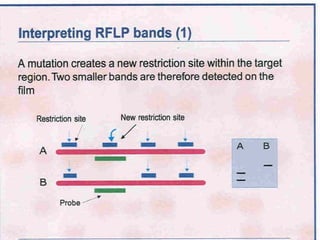
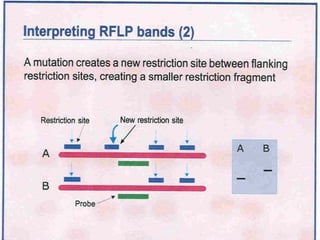
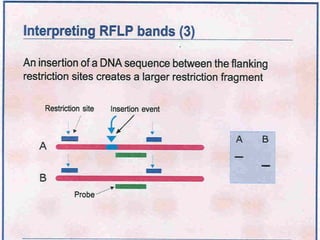
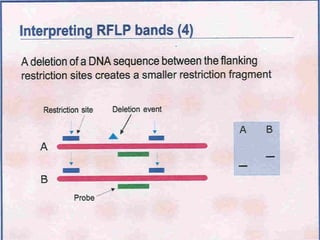
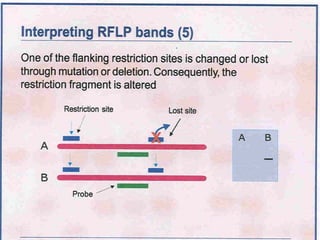
 Interpreting RFLP bands
 Advantage and disadvantage of RFLPs
RFLP detection relies on the possibility of comparing
band profiles generated after restriction enzymes
digestion of target DNA.
 The laboratory steps involved are as follows:
 Isolation of DNA
 Restriction digestion and gel electrophoresis
 DNA transfer by southern blotting
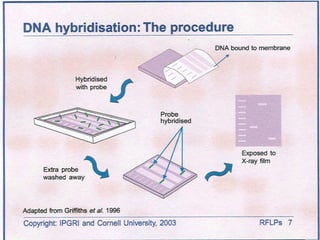
 DNA hybridization
• The procedure
• The DNA probe
• Sources of probes
 Equipments
 Total DNA is extracted from fish cells
 DNA must be clean and of high molecular weight
 Complication:
• Breaking during isolation
• DNA degraded by nucleases
• Isolation of secondary fish metabolites
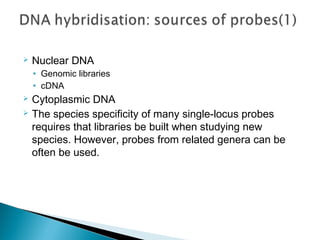
 Nuclear DNA
• Genomic libraries
• cDNA
 Cytoplasmic DNA
 The species specificity of many single-locus probes
requires that libraries be built when studying new
species. However, probes from related genera can be
often be used.
 Repetitive sequence or minisatellite-type:
• Basic motif of 10 to 60bp in tendem
• Highly variable between human individuals
• Polymorphism in the no. of repeated units (also called VNTRs)
 In fish, probes from an internal repeat from the protein lll
gene of the bacteriophase M13 have been to reveal
minisatellite sequences
 Resource:
• Distilled and/or deionised water
• Reagents
 Equipment:
• Refrigerator and freezer
• Laminar flow hood
• Centrifuge
• Power supply units
• Hot plate or microwave
• pH meter
• Standard balance
• Gel electrophoresis units
• Dark room
• Uv transilluminatior
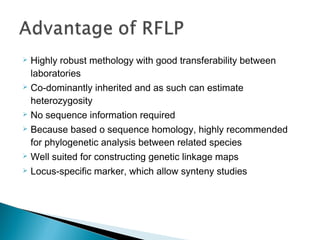
 Highly robust methology with good transferability between
laboratories
 Co-dominantly inherited and as such can estimate
heterozygosity
 No sequence information required
 Because based o sequence homology, highly recommended
for phylogenetic analysis between related species
 Well suited for constructing genetic linkage maps
 Locus-specific marker, which allow synteny studies
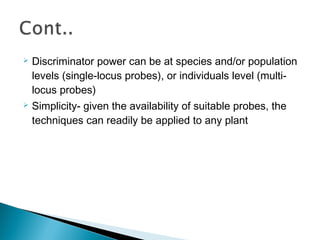
 Discriminator power can be at species and/or population
levels (single-locus probes), or individuals level (multi-
locus probes)
 Simplicity- given the availability of suitable probes, the
techniques can readily be applied to any plant
 Large amounts of DNA required
 Automation not possible
 Low level of polymorphuism in some species
 Few loci detected per assay
 Need a suitable probe library
 Time consuming, especially with single copy probes
 Costly
 Distribution of probes to collaborating laboratories
required
 Moderately demanding technically
 Different probes/ enzymes combinations may be needed
 Genetic diversity
 Genetic relationships
 History of domestication
 Origin and evaluation of species
 Genetic drifts and selection
 Whole genome and comparative mapping
 Gene tagging
 Unlocking valuable genes from wild species
 Construction of exotic libraries
 The RFLP technology detects length changes in target
DNA molecules after restriction enzymes digestion
 RFLP bands are detected by hybridizing the target DNA
with a DNA probes
 RFLP banding pattern reflected different mutational
events at the hybridizations site of the probe or its
neighboring region
 RFLP is highly robust technology, but time consuming
and technically demanding

Rflp 4

  • 1.
    Jitendra Kumar College ofFisheries, Mangalore
  • 2.
     RFLP technology •Isolating DNA • Restriction digestion and gel electrophoresis • DNA transfer by southern blotting  DNA hybridigestion  Equipment  RFLP technology in pictures  Interpreting RFLP bands  Advantage and disadvantage of RFLPs
  • 3.
    RFLP detection relieson the possibility of comparing band profiles generated after restriction enzymes digestion of target DNA.  The laboratory steps involved are as follows:  Isolation of DNA  Restriction digestion and gel electrophoresis  DNA transfer by southern blotting
  • 4.
     DNA hybridization •The procedure • The DNA probe • Sources of probes  Equipments
  • 5.
     Total DNAis extracted from fish cells  DNA must be clean and of high molecular weight  Complication: • Breaking during isolation • DNA degraded by nucleases • Isolation of secondary fish metabolites
  • 9.
     Nuclear DNA •Genomic libraries • cDNA  Cytoplasmic DNA  The species specificity of many single-locus probes requires that libraries be built when studying new species. However, probes from related genera can be often be used.
  • 10.
     Repetitive sequenceor minisatellite-type: • Basic motif of 10 to 60bp in tendem • Highly variable between human individuals • Polymorphism in the no. of repeated units (also called VNTRs)  In fish, probes from an internal repeat from the protein lll gene of the bacteriophase M13 have been to reveal minisatellite sequences
  • 11.
     Resource: • Distilledand/or deionised water • Reagents  Equipment: • Refrigerator and freezer • Laminar flow hood • Centrifuge • Power supply units • Hot plate or microwave
  • 12.
    • pH meter •Standard balance • Gel electrophoresis units • Dark room • Uv transilluminatior
  • 20.
     Highly robustmethology with good transferability between laboratories  Co-dominantly inherited and as such can estimate heterozygosity  No sequence information required  Because based o sequence homology, highly recommended for phylogenetic analysis between related species  Well suited for constructing genetic linkage maps  Locus-specific marker, which allow synteny studies
  • 21.
     Discriminator powercan be at species and/or population levels (single-locus probes), or individuals level (multi- locus probes)  Simplicity- given the availability of suitable probes, the techniques can readily be applied to any plant
  • 22.
     Large amountsof DNA required  Automation not possible  Low level of polymorphuism in some species  Few loci detected per assay  Need a suitable probe library  Time consuming, especially with single copy probes  Costly  Distribution of probes to collaborating laboratories required
  • 23.
     Moderately demandingtechnically  Different probes/ enzymes combinations may be needed
  • 24.
     Genetic diversity Genetic relationships  History of domestication  Origin and evaluation of species  Genetic drifts and selection  Whole genome and comparative mapping  Gene tagging  Unlocking valuable genes from wild species  Construction of exotic libraries
  • 25.
     The RFLPtechnology detects length changes in target DNA molecules after restriction enzymes digestion  RFLP bands are detected by hybridizing the target DNA with a DNA probes  RFLP banding pattern reflected different mutational events at the hybridizations site of the probe or its neighboring region  RFLP is highly robust technology, but time consuming and technically demanding