

http://www.free-powerpoint-templates-design.com
Genetic engineering
Department Of microbiology
The university of Haripur
CONTENT
 Principle of RFLP
 Pattern generated depends mainly on
 Considerations for use of RFLPs
 Restriction enzymes
 Procedures or steps of RFLP test
 Application of RFLP test
 Advantages
 Disadvantages
 RFLP is an enzymatic procedure for separation
and identification of desired fragments of DNA.
 Using restriction endonuclease enzymes
fragments of DNA is obtained and the desired
fragment is detected by using restriction probes.
 May be used to differentiated two organism by
analysis of patterns derived from cleavage of their
DNA.
 Differences in DNAs of selected strains
 Restriction enzymes used
 DNA probe employed for southern hybridization
 Point and frameshift mutations
 Differences in alleles for a particular sequence
 Relatively slow process.
 Use of radioisotopes has limited RFLP use to certified
laboratories (but non-radioactive labeling systems are
now in wide use)
 Co-dominant markers; often species-specific; highly
locus-specific
 Specific to a single clone/restriction enzyme
combination Need high quality DNA
 Need to develop polymorphic probes
 Expensive
 Endonuclease that cleaves the
double-stranded DNA at specific
4-8 nucleotide long palindromic
sequence.
 TYPE 1
 TYPE 2
 TYPE 3
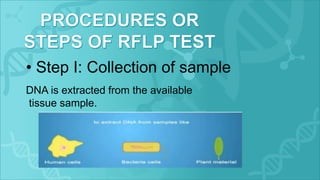
• Step I: Collection of sample
DNA is extracted from the available
tissue sample.
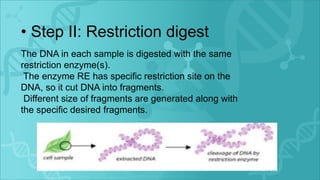
• Step II: Restriction digest
The DNA in each sample is digested with the same
restriction enzyme(s).
The enzyme RE has specific restriction site on the
DNA, so it cut DNA into fragments.
Different size of fragments are generated along with
the specific desired fragments.
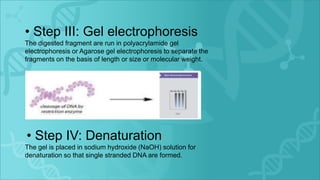
• Step III: Gel electrophoresis
The digested fragment are run in polyacrylamide gel
electrophoresis or Agarose gel electrophoresis to separate the
fragments on the basis of length or size or molecular weight.
• Step IV: Denaturation
The gel is placed in sodium hydroxide (NaOH) solution for
denaturation so that single stranded DNA are formed.
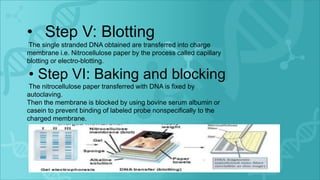
• Step V: Blotting
The single stranded DNA obtained are transferred into charge
membrane i.e. Nitrocellulose paper by the process called capillary
blotting or electro-blotting.
• Step VI: Baking and blocking
The nitrocellulose paper transferred with DNA is fixed by
autoclaving.
Then the membrane is blocked by using bovine serum albumin or
casein to prevent binding of labeled probe nonspecifically to the
charged membrane.
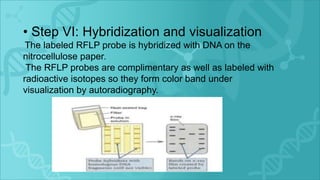
• Step VI: Hybridization and visualization
The labeled RFLP probe is hybridized with DNA on the
nitrocellulose paper.
The RFLP probes are complimentary as well as labeled with
radioactive isotopes so they form color band under
visualization by autoradiography.
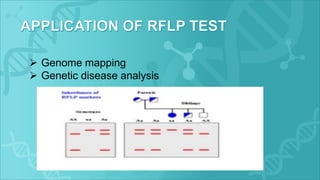
 Genome mapping
 Genetic disease analysis
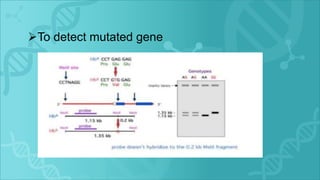
To detect mutated gene
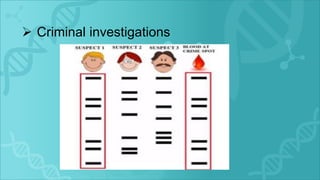
 Criminal investigations
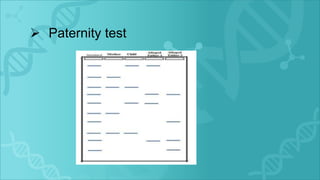
 Paternity test
 Produces semi-dominant markers,
allowing determination of homozygosity,
or heterozygosity.
 Stable and Reproducible, gives constant
results over time, and location.
 No prior information on DNA sequence is
required. Relatively simple technique.
 Very long methodology before results are
gained.
 High labour requirements.
 High quality, and large quantities of DNA must
be used. Must frequently work with radio
isotopes.
 Many probes are not available depending on
species. Too many polymorphisms may be
present for a short probe. Cost of development
is very high due to time, and labour
requirements.
 Low frequency of desired polymorphisms in
polyploid plants (eg. Wheat).
RFLP

RFLP

  • 1.
  • 2.
    CONTENT  Principle ofRFLP  Pattern generated depends mainly on  Considerations for use of RFLPs  Restriction enzymes  Procedures or steps of RFLP test  Application of RFLP test  Advantages  Disadvantages
  • 3.
     RFLP isan enzymatic procedure for separation and identification of desired fragments of DNA.  Using restriction endonuclease enzymes fragments of DNA is obtained and the desired fragment is detected by using restriction probes.  May be used to differentiated two organism by analysis of patterns derived from cleavage of their DNA.
  • 4.
     Differences inDNAs of selected strains  Restriction enzymes used  DNA probe employed for southern hybridization  Point and frameshift mutations  Differences in alleles for a particular sequence
  • 5.
     Relatively slowprocess.  Use of radioisotopes has limited RFLP use to certified laboratories (but non-radioactive labeling systems are now in wide use)  Co-dominant markers; often species-specific; highly locus-specific  Specific to a single clone/restriction enzyme combination Need high quality DNA  Need to develop polymorphic probes  Expensive
  • 6.
     Endonuclease thatcleaves the double-stranded DNA at specific 4-8 nucleotide long palindromic sequence.  TYPE 1  TYPE 2  TYPE 3
  • 7.
    • Step I:Collection of sample DNA is extracted from the available tissue sample.
  • 8.
    • Step II:Restriction digest The DNA in each sample is digested with the same restriction enzyme(s). The enzyme RE has specific restriction site on the DNA, so it cut DNA into fragments. Different size of fragments are generated along with the specific desired fragments.
  • 9.
    • Step III:Gel electrophoresis The digested fragment are run in polyacrylamide gel electrophoresis or Agarose gel electrophoresis to separate the fragments on the basis of length or size or molecular weight. • Step IV: Denaturation The gel is placed in sodium hydroxide (NaOH) solution for denaturation so that single stranded DNA are formed.
  • 10.
    • Step V:Blotting The single stranded DNA obtained are transferred into charge membrane i.e. Nitrocellulose paper by the process called capillary blotting or electro-blotting. • Step VI: Baking and blocking The nitrocellulose paper transferred with DNA is fixed by autoclaving. Then the membrane is blocked by using bovine serum albumin or casein to prevent binding of labeled probe nonspecifically to the charged membrane.
  • 11.
    • Step VI:Hybridization and visualization The labeled RFLP probe is hybridized with DNA on the nitrocellulose paper. The RFLP probes are complimentary as well as labeled with radioactive isotopes so they form color band under visualization by autoradiography.
  • 12.
     Genome mapping Genetic disease analysis
  • 13.
  • 14.
  • 15.
  • 16.
     Produces semi-dominantmarkers, allowing determination of homozygosity, or heterozygosity.  Stable and Reproducible, gives constant results over time, and location.  No prior information on DNA sequence is required. Relatively simple technique.
  • 17.
     Very longmethodology before results are gained.  High labour requirements.  High quality, and large quantities of DNA must be used. Must frequently work with radio isotopes.  Many probes are not available depending on species. Too many polymorphisms may be present for a short probe. Cost of development is very high due to time, and labour requirements.  Low frequency of desired polymorphisms in polyploid plants (eg. Wheat).