PRESENTED BY,
JAYA PRAKASH V
REGULATORY AFFAIRS
REG NO: 218311
CONTENTS...
 INTRODUCTION
 NEED FOR HARMONISE
 ORIGIN OF ICH
 EVOLUTION OF ICH
 OBJECTIVES OF ICH
 ICH MEMBERS
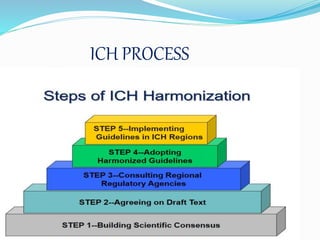
 PROCESS OF ICH
 ICH GUIDELINES
Q,S,E,M
INTRODUCTION
 ICH stands for “International Conference on Harmonization of
Technical Requirements for Registration of Pharmaceuticals for
Human Use”.
 Which is international non-profit Association ,which is unique in bringing
together the regulatory authorities and pharmaceutical industries.
 Where European Union, Japan and the USA involve in scientific and
technical discussions of the testing procedures required to assess and
ensure the safety, quality and efficacy of medicines
 These are the three pillars on which the health of the patients depend.
 ICH Guidelines accepted as law in several Countries to ensure and
access the Q,S,E of medicines but are only used as guidance for the
U.S Food and Drug Administration.
 Each regulatory co-sponsor implements the guidelines according to
its National or Regional requirements.
 They are intended to be used in combination with any regional
requirements.
Need to HarmoniZe
 Many time-consuming and expensive test procedures, in order to market
new products, internationally.
 Over rising costs of health care making safe and efficacious new
treatments available to patients in need.
 Divergence in technical requirements from country to country.
ORIGIN OF ICH
 Harmonization of regulatory requirements was pioneered by the EU,
Europe, in the 1980s as the europe move towards the development of
single market.
 The success achieved in europe demonstrated that harmonization was
feasibile.
 At the same time there were discussions between Europe, Japan and the
US on possibilities for harmonization.
 The birth of ICH took place at a meeting in April 1990.
 Topics selected for harmonisation would be divided into safety ,quality
and efficacy to reflect the three criteria which are the basis for approving
and authorising new medicinal products.
EVOLUTION OF ICH
 First decade :
significant progress in the development of ICH Guidelines on
Safety ,Quality and Efficacy topics and also work on a number of
important multidisciplinary topics.
 Second decade:
implementation of ICH Guidelines in the ICH regions.
Expand communication and information on ICH Guidelines
with other regions
 Third decade :
extending the benefits of harmonisation beyond the ICH regions.
Training ,as well as active participation of other regions in
Guideline development is seen as key in this effort.
OBJECTIVES OF ICH
 Promote public health by early availability of drug in the market.
 Maintaining safeguards on quality, safety and efficacy.
 Improve efficiency of new drug development ,Reduce registration cost.
 Less expensive drugs for patients.
 Prevent the duplication of clinical trails in humans.
 Minimize the animal use with out compromising in safety ,efficacy of
the product.
 Mutual acceptance of clinical data by regulatory authority.
 Reducing testing duplication.
ICH MEMBERS
 EU
 EFPIA (European federation of pharmaceutical industries’
associations).
 MHLW (Ministry of health, Labor and welfare, Japan).
 JPMA (Japan Pharmaceuticals manufacturers Association).
 US FDA.
 PhRMA(pharmaceutical research and manufacturers
association).
 Observers : WHO, TPP(canada).
 International federation of Pharmaceutical manufacturer’s
association.
ICH PROCESS
ICH GUIDELINES
 The guidelines of ICH are broadly categorized into four types.
1) Quality guidelines.
2) Safety guidelines.
3) Efficacy guidelines.
4) Multidisciplinary guidelines.
QUALITY :
Harmonization achievements in the Quality area include such as the
conduct of stability studies, defining relevant thresholds for impurities
testing and a more flexible approach to pharmaceutical quality based
on Good Manufacturing Practice (GMP) risk management.
SAFETY :
ICH has produced a comprehensive set of safety Guidelines to
potential risks like carcinogenicity, genotoxicity and reprotoxicity etc.,
EFFICACY :
The work carried out by ICH under the Efficacy heading is
concerned with the design, conduct, safety and reporting of clinical
trials. It also covers novel types of medicines derived from
biotechnological processes and the use of pharmacogenetics /
genomics techniques to produce better targeted medicines.
MULTIDISCPLINARY :
These are the cross-cutting topics which do not fit uniquely into one
of the Quality, Safety and Efficacy categories. It includes the ICH
medical terminology (MedDRA), the Common Technical Document
(CTD) and the development of Electronic Standards for the Transfer
of Regulatory Information (ESTRI).
QUALITY GUIDELINES
 Q1A - Q1F :Stability
 Q2 : Analytical Validation
 Q3A - Q3D : Impurities
 Q4 - Q4B : Pharmacopoeias
 Q5A - Q5E : Quality of Biotechnological Products
 Q6A- Q6B : Specifications
 Q7 : Good Manufacturing Practice
 Q8 : Pharmaceutical Development
 Q9 : Quality Risk Management
 Q10 : Pharmaceutical Quality System
 Q11 : Development and Manufacture of Drug Substances
 Q12 : Lifecycle Management
 Q13 : Continuous Manufacturing of Drug Substances and Drug Products
 Q14 : Analytical Procedure Development
SAFETY GUIDELINES
 S1A - S1C : Carcinogenicity Studies
 S2 : Genotoxicity Studies
 S3A - S3B : Toxicokinetics and Pharmacokinetics
 S4 : Toxicity Testing
 S5 : Reproductive Toxicology
 S6 : Biotechnological Products
 S7A - S7B : Pharmacology Studies
 S8 : Immunotoxicology Studies
 S9 : Nonclinical Evaluation for Anticancer Pharmaceuticals
 S10 : Photosafety Evaluation
 S11 : Nonclinical Pediatric Safety
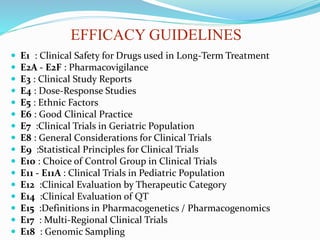
EFFICACY GUIDELINES
 E1 : Clinical Safety for Drugs used in Long-Term Treatment
 E2A - E2F : Pharmacovigilance
 E3 : Clinical Study Reports
 E4 : Dose-Response Studies
 E5 : Ethnic Factors
 E6 : Good Clinical Practice
 E7 :Clinical Trials in Geriatric Population
 E8 : General Considerations for Clinical Trials
 E9 :Statistical Principles for Clinical Trials
 E10 : Choice of Control Group in Clinical Trials
 E11 - E11A : Clinical Trials in Pediatric Population
 E12 :Clinical Evaluation by Therapeutic Category
 E14 :Clinical Evaluation of QT
 E15 :Definitions in Pharmacogenetics / Pharmacogenomics
 E17 : Multi-Regional Clinical Trials
 E18 : Genomic Sampling
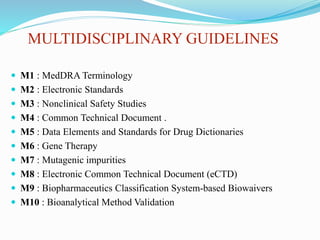
MULTIDISCIPLINARY GUIDELINES
 M1 : MedDRA Terminology
 M2 : Electronic Standards
 M3 : Nonclinical Safety Studies
 M4 : Common Technical Document .
 M5 : Data Elements and Standards for Drug Dictionaries
 M6 : Gene Therapy
 M7 : Mutagenic impurities
 M8 : Electronic Common Technical Document (eCTD)
 M9 : Biopharmaceutics Classification System-based Biowaivers
 M10 : Bioanalytical Method Validation
THANK YOU
?

ICH AND ICH GUIDELINES

  • 1.
    PRESENTED BY, JAYA PRAKASHV REGULATORY AFFAIRS REG NO: 218311
  • 2.
    CONTENTS...  INTRODUCTION  NEEDFOR HARMONISE  ORIGIN OF ICH  EVOLUTION OF ICH  OBJECTIVES OF ICH  ICH MEMBERS  PROCESS OF ICH  ICH GUIDELINES Q,S,E,M
  • 3.
    INTRODUCTION  ICH standsfor “International Conference on Harmonization of Technical Requirements for Registration of Pharmaceuticals for Human Use”.  Which is international non-profit Association ,which is unique in bringing together the regulatory authorities and pharmaceutical industries.  Where European Union, Japan and the USA involve in scientific and technical discussions of the testing procedures required to assess and ensure the safety, quality and efficacy of medicines  These are the three pillars on which the health of the patients depend.
  • 4.
     ICH Guidelinesaccepted as law in several Countries to ensure and access the Q,S,E of medicines but are only used as guidance for the U.S Food and Drug Administration.  Each regulatory co-sponsor implements the guidelines according to its National or Regional requirements.  They are intended to be used in combination with any regional requirements.
  • 5.
    Need to HarmoniZe Many time-consuming and expensive test procedures, in order to market new products, internationally.  Over rising costs of health care making safe and efficacious new treatments available to patients in need.  Divergence in technical requirements from country to country.
  • 6.
    ORIGIN OF ICH Harmonization of regulatory requirements was pioneered by the EU, Europe, in the 1980s as the europe move towards the development of single market.  The success achieved in europe demonstrated that harmonization was feasibile.  At the same time there were discussions between Europe, Japan and the US on possibilities for harmonization.  The birth of ICH took place at a meeting in April 1990.  Topics selected for harmonisation would be divided into safety ,quality and efficacy to reflect the three criteria which are the basis for approving and authorising new medicinal products.
  • 7.
    EVOLUTION OF ICH First decade : significant progress in the development of ICH Guidelines on Safety ,Quality and Efficacy topics and also work on a number of important multidisciplinary topics.  Second decade: implementation of ICH Guidelines in the ICH regions. Expand communication and information on ICH Guidelines with other regions  Third decade : extending the benefits of harmonisation beyond the ICH regions. Training ,as well as active participation of other regions in Guideline development is seen as key in this effort.
  • 8.
    OBJECTIVES OF ICH Promote public health by early availability of drug in the market.  Maintaining safeguards on quality, safety and efficacy.  Improve efficiency of new drug development ,Reduce registration cost.  Less expensive drugs for patients.  Prevent the duplication of clinical trails in humans.  Minimize the animal use with out compromising in safety ,efficacy of the product.  Mutual acceptance of clinical data by regulatory authority.  Reducing testing duplication.
  • 9.
    ICH MEMBERS  EU EFPIA (European federation of pharmaceutical industries’ associations).  MHLW (Ministry of health, Labor and welfare, Japan).  JPMA (Japan Pharmaceuticals manufacturers Association).  US FDA.  PhRMA(pharmaceutical research and manufacturers association).  Observers : WHO, TPP(canada).  International federation of Pharmaceutical manufacturer’s association.
  • 10.
  • 11.
    ICH GUIDELINES  Theguidelines of ICH are broadly categorized into four types. 1) Quality guidelines. 2) Safety guidelines. 3) Efficacy guidelines. 4) Multidisciplinary guidelines.
  • 12.
    QUALITY : Harmonization achievementsin the Quality area include such as the conduct of stability studies, defining relevant thresholds for impurities testing and a more flexible approach to pharmaceutical quality based on Good Manufacturing Practice (GMP) risk management. SAFETY : ICH has produced a comprehensive set of safety Guidelines to potential risks like carcinogenicity, genotoxicity and reprotoxicity etc.,
  • 13.
    EFFICACY : The workcarried out by ICH under the Efficacy heading is concerned with the design, conduct, safety and reporting of clinical trials. It also covers novel types of medicines derived from biotechnological processes and the use of pharmacogenetics / genomics techniques to produce better targeted medicines. MULTIDISCPLINARY : These are the cross-cutting topics which do not fit uniquely into one of the Quality, Safety and Efficacy categories. It includes the ICH medical terminology (MedDRA), the Common Technical Document (CTD) and the development of Electronic Standards for the Transfer of Regulatory Information (ESTRI).
  • 14.
    QUALITY GUIDELINES  Q1A- Q1F :Stability  Q2 : Analytical Validation  Q3A - Q3D : Impurities  Q4 - Q4B : Pharmacopoeias  Q5A - Q5E : Quality of Biotechnological Products  Q6A- Q6B : Specifications  Q7 : Good Manufacturing Practice  Q8 : Pharmaceutical Development  Q9 : Quality Risk Management  Q10 : Pharmaceutical Quality System  Q11 : Development and Manufacture of Drug Substances  Q12 : Lifecycle Management  Q13 : Continuous Manufacturing of Drug Substances and Drug Products  Q14 : Analytical Procedure Development
  • 15.
    SAFETY GUIDELINES  S1A- S1C : Carcinogenicity Studies  S2 : Genotoxicity Studies  S3A - S3B : Toxicokinetics and Pharmacokinetics  S4 : Toxicity Testing  S5 : Reproductive Toxicology  S6 : Biotechnological Products  S7A - S7B : Pharmacology Studies  S8 : Immunotoxicology Studies  S9 : Nonclinical Evaluation for Anticancer Pharmaceuticals  S10 : Photosafety Evaluation  S11 : Nonclinical Pediatric Safety
  • 16.
    EFFICACY GUIDELINES  E1: Clinical Safety for Drugs used in Long-Term Treatment  E2A - E2F : Pharmacovigilance  E3 : Clinical Study Reports  E4 : Dose-Response Studies  E5 : Ethnic Factors  E6 : Good Clinical Practice  E7 :Clinical Trials in Geriatric Population  E8 : General Considerations for Clinical Trials  E9 :Statistical Principles for Clinical Trials  E10 : Choice of Control Group in Clinical Trials  E11 - E11A : Clinical Trials in Pediatric Population  E12 :Clinical Evaluation by Therapeutic Category  E14 :Clinical Evaluation of QT  E15 :Definitions in Pharmacogenetics / Pharmacogenomics  E17 : Multi-Regional Clinical Trials  E18 : Genomic Sampling
  • 17.
    MULTIDISCIPLINARY GUIDELINES  M1: MedDRA Terminology  M2 : Electronic Standards  M3 : Nonclinical Safety Studies  M4 : Common Technical Document .  M5 : Data Elements and Standards for Drug Dictionaries  M6 : Gene Therapy  M7 : Mutagenic impurities  M8 : Electronic Common Technical Document (eCTD)  M9 : Biopharmaceutics Classification System-based Biowaivers  M10 : Bioanalytical Method Validation
  • 18.