ICH Guidelines
PRSENTED BY : MANISH SHANKARPURE
M.PHARM ( QUALITY ASSURANCES AND TECHNIQUES )
INTRODUCTION
The International Conference on Harmonisation of
Technical Requirements for Registration of
Pharmaceuticals for Human Use (ICH) is a unique
project that brings together the regulatory
authorities of Europe, Japan and the United States
and experts from the pharmaceutical industry in the
three regions to discuss scientific and technical
aspects of product registration.
AIM
ICH was established in 1990 as a joint regulatory/industry
project to improve, through harmonisation, the efficiency of
the process for developing and registering new medicinal
products in Europe, Japan and the United States, in order to
make these products available to patients with a minimum of
delay.
The six parties to ICH represent the regulatory bodies and
researchbased industry in the three regions, Europe, Japan
and the USA, where the vast majority of new medicines are
currently developed.
OBJECTIVE
 More economical use of human, animal, and material resources.
 Elimination of unnecessary delay in the global development &
availability of new medicines.
 Maintaining safeguards on Quality, safety, efficacy and regulatory
obligations to protect public. health.
ICH ORGANISATION STRUCTURE
 The ICH structure consists of the
 ICH Steering Committee,
 ICH Coordinators,
 ICH Secretariat and
 ICH Working Groups.
 The ICH Global Cooperation Group (GCG) and the ICH MedDRA Management Board are sub-
committees of the ICH Steering Committee.
ICH PARTIES
 European Commission - European Union (EU).
 European Federation of Pharmaceutical Industries and Associations (EFPIA).
 Ministry of Health, Labour and Welfare, Japan (MHLW).
 Japan Pharmaceutical Manufacturers Association (JPMA).
 US Food and Drug Administration (FDA).
 Pharmaceutical Research and Manufacturers of America (PhRMA).
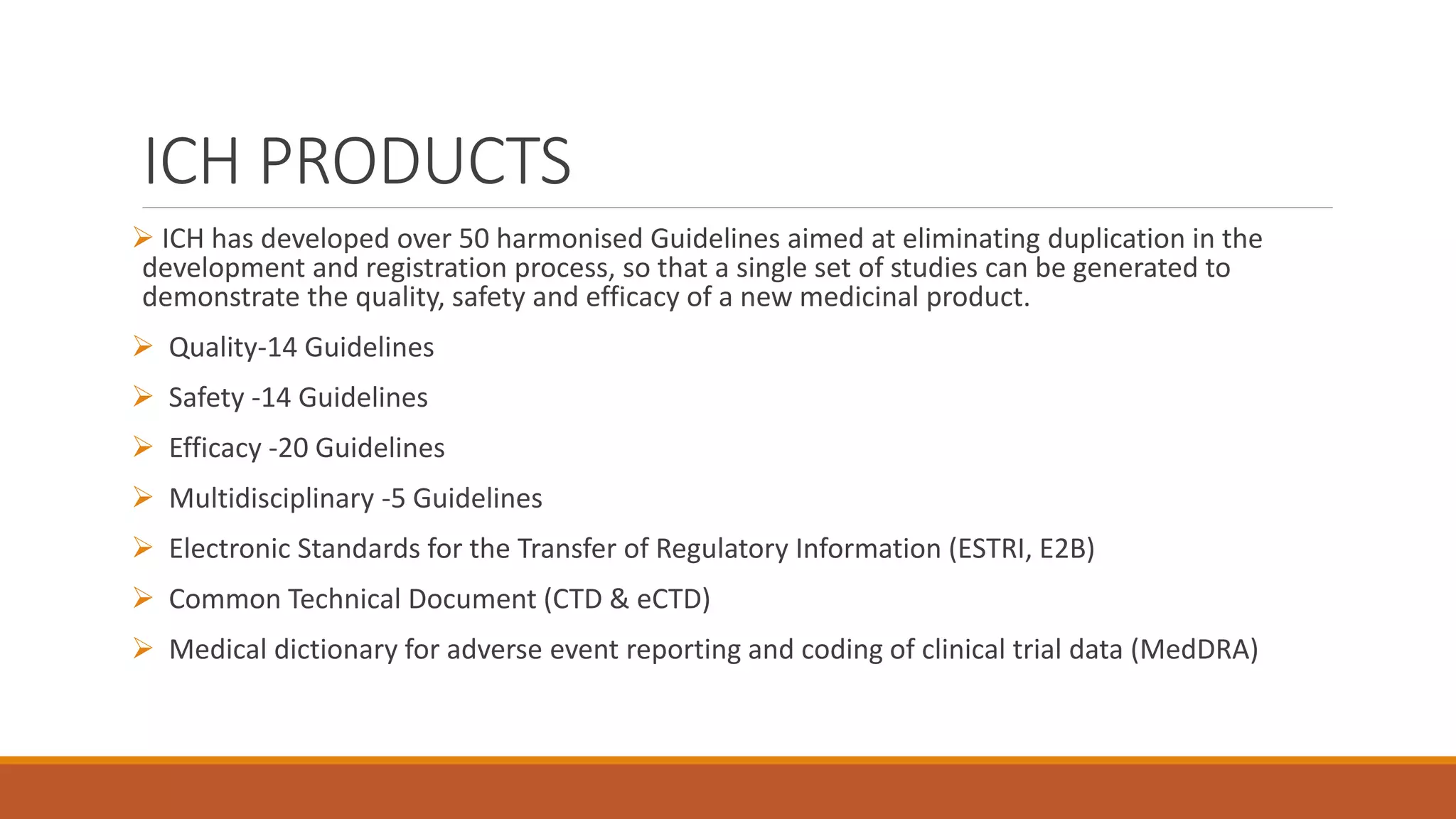
ICH PRODUCTS
 ICH has developed over 50 harmonised Guidelines aimed at eliminating duplication in the
development and registration process, so that a single set of studies can be generated to
demonstrate the quality, safety and efficacy of a new medicinal product.
 Quality-14 Guidelines
 Safety -14 Guidelines
 Efficacy -20 Guidelines
 Multidisciplinary -5 Guidelines
 Electronic Standards for the Transfer of Regulatory Information (ESTRI, E2B)
 Common Technical Document (CTD & eCTD)
 Medical dictionary for adverse event reporting and coding of clinical trial data (MedDRA)
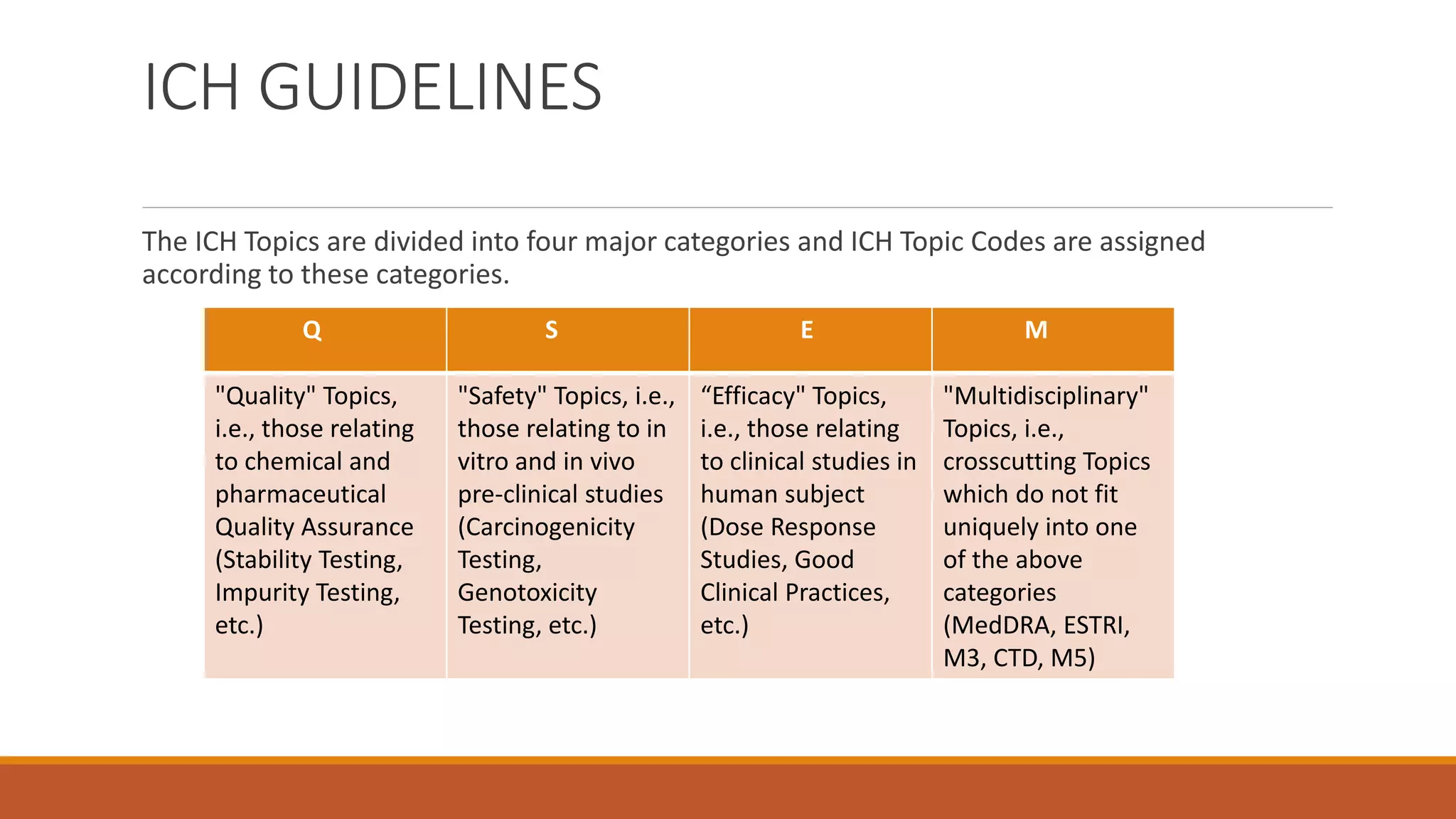
ICH GUIDELINES
The ICH Topics are divided into four major categories and ICH Topic Codes are assigned
according to these categories.
Q S E M
"Quality" Topics,
i.e., those relating
to chemical and
pharmaceutical
Quality Assurance
(Stability Testing,
Impurity Testing,
etc.)
"Safety" Topics, i.e.,
those relating to in
vitro and in vivo
pre-clinical studies
(Carcinogenicity
Testing,
Genotoxicity
Testing, etc.)
“Efficacy" Topics,
i.e., those relating
to clinical studies in
human subject
(Dose Response
Studies, Good
Clinical Practices,
etc.)
"Multidisciplinary"
Topics, i.e.,
crosscutting Topics
which do not fit
uniquely into one
of the above
categories
(MedDRA, ESTRI,
M3, CTD, M5)
QUALITY GUIDELINES
 Harmonisation achievements in the Quality area include pivotal
milestones such as the conduct of stability studies, defining relevant
thresholds for impurities testing and a more flexible approach to
pharmaceutical quality based on Good Manufacturing Practice
(GMP) risk management.
 Consists of Q1A-Q1F, Q2, Q3A-Q3D, Q4-Q4B, Q5A-Q5E, Q6A-Q6B,
Q7, Q8, Q9, Q10, Q11 , Q12, Q13 & Q14.
 Q1A-Q1F: Stability
Q1A(R2): Stability Testing of New Drug Substances and Products
Q1A Q1B: Stability Testing : Photostability Testing of New Drug Substances and Products
Q1C: Stability Testing for New Dosage Forms
Q1D: Bracketing and Matrixing Designs for Stability Testing of New Drug Substances and
Products
Q1E: Evaluation of Stability Data
Q1F: Stability Data Package for Registration Applications in Climatic Zones III and IV.
 Q2: Analytical Validation Validation of Analytical Procedures: Methodology
 Q3A-Q3D: Impurities
Q3A(R2): Impurities in New Drug Substances
Q3B(R2): Impurities in New Drug Products
Q3C(R5): Impurities: Guideline for Residual SolventsQ3C,Q3C(M)
Q3D: Guideline for Elemental Impurities
Q3D: Implementation of Guideline for Elemental Impurities.
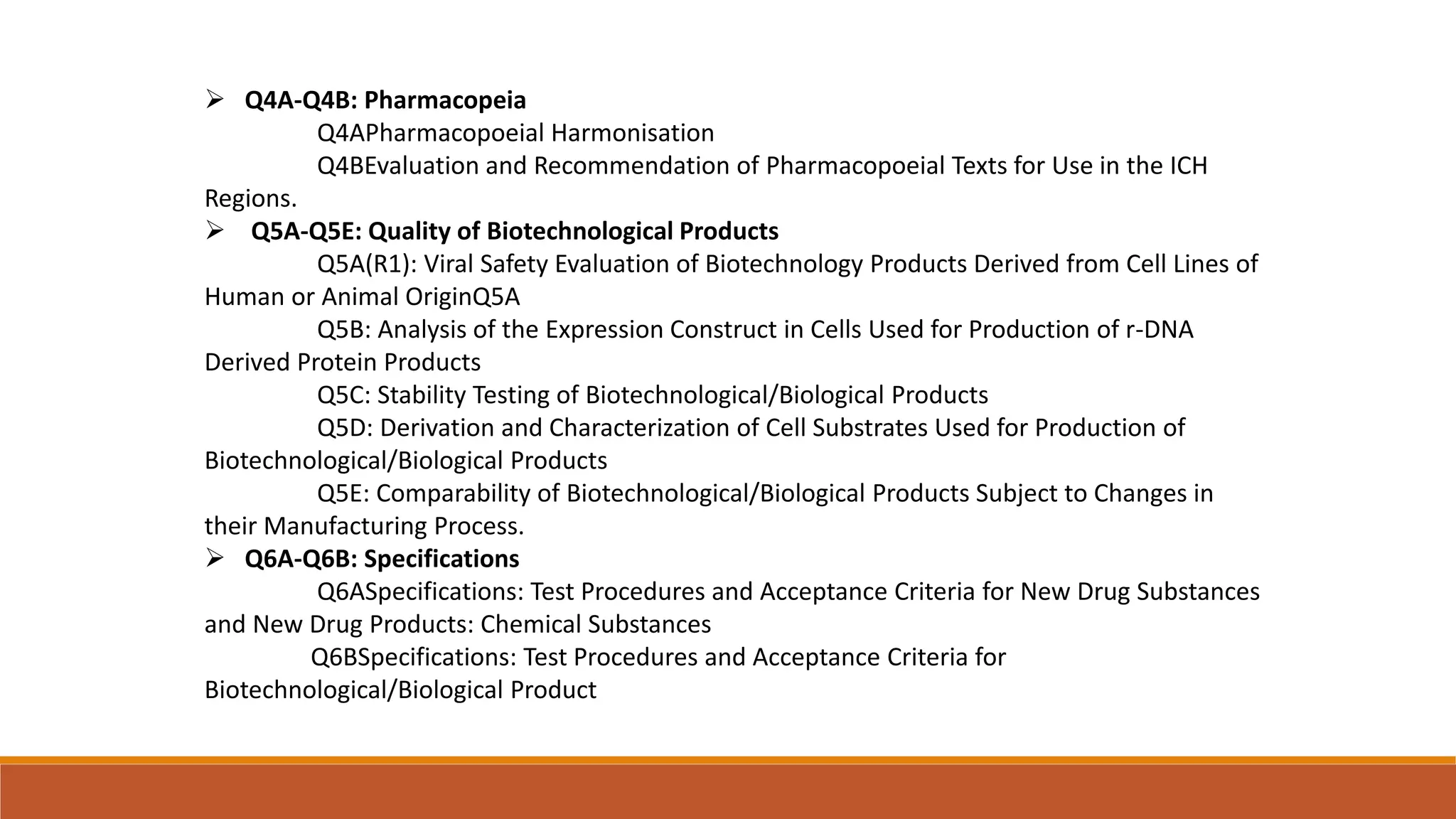
 Q4A-Q4B: Pharmacopeia
Q4APharmacopoeial Harmonisation
Q4BEvaluation and Recommendation of Pharmacopoeial Texts for Use in the ICH
Regions.
 Q5A-Q5E: Quality of Biotechnological Products
Q5A(R1): Viral Safety Evaluation of Biotechnology Products Derived from Cell Lines of
Human or Animal OriginQ5A
Q5B: Analysis of the Expression Construct in Cells Used for Production of r-DNA
Derived Protein Products
Q5C: Stability Testing of Biotechnological/Biological Products
Q5D: Derivation and Characterization of Cell Substrates Used for Production of
Biotechnological/Biological Products
Q5E: Comparability of Biotechnological/Biological Products Subject to Changes in
their Manufacturing Process.
 Q6A-Q6B: Specifications
Q6ASpecifications: Test Procedures and Acceptance Criteria for New Drug Substances
and New Drug Products: Chemical Substances
Q6BSpecifications: Test Procedures and Acceptance Criteria for
Biotechnological/Biological Product
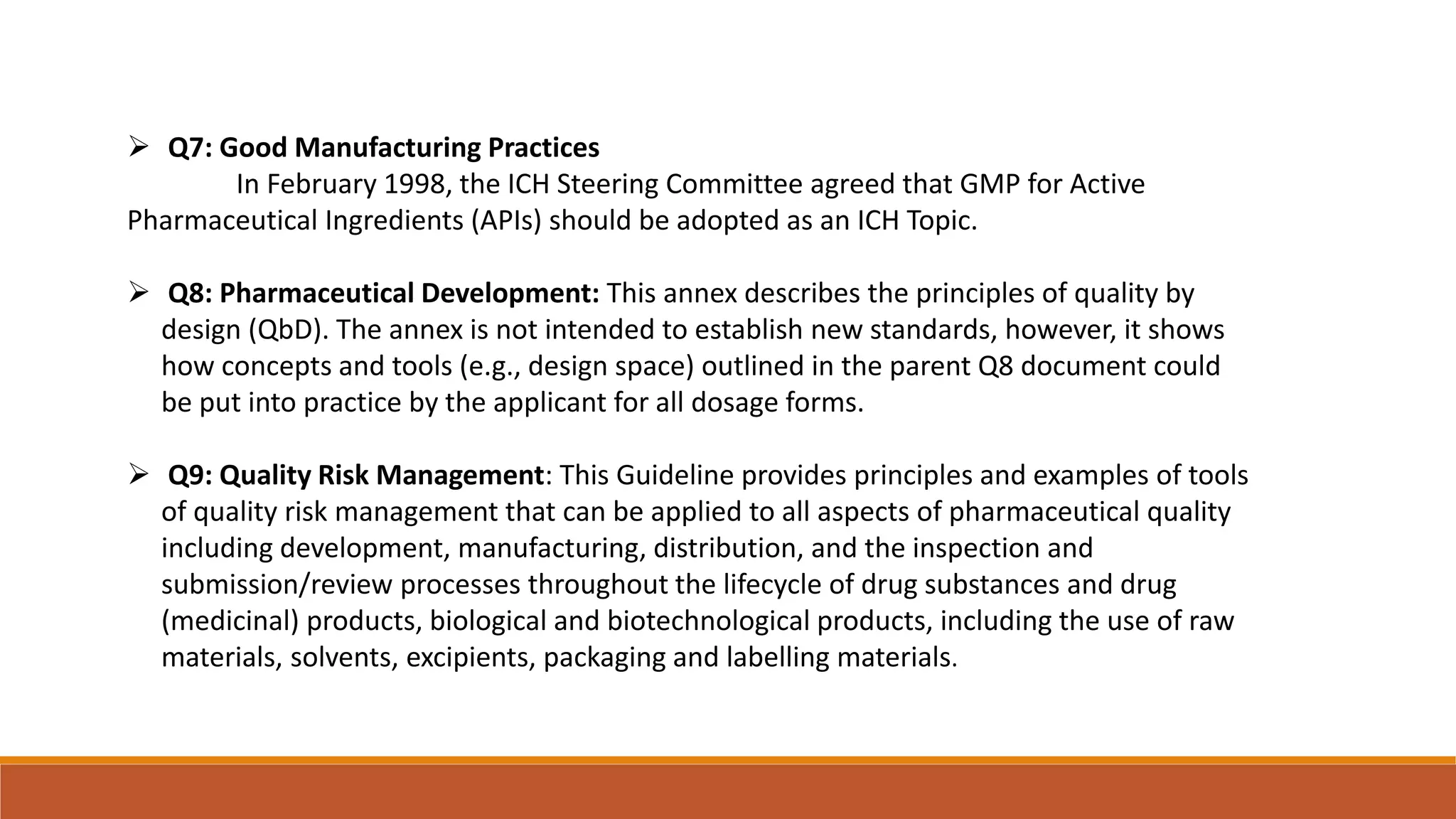
 Q7: Good Manufacturing Practices
In February 1998, the ICH Steering Committee agreed that GMP for Active
Pharmaceutical Ingredients (APIs) should be adopted as an ICH Topic.
 Q8: Pharmaceutical Development: This annex describes the principles of quality by
design (QbD). The annex is not intended to establish new standards, however, it shows
how concepts and tools (e.g., design space) outlined in the parent Q8 document could
be put into practice by the applicant for all dosage forms.
 Q9: Quality Risk Management: This Guideline provides principles and examples of tools
of quality risk management that can be applied to all aspects of pharmaceutical quality
including development, manufacturing, distribution, and the inspection and
submission/review processes throughout the lifecycle of drug substances and drug
(medicinal) products, biological and biotechnological products, including the use of raw
materials, solvents, excipients, packaging and labelling materials.
 Q10: Pharmaceutical Quality System
This Guideline applies to pharmaceutical drug substances and drug products,
including biotechnology and biological products, throughout the product lifecycle.
 Q11: Development and Manufacture of Drug Substances
This new guidance is proposed for Active Pharmaceutical Ingredients (APIs) harmonising
the scientific and technical principles relating to the description and justification of the
development and manufacturing process (CTD sections S 2.2. - S 2.6) of Drug Substances
including both chemical entities and biotechnological/biological entities.
 Q12: Lifecycle Management
This new guideline is proposed to provide guidance on a framework to facilitate the
management of post-approval Chemistry, Manufacturing and Controls (CMC) changes in a
more predictable and efficient manner across the product lifecycle. Adoption of this new
ICH Guideline will promote innovation and continual improvement, and strengthen quality
assurance and reliable supply of product, including proactive planning of supply chain
adjustments.
 Q13: Continous manufacturing of drug substances and drug
products
This topic was endorsed by the Assembly in June 2018. This new
Guideline is proposed to:
• Capture key technical and regulatory considerations that promote
harmonisation, including certain Current Good Manufacturing Practices
(CGMP) elements specific to Continuous Manufacturing (CM)
• Allow drug manufacturers to employ flexible approaches to develop,
implement, or integrate CM for the manufacture – drug substances and
drug products – of small molecules and therapeutic proteins for new and
existing products,
• Provide guidance to industry and regulatory agencies regarding
regulatory expectations on the development, implementation, and
assessment of CM technologies used in the manufacture of drug
substances and drug products.
 Q 14 Analytical procedure development
The new guideline is proposed to harmonise the scientific approaches of
Analytical Procedure Development, and to provide the principles relating to the
description of Analytical Procedure Development process. This new guideline is
intended to improve regulatory communication between industry and regulators
and facilitate more efficient, sound scientific and risk-based approval as well as
post-approval change management of analytical procedures.

ICH - quality guidelines

  • 1.
    ICH Guidelines PRSENTED BY: MANISH SHANKARPURE M.PHARM ( QUALITY ASSURANCES AND TECHNIQUES )
  • 2.
    INTRODUCTION The International Conferenceon Harmonisation of Technical Requirements for Registration of Pharmaceuticals for Human Use (ICH) is a unique project that brings together the regulatory authorities of Europe, Japan and the United States and experts from the pharmaceutical industry in the three regions to discuss scientific and technical aspects of product registration.
  • 3.
    AIM ICH was establishedin 1990 as a joint regulatory/industry project to improve, through harmonisation, the efficiency of the process for developing and registering new medicinal products in Europe, Japan and the United States, in order to make these products available to patients with a minimum of delay. The six parties to ICH represent the regulatory bodies and researchbased industry in the three regions, Europe, Japan and the USA, where the vast majority of new medicines are currently developed.
  • 4.
    OBJECTIVE  More economicaluse of human, animal, and material resources.  Elimination of unnecessary delay in the global development & availability of new medicines.  Maintaining safeguards on Quality, safety, efficacy and regulatory obligations to protect public. health.
  • 5.
    ICH ORGANISATION STRUCTURE The ICH structure consists of the  ICH Steering Committee,  ICH Coordinators,  ICH Secretariat and  ICH Working Groups.  The ICH Global Cooperation Group (GCG) and the ICH MedDRA Management Board are sub- committees of the ICH Steering Committee.
  • 6.
    ICH PARTIES  EuropeanCommission - European Union (EU).  European Federation of Pharmaceutical Industries and Associations (EFPIA).  Ministry of Health, Labour and Welfare, Japan (MHLW).  Japan Pharmaceutical Manufacturers Association (JPMA).  US Food and Drug Administration (FDA).  Pharmaceutical Research and Manufacturers of America (PhRMA).
  • 7.
    ICH PRODUCTS  ICHhas developed over 50 harmonised Guidelines aimed at eliminating duplication in the development and registration process, so that a single set of studies can be generated to demonstrate the quality, safety and efficacy of a new medicinal product.  Quality-14 Guidelines  Safety -14 Guidelines  Efficacy -20 Guidelines  Multidisciplinary -5 Guidelines  Electronic Standards for the Transfer of Regulatory Information (ESTRI, E2B)  Common Technical Document (CTD & eCTD)  Medical dictionary for adverse event reporting and coding of clinical trial data (MedDRA)
  • 8.
    ICH GUIDELINES The ICHTopics are divided into four major categories and ICH Topic Codes are assigned according to these categories. Q S E M "Quality" Topics, i.e., those relating to chemical and pharmaceutical Quality Assurance (Stability Testing, Impurity Testing, etc.) "Safety" Topics, i.e., those relating to in vitro and in vivo pre-clinical studies (Carcinogenicity Testing, Genotoxicity Testing, etc.) “Efficacy" Topics, i.e., those relating to clinical studies in human subject (Dose Response Studies, Good Clinical Practices, etc.) "Multidisciplinary" Topics, i.e., crosscutting Topics which do not fit uniquely into one of the above categories (MedDRA, ESTRI, M3, CTD, M5)
  • 9.
    QUALITY GUIDELINES  Harmonisationachievements in the Quality area include pivotal milestones such as the conduct of stability studies, defining relevant thresholds for impurities testing and a more flexible approach to pharmaceutical quality based on Good Manufacturing Practice (GMP) risk management.  Consists of Q1A-Q1F, Q2, Q3A-Q3D, Q4-Q4B, Q5A-Q5E, Q6A-Q6B, Q7, Q8, Q9, Q10, Q11 , Q12, Q13 & Q14.
  • 10.
     Q1A-Q1F: Stability Q1A(R2):Stability Testing of New Drug Substances and Products Q1A Q1B: Stability Testing : Photostability Testing of New Drug Substances and Products Q1C: Stability Testing for New Dosage Forms Q1D: Bracketing and Matrixing Designs for Stability Testing of New Drug Substances and Products Q1E: Evaluation of Stability Data Q1F: Stability Data Package for Registration Applications in Climatic Zones III and IV.  Q2: Analytical Validation Validation of Analytical Procedures: Methodology  Q3A-Q3D: Impurities Q3A(R2): Impurities in New Drug Substances Q3B(R2): Impurities in New Drug Products Q3C(R5): Impurities: Guideline for Residual SolventsQ3C,Q3C(M) Q3D: Guideline for Elemental Impurities Q3D: Implementation of Guideline for Elemental Impurities.
  • 11.
     Q4A-Q4B: Pharmacopeia Q4APharmacopoeialHarmonisation Q4BEvaluation and Recommendation of Pharmacopoeial Texts for Use in the ICH Regions.  Q5A-Q5E: Quality of Biotechnological Products Q5A(R1): Viral Safety Evaluation of Biotechnology Products Derived from Cell Lines of Human or Animal OriginQ5A Q5B: Analysis of the Expression Construct in Cells Used for Production of r-DNA Derived Protein Products Q5C: Stability Testing of Biotechnological/Biological Products Q5D: Derivation and Characterization of Cell Substrates Used for Production of Biotechnological/Biological Products Q5E: Comparability of Biotechnological/Biological Products Subject to Changes in their Manufacturing Process.  Q6A-Q6B: Specifications Q6ASpecifications: Test Procedures and Acceptance Criteria for New Drug Substances and New Drug Products: Chemical Substances Q6BSpecifications: Test Procedures and Acceptance Criteria for Biotechnological/Biological Product
  • 12.
     Q7: GoodManufacturing Practices In February 1998, the ICH Steering Committee agreed that GMP for Active Pharmaceutical Ingredients (APIs) should be adopted as an ICH Topic.  Q8: Pharmaceutical Development: This annex describes the principles of quality by design (QbD). The annex is not intended to establish new standards, however, it shows how concepts and tools (e.g., design space) outlined in the parent Q8 document could be put into practice by the applicant for all dosage forms.  Q9: Quality Risk Management: This Guideline provides principles and examples of tools of quality risk management that can be applied to all aspects of pharmaceutical quality including development, manufacturing, distribution, and the inspection and submission/review processes throughout the lifecycle of drug substances and drug (medicinal) products, biological and biotechnological products, including the use of raw materials, solvents, excipients, packaging and labelling materials.
  • 13.
     Q10: PharmaceuticalQuality System This Guideline applies to pharmaceutical drug substances and drug products, including biotechnology and biological products, throughout the product lifecycle.  Q11: Development and Manufacture of Drug Substances This new guidance is proposed for Active Pharmaceutical Ingredients (APIs) harmonising the scientific and technical principles relating to the description and justification of the development and manufacturing process (CTD sections S 2.2. - S 2.6) of Drug Substances including both chemical entities and biotechnological/biological entities.  Q12: Lifecycle Management This new guideline is proposed to provide guidance on a framework to facilitate the management of post-approval Chemistry, Manufacturing and Controls (CMC) changes in a more predictable and efficient manner across the product lifecycle. Adoption of this new ICH Guideline will promote innovation and continual improvement, and strengthen quality assurance and reliable supply of product, including proactive planning of supply chain adjustments.
  • 14.
     Q13: Continousmanufacturing of drug substances and drug products This topic was endorsed by the Assembly in June 2018. This new Guideline is proposed to: • Capture key technical and regulatory considerations that promote harmonisation, including certain Current Good Manufacturing Practices (CGMP) elements specific to Continuous Manufacturing (CM) • Allow drug manufacturers to employ flexible approaches to develop, implement, or integrate CM for the manufacture – drug substances and drug products – of small molecules and therapeutic proteins for new and existing products, • Provide guidance to industry and regulatory agencies regarding regulatory expectations on the development, implementation, and assessment of CM technologies used in the manufacture of drug substances and drug products.
  • 15.
     Q 14Analytical procedure development The new guideline is proposed to harmonise the scientific approaches of Analytical Procedure Development, and to provide the principles relating to the description of Analytical Procedure Development process. This new guideline is intended to improve regulatory communication between industry and regulators and facilitate more efficient, sound scientific and risk-based approval as well as post-approval change management of analytical procedures.