Fixed-dose combinations banned
in India
Presented by,
Jaya prakash v,
218311.
Shri Vishnu College of Pharmacy (Autonomous)
Affiliated to Andhra Univ., Visakhapatnam; Approved by AICTE and PCI, New Delhi, and recognised by APSCHE
1
CONTENTS
• Introduction
• Type of fdcs
• A chronological view on some case studies
• The regulatory framework for fdcs in india
• Misadventure with fdcs
• A glimpse of the parliamentary report on banning
fdcs
• Conclusion
2
INTRODUCTION
• Fixed-dose combination (FDC) medicines contain more than
one approved active pharmaceutical ingredient (API), are
manufactured as a fixed-dose and packed in a single dosage
form.
• To treat either single ailment or multiple co-morbid conditions.
• Moreover, the combination should also prove the superiority
over single compound administration in terms of safety,
efficacy and compliance.
3
• The medical fraternity in India understands that the FDCs has
better efficacy than a single compound, lesser adverse drug
effects, synergistic effects, and reducing the drug resistance.
• The fundamental aim of pharmaceutical company in India is to
create the product in a cost-effective manner.
• Pharmaceutical companies are tempted on FDCs because it is
beneficial to combine the existing active pharmaceutical
ingredients , than designing a new molecule or formulation of
a completely new dosage form.
4
• According to the Drug Price Control Order (DPCO), 2013 the
drugs which are introduced in the national list of essential
medicines (NLEM) were put under the control of the National
Pharmaceutical Pricing Authority of India (NPPA).
• Therefore, to escape from this price control, the companies
have reformulated specific drugs into FDCs.
• Depending on the justification of the combinations they
categorise FDCs into superior, substandard and unfriendly .
5
Type 1
• FDCs in which one or more APIs is a New Drug.
• To get the clinical trials and manufacturing permissions, they
will be treated in the same way as any other ‘New Drug’.
Type 2
• FDCs containing APIs which are already approved or
marketed individually and are made in combination for the
first time.
• Clinical trial permission for such FDCs can be taken by
submitting the summary of the data for pharmacological,
toxicological and clinical trials of the individual APIs.
6
TYPE OF FDCS
Type 3
• It includes the FDCs which are already marketed, but they
claim a change in the ratio of APIs or new therapeutic
indication.
• For the clinical trial approvals of these, the appropriate
rationale should be submitted and for the marketing approvals,
clinical trials data should be submitted.
7
Type 4
• These FDCs contain APIs which has been used commonly for
a particular indication.
• However, their concomitant use is often necessary, and no
claim is proposed to be made other than convenience, stable
dosage form, no significant pharmacokinetic and
pharmacodynamic interactions between the ingredients.
• To grant marketing permissions for these FDCs, they should
have an acceptable rationale, and no additional preclinical or
clinical data is required.
8
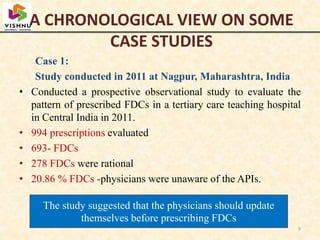
A CHRONOLOGICAL VIEW ON SOME
CASE STUDIES
Case 1:
Study conducted in 2011 at Nagpur, Maharashtra, India
• Conducted a prospective observational study to evaluate the
pattern of prescribed FDCs in a tertiary care teaching hospital
in Central India in 2011.
• 994 prescriptions evaluated
• 693- FDCs
• 278 FDCs were rational
• 20.86 % FDCs -physicians were unaware of the APIs.
9
The study suggested that the physicians should update
themselves before prescribing FDCs
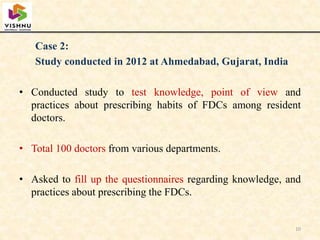
Case 2:
Study conducted in 2012 at Ahmedabad, Gujarat, India
• Conducted study to test knowledge, point of view and
practices about prescribing habits of FDCs among resident
doctors.
• Total 100 doctors from various departments.
• Asked to fill up the questionnaires regarding knowledge, and
practices about prescribing the FDCs.
10
11
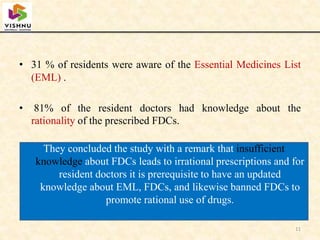
• 31 % of residents were aware of the Essential Medicines List
(EML) .
• 81% of the resident doctors had knowledge about the
rationality of the prescribed FDCs.
They concluded the study with a remark that insufficient
knowledge about FDCs leads to irrational prescriptions and for
resident doctors it is prerequisite to have an updated
knowledge about EML, FDCs, and likewise banned FDCs to
promote rational use of drugs.
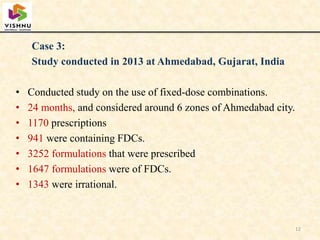
Case 3:
Study conducted in 2013 at Ahmedabad, Gujarat, India
• Conducted study on the use of fixed-dose combinations.
• 24 months, and considered around 6 zones of Ahmedabad city.
• 1170 prescriptions
• 941 were containing FDCs.
• 3252 formulations that were prescribed
• 1647 formulations were of FDCs.
• 1343 were irrational.
12
• During this study, they saw it that the banned or irrational FDCs
were available in the market and are still being prescribed.
• Most of the prescribed FDCs were not found in the Essential
Medicines List (EML).
• They saw that those irrational combinations like NSAIDs being
combines with NSAIDs which does not provide any therapeutic
justification to the FDCs being prescribed.
13
This survey revealed that more irrational FDCs were prescribed to
patients than rational FDCs.
Case 4:
Study conducted in 2017 at Rajnandgaon, Chhattisgarh,
India
• They assessed a total of 300 prescriptions.
• Majority of these prescriptions were of FDCs.
• 53 % of the FDCs were rational .
• 30% semi-rational.
• 17 % irrational.
• 83 % were branded names.
• 17 % were generic.
14
• When an FDC is planned, the first thing that needs to be
considered is that each of the combinations of API should be
present in the essential list of medicines and further the overall
cost of the FDC should be lesser than the individual drugs.
• FDCs that were not formulated with care, precision posed
problems to the pharmacokinetics and pharmacodynamics of
the two combinations, drug interactions, and there was a
problem of chemical incompatibility.
15
Case 5:
Study conducted in 2018 at Mumbai, Maharashtra
• To evaluate the number of FDCs prescribed by clinicians and
to find out its rationality concerning the indications in a
tertiary care hospital.
• 3500 prescriptions
• 28 % had FDCs
• 81 % were rational
• 18 % were irrational
16
The study revealed that most prescriptions had rational FDCs
prescribed by the treating doctors, reflecting rational use of FDCs
in patients.
THE REGULATORY FRAMEWORK FOR
FDCS IN INDIA
• The Drugs and Cosmetics Act, 1940 and Rules, 1945 regulate
the drugs in India.
• According to the act before the independence,
The central government held responsible for the import of
the drugs.
The state government regulated the manufacture,
distribution and sale of the drugs.
• After independence in 1947, both the Central and the State
Governments had the power to make laws related to the drugs.
17
• According to the Drugs and Cosmetics Act, 1940 the approval
is granted by the Drug Controller General of India (DCGI).
• Before granting approvals, the CDSCO will inspect the
product concerning quality, safety and efficacy.
• In 1952, the national rules introduced the concept of ‘new
drug’ with the requirements before the approval of imports.
• However, the state government has retained its power to
license the manufacturing and sale of the drugs.
18
• In 1988, the FDCs combining for the first time are considered
as ‘New Drug’ under the rule 122E.
• Because of this, these FDCs will require prior approval from
the central government under Rules 122B or 122C along with
the evidence.
• In 2001, there was another amendment passed to these rules to
have a legal duty on CDSCO to be satisfied with the drug that
will be imported or manufactured are safe and effective.
19
• Until four years after the approval the companies seeking to
market their new drug including FDCs must obtain approval
from the CDSCO for their formulation.
• After the four year mark, the manufacturing or distribution of
the FDC must be done by getting approval from the state
licensing authority without prior approval from CDSCO.
20
• Appendix VI of Schedule Y of D&C Rules, 1945 provides
details regarding the requirements for marketing authorisation
for different types of FDCs.
• A treasury challan of 15,000 is required if all of the APIs are
approved for more than one year.
• In case if the API is not approved or approved for less than one
year, the challan will be of 50,000.
21
• If the FDCs that are not marketed in India and its APIs not
approved in any other countries , it is mandatory to conduct
four-phase clinical trial studies.
• However, for the FDCs that are marketed in other countries
merely the Phase III clinical trials are required to conduct.
• Particularly in vitro studies are sufficient for those FDCs
whose active ingredient(s) are approved and marketed in India.
• A BA/BE study is still recommended when ‘some changes are
sought in an FDC, which is previously in the Indian market’.
22
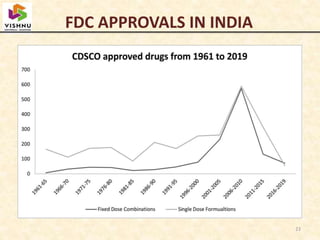
FDC APPROVALS IN INDIA
23
MISADVENTURE WITH FDCS
• As per the Rule 122E of Drugs and Cosmetics Act, 1940 a new
combination of the drug is considered as a ‘new drug’.
• In the last few decades, newer and newer FDCs are introduced
into the market at regular intervals without proper justification
for its safety and effectiveness.
• This has led to confusion among the doctors which FDC to
prescribe.
24
• After 2005, following the TRIPS agreement, the
pharmaceutical companies were compelled to maintain records
for their growth.
• From 2005 to 2011, India witnessed a sudden increase in the
approval of FDCs by the Central Government.
• Inclusion of commonly used drugs under NLEM and the
DPCO also affected the financial comforts of the companies.
• Because out of 433 medicines listed under the latest edition of
NLEM, only 37 are FDCs.
25
• However, the problems with these irrational FDCs are the
chemical, therapeutic incompatibilities which may not offer
Desired therapeutic effect
Pharmacokinetic and pharmacodynamic mismatch
Which may lead to reduced efficacy, enhanced toxicity.
• The first approved combination will become the ‘reference’
sample, and the next manufacturers of the same combination
will have to show equivalence to this reference sample to
obtain DCGI approval.
26
• But the regulatory competition between individual states and
the central is not new in India.
• A deeper investigation of the irrational FDCs present in the
Indian market reveals the complex relationship that the central
regulatory authority shared with its state-level counterparts.
• In many cases, it is contended that the regulatory authorities in
the states have issued licences for FDCs without exchanging
relevant information with the central authority.
27
• Unfortunately, state licensing authority has the inadequate
technical expertise and thus, most times, directly licenses were
issued without getting approval from the central regulatory
body which is mandatory for the approval of new drugs
including FDCs.
• The authors further suggest it that the regulatory bodies
should concentrate on personnel performance management
system to develop existing talent and build next generation
leaders with a better quality of decision making.
28
• Reports suggested that pharmaceutical companies were known
to be the worst offenders, as they have used the concept of
FDCs for their business benefits.
• Initially, it was a means to escape from the price control, but
slowly, it became a tool to comprehend in a market over-run
with me-too drugs.
29
A GLIMPSE OF THE PARLIAMENTARY
REPORT ON BANNING FDCS
• In the year 2007, the central government passed the order to
the state drug controllers to withdraw 294 FDCs which were
licensed without the approval of the DCGI.
• However, the FDC manufacturers obtained a stay from the
Madras High Court after appealing against the ban.
• After in the year, 2013 CDSCO issued a list of guidelines for
the approval of FDCs and periodically they started banning
FDCs for lacking justification concerning safety.
30
• The Parliamentary Standing Committee on Health and Family
Welfare in its report stated
That there are many State Licensing Authorities (SLAs) in
India issued manufacturing license to FDCs without getting
clearance from the DCGI.
That the FDCs which were licensed before October 2012
have to prove the safety and efficacy of the combination
within 18 months and to fail to prove the same would be
considered prohibited from being manufactured and
marketed in India.
31
• In 2014, considering the safety and efficacy of fdcs, the
ministry of health and family welfare constituted a committee
under the leadership of prof. C. K. Kokate.
• He was directed to examine the applications regarding the
rationality of the fdcs in terms of
• Patient safety
• Drug toxicity
• Adverse effect
• Misuse of drug/prescription error
32
• Pharmacokinetic and pharmacodynamics
• Dosage compatibilities of fdcs with regard to that of single
ingredients
• Issue of antimicrobial drug resistance
• Latest treatment standard guidelines (STG)
• Risk/benefit ratio
• Patient compliance
• International status
33
• The committee submitted the detailed recommendations
against each FDCs in the report on April 16, 2015.
• After the reports obtained from the expert panel, in March
2016, 344 FDCs were prohibited under the section 26A of
Drugs and Cosmetics Act, 1940.
• Against this ban, the various pharmaceutical industries joined
together and appealed to the second highest court of India, the
High court of Delhi, Chennai and Bengaluru to put a stay on
this ban order passed by CDSCO.
34
• The representatives of pharmaceutical industry put up an
argument before the court is that the DCGI was not fair as the
DTAB and Drug Consultative Committee (DCC) did not
consult it regarding the ban.
• In 2016, a decision in favour of the pharmaceutical industries
stated that the government did not adhere to the proper
procedure and not consulted to the statutory bodies and
various stakeholders.
35
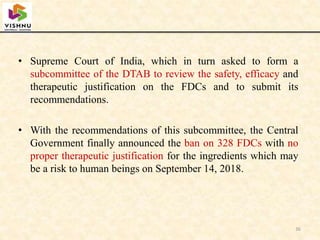
• Supreme Court of India, which in turn asked to form a
subcommittee of the DTAB to review the safety, efficacy and
therapeutic justification on the FDCs and to submit its
recommendations.
• With the recommendations of this subcommittee, the Central
Government finally announced the ban on 328 FDCs with no
proper therapeutic justification for the ingredients which may
be a risk to human beings on September 14, 2018.
36
• The Supreme Court stated to the Central Government that it
could not use DTAB report to prohibit 15 FDCs manufactured
before 1988 in India.
• However, the Supreme Court had asked the government to
look into the safety of these 15 FDCs and to initiate a fresh
investigation in case the government wants to ban them.
37
• The value of the Indian domestic pharmaceutical market is
around Rs 1.18-1.25 lakh crore, and FDCs contribute over 50
% of it.
• The Central Government’s ban on 328 irrational FDCs
impacted over 2 % (approximately Rs 2,900 crore) of the
organised retail market.
• This ban resulted in succumbing the growth of the Indian
pharmaceutical sector to its 2 year low.
38
• But the logic behind the ban is simple; the chances of ADRs
and drug interactions can go up if the medicines are combined
instead of taking it separately.
• The fact of the matter is that some drugs have dangerous side
effects; unnecessary use of combination drugs makes the
human body resistant to treatment.
39
CONCLUSION
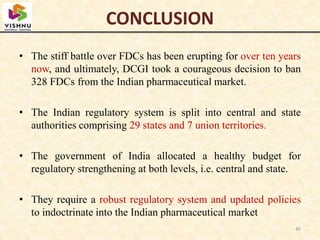
• The stiff battle over FDCs has been erupting for over ten years
now, and ultimately, DCGI took a courageous decision to ban
328 FDCs from the Indian pharmaceutical market.
• The Indian regulatory system is split into central and state
authorities comprising 29 states and 7 union territories.
• The government of India allocated a healthy budget for
regulatory strengthening at both levels, i.e. central and state.
• They require a robust regulatory system and updated policies
to indoctrinate into the Indian pharmaceutical market
40
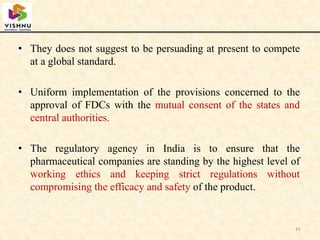
• They does not suggest to be persuading at present to compete
at a global standard.
• Uniform implementation of the provisions concerned to the
approval of FDCs with the mutual consent of the states and
central authorities.
• The regulatory agency in India is to ensure that the
pharmaceutical companies are standing by the highest level of
working ethics and keeping strict regulations without
compromising the efficacy and safety of the product.
41
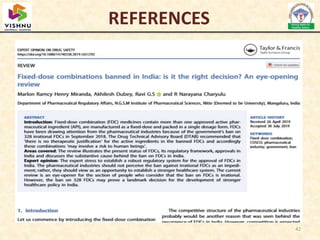
REFERENCES
42
43

FIXED DOSE COMBINATIONS BANNED IN INDIA

  • 1.
    Fixed-dose combinations banned inIndia Presented by, Jaya prakash v, 218311. Shri Vishnu College of Pharmacy (Autonomous) Affiliated to Andhra Univ., Visakhapatnam; Approved by AICTE and PCI, New Delhi, and recognised by APSCHE 1
  • 2.
    CONTENTS • Introduction • Typeof fdcs • A chronological view on some case studies • The regulatory framework for fdcs in india • Misadventure with fdcs • A glimpse of the parliamentary report on banning fdcs • Conclusion 2
  • 3.
    INTRODUCTION • Fixed-dose combination(FDC) medicines contain more than one approved active pharmaceutical ingredient (API), are manufactured as a fixed-dose and packed in a single dosage form. • To treat either single ailment or multiple co-morbid conditions. • Moreover, the combination should also prove the superiority over single compound administration in terms of safety, efficacy and compliance. 3
  • 4.
    • The medicalfraternity in India understands that the FDCs has better efficacy than a single compound, lesser adverse drug effects, synergistic effects, and reducing the drug resistance. • The fundamental aim of pharmaceutical company in India is to create the product in a cost-effective manner. • Pharmaceutical companies are tempted on FDCs because it is beneficial to combine the existing active pharmaceutical ingredients , than designing a new molecule or formulation of a completely new dosage form. 4
  • 5.
    • According tothe Drug Price Control Order (DPCO), 2013 the drugs which are introduced in the national list of essential medicines (NLEM) were put under the control of the National Pharmaceutical Pricing Authority of India (NPPA). • Therefore, to escape from this price control, the companies have reformulated specific drugs into FDCs. • Depending on the justification of the combinations they categorise FDCs into superior, substandard and unfriendly . 5
  • 6.
    Type 1 • FDCsin which one or more APIs is a New Drug. • To get the clinical trials and manufacturing permissions, they will be treated in the same way as any other ‘New Drug’. Type 2 • FDCs containing APIs which are already approved or marketed individually and are made in combination for the first time. • Clinical trial permission for such FDCs can be taken by submitting the summary of the data for pharmacological, toxicological and clinical trials of the individual APIs. 6 TYPE OF FDCS
  • 7.
    Type 3 • Itincludes the FDCs which are already marketed, but they claim a change in the ratio of APIs or new therapeutic indication. • For the clinical trial approvals of these, the appropriate rationale should be submitted and for the marketing approvals, clinical trials data should be submitted. 7
  • 8.
    Type 4 • TheseFDCs contain APIs which has been used commonly for a particular indication. • However, their concomitant use is often necessary, and no claim is proposed to be made other than convenience, stable dosage form, no significant pharmacokinetic and pharmacodynamic interactions between the ingredients. • To grant marketing permissions for these FDCs, they should have an acceptable rationale, and no additional preclinical or clinical data is required. 8
  • 9.
    A CHRONOLOGICAL VIEWON SOME CASE STUDIES Case 1: Study conducted in 2011 at Nagpur, Maharashtra, India • Conducted a prospective observational study to evaluate the pattern of prescribed FDCs in a tertiary care teaching hospital in Central India in 2011. • 994 prescriptions evaluated • 693- FDCs • 278 FDCs were rational • 20.86 % FDCs -physicians were unaware of the APIs. 9 The study suggested that the physicians should update themselves before prescribing FDCs
  • 10.
    Case 2: Study conductedin 2012 at Ahmedabad, Gujarat, India • Conducted study to test knowledge, point of view and practices about prescribing habits of FDCs among resident doctors. • Total 100 doctors from various departments. • Asked to fill up the questionnaires regarding knowledge, and practices about prescribing the FDCs. 10
  • 11.
    11 • 31 %of residents were aware of the Essential Medicines List (EML) . • 81% of the resident doctors had knowledge about the rationality of the prescribed FDCs. They concluded the study with a remark that insufficient knowledge about FDCs leads to irrational prescriptions and for resident doctors it is prerequisite to have an updated knowledge about EML, FDCs, and likewise banned FDCs to promote rational use of drugs.
  • 12.
    Case 3: Study conductedin 2013 at Ahmedabad, Gujarat, India • Conducted study on the use of fixed-dose combinations. • 24 months, and considered around 6 zones of Ahmedabad city. • 1170 prescriptions • 941 were containing FDCs. • 3252 formulations that were prescribed • 1647 formulations were of FDCs. • 1343 were irrational. 12
  • 13.
    • During thisstudy, they saw it that the banned or irrational FDCs were available in the market and are still being prescribed. • Most of the prescribed FDCs were not found in the Essential Medicines List (EML). • They saw that those irrational combinations like NSAIDs being combines with NSAIDs which does not provide any therapeutic justification to the FDCs being prescribed. 13 This survey revealed that more irrational FDCs were prescribed to patients than rational FDCs.
  • 14.
    Case 4: Study conductedin 2017 at Rajnandgaon, Chhattisgarh, India • They assessed a total of 300 prescriptions. • Majority of these prescriptions were of FDCs. • 53 % of the FDCs were rational . • 30% semi-rational. • 17 % irrational. • 83 % were branded names. • 17 % were generic. 14
  • 15.
    • When anFDC is planned, the first thing that needs to be considered is that each of the combinations of API should be present in the essential list of medicines and further the overall cost of the FDC should be lesser than the individual drugs. • FDCs that were not formulated with care, precision posed problems to the pharmacokinetics and pharmacodynamics of the two combinations, drug interactions, and there was a problem of chemical incompatibility. 15
  • 16.
    Case 5: Study conductedin 2018 at Mumbai, Maharashtra • To evaluate the number of FDCs prescribed by clinicians and to find out its rationality concerning the indications in a tertiary care hospital. • 3500 prescriptions • 28 % had FDCs • 81 % were rational • 18 % were irrational 16 The study revealed that most prescriptions had rational FDCs prescribed by the treating doctors, reflecting rational use of FDCs in patients.
  • 17.
    THE REGULATORY FRAMEWORKFOR FDCS IN INDIA • The Drugs and Cosmetics Act, 1940 and Rules, 1945 regulate the drugs in India. • According to the act before the independence, The central government held responsible for the import of the drugs. The state government regulated the manufacture, distribution and sale of the drugs. • After independence in 1947, both the Central and the State Governments had the power to make laws related to the drugs. 17
  • 18.
    • According tothe Drugs and Cosmetics Act, 1940 the approval is granted by the Drug Controller General of India (DCGI). • Before granting approvals, the CDSCO will inspect the product concerning quality, safety and efficacy. • In 1952, the national rules introduced the concept of ‘new drug’ with the requirements before the approval of imports. • However, the state government has retained its power to license the manufacturing and sale of the drugs. 18
  • 19.
    • In 1988,the FDCs combining for the first time are considered as ‘New Drug’ under the rule 122E. • Because of this, these FDCs will require prior approval from the central government under Rules 122B or 122C along with the evidence. • In 2001, there was another amendment passed to these rules to have a legal duty on CDSCO to be satisfied with the drug that will be imported or manufactured are safe and effective. 19
  • 20.
    • Until fouryears after the approval the companies seeking to market their new drug including FDCs must obtain approval from the CDSCO for their formulation. • After the four year mark, the manufacturing or distribution of the FDC must be done by getting approval from the state licensing authority without prior approval from CDSCO. 20
  • 21.
    • Appendix VIof Schedule Y of D&C Rules, 1945 provides details regarding the requirements for marketing authorisation for different types of FDCs. • A treasury challan of 15,000 is required if all of the APIs are approved for more than one year. • In case if the API is not approved or approved for less than one year, the challan will be of 50,000. 21
  • 22.
    • If theFDCs that are not marketed in India and its APIs not approved in any other countries , it is mandatory to conduct four-phase clinical trial studies. • However, for the FDCs that are marketed in other countries merely the Phase III clinical trials are required to conduct. • Particularly in vitro studies are sufficient for those FDCs whose active ingredient(s) are approved and marketed in India. • A BA/BE study is still recommended when ‘some changes are sought in an FDC, which is previously in the Indian market’. 22
  • 23.
  • 24.
    MISADVENTURE WITH FDCS •As per the Rule 122E of Drugs and Cosmetics Act, 1940 a new combination of the drug is considered as a ‘new drug’. • In the last few decades, newer and newer FDCs are introduced into the market at regular intervals without proper justification for its safety and effectiveness. • This has led to confusion among the doctors which FDC to prescribe. 24
  • 25.
    • After 2005,following the TRIPS agreement, the pharmaceutical companies were compelled to maintain records for their growth. • From 2005 to 2011, India witnessed a sudden increase in the approval of FDCs by the Central Government. • Inclusion of commonly used drugs under NLEM and the DPCO also affected the financial comforts of the companies. • Because out of 433 medicines listed under the latest edition of NLEM, only 37 are FDCs. 25
  • 26.
    • However, theproblems with these irrational FDCs are the chemical, therapeutic incompatibilities which may not offer Desired therapeutic effect Pharmacokinetic and pharmacodynamic mismatch Which may lead to reduced efficacy, enhanced toxicity. • The first approved combination will become the ‘reference’ sample, and the next manufacturers of the same combination will have to show equivalence to this reference sample to obtain DCGI approval. 26
  • 27.
    • But theregulatory competition between individual states and the central is not new in India. • A deeper investigation of the irrational FDCs present in the Indian market reveals the complex relationship that the central regulatory authority shared with its state-level counterparts. • In many cases, it is contended that the regulatory authorities in the states have issued licences for FDCs without exchanging relevant information with the central authority. 27
  • 28.
    • Unfortunately, statelicensing authority has the inadequate technical expertise and thus, most times, directly licenses were issued without getting approval from the central regulatory body which is mandatory for the approval of new drugs including FDCs. • The authors further suggest it that the regulatory bodies should concentrate on personnel performance management system to develop existing talent and build next generation leaders with a better quality of decision making. 28
  • 29.
    • Reports suggestedthat pharmaceutical companies were known to be the worst offenders, as they have used the concept of FDCs for their business benefits. • Initially, it was a means to escape from the price control, but slowly, it became a tool to comprehend in a market over-run with me-too drugs. 29
  • 30.
    A GLIMPSE OFTHE PARLIAMENTARY REPORT ON BANNING FDCS • In the year 2007, the central government passed the order to the state drug controllers to withdraw 294 FDCs which were licensed without the approval of the DCGI. • However, the FDC manufacturers obtained a stay from the Madras High Court after appealing against the ban. • After in the year, 2013 CDSCO issued a list of guidelines for the approval of FDCs and periodically they started banning FDCs for lacking justification concerning safety. 30
  • 31.
    • The ParliamentaryStanding Committee on Health and Family Welfare in its report stated That there are many State Licensing Authorities (SLAs) in India issued manufacturing license to FDCs without getting clearance from the DCGI. That the FDCs which were licensed before October 2012 have to prove the safety and efficacy of the combination within 18 months and to fail to prove the same would be considered prohibited from being manufactured and marketed in India. 31
  • 32.
    • In 2014,considering the safety and efficacy of fdcs, the ministry of health and family welfare constituted a committee under the leadership of prof. C. K. Kokate. • He was directed to examine the applications regarding the rationality of the fdcs in terms of • Patient safety • Drug toxicity • Adverse effect • Misuse of drug/prescription error 32
  • 33.
    • Pharmacokinetic andpharmacodynamics • Dosage compatibilities of fdcs with regard to that of single ingredients • Issue of antimicrobial drug resistance • Latest treatment standard guidelines (STG) • Risk/benefit ratio • Patient compliance • International status 33
  • 34.
    • The committeesubmitted the detailed recommendations against each FDCs in the report on April 16, 2015. • After the reports obtained from the expert panel, in March 2016, 344 FDCs were prohibited under the section 26A of Drugs and Cosmetics Act, 1940. • Against this ban, the various pharmaceutical industries joined together and appealed to the second highest court of India, the High court of Delhi, Chennai and Bengaluru to put a stay on this ban order passed by CDSCO. 34
  • 35.
    • The representativesof pharmaceutical industry put up an argument before the court is that the DCGI was not fair as the DTAB and Drug Consultative Committee (DCC) did not consult it regarding the ban. • In 2016, a decision in favour of the pharmaceutical industries stated that the government did not adhere to the proper procedure and not consulted to the statutory bodies and various stakeholders. 35
  • 36.
    • Supreme Courtof India, which in turn asked to form a subcommittee of the DTAB to review the safety, efficacy and therapeutic justification on the FDCs and to submit its recommendations. • With the recommendations of this subcommittee, the Central Government finally announced the ban on 328 FDCs with no proper therapeutic justification for the ingredients which may be a risk to human beings on September 14, 2018. 36
  • 37.
    • The SupremeCourt stated to the Central Government that it could not use DTAB report to prohibit 15 FDCs manufactured before 1988 in India. • However, the Supreme Court had asked the government to look into the safety of these 15 FDCs and to initiate a fresh investigation in case the government wants to ban them. 37
  • 38.
    • The valueof the Indian domestic pharmaceutical market is around Rs 1.18-1.25 lakh crore, and FDCs contribute over 50 % of it. • The Central Government’s ban on 328 irrational FDCs impacted over 2 % (approximately Rs 2,900 crore) of the organised retail market. • This ban resulted in succumbing the growth of the Indian pharmaceutical sector to its 2 year low. 38
  • 39.
    • But thelogic behind the ban is simple; the chances of ADRs and drug interactions can go up if the medicines are combined instead of taking it separately. • The fact of the matter is that some drugs have dangerous side effects; unnecessary use of combination drugs makes the human body resistant to treatment. 39
  • 40.
    CONCLUSION • The stiffbattle over FDCs has been erupting for over ten years now, and ultimately, DCGI took a courageous decision to ban 328 FDCs from the Indian pharmaceutical market. • The Indian regulatory system is split into central and state authorities comprising 29 states and 7 union territories. • The government of India allocated a healthy budget for regulatory strengthening at both levels, i.e. central and state. • They require a robust regulatory system and updated policies to indoctrinate into the Indian pharmaceutical market 40
  • 41.
    • They doesnot suggest to be persuading at present to compete at a global standard. • Uniform implementation of the provisions concerned to the approval of FDCs with the mutual consent of the states and central authorities. • The regulatory agency in India is to ensure that the pharmaceutical companies are standing by the highest level of working ethics and keeping strict regulations without compromising the efficacy and safety of the product. 41
  • 42.
  • 43.