By Tanushree Karmakar
M.Pharm Pharmacology 1st Year
INTRODUCTION
• The purpose of clinical research provide a
more rational approach for the improvement
and maintenance of healthcare systems and
play a vital role and efforts in combating
diseases.
• The mission of ICH is to promote public health
by achieving greater harmonisation through
the development of technical guidelines and
requirements for pharmaceutical product
registration.
What is ICH?
• International conference on Harmonisation (April
1990)
• ICH is an initiative that brings altogether regulatory
authorities and pharmaceutical industry to discuss
scientific and technical aspects of pharmaceutical
product development and registration which are
required to ensure and assess the safety , quality and
efficacy of the pharmaceutical products.
• Coordinate regulatory activities of the European
Union ,Japanese and United States regulatory bodies
in consultation with the pharmaceutical trade
association to discuss and agree the scientific aspects
arising from product registration.
Objectives of ICH
• To make recommendations towards achieving
greater harmonisation in the interpretation and
application of technical guidelines and
requirement for pharmaceutical product
registration.
• To contribute to the protection of public health in
the interest of patients from an international
perspective.
• To facilitate the adoption of new or improved
technical research and development approaches
which update or replace current practices.
• To prevent unnecessary duplication of clinical
trials on humans.
Rationale for Harmonisation
• Unification of regulatory requirement for new
medicinal product
• Reduction in cost of duplicating research
• Acceleration in medicinal product licensing
times
• Reduction in medicinal product development
cost
• Increase of patent protection times
• Availability of safe and effective therapies to
patients
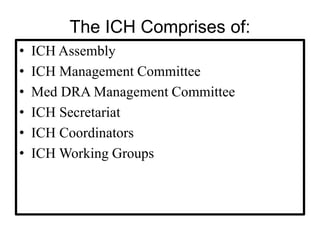
The ICH Comprises of:
• ICH Assembly
• ICH Management Committee
• Med DRA Management Committee
• ICH Secretariat
• ICH Coordinators
• ICH Working Groups
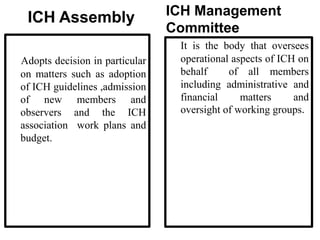
ICH Assembly
Adopts decision in particular
on matters such as adoption
of ICH guidelines ,admission
of new members and
observers and the ICH
association work plans and
budget.
ICH Management
Committee
It is the body that oversees
operational aspects of ICH on
behalf of all members
including administrative and
financial matters and
oversight of working groups.
Med DRA Management
Committee
• Responsible for direction of
Med DRA ;ICH standardized
medical terminology.
• The Med DRA management
committee has the role of
supporting ,managing and
facilitating the development ,
maintenance and dissemination
of Med DRA
ICH Secretariat
• Responsible for day to day
management of ICH ,
coordinating ICH
activities as well as
providing support to the
assembly .
• The ICH Secretariat is
based in
Geneva,Switzerland
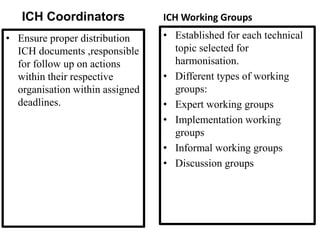
ICH Coordinators
• Ensure proper distribution
ICH documents ,responsible
for follow up on actions
within their respective
organisation within assigned
deadlines.
ICH Working Groups
• Established for each technical
topic selected for
harmonisation.
• Different types of working
groups:
• Expert working groups
• Implementation working
groups
• Informal working groups
• Discussion groups
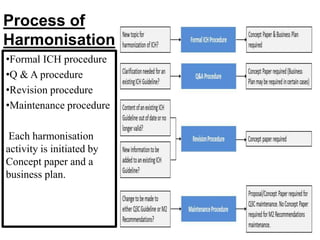
Process of
Harmonisation
•Formal ICH procedure
•Q & A procedure
•Revision procedure
•Maintenance procedure
Each harmonisation
activity is initiated by
Concept paper and a
business plan.
Steps in ICH process:
• Consensus building
• Initiation of regulatory action
• Regulatory consultation and discussion
• Adoption of a tripartite harmonised guideline
• Implementation
Benefits of ICH Process
• More than 50 harmonised guidelines
• Streamline R&D process
• Rapid access to new medicines
• Benefits for the regulators
• Reference and educational material for non-
ICH members
ICH Guidelines
• Four categories of ICH guidelines
• Quality guidelines : relating to chemical and
pharmaceutical QA
• Safety guidelines : relating to in vitro and in vivo
preclinical studies
• Efficacy guideline : relating to clinical studies in
human subjects
• Multidisciplinary guidelines : cross cutting topics
Quality Guidelines
• Harmonisation achievements in the Quality area include pivotal
milestones such as the conduct of stability studies, defining relevant
thresholds for impurities testing and a more flexible approach to
pharmaceutical quality based on Good Manufacturing Practice
(GMP) risk management.
• Q1A-Q1F: Stability
• Q2: Analytical Validation
• Q3A-Q3D: Impurities
• Q4A-Q4B: Pharmacopeia
• Q5A-Q5E: Quality of Biotechnological Products
• Q6A-Q6B: Specifications
• Q7: Good Manufacturing Practices
• Q8: Pharmaceutical Development
• Q9: Quality Risk Management
• Q10: Pharmaceutical Quality System
• Q11: Development and Manufacture of Drug
• Q12: Lifecycle Management
Safety Guidelines
• ICH has produced a comprehensive set of safety Guidelines
to uncover potential risks like carcinogenicity, genotoxicity
and reprotoxicity.
• S1A - S1C: Carcinogenicity Studies
• S2 : Genotoxicity Studies
• S3A - S3B: Toxicokinetics and Pharmacokinetics
• S4 :Toxicity Testing
• S5: Reproductive Toxicology
• S6 :Biotechnological Products
• S7A - S7B :Pharmacology Studies
• S8: Immunotoxicology Studies
• S9 :Nonclinical Evaluation for Anticancer Pharmaceuticals
• S10 :Photosafety Evaluation
• S11: Nonclinical Paediatric Safety
Efficacy Guidelines
• Concerned with the design, conduct, safety and reporting of clinical trials. It also covers novel types of
medicines derived from biotechnological processes and the use of pharmacogenetics/genomics
techniques to produce better targeted medicines.
• E1: Clinical Safety for Drugs used in Long-Term Treatment
• E2A - E2F: Pharmacovigilance
• E3: Clinical Study Reports
• E4 : Dose-Response Studies
• E5 : Ethnic Factors
• E6: Good Clinical Practice
• E7: Clinical Trials in Geriatric Population
• E8 : General Considerations for Clinical Trials
• E9: Statistical Principles for Clinical Trials
• E10: Choice of Control Group in Clinical Trials
• E11 - E11A : Clinical Trials in Pediatric Population
• E12: Clinical Evaluation by Therapeutic Category
• E14: Clinical Evaluation of QT
• E15: Definitions in Pharmacogenetics / Pharmacogenomics
• E16: Qualification of Genomic Biomarkers
• E17: Multi-Regional Clinical Trials
• E18 : Genomic Sampling
• E19 : Safety Data Collection
Multi Disciplinary Guidelines
• Those are the cross-cutting topics which do not fit uniquely into one
of the Quality, Safety and Efficacy categories. It includes the ICH
medical terminology (MedDRA), the Common Technical Document
(CTD) and the development of Electronic Standards for the Transfer
of Regulatory Information (ESTRI).
• M1: MedDRA Terminology
• M2 : Electronic Standards
• M3 : Nonclinical Safety Studies
• M4 : Common Technical Document
• M5 : Data Elements and Standards for Drug Dictionaries
• M6 : Gene Therapy
• M7 : Mutagenic impurities
• M8 : Electronic Common Technical Document (eCTD)
• M9: Biopharmaceutics Classification System-based Biowaivers
• M10 : Bioanalytical Method Validation
• M11 : Clinical electronic Structured Harmonised Protocol
Ich ppt

Ich ppt

  • 1.
    By Tanushree Karmakar M.PharmPharmacology 1st Year
  • 2.
    INTRODUCTION • The purposeof clinical research provide a more rational approach for the improvement and maintenance of healthcare systems and play a vital role and efforts in combating diseases. • The mission of ICH is to promote public health by achieving greater harmonisation through the development of technical guidelines and requirements for pharmaceutical product registration.
  • 3.
    What is ICH? •International conference on Harmonisation (April 1990) • ICH is an initiative that brings altogether regulatory authorities and pharmaceutical industry to discuss scientific and technical aspects of pharmaceutical product development and registration which are required to ensure and assess the safety , quality and efficacy of the pharmaceutical products. • Coordinate regulatory activities of the European Union ,Japanese and United States regulatory bodies in consultation with the pharmaceutical trade association to discuss and agree the scientific aspects arising from product registration.
  • 4.
    Objectives of ICH •To make recommendations towards achieving greater harmonisation in the interpretation and application of technical guidelines and requirement for pharmaceutical product registration. • To contribute to the protection of public health in the interest of patients from an international perspective. • To facilitate the adoption of new or improved technical research and development approaches which update or replace current practices. • To prevent unnecessary duplication of clinical trials on humans.
  • 5.
    Rationale for Harmonisation •Unification of regulatory requirement for new medicinal product • Reduction in cost of duplicating research • Acceleration in medicinal product licensing times • Reduction in medicinal product development cost • Increase of patent protection times • Availability of safe and effective therapies to patients
  • 6.
    The ICH Comprisesof: • ICH Assembly • ICH Management Committee • Med DRA Management Committee • ICH Secretariat • ICH Coordinators • ICH Working Groups
  • 8.
    ICH Assembly Adopts decisionin particular on matters such as adoption of ICH guidelines ,admission of new members and observers and the ICH association work plans and budget. ICH Management Committee It is the body that oversees operational aspects of ICH on behalf of all members including administrative and financial matters and oversight of working groups.
  • 9.
    Med DRA Management Committee •Responsible for direction of Med DRA ;ICH standardized medical terminology. • The Med DRA management committee has the role of supporting ,managing and facilitating the development , maintenance and dissemination of Med DRA ICH Secretariat • Responsible for day to day management of ICH , coordinating ICH activities as well as providing support to the assembly . • The ICH Secretariat is based in Geneva,Switzerland
  • 10.
    ICH Coordinators • Ensureproper distribution ICH documents ,responsible for follow up on actions within their respective organisation within assigned deadlines. ICH Working Groups • Established for each technical topic selected for harmonisation. • Different types of working groups: • Expert working groups • Implementation working groups • Informal working groups • Discussion groups
  • 11.
    Process of Harmonisation •Formal ICHprocedure •Q & A procedure •Revision procedure •Maintenance procedure Each harmonisation activity is initiated by Concept paper and a business plan.
  • 12.
    Steps in ICHprocess: • Consensus building • Initiation of regulatory action • Regulatory consultation and discussion • Adoption of a tripartite harmonised guideline • Implementation
  • 13.
    Benefits of ICHProcess • More than 50 harmonised guidelines • Streamline R&D process • Rapid access to new medicines • Benefits for the regulators • Reference and educational material for non- ICH members
  • 14.
    ICH Guidelines • Fourcategories of ICH guidelines • Quality guidelines : relating to chemical and pharmaceutical QA • Safety guidelines : relating to in vitro and in vivo preclinical studies • Efficacy guideline : relating to clinical studies in human subjects • Multidisciplinary guidelines : cross cutting topics
  • 15.
    Quality Guidelines • Harmonisationachievements in the Quality area include pivotal milestones such as the conduct of stability studies, defining relevant thresholds for impurities testing and a more flexible approach to pharmaceutical quality based on Good Manufacturing Practice (GMP) risk management. • Q1A-Q1F: Stability • Q2: Analytical Validation • Q3A-Q3D: Impurities • Q4A-Q4B: Pharmacopeia • Q5A-Q5E: Quality of Biotechnological Products • Q6A-Q6B: Specifications • Q7: Good Manufacturing Practices • Q8: Pharmaceutical Development • Q9: Quality Risk Management • Q10: Pharmaceutical Quality System • Q11: Development and Manufacture of Drug • Q12: Lifecycle Management
  • 16.
    Safety Guidelines • ICHhas produced a comprehensive set of safety Guidelines to uncover potential risks like carcinogenicity, genotoxicity and reprotoxicity. • S1A - S1C: Carcinogenicity Studies • S2 : Genotoxicity Studies • S3A - S3B: Toxicokinetics and Pharmacokinetics • S4 :Toxicity Testing • S5: Reproductive Toxicology • S6 :Biotechnological Products • S7A - S7B :Pharmacology Studies • S8: Immunotoxicology Studies • S9 :Nonclinical Evaluation for Anticancer Pharmaceuticals • S10 :Photosafety Evaluation • S11: Nonclinical Paediatric Safety
  • 17.
    Efficacy Guidelines • Concernedwith the design, conduct, safety and reporting of clinical trials. It also covers novel types of medicines derived from biotechnological processes and the use of pharmacogenetics/genomics techniques to produce better targeted medicines. • E1: Clinical Safety for Drugs used in Long-Term Treatment • E2A - E2F: Pharmacovigilance • E3: Clinical Study Reports • E4 : Dose-Response Studies • E5 : Ethnic Factors • E6: Good Clinical Practice • E7: Clinical Trials in Geriatric Population • E8 : General Considerations for Clinical Trials • E9: Statistical Principles for Clinical Trials • E10: Choice of Control Group in Clinical Trials • E11 - E11A : Clinical Trials in Pediatric Population • E12: Clinical Evaluation by Therapeutic Category • E14: Clinical Evaluation of QT • E15: Definitions in Pharmacogenetics / Pharmacogenomics • E16: Qualification of Genomic Biomarkers • E17: Multi-Regional Clinical Trials • E18 : Genomic Sampling • E19 : Safety Data Collection
  • 18.
    Multi Disciplinary Guidelines •Those are the cross-cutting topics which do not fit uniquely into one of the Quality, Safety and Efficacy categories. It includes the ICH medical terminology (MedDRA), the Common Technical Document (CTD) and the development of Electronic Standards for the Transfer of Regulatory Information (ESTRI). • M1: MedDRA Terminology • M2 : Electronic Standards • M3 : Nonclinical Safety Studies • M4 : Common Technical Document • M5 : Data Elements and Standards for Drug Dictionaries • M6 : Gene Therapy • M7 : Mutagenic impurities • M8 : Electronic Common Technical Document (eCTD) • M9: Biopharmaceutics Classification System-based Biowaivers • M10 : Bioanalytical Method Validation • M11 : Clinical electronic Structured Harmonised Protocol