www.ngsmips.nitte.edu.in
CTD
Common Technical Document
Department of Regulatory Affairs
NGSMIPS, Nitte University
Mangalore
- Swapnil Dylan Fernandes
1st M.Pharm
1
www.ngsmips.nitte.edu.in
WILL DISCUSS ABOUT :-
 What is CTD?
 Why CTD?
 Preparing and organizing the CTD (Modules)
 Conclusion
 References
2
www.ngsmips.nitte.edu.in
ABBREVIATIONS
 CDSCO: Central Drugs Standard Control Organization
 CTD: Common Technical Document
 DCGI: Drug Controller General of India
 eCTD: Electronic Common Technical Document
 FDA: Food and Drug Administration
 ICH: International Conference on Harmonisation
 IND: Investigational New Drug application
 NDA: New Drug Application
 USFDA: US Food and Drug Administration
 TGA: Therapeutic Goods Administration
 EMA: European Medicines Agency
3
www.ngsmips.nitte.edu.in
WHAT IS CTD?
 Application format
 CTD IS A JOINT EFFORT OF 3 REGULATORY AGENCIES:
 1.European Medicines Agency (EMEA, Europe),
 2.Food and Drug Administration (FDA, USA) and
 3.Ministry of Health, Labour and Welfare (MHLW,Japan).
 The CTD is a set of specifications for a dossier for the
registration of medicines (TGA)
 CTD is an internationally agreed “well structured common
format” for the organization of the technical requirements
that is to be submitted to the regulatory authority as an
application for the registration of pharmaceuticals for human
use in all three ICH regions (U.S.A., Europe and Japan).
4
www.ngsmips.nitte.edu.in
WHY CTD?
 Hurdles put down by the 3 major regulatory
authorities.
 Objective of ICH to prepare the CTD.
 Reduce the time and resources used to compile
applications
 It will ease the preparation of electronic submissions.
 To facilitate simultaneous submission in three
regions.
 To facilitate easier exchange of regulatory
information and thereby ensure faster availability of
new medicines.
5
www.ngsmips.nitte.edu.in
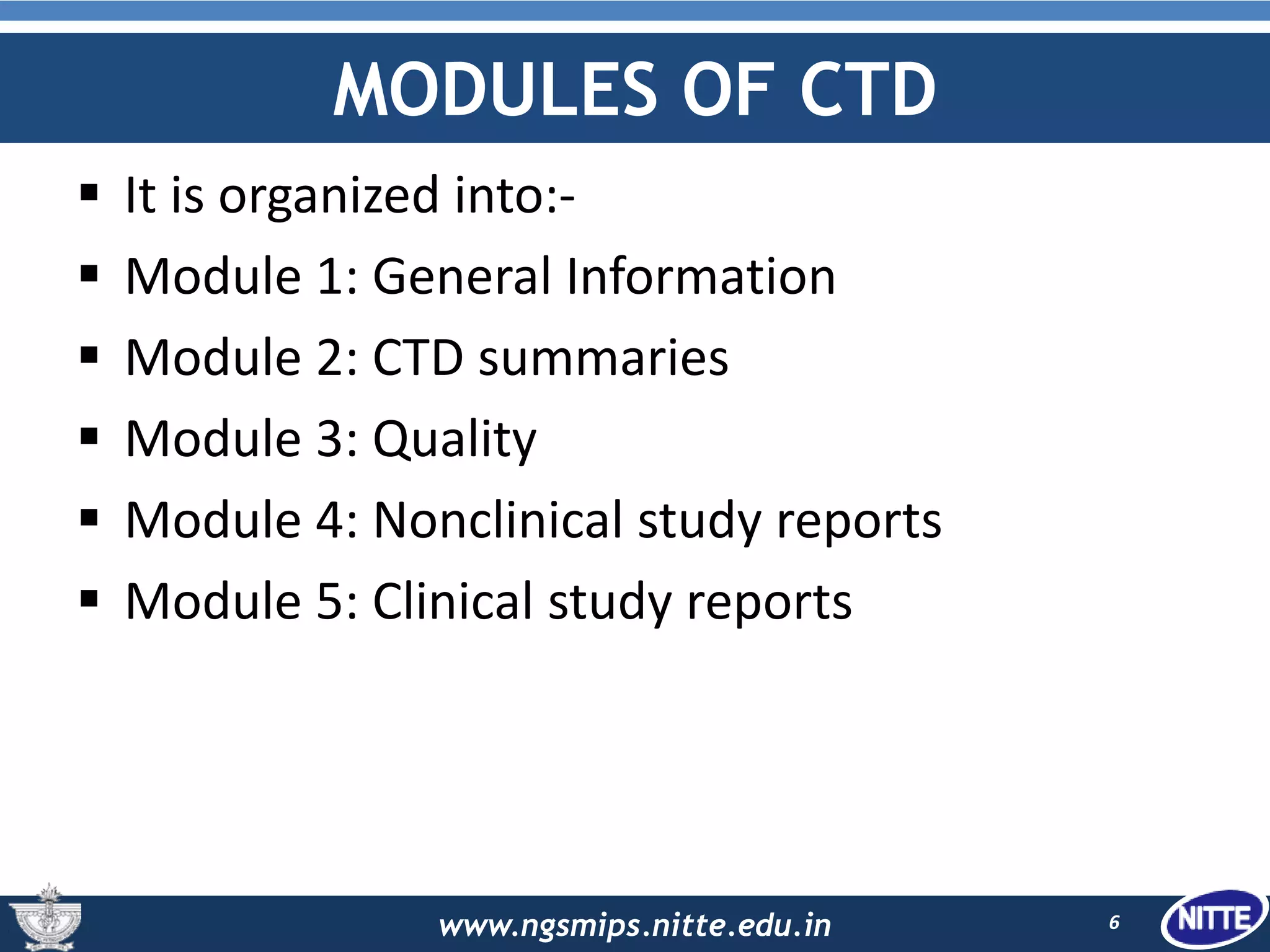
MODULES OF CTD
 It is organized into:-
 Module 1: General Information
 Module 2: CTD summaries
 Module 3: Quality
 Module 4: Nonclinical study reports
 Module 5: Clinical study reports
6
www.ngsmips.nitte.edu.in 7
www.ngsmips.nitte.edu.in
MODULE 1
 Administrative information and prescribing
information.
 Document specific to each region.
 E.g. Application form
Proposed label for use in the region
8
www.ngsmips.nitte.edu.in
MODULE 1: GENERAL INFORMATION
1.1. Covering letter & comprehensive table of contents
1.2. Administrative information
 Brief introduction about the applicant company
 Duly filled and signed application in Form 44 and Treasury Challan
 Legal and Critical Documents such as Copy of Clinical Trial/BE., No
Objection letters issued by CDSCO, Batch release certificate issued by
National Regulatory Authorities
E.g. For manufacture and marketing of finished products, in addition to the above
mentioned docs,
Copy of existing manufacturing license in Form 25 / 28.
Copy of Form-29
Certificate of Analysis
Coordinates related to the application
9
www.ngsmips.nitte.edu.in
1.3 General Information on Drug Product
1.5 Regulatory status in other countries
1.6 Domestic price of the drug followed in the countries of
1.7 A brief profile of the manufacturer’s research activity
1.8 A brief profile of the manufacturer’s business activity in
domestic as well as global market
1.9 Information regarding involvement of experts, if any
1.10 Samples of drug product
1.11 Promotional materials
10
www.ngsmips.nitte.edu.in
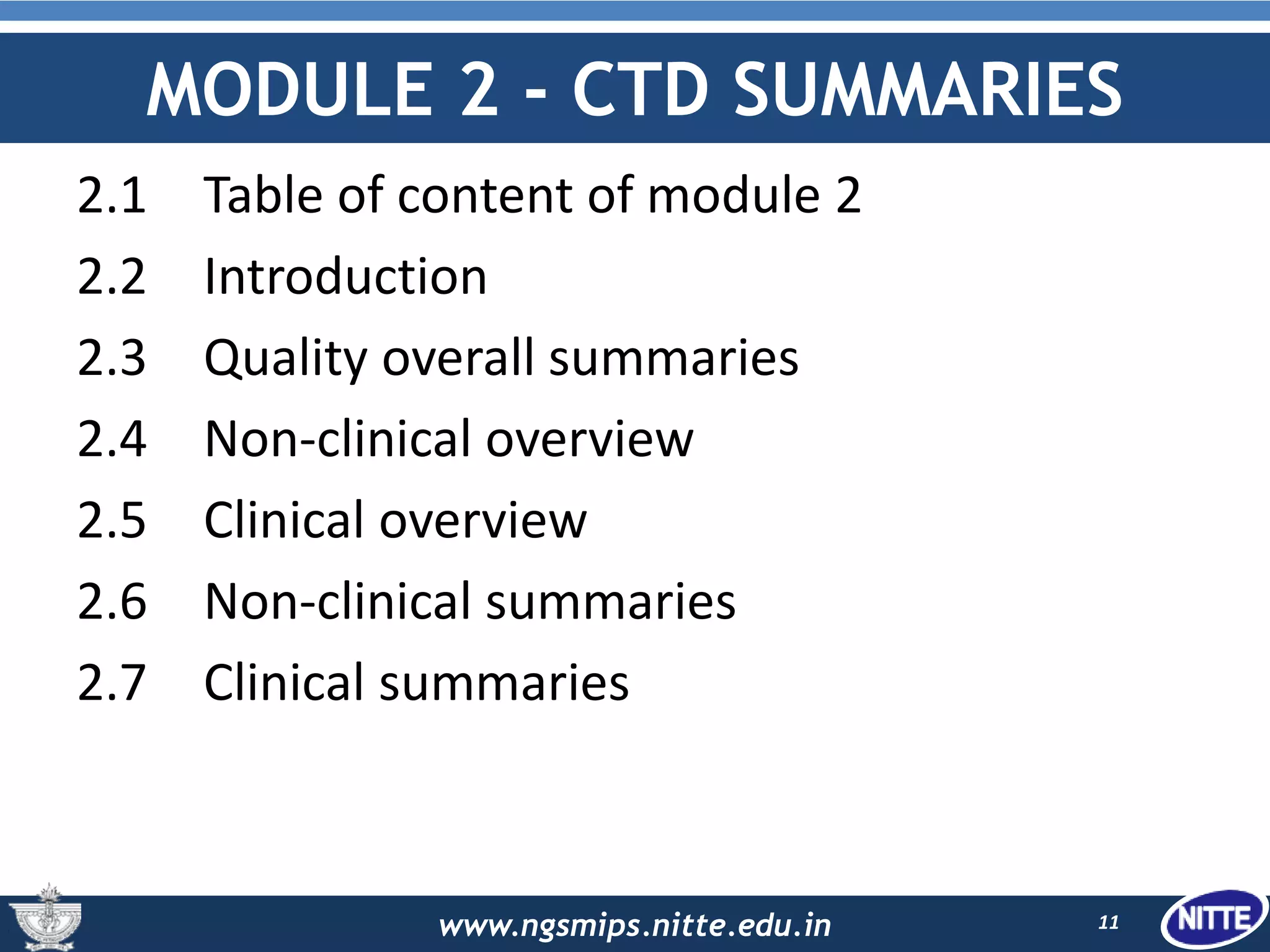
MODULE 2 - CTD SUMMARIES
2.1 Table of content of module 2
2.2 Introduction
2.3 Quality overall summaries
2.4 Non-clinical overview
2.5 Clinical overview
2.6 Non-clinical summaries
2.7 Clinical summaries
11
www.ngsmips.nitte.edu.in
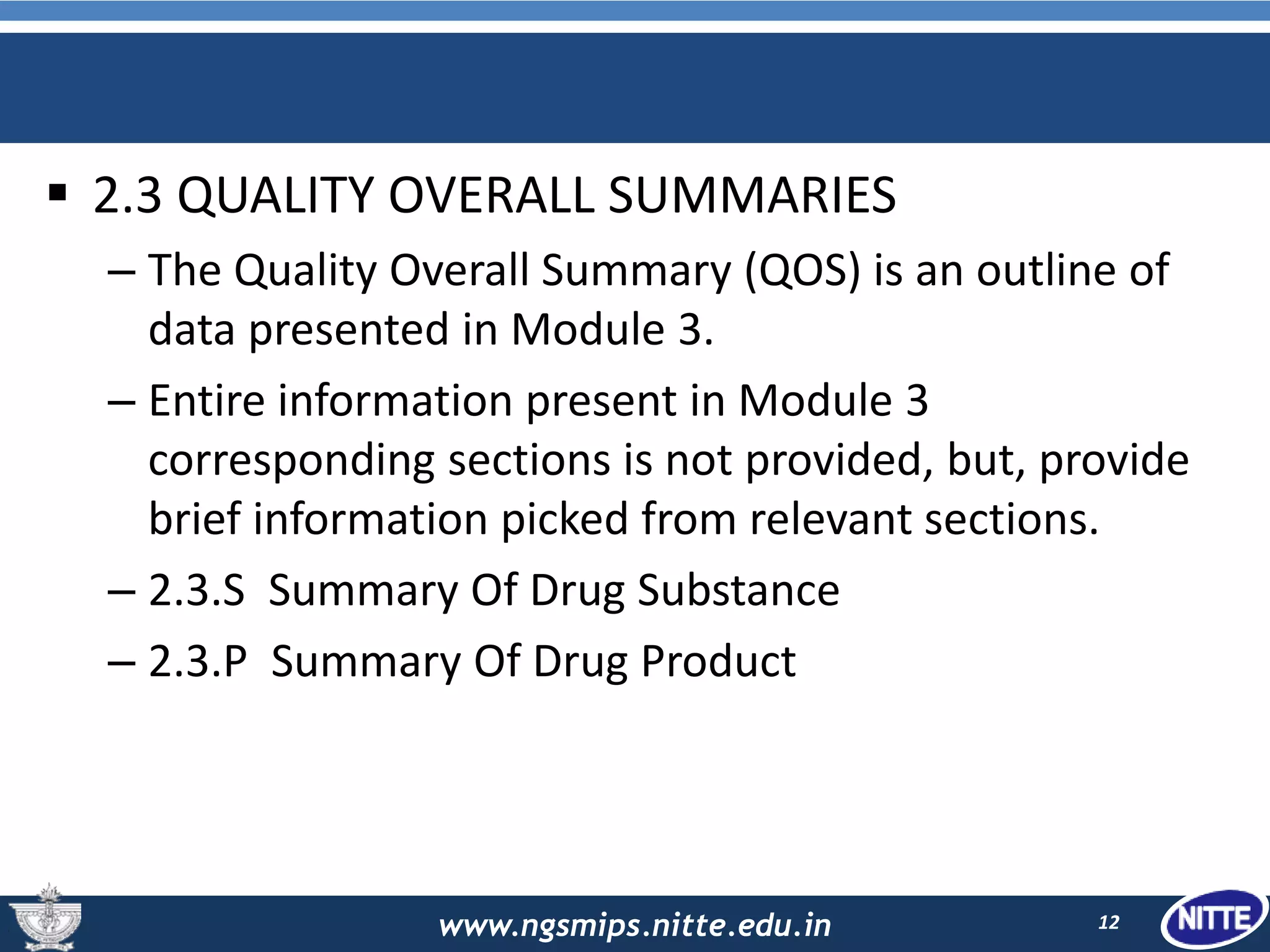
 2.3 QUALITY OVERALL SUMMARIES
– The Quality Overall Summary (QOS) is an outline of
data presented in Module 3.
– Entire information present in Module 3
corresponding sections is not provided, but, provide
brief information picked from relevant sections.
– 2.3.S Summary Of Drug Substance
– 2.3.P Summary Of Drug Product
12
www.ngsmips.nitte.edu.in
 2.4 NON-CLINICAL OVERVIEW
– 2.4.1 Introduction and GLP statement
– 2.4.2 Overview of the Non Clinical Testing Strategy
– 2.4.3 Pharmacology
– 2.4.4 Pharmacokinetics
– 2.4.5 Toxicology
– 2.4.6 Integrated Overview and Conclusions
– 2.4.7 List of Literature References
 Implications of nonclinical findings for the safe use of
the pharmaceutical.
13
www.ngsmips.nitte.edu.in
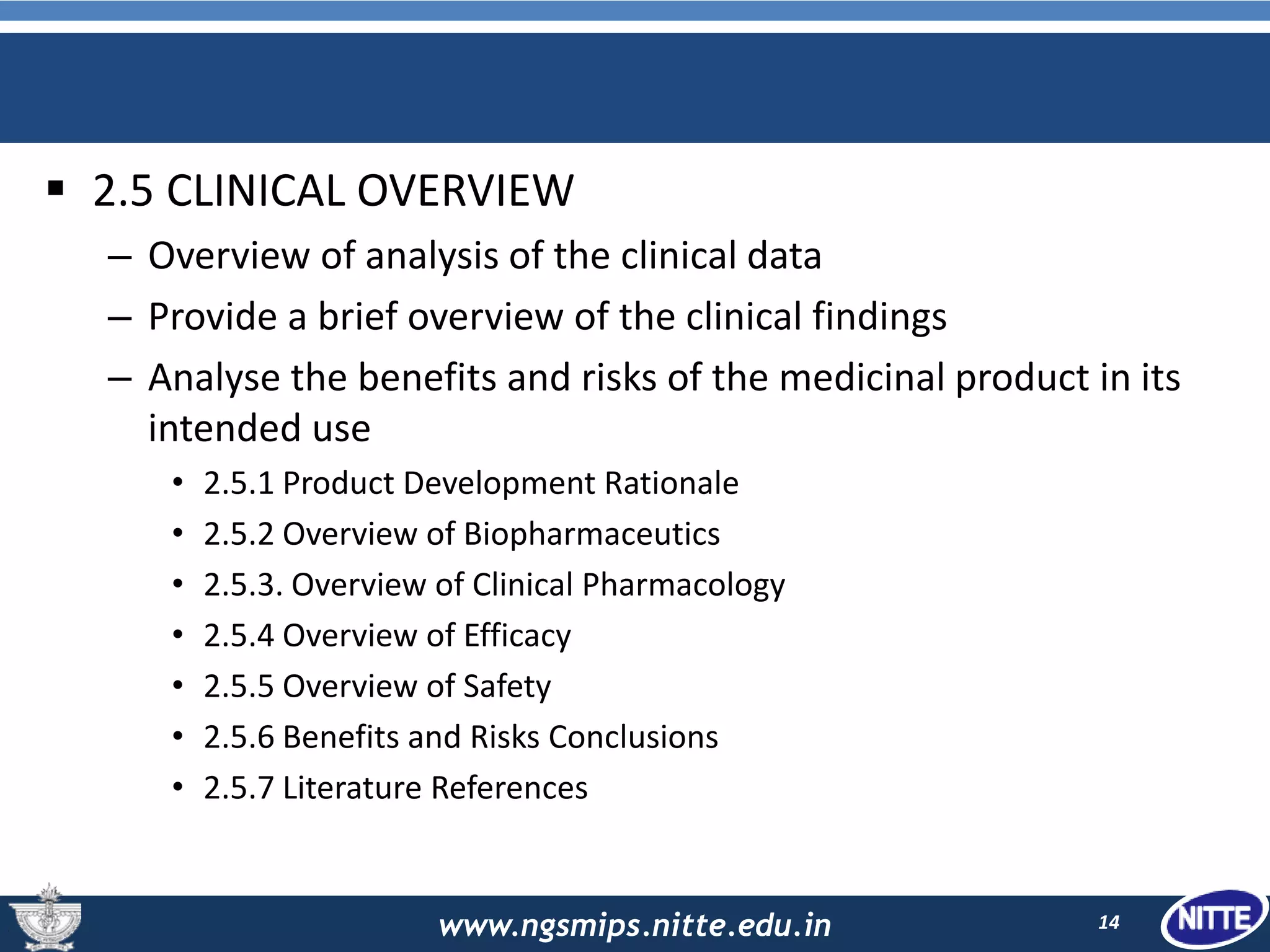
 2.5 CLINICAL OVERVIEW
– Overview of analysis of the clinical data
– Provide a brief overview of the clinical findings
– Analyse the benefits and risks of the medicinal product in its
intended use
• 2.5.1 Product Development Rationale
• 2.5.2 Overview of Biopharmaceutics
• 2.5.3. Overview of Clinical Pharmacology
• 2.5.4 Overview of Efficacy
• 2.5.5 Overview of Safety
• 2.5.6 Benefits and Risks Conclusions
• 2.5.7 Literature References
14
www.ngsmips.nitte.edu.in
 2.6 NON-CLINICAL SUMMARIES
– Summary of pharmacokinetic, pharmacological
and toxicology studies – in-vivo/in-vitro, species,
route and duration
– Appropriate age and gender related effects
15
www.ngsmips.nitte.edu.in
 2.7 CLINICAL SUMMARIES
– This section is intended to provide a detailed, factual
summarization of all of the clinical information in the
CTD. This includes:
• information provided in clinical study reports
• information obtained from any analyses for which full
reports have been included in Module 5; and
• post-marketing data for products that have been marketed
in other regions
– Synopses of Individual Studies
16
www.ngsmips.nitte.edu.in
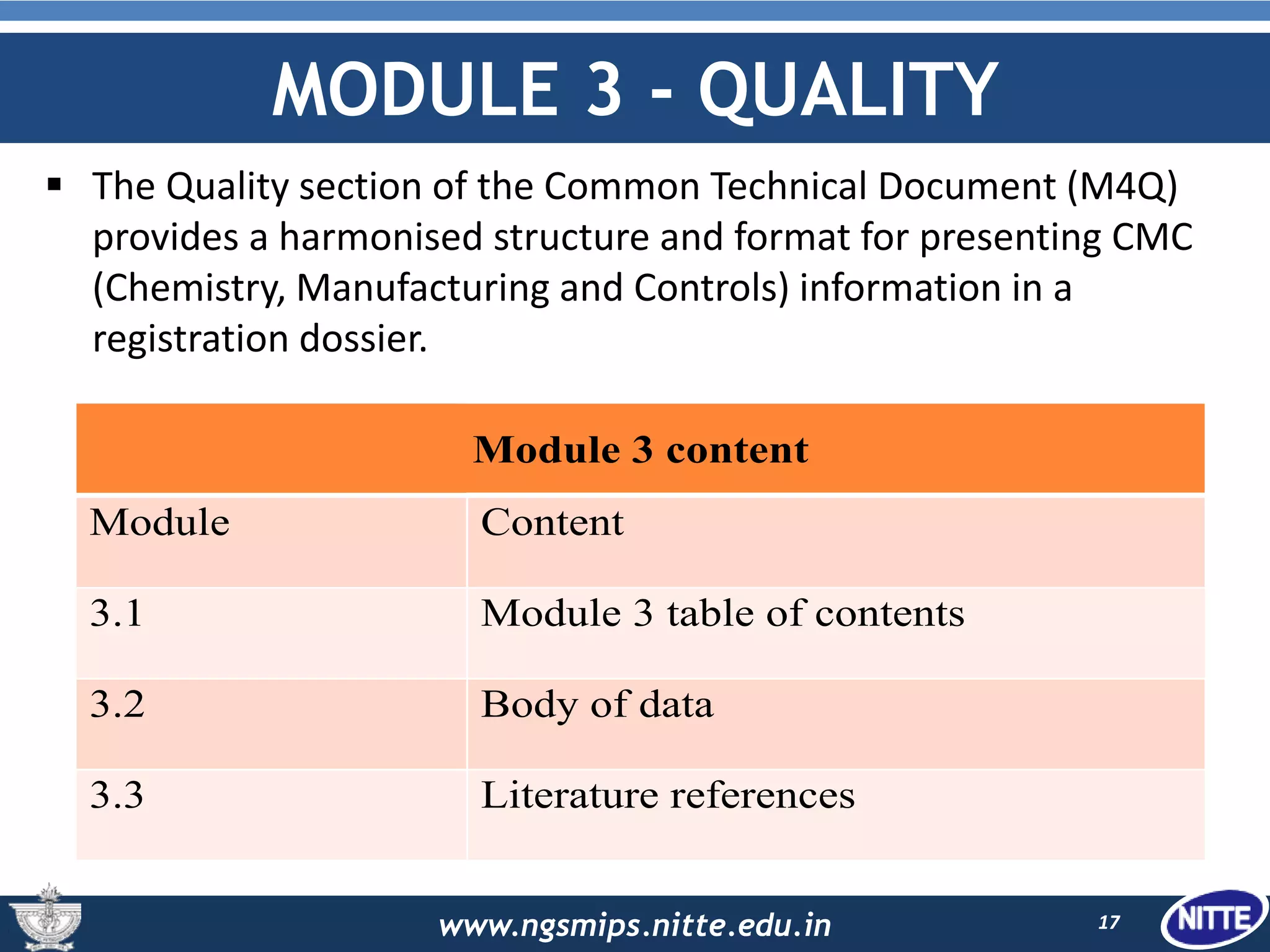
MODULE 3 - QUALITY
 The Quality section of the Common Technical Document (M4Q)
provides a harmonised structure and format for presenting CMC
(Chemistry, Manufacturing and Controls) information in a
registration dossier.
17
Module 3 content
Module Content
3.1 Module 3 table of contents
3.2 Body of data
3.3 Literature references
www.ngsmips.nitte.edu.in
 3.2 BODY OF DATA
– 3.2.S DRUG SUBSTANCE(S)
 3.2.S.1 General information (name, manufacturer)
 3.2.S.2 Manufacture of Drug Substance (name, manufacturer)
• 3.2.S.3 Characterization of Drug Substance
• 3.2.S.4 Quality control of Drug Substance
• 3.2.S.5 Reference Standards or Materials
• 3.2.S.6 Container Closure System
• 3.2.S.7 Stability of Drug Substance
– 3.2.P DRUG PRODUCT (NAME, DOSAGE FORM)
 3.2.P.4 Control of Excipients
 3.2.P.5 Control of Drug Product
18
www.ngsmips.nitte.edu.in
MODULE 4: NON-CLINICAL STUDY REPORTS
 Module 4 describes the format and organisation
of the nonclinical (pharmaco-toxicological) data
relevant to the application.
– 4.2 STUDY REPORTS
– 4.2.1 Pharmacology
– 4.2.2 Pharmacokinetics
– 4.2.3 Toxicology
– 4.3 literature references
19
www.ngsmips.nitte.edu.in
MODULE 5: CLINICAL STUDY REPORTS
 Module 5 describes the format and organisation of the clinical data
relevant to the application.
– 5.3.1 Reports of Biopharmaceutical Studies
– 5.3.2 Reports of Studies Pertinent to Pharmacokinetics Using
Human Biomaterials
– 5.3.3 Reports of Human Pharmacokinetic (PK) Studies
– 5.3.4 Reports of Human Pharmacodynamic (PD) Studies
– 5.3.5 Reports of Efficacy and Safety Studies
– 5.3.6 Reports of Post-Marketing Experience
– 5.3.7 Case Report Forms and Individual Patient Listings
– 5.4 literature references
20
www.ngsmips.nitte.edu.in 21
GUIDANCE FOR THE INDUSTRY
 Divided in 4 guidance document
www.ngsmips.nitte.edu.in
CONCLUSION
 Whilst the realization of the CTD took many years,
there is now a common format for the submission of
Marketing Authorizations Applications across the
three ICH regions - Europe, Japan and the USA.
 This should facilitate pharmaceutical companies to
make simultaneous filings in the ICH regions as it will
eliminate the extensive work previously required to
convert, for example, a US dossier to an EU dossier
and vice versa.
22
www.ngsmips.nitte.edu.in
REFERENCES
1. “Guidance for Industry on Preparation of Common Technical Document
for Import / Manufacture And Marketing Approval Of New Drugs For
Human Use (New Drug Application – NDA)”. Available at
http://cdsco.nic.in/CTD_Guidance%20-Final.pdf
2. “Guideline M4: The Common Technical Document”. Available at
http://www.ich.org/products/ctd.html
3. “ICH Harmonised Tripartite Guideline: Organisation Of The Common
Technical Document For The Registration Of Pharmaceuticals For Human
Use M4”. Available at http://www.ich.org/fileadmin
23

Common Technical Document (CTD)

  • 1.
    www.ngsmips.nitte.edu.in CTD Common Technical Document Departmentof Regulatory Affairs NGSMIPS, Nitte University Mangalore - Swapnil Dylan Fernandes 1st M.Pharm 1
  • 2.
    www.ngsmips.nitte.edu.in WILL DISCUSS ABOUT:-  What is CTD?  Why CTD?  Preparing and organizing the CTD (Modules)  Conclusion  References 2
  • 3.
    www.ngsmips.nitte.edu.in ABBREVIATIONS  CDSCO: CentralDrugs Standard Control Organization  CTD: Common Technical Document  DCGI: Drug Controller General of India  eCTD: Electronic Common Technical Document  FDA: Food and Drug Administration  ICH: International Conference on Harmonisation  IND: Investigational New Drug application  NDA: New Drug Application  USFDA: US Food and Drug Administration  TGA: Therapeutic Goods Administration  EMA: European Medicines Agency 3
  • 4.
    www.ngsmips.nitte.edu.in WHAT IS CTD? Application format  CTD IS A JOINT EFFORT OF 3 REGULATORY AGENCIES:  1.European Medicines Agency (EMEA, Europe),  2.Food and Drug Administration (FDA, USA) and  3.Ministry of Health, Labour and Welfare (MHLW,Japan).  The CTD is a set of specifications for a dossier for the registration of medicines (TGA)  CTD is an internationally agreed “well structured common format” for the organization of the technical requirements that is to be submitted to the regulatory authority as an application for the registration of pharmaceuticals for human use in all three ICH regions (U.S.A., Europe and Japan). 4
  • 5.
    www.ngsmips.nitte.edu.in WHY CTD?  Hurdlesput down by the 3 major regulatory authorities.  Objective of ICH to prepare the CTD.  Reduce the time and resources used to compile applications  It will ease the preparation of electronic submissions.  To facilitate simultaneous submission in three regions.  To facilitate easier exchange of regulatory information and thereby ensure faster availability of new medicines. 5
  • 6.
    www.ngsmips.nitte.edu.in MODULES OF CTD It is organized into:-  Module 1: General Information  Module 2: CTD summaries  Module 3: Quality  Module 4: Nonclinical study reports  Module 5: Clinical study reports 6
  • 7.
  • 8.
    www.ngsmips.nitte.edu.in MODULE 1  Administrativeinformation and prescribing information.  Document specific to each region.  E.g. Application form Proposed label for use in the region 8
  • 9.
    www.ngsmips.nitte.edu.in MODULE 1: GENERALINFORMATION 1.1. Covering letter & comprehensive table of contents 1.2. Administrative information  Brief introduction about the applicant company  Duly filled and signed application in Form 44 and Treasury Challan  Legal and Critical Documents such as Copy of Clinical Trial/BE., No Objection letters issued by CDSCO, Batch release certificate issued by National Regulatory Authorities E.g. For manufacture and marketing of finished products, in addition to the above mentioned docs, Copy of existing manufacturing license in Form 25 / 28. Copy of Form-29 Certificate of Analysis Coordinates related to the application 9
  • 10.
    www.ngsmips.nitte.edu.in 1.3 General Informationon Drug Product 1.5 Regulatory status in other countries 1.6 Domestic price of the drug followed in the countries of 1.7 A brief profile of the manufacturer’s research activity 1.8 A brief profile of the manufacturer’s business activity in domestic as well as global market 1.9 Information regarding involvement of experts, if any 1.10 Samples of drug product 1.11 Promotional materials 10
  • 11.
    www.ngsmips.nitte.edu.in MODULE 2 -CTD SUMMARIES 2.1 Table of content of module 2 2.2 Introduction 2.3 Quality overall summaries 2.4 Non-clinical overview 2.5 Clinical overview 2.6 Non-clinical summaries 2.7 Clinical summaries 11
  • 12.
    www.ngsmips.nitte.edu.in  2.3 QUALITYOVERALL SUMMARIES – The Quality Overall Summary (QOS) is an outline of data presented in Module 3. – Entire information present in Module 3 corresponding sections is not provided, but, provide brief information picked from relevant sections. – 2.3.S Summary Of Drug Substance – 2.3.P Summary Of Drug Product 12
  • 13.
    www.ngsmips.nitte.edu.in  2.4 NON-CLINICALOVERVIEW – 2.4.1 Introduction and GLP statement – 2.4.2 Overview of the Non Clinical Testing Strategy – 2.4.3 Pharmacology – 2.4.4 Pharmacokinetics – 2.4.5 Toxicology – 2.4.6 Integrated Overview and Conclusions – 2.4.7 List of Literature References  Implications of nonclinical findings for the safe use of the pharmaceutical. 13
  • 14.
    www.ngsmips.nitte.edu.in  2.5 CLINICALOVERVIEW – Overview of analysis of the clinical data – Provide a brief overview of the clinical findings – Analyse the benefits and risks of the medicinal product in its intended use • 2.5.1 Product Development Rationale • 2.5.2 Overview of Biopharmaceutics • 2.5.3. Overview of Clinical Pharmacology • 2.5.4 Overview of Efficacy • 2.5.5 Overview of Safety • 2.5.6 Benefits and Risks Conclusions • 2.5.7 Literature References 14
  • 15.
    www.ngsmips.nitte.edu.in  2.6 NON-CLINICALSUMMARIES – Summary of pharmacokinetic, pharmacological and toxicology studies – in-vivo/in-vitro, species, route and duration – Appropriate age and gender related effects 15
  • 16.
    www.ngsmips.nitte.edu.in  2.7 CLINICALSUMMARIES – This section is intended to provide a detailed, factual summarization of all of the clinical information in the CTD. This includes: • information provided in clinical study reports • information obtained from any analyses for which full reports have been included in Module 5; and • post-marketing data for products that have been marketed in other regions – Synopses of Individual Studies 16
  • 17.
    www.ngsmips.nitte.edu.in MODULE 3 -QUALITY  The Quality section of the Common Technical Document (M4Q) provides a harmonised structure and format for presenting CMC (Chemistry, Manufacturing and Controls) information in a registration dossier. 17 Module 3 content Module Content 3.1 Module 3 table of contents 3.2 Body of data 3.3 Literature references
  • 18.
    www.ngsmips.nitte.edu.in  3.2 BODYOF DATA – 3.2.S DRUG SUBSTANCE(S)  3.2.S.1 General information (name, manufacturer)  3.2.S.2 Manufacture of Drug Substance (name, manufacturer) • 3.2.S.3 Characterization of Drug Substance • 3.2.S.4 Quality control of Drug Substance • 3.2.S.5 Reference Standards or Materials • 3.2.S.6 Container Closure System • 3.2.S.7 Stability of Drug Substance – 3.2.P DRUG PRODUCT (NAME, DOSAGE FORM)  3.2.P.4 Control of Excipients  3.2.P.5 Control of Drug Product 18
  • 19.
    www.ngsmips.nitte.edu.in MODULE 4: NON-CLINICALSTUDY REPORTS  Module 4 describes the format and organisation of the nonclinical (pharmaco-toxicological) data relevant to the application. – 4.2 STUDY REPORTS – 4.2.1 Pharmacology – 4.2.2 Pharmacokinetics – 4.2.3 Toxicology – 4.3 literature references 19
  • 20.
    www.ngsmips.nitte.edu.in MODULE 5: CLINICALSTUDY REPORTS  Module 5 describes the format and organisation of the clinical data relevant to the application. – 5.3.1 Reports of Biopharmaceutical Studies – 5.3.2 Reports of Studies Pertinent to Pharmacokinetics Using Human Biomaterials – 5.3.3 Reports of Human Pharmacokinetic (PK) Studies – 5.3.4 Reports of Human Pharmacodynamic (PD) Studies – 5.3.5 Reports of Efficacy and Safety Studies – 5.3.6 Reports of Post-Marketing Experience – 5.3.7 Case Report Forms and Individual Patient Listings – 5.4 literature references 20
  • 21.
    www.ngsmips.nitte.edu.in 21 GUIDANCE FORTHE INDUSTRY  Divided in 4 guidance document
  • 22.
    www.ngsmips.nitte.edu.in CONCLUSION  Whilst therealization of the CTD took many years, there is now a common format for the submission of Marketing Authorizations Applications across the three ICH regions - Europe, Japan and the USA.  This should facilitate pharmaceutical companies to make simultaneous filings in the ICH regions as it will eliminate the extensive work previously required to convert, for example, a US dossier to an EU dossier and vice versa. 22
  • 23.
    www.ngsmips.nitte.edu.in REFERENCES 1. “Guidance forIndustry on Preparation of Common Technical Document for Import / Manufacture And Marketing Approval Of New Drugs For Human Use (New Drug Application – NDA)”. Available at http://cdsco.nic.in/CTD_Guidance%20-Final.pdf 2. “Guideline M4: The Common Technical Document”. Available at http://www.ich.org/products/ctd.html 3. “ICH Harmonised Tripartite Guideline: Organisation Of The Common Technical Document For The Registration Of Pharmaceuticals For Human Use M4”. Available at http://www.ich.org/fileadmin 23