

INTERNATIONAL COUNCIL FOR
HARMONISATION (ICH)
GUIDELINES
MADE BY: ASST PROF MASARRAT KHAN
RBT COLLEGE OF B.PHARMACY, AURANGABAD.
CONTENTS
 What is ICH
 Purpose of ICH
 Objectives of ICH
 Organizational structure of ICH
 Working Groups
 ICH guidelines
 Members of ICH
 Process of Harmonization
 Brief overview of QSEM Guidelines
 ICH Stability Testing Guidelines.
WHAT IS ICH
 ICH is a joint initiative both regulators and research
based industry representatives of the European
Union, Japan and the USA in Scientific and
technical discussion of the testing procedures
required to assess and ensure the safety, quality
and efficacy of the medicines.
INTERNATIONAL COUNCIL FOR
HARMONISATION (ICH)
 Harmonization of technical requirement for ICH is the “
International Conference on Harmonization of Technical
requirements for registration of pharmaceutical for human
use”
 It’s a unique project that brings together the regulatory
authorities of Europe, Japan and USA and experts from
pharmaceutical industry representatives of the EU, Japan and
US in scientific and technical discussion of the testing
procedure requires to assess and ensure the safety, quality
and efficacy of the medicines.
 The focus of ICH has been on the technical requirements for
medicinal products containing new drugs.
 The vast majority of those new drugs and medicines are
developed in western Europe, Japan and USA, when ICH was
established it was agreed that its scope would be confined to
registration In those three regions.
PURPOSE OF ICH
 The main purpose of ICH is to make
recommendations on ways to achieve greater
harmonization in the interpretation and application
of technical guidelines and requirements for
products registration in order to reduce or obviate
the need to duplicate the testing carried out during
the research and development of new medicines.
OBJECTIVES OF ICH
 To increase international harmonization of technical
requirements to ensure that safe, effective and high
quality medicines are developed.
 To harmonize technical requirement for registration
or marketing approval.
 To develop and register pharmaceutical in the and
most efficient and effective manner.
 t o promote the public health
 To prevent unnecessary duplication of clinical trials
on humans.
 To minimize the use of animal testing without
compromising safety and effectiveness of drug.
ICH ORGANISATIONAL STRUCTURE
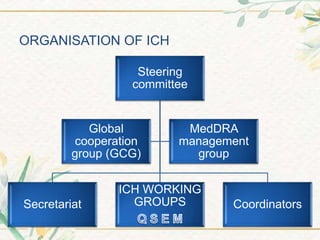
 The ICH structure consist of the,
 ICH Steering Committee,
 ICH Coordinators,
 ICH Secretariat and
 ICH Working Groups.
 The ICH Global Cooperation Group (GCG) and the
ICH MedDRA Management Board and Sub-
committees of the ICH Steering Committee.
ORGANISATION OF ICH
Steering
committee
Secretariat
ICH WORKING
GROUPS Coordinators
Global
cooperation
group (GCG)
MedDRA
management
group
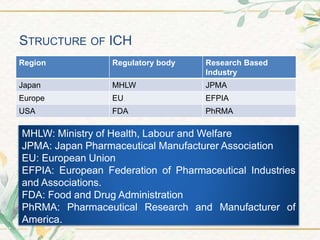
STRUCTURE OF ICH
Region Regulatory body Research Based
Industry
Japan MHLW JPMA
Europe EU EFPIA
USA FDA PhRMA
MHLW: Ministry of Health, Labour and Welfare
JPMA: Japan Pharmaceutical Manufacturer Association
EU: European Union
EFPIA: European Federation of Pharmaceutical Industries
and Associations.
FDA: Food and Drug Administration
PhRMA: Pharmaceutical Research and Manufacturer of
America.
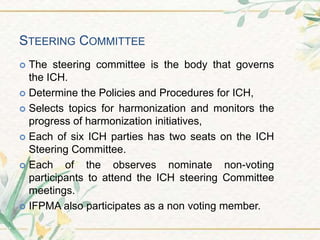
STEERING COMMITTEE
 The steering committee is the body that governs
the ICH.
 Determine the Policies and Procedures for ICH,
 Selects topics for harmonization and monitors the
progress of harmonization initiatives,
 Each of six ICH parties has two seats on the ICH
Steering Committee.
 Each of the observes nominate non-voting
participants to attend the ICH steering Committee
meetings.
 IFPMA also participates as a non voting member.
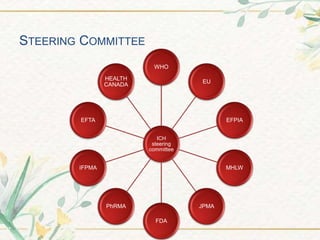
STEERING COMMITTEE
ICH
steering
committee
WHO
EU
EFPIA
MHLW
JPMA
FDA
PhRMA
IFPMA
EFTA
HEALTH
CANADA
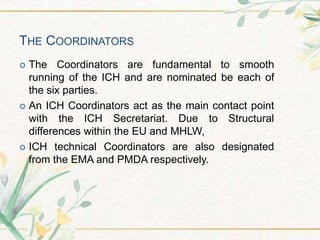
THE COORDINATORS
 The Coordinators are fundamental to smooth
running of the ICH and are nominated be each of
the six parties.
 An ICH Coordinators act as the main contact point
with the ICH Secretariat. Due to Structural
differences within the EU and MHLW,
 ICH technical Coordinators are also designated
from the EMA and PMDA respectively.
THE ICH SECRETARIAT
 The secretariat operates from the IFPMA
(International Federation of Pharmaceutical
Manufacturers and Associations) Offices, in
Geneva, and is primarily Concerned with
Preparation for, and documentation of, meetings of
the Steering Committee.
 At the time of ICH Conferences, the Secretariat is
responsible for the technical documentation and for
liaison with the speakers for the Conference.
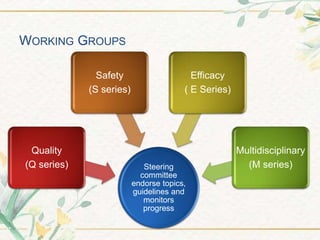
WORKING GROUPS
Steering
committee
endorse topics,
guidelines and
monitors
progress
Quality
(Q series)
Safety
(S series)
Efficacy
( E Series)
Multidisciplinary
(M series)
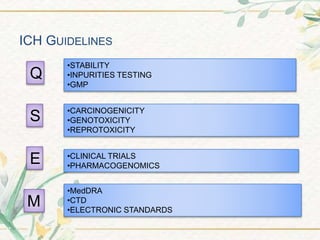
ICH GUIDELINES
Q
•STABILITY
•INPURITIES TESTING
•GMP
S •CARCINOGENICITY
•GENOTOXICITY
•REPROTOXICITY
E •CLINICAL TRIALS
•PHARMACOGENOMICS
M
•MedDRA
•CTD
•ELECTRONIC STANDARDS
MEMBERS OF ICH
 ICH is comprised of representatives from six parties
that represent the regulatory bodies and research
based industry in the European Union, Japan and
the USA.
 In Japan, the members are the Ministry of Health,
Labour and Welfare (MHLW), and the Japan
Pharmaceutical Manufacturers Association (JPMA).
 In Europe the members are the European Union
(EU), and the European Federation of
Pharmaceutical Industries and Association (EFPIA)
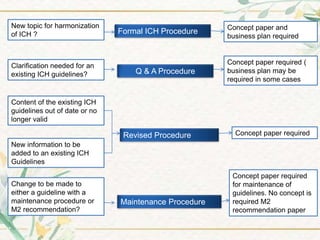
PROCESS OF HARMONIZATION
New topic for harmonization
of ICH ?
Clarification needed for an
existing ICH guidelines?
Content of the existing ICH
guidelines out of date or no
longer valid
New information to be
added to an existing ICH
Guidelines
Change to be made to
either a guideline with a
maintenance procedure or
M2 recommendation?
Formal ICH Procedure
Q & A Procedure
Revised Procedure
Maintenance Procedure
Concept paper and
business plan required
Concept paper required (
business plan may be
required in some cases
Concept paper required
for maintenance of
guidelines. No concept is
required M2
recommendation paper
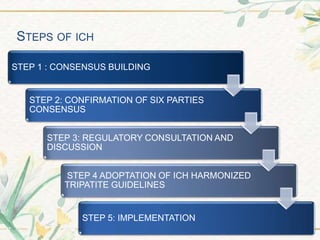
STEPS OF ICH
STEP 1 : CONSENSUS BUILDING
STEP 2: CONFIRMATION OF SIX PARTIES
CONSENSUS
STEP 3: REGULATORY CONSULTATION AND
DISCUSSION
STEP 4 ADOPTATION OF ICH HARMONIZED
TRIPATITE GUIDELINES
STEP 5: IMPLEMENTATION
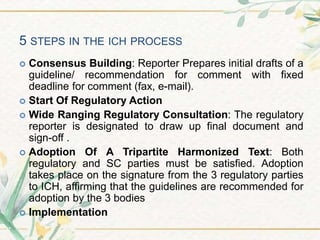
5 STEPS IN THE ICH PROCESS
 Consensus Building: Reporter Prepares initial drafts of a
guideline/ recommendation for comment with fixed
deadline for comment (fax, e-mail).
 Start Of Regulatory Action
 Wide Ranging Regulatory Consultation: The regulatory
reporter is designated to draw up final document and
sign-off .
 Adoption Of A Tripartite Harmonized Text: Both
regulatory and SC parties must be satisfied. Adoption
takes place on the signature from the 3 regulatory parties
to ICH, affirming that the guidelines are recommended for
adoption by the 3 bodies
 Implementation
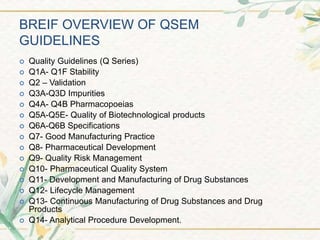
BREIF OVERVIEW OF QSEM
GUIDELINES
 Quality Guidelines (Q Series)
 Q1A- Q1F Stability
 Q2 – Validation
 Q3A-Q3D Impurities
 Q4A- Q4B Pharmacopoeias
 Q5A-Q5E- Quality of Biotechnological products
 Q6A-Q6B Specifications
 Q7- Good Manufacturing Practice
 Q8- Pharmaceutical Development
 Q9- Quality Risk Management
 Q10- Pharmaceutical Quality System
 Q11- Development and Manufacturing of Drug Substances
 Q12- Lifecycle Management
 Q13- Continuous Manufacturing of Drug Substances and Drug
Products
 Q14- Analytical Procedure Development.
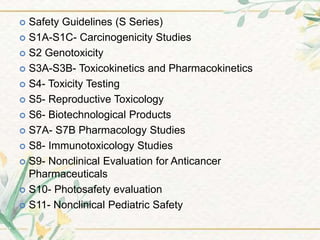
 Safety Guidelines (S Series)
 S1A-S1C- Carcinogenicity Studies
 S2 Genotoxicity
 S3A-S3B- Toxicokinetics and Pharmacokinetics
 S4- Toxicity Testing
 S5- Reproductive Toxicology
 S6- Biotechnological Products
 S7A- S7B Pharmacology Studies
 S8- Immunotoxicology Studies
 S9- Nonclinical Evaluation for Anticancer
Pharmaceuticals
 S10- Photosafety evaluation
 S11- Nonclinical Pediatric Safety
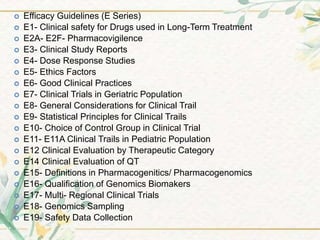
 Efficacy Guidelines (E Series)
 E1- Clinical safety for Drugs used in Long-Term Treatment
 E2A- E2F- Pharmacovigilence
 E3- Clinical Study Reports
 E4- Dose Response Studies
 E5- Ethics Factors
 E6- Good Clinical Practices
 E7- Clinical Trials in Geriatric Population
 E8- General Considerations for Clinical Trail
 E9- Statistical Principles for Clinical Trails
 E10- Choice of Control Group in Clinical Trial
 E11- E11A Clinical Trails in Pediatric Population
 E12 Clinical Evaluation by Therapeutic Category
 E14 Clinical Evaluation of QT
 E15- Definitions in Pharmacogenitics/ Pharmacogenomics
 E16- Qualification of Genomics Biomakers
 E17- Multi- Regional Clinical Trials
 E18- Genomics Sampling
 E19- Safety Data Collection
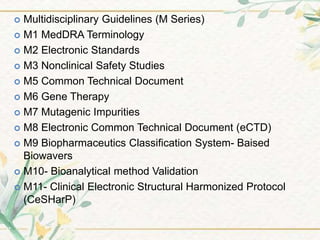
 Multidisciplinary Guidelines (M Series)
 M1 MedDRA Terminology
 M2 Electronic Standards
 M3 Nonclinical Safety Studies
 M5 Common Technical Document
 M6 Gene Therapy
 M7 Mutagenic Impurities
 M8 Electronic Common Technical Document (eCTD)
 M9 Biopharmaceutics Classification System- Baised
Biowavers
 M10- Bioanalytical method Validation
 M11- Clinical Electronic Structural Harmonized Protocol
(CeSHarP)
ICH STABILITY TESTING GUIDELINES
ICH GUIDELINES FOR STABILITY
STUDIES
 Q1A(R2)- Stability testing for new drug substances and
products
 Q1B- Photo Stability testing for new drug substances
and products
 Q1C- Stability testing for new dosage form
 Q1D- Bracketing and Matrixing Designs for Stability
 Q1E- Evaluation of Stability Data
 Q1F: Stability Data Package for Registration: application
in Climate Zones III and IV.
THANK YOU

International council for harmonisation (ich) guidelines

  • 1.
    INTERNATIONAL COUNCIL FOR HARMONISATION(ICH) GUIDELINES MADE BY: ASST PROF MASARRAT KHAN RBT COLLEGE OF B.PHARMACY, AURANGABAD.
  • 2.
    CONTENTS  What isICH  Purpose of ICH  Objectives of ICH  Organizational structure of ICH  Working Groups  ICH guidelines  Members of ICH  Process of Harmonization  Brief overview of QSEM Guidelines  ICH Stability Testing Guidelines.
  • 3.
    WHAT IS ICH ICH is a joint initiative both regulators and research based industry representatives of the European Union, Japan and the USA in Scientific and technical discussion of the testing procedures required to assess and ensure the safety, quality and efficacy of the medicines.
  • 4.
    INTERNATIONAL COUNCIL FOR HARMONISATION(ICH)  Harmonization of technical requirement for ICH is the “ International Conference on Harmonization of Technical requirements for registration of pharmaceutical for human use”  It’s a unique project that brings together the regulatory authorities of Europe, Japan and USA and experts from pharmaceutical industry representatives of the EU, Japan and US in scientific and technical discussion of the testing procedure requires to assess and ensure the safety, quality and efficacy of the medicines.  The focus of ICH has been on the technical requirements for medicinal products containing new drugs.  The vast majority of those new drugs and medicines are developed in western Europe, Japan and USA, when ICH was established it was agreed that its scope would be confined to registration In those three regions.
  • 5.
    PURPOSE OF ICH The main purpose of ICH is to make recommendations on ways to achieve greater harmonization in the interpretation and application of technical guidelines and requirements for products registration in order to reduce or obviate the need to duplicate the testing carried out during the research and development of new medicines.
  • 6.
    OBJECTIVES OF ICH To increase international harmonization of technical requirements to ensure that safe, effective and high quality medicines are developed.  To harmonize technical requirement for registration or marketing approval.  To develop and register pharmaceutical in the and most efficient and effective manner.  t o promote the public health  To prevent unnecessary duplication of clinical trials on humans.  To minimize the use of animal testing without compromising safety and effectiveness of drug.
  • 7.
    ICH ORGANISATIONAL STRUCTURE The ICH structure consist of the,  ICH Steering Committee,  ICH Coordinators,  ICH Secretariat and  ICH Working Groups.  The ICH Global Cooperation Group (GCG) and the ICH MedDRA Management Board and Sub- committees of the ICH Steering Committee.
  • 8.
    ORGANISATION OF ICH Steering committee Secretariat ICHWORKING GROUPS Coordinators Global cooperation group (GCG) MedDRA management group
  • 9.
    STRUCTURE OF ICH RegionRegulatory body Research Based Industry Japan MHLW JPMA Europe EU EFPIA USA FDA PhRMA MHLW: Ministry of Health, Labour and Welfare JPMA: Japan Pharmaceutical Manufacturer Association EU: European Union EFPIA: European Federation of Pharmaceutical Industries and Associations. FDA: Food and Drug Administration PhRMA: Pharmaceutical Research and Manufacturer of America.
  • 10.
    STEERING COMMITTEE  Thesteering committee is the body that governs the ICH.  Determine the Policies and Procedures for ICH,  Selects topics for harmonization and monitors the progress of harmonization initiatives,  Each of six ICH parties has two seats on the ICH Steering Committee.  Each of the observes nominate non-voting participants to attend the ICH steering Committee meetings.  IFPMA also participates as a non voting member.
  • 11.
  • 12.
    THE COORDINATORS  TheCoordinators are fundamental to smooth running of the ICH and are nominated be each of the six parties.  An ICH Coordinators act as the main contact point with the ICH Secretariat. Due to Structural differences within the EU and MHLW,  ICH technical Coordinators are also designated from the EMA and PMDA respectively.
  • 13.
    THE ICH SECRETARIAT The secretariat operates from the IFPMA (International Federation of Pharmaceutical Manufacturers and Associations) Offices, in Geneva, and is primarily Concerned with Preparation for, and documentation of, meetings of the Steering Committee.  At the time of ICH Conferences, the Secretariat is responsible for the technical documentation and for liaison with the speakers for the Conference.
  • 14.
    WORKING GROUPS Steering committee endorse topics, guidelinesand monitors progress Quality (Q series) Safety (S series) Efficacy ( E Series) Multidisciplinary (M series)
  • 15.
    ICH GUIDELINES Q •STABILITY •INPURITIES TESTING •GMP S•CARCINOGENICITY •GENOTOXICITY •REPROTOXICITY E •CLINICAL TRIALS •PHARMACOGENOMICS M •MedDRA •CTD •ELECTRONIC STANDARDS
  • 16.
    MEMBERS OF ICH ICH is comprised of representatives from six parties that represent the regulatory bodies and research based industry in the European Union, Japan and the USA.  In Japan, the members are the Ministry of Health, Labour and Welfare (MHLW), and the Japan Pharmaceutical Manufacturers Association (JPMA).  In Europe the members are the European Union (EU), and the European Federation of Pharmaceutical Industries and Association (EFPIA)
  • 17.
  • 18.
    New topic forharmonization of ICH ? Clarification needed for an existing ICH guidelines? Content of the existing ICH guidelines out of date or no longer valid New information to be added to an existing ICH Guidelines Change to be made to either a guideline with a maintenance procedure or M2 recommendation? Formal ICH Procedure Q & A Procedure Revised Procedure Maintenance Procedure Concept paper and business plan required Concept paper required ( business plan may be required in some cases Concept paper required Concept paper required for maintenance of guidelines. No concept is required M2 recommendation paper
  • 19.
    STEPS OF ICH STEP1 : CONSENSUS BUILDING STEP 2: CONFIRMATION OF SIX PARTIES CONSENSUS STEP 3: REGULATORY CONSULTATION AND DISCUSSION STEP 4 ADOPTATION OF ICH HARMONIZED TRIPATITE GUIDELINES STEP 5: IMPLEMENTATION
  • 20.
    5 STEPS INTHE ICH PROCESS  Consensus Building: Reporter Prepares initial drafts of a guideline/ recommendation for comment with fixed deadline for comment (fax, e-mail).  Start Of Regulatory Action  Wide Ranging Regulatory Consultation: The regulatory reporter is designated to draw up final document and sign-off .  Adoption Of A Tripartite Harmonized Text: Both regulatory and SC parties must be satisfied. Adoption takes place on the signature from the 3 regulatory parties to ICH, affirming that the guidelines are recommended for adoption by the 3 bodies  Implementation
  • 21.
    BREIF OVERVIEW OFQSEM GUIDELINES  Quality Guidelines (Q Series)  Q1A- Q1F Stability  Q2 – Validation  Q3A-Q3D Impurities  Q4A- Q4B Pharmacopoeias  Q5A-Q5E- Quality of Biotechnological products  Q6A-Q6B Specifications  Q7- Good Manufacturing Practice  Q8- Pharmaceutical Development  Q9- Quality Risk Management  Q10- Pharmaceutical Quality System  Q11- Development and Manufacturing of Drug Substances  Q12- Lifecycle Management  Q13- Continuous Manufacturing of Drug Substances and Drug Products  Q14- Analytical Procedure Development.
  • 22.
     Safety Guidelines(S Series)  S1A-S1C- Carcinogenicity Studies  S2 Genotoxicity  S3A-S3B- Toxicokinetics and Pharmacokinetics  S4- Toxicity Testing  S5- Reproductive Toxicology  S6- Biotechnological Products  S7A- S7B Pharmacology Studies  S8- Immunotoxicology Studies  S9- Nonclinical Evaluation for Anticancer Pharmaceuticals  S10- Photosafety evaluation  S11- Nonclinical Pediatric Safety
  • 23.
     Efficacy Guidelines(E Series)  E1- Clinical safety for Drugs used in Long-Term Treatment  E2A- E2F- Pharmacovigilence  E3- Clinical Study Reports  E4- Dose Response Studies  E5- Ethics Factors  E6- Good Clinical Practices  E7- Clinical Trials in Geriatric Population  E8- General Considerations for Clinical Trail  E9- Statistical Principles for Clinical Trails  E10- Choice of Control Group in Clinical Trial  E11- E11A Clinical Trails in Pediatric Population  E12 Clinical Evaluation by Therapeutic Category  E14 Clinical Evaluation of QT  E15- Definitions in Pharmacogenitics/ Pharmacogenomics  E16- Qualification of Genomics Biomakers  E17- Multi- Regional Clinical Trials  E18- Genomics Sampling  E19- Safety Data Collection
  • 24.
     Multidisciplinary Guidelines(M Series)  M1 MedDRA Terminology  M2 Electronic Standards  M3 Nonclinical Safety Studies  M5 Common Technical Document  M6 Gene Therapy  M7 Mutagenic Impurities  M8 Electronic Common Technical Document (eCTD)  M9 Biopharmaceutics Classification System- Baised Biowavers  M10- Bioanalytical method Validation  M11- Clinical Electronic Structural Harmonized Protocol (CeSHarP)
  • 25.
  • 26.
    ICH GUIDELINES FORSTABILITY STUDIES  Q1A(R2)- Stability testing for new drug substances and products  Q1B- Photo Stability testing for new drug substances and products  Q1C- Stability testing for new dosage form  Q1D- Bracketing and Matrixing Designs for Stability  Q1E- Evaluation of Stability Data  Q1F: Stability Data Package for Registration: application in Climate Zones III and IV.
  • 27.