SUBMITTED BY
JAYA PRAKASH V
REGULATORY AFFAIRS
REG NO -218311
WHAT IS MUTUAL RECOGNITION ?
 Mutual recognition is the principle of European Union
(EU) law under which member states must allow goods
that are legally sold in another member state also to be
sold in their own territory.
 For the exporter, this means that a product legally on sale
in one EU country should not have to meet a second set of
requirements in the country to which they are exporting.
 The importing member state can disregard this
principle only under strictly defined circumstances,
such as where public health, the environment or
consumer safety are at risk, and where the measures
taken can be shown to be proportionate.
 The EU total population is about 500 million people.
 The European Union includes 50 Member States
located in Europe, which are:
 Austria, Belgium, Bulgaria, Croatia, Cyprus, Czech
Republic, Denmark, Estonia, Finland, France,
Germany, Greece, Hungary, Ireland, Italy, Latvia,
Lithuania, Luxemburg, Malta, Netherlands, Poland,
Portugal, Romania, Slovakia, Slovenia, Spain, Sweden,
and United Kingdom.
Mutual recognition agreement
 mutual recognition agreement (MRA) is an
international agreement by which two or more countries
agree to recognize one another's conformity assessments.
 A mutual recognition arrangement is an international
arrangement based on such an agreement.
 Mutual Recognition Agreement or Arrangements (MRAs)
is about mutual recognition of conformity assessment
procedures between two countries.
 MRAs eliminate the cost of retesting and
re‐certification, and shorten time‐to‐market for partner
countries’ manufacturers and exporters.
 Under the MRA, companies enjoy significant cost
savings from not having to re‐test and re‐ certify their
product in the importing countries. They also gain
immediate entry into the markets by saving several
weeks of re‐testing.
 There will be two phases in the MRA.
 Phase I is the mutual acceptance of test reports. This
means product that has been tested by our MRA
partners will not require retesting in MRA partner
country .
 Phase II is the mutual acceptance of product
certification. This means product that has been
certified by our MRA partners can enter directly into
Indian market without the need for re‐certification.
The same principle applies to export from India to
MRA partners.
Conformity Assessment Bodies
 Mutual recognition agreements lay down the
conditions under which one Party (non-member
country) will accept conformity assessment results
(e.g. testing or certification) performed by the other's
Party (the EU) designated conformity assessment
bodies (CABs) .
 MRAs include relevant lists of designated laboratories,
inspection bodies and conformity assessment bodies
in both the EU and the other country.
What the Commission does ?
 Technical rules developed at national levels may create
unnecessary obstacles to inter-EU trade. The European
Commission’s aims to:
 guarantee the free movement of goods.
 make sure EU countries accept products lawfully sold in
another EU country unless very specific conditions are
met.
CONT...
 These specific conditions relate to the protection of
public safety, health, or the environment.
 The mutual recognition principle should not be
mistaken for mutual recognition agreements that
facilitate access to markets between the EU and non-
EU countries.
Mutual recognition procedure
 The MRA Product Index includes medicines approved in
the Member States of the European Union according to
the Mutual Recognition.
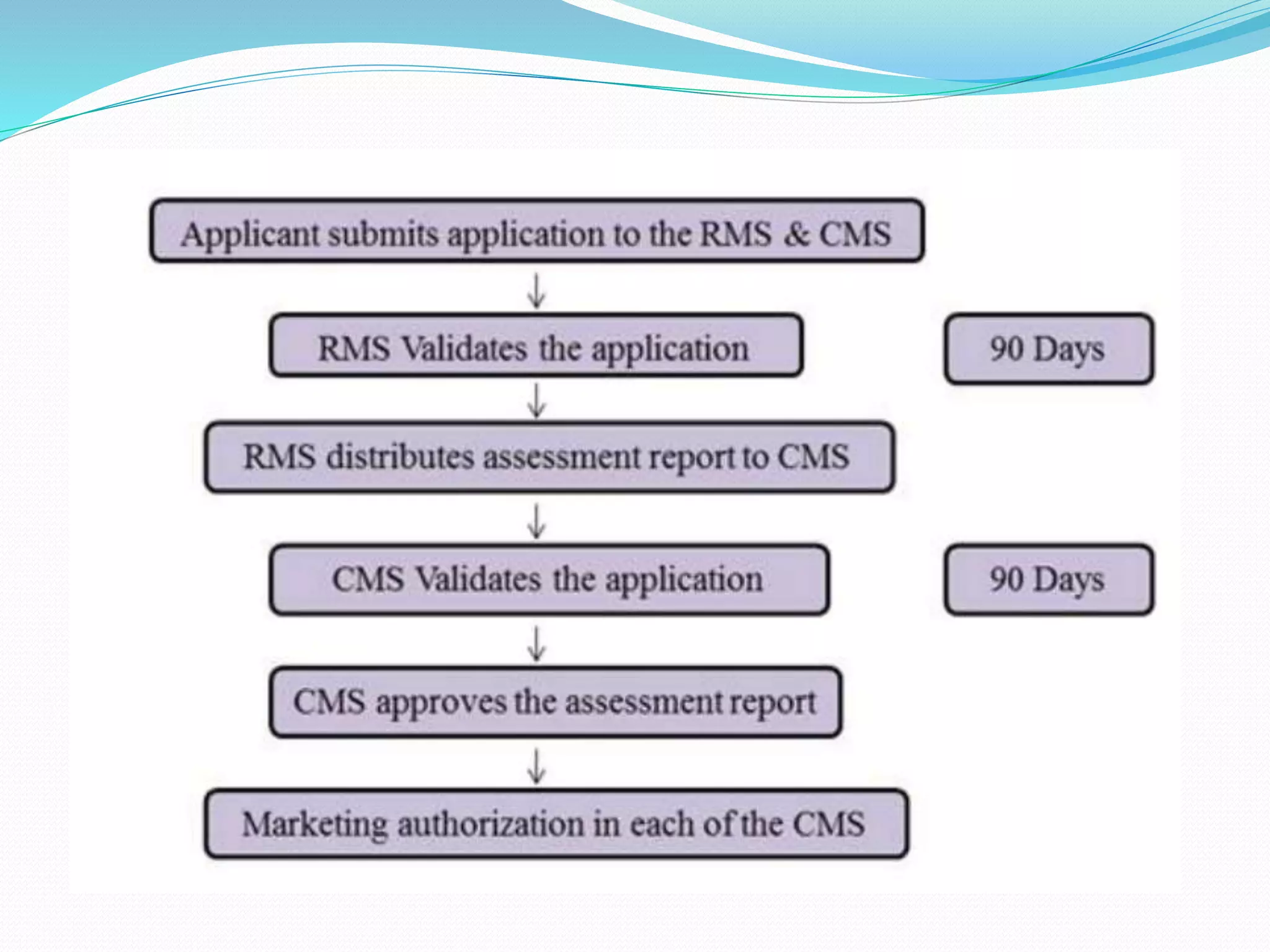
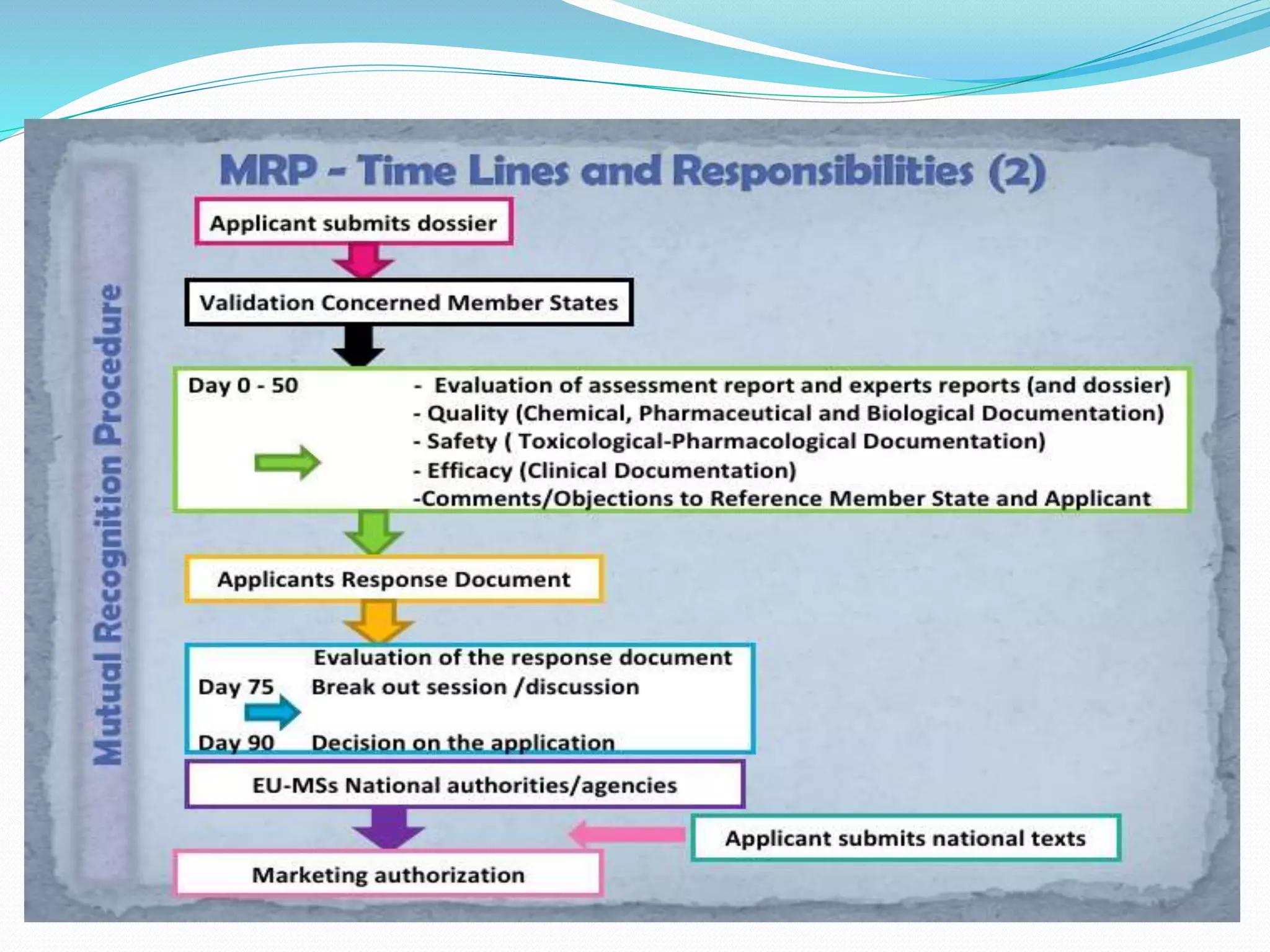
 The mutual recognition procedure (MRP) is based on
that medicines are evaluated and approved by a
Reference Member State (RMS) followed by a 90-day
period where the Concerned Member States (CMS)
consider the RMS assessment report.
 If the CMS agree with the assessment they should issue a
marketing authorisation within 30 days after closure of
the procedure. If the CMS does not agree with the RMS
decision, they can refer the application to the CMDh for
discussion during a 60 day referral procedure.
 If no agreement can be reached during the CMDh
referral, the RMS will forward the procedure to the
European Medicines Agency (EMA) for arbitration. The
Committee for Human Medicinal Products (CHMP) at
the EMA will handle the arbitration.
What is the benefit of mutual
recognition?
 The main advantage of mutual recognition is that it
removes the need to harmonise all national technical
rules. Technical rules typically relate to weight, size,
composition, labelling and packaging.
 All manufactures and vendors can take advantage of
the MRA.
 For example, if a vendor in India wants to export a
product to MRA partners country, he can have the
product tested in India and export directly into to MRA
partners country without re‐testing.
 The same principle applies to import to India
from MRA partners.
 It provides an opportunity for industry and regulatory
agencies in the region to explore opportunities for new
business, for cost savings, and for efficiency gains
through implementation of such an arrangement
hence it provides a significant step forward in trade
liberalization.
The Mutual Recognition Agreement (MRA)
between FDA and European Union
 The Mutual Recognition Agreement (MRA) between
FDA and European Union allows drug inspectors to rely
upon information from drug inspections conducted
within each other’s borders. Under the Food and Drug
Administration Safety and Innovation Act, enacted in
2012 requirements.
 FDA and the EU have collaborated since May 2014 to
evaluate the way they each inspect drug manufacturers
and assess the risk and benefits of mutual recognition
of drug inspections.
 MRA Yields greater efficiencies for U.S. and E.U.
regulatory systems by avoiding duplication of
inspections.
 FDA is collaborating with the following inspectorates
it has assessed as capable and is reviewing their recent
inspection reports and related information in
determining each manufacturer’s suitability for the
U.S. market.
 FDA expects to complete its capability assessment of
all EU inspectorates by July 2019.
Countries that are Recognized
 September 14, 2018
 Portugal National Authority of Medicines and Health
Products.
 June 1, 2018
 Ireland Health Products Regulatory Authority (HPRA).
 March 1, 2018
 Greece National Organisation for Medicines
Hungary,Romania National Agency for Medicines and
Medical Devices.
 November 1, 2017
 United States Food and Drug Administration.
 Austria - Austrian Agency for Health and Food Safety
for Medicinal Products and Medical Devices .
 France- French National Agency for Medicines and
Health Products Safety .
 United Kingdom Medicines and Healthcare products
Regulatory Agency.
Limitations:
 The capability determinations apply to routine surveillance
inspections. In the future the following product and
inspection types may be included in the coverage of the
agreement, pending further consideration:
 Vaccines for human use.
 Plasma derived pharmaceuticals.
 Investigational products (clinical trial material).
 Veterinary products.
 Excluded from the MRA scope are human blood, human
plasma, human tissues and organs and veterinary
immunologicals.
20 Latest Human Products
 Blopress 32mg Tablets
 Ospen 28
 Natriumvalproaat Chrono Sandoz 300 mg, tabletten met
verlengde afgifte
 Natriumvalproaat Chrono Sandoz 500 mg, tabletten met
verlengde afgifte
 Pantoprazol "Actavis"
 Atorvastatin "Generics"
 Nebivololo Mylan Italia
 Aromestane 25mg
 Ouetiapine Bluefish 400 mg, prolonged release tablets
 Ouetiapine Bluefish 300 mg, prolonged release tablets
 Perindopril tosilaat / Indapamide 2.5 mg/0.625 mg
ratiopharm
 Perindopril tosilaat / Indapamide 5 mg/1.25 mg ratiopharm
 Zolpidem Aurobindo
 Pemetrexedo Tamarang
 Tamayra 5mg/5mg
THANK YOU

Mutual recognition

  • 1.
    SUBMITTED BY JAYA PRAKASHV REGULATORY AFFAIRS REG NO -218311
  • 2.
    WHAT IS MUTUALRECOGNITION ?  Mutual recognition is the principle of European Union (EU) law under which member states must allow goods that are legally sold in another member state also to be sold in their own territory.  For the exporter, this means that a product legally on sale in one EU country should not have to meet a second set of requirements in the country to which they are exporting.
  • 3.
     The importingmember state can disregard this principle only under strictly defined circumstances, such as where public health, the environment or consumer safety are at risk, and where the measures taken can be shown to be proportionate.
  • 4.
     The EUtotal population is about 500 million people.  The European Union includes 50 Member States located in Europe, which are:  Austria, Belgium, Bulgaria, Croatia, Cyprus, Czech Republic, Denmark, Estonia, Finland, France, Germany, Greece, Hungary, Ireland, Italy, Latvia, Lithuania, Luxemburg, Malta, Netherlands, Poland, Portugal, Romania, Slovakia, Slovenia, Spain, Sweden, and United Kingdom.
  • 5.
    Mutual recognition agreement mutual recognition agreement (MRA) is an international agreement by which two or more countries agree to recognize one another's conformity assessments.  A mutual recognition arrangement is an international arrangement based on such an agreement.  Mutual Recognition Agreement or Arrangements (MRAs) is about mutual recognition of conformity assessment procedures between two countries.
  • 6.
     MRAs eliminatethe cost of retesting and re‐certification, and shorten time‐to‐market for partner countries’ manufacturers and exporters.  Under the MRA, companies enjoy significant cost savings from not having to re‐test and re‐ certify their product in the importing countries. They also gain immediate entry into the markets by saving several weeks of re‐testing.
  • 7.
     There willbe two phases in the MRA.  Phase I is the mutual acceptance of test reports. This means product that has been tested by our MRA partners will not require retesting in MRA partner country .  Phase II is the mutual acceptance of product certification. This means product that has been certified by our MRA partners can enter directly into Indian market without the need for re‐certification. The same principle applies to export from India to MRA partners.
  • 8.
    Conformity Assessment Bodies Mutual recognition agreements lay down the conditions under which one Party (non-member country) will accept conformity assessment results (e.g. testing or certification) performed by the other's Party (the EU) designated conformity assessment bodies (CABs) .  MRAs include relevant lists of designated laboratories, inspection bodies and conformity assessment bodies in both the EU and the other country.
  • 9.
    What the Commissiondoes ?  Technical rules developed at national levels may create unnecessary obstacles to inter-EU trade. The European Commission’s aims to:  guarantee the free movement of goods.  make sure EU countries accept products lawfully sold in another EU country unless very specific conditions are met.
  • 10.
    CONT...  These specificconditions relate to the protection of public safety, health, or the environment.  The mutual recognition principle should not be mistaken for mutual recognition agreements that facilitate access to markets between the EU and non- EU countries.
  • 11.
    Mutual recognition procedure The MRA Product Index includes medicines approved in the Member States of the European Union according to the Mutual Recognition.  The mutual recognition procedure (MRP) is based on that medicines are evaluated and approved by a Reference Member State (RMS) followed by a 90-day period where the Concerned Member States (CMS) consider the RMS assessment report.
  • 12.
     If theCMS agree with the assessment they should issue a marketing authorisation within 30 days after closure of the procedure. If the CMS does not agree with the RMS decision, they can refer the application to the CMDh for discussion during a 60 day referral procedure.  If no agreement can be reached during the CMDh referral, the RMS will forward the procedure to the European Medicines Agency (EMA) for arbitration. The Committee for Human Medicinal Products (CHMP) at the EMA will handle the arbitration.
  • 15.
    What is thebenefit of mutual recognition?  The main advantage of mutual recognition is that it removes the need to harmonise all national technical rules. Technical rules typically relate to weight, size, composition, labelling and packaging.
  • 16.
     All manufacturesand vendors can take advantage of the MRA.  For example, if a vendor in India wants to export a product to MRA partners country, he can have the product tested in India and export directly into to MRA partners country without re‐testing.  The same principle applies to import to India from MRA partners.
  • 17.
     It providesan opportunity for industry and regulatory agencies in the region to explore opportunities for new business, for cost savings, and for efficiency gains through implementation of such an arrangement hence it provides a significant step forward in trade liberalization.
  • 18.
    The Mutual RecognitionAgreement (MRA) between FDA and European Union  The Mutual Recognition Agreement (MRA) between FDA and European Union allows drug inspectors to rely upon information from drug inspections conducted within each other’s borders. Under the Food and Drug Administration Safety and Innovation Act, enacted in 2012 requirements.
  • 19.
     FDA andthe EU have collaborated since May 2014 to evaluate the way they each inspect drug manufacturers and assess the risk and benefits of mutual recognition of drug inspections.  MRA Yields greater efficiencies for U.S. and E.U. regulatory systems by avoiding duplication of inspections.
  • 20.
     FDA iscollaborating with the following inspectorates it has assessed as capable and is reviewing their recent inspection reports and related information in determining each manufacturer’s suitability for the U.S. market.  FDA expects to complete its capability assessment of all EU inspectorates by July 2019.
  • 21.
    Countries that areRecognized  September 14, 2018  Portugal National Authority of Medicines and Health Products.  June 1, 2018  Ireland Health Products Regulatory Authority (HPRA).  March 1, 2018  Greece National Organisation for Medicines Hungary,Romania National Agency for Medicines and Medical Devices.
  • 22.
     November 1,2017  United States Food and Drug Administration.  Austria - Austrian Agency for Health and Food Safety for Medicinal Products and Medical Devices .  France- French National Agency for Medicines and Health Products Safety .  United Kingdom Medicines and Healthcare products Regulatory Agency.
  • 23.
    Limitations:  The capabilitydeterminations apply to routine surveillance inspections. In the future the following product and inspection types may be included in the coverage of the agreement, pending further consideration:  Vaccines for human use.  Plasma derived pharmaceuticals.  Investigational products (clinical trial material).  Veterinary products.  Excluded from the MRA scope are human blood, human plasma, human tissues and organs and veterinary immunologicals.
  • 24.
    20 Latest HumanProducts  Blopress 32mg Tablets  Ospen 28  Natriumvalproaat Chrono Sandoz 300 mg, tabletten met verlengde afgifte  Natriumvalproaat Chrono Sandoz 500 mg, tabletten met verlengde afgifte  Pantoprazol "Actavis"  Atorvastatin "Generics"  Atorvastatin "Generics"  Atorvastatin "Generics"  Atorvastatin "Generics"
  • 25.
     Nebivololo MylanItalia  Aromestane 25mg  Ouetiapine Bluefish 400 mg, prolonged release tablets  Ouetiapine Bluefish 300 mg, prolonged release tablets  Perindopril tosilaat / Indapamide 2.5 mg/0.625 mg ratiopharm  Perindopril tosilaat / Indapamide 5 mg/1.25 mg ratiopharm  Zolpidem Aurobindo  Zolpidem Aurobindo  Pemetrexedo Tamarang  Pemetrexedo Tamarang  Tamayra 5mg/5mg
  • 26.