







International Council for Harmonization
(ICH)
Roshan Gomaji Bodhe
SVPM’S College of pharmacy Baramati
Organisational Changes:
The International Council for Harmonisation (ICH), formerly the
International Conference on Harmonisation (ICH)
ICH announces organisation changes as it marks 25 year of successful
harmonisation.
 
• The ICH of Technical Requirements for Registration of
Pharmaceuticals for Human Use (ICH) is unique in
bringing together the regulatory authorities and
pharmaceutical industry.
•
•
Mission
ICH’s mission is to make recommendations towards achieving
greater harmonisation in the interpretation and application of
technical guidelines and requirements for pharmaceutical product
registration, thereby reducing or obviating duplication of testing
carried out during the research and development of new human
medicines.
Contd..
ICH's mission is to achieve greater harmonization to ensure that safe,
effective, and high quality medicines are developed and registered in
the most resource-efficient manner.
• ICH is a joint initiative involving both regulators and research-based
industry representatives of the EU, Japan and the US in scientific
and technical discussions of the testing procedures required to
assess and ensure the safety, quality and efficacy of medicines.
History
•
•
•
Harmonization of regulatory authority requirement was
pioneered by the European community in the 1980.
The EC moved towards the development of a single
marketed for pharmaceuticals the success achieved in
Europe demonstrated the harmonization was feasible.
At the same time there were Internal discussion
between Europe, Japan and US on possibilities for the
harmonization.
Cont..
•
•
•
The birth of ICH took place at a meeting in April 1990.
The ICH steering committee was established at the
meeting has since met at least twice a year with the
location rotatory between the three region.
The ICH process was first drawn up at the steering
committee meeting in Washington march 1992 and
amended in Tokyo sep. 1992.
Objectives
•
•
•
•
•
•
To achieve greater harmonization in the interpretation and
application of technical guideline.
Requirement for the product registration.
To reduce or obviate the need to duplicate the testing carried
out during the research and development of new medicine.
To maintain a forum for a constructive dialogue b/w regulatory
authorities and the pharmaceutical industries on the real and
perceived difference in the technical requirement for product
registration in Europe, USA and Japan.
To contribute to the protection of public health from
international perspective.
To maintain and update harmonized technical requirement
leading to a grater mutual acceptance of research and
development data.
Cont…
•
•
•
To avoid divergent future requirement through harmonization of
selected topic needed as result of therapeutic advances and the
development of new technologies for the production of medicinal
products.
To facilitate the adoption of new of improved technical research
and development approaches which updates or replace current
practices.
To facilitate the dissemination and communication of information
on harmonized guidelines and their use such as to encourage the
implementation and integration of common standards.
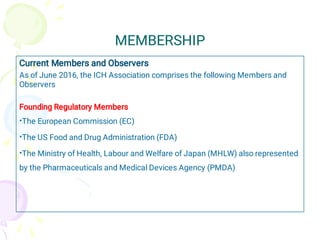
MEMBERSHIP
•
•
•
Current Members and Observers
As of June 2016, the ICH Association comprises the following Members and
Observers
Founding Regulatory Members
The European Commission (EC)
The US Food and Drug Administration (FDA)
The Ministry of Health, Labour and Welfare of Japan (MHLW) also represented
by the Pharmaceuticals and Medical Devices Agency (PMDA)
•
•
•
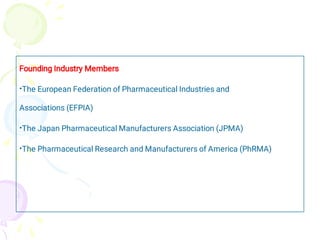
Founding Industry Members
The European Federation of Pharmaceutical Industries and
Associations (EFPIA)
The Japan Pharmaceutical Manufacturers Association (JPMA)
The Pharmaceutical Research and Manufacturers of America (PhRMA)
•
•
•
•
•
•
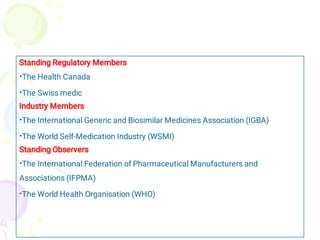
Standing Regulatory Members
The Health Canada
The Swiss medic
Industry Members
The International Generic and Biosimilar Medicines Association (IGBA)
The World Self-Medication Industry (WSMI)
Standing Observers
The International Federation of Pharmaceutical Manufacturers and
Associations (IFPMA)
The World Health Organisation (WHO)
 
•
•
•
•
•
•
•
•
•
•
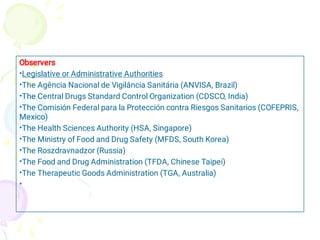
Observers
Legislative or Administrative Authorities
The Agência Nacional de Vigilância Sanitária (ANVISA, Brazil)
The Central Drugs Standard Control Organization (CDSCO, India)
The Comisión Federal para la Protección contra Riesgos Sanitarios (COFEPRIS,
Mexico)
The Health Sciences Authority (HSA, Singapore)
The Ministry of Food and Drug Safety (MFDS, South Korea)
The Roszdravnadzor (Russia)
The Food and Drug Administration (TFDA, Chinese Taipei)
The Therapeutic Goods Administration (TGA, Australia)
 
•
•
•
•
•
•
Regional Harmonisation Initiatives (RHIs)
The Asia-Pacific Economic Cooperation (APEC)
The Association of Southeast Asian Nations (ASEAN)
The East African Community (EAC)
The Gulf Cooperation Council (GCC)
The Pan American Network for Drug Regulatory Harmonization (PANDRH)
The Southern African Development Community (SADC)
•
•
•
•
•
International Pharmaceutical Industry Organisations
The Biotechnology Innovation Organisation (BIO)
International Organisations with an Interest in Pharmaceuticals
The Council for International Organizations of Medical Sciences (CIOMS)
The European Directorate for the Quality of Medicines & HealthCare (EDQM)
The International Pharmaceutical Excipient Council (IPEC)
The United States Pharmacopeia (USP)
Steps in the ICH Process
•
•
•
•
•
1. Consensus building
2. Start of regulatory action
3. Regulatory consolation
4. Adoption of a triplicate harmonized text
5.Implementation
1. Consensus building
•
•
The rapporteur prepare an initial draft of a guidelines based on the
objective in the concept paper, and in consultation with expert
designated to the EWG.
The initial draft and successive revision are circulated for comment
interim reports are made to each meeting to the ICH steering
committee if consensus is reached within the agreed time table
with consensus text with EWG signature is submitted to the
steering committee for adaptation as step to of ICH.
2. Start of regulatory action
• Step is to reach when steering committee agrees, on the
basis report from expert working groups that there is
sufficient scientific consensus on the technical issues,
for the draft guidelines to proceed to next stages
regularity consolation. This agreement is conformed by
steering committee members.
3. Regulatory consolation
•
•
•
•
At this stage embodying the scientist consensus leaves
the ICH process, become the subject of normal wide
ranging regulatory consolation in the three region.
In the EU it is published as a draft CPMP guidelines .
In the USA it is published as a draft guidance.
Japan it is translated and issued by MHLW for internal
and external consulation.
4. Adoption of a triplicate harmonized text
•
•
At step four the topic returns to ICH forum where the
steering committee receive a report from the regulatory
rapporteur.
If both regulatory and industry parties are satisfied that
the consensus achieved at step two is not substantially
altered as a result of consultation. The text is adapted by
steering committee.
5.Implementation
•
•
Having reached step four the tripartite harmonized text
moves immediately to final step of the process which is
regulatory implementation.
This is carried according to same national/ regional
procedure that applied to other regulatory guidelines and
requirement in the EU, Japan and USA.
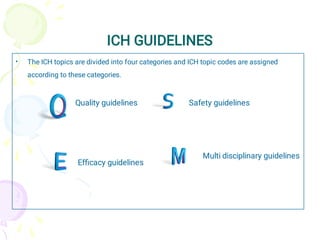
ICH GUIDELINES
• The ICH topics are divided into four categories and ICH topic codes are assigned
according to these categories.
Quality guidelines Safety guidelines
Efficacy guidelines
Multi disciplinary guidelines
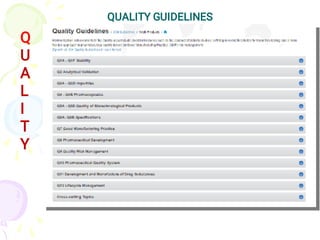
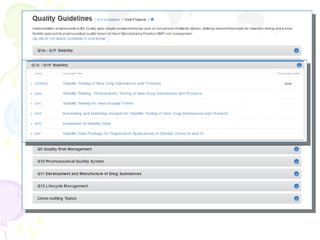
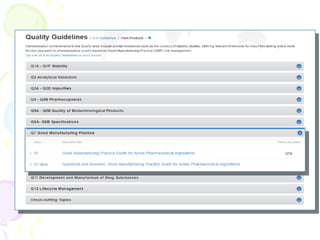
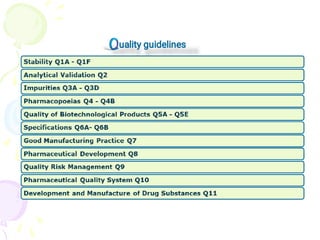
Quality Guidelines
• Harmonisation achievements in the Quality area include pivotal
milestones such as the conduct of stability studies, defining
relevant thresholds for impurities testing and a more flexible
approach to pharmaceutical quality based on Good Manufacturing
Practice (GMP) risk management.
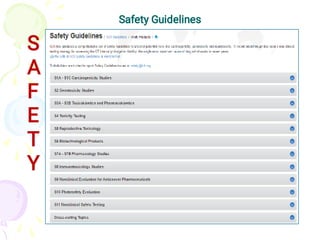
Safety Guidelines
• ICH has produced a comprehensive set of safety Guidelines to
uncover potential risks like carcinogenicity, genotoxicity and
reprotoxicity. A recent breakthrough has been a non-clinical testing
strategy for assessing the QT interval prolongation liability: the
single most important cause of drug withdrawals in recent years.
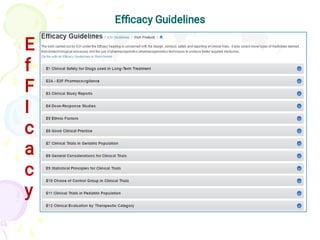
Efficacy guidelines
• The work carried out by ICH under the Efficacy heading is concerned
with the design, conduct, safety and reporting of clinical trials. It
also covers novel types of medicines derived from biotechnological
processes and the use of pharmacogenetics/genomics techniques
to produce better targeted medicines.
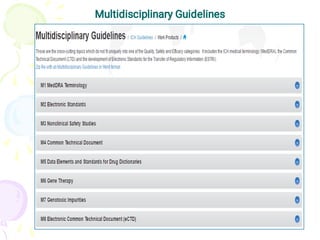
Multidisciplinary Guidelines
• Those are the cross-cutting topics which do not fit uniquely into one
of the Quality, Safety and Efficacy categories. It includes the ICH
medical terminology (MedDRA), the Common Technical Document
(CTD) and the development of Electronic Standards for the Transfer
of Regulatory Information (ESTRI).
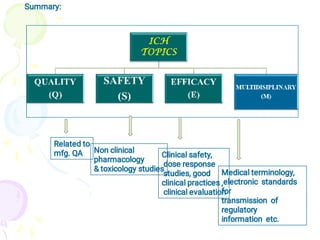
Related to
mfg. QA Non clinical
pharmacology
& toxicology studies
Clinical safety,
dose response
studies, good
clinical practices ,
clinical evaluation
Medical terminology,
electronic standards
for
transmission of
regulatory
information etc.
Summary:
QUALITY GUIDELINES
Q
U
A
L
I
T
Y
Safety Guidelines
S
A
F
E
T
Y
Efficacy Guidelines
E
f
F
I
c
a
c
y
Multidisciplinary Guidelines
uality guidelines
•
•
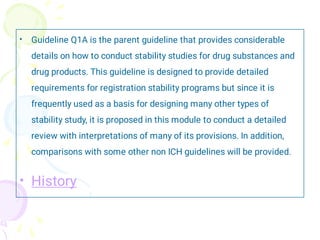
Guideline Q1A is the parent guideline that provides considerable
details on how to conduct stability studies for drug substances and
drug products. This guideline is designed to provide detailed
requirements for registration stability programs but since it is
frequently used as a basis for designing many other types of
stability study, it is proposed in this module to conduct a detailed
review with interpretations of many of its provisions. In addition,
comparisons with some other non ICH guidelines will be provided.
History
• This Guideline provides recommendations on stability testing
protocols including temperature, humidity and trial duration for
climatic Zone I and II. Furthermore, the revised document takes into
account the requirements for stability testing in Climatic Zones III
and IV in order to minimise the different storage conditions for
submission of a global dossier.


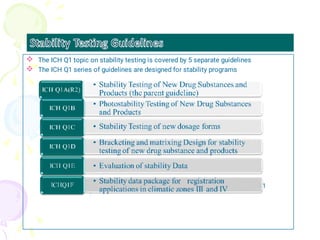
The ICH Q1 topic on stability testing is covered by 5 separate guidelines
The ICH Q1 series of guidelines are designed for stability programs
41
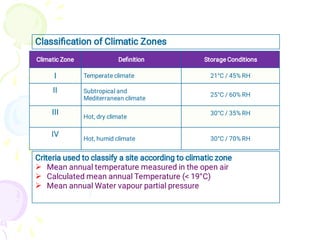
Climatic Zone Definition Storage Conditions
I Temperate climate 21°C / 45% RH
II Subtropical and
Mediterranean climate
25°C / 60% RH
III
Hot, dry climate
30°C / 35% RH
IV
Hot, humid climate 30°C / 70% RH
Classification of Climatic Zones



Criteria used to classify a site according to climatic zone
Mean annual temperature measured in the open air
Calculated mean annual Temperature (< 19°C)
Mean annual Water vapour partial pressure
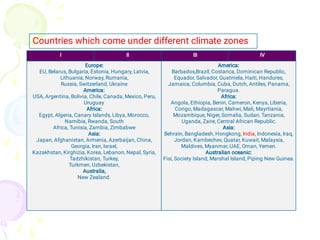
I II III IV
Europe:
EU, Belarus, Bulgaria, Estonia, Hungary, Latvia,
Lithuania, Norway, Rumania,
Russia, Switzerland, Ukraine
America:
USA, Argentina, Bolivia, Chile, Canada, Mexico, Peru,
Uruguay
Africa:
Egypt, Algeria, Canary Islands, Libya, Morocco,
Namibia, Rwanda, South
Africa, Tunisia, Zambia, Zimbabwe
Asia:
Japan, Afghanistan, Armenia, Azerbaijan, China,
Georgia, Iran, Israel,
Kazakhstan, Kirghizia, Korea, Lebanon, Nepal, Syria,
Tadzhikistan, Turkey,
Turkmen, Uzbekistan,
Australia,
New Zealand.
America:
Barbados,Brazil, Costarica, Dominican Republic,
Equador, Salvador, Guatmela, Haiti, Handures,
Jamaica, Columbia, Cuba, Dutch, Antiles, Panama,
Paragua.
Africa:
Angola, Ethiopia, Benin, Cameron, Kenya, Liberia,
Congo, Madagascar, Mahwi, Mali, Mayrtiania,
Mozambique, Niger, Somalia, Sudan, Tanzania,
Uganda, Zaire, Central African Republic.
Asia:
Behrain, Bangladesh, Hongkong, India, Indonesia, Iraq,
Jordan, Kambechev, Quatar, Kuwait, Malaysia,
Maldives, Myanmar, UAE, Oman, Yemen.
Australian oceanic:
Fisi, Society Island, Marshal Island, Piping New Guinea.
Countries which come under different climate zones
The following definitions are provided to facilitate interpretation of the
guideline:
Accelerated testing Studies: Designed to increase the rate of chemical
degradation or physical change of a drug substance or drug product by using
exaggerated storage conditions as part of the formal stability studies.
Climatic zones The four zones in the world that are distinguished by their
characteristic prevalent annual climatic conditions. This is based on the
concept described by W. Grimm (Drugs Made in Germany, 28:196-202, 1985
and 29:39-47, 1986).
Drug substance The unformulated drug substance that may subsequently be
formulated with excipients to produce the dosage form.
Drug product The dosage form in the final immediate packaging intended for
marketing
Excipient Anything other than the drug substance in the dosage form.
Expiration date The date placed on the container label of a drug product
designating the time prior to which a batch of the product is expected to remain
within the approved shelf life specification if stored under defined conditions, and
after which it must not be used.
Re-test date
The date after which samples of an API should be examined to
ensure that the material is still in compliance with the specification
and thus suitable for use in the manufacture of a given FPP.
Shelf life (expiration dating period, conformance period)
The time period during which an API or a FPP is expected to remain
within the approved shelf-life specification, provided that it is stored
under the conditions defined on the container label.



Formal stability studies
Long term and accelerated (and intermediate) studies undertaken on primary
and/or commitment batches according to a prescribed stability protocol to
establish or confirm the re-test period of an API or the shelf life of a FPP.
Stress testing – forced degradation (API)
Studies undertaken to elucidate the intrinsic stability of the API. Such testing
is part of the development strategy and is normally carried out under more
severe conditions than those used for accelerated testing.
Stress testing – forced degradation (FPP)
Studies undertaken to assess the effect of severe conditions on the FPP.
Such studies include photostability testing and compatibility testing on APIs
with each other in FDCs and API(s) with excipients during formulation
development.
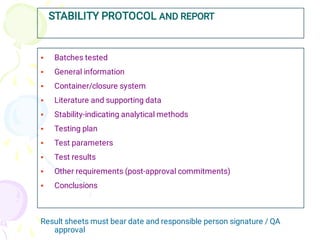
STABILITY PROTOCOL AND REPORT










Batches tested
General information
Container/closure system
Literature and supporting data
Stability-indicating analytical methods
Testing plan
Test parameters
Test results
Other requirements (post-approval commitments)
Conclusions
Result sheets must bear date and responsible person signature / QA
approval
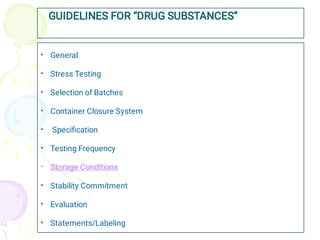
GUIDELINES FOR “DRUG SUBSTANCES”
•
•
•
•
•
•
•
•
•
•
General
Stress Testing
Selection of Batches
Container Closure System
Specification
Testing Frequency
Storage Conditions
Stability Commitment
Evaluation
Statements/Labeling
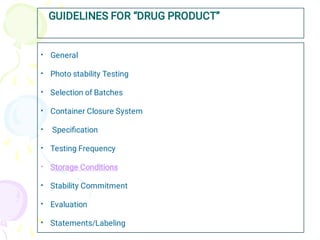
GUIDELINES FOR “DRUG PRODUCT”
•
•
•
•
•
•
•
•
•
•
General
Photo stability Testing
Selection of Batches
Container Closure System
Specification
Testing Frequency
Storage Conditions
Stability Commitment
Evaluation
Statements/Labeling
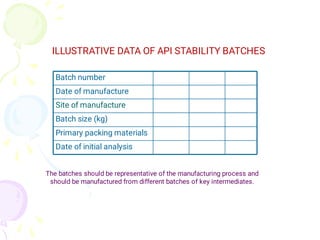
ILLUSTRATIVE DATA OF API STABILITY BATCHES
Batch number
Date of manufacture
Site of manufacture
Batch size (kg)
Primary packing materials
Date of initial analysis
The batches should be representative of the manufacturing process and
should be manufactured from different batches of key intermediates.
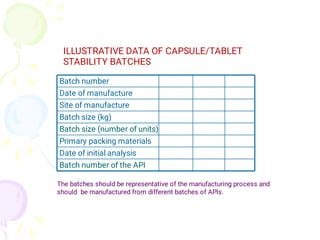
ILLUSTRATIVE DATA OF CAPSULE/TABLET
STABILITY BATCHES
Batch number
Date of manufacture
Site of manufacture
Batch size (kg)
Batch size (number of units)
Primary packing materials
Date of initial analysis
Batch number of the API
The batches should be representative of the manufacturing process and
should be manufactured from different batches of APIs.
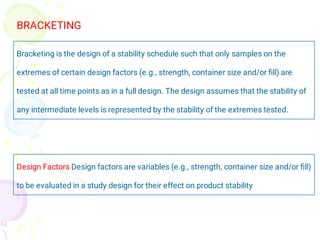
Bracketing is the design of a stability schedule such that only samples on the
extremes of certain design factors (e.g., strength, container size and/or fill) are
tested at all time points as in a full design. The design assumes that the stability of
any intermediate levels is represented by the stability of the extremes tested.
BRACKETING
Design Factors Design factors are variables (e.g., strength, container size and/or fill)
to be evaluated in a study design for their effect on product stability
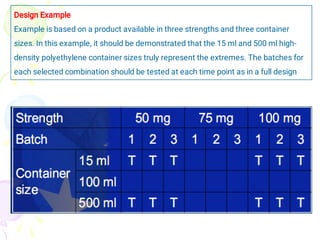
Design Example
Example is based on a product available in three strengths and three container
sizes. In this example, it should be demonstrated that the 15 ml and 500 ml high-
density polyethylene container sizes truly represent the extremes. The batches for
each selected combination should be tested at each time point as in a full design
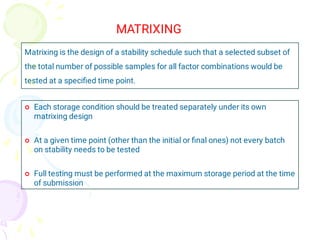
MATRIXING
Matrixing is the design of a stability schedule such that a selected subset of
the total number of possible samples for all factor combinations would be
tested at a specified time point.



Each storage condition should be treated separately under its own
matrixing design
At a given time point (other than the initial or final ones) not every batch
on stability needs to be tested
Full testing must be performed at the maximum storage period at the time
of submission
EXAMPLE OF MATRIX DESIGN
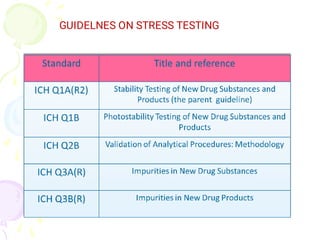
GUIDELNES ON STRESS TESTING
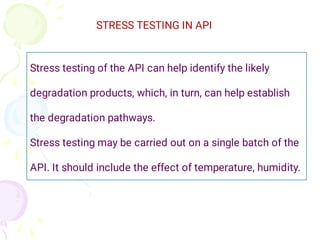
STRESS TESTING IN API
Stress testing of the API can help identify the likely
degradation products, which, in turn, can help establish
the degradation pathways.
Stress testing may be carried out on a single batch of the
API. It should include the effect of temperature, humidity.
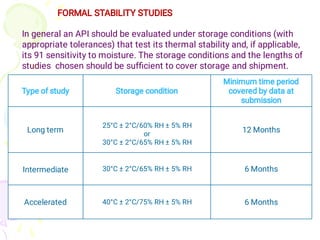
FORMAL STABILITY STUDIES
In general an API should be evaluated under storage conditions (with
appropriate tolerances) that test its thermal stability and, if applicable,
its 91 sensitivity to moisture. The storage conditions and the lengths of
studies chosen should be sufficient to cover storage and shipment.
Type of study Storage condition
Minimum time period
covered by data at
submission
Long term
25°C ± 2°C/60% RH ± 5% RH
or
30°C ± 2°C/65% RH ± 5% RH
12 Months
Intermediate 30°C ± 2°C/65% RH ± 5% RH 6 Months
Accelerated 40°C ± 2°C/75% RH ± 5% RH 6 Months
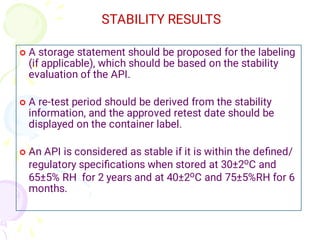
STABILITY RESULTS



A storage statement should be proposed for the labeling
(if applicable), which should be based on the stability
evaluation of the API.
A re-test period should be derived from the stability
information, and the approved retest date should be
displayed on the container label.
An API is considered as stable if it is within the defined/
regulatory specifications when stored at 30±2oC and
65±5% RH for 2 years and at 40±2oC and 75±5%RH for 6
months.
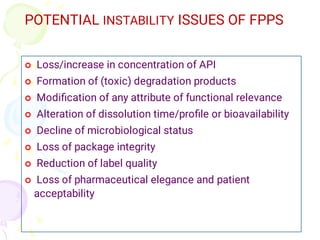
POTENTIAL INSTABILITY ISSUES OF FPPS








Loss/increase in concentration of API
Formation of (toxic) degradation products
Modification of any attribute of functional relevance
Alteration of dissolution time/profile or bioavailability
Decline of microbiological status
Loss of package integrity
Reduction of label quality
Loss of pharmaceutical elegance and patient
acceptability
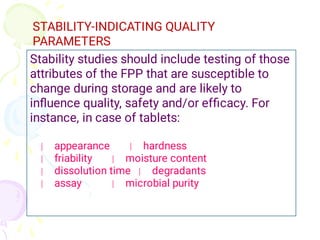
STABILITY-INDICATING QUALITY
PARAMETERS
Stability studies should include testing of those
attributes of the FPP that are susceptible to
change during storage and are likely to
influence quality, safety and/or efficacy. For
instance, in case of tablets:
appearance hardness
friability moisture content
dissolution time degradants
assay microbial purity
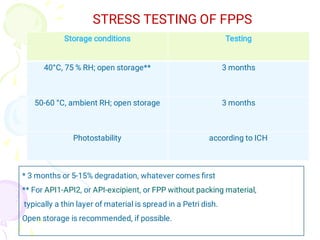
STRESS TESTING OF FPPS
Storage conditions Testing
40°C, 75 % RH; open storage** 3 months
50-60 °C, ambient RH; open storage 3 months
Photostability according to ICH
* 3 months or 5-15% degradation, whatever comes first
** For API1-API2, or API-excipient, or FPP without packing material,
typically a thin layer of material is spread in a Petri dish.
Open storage is recommended, if possible.
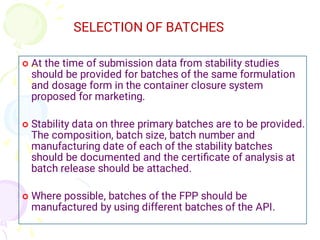
SELECTION OF BATCHES



At the time of submission data from stability studies
should be provided for batches of the same formulation
and dosage form in the container closure system
proposed for marketing.
Stability data on three primary batches are to be provided.
The composition, batch size, batch number and
manufacturing date of each of the stability batches
should be documented and the certificate of analysis at
batch release should be attached.
Where possible, batches of the FPP should be
manufactured by using different batches of the API.
TESTS AT ELEVATED TEMPERATURE AND/OR EXTREMES OF
HUMIDITY (ICH-Q1F)


Special transportation and climatic conditions outside the storage
conditions recommended in this guideline should be supported by
additional data. For example, these data can be obtained from
studies on one batch of drug product conducted for up to 3 months
at 50°C/ambient humidity to cover extremely hot and dry
conditions and at 25°C/80% RH to cover extremely high humidity
conditions.
Stability testing at a high humidity condition, e.g., 25°C/80% RH, is
recommended for solid dosage forms in water-vapour permeable
packaging, e.g., tablets in PVC/aluminum blisters, intended to be
marketed in territories with extremely high humidity conditions in
Zone IV. However, for solid dosage forms in primary containers
designed to provide a barrier to water vapour, e.g. aluminum/
aluminum blisters, stability testing at a storage condition of
extremely high humidity is not considered necessary.
2018/1/9 66
EVALUATION



A systematic approach should be adopted in the presentation
and evaluation of the stability information.
Where the data show so little degradation and so little
variability that it is apparent from looking at the data that the
requested shelf life will be granted, it is normally unnecessary
to go through the formal statistical analysis; providing a
justification for the omission should be sufficient.
An approach for analysing data on a quantitative attribute that
is expected to change with time is to determine the time at
which the 95% one-sided confidence limit for the mean curve
intersects the (lower) acceptance criterion (95% assay).
1.
2.
3.
4.
5.
No significant change at accelerated conditions within
six (6) months.
Long-term data show little or no variability and little or
no change over time.
Accelerated data show little or no variability and little
or no change over time.
Statistical analysis is normally unnecessary.
A retest period or shelf life granted on the basis of
extrapolation should always be verified by additional
long-term stability data
EVALUATION – BEST CASE
VARIATIONS
Once the FPP has been registered, additional stability studies are
required whenever variations that may affect the stability of the API or
FPP are made,
such as major variations
The following are examples of such changes:
— change in the manufacturing process;
— change in the composition of the FPP;
— change of the immediate packaging;
— change in the manufacturing process of an API.



ONGOING STABILITY STUDIES
The purpose of the ongoing stability programme is to monitor the
API and to determine that the API /FPP remains, and can be
expected to remain, within specifications under the storage
conditions indicated on the label, within the re-test period in all
future batches.
This mainly applies to the FPP in the container closure system in
which it is supplied, but consideration should also be given to
inclusion in the programme of bulk products.
The number of batches and frequency of testing should provide
suffi cient data to allow for trend analysis. Unless otherwise justifi
ed, at least one batch per year of product manufactured in every
strength and every primary packaging type, if relevant, should be
included in the stability programme (unless none is produced during
that year).




Stability studies should be planned on the basis of pharmaceutical
R+D and regulatory requirements.
Forced degradation studies reveal the intrinsic chemical properties
of the API, while formal stability studies establish the retest date.
The shelf life (expiry date) of FPPs is derived from formal stability
studies.
Variability and time trends of stability data must be evaluated by the
manufacturer in order to propose a retest date or expiry date.
CONCLUSION
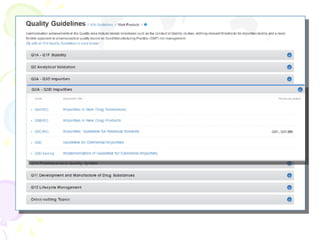
Q3-Q3D Impurities
• Q3A(R2) :IMPURITIES IN NEW DRUG SUBSTANCES
PREAMBLE
CLASSIFICATION OF IMPURITIES
RATIONALE FOR THE REPORTING AND CONTROL OF IMPURITIES
ANALYTICAL PROCEDURES
REPORTING IMPURITY CONTENT OF BATCHES
LISTING OF IMPURITIES IN SPECIFICATIONS
QUALIFICATION OF IMPURITIES
This document is intended to provide guidance for
registration applications on the content and qualification
of impurities in new drug substances produced by
chemical syntheses and not previously registered in a
region or member state.
The following types of drug substances are not covered in this
guideline:
Biological / biotechnological, peptide, oligonucleotide,
radiopharmaceutical, fermentation product and semi-synthetic
products derived there from, herbal products, and crude products of
animal or plant origin.
•
•
•
•
Impurities in new drug substances are addressed from two
perspectives:
Chemistry Aspects include classification and identification of
impurities, report generation, listing of impurities in specifications,
and a brief discussion of analytical procedures;
and Safety Aspects include specific guidance for qualifying those
impurities that were
not present, or were present at substantially lower levels, in batches
of a new drug substance used in safety and clinical studies.
•
•
•
CLASSIFICATION OF IMPURITIES
Impurities can be classified into the following categories:
Organic impurities (process- and drug-related)
Inorganic impurities
Residual solvents
•
•
•
•
•
Organic impurities can arise during the manufacturing process and/or
storage of the new drug substance. They can be identified or
unidentified, volatile or non-volatile, and include:
Starting materials
By-products
Intermediates
Degradation products
Reagents, ligands and catalysts
•
•
•
•
Inorganic impurities can result from the manufacturing process. They
are normally known and identified and include:
Reagents, ligands and catalysts
Heavy metals or other residual metals
Inorganic salts
Other materials (e.g., filter aids, charcoal)
Solvents are inorganic or organic liquids used as vehicles for the
preparation of solutions or suspensions in the synthesis of a new drug
substance. Since these are Impurities in New Drug Substances
generally of known toxicity, the selection of appropriate controls is
easily accomplished (see ICH Guideline Q3C on Residual Solvents).
RATIONALE FOR THE REPORTING AND CONTROL OF IMPURITIES
Organic Impurities:
The applicant should summarize the actual and potential impurities
most likely to rise during the synthesis, purification, and storage of
the new drug substance.
The applicant should summaries the laboratory studies conducted to
detect impurities in the new drug substance.
The studies conducted to characterize the structure of actual
impurities present in the new drug substance at a level greater than
(>) the identification threshold.
•
Where attempts have been made to identify impurities present at
levels of not more than (≤) the identification thresholds, it is useful
also to report the results of these studies.
Inorganic Impurities
Inorganic impurities are normally detected and quantified using
pharmacopoeial or other appropriate procedures.
• Solvents: As per ICH Q3C Guideline for Residual
Solvents
ANALYTICAL PROCEDURES
•
Analytical procedures are validated and suitable for the detection and
quantification of impurities (see ICH Q2A and Q2B Guidelines for Analytical
Validation).
The quantitation limit for the analytical procedure should be not more than (≤)
the reporting threshold.
Reference standards used in the analytical procedures for control of impurities
should be evaluated and characterized according to their intended uses.
REPORTING IMPURITY CONTENT OF BATCHES
•
•
•
•
•
•
•
For each batch of the new drug substance, the report should include:
Batch identity and size
Date of manufacture
Site of manufacture
Manufacturing process
Impurity content, individual and total
Use of batches
Reference to analytical procedure used
• Any impurity at a level greater than (>) the reporting
threshold and total impurities observed in these batches
of the new drug substance should be reported with the
analytical procedures indicated. Below 1.0%, the results
should be reported to two decimal places (e.g., 0.06%,
0.13%); at and above 1.0%, the results should be
reported to one decimal place (e.g., 1.3%).
LISTING OF IMPURITIES IN SPECIFICATIONS
•
The specification for a new drug substance should include a list of
impurities.
Those individual impurities with specific acceptance criteria included
in the specification for the new drug substance are referred to as "
specified impurities" in this guideline. Specified impurities can be
identified or unidentified.
•
•
•
•
•
•
•
In summary, the new drug substance specification should include,
where applicable, the following list of impurities:
Organic Impurities
Each specified identified impurity
Each specified unidentified impurity
Any unspecified impurity with an acceptance criterion of not more
than (≤) the identification threshold
Total impurities
Residual Solvents
Inorganic Impurities
QUALIFICATION OF IMPURITIES
•
•
Qualification is the process of acquiring and evaluating
data that establishes the biological safety of an
individual impurity or a given impurity profile at the
level(s) specified. The applicant should provide a
rationale for establishing impurity.
The "Decision Tree” for Identification and Qualification"
describes considerations for the qualification of
impurities when thresholds are exceeded.
• Threshold
Decision Tree
IMPURITIES IN NEW DRUG PRODUCTS
Q3B(R2)
1. INTRODUCTION
2. RATIONALE FOR THE REPORTING AND CONTROL OF
DEGRADATION PRODUCTS
3. ANALYTICAL PROCEDURES
4. REPORTING DEGRADATION PRODUCTS CONTENT OF
BATCHES
5.LISTING OF DEGRADATION PRODUCTS IN SPECIFICATIONS
6. QUALIFICATION OF DEGRADATION PRODUCTS
7. GLOSSARY
Introduction
Objective of the guideline: This document provides guidance
for registration applications on the content and qualification of
impurities in new drug products
This guideline is complementary to the ICH Q3A(R) guideline “Impurities in New
Drug Substances”, which should be consulted for basic principles.
Introduction
• Scope of the guideline: This guideline addresses only those
impurities in new drug products classified as degradation products
of the drug substance or reaction products of the drug substance
with an excipient and/or immediate container closure system
(collectively referred to
as “degradation products” in this guideline).
2. RATIONALE FOR THE REPORTING AND CONTROL OF
DEGRADATION PRODUCTS
•
•
The applicant should summaries the degradation products
observed during manufacture and/or stability studies of the new
drug product.
Any degradation product observed in stability studies conducted at
the recommended storage condition should be identified when
present at a level greater than (>) the identification thresholds.
•
•
Degradation products present at a level of not more than (≤) the
identification threshold generally would not need to be identified.
However, analytical procedures
Degradation products present at a level of not more than (≤) the
identification
ANALYTICAL PROCEDURES
•
•
The registration application should include documented evidence
that the analytical procedures have been validated and are suitable
for the detection and quantitation of degradation products (ICH Q2A
and Q2B guidelines on analytical validation).
The quantitation limit for the analytical procedure should be not
more than (≤) the reporting threshold.
• Reference standards used in the analytical procedures for control of
degradation products should be evaluated and characterised
according to their intended uses. The drug substance can be used
to estimate the levels of degradation products.
REPORTING DEGRADATION PRODUCTS CONTENT OF
BATCHES










For each batch of the new drug product described in the registration
application, the documentation should include:
Batch identity, strength, and size
Date of manufacture
Site of manufacture
Manufacturing process
Immediate container closure
Degradation product content, individual and total
Use of batch (e.g., clinical studies, stability studies)
Reference to analytical procedure used
Batch number of the drug substance used in the new drug product
Storage conditions for stability studies
LISTING OF DEGRADATION PRODUCTS IN
SPECIFICATIONS
•
•
The specification for a new drug product should include a list of
degradation products expected to occur during manufacture of the
commercial product and under recommended storage conditions.
In this guideline, the use of two decimal places for thresholds does
not necessarily indicate the precision of the accept degradation
products and total degradation products.
•
•
•
•
In summary, the new drug product specification should include, where
applicable, the following list of degradation products:
Each specified identified degradation product
Each specified unidentified degradation product
Any unspecified degradation product with an acceptance criterion of
not more than (=) the identification threshold.
Total degradation products.
QUALIFICATION OF DEGRADATION PRODUCTS
The level of any degradation product present in a new drug
product that has been adequately tested in safety and/or
clinical studies would be considered qualified.
• The "Decision Tree for Identification and Qualification of
a Degradation Product“ describes considerations for the
qualification of degradation products when thresholds
are exceeded.
• Threshold
IMPURITIES: GUIDELINE FOR RESIDUAL SOLVENTS
Q3C(R5)
• History
TABLE OF CONTENTS
•
•
•
•
PART I
PART II
PART III
PART IV
PART I
•
•
•
•
•
•
•
•
•
1.INTRODUCTION
2.SCOPE OF THE GUIDELINE
3.GENERAL PRINCIPLES
Classification of Residual Solvents by Risk Assessment
Methods for Establishing Exposure Limits
Options for Describing Limits of Class 2 Solvents
Analytical Procedures
Reporting levels of residual solvents
4. LIMITS of RESIDUAL SOLVENTS
Solvents to Be Avoided
Solvents to Be Limited
Solvents with Low Toxic Potential
Solvents for which No Adequate Toxicological Data was Found
•
•
•
•
4.1 Solvents to Be Avoided
4.2 Solvents to Be Limited
4.3 Solvents with Low Toxic Potential
4.4 Solvents for which No Adequate Toxicological Data was Found
•
•
•
•
•
•
GLOSSARY
APPENDIX 1. LIST OF SOLVENTS INCLUDED IN THE GUIDELINE
APPENDIX 2. ADDITIONAL BACKGROUND
2.1 Environmental Regulation of Organic Volatile Solvents.
2.2 Residual Solvents in Pharmaceuticals
APPENDIX 3. METHODS FOR ESTABLISHING EXPOSURE LIMITS
•
•
•
PART II: PDE FOR TETRAHYDROFURAN
PART III: PDE FOR N-METHYLPYRROLIDONE (NMP)
PART IV: PDE FOR CUMENE
*(PDE) Permissible Daily Exposure
•
•
Objective: The objective of this guideline is to recommend
acceptable amounts for residual solvents in pharmaceuticals for
the safety of the patient.
The guideline recommends use of less toxic solvents and describes
levels considered to be toxicologically acceptable for some residual
solvents.
SCOPE OF THE GUIDELINE
•
•
•
Residual solvents in drug substances, excipients, and in drug products are
within the scope of this guideline.
Therefore, testing should be performed for residual solvents when
production or purification processes are known to result in the presence of
such solvents.
If the calculation results in a level Impurities is equal to or below that
recommended in this guideline, no testing of the drug product for residual
solvents need be considered. If, however, the calculated level is above the
recommended level, the drug product should be tested to ascertain whether
the formulation process has reduced the relevant solvent level to within the
acceptable amount.
• This guideline does not apply to potential new drug substances,
excipients, or drug products used during the clinical research stages
of development, nor does it apply to existing marketed drug
products.
• The guideline applies to all dosage forms and routes of
administration. Higher levels of residual solvents may be
acceptable in certain cases such as short term (30 days or less) or
topical application. Justification for these levels should be made on
a case by case basis.
* Appendix 2 for additional background information related to residual solvents
General Principle
Classification of Residual Solvents by Risk Assessment:
The term "tolerable daily intake" (TDI) is used by the International Program on Chemical
Safety (IPCS) to describe exposure limits of toxic chemicals and "acceptable daily intake"
(ADI) is used by the World Health Organization (WHO) and other national and
international health authorities and institutes.
The new term "permitted daily exposure" (PDE) is defined in the present guideline as a
pharmaceutically acceptable intake of residual solvents to avoid confusion of differing
values for ADI's of the same substance.
•
•
Residual solvents assessed in this guideline are listed in Appendix 1 by
common names and structures.
Three classes as follows:
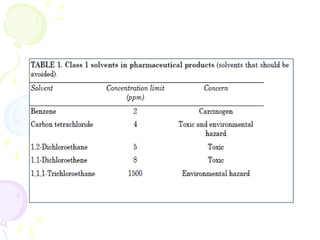
Class 1 solvents: Solvents to be avoided Known human carcinogens, strongly
suspected human carcinogens, and environmental hazards.
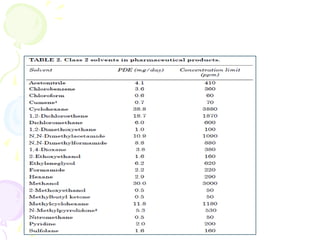
Class 2 solvents: Solvents to be limited Non-genotoxic animal carcinogens or
possible causative agents of other irreversible toxicity such as neurotoxicity
or teratogenicity.
Solvents suspected of other significant but reversible toxicities.
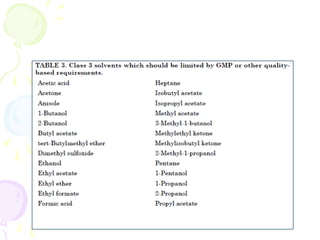
• Class 3 solvents: Solvents with low toxic potential Solvents with low toxic
potential to man; no health-based exposure limit is needed. Class 3 sol.vents
have PDEs of 50 mg or more per day
Methods for Establishing Exposure Limits
In Appendix 3. Summaries of the toxicity data that were used to establish limits
are published in Pharmeuropa, Vol. 9, No. 1, Supplement, April 1997.
•
•
•
•
Options for Describing Limits of Class 2 Solvents Two options are available
when setting limits for Class 2 solvents.
Option 1: The concentration limits in ppm stated in Table 2 can be used.
They were calculated using equation (1) below by assuming a product mass
of 10 g administered daily.
Concentration (ppm)= 1000 x PDE dose / Dose
Here, PDE is given in terms of mg/day and dose is given in g/day.
•
•
Option 2:
It is not considered necessary for each component of the drug product
to comply with the limits given in Option 1.
May be applied by adding the amounts of a residual solvent present in
each of the components of the drug product. The sum of the amounts
of solvent per day should be less than that given by the PDE.
Analytical Procedures
•
•
Residual solvents are typically determined using chromatographic
techniques such as gas chromatography. Any harmonised procedures for
determining levels of residual solvents as described in the pharmacopoeias
should be used, if feasible.
Otherwise, manufacturers would be free to select the most appropriate
validated analytical procedure for a particular application. If only Class 3
solvents are present, a nonspecific method such as loss on drying may be
used.
• Validation of methods for residual solvents should conform to ICH guidelines
Text on Validation of Analytical Procedures and Extension of the ICH Text on
Validation of Analytical Procedures.
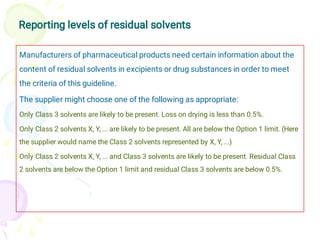
Reporting levels of residual solvents
Manufacturers of pharmaceutical products need certain information about the
content of residual solvents in excipients or drug substances in order to meet
the criteria of this guideline.
The supplier might choose one of the following as appropriate:
Only Class 3 solvents are likely to be present. Loss on drying is less than 0.5%.
Only Class 2 solvents X, Y, ... are likely to be present. All are below the Option 1 limit. (Here
the supplier would name the Class 2 solvents represented by X, Y, ...)
Only Class 2 solvents X, Y, ... and Class 3 solvents are likely to be present. Residual Class
2 solvents are below the Option 1 limit and residual Class 3 solvents are below 0.5%.
•
•
•
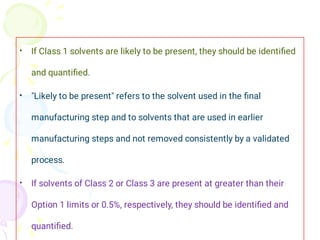
If Class 1 solvents are likely to be present, they should be identified
and quantified.
"Likely to be present" refers to the solvent used in the final
manufacturing step and to solvents that are used in earlier
manufacturing steps and not removed consistently by a validated
process.
If solvents of Class 2 or Class 3 are present at greater than their
Option 1 limits or 0.5%, respectively, they should be identified and
quantified.
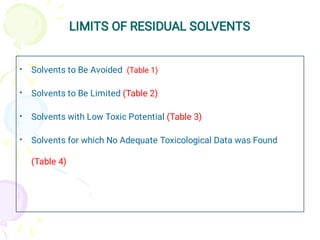
LIMITS OF RESIDUAL SOLVENTS
•
•
•
•
Solvents to Be Avoided (Table 1)
Solvents to Be Limited (Table 2)
Solvents with Low Toxic Potential (Table 3)
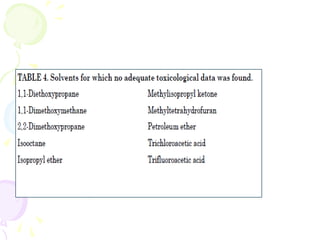
Solvents for which No Adequate Toxicological Data was Found
(Table 4)
ICH GUIDELINE IN PHARMACY

ICH GUIDELINE IN PHARMACY

  • 1.
    International Council forHarmonization (ICH) Roshan Gomaji Bodhe SVPM’S College of pharmacy Baramati
  • 2.
    Organisational Changes: The InternationalCouncil for Harmonisation (ICH), formerly the International Conference on Harmonisation (ICH) ICH announces organisation changes as it marks 25 year of successful harmonisation.  
  • 3.
    • The ICHof Technical Requirements for Registration of Pharmaceuticals for Human Use (ICH) is unique in bringing together the regulatory authorities and pharmaceutical industry.
  • 4.
    • • Mission ICH’s mission isto make recommendations towards achieving greater harmonisation in the interpretation and application of technical guidelines and requirements for pharmaceutical product registration, thereby reducing or obviating duplication of testing carried out during the research and development of new human medicines.
  • 5.
    Contd.. ICH's mission isto achieve greater harmonization to ensure that safe, effective, and high quality medicines are developed and registered in the most resource-efficient manner.
  • 6.
    • ICH isa joint initiative involving both regulators and research-based industry representatives of the EU, Japan and the US in scientific and technical discussions of the testing procedures required to assess and ensure the safety, quality and efficacy of medicines.
  • 7.
    History • • • Harmonization of regulatoryauthority requirement was pioneered by the European community in the 1980. The EC moved towards the development of a single marketed for pharmaceuticals the success achieved in Europe demonstrated the harmonization was feasible. At the same time there were Internal discussion between Europe, Japan and US on possibilities for the harmonization.
  • 8.
    Cont.. • • • The birth ofICH took place at a meeting in April 1990. The ICH steering committee was established at the meeting has since met at least twice a year with the location rotatory between the three region. The ICH process was first drawn up at the steering committee meeting in Washington march 1992 and amended in Tokyo sep. 1992.
  • 9.
    Objectives • • • • • • To achieve greaterharmonization in the interpretation and application of technical guideline. Requirement for the product registration. To reduce or obviate the need to duplicate the testing carried out during the research and development of new medicine. To maintain a forum for a constructive dialogue b/w regulatory authorities and the pharmaceutical industries on the real and perceived difference in the technical requirement for product registration in Europe, USA and Japan. To contribute to the protection of public health from international perspective. To maintain and update harmonized technical requirement leading to a grater mutual acceptance of research and development data.
  • 10.
    Cont… • • • To avoid divergentfuture requirement through harmonization of selected topic needed as result of therapeutic advances and the development of new technologies for the production of medicinal products. To facilitate the adoption of new of improved technical research and development approaches which updates or replace current practices. To facilitate the dissemination and communication of information on harmonized guidelines and their use such as to encourage the implementation and integration of common standards.
  • 11.
    MEMBERSHIP • • • Current Members andObservers As of June 2016, the ICH Association comprises the following Members and Observers Founding Regulatory Members The European Commission (EC) The US Food and Drug Administration (FDA) The Ministry of Health, Labour and Welfare of Japan (MHLW) also represented by the Pharmaceuticals and Medical Devices Agency (PMDA)
  • 12.
    • • • Founding Industry Members TheEuropean Federation of Pharmaceutical Industries and Associations (EFPIA) The Japan Pharmaceutical Manufacturers Association (JPMA) The Pharmaceutical Research and Manufacturers of America (PhRMA)
  • 13.
    • • • • • • Standing Regulatory Members TheHealth Canada The Swiss medic Industry Members The International Generic and Biosimilar Medicines Association (IGBA) The World Self-Medication Industry (WSMI) Standing Observers The International Federation of Pharmaceutical Manufacturers and Associations (IFPMA) The World Health Organisation (WHO)  
  • 14.
    • • • • • • • • • • Observers Legislative or AdministrativeAuthorities The Agência Nacional de Vigilância Sanitária (ANVISA, Brazil) The Central Drugs Standard Control Organization (CDSCO, India) The Comisión Federal para la Protección contra Riesgos Sanitarios (COFEPRIS, Mexico) The Health Sciences Authority (HSA, Singapore) The Ministry of Food and Drug Safety (MFDS, South Korea) The Roszdravnadzor (Russia) The Food and Drug Administration (TFDA, Chinese Taipei) The Therapeutic Goods Administration (TGA, Australia)  
  • 15.
    • • • • • • Regional Harmonisation Initiatives(RHIs) The Asia-Pacific Economic Cooperation (APEC) The Association of Southeast Asian Nations (ASEAN) The East African Community (EAC) The Gulf Cooperation Council (GCC) The Pan American Network for Drug Regulatory Harmonization (PANDRH) The Southern African Development Community (SADC)
  • 16.
    • • • • • International Pharmaceutical IndustryOrganisations The Biotechnology Innovation Organisation (BIO) International Organisations with an Interest in Pharmaceuticals The Council for International Organizations of Medical Sciences (CIOMS) The European Directorate for the Quality of Medicines & HealthCare (EDQM) The International Pharmaceutical Excipient Council (IPEC) The United States Pharmacopeia (USP)
  • 17.
    Steps in theICH Process • • • • • 1. Consensus building 2. Start of regulatory action 3. Regulatory consolation 4. Adoption of a triplicate harmonized text 5.Implementation
  • 18.
    1. Consensus building • • Therapporteur prepare an initial draft of a guidelines based on the objective in the concept paper, and in consultation with expert designated to the EWG. The initial draft and successive revision are circulated for comment interim reports are made to each meeting to the ICH steering committee if consensus is reached within the agreed time table with consensus text with EWG signature is submitted to the steering committee for adaptation as step to of ICH.
  • 19.
    2. Start ofregulatory action • Step is to reach when steering committee agrees, on the basis report from expert working groups that there is sufficient scientific consensus on the technical issues, for the draft guidelines to proceed to next stages regularity consolation. This agreement is conformed by steering committee members.
  • 20.
    3. Regulatory consolation • • • • Atthis stage embodying the scientist consensus leaves the ICH process, become the subject of normal wide ranging regulatory consolation in the three region. In the EU it is published as a draft CPMP guidelines . In the USA it is published as a draft guidance. Japan it is translated and issued by MHLW for internal and external consulation.
  • 21.
    4. Adoption ofa triplicate harmonized text • • At step four the topic returns to ICH forum where the steering committee receive a report from the regulatory rapporteur. If both regulatory and industry parties are satisfied that the consensus achieved at step two is not substantially altered as a result of consultation. The text is adapted by steering committee.
  • 22.
    5.Implementation • • Having reached stepfour the tripartite harmonized text moves immediately to final step of the process which is regulatory implementation. This is carried according to same national/ regional procedure that applied to other regulatory guidelines and requirement in the EU, Japan and USA.
  • 23.
    ICH GUIDELINES • TheICH topics are divided into four categories and ICH topic codes are assigned according to these categories. Quality guidelines Safety guidelines Efficacy guidelines Multi disciplinary guidelines
  • 24.
    Quality Guidelines • Harmonisationachievements in the Quality area include pivotal milestones such as the conduct of stability studies, defining relevant thresholds for impurities testing and a more flexible approach to pharmaceutical quality based on Good Manufacturing Practice (GMP) risk management.
  • 25.
    Safety Guidelines • ICHhas produced a comprehensive set of safety Guidelines to uncover potential risks like carcinogenicity, genotoxicity and reprotoxicity. A recent breakthrough has been a non-clinical testing strategy for assessing the QT interval prolongation liability: the single most important cause of drug withdrawals in recent years.
  • 26.
    Efficacy guidelines • Thework carried out by ICH under the Efficacy heading is concerned with the design, conduct, safety and reporting of clinical trials. It also covers novel types of medicines derived from biotechnological processes and the use of pharmacogenetics/genomics techniques to produce better targeted medicines.
  • 27.
    Multidisciplinary Guidelines • Thoseare the cross-cutting topics which do not fit uniquely into one of the Quality, Safety and Efficacy categories. It includes the ICH medical terminology (MedDRA), the Common Technical Document (CTD) and the development of Electronic Standards for the Transfer of Regulatory Information (ESTRI).
  • 28.
    Related to mfg. QANon clinical pharmacology & toxicology studies Clinical safety, dose response studies, good clinical practices , clinical evaluation Medical terminology, electronic standards for transmission of regulatory information etc. Summary:
  • 29.
  • 30.
  • 31.
  • 32.
  • 38.
  • 39.
    • • Guideline Q1A isthe parent guideline that provides considerable details on how to conduct stability studies for drug substances and drug products. This guideline is designed to provide detailed requirements for registration stability programs but since it is frequently used as a basis for designing many other types of stability study, it is proposed in this module to conduct a detailed review with interpretations of many of its provisions. In addition, comparisons with some other non ICH guidelines will be provided. History
  • 40.
    • This Guidelineprovides recommendations on stability testing protocols including temperature, humidity and trial duration for climatic Zone I and II. Furthermore, the revised document takes into account the requirements for stability testing in Climatic Zones III and IV in order to minimise the different storage conditions for submission of a global dossier.
  • 41.
      The ICH Q1topic on stability testing is covered by 5 separate guidelines The ICH Q1 series of guidelines are designed for stability programs 41
  • 42.
    Climatic Zone DefinitionStorage Conditions I Temperate climate 21°C / 45% RH II Subtropical and Mediterranean climate 25°C / 60% RH III Hot, dry climate 30°C / 35% RH IV Hot, humid climate 30°C / 70% RH Classification of Climatic Zones    Criteria used to classify a site according to climatic zone Mean annual temperature measured in the open air Calculated mean annual Temperature (< 19°C) Mean annual Water vapour partial pressure
  • 43.
    I II IIIIV Europe: EU, Belarus, Bulgaria, Estonia, Hungary, Latvia, Lithuania, Norway, Rumania, Russia, Switzerland, Ukraine America: USA, Argentina, Bolivia, Chile, Canada, Mexico, Peru, Uruguay Africa: Egypt, Algeria, Canary Islands, Libya, Morocco, Namibia, Rwanda, South Africa, Tunisia, Zambia, Zimbabwe Asia: Japan, Afghanistan, Armenia, Azerbaijan, China, Georgia, Iran, Israel, Kazakhstan, Kirghizia, Korea, Lebanon, Nepal, Syria, Tadzhikistan, Turkey, Turkmen, Uzbekistan, Australia, New Zealand. America: Barbados,Brazil, Costarica, Dominican Republic, Equador, Salvador, Guatmela, Haiti, Handures, Jamaica, Columbia, Cuba, Dutch, Antiles, Panama, Paragua. Africa: Angola, Ethiopia, Benin, Cameron, Kenya, Liberia, Congo, Madagascar, Mahwi, Mali, Mayrtiania, Mozambique, Niger, Somalia, Sudan, Tanzania, Uganda, Zaire, Central African Republic. Asia: Behrain, Bangladesh, Hongkong, India, Indonesia, Iraq, Jordan, Kambechev, Quatar, Kuwait, Malaysia, Maldives, Myanmar, UAE, Oman, Yemen. Australian oceanic: Fisi, Society Island, Marshal Island, Piping New Guinea. Countries which come under different climate zones
  • 44.
    The following definitionsare provided to facilitate interpretation of the guideline: Accelerated testing Studies: Designed to increase the rate of chemical degradation or physical change of a drug substance or drug product by using exaggerated storage conditions as part of the formal stability studies. Climatic zones The four zones in the world that are distinguished by their characteristic prevalent annual climatic conditions. This is based on the concept described by W. Grimm (Drugs Made in Germany, 28:196-202, 1985 and 29:39-47, 1986). Drug substance The unformulated drug substance that may subsequently be formulated with excipients to produce the dosage form.
  • 45.
    Drug product Thedosage form in the final immediate packaging intended for marketing Excipient Anything other than the drug substance in the dosage form. Expiration date The date placed on the container label of a drug product designating the time prior to which a batch of the product is expected to remain within the approved shelf life specification if stored under defined conditions, and after which it must not be used.
  • 46.
    Re-test date The dateafter which samples of an API should be examined to ensure that the material is still in compliance with the specification and thus suitable for use in the manufacture of a given FPP. Shelf life (expiration dating period, conformance period) The time period during which an API or a FPP is expected to remain within the approved shelf-life specification, provided that it is stored under the conditions defined on the container label.
  • 47.
       Formal stability studies Longterm and accelerated (and intermediate) studies undertaken on primary and/or commitment batches according to a prescribed stability protocol to establish or confirm the re-test period of an API or the shelf life of a FPP. Stress testing – forced degradation (API) Studies undertaken to elucidate the intrinsic stability of the API. Such testing is part of the development strategy and is normally carried out under more severe conditions than those used for accelerated testing. Stress testing – forced degradation (FPP) Studies undertaken to assess the effect of severe conditions on the FPP. Such studies include photostability testing and compatibility testing on APIs with each other in FDCs and API(s) with excipients during formulation development.
  • 48.
    STABILITY PROTOCOL ANDREPORT           Batches tested General information Container/closure system Literature and supporting data Stability-indicating analytical methods Testing plan Test parameters Test results Other requirements (post-approval commitments) Conclusions Result sheets must bear date and responsible person signature / QA approval
  • 49.
    GUIDELINES FOR “DRUGSUBSTANCES” • • • • • • • • • • General Stress Testing Selection of Batches Container Closure System Specification Testing Frequency Storage Conditions Stability Commitment Evaluation Statements/Labeling
  • 50.
    GUIDELINES FOR “DRUGPRODUCT” • • • • • • • • • • General Photo stability Testing Selection of Batches Container Closure System Specification Testing Frequency Storage Conditions Stability Commitment Evaluation Statements/Labeling
  • 51.
    ILLUSTRATIVE DATA OFAPI STABILITY BATCHES Batch number Date of manufacture Site of manufacture Batch size (kg) Primary packing materials Date of initial analysis The batches should be representative of the manufacturing process and should be manufactured from different batches of key intermediates.
  • 52.
    ILLUSTRATIVE DATA OFCAPSULE/TABLET STABILITY BATCHES Batch number Date of manufacture Site of manufacture Batch size (kg) Batch size (number of units) Primary packing materials Date of initial analysis Batch number of the API The batches should be representative of the manufacturing process and should be manufactured from different batches of APIs.
  • 53.
    Bracketing is thedesign of a stability schedule such that only samples on the extremes of certain design factors (e.g., strength, container size and/or fill) are tested at all time points as in a full design. The design assumes that the stability of any intermediate levels is represented by the stability of the extremes tested. BRACKETING Design Factors Design factors are variables (e.g., strength, container size and/or fill) to be evaluated in a study design for their effect on product stability
  • 54.
    Design Example Example isbased on a product available in three strengths and three container sizes. In this example, it should be demonstrated that the 15 ml and 500 ml high- density polyethylene container sizes truly represent the extremes. The batches for each selected combination should be tested at each time point as in a full design
  • 55.
    MATRIXING Matrixing is thedesign of a stability schedule such that a selected subset of the total number of possible samples for all factor combinations would be tested at a specified time point.    Each storage condition should be treated separately under its own matrixing design At a given time point (other than the initial or final ones) not every batch on stability needs to be tested Full testing must be performed at the maximum storage period at the time of submission
  • 56.
  • 57.
  • 58.
    STRESS TESTING INAPI Stress testing of the API can help identify the likely degradation products, which, in turn, can help establish the degradation pathways. Stress testing may be carried out on a single batch of the API. It should include the effect of temperature, humidity.
  • 59.
    FORMAL STABILITY STUDIES Ingeneral an API should be evaluated under storage conditions (with appropriate tolerances) that test its thermal stability and, if applicable, its 91 sensitivity to moisture. The storage conditions and the lengths of studies chosen should be sufficient to cover storage and shipment. Type of study Storage condition Minimum time period covered by data at submission Long term 25°C ± 2°C/60% RH ± 5% RH or 30°C ± 2°C/65% RH ± 5% RH 12 Months Intermediate 30°C ± 2°C/65% RH ± 5% RH 6 Months Accelerated 40°C ± 2°C/75% RH ± 5% RH 6 Months
  • 60.
    STABILITY RESULTS    A storagestatement should be proposed for the labeling (if applicable), which should be based on the stability evaluation of the API. A re-test period should be derived from the stability information, and the approved retest date should be displayed on the container label. An API is considered as stable if it is within the defined/ regulatory specifications when stored at 30±2oC and 65±5% RH for 2 years and at 40±2oC and 75±5%RH for 6 months.
  • 61.
    POTENTIAL INSTABILITY ISSUESOF FPPS         Loss/increase in concentration of API Formation of (toxic) degradation products Modification of any attribute of functional relevance Alteration of dissolution time/profile or bioavailability Decline of microbiological status Loss of package integrity Reduction of label quality Loss of pharmaceutical elegance and patient acceptability
  • 62.
    STABILITY-INDICATING QUALITY PARAMETERS Stability studiesshould include testing of those attributes of the FPP that are susceptible to change during storage and are likely to influence quality, safety and/or efficacy. For instance, in case of tablets: appearance hardness friability moisture content dissolution time degradants assay microbial purity
  • 63.
    STRESS TESTING OFFPPS Storage conditions Testing 40°C, 75 % RH; open storage** 3 months 50-60 °C, ambient RH; open storage 3 months Photostability according to ICH * 3 months or 5-15% degradation, whatever comes first ** For API1-API2, or API-excipient, or FPP without packing material, typically a thin layer of material is spread in a Petri dish. Open storage is recommended, if possible.
  • 64.
    SELECTION OF BATCHES    Atthe time of submission data from stability studies should be provided for batches of the same formulation and dosage form in the container closure system proposed for marketing. Stability data on three primary batches are to be provided. The composition, batch size, batch number and manufacturing date of each of the stability batches should be documented and the certificate of analysis at batch release should be attached. Where possible, batches of the FPP should be manufactured by using different batches of the API.
  • 65.
    TESTS AT ELEVATEDTEMPERATURE AND/OR EXTREMES OF HUMIDITY (ICH-Q1F)   Special transportation and climatic conditions outside the storage conditions recommended in this guideline should be supported by additional data. For example, these data can be obtained from studies on one batch of drug product conducted for up to 3 months at 50°C/ambient humidity to cover extremely hot and dry conditions and at 25°C/80% RH to cover extremely high humidity conditions. Stability testing at a high humidity condition, e.g., 25°C/80% RH, is recommended for solid dosage forms in water-vapour permeable packaging, e.g., tablets in PVC/aluminum blisters, intended to be marketed in territories with extremely high humidity conditions in Zone IV. However, for solid dosage forms in primary containers designed to provide a barrier to water vapour, e.g. aluminum/ aluminum blisters, stability testing at a storage condition of extremely high humidity is not considered necessary.
  • 66.
    2018/1/9 66 EVALUATION    A systematicapproach should be adopted in the presentation and evaluation of the stability information. Where the data show so little degradation and so little variability that it is apparent from looking at the data that the requested shelf life will be granted, it is normally unnecessary to go through the formal statistical analysis; providing a justification for the omission should be sufficient. An approach for analysing data on a quantitative attribute that is expected to change with time is to determine the time at which the 95% one-sided confidence limit for the mean curve intersects the (lower) acceptance criterion (95% assay).
  • 67.
    1. 2. 3. 4. 5. No significant changeat accelerated conditions within six (6) months. Long-term data show little or no variability and little or no change over time. Accelerated data show little or no variability and little or no change over time. Statistical analysis is normally unnecessary. A retest period or shelf life granted on the basis of extrapolation should always be verified by additional long-term stability data EVALUATION – BEST CASE
  • 68.
    VARIATIONS Once the FPPhas been registered, additional stability studies are required whenever variations that may affect the stability of the API or FPP are made, such as major variations The following are examples of such changes: — change in the manufacturing process; — change in the composition of the FPP; — change of the immediate packaging; — change in the manufacturing process of an API.
  • 69.
       ONGOING STABILITY STUDIES Thepurpose of the ongoing stability programme is to monitor the API and to determine that the API /FPP remains, and can be expected to remain, within specifications under the storage conditions indicated on the label, within the re-test period in all future batches. This mainly applies to the FPP in the container closure system in which it is supplied, but consideration should also be given to inclusion in the programme of bulk products. The number of batches and frequency of testing should provide suffi cient data to allow for trend analysis. Unless otherwise justifi ed, at least one batch per year of product manufactured in every strength and every primary packaging type, if relevant, should be included in the stability programme (unless none is produced during that year).
  • 70.
        Stability studies shouldbe planned on the basis of pharmaceutical R+D and regulatory requirements. Forced degradation studies reveal the intrinsic chemical properties of the API, while formal stability studies establish the retest date. The shelf life (expiry date) of FPPs is derived from formal stability studies. Variability and time trends of stability data must be evaluated by the manufacturer in order to propose a retest date or expiry date. CONCLUSION
  • 72.
    Q3-Q3D Impurities • Q3A(R2):IMPURITIES IN NEW DRUG SUBSTANCES PREAMBLE CLASSIFICATION OF IMPURITIES RATIONALE FOR THE REPORTING AND CONTROL OF IMPURITIES ANALYTICAL PROCEDURES REPORTING IMPURITY CONTENT OF BATCHES LISTING OF IMPURITIES IN SPECIFICATIONS QUALIFICATION OF IMPURITIES
  • 73.
    This document isintended to provide guidance for registration applications on the content and qualification of impurities in new drug substances produced by chemical syntheses and not previously registered in a region or member state.
  • 74.
    The following typesof drug substances are not covered in this guideline: Biological / biotechnological, peptide, oligonucleotide, radiopharmaceutical, fermentation product and semi-synthetic products derived there from, herbal products, and crude products of animal or plant origin.
  • 75.
    • • • • Impurities in newdrug substances are addressed from two perspectives: Chemistry Aspects include classification and identification of impurities, report generation, listing of impurities in specifications, and a brief discussion of analytical procedures; and Safety Aspects include specific guidance for qualifying those impurities that were not present, or were present at substantially lower levels, in batches of a new drug substance used in safety and clinical studies.
  • 76.
    • • • CLASSIFICATION OF IMPURITIES Impuritiescan be classified into the following categories: Organic impurities (process- and drug-related) Inorganic impurities Residual solvents
  • 77.
    • • • • • Organic impurities canarise during the manufacturing process and/or storage of the new drug substance. They can be identified or unidentified, volatile or non-volatile, and include: Starting materials By-products Intermediates Degradation products Reagents, ligands and catalysts
  • 78.
    • • • • Inorganic impurities canresult from the manufacturing process. They are normally known and identified and include: Reagents, ligands and catalysts Heavy metals or other residual metals Inorganic salts Other materials (e.g., filter aids, charcoal)
  • 79.
    Solvents are inorganicor organic liquids used as vehicles for the preparation of solutions or suspensions in the synthesis of a new drug substance. Since these are Impurities in New Drug Substances generally of known toxicity, the selection of appropriate controls is easily accomplished (see ICH Guideline Q3C on Residual Solvents).
  • 80.
    RATIONALE FOR THEREPORTING AND CONTROL OF IMPURITIES Organic Impurities: The applicant should summarize the actual and potential impurities most likely to rise during the synthesis, purification, and storage of the new drug substance. The applicant should summaries the laboratory studies conducted to detect impurities in the new drug substance. The studies conducted to characterize the structure of actual impurities present in the new drug substance at a level greater than (>) the identification threshold.
  • 81.
    • Where attempts havebeen made to identify impurities present at levels of not more than (≤) the identification thresholds, it is useful also to report the results of these studies. Inorganic Impurities Inorganic impurities are normally detected and quantified using pharmacopoeial or other appropriate procedures.
  • 82.
    • Solvents: Asper ICH Q3C Guideline for Residual Solvents
  • 83.
    ANALYTICAL PROCEDURES • Analytical proceduresare validated and suitable for the detection and quantification of impurities (see ICH Q2A and Q2B Guidelines for Analytical Validation). The quantitation limit for the analytical procedure should be not more than (≤) the reporting threshold. Reference standards used in the analytical procedures for control of impurities should be evaluated and characterized according to their intended uses.
  • 84.
    REPORTING IMPURITY CONTENTOF BATCHES • • • • • • • For each batch of the new drug substance, the report should include: Batch identity and size Date of manufacture Site of manufacture Manufacturing process Impurity content, individual and total Use of batches Reference to analytical procedure used
  • 85.
    • Any impurityat a level greater than (>) the reporting threshold and total impurities observed in these batches of the new drug substance should be reported with the analytical procedures indicated. Below 1.0%, the results should be reported to two decimal places (e.g., 0.06%, 0.13%); at and above 1.0%, the results should be reported to one decimal place (e.g., 1.3%).
  • 86.
    LISTING OF IMPURITIESIN SPECIFICATIONS • The specification for a new drug substance should include a list of impurities. Those individual impurities with specific acceptance criteria included in the specification for the new drug substance are referred to as " specified impurities" in this guideline. Specified impurities can be identified or unidentified.
  • 87.
    • • • • • • • In summary, thenew drug substance specification should include, where applicable, the following list of impurities: Organic Impurities Each specified identified impurity Each specified unidentified impurity Any unspecified impurity with an acceptance criterion of not more than (≤) the identification threshold Total impurities Residual Solvents Inorganic Impurities
  • 88.
    QUALIFICATION OF IMPURITIES • • Qualificationis the process of acquiring and evaluating data that establishes the biological safety of an individual impurity or a given impurity profile at the level(s) specified. The applicant should provide a rationale for establishing impurity. The "Decision Tree” for Identification and Qualification" describes considerations for the qualification of impurities when thresholds are exceeded.
  • 89.
  • 90.
  • 91.
    IMPURITIES IN NEWDRUG PRODUCTS Q3B(R2) 1. INTRODUCTION 2. RATIONALE FOR THE REPORTING AND CONTROL OF DEGRADATION PRODUCTS 3. ANALYTICAL PROCEDURES 4. REPORTING DEGRADATION PRODUCTS CONTENT OF BATCHES 5.LISTING OF DEGRADATION PRODUCTS IN SPECIFICATIONS 6. QUALIFICATION OF DEGRADATION PRODUCTS 7. GLOSSARY
  • 92.
    Introduction Objective of theguideline: This document provides guidance for registration applications on the content and qualification of impurities in new drug products This guideline is complementary to the ICH Q3A(R) guideline “Impurities in New Drug Substances”, which should be consulted for basic principles.
  • 93.
    Introduction • Scope ofthe guideline: This guideline addresses only those impurities in new drug products classified as degradation products of the drug substance or reaction products of the drug substance with an excipient and/or immediate container closure system (collectively referred to as “degradation products” in this guideline).
  • 94.
    2. RATIONALE FORTHE REPORTING AND CONTROL OF DEGRADATION PRODUCTS • • The applicant should summaries the degradation products observed during manufacture and/or stability studies of the new drug product. Any degradation product observed in stability studies conducted at the recommended storage condition should be identified when present at a level greater than (>) the identification thresholds.
  • 95.
    • • Degradation products presentat a level of not more than (≤) the identification threshold generally would not need to be identified. However, analytical procedures Degradation products present at a level of not more than (≤) the identification
  • 96.
    ANALYTICAL PROCEDURES • • The registrationapplication should include documented evidence that the analytical procedures have been validated and are suitable for the detection and quantitation of degradation products (ICH Q2A and Q2B guidelines on analytical validation). The quantitation limit for the analytical procedure should be not more than (≤) the reporting threshold.
  • 97.
    • Reference standardsused in the analytical procedures for control of degradation products should be evaluated and characterised according to their intended uses. The drug substance can be used to estimate the levels of degradation products.
  • 98.
    REPORTING DEGRADATION PRODUCTSCONTENT OF BATCHES           For each batch of the new drug product described in the registration application, the documentation should include: Batch identity, strength, and size Date of manufacture Site of manufacture Manufacturing process Immediate container closure Degradation product content, individual and total Use of batch (e.g., clinical studies, stability studies) Reference to analytical procedure used Batch number of the drug substance used in the new drug product Storage conditions for stability studies
  • 99.
    LISTING OF DEGRADATIONPRODUCTS IN SPECIFICATIONS • • The specification for a new drug product should include a list of degradation products expected to occur during manufacture of the commercial product and under recommended storage conditions. In this guideline, the use of two decimal places for thresholds does not necessarily indicate the precision of the accept degradation products and total degradation products.
  • 100.
    • • • • In summary, thenew drug product specification should include, where applicable, the following list of degradation products: Each specified identified degradation product Each specified unidentified degradation product Any unspecified degradation product with an acceptance criterion of not more than (=) the identification threshold. Total degradation products.
  • 101.
    QUALIFICATION OF DEGRADATIONPRODUCTS The level of any degradation product present in a new drug product that has been adequately tested in safety and/or clinical studies would be considered qualified.
  • 102.
    • The "DecisionTree for Identification and Qualification of a Degradation Product“ describes considerations for the qualification of degradation products when thresholds are exceeded.
  • 103.
  • 104.
    IMPURITIES: GUIDELINE FORRESIDUAL SOLVENTS Q3C(R5) • History
  • 105.
    TABLE OF CONTENTS • • • • PARTI PART II PART III PART IV
  • 106.
    PART I • • • • • • • • • 1.INTRODUCTION 2.SCOPE OFTHE GUIDELINE 3.GENERAL PRINCIPLES Classification of Residual Solvents by Risk Assessment Methods for Establishing Exposure Limits Options for Describing Limits of Class 2 Solvents Analytical Procedures Reporting levels of residual solvents 4. LIMITS of RESIDUAL SOLVENTS Solvents to Be Avoided Solvents to Be Limited Solvents with Low Toxic Potential Solvents for which No Adequate Toxicological Data was Found
  • 107.
    • • • • 4.1 Solvents toBe Avoided 4.2 Solvents to Be Limited 4.3 Solvents with Low Toxic Potential 4.4 Solvents for which No Adequate Toxicological Data was Found
  • 108.
    • • • • • • GLOSSARY APPENDIX 1. LISTOF SOLVENTS INCLUDED IN THE GUIDELINE APPENDIX 2. ADDITIONAL BACKGROUND 2.1 Environmental Regulation of Organic Volatile Solvents. 2.2 Residual Solvents in Pharmaceuticals APPENDIX 3. METHODS FOR ESTABLISHING EXPOSURE LIMITS
  • 109.
    • • • PART II: PDEFOR TETRAHYDROFURAN PART III: PDE FOR N-METHYLPYRROLIDONE (NMP) PART IV: PDE FOR CUMENE *(PDE) Permissible Daily Exposure
  • 110.
    • • Objective: The objectiveof this guideline is to recommend acceptable amounts for residual solvents in pharmaceuticals for the safety of the patient. The guideline recommends use of less toxic solvents and describes levels considered to be toxicologically acceptable for some residual solvents.
  • 111.
    SCOPE OF THEGUIDELINE • • • Residual solvents in drug substances, excipients, and in drug products are within the scope of this guideline. Therefore, testing should be performed for residual solvents when production or purification processes are known to result in the presence of such solvents. If the calculation results in a level Impurities is equal to or below that recommended in this guideline, no testing of the drug product for residual solvents need be considered. If, however, the calculated level is above the recommended level, the drug product should be tested to ascertain whether the formulation process has reduced the relevant solvent level to within the acceptable amount.
  • 112.
    • This guidelinedoes not apply to potential new drug substances, excipients, or drug products used during the clinical research stages of development, nor does it apply to existing marketed drug products.
  • 113.
    • The guidelineapplies to all dosage forms and routes of administration. Higher levels of residual solvents may be acceptable in certain cases such as short term (30 days or less) or topical application. Justification for these levels should be made on a case by case basis. * Appendix 2 for additional background information related to residual solvents
  • 114.
    General Principle Classification ofResidual Solvents by Risk Assessment: The term "tolerable daily intake" (TDI) is used by the International Program on Chemical Safety (IPCS) to describe exposure limits of toxic chemicals and "acceptable daily intake" (ADI) is used by the World Health Organization (WHO) and other national and international health authorities and institutes. The new term "permitted daily exposure" (PDE) is defined in the present guideline as a pharmaceutically acceptable intake of residual solvents to avoid confusion of differing values for ADI's of the same substance.
  • 115.
    • • Residual solvents assessedin this guideline are listed in Appendix 1 by common names and structures. Three classes as follows: Class 1 solvents: Solvents to be avoided Known human carcinogens, strongly suspected human carcinogens, and environmental hazards. Class 2 solvents: Solvents to be limited Non-genotoxic animal carcinogens or possible causative agents of other irreversible toxicity such as neurotoxicity or teratogenicity. Solvents suspected of other significant but reversible toxicities.
  • 116.
    • Class 3solvents: Solvents with low toxic potential Solvents with low toxic potential to man; no health-based exposure limit is needed. Class 3 sol.vents have PDEs of 50 mg or more per day
  • 117.
    Methods for EstablishingExposure Limits In Appendix 3. Summaries of the toxicity data that were used to establish limits are published in Pharmeuropa, Vol. 9, No. 1, Supplement, April 1997.
  • 118.
    • • • • Options for DescribingLimits of Class 2 Solvents Two options are available when setting limits for Class 2 solvents. Option 1: The concentration limits in ppm stated in Table 2 can be used. They were calculated using equation (1) below by assuming a product mass of 10 g administered daily. Concentration (ppm)= 1000 x PDE dose / Dose Here, PDE is given in terms of mg/day and dose is given in g/day.
  • 119.
    • • Option 2: It isnot considered necessary for each component of the drug product to comply with the limits given in Option 1. May be applied by adding the amounts of a residual solvent present in each of the components of the drug product. The sum of the amounts of solvent per day should be less than that given by the PDE.
  • 120.
    Analytical Procedures • • Residual solventsare typically determined using chromatographic techniques such as gas chromatography. Any harmonised procedures for determining levels of residual solvents as described in the pharmacopoeias should be used, if feasible. Otherwise, manufacturers would be free to select the most appropriate validated analytical procedure for a particular application. If only Class 3 solvents are present, a nonspecific method such as loss on drying may be used.
  • 121.
    • Validation ofmethods for residual solvents should conform to ICH guidelines Text on Validation of Analytical Procedures and Extension of the ICH Text on Validation of Analytical Procedures.
  • 122.
    Reporting levels ofresidual solvents Manufacturers of pharmaceutical products need certain information about the content of residual solvents in excipients or drug substances in order to meet the criteria of this guideline. The supplier might choose one of the following as appropriate: Only Class 3 solvents are likely to be present. Loss on drying is less than 0.5%. Only Class 2 solvents X, Y, ... are likely to be present. All are below the Option 1 limit. (Here the supplier would name the Class 2 solvents represented by X, Y, ...) Only Class 2 solvents X, Y, ... and Class 3 solvents are likely to be present. Residual Class 2 solvents are below the Option 1 limit and residual Class 3 solvents are below 0.5%.
  • 123.
    • • • If Class 1solvents are likely to be present, they should be identified and quantified. "Likely to be present" refers to the solvent used in the final manufacturing step and to solvents that are used in earlier manufacturing steps and not removed consistently by a validated process. If solvents of Class 2 or Class 3 are present at greater than their Option 1 limits or 0.5%, respectively, they should be identified and quantified.
  • 124.
    LIMITS OF RESIDUALSOLVENTS • • • • Solvents to Be Avoided (Table 1) Solvents to Be Limited (Table 2) Solvents with Low Toxic Potential (Table 3) Solvents for which No Adequate Toxicological Data was Found (Table 4)