
THIN LAYER
CHROMATOGRAPHY
INTRODUCTION
 Thin-layer chromatography (TLC) is a
chromatography technique used to
separate non-volatile mixtures.
 principle of separation depends on the
relative affinity of compounds towards
stationary and the mobile phase.
 A polar solvent will carry a polar compound
farther while a non-polar solvent will carry a
non-polar compound farther.
Thin layer chromatography can be used to:
 Identify compounds present in a given
substance.
 Determine the purity of a substance.
-A plate of TLC can be made from aluminium or
glass which is coated by a solid matter as a
stationary phase.
- The coated material has 0.1-0.3mm in thickness
-some of them has been added by fluorescent
indicator that will make it florescence during the
UV light exposure.
STATIONARY PHASE
 Silica is commonly used as stationary phase
 The separation of sample mixture will be
depent on the polarity of sample.
 Some modified silica is also used in certain
purposes.
 EXAMPLES; Silicagel G , Cellulose.
MOBILE PHASE
 The ability of mobile phase to move
up is depent on the polarity itself.
 Volatile organic solvents is
preferably used as as mobile phase.
 Examples ; Chloroform , methanol.
MATERIALS
• TLC plate
• ‘Developing container’
- chamber/ jar/ glass beaker
• Pencil
• Ruler
• Capillary pipe
• Solvents / mobile phase
- organic solvents
• UV lamp
METHOD OF PREPARATION
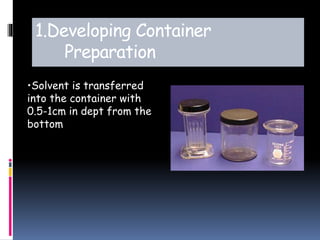
1.Developing Container
Preparation
•Solvent is transferred
into the container with
0.5-1cm in dept from the
bottom
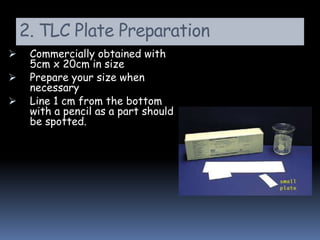
 Commercially obtained with
5cm x 20cm in size
 Prepare your size when
necessary
 Line 1 cm from the bottom
with a pencil as a part should
be spotted.
2. TLC Plate Preparation
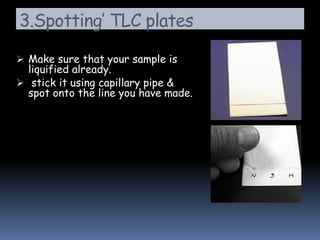
3.Spotting’ TLC plates
 Make sure that your sample is
liquified already.
 stick it using capillary pipe &
spot onto the line you have made.
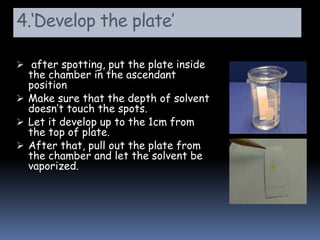
4.‘Develop the plate’
 after spotting, put the plate inside
the chamber in the ascendant
position
 Make sure that the depth of solvent
doesn’t touch the spots.
 Let it develop up to the 1cm from
the top of plate.
 After that, pull out the plate from
the chamber and let the solvent be
vaporized.
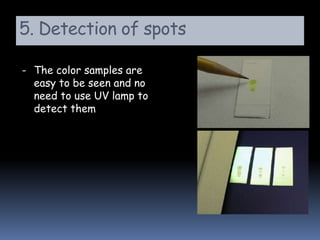
5. Detection of spots
- The color samples are
easy to be seen and no
need to use UV lamp to
detect them
6. DETECTION OF SPOT
1) Ninhydrin :
- spesific identification of amino acid
compounds.
- Ninhydrin solution will show a purple spot
when it is sprayed to the amino acid spot.
2) KMnO4 :
used to identify a reducing agent such as
glucose, fructose, vitamin C and others.
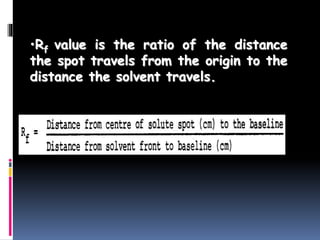
•Rf value is the ratio of the distance
the spot travels from the origin to the
distance the solvent travels.
Advantages
 Cheap
 Simple
 The developing can be monitored visually
 Able to use various chemical as a detector
Examples on TLC separations
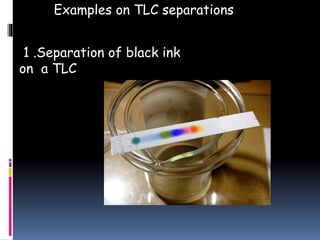
1. 1 .Separation of black ink
on a TLC
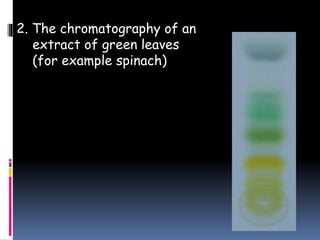
2. The chromatography of an
extract of green leaves
(for example spinach)
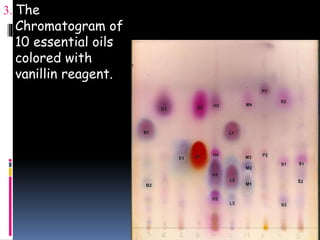
3. The
Chromatogram of
10 essential oils
colored with
vanillin reagent.
THANK
YOU

THIN LAYER CHROMATOGRAPHY

  • 1.
  • 2.
    INTRODUCTION  Thin-layer chromatography(TLC) is a chromatography technique used to separate non-volatile mixtures.  principle of separation depends on the relative affinity of compounds towards stationary and the mobile phase.
  • 3.
     A polarsolvent will carry a polar compound farther while a non-polar solvent will carry a non-polar compound farther. Thin layer chromatography can be used to:  Identify compounds present in a given substance.  Determine the purity of a substance.
  • 4.
    -A plate ofTLC can be made from aluminium or glass which is coated by a solid matter as a stationary phase. - The coated material has 0.1-0.3mm in thickness -some of them has been added by fluorescent indicator that will make it florescence during the UV light exposure.
  • 5.
    STATIONARY PHASE  Silicais commonly used as stationary phase  The separation of sample mixture will be depent on the polarity of sample.  Some modified silica is also used in certain purposes.  EXAMPLES; Silicagel G , Cellulose.
  • 6.
    MOBILE PHASE  Theability of mobile phase to move up is depent on the polarity itself.  Volatile organic solvents is preferably used as as mobile phase.  Examples ; Chloroform , methanol.
  • 7.
    MATERIALS • TLC plate •‘Developing container’ - chamber/ jar/ glass beaker • Pencil • Ruler • Capillary pipe • Solvents / mobile phase - organic solvents • UV lamp
  • 8.
  • 9.
    1.Developing Container Preparation •Solvent istransferred into the container with 0.5-1cm in dept from the bottom
  • 10.
     Commercially obtainedwith 5cm x 20cm in size  Prepare your size when necessary  Line 1 cm from the bottom with a pencil as a part should be spotted. 2. TLC Plate Preparation
  • 11.
    3.Spotting’ TLC plates Make sure that your sample is liquified already.  stick it using capillary pipe & spot onto the line you have made.
  • 12.
    4.‘Develop the plate’ after spotting, put the plate inside the chamber in the ascendant position  Make sure that the depth of solvent doesn’t touch the spots.  Let it develop up to the 1cm from the top of plate.  After that, pull out the plate from the chamber and let the solvent be vaporized.
  • 13.
    5. Detection ofspots - The color samples are easy to be seen and no need to use UV lamp to detect them
  • 14.
    6. DETECTION OFSPOT 1) Ninhydrin : - spesific identification of amino acid compounds. - Ninhydrin solution will show a purple spot when it is sprayed to the amino acid spot. 2) KMnO4 : used to identify a reducing agent such as glucose, fructose, vitamin C and others.
  • 15.
    •Rf value isthe ratio of the distance the spot travels from the origin to the distance the solvent travels.
  • 16.
    Advantages  Cheap  Simple The developing can be monitored visually  Able to use various chemical as a detector
  • 17.
    Examples on TLCseparations 1. 1 .Separation of black ink on a TLC
  • 18.
    2. The chromatographyof an extract of green leaves (for example spinach)
  • 19.
    3. The Chromatogram of 10essential oils colored with vanillin reagent.
  • 20.