1
4th National Conference on “Recent Advances in Engineering Technology and
                      Environmental issues (RAETE)”
                     J.C.D.M.College of Engineering,Sirsa


   A WRONG TURN BY QUANTUM DOTS
   RESULTED TOXICITY

                  AMIT SINGH          B.Pharmacy(final year)
                  Bharat Bhushan    Assistant Professor(JCDM College of Pharmacy)
                  Jagdish Chander   Associate Professor(JCDM College of Engg.)
          2


                            Thursday, Feb23, 2012
Introduction
   Quantum Dots (QDs), a heterogeneous class of
    engineered nanoparticles that are both semiconductors
    and fluorophores, are rapidly emerging as an important
    class of nanoparticles with numerous potential
    applications ranging from medicine to energy.
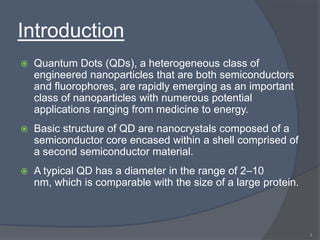
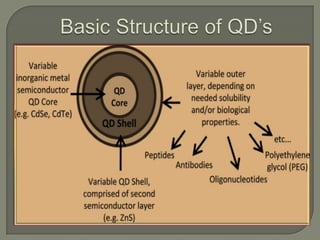
   Basic structure of QD are nanocrystals composed of a
    semiconductor core encased within a shell comprised of
    a second semiconductor material.
   A typical QD has a diameter in the range of 2–10
    nm, which is comparable with the size of a large protein.


                                                                3
Applications of Quantum Dots
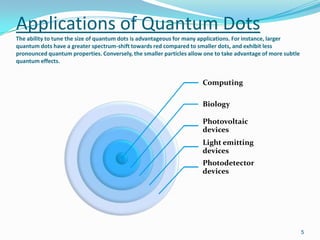
The ability to tune the size of quantum dots is advantageous for many applications. For instance, larger
quantum dots have a greater spectrum-shift towards red compared to smaller dots, and exhibit less
pronounced quantum properties. Conversely, the smaller particles allow one to take advantage of more subtle
quantum effects.


                                                                      Computing

                                                                      Biology

                                                                      Photovoltaic
                                                                      devices
                                                                      Light emitting
                                                                      devices
                                                                      Photodetector
                                                                      devices


                                                                                                              5

              COMPUTING
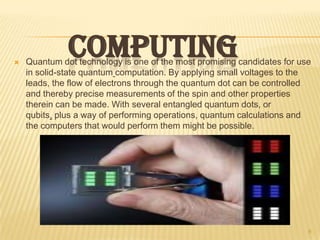
    Quantum dot technology is one of the most promising candidates for use
    in solid-state quantum computation. By applying small voltages to the
    leads, the flow of electrons through the quantum dot can be controlled
    and thereby precise measurements of the spin and other properties
    therein can be made. With several entangled quantum dots, or
    qubits, plus a way of performing operations, quantum calculations and
    the computers that would perform them might be possible.


                                                                         6
Biology
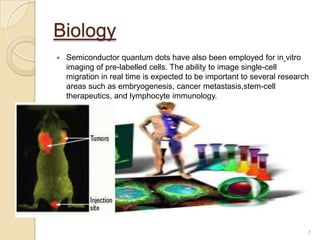
   Semiconductor quantum dots have also been employed for in vitro
    imaging of pre-labelled cells. The ability to image single-cell
    migration in real time is expected to be important to several research
    areas such as embryogenesis, cancer metastasis,stem-cell
    therapeutics, and lymphocyte immunology.


                                                                         7
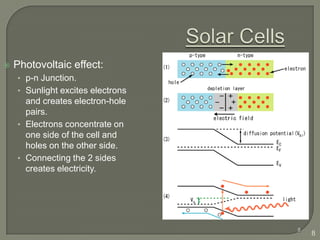
   Photovoltaic effect:
    • p-n Junction.
    • Sunlight excites electrons
      and creates electron-hole
      pairs.
    • Electrons concentrate on
      one side of the cell and
      holes on the other side.
    • Connecting the 2 sides
      creates electricity.


                                   8
                                       8
Light emitting devices
                                         9

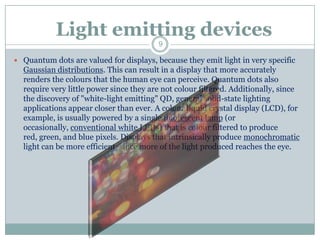
 Quantum dots are valued for displays, because they emit light in very specific
  Gaussian distributions. This can result in a display that more accurately
  renders the colours that the human eye can perceive. Quantum dots also
  require very little power since they are not colour filtered. Additionally, since
  the discovery of "white-light emitting" QD, general solid-state lighting
  applications appear closer than ever. A colour liquid crystal display (LCD), for
  example, is usually powered by a single fluorescent lamp (or
  occasionally, conventional white LEDs) that is colour filtered to produce
  red, green, and blue pixels. Displays that intrinsically produce monochromatic
  light can be more efficient, since more of the light produced reaches the eye.
PHOTODETECTOR DEVICES
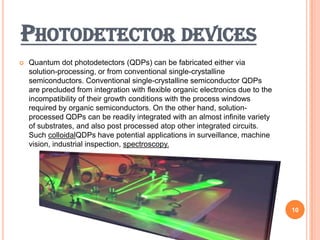
   Quantum dot photodetectors (QDPs) can be fabricated either via
    solution-processing, or from conventional single-crystalline
    semiconductors. Conventional single-crystalline semiconductor QDPs
    are precluded from integration with flexible organic electronics due to the
    incompatibility of their growth conditions with the process windows
    required by organic semiconductors. On the other hand, solution-
    processed QDPs can be readily integrated with an almost infinite variety
    of substrates, and also post processed atop other integrated circuits.
    Such colloidalQDPs have potential applications in surveillance, machine
    vision, industrial inspection, spectroscopy.


                                                                                  10
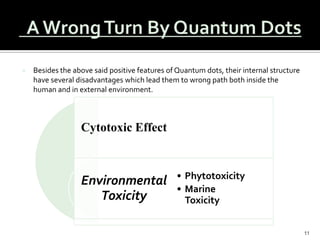
   Besides the above said positive features of Quantum dots, their internal structure
    have several disadvantages which lead them to wrong path both inside the
    human and in external environment.


                  Cytotoxic Effect


                                                • Phytotoxicity
                  Environmental
                                                • Marine
                     Toxicity                     Toxicity


                                                                                         11
A Road to Wrong Path
                       12
Conclusion


             13
 L. Jacak, P. Hawrylak, A. Wojs. Quantum dots. Springer-Verlag, Berlin, 1998.
 “Quantum Dots Explained.” Evident Technologies. 2008.
    <http://www.evidenttech.com/quantum-dots-explained.html>.
   Hanaki K, Momo A, Oku T, Komoto A, Maenosono S, Yamaguchi Y, Yamamoto K.
    Semiconductor quantum dot/albumin complex is a long-life and highly
    photostable endosome marker. Biochem. Biophys. Res. Commun. 2003;302:496-501
   Guo G, Liu W, Liang J, He Z, Xu H, Yang X. Probing the cytotoxicity of CdSe
    quantum dots with surface modification. Mater. Lett. 2007;61:1641-1644.
   Hardman R. A toxicologic review of quantum dots: Toxicity depends on
    physicochemical and environmental factors. Environ. Health Perspect. 2006;114:165-
    172
   Choi HS, Liu W, Misra P, Tanaka E, Zimmer JP, Itty Ipe B, Bawendi MG, Frangioni
    JV. Nat Biotechnol. 2007 Oct;25(10):1165-70. Epub 2007 Sep 23 (2007). "Renal
    clearance of quantum dots“. Nature biotechnology 25 (10): 1165–70.
   Pelley JL, Daar AS, Saner MA. Toxicol Sci. 2009 Dec;112(2):276-96 (2009). "State of academic
    knowledge on toxicity and biological fate of quantum dots". Toxicological sciences : an official
    journal of the Society of Toxicology 112 (2): 276–96.


                                                                                                       14

Quantum dots ppt

  • 1.
  • 2.
    4th National Conferenceon “Recent Advances in Engineering Technology and Environmental issues (RAETE)” J.C.D.M.College of Engineering,Sirsa A WRONG TURN BY QUANTUM DOTS RESULTED TOXICITY AMIT SINGH B.Pharmacy(final year) Bharat Bhushan Assistant Professor(JCDM College of Pharmacy) Jagdish Chander Associate Professor(JCDM College of Engg.) 2 Thursday, Feb23, 2012
  • 3.
    Introduction  Quantum Dots (QDs), a heterogeneous class of engineered nanoparticles that are both semiconductors and fluorophores, are rapidly emerging as an important class of nanoparticles with numerous potential applications ranging from medicine to energy.  Basic structure of QD are nanocrystals composed of a semiconductor core encased within a shell comprised of a second semiconductor material.  A typical QD has a diameter in the range of 2–10 nm, which is comparable with the size of a large protein. 3
  • 5.
    Applications of QuantumDots The ability to tune the size of quantum dots is advantageous for many applications. For instance, larger quantum dots have a greater spectrum-shift towards red compared to smaller dots, and exhibit less pronounced quantum properties. Conversely, the smaller particles allow one to take advantage of more subtle quantum effects. Computing Biology Photovoltaic devices Light emitting devices Photodetector devices 5
  • 6.
    COMPUTING Quantum dot technology is one of the most promising candidates for use in solid-state quantum computation. By applying small voltages to the leads, the flow of electrons through the quantum dot can be controlled and thereby precise measurements of the spin and other properties therein can be made. With several entangled quantum dots, or qubits, plus a way of performing operations, quantum calculations and the computers that would perform them might be possible. 6
  • 7.
    Biology  Semiconductor quantum dots have also been employed for in vitro imaging of pre-labelled cells. The ability to image single-cell migration in real time is expected to be important to several research areas such as embryogenesis, cancer metastasis,stem-cell therapeutics, and lymphocyte immunology. 7
  • 8.
    Photovoltaic effect: • p-n Junction. • Sunlight excites electrons and creates electron-hole pairs. • Electrons concentrate on one side of the cell and holes on the other side. • Connecting the 2 sides creates electricity. 8 8
  • 9.
    Light emitting devices 9  Quantum dots are valued for displays, because they emit light in very specific Gaussian distributions. This can result in a display that more accurately renders the colours that the human eye can perceive. Quantum dots also require very little power since they are not colour filtered. Additionally, since the discovery of "white-light emitting" QD, general solid-state lighting applications appear closer than ever. A colour liquid crystal display (LCD), for example, is usually powered by a single fluorescent lamp (or occasionally, conventional white LEDs) that is colour filtered to produce red, green, and blue pixels. Displays that intrinsically produce monochromatic light can be more efficient, since more of the light produced reaches the eye.
  • 10.
    PHOTODETECTOR DEVICES  Quantum dot photodetectors (QDPs) can be fabricated either via solution-processing, or from conventional single-crystalline semiconductors. Conventional single-crystalline semiconductor QDPs are precluded from integration with flexible organic electronics due to the incompatibility of their growth conditions with the process windows required by organic semiconductors. On the other hand, solution- processed QDPs can be readily integrated with an almost infinite variety of substrates, and also post processed atop other integrated circuits. Such colloidalQDPs have potential applications in surveillance, machine vision, industrial inspection, spectroscopy. 10
  • 11.
    Besides the above said positive features of Quantum dots, their internal structure have several disadvantages which lead them to wrong path both inside the human and in external environment. Cytotoxic Effect • Phytotoxicity Environmental • Marine Toxicity Toxicity 11
  • 12.
    A Road toWrong Path 12
  • 13.
  • 14.
     L. Jacak,P. Hawrylak, A. Wojs. Quantum dots. Springer-Verlag, Berlin, 1998.  “Quantum Dots Explained.” Evident Technologies. 2008. <http://www.evidenttech.com/quantum-dots-explained.html>.  Hanaki K, Momo A, Oku T, Komoto A, Maenosono S, Yamaguchi Y, Yamamoto K. Semiconductor quantum dot/albumin complex is a long-life and highly photostable endosome marker. Biochem. Biophys. Res. Commun. 2003;302:496-501  Guo G, Liu W, Liang J, He Z, Xu H, Yang X. Probing the cytotoxicity of CdSe quantum dots with surface modification. Mater. Lett. 2007;61:1641-1644.  Hardman R. A toxicologic review of quantum dots: Toxicity depends on physicochemical and environmental factors. Environ. Health Perspect. 2006;114:165- 172  Choi HS, Liu W, Misra P, Tanaka E, Zimmer JP, Itty Ipe B, Bawendi MG, Frangioni JV. Nat Biotechnol. 2007 Oct;25(10):1165-70. Epub 2007 Sep 23 (2007). "Renal clearance of quantum dots“. Nature biotechnology 25 (10): 1165–70.  Pelley JL, Daar AS, Saner MA. Toxicol Sci. 2009 Dec;112(2):276-96 (2009). "State of academic knowledge on toxicity and biological fate of quantum dots". Toxicological sciences : an official journal of the Society of Toxicology 112 (2): 276–96. 14