QUANTUM DOTS
A potential exiler in the
field of biology
:-by
Saumya Pandey-113BT0579
INTRODUCTION
• Wouldn't it be great if we could control individual atoms?
• Just imagine if we could "turn" them on and off to store
bits of information, make them light up with different
colors, or control them in all kinds of other ways.
• Simply speaking, quantum dots are examples
of nanotechnology:
“groups of atoms made from semiconductor materials
that promise to revolutionize everything from home lights
and computer displays to solar cells and biological
warfare detectors”
QUANTUM DOTS
• A quantum dot is a crystal, a few
nanometers wide, which is a tiny
speck of matter, so small that it's
effectively concentrated into a single
point (in other words, it's zero-
dimensional).
• They're made from
a semiconductor such as silicon.
• Although they're crystals, they
behave more like individual atoms—
hence the nickname artificial atoms.
CARBON QUANTUM DOTS
• Carbon quantum dots (CQDs, C-dots or CDs)
are small carbon nanoparticles (less than 10 nm
in size) with some form of surface passivation.
• CQDs were first discovered by Xu et al. in 2004
accidentally during the purification of single-
walled carbon nanotubes.
SYNTHESIS
PROPERTIES
As a new class of fluorescent carbon nanomaterials, CQDs possess the
attractive properties of :-
•high stability
•good conductivity
•low toxicity
•environmental friendliness
Making hydrophobic quantum dots bio-compatible
Conjugation quantum dots to bio molecules
APPLICATIONS OF QUANTUM
DOTS
The ability to tune the size of quantum dots is advantageous for many
applications. For instance, larger quantum dots have a greater
spectrum-shift towards red compared to smaller dots, and exhibit less
pronounced quantum properties. Conversely, the smaller particles
allow one to take advantage of more subtle quantum effects.
APPLICATIONS OF QDS:
BIOLOGICAL
• Biological Tagging and Labeling
– Biological assays and microarrays
– Labeling of cells and intracellular structures
– in vivo and in vitro imaging
– Pathogen and Toxin detection
BIOLOGY
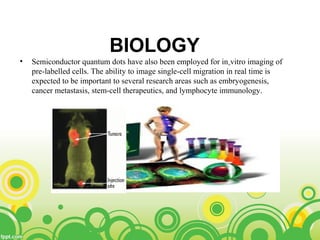
• Semiconductor quantum dots have also been employed for in vitro imaging of
pre-labelled cells. The ability to image single-cell migration in real time is
expected to be important to several research areas such as embryogenesis,
cancer metastasis, stem-cell therapeutics, and lymphocyte immunology.
APPLICATIONS OF QDS:
BIOLOGICAL
• Biological Tagging
– Organic fluorophores such as genetically encoded fluorescent
protein, like GFP, or chemically synthesized fluorescent dyes
have been the most common way of tagging biological
entities.
– Some limitations of organic fluorophores:
• do not continuously fluoresce for extended periods of time
• Degrade or photo-bleach
• are not optimized for multicolor applications
APPLICATIONS OF
QDS: BIOLOGICAL
• The unique optical properties of quantum dots make them suitable for biological
tagging and labeling applications.
• QDs are excellent fluorophores.
– Fluorescence is a type of luminescence in which the absorption of an incident
photon triggers the emission of a lower energy or longer wavelength photon.
– Quantum dots absorb over a broad spectrum and fluoresce over a narrow
range of wavelengths. This is tunable by particle size.
– So, a single excitation source can be used to excite QDs of different colors
making them ideal for imaging multiple targets simultaneously.
APPLICATIONS OF
QDS: BIOLOGICAL
Absorption and emission Spectra of CdSe/ZnS QDs compared to
Rhodamine, a common organic die.
– The absorption spectrum (dashed lines) of the QD (green) is very
broad, whereas that of the organic die (orange) is narrow.
– Conversely, the emission spectrum (solid lines) of the QD is more
narrow than that of the organic die
Jyoti K. Jaiswal and Sanford M. Simon. Potentials and pitfalls of fluorescent quantum
dots for biological imaging. TRENDS in Cell Biology Vol.14 No.9 September 2004
• A broad absorption and narrow emission spectrum means a
single excitation source can be used to excite QDs of different
colors making them ideal for imaging multiple targets
simultaneously.
Gao, Xiaohu. "In vivo cancer targeting and imaging with."
Nature Biotechnology 22(2004): 8.
APPLICATIONS OF QDS:
BIOLOGICAL
CdSe/ZnS QDs used to image cancer cells in a live mouse.
Diagnosis by dot
Observing components of cell
PHOTOCATALYSIS
• Photocatalytic processes have gained tremendous momentum as
greener alternatives in organic synthesis
• Flexibility of functionalization with various groups CQDs makes them
possible to absorb lights of different wavelengths, which offers good
opportunities for applications in photocatalysis.
• Demonstrated capability of harnessing long wavelength light and
energy exchange with solution species of CQDs offers an excellent
opportunity for their use as photocatalysts in organic synthesis.
• Recent study has indicated that smaller CQDs (1–4 nm) are effective
NIR light-driven photocatalysts for selective oxidation of alcohols to
benzaldehydes with good conversion efficiency (92%). The larger
CQDs (5–10 nm) showed light-induced proton properties in solution,
which can be used as acid catalysts to catalyse a series of organic
transformations in aqueous media under visible light.
NANOMEDICINE
• CQDs, being small fluorescent nanoparticles which can be
synthesised quickly via many inexpensive and simple synthetic
routes.
• CQDs are also very attractive in nanomedicine because they do not
show any visible signs of toxicity and biocompatible in animals and
thus can be used for in vivo studies.
• The work by Bechet and co-workers showed that CQDs can be used for
photodynamic therapy. Photodynamic therapy is a clinical treatment mainly
for superficial tumours.It involves the localisation and accumulation of
photosensitizers in the tumour tissue, following which they are irradiated
with a specific wavelength, triggering the formation of singlet oxygen
species that result in cell death. It has been validated that CQDs have high
inhibition effect on MCF-7 and MDA-MB-231 cancer cells.
• From Huang et al. studies, it was learnt that CQDs are quickly and
effectively excreted from the body when intravenous, intramuscular and
subcutaneous injection routes are used.
COMPUTING
• Quantum dot technology is one of the most promising candidates for
use in solid-state quantum computation. By applying small voltages to
the leads, the flow of electrons through the quantum dot can be
controlled and thereby precise measurements of the spin and other
properties therein can be made. With several entangled quantum dots,
or qubits, plus a way of performing operations, quantum calculations
and the computers that would perform them might be possible.
SOLAR CELL
• Leading researchers and institutions are
investigating various ways in which quantum
dots can be incorporated into semiconductor
surfaces
• Or inks and deposited onto low cost materials
SOLAR CELL
• Quantum dots are cost effectively produced in
bulk via chemical manufacturing techniques
• This will ultimately lead to lower cost higher
output cells
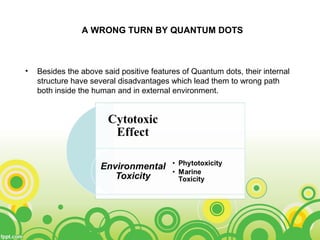
A WRONG TURN BY QUANTUM DOTS
• Besides the above said positive features of Quantum dots, their internal
structure have several disadvantages which lead them to wrong path
both inside the human and in external environment.
CONCLUSION
• QUANTUM DOTS is a Nano crystal made of semi-conductor materials that are small
enough to exhibit quantum mechanical properties.
• There are several ways to confine excitons in semiconductors, resulting in different
methods to produce quantum dots.
• Research effort around the world is being applied to expanding the accuracy and
capabilities of this Nano Particles for its usage in the industry of Hardware Components
and Electronics as it is one of the most promising candidates for use in solid-
state quantum computation and in biological application.
• Quantum dots have also been suggested as implementations of qubits for Quantum
Information Processing.
References
• Youfu Wang and Aiguo Hu, Carbon quantum dots: synthesis, properties and
applications, J. Mater. Chem. C, 2014, 2, 6921
• Haitao Li,Xiaodie He Dr.,Zhenhui Kang ,Hui Huang Dr.,Yang Liu,Jinglin Liu
,Suoyuan Lian,Chi Him A. Tsang, Xiaobao Yang Dr.,Shuit-Tong Lee,    Water-
Soluble Fluorescent Carbon Quantum Dots and Photocatalyst Design, Volume
49, Issue 26 June 14, 2010 Pages 4430–4434.
• K. S. Novoselov,A. K. Geim,S. V. Morozov,D. Jiang, Y. ZhangS. V. Dubonos,I.
V. Grigorieva,A. A. Firsov, Electric Field Effect in Atomically Thin Carbon
Films, Science 22 Oct 2004:Vol. 306, Issue 5696, pp. 666-669

Carbon Quantum Dots

  • 1.
    QUANTUM DOTS A potentialexiler in the field of biology :-by Saumya Pandey-113BT0579
  • 2.
    INTRODUCTION • Wouldn't itbe great if we could control individual atoms? • Just imagine if we could "turn" them on and off to store bits of information, make them light up with different colors, or control them in all kinds of other ways. • Simply speaking, quantum dots are examples of nanotechnology: “groups of atoms made from semiconductor materials that promise to revolutionize everything from home lights and computer displays to solar cells and biological warfare detectors”
  • 3.
    QUANTUM DOTS • Aquantum dot is a crystal, a few nanometers wide, which is a tiny speck of matter, so small that it's effectively concentrated into a single point (in other words, it's zero- dimensional). • They're made from a semiconductor such as silicon. • Although they're crystals, they behave more like individual atoms— hence the nickname artificial atoms.
  • 4.
    CARBON QUANTUM DOTS •Carbon quantum dots (CQDs, C-dots or CDs) are small carbon nanoparticles (less than 10 nm in size) with some form of surface passivation. • CQDs were first discovered by Xu et al. in 2004 accidentally during the purification of single- walled carbon nanotubes.
  • 5.
  • 6.
    PROPERTIES As a newclass of fluorescent carbon nanomaterials, CQDs possess the attractive properties of :- •high stability •good conductivity •low toxicity •environmental friendliness
  • 8.
    Making hydrophobic quantumdots bio-compatible
  • 9.
    Conjugation quantum dotsto bio molecules
  • 10.
    APPLICATIONS OF QUANTUM DOTS Theability to tune the size of quantum dots is advantageous for many applications. For instance, larger quantum dots have a greater spectrum-shift towards red compared to smaller dots, and exhibit less pronounced quantum properties. Conversely, the smaller particles allow one to take advantage of more subtle quantum effects.
  • 11.
    APPLICATIONS OF QDS: BIOLOGICAL •Biological Tagging and Labeling – Biological assays and microarrays – Labeling of cells and intracellular structures – in vivo and in vitro imaging – Pathogen and Toxin detection
  • 12.
    BIOLOGY • Semiconductor quantumdots have also been employed for in vitro imaging of pre-labelled cells. The ability to image single-cell migration in real time is expected to be important to several research areas such as embryogenesis, cancer metastasis, stem-cell therapeutics, and lymphocyte immunology.
  • 13.
    APPLICATIONS OF QDS: BIOLOGICAL •Biological Tagging – Organic fluorophores such as genetically encoded fluorescent protein, like GFP, or chemically synthesized fluorescent dyes have been the most common way of tagging biological entities. – Some limitations of organic fluorophores: • do not continuously fluoresce for extended periods of time • Degrade or photo-bleach • are not optimized for multicolor applications
  • 14.
    APPLICATIONS OF QDS: BIOLOGICAL •The unique optical properties of quantum dots make them suitable for biological tagging and labeling applications. • QDs are excellent fluorophores. – Fluorescence is a type of luminescence in which the absorption of an incident photon triggers the emission of a lower energy or longer wavelength photon. – Quantum dots absorb over a broad spectrum and fluoresce over a narrow range of wavelengths. This is tunable by particle size. – So, a single excitation source can be used to excite QDs of different colors making them ideal for imaging multiple targets simultaneously.
  • 15.
    APPLICATIONS OF QDS: BIOLOGICAL Absorptionand emission Spectra of CdSe/ZnS QDs compared to Rhodamine, a common organic die. – The absorption spectrum (dashed lines) of the QD (green) is very broad, whereas that of the organic die (orange) is narrow. – Conversely, the emission spectrum (solid lines) of the QD is more narrow than that of the organic die Jyoti K. Jaiswal and Sanford M. Simon. Potentials and pitfalls of fluorescent quantum dots for biological imaging. TRENDS in Cell Biology Vol.14 No.9 September 2004
  • 16.
    • A broadabsorption and narrow emission spectrum means a single excitation source can be used to excite QDs of different colors making them ideal for imaging multiple targets simultaneously. Gao, Xiaohu. "In vivo cancer targeting and imaging with." Nature Biotechnology 22(2004): 8. APPLICATIONS OF QDS: BIOLOGICAL CdSe/ZnS QDs used to image cancer cells in a live mouse.
  • 17.
  • 18.
  • 19.
    PHOTOCATALYSIS • Photocatalytic processeshave gained tremendous momentum as greener alternatives in organic synthesis • Flexibility of functionalization with various groups CQDs makes them possible to absorb lights of different wavelengths, which offers good opportunities for applications in photocatalysis. • Demonstrated capability of harnessing long wavelength light and energy exchange with solution species of CQDs offers an excellent opportunity for their use as photocatalysts in organic synthesis. • Recent study has indicated that smaller CQDs (1–4 nm) are effective NIR light-driven photocatalysts for selective oxidation of alcohols to benzaldehydes with good conversion efficiency (92%). The larger CQDs (5–10 nm) showed light-induced proton properties in solution, which can be used as acid catalysts to catalyse a series of organic transformations in aqueous media under visible light.
  • 20.
    NANOMEDICINE • CQDs, beingsmall fluorescent nanoparticles which can be synthesised quickly via many inexpensive and simple synthetic routes. • CQDs are also very attractive in nanomedicine because they do not show any visible signs of toxicity and biocompatible in animals and thus can be used for in vivo studies.
  • 21.
    • The workby Bechet and co-workers showed that CQDs can be used for photodynamic therapy. Photodynamic therapy is a clinical treatment mainly for superficial tumours.It involves the localisation and accumulation of photosensitizers in the tumour tissue, following which they are irradiated with a specific wavelength, triggering the formation of singlet oxygen species that result in cell death. It has been validated that CQDs have high inhibition effect on MCF-7 and MDA-MB-231 cancer cells. • From Huang et al. studies, it was learnt that CQDs are quickly and effectively excreted from the body when intravenous, intramuscular and subcutaneous injection routes are used.
  • 22.
    COMPUTING • Quantum dottechnology is one of the most promising candidates for use in solid-state quantum computation. By applying small voltages to the leads, the flow of electrons through the quantum dot can be controlled and thereby precise measurements of the spin and other properties therein can be made. With several entangled quantum dots, or qubits, plus a way of performing operations, quantum calculations and the computers that would perform them might be possible.
  • 23.
    SOLAR CELL • Leadingresearchers and institutions are investigating various ways in which quantum dots can be incorporated into semiconductor surfaces • Or inks and deposited onto low cost materials
  • 24.
    SOLAR CELL • Quantumdots are cost effectively produced in bulk via chemical manufacturing techniques • This will ultimately lead to lower cost higher output cells
  • 25.
    A WRONG TURNBY QUANTUM DOTS • Besides the above said positive features of Quantum dots, their internal structure have several disadvantages which lead them to wrong path both inside the human and in external environment.
  • 26.
    CONCLUSION • QUANTUM DOTSis a Nano crystal made of semi-conductor materials that are small enough to exhibit quantum mechanical properties. • There are several ways to confine excitons in semiconductors, resulting in different methods to produce quantum dots. • Research effort around the world is being applied to expanding the accuracy and capabilities of this Nano Particles for its usage in the industry of Hardware Components and Electronics as it is one of the most promising candidates for use in solid- state quantum computation and in biological application. • Quantum dots have also been suggested as implementations of qubits for Quantum Information Processing.
  • 27.
    References • Youfu Wangand Aiguo Hu, Carbon quantum dots: synthesis, properties and applications, J. Mater. Chem. C, 2014, 2, 6921 • Haitao Li,Xiaodie He Dr.,Zhenhui Kang ,Hui Huang Dr.,Yang Liu,Jinglin Liu ,Suoyuan Lian,Chi Him A. Tsang, Xiaobao Yang Dr.,Shuit-Tong Lee,    Water- Soluble Fluorescent Carbon Quantum Dots and Photocatalyst Design, Volume 49, Issue 26 June 14, 2010 Pages 4430–4434. • K. S. Novoselov,A. K. Geim,S. V. Morozov,D. Jiang, Y. ZhangS. V. Dubonos,I. V. Grigorieva,A. A. Firsov, Electric Field Effect in Atomically Thin Carbon Films, Science 22 Oct 2004:Vol. 306, Issue 5696, pp. 666-669