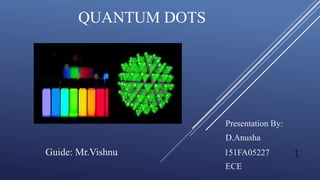
This document discusses quantum dots, which are semiconductor nanocrystals that exhibit quantum mechanical properties due to their small size on the order of nanometers. It describes three main methods for producing quantum dots: lithography, colloidal synthesis, and epitaxy. Potential applications of quantum dots include computing, biology, photovoltaics, light-emitting devices, and photodetectors. Advantages are their small energy requirements and suitability for applications like fluorescence tagging, while disadvantages include potential for blinking and low quantum yields.