Science and Biological Applications
Presented by
Ankit Nautiyal
Reg. No. 2015MT07
Department of Applied Mechanics
Motilal Nehru National Institute of Technology Allahabad
Allahabad-211004
Why I chose this topic?
Useful Now: I chose to research and present on the science and
applications of Quantum Dots because of the many interesting
and important applications currently in use by this nano-
technology.
The Future is Bright: The usefulness and application of
Quantum Dot technology continues to expand and research is
striving to bring their benefits to more and more technologically
applied fields.
What are Quantum Dots?
 Quantum dots (QDs) are
nanometer-scale
semiconductor crystals
composed of groups II–VI
or III–V elements.
 Particles with physical
dimensions smaller than the
Bohr radius .
 Quantum dots were
discovered during research
work in 1980s by Alexie
Ekimov in glass matrix and
Louis E Brus in colloidal
solutions .
Fig. 1 1.distance between electron and
nucleus in hydrogen atom.
• Size , energy level and emission color can precisely controlled .
• Requisite absorption and resultant emission wavelengths
dependent on dot size.
• Metal and semiconductor nanoparticles in the size range of 2–10
nm are of considerable interest, due to their dimensional similarities
with biological macromolecules (e.g. nucleic acids and proteins)
Quantum Dots Description…
The bigger quantum dots larger the wavelength the smaller the
frequency .
The energy band gap increases with a decrease in size of the
quantum dot(The smaller the size of the crystal, means larger the
band gap)
therefore more energy is needed to excite the dot.
more energy is released when the crystal returns to its resting state.
Fig. 4. The energy band gap associated with semi-conducting materials. In
order to produce electric current electrons must exist in the conduction band.
As the crystal size grows smaller, resulting in a color shift from red to
blue in the light emitted.
Figure 5. Solutions of quantum dots of varying size. Note the variation
in color of each solution illustrating the particle size dependence of the
optical absorption for each sample. Note that the smaller particles are in
the blue solution (absorbs blue), and that the larger ones are in the red
(absorbs red).
Synthesis
Traditionally chalcogenides (selenides or sulfides) of metals like
cadmium or zinc(CdSe or ZnS, for example), which range from 2 to
100 nanometers in diameter (about the width of 50 atoms)are used to
make Q. dots .
fluorescence in the visible region is usually required
 both core and shell are composed of elements from the II B and VI
A groups of the Periodic Table.
The major examples are CdSe/ZnS, CdTe/CdS and ZnSe/ZnS Q.
Dots.
Core and shell of Q.Dots……
Quantum Dot Applications
The ability to tune the size of quantum dots is
advantageous for many applications.
Colloidal QDs once dispersed in a solvent are quite interesting
fluorescence probes for all types of labelling studies
1.biological application
a. imaging
b. labelling
c. tracking of cell movement
d. Detection of disease
2. other than biological application
Medical Imaging and Disease Detection
Can be set to any arbitrary emission spectra to allow labeling and
observation of detailed biological processes.
Quantum Dots can be useful tool for monitoring cancerous cells
and providing a means to better understand its evolution.
In the future, Qdots could also be armed with tumor-fighting
toxic therapies to provide the diagnosis and treatment of cancer.
Qdots are much more resistant to degradation than other optical
imaging probes such as organic dyes, allowing them to track cell
processes for longer periods of time.
Imaging Techniques
Conventional Techniques:
X-ray, MRI, Fluoroscopy
CT scan
Limitations
Limited detail
Difficult to track movement
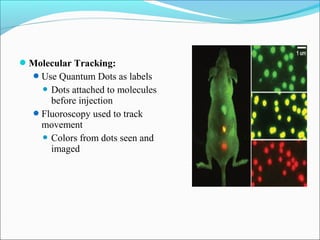
Molecular Tracking:
Use Quantum Dots as labels
 Dots attached to molecules
before injection
Fluoroscopy used to track
movement
 Colors from dots seen and
imaged
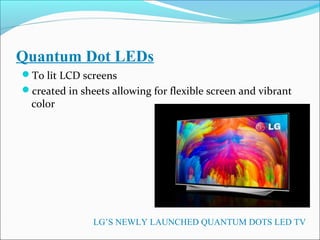
Quantum Dot LEDs
To lit LCD screens
created in sheets allowing for flexible screen and vibrant
color
LG’S NEWLY LAUNCHED QUANTUM DOTS LED TV
Solar Cells and Photovoltaics
Traditional solar cells are made of semi-conductors and
expensive to produce. Theoretical upper limit is 33%
efficiency for conversion of sunlight to electricity for these
cells.
Utilizing quantum dots allows realization of third-
generation solar cells at ~60% efficiency in electricity
production while being $100 or less per square meter of
paneling necessary.
Effective due to quantum dots’ ability to preferentially
absorb and emit radiation that results in optimal
generation of electric current and voltage.
Purposed work
Procedure to synthesis
Bare uncoated QDs cannot be used directly for biological
applications so Need to Surface Modification
References……
Ankhi Maiti1 and Sagarika Bhattacharyya2(1,2Department of
Chemistry, Sudhir Chandra Sur Degree Engineering College,
Dumdum, Kolkata, India)
Ajay Singh Karakoti, Ritesh Shukla, Rishi Shanker, Sanjay Singh
1Battelle Science and Technology India Pvt. Ltd., 302, Panchshil
Technology Park, Hinjewadi, Pune
Timothy Jamiesona, Raheleh Bakhshia, Daniela Petrovaa, Rachael
Pococka, Mo Imanib, Alexander M. Seifaliana,c, a Biomaterials &
Tissue Engineering Centre (BTEC), University College London.
Ankit quantum-dots-semina1r

Ankit quantum-dots-semina1r

  • 1.
    Science and BiologicalApplications Presented by Ankit Nautiyal Reg. No. 2015MT07 Department of Applied Mechanics Motilal Nehru National Institute of Technology Allahabad Allahabad-211004
  • 2.
    Why I chosethis topic? Useful Now: I chose to research and present on the science and applications of Quantum Dots because of the many interesting and important applications currently in use by this nano- technology. The Future is Bright: The usefulness and application of Quantum Dot technology continues to expand and research is striving to bring their benefits to more and more technologically applied fields.
  • 3.
    What are QuantumDots?  Quantum dots (QDs) are nanometer-scale semiconductor crystals composed of groups II–VI or III–V elements.  Particles with physical dimensions smaller than the Bohr radius .  Quantum dots were discovered during research work in 1980s by Alexie Ekimov in glass matrix and Louis E Brus in colloidal solutions . Fig. 1 1.distance between electron and nucleus in hydrogen atom.
  • 4.
    • Size ,energy level and emission color can precisely controlled . • Requisite absorption and resultant emission wavelengths dependent on dot size. • Metal and semiconductor nanoparticles in the size range of 2–10 nm are of considerable interest, due to their dimensional similarities with biological macromolecules (e.g. nucleic acids and proteins)
  • 5.
    Quantum Dots Description… Thebigger quantum dots larger the wavelength the smaller the frequency . The energy band gap increases with a decrease in size of the quantum dot(The smaller the size of the crystal, means larger the band gap) therefore more energy is needed to excite the dot. more energy is released when the crystal returns to its resting state.
  • 6.
    Fig. 4. Theenergy band gap associated with semi-conducting materials. In order to produce electric current electrons must exist in the conduction band.
  • 7.
    As the crystalsize grows smaller, resulting in a color shift from red to blue in the light emitted.
  • 8.
    Figure 5. Solutionsof quantum dots of varying size. Note the variation in color of each solution illustrating the particle size dependence of the optical absorption for each sample. Note that the smaller particles are in the blue solution (absorbs blue), and that the larger ones are in the red (absorbs red).
  • 9.
    Synthesis Traditionally chalcogenides (selenidesor sulfides) of metals like cadmium or zinc(CdSe or ZnS, for example), which range from 2 to 100 nanometers in diameter (about the width of 50 atoms)are used to make Q. dots . fluorescence in the visible region is usually required  both core and shell are composed of elements from the II B and VI A groups of the Periodic Table. The major examples are CdSe/ZnS, CdTe/CdS and ZnSe/ZnS Q. Dots.
  • 10.
    Core and shellof Q.Dots……
  • 11.
    Quantum Dot Applications Theability to tune the size of quantum dots is advantageous for many applications. Colloidal QDs once dispersed in a solvent are quite interesting fluorescence probes for all types of labelling studies 1.biological application a. imaging b. labelling c. tracking of cell movement d. Detection of disease 2. other than biological application
  • 12.
    Medical Imaging andDisease Detection Can be set to any arbitrary emission spectra to allow labeling and observation of detailed biological processes. Quantum Dots can be useful tool for monitoring cancerous cells and providing a means to better understand its evolution. In the future, Qdots could also be armed with tumor-fighting toxic therapies to provide the diagnosis and treatment of cancer. Qdots are much more resistant to degradation than other optical imaging probes such as organic dyes, allowing them to track cell processes for longer periods of time.
  • 13.
    Imaging Techniques Conventional Techniques: X-ray,MRI, Fluoroscopy CT scan Limitations Limited detail Difficult to track movement
  • 14.
    Molecular Tracking: Use QuantumDots as labels  Dots attached to molecules before injection Fluoroscopy used to track movement  Colors from dots seen and imaged
  • 15.
    Quantum Dot LEDs Tolit LCD screens created in sheets allowing for flexible screen and vibrant color LG’S NEWLY LAUNCHED QUANTUM DOTS LED TV
  • 16.
    Solar Cells andPhotovoltaics Traditional solar cells are made of semi-conductors and expensive to produce. Theoretical upper limit is 33% efficiency for conversion of sunlight to electricity for these cells. Utilizing quantum dots allows realization of third- generation solar cells at ~60% efficiency in electricity production while being $100 or less per square meter of paneling necessary. Effective due to quantum dots’ ability to preferentially absorb and emit radiation that results in optimal generation of electric current and voltage.
  • 17.
    Purposed work Procedure tosynthesis Bare uncoated QDs cannot be used directly for biological applications so Need to Surface Modification
  • 18.
    References…… Ankhi Maiti1 andSagarika Bhattacharyya2(1,2Department of Chemistry, Sudhir Chandra Sur Degree Engineering College, Dumdum, Kolkata, India) Ajay Singh Karakoti, Ritesh Shukla, Rishi Shanker, Sanjay Singh 1Battelle Science and Technology India Pvt. Ltd., 302, Panchshil Technology Park, Hinjewadi, Pune Timothy Jamiesona, Raheleh Bakhshia, Daniela Petrovaa, Rachael Pococka, Mo Imanib, Alexander M. Seifaliana,c, a Biomaterials & Tissue Engineering Centre (BTEC), University College London.

Editor's Notes

  • #5 Not on material