Nanocrystals for optical
      amplification

S. Janssens1,2, G. Williams2, D. Clarke1 and S. G. Raymond1

          1
           Industrial Research Ltd, P.O. Box 31310, Lower Hutt, New Zealand.

              Victoria University, P.O. Box 600, Wellington, New Zealand.
              2


                                                                               1
Nanoparticles

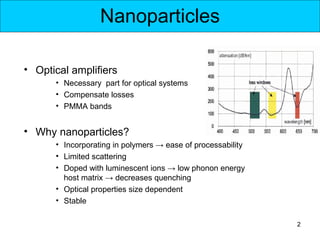
• Optical amplifiers
      • Necessary part for optical systems
      • Compensate losses
      • PMMA bands


• Why nanoparticles?
      • Incorporating in polymers → ease of processability
      • Limited scattering
      • Doped with luminescent ions → low phonon energy
        host matrix → decreases quenching
      • Optical properties size dependent
      • Stable

                                                             2
Nanoparticles
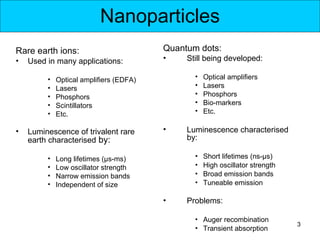
Rare earth ions:                         Quantum dots:
•   Used in many applications:           •    Still being developed:

         •   Optical amplifiers (EDFA)          •   Optical amplifiers
         •   Lasers                             •   Lasers
         •   Phosphors                          •   Phosphors
         •   Scintillators                      •   Bio-markers
         •   Etc.                               •   Etc.

•   Luminescence of trivalent rare       •    Luminescence characterised
    earth characterised by:                   by:

         •   Long lifetimes (μs-ms)             •   Short lifetimes (ns-μs)
         •   Low oscillator strength            •   High oscillator strength
         •   Narrow emission bands              •   Broad emission bands
         •   Independent of size                •   Tuneable emission

                                         •    Problems:

                                                • Auger recombination
                                                                               3
                                                • Transient absorption
Quantum dots
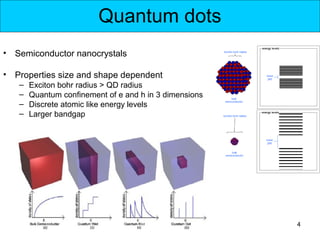
• Semiconductor nanocrystals

• Properties size and shape dependent
   –   Exciton bohr radius > QD radius
   –   Quantum confinement of e and h in 3 dimensions
   –   Discrete atomic like energy levels
   –   Larger bandgap


                                                        4
Quantum dots

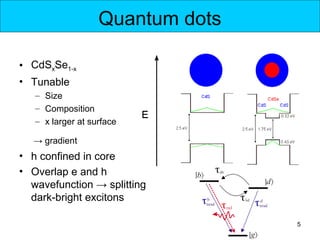
• CdSxSe1-x
• Tunable
   – Size
   – Composition
   – x larger at surface

  → gradient
• h confined in core
• Overlap e and h
  wavefunction → splitting
  dark-bright excitons

                                  5
Structural Characterization


Sample      x          x     Particle size
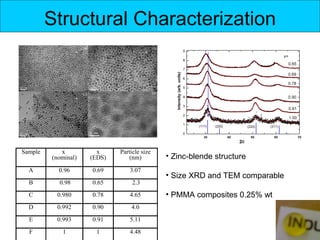
         (nominal)   (EDS)       (nm)        • Zinc-blende structure
  A        0.96      0.69        3.07
                                             • Size XRD and TEM comparable
  B         0.98     0.65         2.3
  C       0.980      0.78        4.65        • PMMA composites 0.25% wt
  D       0.992      0.90        4.0
  E       0.993      0.91        5.11
                                                                             6
  F         1          1         4.48
Optical properties

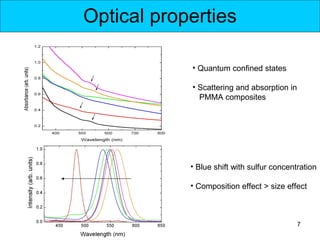
            • Quantum confined states

            • Scattering and absorption in
              PMMA composites


            • Blue shift with sulfur concentration

            • Composition effect > size effect


                                             7
Optical properties in solution

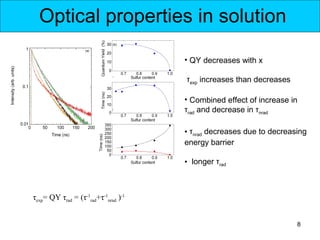
                                      • QY decreases with x

                                      τexp increases than decreases

                                      • Combined effect of increase in
                                      τrad and decrease in τnrad

                                      • τnrad decreases due to decreasing
                                      energy barrier

                                      • longer τrad


τexp= QY τrad = (τ-1rad+τ-1nrad )-1


                                                                      8
Optical properties in PMMA


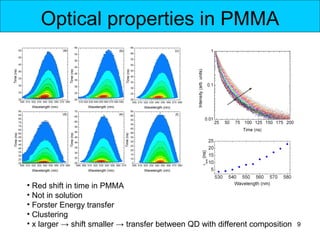
• Red shift in time in PMMA
• Not in solution
• Forster Energy transfer
• Clustering
• x larger → shift smaller → transfer between QD with different composition   9
BaMgF4 nanoparticles

• BaMgF4 ferroelectric crystal

• 2nd order nonlinear material

• Doped with luminescent ions

• Synthesised using reverse microemulsion


                                            10
XRD and TEM


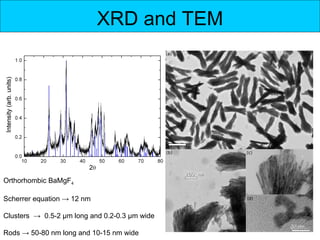
Orthorhombic BaMgF4

Scherrer equation → 12 nm

Clusters → 0.5-2 μm long and 0.2-0.3 μm wide
                                               11
Rods → 50-80 nm long and 10-15 nm wide
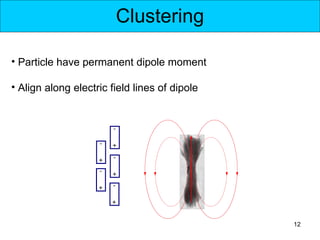
Clustering

• Particle have permanent dipole moment

• Align along electric field lines of dipole


                                               12
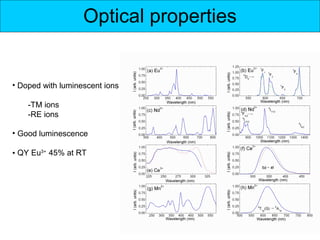
Optical properties


• Doped with luminescent ions

    -TM ions
    -RE ions

• Good luminescence

• QY Eu3+ 45% at RT


                                        13
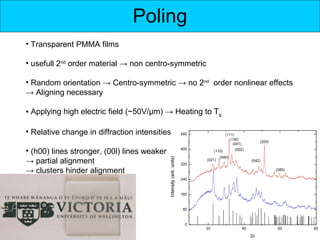
Poling
• Transparent PMMA films

• usefull 2nd order material → non centro-symmetric

• Random orientation → Centro-symmetric → no 2nd order nonlinear effects
→ Aligning necessary

• Applying high electric field (~50V/μm) → Heating to Tg

• Relative change in diffraction intensities

• (h00) lines stronger, (00l) lines weaker
→ partial alignment
→ clusters hinder alignment


                                                                           14
Conclusion

• QY of QD ~30% and decreases with x
• Shift in wavelength mainly due to change in composition
• Clustering in PMMA composites, but still good
  transparancy


• Synthesizing BaMgF4 nanoparticles
• Good luminescence for doped BaMgF4 particles
• Possible to partially align particles using electric field
• Potential for optical amplification and EO devices
                                                               15
Thanks for your attention


    Questions?


                            16

16.40 o4 s janssens

  • 1.
    Nanocrystals for optical amplification S. Janssens1,2, G. Williams2, D. Clarke1 and S. G. Raymond1 1 Industrial Research Ltd, P.O. Box 31310, Lower Hutt, New Zealand. Victoria University, P.O. Box 600, Wellington, New Zealand. 2 1
  • 2.
    Nanoparticles • Optical amplifiers • Necessary part for optical systems • Compensate losses • PMMA bands • Why nanoparticles? • Incorporating in polymers → ease of processability • Limited scattering • Doped with luminescent ions → low phonon energy host matrix → decreases quenching • Optical properties size dependent • Stable 2
  • 3.
    Nanoparticles Rare earth ions: Quantum dots: • Used in many applications: • Still being developed: • Optical amplifiers (EDFA) • Optical amplifiers • Lasers • Lasers • Phosphors • Phosphors • Scintillators • Bio-markers • Etc. • Etc. • Luminescence of trivalent rare • Luminescence characterised earth characterised by: by: • Long lifetimes (μs-ms) • Short lifetimes (ns-μs) • Low oscillator strength • High oscillator strength • Narrow emission bands • Broad emission bands • Independent of size • Tuneable emission • Problems: • Auger recombination 3 • Transient absorption
  • 4.
    Quantum dots • Semiconductornanocrystals • Properties size and shape dependent – Exciton bohr radius > QD radius – Quantum confinement of e and h in 3 dimensions – Discrete atomic like energy levels – Larger bandgap 4
  • 5.
    Quantum dots • CdSxSe1-x •Tunable – Size – Composition – x larger at surface → gradient • h confined in core • Overlap e and h wavefunction → splitting dark-bright excitons 5
  • 6.
    Structural Characterization Sample x x Particle size (nominal) (EDS) (nm) • Zinc-blende structure A 0.96 0.69 3.07 • Size XRD and TEM comparable B  0.98 0.65  2.3 C 0.980 0.78 4.65 • PMMA composites 0.25% wt D 0.992 0.90 4.0 E 0.993 0.91 5.11 6 F 1 1 4.48
  • 7.
    Optical properties • Quantum confined states • Scattering and absorption in PMMA composites • Blue shift with sulfur concentration • Composition effect > size effect 7
  • 8.
    Optical properties insolution • QY decreases with x τexp increases than decreases • Combined effect of increase in τrad and decrease in τnrad • τnrad decreases due to decreasing energy barrier • longer τrad τexp= QY τrad = (τ-1rad+τ-1nrad )-1 8
  • 9.
    Optical properties inPMMA • Red shift in time in PMMA • Not in solution • Forster Energy transfer • Clustering • x larger → shift smaller → transfer between QD with different composition 9
  • 10.
    BaMgF4 nanoparticles • BaMgF4ferroelectric crystal • 2nd order nonlinear material • Doped with luminescent ions • Synthesised using reverse microemulsion 10
  • 11.
    XRD and TEM OrthorhombicBaMgF4 Scherrer equation → 12 nm Clusters → 0.5-2 μm long and 0.2-0.3 μm wide 11 Rods → 50-80 nm long and 10-15 nm wide
  • 12.
    Clustering • Particle havepermanent dipole moment • Align along electric field lines of dipole 12
  • 13.
    Optical properties • Dopedwith luminescent ions -TM ions -RE ions • Good luminescence • QY Eu3+ 45% at RT 13
  • 14.
    Poling • Transparent PMMAfilms • usefull 2nd order material → non centro-symmetric • Random orientation → Centro-symmetric → no 2nd order nonlinear effects → Aligning necessary • Applying high electric field (~50V/μm) → Heating to Tg • Relative change in diffraction intensities • (h00) lines stronger, (00l) lines weaker → partial alignment → clusters hinder alignment 14
  • 15.
    Conclusion • QY ofQD ~30% and decreases with x • Shift in wavelength mainly due to change in composition • Clustering in PMMA composites, but still good transparancy • Synthesizing BaMgF4 nanoparticles • Good luminescence for doped BaMgF4 particles • Possible to partially align particles using electric field • Potential for optical amplification and EO devices 15
  • 16.
    Thanks for yourattention Questions? 16