MAULANA AZAD
NATIONAL INSTITUTE OF TECHONOLOGY
BHOPAL(M.P)
DEPARTMENT OF PHYSICS
QUANTUM DOTS DISPLAY
Presented by-NITIN PALIWAL
Scholar No. 222105001
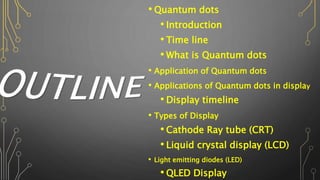
• Quantum dots
• Introduction
• Time line
• What is Quantum dots
• Application of Quantum dots
• Applications of Quantum dots in display
• Display timeline
• Types of Display
• Cathode Ray tube (CRT)
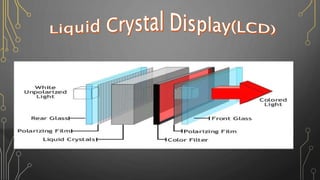
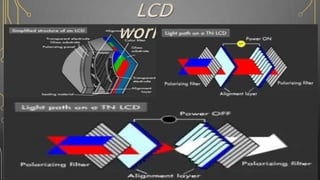
• Liquid crystal display (LCD)
• Light emitting diodes (LED)
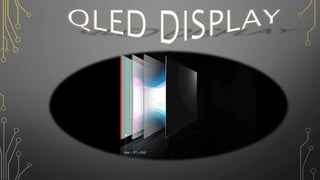
• QLED Display
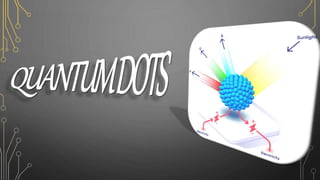
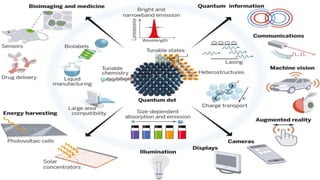
•Quantum dots are semiconductor Nano crystals.
•They are made of the same materials as ordinary
semiconductors (mainly combinations of transition
metals and /or metalloids).
•Unlike ordinary bulk semiconductors, which are
generally macroscopic objects, quantum dots are
extremely small, on the order of few nanometres.
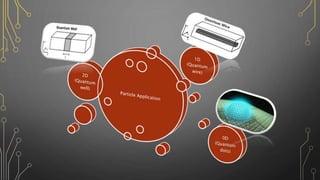
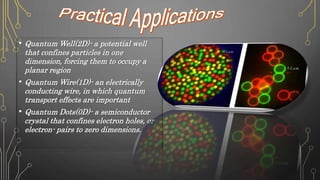
• Quantum Well(2D)- a potential well
that confines particles in one
dimension, forcing them to occupy a
planar region
• Quantum Wire(1D)- an electrically
conducting wire, in which quantum
transport effects are important
• Quantum Dots(0D)- a semiconductor
crystal that confines electron holes, or
electron- pairs to zero dimensions.
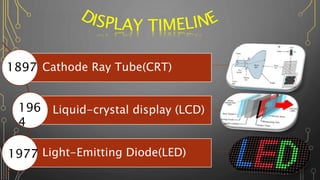
Cathode Ray Tube(CRT)
Liquid-crystal display (LCD)
Light-Emitting Diode(LED)
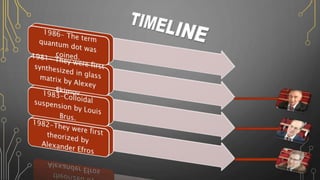
1897
1977
196
4
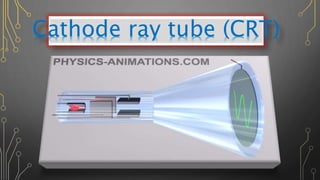
Cathode ray tube (CRT)
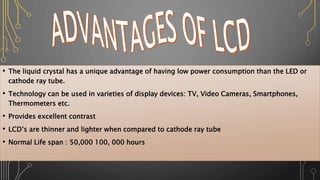
• The liquid crystal has a unique advantage of having low power consumption than the LED or
cathode ray tube.
• Technology can be used in varieties of display devices: TV, Video Cameras, Smartphones,
Thermometers etc.
• Provides excellent contrast
• LCD’s are thinner and lighter when compared to cathode ray tube
• Normal Life span : 50,000 100, 000 hours
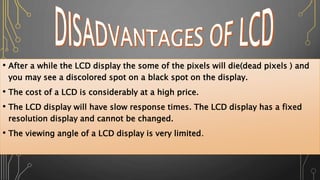
• After a while the LCD display the some of the pixels will die(dead pixels ) and
you may see a discolored spot on a black spot on the display.
• The cost of a LCD is considerably at a high price.
• The LCD display will have slow response times. The LCD display has a fixed
resolution display and cannot be changed.
• The viewing angle of a LCD display is very limited.
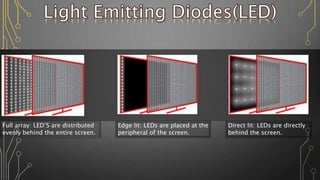
Full array: LED’S are distributed
evenly behind the entire screen.
Edge lit: LEDs are placed at the
peripheral of the screen.
Direct lit: LEDs are directly
behind the screen.
• Emissive display technology which is like an LCD screen, but instead of having
a normal CCFL backlight, it uses light emitting diodes (LEDs) as a source of
light behind the screen.
• Some available in market uses same liquid crystal to form pixels with LED as
backlight.
• Some didn’t have an LCD panel but instead have 3 small colored LEDs per
pixel with backlight.
1.Improved viewing angle than LCDs.
2.Thin screen with sleek design which is adjustable at
any place.
3.LEDs are far better than LCD monitors because they do
not use fluorescent bulbs due to which they are lighter
and thinner in weight.
4.LEDs consume less energy and save a lot of power.
5.LEDs provide bright image quality by enhancing the
contrast and enriching the range of colors.
6.These LEDs monitor produces flicker free image which
reduces eye fatigue, eye strains and headaches.
7. They have a long lifespan in comparison to the LCD’s.
8.LEDs don’t produce heat because they do not contain
the fluorescent bulbs which can also cause damage by
short-circuiting .
9. Life span : Around 100,000 hours
• Top most disadvantage is the price rate at
which they are available in the market, which
is very expensive .
• LEDs must be supplied with the correct
voltage and current at a constant flow. This
requires some electronics expertise to design
the electronic drivers.
• LED performance largely depends on the
ambient temperature of the operating
environment. Overdriving the LED in high
ambient temperatures may result in
overheating of the LED package, eventually
leading to device failure .
LCD
LCD
PHOTO-ENHANCE QUANTUM DOT DISPLAY
SYSTEMS
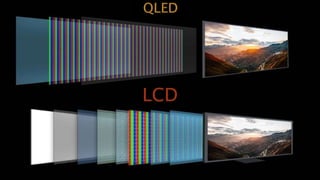
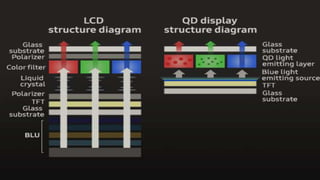
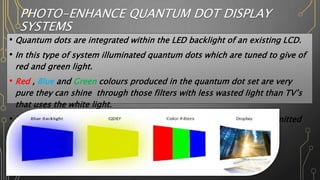
• Quantum dots are integrated within the LED backlight of an existing LCD.
• In this type of system illuminated quantum dots which are tuned to give of
red and green light.
• Red , Blue and Green colours produced in the quantum dot set are very
pure they can shine through those filters with less wasted light than TV’s
that uses the white light.
• In this method quantum dots are used to enhanced the quality of emitted
light.
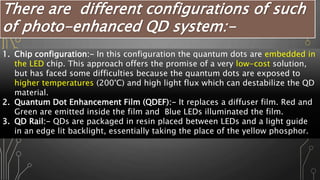
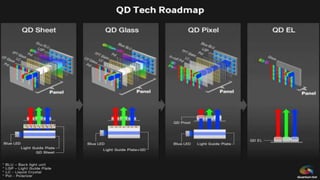
There are different configurations of such
of photo-enhanced QD system:-
1. Chip configuration:- In this configuration the quantum dots are embedded in
the LED chip. This approach offers the promise of a very low-cost solution,
but has faced some difficulties because the quantum dots are exposed to
higher temperatures (200°C) and high light flux which can destabilize the QD
material.
2. Quantum Dot Enhancement Film (QDEF):- It replaces a diffuser film. Red and
Green are emitted inside the film and Blue LEDs illuminated the film.
3. QD Rail:- QDs are packaged in resin placed between LEDs and a light guide
in an edge lit backlight, essentially taking the place of the yellow phosphor.
The micro-LED
array with a single
pixel size of 20 ×
20 µm2 , and a
pitch of 25 µm
was fabricated, as
shown Figure.
The EL
(electroluminesce
nce) optical
microscopy image
of RGB NP pixel
micro-LED is
shown in Figure
References :- Chen, Z.; Yan, S.; Danesh, C. MicroLED technologies and applications:
Characteristics, fabrication, progress, and challenges. J. Phys. D Appl. Phys. 2021, 54,
123001. [CrossRef]
EL(Electroluminesce
nce) spectra of red
and green pixel
EL(Electroluminescen
ce) image of RGB
pixels.
References:- Ashoori, R.C. Electrons in artificial atoms. Nature 1996, 379,
413–419. [CrossRef]
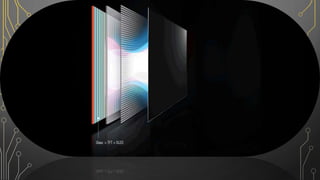
1. Like photo-enhanced system the photo-emissive can achieve extremely pure
colors and thereby achieves a wide colour spectrum, because the light out of
the quantum dots has a very narrow spectrum than that from there yellow
phosphorous is used to make white LEDs.
2. Because the light from the red and the green pixels originating at the front of
the display and in front of the LC layer and polarised, a photo-emissive
display will have much better viewing angle performance ; it will appear as an
emissive display, one of the advantage ascribed to OLED.
3. The structure of the photo-emissive quantum dot display will eliminate the
light scattering that occurs in the colour filter, in between the two polarised
layers , therefore the display will show improved contrast.
1. The invention of Quantum Dots was a revolutionary change in the field of
Quantum Mechanics. With the help of Q dots they found a unique way to
make displays. They are used not only in making displays but also other
devices.
2. Quantum Dot displays have got some unique characteristics that other
displays merely have. Quantum Dot displays consume less electricity as a
compared to other displays . In a nutshell , they have got more efficiency than
the other displays like LEDs , LCDs etc.
3. At the same time , due to decrement in electricity consumption affordability
increased.
4. Also , QLEDs have got more resolution. The resolution can be shifted from
720p to 1080p HD and then 4K to even 8K.
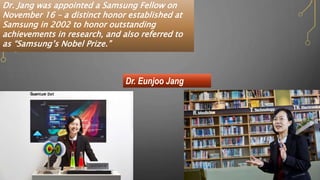
Dr. Eunjoo Jang
Dr. Jang was appointed a Samsung Fellow on
November 16 – a distinct honor established at
Samsung in 2002 to honor outstanding
achievements in research, and also referred to
as “Samsung’s Nobel Prize.”
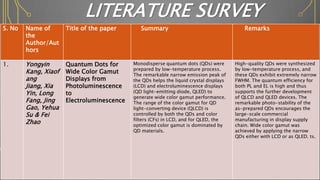
S. No Name of
the
Author/Aut
hors
Title of the paper Summary Remarks
1. Yongyin
Kang, Xiaof
ang
Jiang, Xia
Yin, Long
Fang, Jing
Gao, Yehua
Su & Fei
Zhao
Quantum Dots for
Wide Color Gamut
Displays from
Photoluminescence
to
Electroluminescence
Monodisperse quantum dots (QDs) were
prepared by low-temperature process.
The remarkable narrow emission peak of
the QDs helps the liquid crystal displays
(LCD) and electroluminescence displays
(QD light-emitting diode, QLED) to
generate wide color gamut performance.
The range of the color gamut for QD
light-converting device (QLCD) is
controlled by both the QDs and color
filters (CFs) in LCD, and for QLED, the
optimized color gamut is dominated by
QD materials.
High-quality QDs were synthesized
by low-temperature process, and
these QDs exhibit extremely narrow
FWHM. The quantum efficiency for
both PL and EL is high and thus
supports the further development
of QLCD and QLED devices. The
remarkable photo-stability of the
as-prepared QDs encourages the
large-scale commercial
manufacturing in display supply
chain. Wide color gamut was
achieved by applying the narrow
QDs either with LCD or as QLED. ts.
LITERATURE SURVEY
2
.
Yu-Ming Huang ,
Jo-Hsiang Chen ,
Yu-Hau Liou 1,
Konthoujam James
Singh 1 , Wei-Cheng
Tsai 1, Jung Han 4,
Chun-Jung Lin 1,
Tsung-Sheng Kao 1,
Chien-Chung Lin
2,5,* , Shih-Chen
Chen 3,* and Hao-
Chung Kuo1,3,*
High-Uniform and
High-Efficient Color
Conversion
Nanoporous GaN-
Based Micro-LED
Display with
Embedded
QuantumDots
Quantum dot (QD)-based RGB micro-
LED technology is seen as one of the
most promising approaches towards
full color micro-LED displays. In this
work, we present a novel nanoporous
GaN(NP-GaN) structure that can
scatter light and host QDs, as well as a
new type of micro-LED array based on
an NP-GaN embedded with QDs.
Compared to typical QD films, this
structure can significantly enhance the
light absorption and stability of QDs.
As a result, the green and red QDs
exhibited light conversion efficiencies
of 90.3% and 96.1% respectively,
leading to improvements to the
luminous uniformity of the green and
red subpixels by 90.7% and 91.2%
respectively. This study provides a
viable pathway to develop high-
uniform and high-efficient color
conversion microLEDdisplays.
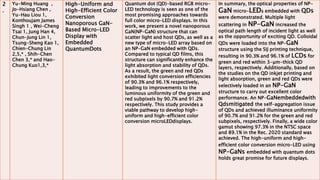
In summary, the optical properties of NP-
GaN micro-LEDs embedded with QDs
were demonstrated. Multiple light
scattering in NP-GaN increased the
optical path length of incident light as well
as the opportunity of exciting QD. Colloidal
QDs were loaded into the NP-GaN
structure using the SIJ printing technique,
resulting in 90.3% and 96.1% of LCDs for
green and red within 3-µm-thick QD
layers, respectively. Additionally, based on
the studies on the QD inkjet printing and
light absorption, green and red QDs were
selectively loaded in an NP-GaN
structure to carry out excellent color
performance. An NP-GaNembeddedwith
Qdsmitigated the self-aggregation issue
of QDs and achieved illuminance uniformity
of 90.7% and 91.2% for the green and red
subpixels, respectively. Finally, a wide color
gamut showing 97.3% in the NTSC space
and 89.1% in the Rec. 2020 standard was
achieved. The high-uniform and high-
efficient color conversion micro-LED using
NP-GaNs embedded with quantum dots
holds great promise for future displays.
3. Yen Lung
Chen1,2,
Zhi Ting
Ye 3,* ,
Wei Lai 3,
Chang Che
Chiu 3,
Kuo Wei
Lin 4 and
Pin Han1,
Application
of Mini-
LEDs with
Microlens
Arrays and
QuantumDo
tFilm as
Extra-Thin,
Large-Area,
and High-
Luminance
Backlight
The demand for extra-
thin, large-area, and
high-luminance flat-
panel displays continues
to grow, especially for
portable displays such
as gaming laptops and
automotive displays. In
this paper, we propose a
design that includes a
light guide layer with a
microstructure above
the mini-lightemitting
diode light board.
Weproposed an
optimized design of a
light guide layer with
concave PSMLAs that
used mini-LEDs as the
light source for extra-
thin, large-area, flat
backlight modules. We
used a 17 in prototype
for the experiments. The
thickness of the module
was only 1.98 mm. For
the mini-LEDs, its
pitches in the x- and y-
directions were 5.3 and
5.1 mm, respectively,
and its UMFs in the x-
and y-directions were
4.49 and 4.32,
respectively.
4. Yu-Ming Huang
1,2,† ,
Konthoujam
James Singh 1 ,
An-Chen Liu 1 ,
Chien-Chung
Lin 2,* , Zhong
Chen 3 , Kai
Wang 4 , Yue
Lin 3 , Zhaojun
Liu 4 , Tingzhu
Wu 3,* and
Hao-Chung Kuo
Advances
in
Quantum
-Dot-
Based
Displays
In terms of their use in
displays, quantum dots (QDs)
exhibit several advantages,
including high illumination
efficiency and color
rendering, low-cost, and
capacity for mass
production. Furthermore,
they are environmentally
friendly. Excellent
luminescence and charge
transport properties of QDs
led to their application in
QD-based light-emitting
diodes (LEDs), which have
attracted considerable
attention in display and
solid-state lighting
applications. In this review,
we discuss the applications
of QDs which are used on
color conversion filter that
exhibit high efficiency in
white LEDs, full-color micro-
LED devices, and liquid-type
This study reviews the trends in
QDs-based display technology,
mainly focusing on µLEDs,
including array structures and
other perovskite QDs-based
LEDs that exhibit high
efficiencies and high
polarization features. Owing to
their exciting potential benefits
in terms of performance, power
consumption, contrast ratio,
lifetime, and response time,
QD-LED-based display
technology is considered the
ultimate option for future
generation displays. The
development of QD printing
technology has been described,
including methods of pulsed
spray coating, aerosol jet
printing, and super inkjet
printing. We moreover discuss
PQDs-based white light LEDs
exhibiting ultra-high luminous
intensity and long operation
REFERENCES
• https://en.wikipedia.org/wiki/Quantum_dot_display
• https://miro.medium.com/max/1400/1*nlsDJMg_DNh4ibF14PUiWA
• https://www.techreviewer.com/content/media/shared-graphics/tr-attr/tv/740-787-
1/qled-vs-lcd-displays
• https://news.samsung.com/global/quantum-dot-artisan-dr-eunjoo-jang-samsung-
fellow
• https://global.canon/en/technology/s_labo/light/002/03.html
• https://www.techtarget.com/whatis/definition/LED-TV-LED-backlight-LCD-television
• https://www.spencerstv.com/blog/led-tvs-faqs
• https://pubs.acs.org/doi/10.1021/acsanm.0c01386#
• https://www.physics.ox.ac.uk/
• https://www2.physics.ox.ac.uk/accelerate/resources/demonstrations/cathode-ray-
tube#:~:text=In%20the%20cathode%20ray%20tube,the%20path%20of%20the%20beam.
Quantum dot displays

Quantum dot displays

  • 1.
    MAULANA AZAD NATIONAL INSTITUTEOF TECHONOLOGY BHOPAL(M.P) DEPARTMENT OF PHYSICS QUANTUM DOTS DISPLAY Presented by-NITIN PALIWAL Scholar No. 222105001
  • 2.
    • Quantum dots •Introduction • Time line • What is Quantum dots • Application of Quantum dots • Applications of Quantum dots in display • Display timeline • Types of Display • Cathode Ray tube (CRT) • Liquid crystal display (LCD) • Light emitting diodes (LED) • QLED Display
  • 5.
    •Quantum dots aresemiconductor Nano crystals. •They are made of the same materials as ordinary semiconductors (mainly combinations of transition metals and /or metalloids). •Unlike ordinary bulk semiconductors, which are generally macroscopic objects, quantum dots are extremely small, on the order of few nanometres.
  • 7.
    • Quantum Well(2D)-a potential well that confines particles in one dimension, forcing them to occupy a planar region • Quantum Wire(1D)- an electrically conducting wire, in which quantum transport effects are important • Quantum Dots(0D)- a semiconductor crystal that confines electron holes, or electron- pairs to zero dimensions.
  • 10.
    Cathode Ray Tube(CRT) Liquid-crystaldisplay (LCD) Light-Emitting Diode(LED) 1897 1977 196 4
  • 11.
  • 14.
    • The liquidcrystal has a unique advantage of having low power consumption than the LED or cathode ray tube. • Technology can be used in varieties of display devices: TV, Video Cameras, Smartphones, Thermometers etc. • Provides excellent contrast • LCD’s are thinner and lighter when compared to cathode ray tube • Normal Life span : 50,000 100, 000 hours
  • 15.
    • After awhile the LCD display the some of the pixels will die(dead pixels ) and you may see a discolored spot on a black spot on the display. • The cost of a LCD is considerably at a high price. • The LCD display will have slow response times. The LCD display has a fixed resolution display and cannot be changed. • The viewing angle of a LCD display is very limited.
  • 16.
    Full array: LED’Sare distributed evenly behind the entire screen. Edge lit: LEDs are placed at the peripheral of the screen. Direct lit: LEDs are directly behind the screen.
  • 17.
    • Emissive displaytechnology which is like an LCD screen, but instead of having a normal CCFL backlight, it uses light emitting diodes (LEDs) as a source of light behind the screen. • Some available in market uses same liquid crystal to form pixels with LED as backlight. • Some didn’t have an LCD panel but instead have 3 small colored LEDs per pixel with backlight.
  • 18.
    1.Improved viewing anglethan LCDs. 2.Thin screen with sleek design which is adjustable at any place. 3.LEDs are far better than LCD monitors because they do not use fluorescent bulbs due to which they are lighter and thinner in weight. 4.LEDs consume less energy and save a lot of power. 5.LEDs provide bright image quality by enhancing the contrast and enriching the range of colors. 6.These LEDs monitor produces flicker free image which reduces eye fatigue, eye strains and headaches. 7. They have a long lifespan in comparison to the LCD’s. 8.LEDs don’t produce heat because they do not contain the fluorescent bulbs which can also cause damage by short-circuiting . 9. Life span : Around 100,000 hours
  • 19.
    • Top mostdisadvantage is the price rate at which they are available in the market, which is very expensive . • LEDs must be supplied with the correct voltage and current at a constant flow. This requires some electronics expertise to design the electronic drivers. • LED performance largely depends on the ambient temperature of the operating environment. Overdriving the LED in high ambient temperatures may result in overheating of the LED package, eventually leading to device failure .
  • 21.
  • 23.
    PHOTO-ENHANCE QUANTUM DOTDISPLAY SYSTEMS • Quantum dots are integrated within the LED backlight of an existing LCD. • In this type of system illuminated quantum dots which are tuned to give of red and green light. • Red , Blue and Green colours produced in the quantum dot set are very pure they can shine through those filters with less wasted light than TV’s that uses the white light. • In this method quantum dots are used to enhanced the quality of emitted light.
  • 24.
    There are differentconfigurations of such of photo-enhanced QD system:- 1. Chip configuration:- In this configuration the quantum dots are embedded in the LED chip. This approach offers the promise of a very low-cost solution, but has faced some difficulties because the quantum dots are exposed to higher temperatures (200°C) and high light flux which can destabilize the QD material. 2. Quantum Dot Enhancement Film (QDEF):- It replaces a diffuser film. Red and Green are emitted inside the film and Blue LEDs illuminated the film. 3. QD Rail:- QDs are packaged in resin placed between LEDs and a light guide in an edge lit backlight, essentially taking the place of the yellow phosphor.
  • 27.
    The micro-LED array witha single pixel size of 20 × 20 µm2 , and a pitch of 25 µm was fabricated, as shown Figure. The EL (electroluminesce nce) optical microscopy image of RGB NP pixel micro-LED is shown in Figure References :- Chen, Z.; Yan, S.; Danesh, C. MicroLED technologies and applications: Characteristics, fabrication, progress, and challenges. J. Phys. D Appl. Phys. 2021, 54, 123001. [CrossRef]
  • 28.
    EL(Electroluminesce nce) spectra ofred and green pixel EL(Electroluminescen ce) image of RGB pixels. References:- Ashoori, R.C. Electrons in artificial atoms. Nature 1996, 379, 413–419. [CrossRef]
  • 29.
    1. Like photo-enhancedsystem the photo-emissive can achieve extremely pure colors and thereby achieves a wide colour spectrum, because the light out of the quantum dots has a very narrow spectrum than that from there yellow phosphorous is used to make white LEDs. 2. Because the light from the red and the green pixels originating at the front of the display and in front of the LC layer and polarised, a photo-emissive display will have much better viewing angle performance ; it will appear as an emissive display, one of the advantage ascribed to OLED. 3. The structure of the photo-emissive quantum dot display will eliminate the light scattering that occurs in the colour filter, in between the two polarised layers , therefore the display will show improved contrast.
  • 30.
    1. The inventionof Quantum Dots was a revolutionary change in the field of Quantum Mechanics. With the help of Q dots they found a unique way to make displays. They are used not only in making displays but also other devices. 2. Quantum Dot displays have got some unique characteristics that other displays merely have. Quantum Dot displays consume less electricity as a compared to other displays . In a nutshell , they have got more efficiency than the other displays like LEDs , LCDs etc. 3. At the same time , due to decrement in electricity consumption affordability increased. 4. Also , QLEDs have got more resolution. The resolution can be shifted from 720p to 1080p HD and then 4K to even 8K.
  • 31.
    Dr. Eunjoo Jang Dr.Jang was appointed a Samsung Fellow on November 16 – a distinct honor established at Samsung in 2002 to honor outstanding achievements in research, and also referred to as “Samsung’s Nobel Prize.”
  • 33.
    S. No Nameof the Author/Aut hors Title of the paper Summary Remarks 1. Yongyin Kang, Xiaof ang Jiang, Xia Yin, Long Fang, Jing Gao, Yehua Su & Fei Zhao Quantum Dots for Wide Color Gamut Displays from Photoluminescence to Electroluminescence Monodisperse quantum dots (QDs) were prepared by low-temperature process. The remarkable narrow emission peak of the QDs helps the liquid crystal displays (LCD) and electroluminescence displays (QD light-emitting diode, QLED) to generate wide color gamut performance. The range of the color gamut for QD light-converting device (QLCD) is controlled by both the QDs and color filters (CFs) in LCD, and for QLED, the optimized color gamut is dominated by QD materials. High-quality QDs were synthesized by low-temperature process, and these QDs exhibit extremely narrow FWHM. The quantum efficiency for both PL and EL is high and thus supports the further development of QLCD and QLED devices. The remarkable photo-stability of the as-prepared QDs encourages the large-scale commercial manufacturing in display supply chain. Wide color gamut was achieved by applying the narrow QDs either with LCD or as QLED. ts. LITERATURE SURVEY
  • 34.
    2 . Yu-Ming Huang , Jo-HsiangChen , Yu-Hau Liou 1, Konthoujam James Singh 1 , Wei-Cheng Tsai 1, Jung Han 4, Chun-Jung Lin 1, Tsung-Sheng Kao 1, Chien-Chung Lin 2,5,* , Shih-Chen Chen 3,* and Hao- Chung Kuo1,3,* High-Uniform and High-Efficient Color Conversion Nanoporous GaN- Based Micro-LED Display with Embedded QuantumDots Quantum dot (QD)-based RGB micro- LED technology is seen as one of the most promising approaches towards full color micro-LED displays. In this work, we present a novel nanoporous GaN(NP-GaN) structure that can scatter light and host QDs, as well as a new type of micro-LED array based on an NP-GaN embedded with QDs. Compared to typical QD films, this structure can significantly enhance the light absorption and stability of QDs. As a result, the green and red QDs exhibited light conversion efficiencies of 90.3% and 96.1% respectively, leading to improvements to the luminous uniformity of the green and red subpixels by 90.7% and 91.2% respectively. This study provides a viable pathway to develop high- uniform and high-efficient color conversion microLEDdisplays. In summary, the optical properties of NP- GaN micro-LEDs embedded with QDs were demonstrated. Multiple light scattering in NP-GaN increased the optical path length of incident light as well as the opportunity of exciting QD. Colloidal QDs were loaded into the NP-GaN structure using the SIJ printing technique, resulting in 90.3% and 96.1% of LCDs for green and red within 3-µm-thick QD layers, respectively. Additionally, based on the studies on the QD inkjet printing and light absorption, green and red QDs were selectively loaded in an NP-GaN structure to carry out excellent color performance. An NP-GaNembeddedwith Qdsmitigated the self-aggregation issue of QDs and achieved illuminance uniformity of 90.7% and 91.2% for the green and red subpixels, respectively. Finally, a wide color gamut showing 97.3% in the NTSC space and 89.1% in the Rec. 2020 standard was achieved. The high-uniform and high- efficient color conversion micro-LED using NP-GaNs embedded with quantum dots holds great promise for future displays.
  • 35.
    3. Yen Lung Chen1,2, ZhiTing Ye 3,* , Wei Lai 3, Chang Che Chiu 3, Kuo Wei Lin 4 and Pin Han1, Application of Mini- LEDs with Microlens Arrays and QuantumDo tFilm as Extra-Thin, Large-Area, and High- Luminance Backlight The demand for extra- thin, large-area, and high-luminance flat- panel displays continues to grow, especially for portable displays such as gaming laptops and automotive displays. In this paper, we propose a design that includes a light guide layer with a microstructure above the mini-lightemitting diode light board. Weproposed an optimized design of a light guide layer with concave PSMLAs that used mini-LEDs as the light source for extra- thin, large-area, flat backlight modules. We used a 17 in prototype for the experiments. The thickness of the module was only 1.98 mm. For the mini-LEDs, its pitches in the x- and y- directions were 5.3 and 5.1 mm, respectively, and its UMFs in the x- and y-directions were 4.49 and 4.32, respectively.
  • 36.
    4. Yu-Ming Huang 1,2,†, Konthoujam James Singh 1 , An-Chen Liu 1 , Chien-Chung Lin 2,* , Zhong Chen 3 , Kai Wang 4 , Yue Lin 3 , Zhaojun Liu 4 , Tingzhu Wu 3,* and Hao-Chung Kuo Advances in Quantum -Dot- Based Displays In terms of their use in displays, quantum dots (QDs) exhibit several advantages, including high illumination efficiency and color rendering, low-cost, and capacity for mass production. Furthermore, they are environmentally friendly. Excellent luminescence and charge transport properties of QDs led to their application in QD-based light-emitting diodes (LEDs), which have attracted considerable attention in display and solid-state lighting applications. In this review, we discuss the applications of QDs which are used on color conversion filter that exhibit high efficiency in white LEDs, full-color micro- LED devices, and liquid-type This study reviews the trends in QDs-based display technology, mainly focusing on µLEDs, including array structures and other perovskite QDs-based LEDs that exhibit high efficiencies and high polarization features. Owing to their exciting potential benefits in terms of performance, power consumption, contrast ratio, lifetime, and response time, QD-LED-based display technology is considered the ultimate option for future generation displays. The development of QD printing technology has been described, including methods of pulsed spray coating, aerosol jet printing, and super inkjet printing. We moreover discuss PQDs-based white light LEDs exhibiting ultra-high luminous intensity and long operation
  • 37.
    REFERENCES • https://en.wikipedia.org/wiki/Quantum_dot_display • https://miro.medium.com/max/1400/1*nlsDJMg_DNh4ibF14PUiWA •https://www.techreviewer.com/content/media/shared-graphics/tr-attr/tv/740-787- 1/qled-vs-lcd-displays • https://news.samsung.com/global/quantum-dot-artisan-dr-eunjoo-jang-samsung- fellow • https://global.canon/en/technology/s_labo/light/002/03.html • https://www.techtarget.com/whatis/definition/LED-TV-LED-backlight-LCD-television • https://www.spencerstv.com/blog/led-tvs-faqs • https://pubs.acs.org/doi/10.1021/acsanm.0c01386# • https://www.physics.ox.ac.uk/ • https://www2.physics.ox.ac.uk/accelerate/resources/demonstrations/cathode-ray- tube#:~:text=In%20the%20cathode%20ray%20tube,the%20path%20of%20the%20beam.