QUANTUMDOTS 
Presented by: 
Ashok Kumar Jangid 
Mphil./PhD. Nanosciences 
Centre for Nanosciences 
(ashok4483@gmail.com)
Introduction & Brief history 
Quantum detection & Its optical properties 
How they are made ??? 
Applications 
Outlines
What are the ??? 
Quantum dots are semiconductor Nano crystals 
They are made of many of the same materials as ordinary semiconductors 
They are small and nearly zero dimensional
History of Q Dots 
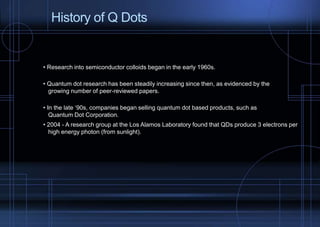
• Research into semiconductor colloids began in the early 1960s. 
• Quantum dot research has been steadily increasing since then, as evidenced by the 
growing number of peer-reviewed papers. 
• In the late ‘90s, companies began selling quantum dot based products, such as 
Quantum Dot Corporation. 
• 2004 - A research group at the Los Alamos Laboratory found that QDs produce 3 electrons per 
high energy photon (from sunlight).
Quantum confinement 
 In semiconductors those diameter is smaller than size of exciting bohr radius, the 
excitation are compress, leading to quantum detection (confinement) 
 The energy levels can then be modeled using the particle in a box model in which 
the energy of different states is dependent on the length of the box. Quantum dots 
are said to be in the 'weak confinement regime' if their radii are on the order of the 
exciton Bohr radius; quantum dots are said to be in the 'strong confinement regime' if 
their radii are smaller than the exciton Bohr radius. If the size of the quantum dot is 
small enough that the quantum confinement effects dominate (typically less than 
10 nm), the electronic and optical properties are highly tunable. 
 The emission and absorption spectra corresponding to the energy band gap of the 
quantum dot is governed by quantum confinement principles in an infinite square 
well potential. 
 The energy band gap increases with a decrease in size of the quantum dot.
Bands and Band gap
Optical properties 
 The Nano crystal's quantum confined size is more significant at energies near the band 
gap. Thus quantum dots of the same material such as CdTe, but with different sizes, can 
emit light of different color. The physical reason is the quantum confinement effect. 
 The coloration of quantum dots are directly related to energy levels. the band gap energy 
that determines the energy (and hence color) of the fluorescent light is inversely 
proportional to the size of the quantum dot. Larger quantum dots have more energy levels 
which are also more closely spaced.
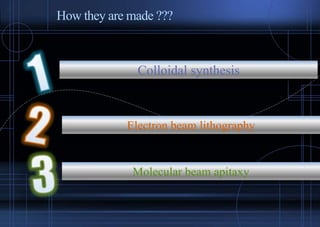
How they are made ??? 
Colloidal synthesis 
Electron beam lithography 
Molecular beam apitaxy
How they are made ??? 
 Colloidal Synthesis: This method can be used to create large numbers of 
quantum dots all at once. Additionally, it is the cheapest method and is 
able to occur at non-extreme conditions. 
 Electron-Beam Lithography: A pattern is etched by an electron beam 
device and the semiconducting material is deposited onto it. 
 Molecular Beam Epitaxy: A thin layer of crystals can be produced by 
heating the constituent elements separately until they begin to evaporate; 
then allowing them to collect and react on the surface of a wafer.
Computing 
Biology 
Photovoltaic devices 
Light emitting devices 
Applications
Conclusion 
 QUANTUM DOTS exhibit quantum mechanical properties. 
 There are several ways to confine excitons in semiconductors, resulting in 
different methods to produce quantum dots. 
 Research effort around the world is being applied to expanding the 
accuracy and capabilities of this Nano Particles for its usage in the 
industry of Hardware Components and Electronics as it is one of the most 
promising candidates for use in solid-state quantum computation. 
 Quantum dots have also been suggested as implementations of qubits 
for Quantum Information Processing.
Ashok quantum dots

Ashok quantum dots

  • 1.
    QUANTUMDOTS Presented by: Ashok Kumar Jangid Mphil./PhD. Nanosciences Centre for Nanosciences (ashok4483@gmail.com)
  • 2.
    Introduction & Briefhistory Quantum detection & Its optical properties How they are made ??? Applications Outlines
  • 3.
    What are the??? Quantum dots are semiconductor Nano crystals They are made of many of the same materials as ordinary semiconductors They are small and nearly zero dimensional
  • 4.
    History of QDots • Research into semiconductor colloids began in the early 1960s. • Quantum dot research has been steadily increasing since then, as evidenced by the growing number of peer-reviewed papers. • In the late ‘90s, companies began selling quantum dot based products, such as Quantum Dot Corporation. • 2004 - A research group at the Los Alamos Laboratory found that QDs produce 3 electrons per high energy photon (from sunlight).
  • 5.
    Quantum confinement In semiconductors those diameter is smaller than size of exciting bohr radius, the excitation are compress, leading to quantum detection (confinement)  The energy levels can then be modeled using the particle in a box model in which the energy of different states is dependent on the length of the box. Quantum dots are said to be in the 'weak confinement regime' if their radii are on the order of the exciton Bohr radius; quantum dots are said to be in the 'strong confinement regime' if their radii are smaller than the exciton Bohr radius. If the size of the quantum dot is small enough that the quantum confinement effects dominate (typically less than 10 nm), the electronic and optical properties are highly tunable.  The emission and absorption spectra corresponding to the energy band gap of the quantum dot is governed by quantum confinement principles in an infinite square well potential.  The energy band gap increases with a decrease in size of the quantum dot.
  • 6.
  • 7.
    Optical properties The Nano crystal's quantum confined size is more significant at energies near the band gap. Thus quantum dots of the same material such as CdTe, but with different sizes, can emit light of different color. The physical reason is the quantum confinement effect.  The coloration of quantum dots are directly related to energy levels. the band gap energy that determines the energy (and hence color) of the fluorescent light is inversely proportional to the size of the quantum dot. Larger quantum dots have more energy levels which are also more closely spaced.
  • 8.
    How they aremade ??? Colloidal synthesis Electron beam lithography Molecular beam apitaxy
  • 9.
    How they aremade ???  Colloidal Synthesis: This method can be used to create large numbers of quantum dots all at once. Additionally, it is the cheapest method and is able to occur at non-extreme conditions.  Electron-Beam Lithography: A pattern is etched by an electron beam device and the semiconducting material is deposited onto it.  Molecular Beam Epitaxy: A thin layer of crystals can be produced by heating the constituent elements separately until they begin to evaporate; then allowing them to collect and react on the surface of a wafer.
  • 10.
    Computing Biology Photovoltaicdevices Light emitting devices Applications
  • 11.
    Conclusion  QUANTUMDOTS exhibit quantum mechanical properties.  There are several ways to confine excitons in semiconductors, resulting in different methods to produce quantum dots.  Research effort around the world is being applied to expanding the accuracy and capabilities of this Nano Particles for its usage in the industry of Hardware Components and Electronics as it is one of the most promising candidates for use in solid-state quantum computation.  Quantum dots have also been suggested as implementations of qubits for Quantum Information Processing.