O.L.E.D   (Organic   Light   Emitting Diode) Presented by: Harsh Veer Singh  Nirwan 8 th -sem ECE ☺ ☺
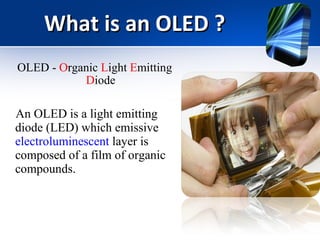
What is an OLED ? OLED -  O rganic  L ight  E mitting  D iode An OLED is a light emitting diode (LED) which emissive  electroluminescent  layer is composed of a film of organic compounds.
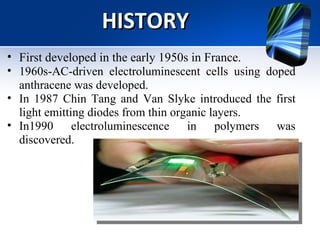
HISTORY First developed in the early 1950s in France. 1960s-AC-driven electroluminescent cells using doped anthracene was developed. In 1987 Chin Tang and Van Slyke introduced the first light emitting diodes from thin organic layers.  In1990 electroluminescence in polymers was discovered. 
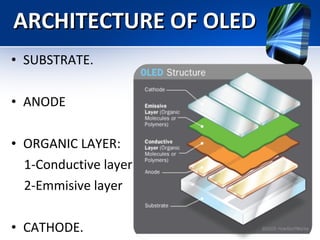
ARCHITECTURE OF OLED SUBSTRATE. ANODE ORGANIC LAYER: 1-Conductive layer 2-Emmisive layer CATHODE.
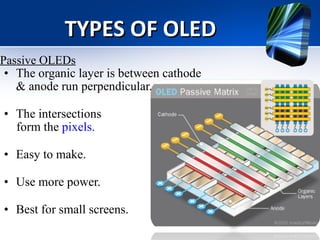
TYPES OF OLED Passive OLEDs The organic layer is between cathode & anode run perpendicular. The intersections  form the  pixels. Easy to make. Use more power. Best for small screens.
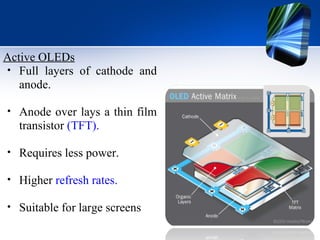
Active OLEDs Full layers of cathode and anode. Anode over lays a thin film transistor  (TFT). Requires less power. Higher  refresh rates. Suitable for large screens
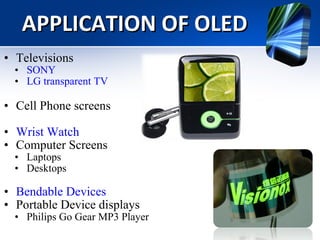
APPLICATION OF OLED Televisions SONY LG transparent TV Cell Phone screens Wrist Watch Computer Screens Laptops Desktops   Bendable Devices Portable Device displays Philips Go Gear MP3 Player
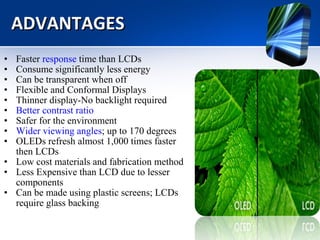
ADVANTAGES Faster  response  time than LCDs  Consume significantly less energy  Can be transparent when off Flexible and Conformal Displays  Thinner display-No backlight required Better contrast ratio Safer for the environment Wider viewing angles ; up to 170 degrees OLEDs refresh almost 1,000 times faster then LCDs Low cost materials and fabrication method Less Expensive than LCD due to lesser components Can be made using plastic screens; LCDs require glass backing
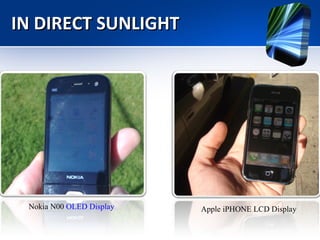
DISADVANTAGES OLED seems to be the perfect technology for all types of displays, but it also has some problems: Lifetime  - While red and green OLED films have longer lifetimes (46,000 to 230,000 hours), blue organics currently have much shorter lifetimes (up to around 14,000 hours) Manufacturing  - Currently, manufacturing is more expensive than LCDs Water  - Water can easily damage OLEDs OLED screens are even worse than LCD in  direct sunlight Overall luminance degradation Limited market availability
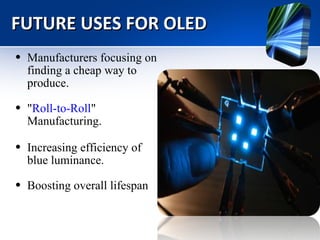
FUTURE USES FOR OLED Manufacturers focusing on finding a cheap way to produce. " Roll-to-Roll " Manufacturing. Increasing efficiency of blue luminance.   Boosting overall lifespan
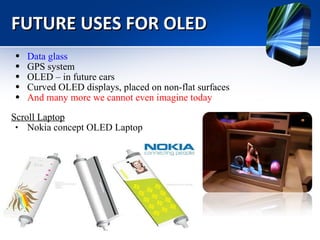
FUTURE USES FOR OLED Data glass GPS system  OLED – in future cars Curved OLED displays, placed on non-flat surfaces And many more we cannot even imagine today Scroll Laptop Nokia concept OLED Laptop
 
THANK YOU FOR  YOUR PATIENCE ☺ ☺
Electroluminescence  (EL) is an optical phenomenon and electrical phenomenon in which a material emits light in response to an electric current passed through it, or to a strong electric field
A  pixel   (or picture element) is the smallest item of information in an image
A  thin-film transistor  ( TFT ) is a special kind of field-effect transistor made by depositing thin films of a semiconductor active layer.
The  refresh rate  is the number of times in a second that display hardware draws the data it is being given
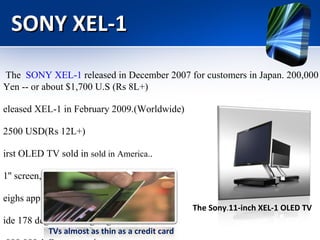
SONY XEL-1 The  SONY XEL-1  released in December 2007 for customers in Japan. 200,000 Yen -- or about $1,700 U.S (Rs 8L+) Released XEL-1 in February 2009.(Worldwide)  $2500 USD(Rs 12L+) First OLED TV sold in  sold in America. . 11'' screen, 3mm thin Weighs approximately 1.9 kg  Wide 178 degree viewing angle 1,000,000:1 Contrast ratio The Sony . 11-inch XEL-1 OLED TV TVs almost as thin as a credit card
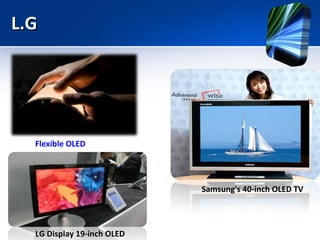
L.G Flexible OLED LG Display 19-inch OLED Samsung's 40-inch OLED TV
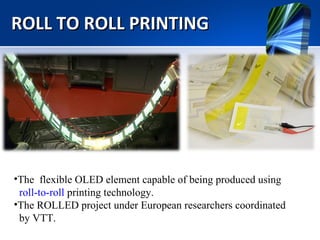
ROLL TO ROLL PRINTING The  flexible OLED element capable of being produced using    roll-to-roll  printing technology. The ROLLED project under European researchers coordinated  by VTT.
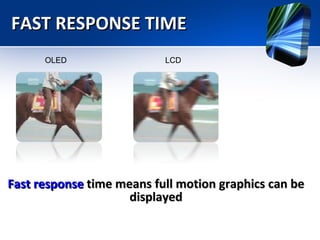
FAST RESPONSE TIME OLED LCD Fast response  time means full motion graphics can be displayed
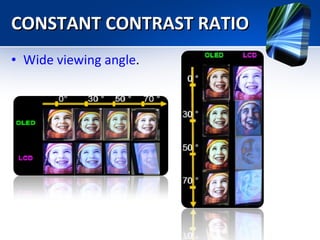
CONSTANT CONTRAST RATIO Wide viewing angle .
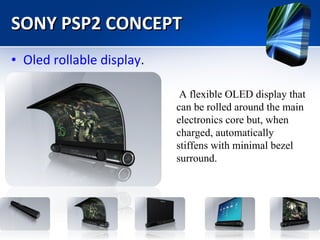
SONY PSP2 CONCEPT Oled rollable display . A flexible OLED display that can be rolled around the main electronics core but, when charged, automatically stiffens with minimal bezel surround.
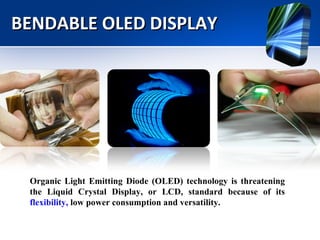
BENDABLE OLED DISPLAY Organic Light Emitting Diode (OLED) technology is threatening the Liquid Crystal Display, or LCD, standard because of its  flexibility,  low power consumption and versatility.
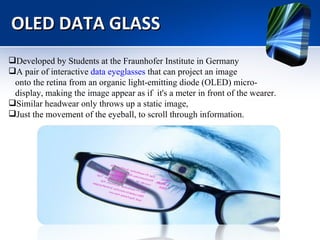
OLED DATA GLASS Developed by Students at the Fraunhofer Institute in Germany  A pair of interactive  data eyeglasses  that can project an image  onto the retina from an organic light-emitting diode (OLED) micro- display, making the image appear as if  it's a meter in front of the wearer.  Similar headwear only throws up a static image,  Just the movement of the eyeball, to scroll through information.
IN DIRECT SUNLIGHT Nokia N00  OLED Display   Apple iPHONE LCD Display
 
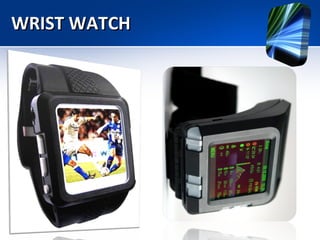
WRIST WATCH

oled ppt

  • 1.
    O.L.E.D (Organic Light Emitting Diode) Presented by: Harsh Veer Singh Nirwan 8 th -sem ECE ☺ ☺
  • 2.
    What is anOLED ? OLED - O rganic L ight E mitting D iode An OLED is a light emitting diode (LED) which emissive electroluminescent layer is composed of a film of organic compounds.
  • 3.
    HISTORY First developedin the early 1950s in France. 1960s-AC-driven electroluminescent cells using doped anthracene was developed. In 1987 Chin Tang and Van Slyke introduced the first light emitting diodes from thin organic layers.  In1990 electroluminescence in polymers was discovered. 
  • 4.
    ARCHITECTURE OF OLEDSUBSTRATE. ANODE ORGANIC LAYER: 1-Conductive layer 2-Emmisive layer CATHODE.
  • 5.
    TYPES OF OLEDPassive OLEDs The organic layer is between cathode & anode run perpendicular. The intersections form the pixels. Easy to make. Use more power. Best for small screens.
  • 6.
    Active OLEDs Fulllayers of cathode and anode. Anode over lays a thin film transistor (TFT). Requires less power. Higher refresh rates. Suitable for large screens
  • 7.
    APPLICATION OF OLEDTelevisions SONY LG transparent TV Cell Phone screens Wrist Watch Computer Screens Laptops Desktops Bendable Devices Portable Device displays Philips Go Gear MP3 Player
  • 8.
    ADVANTAGES Faster response time than LCDs Consume significantly less energy Can be transparent when off Flexible and Conformal Displays Thinner display-No backlight required Better contrast ratio Safer for the environment Wider viewing angles ; up to 170 degrees OLEDs refresh almost 1,000 times faster then LCDs Low cost materials and fabrication method Less Expensive than LCD due to lesser components Can be made using plastic screens; LCDs require glass backing
  • 9.
    DISADVANTAGES OLED seemsto be the perfect technology for all types of displays, but it also has some problems: Lifetime  - While red and green OLED films have longer lifetimes (46,000 to 230,000 hours), blue organics currently have much shorter lifetimes (up to around 14,000 hours) Manufacturing  - Currently, manufacturing is more expensive than LCDs Water  - Water can easily damage OLEDs OLED screens are even worse than LCD in direct sunlight Overall luminance degradation Limited market availability
  • 10.
    FUTURE USES FOROLED Manufacturers focusing on finding a cheap way to produce. " Roll-to-Roll " Manufacturing. Increasing efficiency of blue luminance.   Boosting overall lifespan
  • 11.
    FUTURE USES FOROLED Data glass GPS system  OLED – in future cars Curved OLED displays, placed on non-flat surfaces And many more we cannot even imagine today Scroll Laptop Nokia concept OLED Laptop
  • 12.
  • 13.
    THANK YOU FOR YOUR PATIENCE ☺ ☺
  • 14.
    Electroluminescence  (EL) isan optical phenomenon and electrical phenomenon in which a material emits light in response to an electric current passed through it, or to a strong electric field
  • 15.
    A  pixel (or picture element) is the smallest item of information in an image
  • 16.
    A  thin-film transistor ( TFT ) is a special kind of field-effect transistor made by depositing thin films of a semiconductor active layer.
  • 17.
    The  refresh rate is the number of times in a second that display hardware draws the data it is being given
  • 18.
    SONY XEL-1 The SONY XEL-1 released in December 2007 for customers in Japan. 200,000 Yen -- or about $1,700 U.S (Rs 8L+) Released XEL-1 in February 2009.(Worldwide)  $2500 USD(Rs 12L+) First OLED TV sold in sold in America. . 11'' screen, 3mm thin Weighs approximately 1.9 kg Wide 178 degree viewing angle 1,000,000:1 Contrast ratio The Sony . 11-inch XEL-1 OLED TV TVs almost as thin as a credit card
  • 19.
    L.G Flexible OLEDLG Display 19-inch OLED Samsung's 40-inch OLED TV
  • 20.
    ROLL TO ROLLPRINTING The flexible OLED element capable of being produced using roll-to-roll printing technology. The ROLLED project under European researchers coordinated by VTT.
  • 21.
    FAST RESPONSE TIMEOLED LCD Fast response time means full motion graphics can be displayed
  • 22.
    CONSTANT CONTRAST RATIOWide viewing angle .
  • 23.
    SONY PSP2 CONCEPTOled rollable display . A flexible OLED display that can be rolled around the main electronics core but, when charged, automatically stiffens with minimal bezel surround.
  • 24.
    BENDABLE OLED DISPLAYOrganic Light Emitting Diode (OLED) technology is threatening the Liquid Crystal Display, or LCD, standard because of its flexibility, low power consumption and versatility.
  • 25.
    OLED DATA GLASSDeveloped by Students at the Fraunhofer Institute in Germany A pair of interactive data eyeglasses that can project an image onto the retina from an organic light-emitting diode (OLED) micro- display, making the image appear as if it's a meter in front of the wearer. Similar headwear only throws up a static image, Just the movement of the eyeball, to scroll through information.
  • 26.
    IN DIRECT SUNLIGHTNokia N00 OLED Display Apple iPHONE LCD Display
  • 27.
  • 28.

Editor's Notes

  • #6 Characteristics of learning organizations Learning organizations are: . Progressive The results they generate are better and better as time goes by They are dynamic organization too Their staff and employees work together to improve their future learning and understanding They are highly productive In this sort of organizations people learn how to exploit their assets and also the way to compensate their weakness as well as other people weaknesses They are active participants Every person inside these organizations is highly involved in the willingness of cooperate to design the sort of organization they want to become More common characteristics of learning organizations (1) Development and use of a common language among organization members (2) Mutual trust among members in the organization (3) An adequate error culture (no blame culture) (4) Willingness to challenge old practices on all levels (5) A thorough and shared understanding of the needs of the company and industry (6) Analytical skills to predict how challenges will influence the organization (7) Identifying and removing existing blocks and hindrances to learning and the sharing of knowledge (8) Intellectual mobility or flexibility to think across divisions and functions