Linear Algebra
& Matrix
T- 1-855-694-8886
Email- info@iTutor.com
By iTutor.com
Linear Algebra
History:
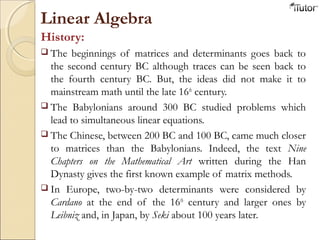
 The beginnings of matrices and determinants goes back to
the second century BC although traces can be seen back to
the fourth century BC. But, the ideas did not make it to
mainstream math until the late 16th
century.
 The Babylonians around 300 BC studied problems which
lead to simultaneous linear equations.
 The Chinese, between 200 BC and 100 BC, came much closer
to matrices than the Babylonians. Indeed, the text Nine
Chapters on the Mathematical Art written during the Han
Dynasty gives the first known example of matrix methods.
 In Europe, two-by-two determinants were considered by
Cardano at the end of the 16th
century and larger ones by
Leibniz and, in Japan, by Seki about 100 years later.
What is a Matrix?
A matrix is a set of elements, organized into rows and columns






dc
ba
Rows
Columns
 a and d are the diagonal elements.
 b and c are the off-diagonal elements.
 Matrices are like plain numbers in many ways: they can be
added, subtracted, and, in some cases, multiplied and
inverted (divided).
Examples:
[ ]δβα=





−
= b
d
b
A ;
1
1
Dimensions of a matrix:
Numbers of rows by numbers of columns. The Matrix A is
a 2x2 matrix, b is a 1x3 matrix.
A matrix with only one column or only one row is called a
vector.
If a matrix has an equal numbers of rows and columns, it is
called a square matrix. Matrix A, above, is a square matrix.
Usual Notation: Upper case letters => matrices
Lower case => vectors
Matrix multiplication
 Multiplication of matrices requires a conformability condition
The conformability condition for multiplication is that the
column dimensions of the lead matrix A must be equal to the
row dimension of the lag matrix B.
If A is an (m x n) and B an (n x p) matrix (A has the same
number of columns a B has rows), then we define the product
of AB. AB is (m x p) matrix with its ij-th element is
What are the dimensions of the vector, matrix, and result?
[ ] [ ]131211
232221
131211
1211 cccc
bb
bbb
aaaB ==








=
[ ]231213112212121121121111 babababababa +++=
 Dimensions: a(1 x 2), B(2 x 3) => c (1 x 3)
jk
n
j ijba∑ =1
Transpose Matrix










−
=′=>




 −
=
49
08
13
401
983
AA:Example
 The transpose of a matrix A is another matrix AT
(also written A
′) created by any one of the following equivalent actions:
- Write the rows (columns) of A as the columns (rows) of AT
- Reflect A by its main diagonal to obtain AT
 Formally, the (i, j) element of AT
is the (j, i) element of A:
[AT
]ij
= [A]ji
 If A is a m × n matrix => AT
is a n × m matrix.
 (A')' = A
 Conformability changes unless the matrix is square.
Special Matrices: Identity and Null




















000
000
000
100
010
001
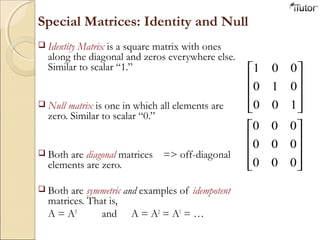
 Identity Matrix is a square matrix with ones
along the diagonal and zeros everywhere else.
Similar to scalar “1.”
 Null matrix is one in which all elements are
zero. Similar to scalar “0.”
 Both are diagonal matrices => off-diagonal
elements are zero.
 Both are symmetric and examples of idempotent
matrices. That is,
A = AT
and A = A2
= A3
= …
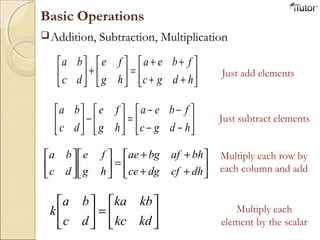
Basic Operations
Addition, Subtraction, Multiplication






++
++
=





+





hdgc
fbea
hg
fe
dc
ba






−−
−−
=





−





hdgc
fbea
hg
fe
dc
ba






++
++
=











dhcfdgce
bhafbgae
hg
fe
dc
ba
Just add elements
Just subtract elements
Multiply each row by
each column and add






=





kdkc
kbka
dc
ba
k Multiply each
element by the scalar
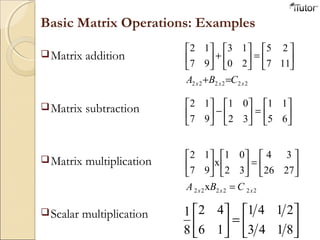
Basic Matrix Operations: Examples
222222
117
25
20
13
97
12
xxx CBA =+






=





+





Matrix addition
Matrix subtraction
Matrix multiplication
Scalar multiplication






=





−





65
11
32
01
97
12
222222 x
2726
34
32
01
x
97
12
xxx CBA =






=

















=





8143
2141
16
42
8
1
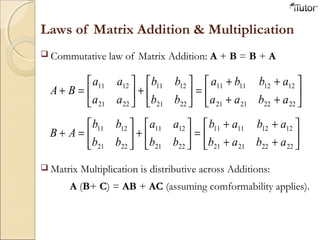
Laws of Matrix Addition & Multiplication






++
++
=





+





=+
22222121
12121111
2221
1211
2221
1211
abaa
abba
bb
bb
aa
aa
BA
 Commutative law of Matrix Addition: A + B = B + A






++
++
=





+





=+
22222121
12121111
2221
1211
2221
1211
abab
abab
bb
aa
bb
bb
AB
 Matrix Multiplication is distributive across Additions:
A (B+ C) = AB + AC (assuming comformability applies).
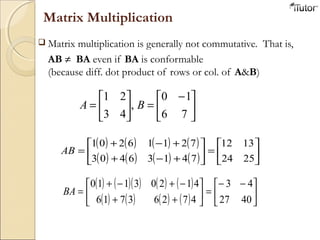
Matrix Multiplication
 Matrix multiplication is generally not commutative. That is,
AB ≠ BA even if BA is conformable
(because diff. dot product of rows or col. of A&B)





 −
=





=
76
10
,
43
21
BA
( ) ( ) ( ) ( )
( ) ( ) ( ) ( ) 





=





+−+
+−+
=
2524
1312
74136403
72116201
AB
( ) ( )( ) ( ) ( )
( ) ( ) ( ) ( ) 




 −−
=





++
−+−+
=
4027
43
47263716
41203110
BA
 Exceptions to non-commutative law:
AB=BA iff
B = a scalar,
B = identity matrix I, or
B = the inverse of A -i.e., A-1
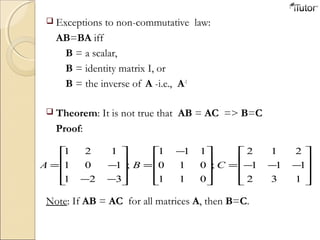
 Theorem: It is not true that AB = AC => B=C
Proof:










−−−=









 −
=










−−
−=
132
111
212
;
011
010
111
;
321
101
121
CBA
Note: If AB = AC for all matrices A, then B=C.
Inverse of a Matrix
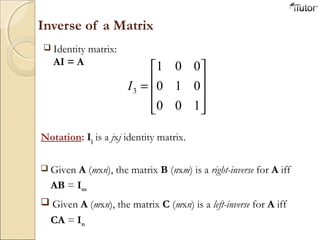
 Identity matrix:
AI = A










=
100
010
001
3I
Notation: Ij is a jxj identity matrix.
 Given A (mxn), the matrix B (nxm) is a right-inverse for A iff
AB = Im
 Given A (mxn), the matrix C (mxn) is a left-inverse for A iff
CA = In
 Theorem: If A (mxn), has both a right-inverse B and a left-inverse C,
thenC = B.
Proof:
We have AB=Im and CA=In.
Thus,
C(AB)= C Im = C and C(AB)=(CA)B= InB = B
=> C(nxm)=B(mxn)
Note:
- This matrix is unique. (Suppose there is another left-inverse D,
then D=B by the theorem, so D=C.)
- If A has both a right and a left inverse, it is a square matrix. It
is usually called invertible.
 Inversion is tricky:
(ABC)-1
= C-1
B-1
A-1
 Theorem: If A (mxn) and B (nxp) have inverses, then AB is
invertible and (AB)-1
= B-1
A-1
Proof:
We have AA-1
=In and A-1
A=Im
BB-1
=In and B-1
B=Ip
Thus,
B-1
A-1
(AB) = B-1
(A-1
A) B= B-1
InB = B-1
B = Ip
(AB) B-1
A-1
= A (BB-1
) A-1
= A In A-1
= A A-1
= Im
=> AB is invertible and (AB)-1
= B-1
A-1
 More on this topic later
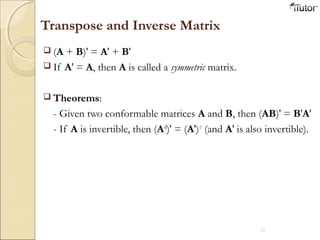
Transpose and Inverse Matrix
 (A + B)' = A' + B'
 If A' = A, then A is called a symmetric matrix.
 Theorems:
- Given two conformable matrices A and B, then (AB)' = B'A'
- If A is invertible, then (A-1
)' = (A')-1
(and A' is also invertible).
16
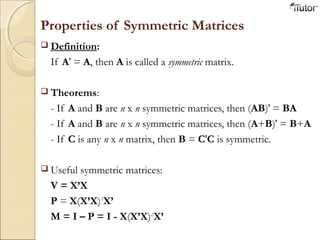
Properties of Symmetric Matrices
 Definition:
If A' = A, then A is called a symmetric matrix.
 Theorems:
- If A and B are n x n symmetric matrices, then (AB)' = BA
- If A and B are n x n symmetric matrices, then (A+B)' = B+A
- If C is any n x n matrix, then B = C'C is symmetric.
 Useful symmetric matrices:
V = X’X
P = X(X’X)-1
X’
M = I – P = I - X(X’X)-1
X’
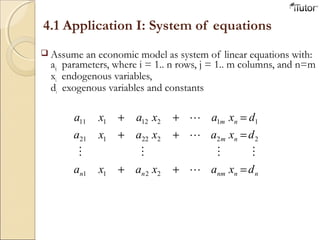
4.1 Application I: System of equations
 Assume an economic model as system of linear equations with:
aij parameters, where i = 1.. n rows, j = 1.. m columns, and n=m
xi endogenous variables,
di exogenous variables and constants
nn
n
n
nm
m
m
nn d
d
d
x
x
x
ax
ax
ax
axa
axa
axa






2
1
2
22
12
211
22121
12111
=
=
=
+
+
+
+
+
+
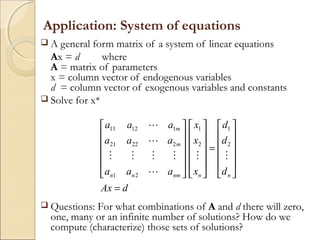
 A general form matrix of a system of linear equations
Ax = d where
A = matrix of parameters
x = column vector of endogenous variables
d = column vector of exogenous variables and constants
 Solve for x*
dAx
d
d
d
x
x
x
aaa
aaa
aaa
nnnmnn
m
m
=












=





























2
1
2
1
21
22221
11211
 Questions: For what combinations of A and d there will zero,
one, many or an infinite number of solutions? How do we
compute (characterize) those sets of solutions?
Application: System of equations
Solution of a General-equation System
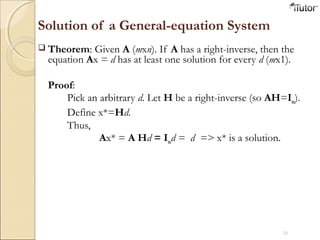
 Theorem: Given A (mxn). If A has a right-inverse, then the
equation Ax = d has at least one solution for every d (mx1).
Proof:
Pick an arbitrary d. Let H be a right-inverse (so AH=Im).
Define x*=Hd.
Thus,
Ax* = A Hd = Imd = d => x* is a solution.
20
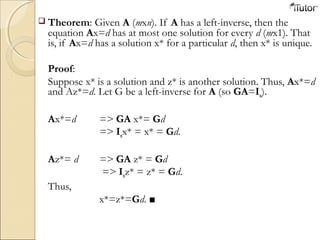
 Theorem: Given A (mxn). If A has a left-inverse, then the
equation Ax=d has at most one solution for every d (mx1). That
is, if Ax=d has a solution x* for a particular d, then x* is unique.
Proof:
Suppose x* is a solution and z* is another solution. Thus, Ax*=d
and Az*=d. Let G be a left-inverse for A (so GA=In).
Ax*=d => GA x*= Gd
=> Inx* = x* = Gd.
Az*= d => GA z* = Gd
=> Inz* = z* = Gd.
Thus,
x*=z*=Gd. ■
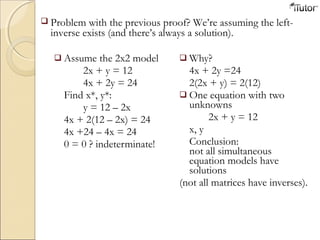
 Assume the 2x2 model
2x + y = 12
4x + 2y = 24
Find x*, y*:
y = 12 – 2x
4x + 2(12 – 2x) = 24
4x +24 – 4x = 24
0 = 0 ? indeterminate!
 Why?
4x + 2y =24
2(2x + y) = 2(12)
 One equation with two
unknowns
2x + y = 12
x, y
Conclusion:
not all simultaneous
equation models have
solutions
(not all matrices have inverses).
 Problem with the previous proof? We’re assuming the left-
inverse exists (and there’s always a solution).
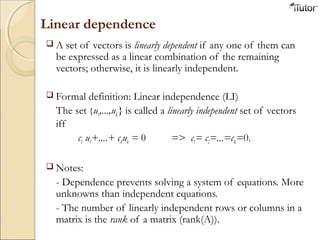
Linear dependence
 A set of vectors is linearly dependent if any one of them can
be expressed as a linear combination of the remaining
vectors; otherwise, it is linearly independent.
 Formal definition: Linear independence (LI)
The set {u1,...,uk} is called a linearly independent set of vectors
iff
c1 u1+....+ ckuk = θ => c1= c2=...=ck,=0.
 Notes:
- Dependence prevents solving a system of equations. More
unknowns than independent equations.
- The number of linearly independent rows or columns in a
matrix is the rank of a matrix (rank(A)).
 Examples:
[ ]
[ ]
//
2
/
1
'
2
'
1
'
2
'
1
02
2412
105
2410
125
=−








=





=
=
vv
v
v
v
v
[ ] [ ]
[ ]
023
54
162216
23
5
4
;
8
1
;
7
2
321
3
21
321
=−−
==
−=
−






=





=





=
vvv
v
vv
vvv
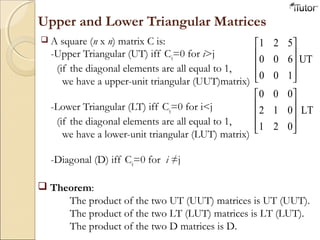
Upper and Lower Triangular Matrices
LT
021
012
000
UT
100
600
521



















 A square (n x n) matrix C is:
-Upper Triangular (UT) iff Cij=0 for i>j
(if the diagonal elements are all equal to 1,
we have a upper-unit triangular (UUT)matrix)
-Lower Triangular (LT) iff Cij=0 for i<j
(if the diagonal elements are all equal to 1,
we have a lower-unit triangular (LUT) matrix)
-Diagonal (D) iff Cij=0 for i ≠j
 Theorem:
The product of the two UT (UUT) matrices is UT (UUT).
The product of the two LT (LUT) matrices is LT (LUT).
The product of the two D matrices is D.
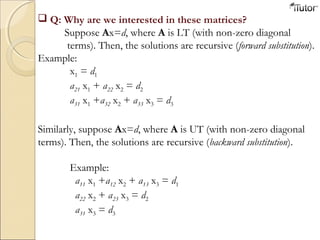
 Q: Why are we interested in these matrices?
Suppose Ax=d, where A is LT (with non-zero diagonal
terms). Then, the solutions are recursive (forward substitution).
Example:
x1 = d1
a21 x1 + a22 x2 = d2
a31 x1 +a32 x2 + a33 x3 = d3
Similarly, suppose Ax=d, where A is UT (with non-zero diagonal
terms). Then, the solutions are recursive (backward substitution).
Example:
a11 x1 +a12 x2 + a13 x3 = d1
a22 x2 + a23 x3 = d2
a31 x3 = d3
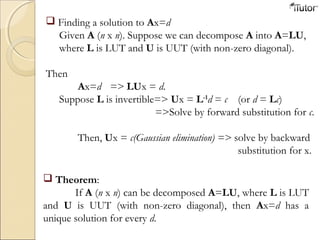
 Finding a solution to Ax=d
Given A (n x n). Suppose we can decompose A into A=LU,
where L is LUT and U is UUT (with non-zero diagonal).
Then
Ax=d => LUx = d.
Suppose L is invertible=> Ux = L-1
d = c (or d = Lc)
=>Solve by forward substitution for c.
Then, Ux = c(Gaussian elimination) => solve by backward
substitution for x.
 Theorem:
If A (n x n) can be decomposed A=LU, where L is LUT
and U is UUT (with non-zero diagonal), then Ax=d has a
unique solution for every d.
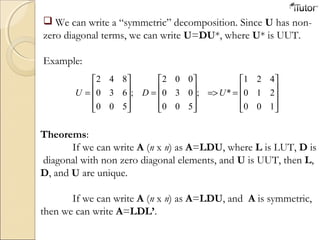
 We can write a “symmetric” decomposition. Since U has non-
zero diagonal terms, we can write U=DU*, where U* is UUT.
Example:










==>










=










=
100
210
421
*;
500
030
002
;
500
630
842
UDU
Theorems:
If we can write A (n x n) as A=LDU, where L is LUT, D is
diagonal with non zero diagonal elements, and U is UUT, then L,
D, and U are unique.
If we can write A (n x n) as A=LDU, and A is symmetric,
then we can write A=LDL’.
Theorem: Cholesky decomposition
If A is symmetric, A=LDL’, and all diagonal elements of D are positive,
then A = HH’.
Proof:
Since A is symmetric, then A=LDL.
The product of a LUT matrix and a D matrix is a LUT
matrix.
Let D*=D1/2
and L be a LT matrix.
Then H=LD* is matrix is LT.
=> A=HH’. ■
The Cholesky decomposition is unique. It is used in the numerical
solution systems of equations, non-linear optimization, Kalman
filter algorithms, etc..
André-Louis Cholesky (1875–1918)
Cholesky decomposition: Application
30
System of Equations
If A is symmetric and A=LDL’, and all elements of D are
positive (A is a positive definite matrix), then we can solve
Ax = b by
(1) Compute the Cholesky decomposition A=HH’.
(2) Solve Hy = b for y,
(3) With y known, solve H’x = y for x.
Note: A-1
is never computed.
Ordinary Least squares
Systems of the form Ax = b with A symmetric and positive
definite are common in economics. For example, the normal
equations in ordinary –i.e., linear- least squares problems are of this
form. A-1
is never computed.
The EndThe End
Call us for more
Information:
www.iTutor.com
Visit
1-855-694-8886

Linear Algebra and Matrix

  • 1.
    Linear Algebra & Matrix T-1-855-694-8886 Email- info@iTutor.com By iTutor.com
  • 2.
    Linear Algebra History:  Thebeginnings of matrices and determinants goes back to the second century BC although traces can be seen back to the fourth century BC. But, the ideas did not make it to mainstream math until the late 16th century.  The Babylonians around 300 BC studied problems which lead to simultaneous linear equations.  The Chinese, between 200 BC and 100 BC, came much closer to matrices than the Babylonians. Indeed, the text Nine Chapters on the Mathematical Art written during the Han Dynasty gives the first known example of matrix methods.  In Europe, two-by-two determinants were considered by Cardano at the end of the 16th century and larger ones by Leibniz and, in Japan, by Seki about 100 years later.
  • 3.
    What is aMatrix? A matrix is a set of elements, organized into rows and columns       dc ba Rows Columns  a and d are the diagonal elements.  b and c are the off-diagonal elements.  Matrices are like plain numbers in many ways: they can be added, subtracted, and, in some cases, multiplied and inverted (divided).
  • 4.
    Examples: [ ]δβα=      − = b d b A; 1 1 Dimensions of a matrix: Numbers of rows by numbers of columns. The Matrix A is a 2x2 matrix, b is a 1x3 matrix. A matrix with only one column or only one row is called a vector. If a matrix has an equal numbers of rows and columns, it is called a square matrix. Matrix A, above, is a square matrix. Usual Notation: Upper case letters => matrices Lower case => vectors
  • 5.
    Matrix multiplication  Multiplicationof matrices requires a conformability condition The conformability condition for multiplication is that the column dimensions of the lead matrix A must be equal to the row dimension of the lag matrix B. If A is an (m x n) and B an (n x p) matrix (A has the same number of columns a B has rows), then we define the product of AB. AB is (m x p) matrix with its ij-th element is What are the dimensions of the vector, matrix, and result? [ ] [ ]131211 232221 131211 1211 cccc bb bbb aaaB ==         = [ ]231213112212121121121111 babababababa +++=  Dimensions: a(1 x 2), B(2 x 3) => c (1 x 3) jk n j ijba∑ =1
  • 6.
    Transpose Matrix           − =′=>      − = 49 08 13 401 983 AA:Example The transpose of a matrix A is another matrix AT (also written A ′) created by any one of the following equivalent actions: - Write the rows (columns) of A as the columns (rows) of AT - Reflect A by its main diagonal to obtain AT  Formally, the (i, j) element of AT is the (j, i) element of A: [AT ]ij = [A]ji  If A is a m × n matrix => AT is a n × m matrix.  (A')' = A  Conformability changes unless the matrix is square.
  • 7.
    Special Matrices: Identityand Null                     000 000 000 100 010 001  Identity Matrix is a square matrix with ones along the diagonal and zeros everywhere else. Similar to scalar “1.”  Null matrix is one in which all elements are zero. Similar to scalar “0.”  Both are diagonal matrices => off-diagonal elements are zero.  Both are symmetric and examples of idempotent matrices. That is, A = AT and A = A2 = A3 = …
  • 8.
    Basic Operations Addition, Subtraction,Multiplication       ++ ++ =      +      hdgc fbea hg fe dc ba       −− −− =      −      hdgc fbea hg fe dc ba       ++ ++ =            dhcfdgce bhafbgae hg fe dc ba Just add elements Just subtract elements Multiply each row by each column and add       =      kdkc kbka dc ba k Multiply each element by the scalar
  • 9.
    Basic Matrix Operations:Examples 222222 117 25 20 13 97 12 xxx CBA =+       =      +      Matrix addition Matrix subtraction Matrix multiplication Scalar multiplication       =      −      65 11 32 01 97 12 222222 x 2726 34 32 01 x 97 12 xxx CBA =       =                  =      8143 2141 16 42 8 1
  • 10.
    Laws of MatrixAddition & Multiplication       ++ ++ =      +      =+ 22222121 12121111 2221 1211 2221 1211 abaa abba bb bb aa aa BA  Commutative law of Matrix Addition: A + B = B + A       ++ ++ =      +      =+ 22222121 12121111 2221 1211 2221 1211 abab abab bb aa bb bb AB  Matrix Multiplication is distributive across Additions: A (B+ C) = AB + AC (assuming comformability applies).
  • 11.
    Matrix Multiplication  Matrixmultiplication is generally not commutative. That is, AB ≠ BA even if BA is conformable (because diff. dot product of rows or col. of A&B)       − =      = 76 10 , 43 21 BA ( ) ( ) ( ) ( ) ( ) ( ) ( ) ( )       =      +−+ +−+ = 2524 1312 74136403 72116201 AB ( ) ( )( ) ( ) ( ) ( ) ( ) ( ) ( )       −− =      ++ −+−+ = 4027 43 47263716 41203110 BA
  • 12.
     Exceptions tonon-commutative law: AB=BA iff B = a scalar, B = identity matrix I, or B = the inverse of A -i.e., A-1  Theorem: It is not true that AB = AC => B=C Proof:           −−−=           − =           −− −= 132 111 212 ; 011 010 111 ; 321 101 121 CBA Note: If AB = AC for all matrices A, then B=C.
  • 13.
    Inverse of aMatrix  Identity matrix: AI = A           = 100 010 001 3I Notation: Ij is a jxj identity matrix.  Given A (mxn), the matrix B (nxm) is a right-inverse for A iff AB = Im  Given A (mxn), the matrix C (mxn) is a left-inverse for A iff CA = In
  • 14.
     Theorem: IfA (mxn), has both a right-inverse B and a left-inverse C, thenC = B. Proof: We have AB=Im and CA=In. Thus, C(AB)= C Im = C and C(AB)=(CA)B= InB = B => C(nxm)=B(mxn) Note: - This matrix is unique. (Suppose there is another left-inverse D, then D=B by the theorem, so D=C.) - If A has both a right and a left inverse, it is a square matrix. It is usually called invertible.
  • 15.
     Inversion istricky: (ABC)-1 = C-1 B-1 A-1  Theorem: If A (mxn) and B (nxp) have inverses, then AB is invertible and (AB)-1 = B-1 A-1 Proof: We have AA-1 =In and A-1 A=Im BB-1 =In and B-1 B=Ip Thus, B-1 A-1 (AB) = B-1 (A-1 A) B= B-1 InB = B-1 B = Ip (AB) B-1 A-1 = A (BB-1 ) A-1 = A In A-1 = A A-1 = Im => AB is invertible and (AB)-1 = B-1 A-1  More on this topic later
  • 16.
    Transpose and InverseMatrix  (A + B)' = A' + B'  If A' = A, then A is called a symmetric matrix.  Theorems: - Given two conformable matrices A and B, then (AB)' = B'A' - If A is invertible, then (A-1 )' = (A')-1 (and A' is also invertible). 16
  • 17.
    Properties of SymmetricMatrices  Definition: If A' = A, then A is called a symmetric matrix.  Theorems: - If A and B are n x n symmetric matrices, then (AB)' = BA - If A and B are n x n symmetric matrices, then (A+B)' = B+A - If C is any n x n matrix, then B = C'C is symmetric.  Useful symmetric matrices: V = X’X P = X(X’X)-1 X’ M = I – P = I - X(X’X)-1 X’
  • 18.
    4.1 Application I:System of equations  Assume an economic model as system of linear equations with: aij parameters, where i = 1.. n rows, j = 1.. m columns, and n=m xi endogenous variables, di exogenous variables and constants nn n n nm m m nn d d d x x x ax ax ax axa axa axa       2 1 2 22 12 211 22121 12111 = = = + + + + + +
  • 19.
     A generalform matrix of a system of linear equations Ax = d where A = matrix of parameters x = column vector of endogenous variables d = column vector of exogenous variables and constants  Solve for x* dAx d d d x x x aaa aaa aaa nnnmnn m m =             =                              2 1 2 1 21 22221 11211  Questions: For what combinations of A and d there will zero, one, many or an infinite number of solutions? How do we compute (characterize) those sets of solutions? Application: System of equations
  • 20.
    Solution of aGeneral-equation System  Theorem: Given A (mxn). If A has a right-inverse, then the equation Ax = d has at least one solution for every d (mx1). Proof: Pick an arbitrary d. Let H be a right-inverse (so AH=Im). Define x*=Hd. Thus, Ax* = A Hd = Imd = d => x* is a solution. 20
  • 21.
     Theorem: GivenA (mxn). If A has a left-inverse, then the equation Ax=d has at most one solution for every d (mx1). That is, if Ax=d has a solution x* for a particular d, then x* is unique. Proof: Suppose x* is a solution and z* is another solution. Thus, Ax*=d and Az*=d. Let G be a left-inverse for A (so GA=In). Ax*=d => GA x*= Gd => Inx* = x* = Gd. Az*= d => GA z* = Gd => Inz* = z* = Gd. Thus, x*=z*=Gd. ■
  • 22.
     Assume the2x2 model 2x + y = 12 4x + 2y = 24 Find x*, y*: y = 12 – 2x 4x + 2(12 – 2x) = 24 4x +24 – 4x = 24 0 = 0 ? indeterminate!  Why? 4x + 2y =24 2(2x + y) = 2(12)  One equation with two unknowns 2x + y = 12 x, y Conclusion: not all simultaneous equation models have solutions (not all matrices have inverses).  Problem with the previous proof? We’re assuming the left- inverse exists (and there’s always a solution).
  • 23.
    Linear dependence  Aset of vectors is linearly dependent if any one of them can be expressed as a linear combination of the remaining vectors; otherwise, it is linearly independent.  Formal definition: Linear independence (LI) The set {u1,...,uk} is called a linearly independent set of vectors iff c1 u1+....+ ckuk = θ => c1= c2=...=ck,=0.  Notes: - Dependence prevents solving a system of equations. More unknowns than independent equations. - The number of linearly independent rows or columns in a matrix is the rank of a matrix (rank(A)).
  • 24.
     Examples: [ ] [] // 2 / 1 ' 2 ' 1 ' 2 ' 1 02 2412 105 2410 125 =−         =      = = vv v v v v [ ] [ ] [ ] 023 54 162216 23 5 4 ; 8 1 ; 7 2 321 3 21 321 =−− == −= −       =      =      = vvv v vv vvv
  • 25.
    Upper and LowerTriangular Matrices LT 021 012 000 UT 100 600 521                     A square (n x n) matrix C is: -Upper Triangular (UT) iff Cij=0 for i>j (if the diagonal elements are all equal to 1, we have a upper-unit triangular (UUT)matrix) -Lower Triangular (LT) iff Cij=0 for i<j (if the diagonal elements are all equal to 1, we have a lower-unit triangular (LUT) matrix) -Diagonal (D) iff Cij=0 for i ≠j  Theorem: The product of the two UT (UUT) matrices is UT (UUT). The product of the two LT (LUT) matrices is LT (LUT). The product of the two D matrices is D.
  • 26.
     Q: Whyare we interested in these matrices? Suppose Ax=d, where A is LT (with non-zero diagonal terms). Then, the solutions are recursive (forward substitution). Example: x1 = d1 a21 x1 + a22 x2 = d2 a31 x1 +a32 x2 + a33 x3 = d3 Similarly, suppose Ax=d, where A is UT (with non-zero diagonal terms). Then, the solutions are recursive (backward substitution). Example: a11 x1 +a12 x2 + a13 x3 = d1 a22 x2 + a23 x3 = d2 a31 x3 = d3
  • 27.
     Finding asolution to Ax=d Given A (n x n). Suppose we can decompose A into A=LU, where L is LUT and U is UUT (with non-zero diagonal). Then Ax=d => LUx = d. Suppose L is invertible=> Ux = L-1 d = c (or d = Lc) =>Solve by forward substitution for c. Then, Ux = c(Gaussian elimination) => solve by backward substitution for x.  Theorem: If A (n x n) can be decomposed A=LU, where L is LUT and U is UUT (with non-zero diagonal), then Ax=d has a unique solution for every d.
  • 28.
     We canwrite a “symmetric” decomposition. Since U has non- zero diagonal terms, we can write U=DU*, where U* is UUT. Example:           ==>           =           = 100 210 421 *; 500 030 002 ; 500 630 842 UDU Theorems: If we can write A (n x n) as A=LDU, where L is LUT, D is diagonal with non zero diagonal elements, and U is UUT, then L, D, and U are unique. If we can write A (n x n) as A=LDU, and A is symmetric, then we can write A=LDL’.
  • 29.
    Theorem: Cholesky decomposition IfA is symmetric, A=LDL’, and all diagonal elements of D are positive, then A = HH’. Proof: Since A is symmetric, then A=LDL. The product of a LUT matrix and a D matrix is a LUT matrix. Let D*=D1/2 and L be a LT matrix. Then H=LD* is matrix is LT. => A=HH’. ■ The Cholesky decomposition is unique. It is used in the numerical solution systems of equations, non-linear optimization, Kalman filter algorithms, etc.. André-Louis Cholesky (1875–1918)
  • 30.
    Cholesky decomposition: Application 30 Systemof Equations If A is symmetric and A=LDL’, and all elements of D are positive (A is a positive definite matrix), then we can solve Ax = b by (1) Compute the Cholesky decomposition A=HH’. (2) Solve Hy = b for y, (3) With y known, solve H’x = y for x. Note: A-1 is never computed. Ordinary Least squares Systems of the form Ax = b with A symmetric and positive definite are common in economics. For example, the normal equations in ordinary –i.e., linear- least squares problems are of this form. A-1 is never computed.
  • 31.
    The EndThe End Callus for more Information: www.iTutor.com Visit 1-855-694-8886

Editor's Notes

  • #5 Stephen Cooke, University of Idaho
  • #7 Stephen Cooke, University of Idaho
  • #17 Stephen Cooke, University of Idaho
  • #18 Stephen Cooke, University of Idaho
  • #21 Stephen Cooke, University of Idaho
  • #22 Stephen Cooke, University of Idaho
  • #25 Stephen Cooke, University of Idaho
  • #26 Stephen Cooke, University of Idaho
  • #27 Stephen Cooke, University of Idaho
  • #28 Stephen Cooke, University of Idaho
  • #29 Stephen Cooke, University of Idaho
  • #30 Stephen Cooke, University of Idaho
  • #31 Stephen Cooke, University of Idaho