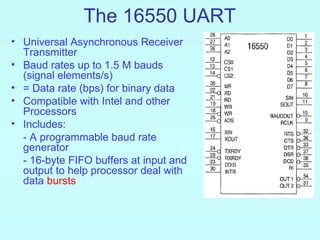
The 16550 UART
• Universal Asynchronous Receiver
  Transmitter
• Baud rates up to 1.5 M bauds
  (signal elements/s)
• = Data rate (bps) for binary data
• Compatible with Intel and other
  Processors
• Includes:
  - A programmable baud rate
  generator
  - 16-byte FIFO buffers at input and
  output to help processor deal with
  data bursts
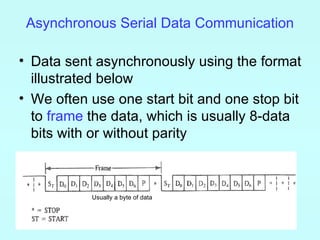
Asynchronous Serial Data Communication

• Data sent asynchronously using the format
  illustrated below
• We often use one start bit and one stop bit
  to frame the data, which is usually 8-data
  bits with or without parity


           Usually a byte of data
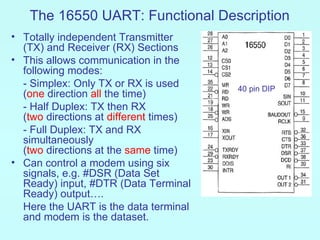
The 16550 UART: Functional Description
• Totally independent Transmitter
  (TX) and Receiver (RX) Sections
• This allows communication in the
  following modes:
  - Simplex: Only TX or RX is used      40 pin DIP
  (one direction all the time)
  - Half Duplex: TX then RX
  (two directions at different times)
  - Full Duplex: TX and RX
  simultaneously
  (two directions at the same time)
• Can control a modem using six
  signals, e.g. #DSR (Data Set
  Ready) input, #DTR (Data Terminal
  Ready) output….
  Here the UART is the data terminal
  and modem is the dataset.
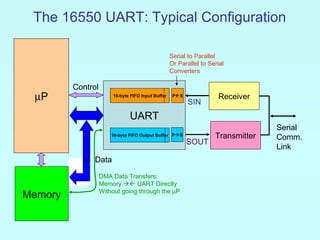
The 16550 UART: Typical Configuration

                                                   Serial to Parallel
                                                   Or Parallel to Serial
                                                   Converters

         Control
 µP                    16-byte FIFO Input Buffer    PS
                                                          SIN
                                                                     Receiver

                              UART
                                                                                  Serial
                       16-byte FIFO Output Buffer PS               Transmitter   Comm.
                                                          SOUT
                                                                                  Link
               Data

                   DMA Data Transfers:
                   Memory  UART Directly
                   Without going through the µP
Memory
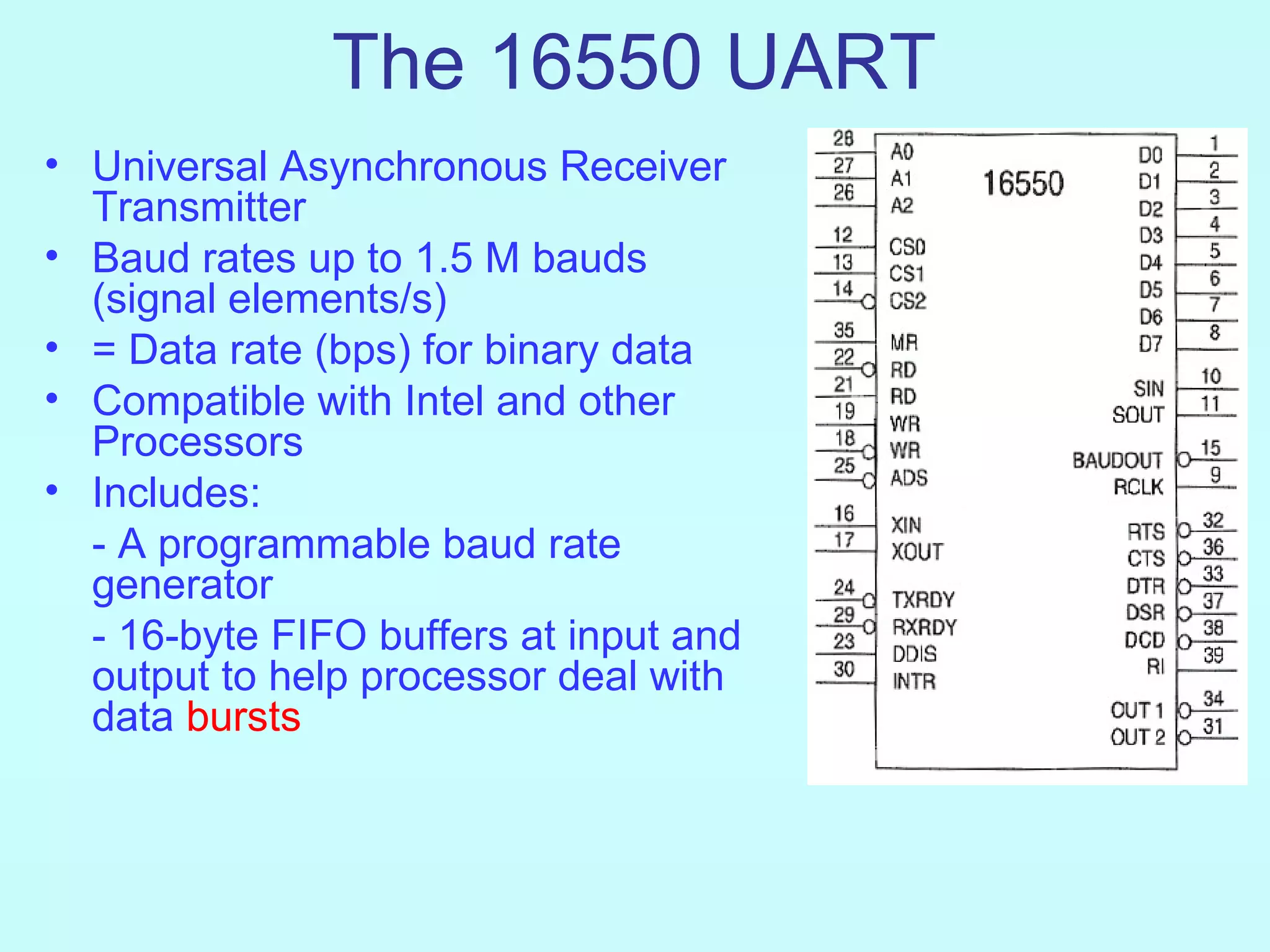
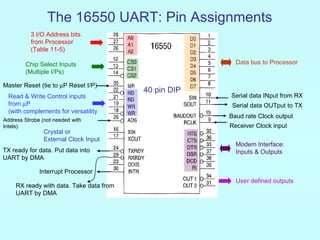
The 16550 UART: Pin Assignments
          3 I/O Address bits
          from Processor
          (Table 11-5)

        Chip Select Inputs                               Data bus to Processor
        (Multiple I/Ps)

Master Reset (tie to µP Reset I/P)
                                          40 pin DIP
  Read & Write Control inputs                          Serial data INput from RX
  from µP                                               Serial data OUTput to TX
  (with complements for versatility
                                                       Baud rate Clock output
Address Strobe (not needed with
Intels)                                                Receiver Clock input
                Crystal or
                External Clock Input
                                                         Modem Interface:
TX ready for data. Put data into                         Inputs & Outputs
UART by DMA

              Interrupt Processor
                                                         User defined outputs
     RX ready with data. Take data from
     UART by DMA
UARTs in the PC
• Used to control the COM ports of the PC
  - UART at I/O address 3F8-3FF: COM Port 0
  - UART at I/O address 2F8-2FF: COM Port 2
Programming the UART
Two Stages:

a. Initialization Dialog: (Setup)
   - Follows RESET
   - Has two steps:
         1. Program the line control register
           (Set asynchronous transmission parameters:
            # of stop, data, and parity bits, etc.)
         2. Program the baud rate generator for the required
            baud rate

b. Operation Dialog: (Actual Communication)
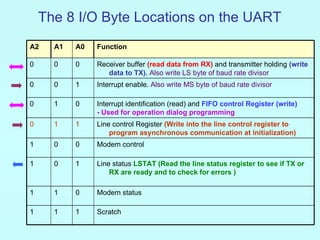
The 8 I/O Byte Locations on the UART
A2    A1   A0   Function

0     0    0    Receiver buffer (read data from RX) and transmitter holding (write
                   data to TX). Also write LS byte of baud rate divisor
0     0    1    Interrupt enable. Also write MS byte of baud rate divisor

0     1    0    Interrupt identification (read) and FIFO control Register (write)
                - Used for operation dialog programming
0     1    1    Line control Register (Write into the line control register to
                    program asynchronous communication at initialization)
1     0    0    Modem control

1     0    1    Line status LSTAT (Read the line status register to see if TX or
                    RX are ready and to check for errors )

1     1    0    Modem status

1     1    1    Scratch
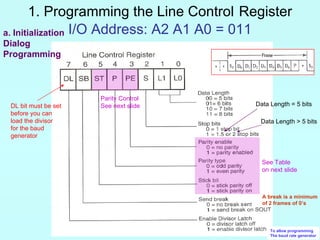
1. Programming the Line Control Register
a. Initialization I/O Address: A2 A1 A0 = 011
Dialog
Programming


                      Parity Control
 DL bit must be set   See next slide     Data Length = 5 bits
 before you can
 load the divisor                         Data Length > 5 bits
 for the baud
 generator


                                           See Table
                                           on next slide


                                           A break is a minimum
                                           of 2 frames of 0’s


                                              To allow programming
                                              The baud rate generator
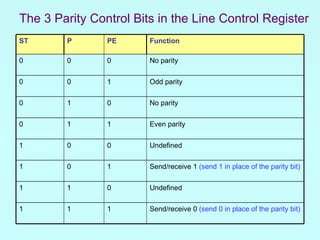
The 3 Parity Control Bits in the Line Control Register
ST      P       PE      Function

0       0       0       No parity

0       0       1       Odd parity

0       1       0       No parity

0       1       1       Even parity

1       0       0       Undefined

1       0       1       Send/receive 1 (send 1 in place of the parity bit)

1       1       0       Undefined

1       1       1       Send/receive 0 (send 0 in place of the parity bit)
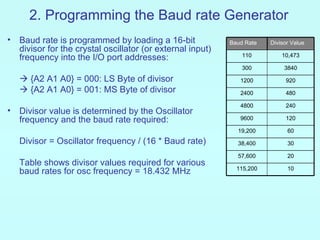
2. Programming the Baud rate Generator
•   Baud rate is programmed by loading a 16-bit              Baud Rate   Divisor Value
    divisor for the crystal oscillator (or external input)
                                                                 110         10,473
    frequency into the I/O port addresses:
                                                                 300          3840

     {A2 A1 A0} = 000: LS Byte of divisor                      1200          920
     {A2 A1 A0} = 001: MS Byte of divisor                      2400          480

                                                                4800          240
•   Divisor value is determined by the Oscillator
    frequency and the baud rate required:                       9600          120

                                                               19,200          60
    Divisor = Oscillator frequency / (16 * Baud rate)          38,400          30

                                                               57,600          20
    Table shows divisor values required for various
                                                               115,200         10
    baud rates for osc frequency = 18.432 MHz
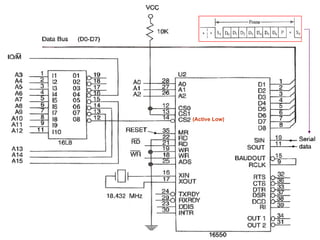
(Active Low)
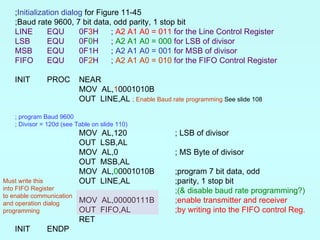
;Initialization dialog for Figure 11-45
   ;Baud rate 9600, 7 bit data, odd parity, 1 stop bit
   LINE       EQU       0F3H      ; A2 A1 A0 = 011 for the Line Control Register
   LSB        EQU       0F0H      ; A2 A1 A0 = 000 for LSB of divisor
   MSB        EQU       0F1H      ; A2 A1 A0 = 001 for MSB of divisor
   FIFO       EQU       0F2H      ; A2 A1 A0 = 010 for the FIFO Control Register

   INIT       PROC        NEAR
                          MOV AL,10001010B
                          OUT LINE,AL ; Enable Baud rate programming See slide 108

   ; program Baud 9600
   ; Divisor = 120d (see Table on slide 110)
                          MOV     AL,120               ; LSB of divisor
                          OUT     LSB,AL
                          MOV     AL,0                 ; MS Byte of divisor
                          OUT     MSB,AL
                          MOV     AL,00001010B         ;program 7 bit data, odd
Must write this           OUT     LINE,AL              ;parity, 1 stop bit
into FIFO Register                                     ;(& disable baud rate programming?)
to enable communication
and operation dialog      MOV AL,00000111B             ;enable transmitter and receiver
programming               OUT FIFO,AL                  ;by writing into the FIFO control Reg.
                          RET
   INIT       ENDP
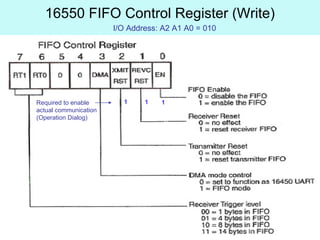
16550 FIFO Control Register (Write)
                       I/O Address: A2 A1 A0 = 010


Required to enable       1     1   1
actual communication
(Operation Dialog)
b. Operation
Dialog 16550 Line Status Register (LSTAT)
Programming     I/O Address: A2 A1 A0 = 101

                                              Before reading data
                                              from receiver, ensure
                                              RX has data
                                              [DR (bit 1) = 1]


                                                 Error status bits
                                                 Any being 1 indicates
                                                 An error


                                                 Before writing data
                                                 for transmission,
                                                 Ensure TX is ready
                                                 to take it
                                                 [TH (bit 5) = 1]
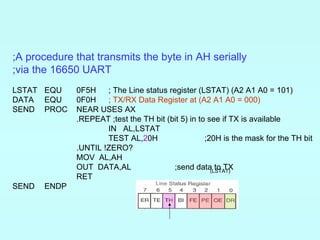
;A procedure that transmits the byte in AH serially
;via the 16650 UART
LSTAT EQU     0F5H    ; The Line status register (LSTAT) (A2 A1 A0 = 101)
DATA EQU      0F0H    ; TX/RX Data Register at (A2 A1 A0 = 000)
SEND PROC     NEAR USES AX
              .REPEAT ;test the TH bit (bit 5) in to see if TX is available
                      IN AL,LSTAT
                      TEST AL,20H                   ;20H is the mask for the TH bit
              .UNTIL !ZERO?
              MOV AL,AH
              OUT DATA,AL                 ;send data to TX
                                                      (LSTAT)
              RET
SEND   ENDP
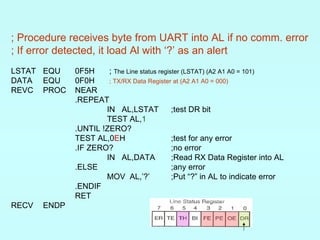
; Procedure receives byte from UART into AL if no comm. error
; If error detected, it load Al with ‘?’ as an alert
LSTAT EQU     0F5H     ; The Line status register (LSTAT) (A2 A1 A0 = 101)
DATA EQU      0F0H     ; TX/RX Data Register at (A2 A1 A0 = 000)
REVC PROC     NEAR
              .REPEAT
                      IN AL,LSTAT             ;test DR bit
                      TEST AL,1
              .UNTIL !ZERO?
              TEST AL,0EH                     ;test for any error
              .IF ZERO?                       ;no error
                      IN AL,DATA              ;Read RX Data Register into AL
              .ELSE                           ;any error
                      MOV AL,’?’              ;Put “?” in AL to indicate error
              .ENDIF
              RET
RECV   ENDP

Uart 16550

  • 1.
    The 16550 UART •Universal Asynchronous Receiver Transmitter • Baud rates up to 1.5 M bauds (signal elements/s) • = Data rate (bps) for binary data • Compatible with Intel and other Processors • Includes: - A programmable baud rate generator - 16-byte FIFO buffers at input and output to help processor deal with data bursts
  • 2.
    Asynchronous Serial DataCommunication • Data sent asynchronously using the format illustrated below • We often use one start bit and one stop bit to frame the data, which is usually 8-data bits with or without parity Usually a byte of data
  • 3.
    The 16550 UART:Functional Description • Totally independent Transmitter (TX) and Receiver (RX) Sections • This allows communication in the following modes: - Simplex: Only TX or RX is used 40 pin DIP (one direction all the time) - Half Duplex: TX then RX (two directions at different times) - Full Duplex: TX and RX simultaneously (two directions at the same time) • Can control a modem using six signals, e.g. #DSR (Data Set Ready) input, #DTR (Data Terminal Ready) output…. Here the UART is the data terminal and modem is the dataset.
  • 4.
    The 16550 UART:Typical Configuration Serial to Parallel Or Parallel to Serial Converters Control µP 16-byte FIFO Input Buffer PS SIN Receiver UART Serial 16-byte FIFO Output Buffer PS Transmitter Comm. SOUT Link Data DMA Data Transfers: Memory  UART Directly Without going through the µP Memory
  • 5.
    The 16550 UART:Pin Assignments 3 I/O Address bits from Processor (Table 11-5) Chip Select Inputs Data bus to Processor (Multiple I/Ps) Master Reset (tie to µP Reset I/P) 40 pin DIP Read & Write Control inputs Serial data INput from RX from µP Serial data OUTput to TX (with complements for versatility Baud rate Clock output Address Strobe (not needed with Intels) Receiver Clock input Crystal or External Clock Input Modem Interface: TX ready for data. Put data into Inputs & Outputs UART by DMA Interrupt Processor User defined outputs RX ready with data. Take data from UART by DMA
  • 6.
    UARTs in thePC • Used to control the COM ports of the PC - UART at I/O address 3F8-3FF: COM Port 0 - UART at I/O address 2F8-2FF: COM Port 2
  • 7.
    Programming the UART TwoStages: a. Initialization Dialog: (Setup) - Follows RESET - Has two steps: 1. Program the line control register (Set asynchronous transmission parameters: # of stop, data, and parity bits, etc.) 2. Program the baud rate generator for the required baud rate b. Operation Dialog: (Actual Communication)
  • 8.
    The 8 I/OByte Locations on the UART A2 A1 A0 Function 0 0 0 Receiver buffer (read data from RX) and transmitter holding (write data to TX). Also write LS byte of baud rate divisor 0 0 1 Interrupt enable. Also write MS byte of baud rate divisor 0 1 0 Interrupt identification (read) and FIFO control Register (write) - Used for operation dialog programming 0 1 1 Line control Register (Write into the line control register to program asynchronous communication at initialization) 1 0 0 Modem control 1 0 1 Line status LSTAT (Read the line status register to see if TX or RX are ready and to check for errors ) 1 1 0 Modem status 1 1 1 Scratch
  • 9.
    1. Programming theLine Control Register a. Initialization I/O Address: A2 A1 A0 = 011 Dialog Programming Parity Control DL bit must be set See next slide Data Length = 5 bits before you can load the divisor Data Length > 5 bits for the baud generator See Table on next slide A break is a minimum of 2 frames of 0’s To allow programming The baud rate generator
  • 10.
    The 3 ParityControl Bits in the Line Control Register ST P PE Function 0 0 0 No parity 0 0 1 Odd parity 0 1 0 No parity 0 1 1 Even parity 1 0 0 Undefined 1 0 1 Send/receive 1 (send 1 in place of the parity bit) 1 1 0 Undefined 1 1 1 Send/receive 0 (send 0 in place of the parity bit)
  • 11.
    2. Programming theBaud rate Generator • Baud rate is programmed by loading a 16-bit Baud Rate Divisor Value divisor for the crystal oscillator (or external input) 110 10,473 frequency into the I/O port addresses: 300 3840  {A2 A1 A0} = 000: LS Byte of divisor 1200 920  {A2 A1 A0} = 001: MS Byte of divisor 2400 480 4800 240 • Divisor value is determined by the Oscillator frequency and the baud rate required: 9600 120 19,200 60 Divisor = Oscillator frequency / (16 * Baud rate) 38,400 30 57,600 20 Table shows divisor values required for various 115,200 10 baud rates for osc frequency = 18.432 MHz
  • 12.
  • 13.
    ;Initialization dialog forFigure 11-45 ;Baud rate 9600, 7 bit data, odd parity, 1 stop bit LINE EQU 0F3H ; A2 A1 A0 = 011 for the Line Control Register LSB EQU 0F0H ; A2 A1 A0 = 000 for LSB of divisor MSB EQU 0F1H ; A2 A1 A0 = 001 for MSB of divisor FIFO EQU 0F2H ; A2 A1 A0 = 010 for the FIFO Control Register INIT PROC NEAR MOV AL,10001010B OUT LINE,AL ; Enable Baud rate programming See slide 108 ; program Baud 9600 ; Divisor = 120d (see Table on slide 110) MOV AL,120 ; LSB of divisor OUT LSB,AL MOV AL,0 ; MS Byte of divisor OUT MSB,AL MOV AL,00001010B ;program 7 bit data, odd Must write this OUT LINE,AL ;parity, 1 stop bit into FIFO Register ;(& disable baud rate programming?) to enable communication and operation dialog MOV AL,00000111B ;enable transmitter and receiver programming OUT FIFO,AL ;by writing into the FIFO control Reg. RET INIT ENDP
  • 14.
    16550 FIFO ControlRegister (Write) I/O Address: A2 A1 A0 = 010 Required to enable 1 1 1 actual communication (Operation Dialog)
  • 15.
    b. Operation Dialog 16550Line Status Register (LSTAT) Programming I/O Address: A2 A1 A0 = 101 Before reading data from receiver, ensure RX has data [DR (bit 1) = 1] Error status bits Any being 1 indicates An error Before writing data for transmission, Ensure TX is ready to take it [TH (bit 5) = 1]
  • 16.
    ;A procedure thattransmits the byte in AH serially ;via the 16650 UART LSTAT EQU 0F5H ; The Line status register (LSTAT) (A2 A1 A0 = 101) DATA EQU 0F0H ; TX/RX Data Register at (A2 A1 A0 = 000) SEND PROC NEAR USES AX .REPEAT ;test the TH bit (bit 5) in to see if TX is available IN AL,LSTAT TEST AL,20H ;20H is the mask for the TH bit .UNTIL !ZERO? MOV AL,AH OUT DATA,AL ;send data to TX (LSTAT) RET SEND ENDP
  • 17.
    ; Procedure receivesbyte from UART into AL if no comm. error ; If error detected, it load Al with ‘?’ as an alert LSTAT EQU 0F5H ; The Line status register (LSTAT) (A2 A1 A0 = 101) DATA EQU 0F0H ; TX/RX Data Register at (A2 A1 A0 = 000) REVC PROC NEAR .REPEAT IN AL,LSTAT ;test DR bit TEST AL,1 .UNTIL !ZERO? TEST AL,0EH ;test for any error .IF ZERO? ;no error IN AL,DATA ;Read RX Data Register into AL .ELSE ;any error MOV AL,’?’ ;Put “?” in AL to indicate error .ENDIF RET RECV ENDP