PROJECT ASSIGNMENTS
EXECUTED
IN
INTERNSHIP PROGRAMME


Mentor & Guide by
Dr. Subhajit Roy Chowdhury
Key Assignments & Highlights


 SPI Controller – implementation in VHDL

  ADC interfacing using FPGA

  Notch Filter Design & simulation using MATLAB

 ATmega169 projects – Atmel Studio tool
     ADC configuration program using C-language
    USART configuration program using C-language

 PIC16f877 projects – Microchip MPLABx tool
      ADC configuration program using C-language
     USART configuration program using C-language
     EEPROM RD/WR program using C-language

  VHDL Assignments
      8-Bit Counter design and simulation using ModelSim
      16-Bit Register design and simulation using ModelSim
      4-Bit parallel Adder design and simulation using ModelSim
      16-Bit Adder design and simulation using ModelSim
      16-Bit Subtraction design and simulation using ModelSim
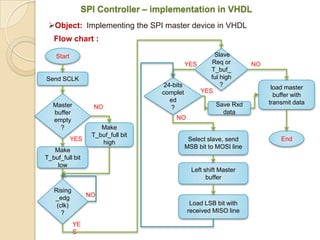
SPI Controller – implementation in VHDL
 Object: Implementing the SPI master device in VHDL
   Flow chart :

    Start                                           Slave
                                            YES    Req or        NO
                                                   T_buf_
Send SCLK                                          ful high
                                    24-bits            ?               load master
                                    complet     YES
                                                                        buffer with
                                      ed                              transmit data
   Master           NO                ?              Save Rxd
   buffer                                                data
   empty                                 NO
     ?                Make
                   T_buf_full bit
            YES                            Select slave, send             End
                      high
                                          MSB bit to MOSI line
   Make
T_buf_full bit
    low
                                             Left shift Master
                                                   buffer

   Rising
   _edg           NO
    (clk)                                   Load LSB bit with
      ?                                    received MISO line

            YE
            S
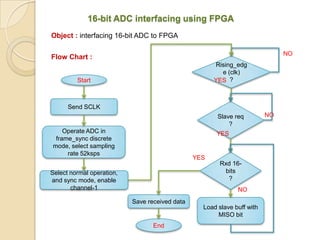
16-bit ADC interfacing using FPGA
Object : interfacing 16-bit ADC to FPGA

                                                                              NO
Flow Chart :
                                                      Rising_edg
                                                        e (clk)
         Start                                        YES ?


      Send SCLK
                                                       Slave req         NO
                                                           ?
    Operate ADC in                                    YES
 frame_sync discrete
mode, select sampling
     rate 52ksps
                                                YES
                                                        Rxd 16-
Select normal operation,                                 bits
and sync mode, enable                                     ?
       channel-1                                              NO
                           Save received data
                                                  Load slave buff with
                                                       MISO bit
                                  End
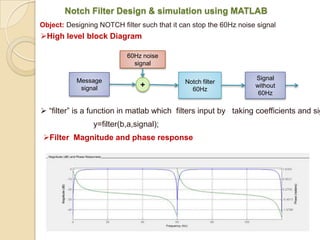
Notch Filter Design & simulation using MATLAB
Object: Designing NOTCH filter such that it can stop the 60Hz noise signal
High level block Diagram

                           60Hz noise
                             signal

           Message                                                 Signal
                                             Notch filter
            signal             +               60Hz
                                                                   without
                                                                    60Hz

 “filter” is a function in matlab which filters input by taking coefficients and sig
                y=filter(b,a,signal);
 Filter Magnitude and phase response
ATmega169 : ADC configuration program

Object : writing firmware to control internal ADC in Atmega169

Configuring Internal Registers:
         Load SREG|=0x80; global interrupt enable ; ADMUX|=0xC0
           internal 1.1v reference; ADCSRA|=0x84; AD enable, AD interrupt enable;
        ADCSRA|=0x20; positive edge trigger; ADCSRB|=0x40; free running mode;
         ADCSRA|=0x40; start conversion
 Flow Chart :

                 Start


           Make PORT-B,-C                                                NO
               output                              Conversion
                                                    complete


          enable AD interrupt,                               YES
         AD conversion ,select
            1.1v reference
                                              Load higher byte into
                                             port-b, lower into port-c
            Operate in free
          running mode, start
              conversion
                                                       End
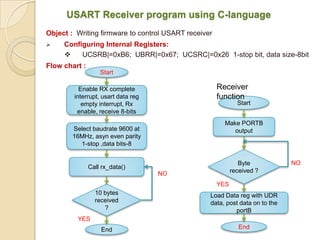
USART Receiver program using C-language
Object : Writing firmware to control USART receiver
    Configuring Internal Registers:
         UCSRB|=0xB6; UBRR|=0x67; UCSRC|=0x26 1-stop bit, data size-8bit
Flow chart :
                   Start

          Enable RX complete                          Receiver
        interrupt, usart data reg                     function
           empty interrupt, Rx                                Start
         enable, receive 8-bits
                                                        Make PORTB
        Select baudrate 9600 at                            output
        16MHz, asyn even parity
          1-stop ,data bits-8


                                                               Byte           NO
               Call rx_data()
                                    NO                      received ?

                                                      YES
                 10 bytes                         Load Data reg with UDR
                 received                         data, post data on to the
                    ?                                      portB
         YES
                   End                                         End
USART Transmitter program using C-language
       Object : Writing firmware to control USART Transmitter
    Configuring Internal Registers:
      UCSRB|=0x69;
      UBRR|=0x67; baud rate 9600 at f=16MHz
      UCSRC|=0x26; aysn, evenparity,1-stopbit, data size 8-bit
    Flow chart :                                                      Tx_data()

              Start                                                     Start


      Enable TX complete                                          Load byte in UDR
    interrupt, usart data reg                                         register
       empty interrupt, Tx
        enable, Txt 8-bits
                                                                         Byte         NO
                                                                     transmitted
    Select baudrate 9600 at                  10
                                                                          ?
    16MHz, asyn even parity                 bytes
                                    NO      txd ?                YE
      1-stop ,data bits-8
                                                                 S
                                                    YES
                                                                  Make TXC bit zero
      Call Tx_data(data[i])                  End
                                                                        End
PIC16F877: ADC configuration program

   Object: Writing firmware to control internal Analog to Digital convertor in
    PIC16F877
   Configuring Internal Registers:
      ADIE=1; this bit enables ADC interrupt
      GIE=1; enables global interrupt
      ADCON0=0x00; selecting channel-0 fosc/2;
      ADCON1=0x8F; select ing analog AN0 input
      ADON=1; start ADC
      GODONE=1 start conversion

           Start

                                                    Conversio
       Make port-c,b                                   n                 NO
    output; enable ADC                              completed
         interrupt                                     ?
                                                               YES
     select AN0 input;                        Load higher byte on to
    Start operating AD;                       port-B, lower byte on to
                                                       port-C
     Start conversion
                                                       End
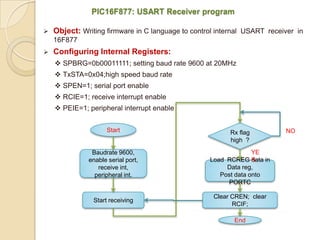
PIC16F877: USART Receiver program

   Object: Writing firmware in C language to control internal USART receiver in
    16F877
   Configuring Internal Registers:
     SPBRG=0b00011111; setting baud rate 9600 at 20MHz
     TxSTA=0x04;high speed baud rate
     SPEN=1; serial port enable
     RCIE=1; receive interrupt enable
     PEIE=1; peripheral interrupt enable


                    Start                                 Rx flag          NO
                                                          high ?

               Baudrate 9600,                                    YE
              enable serial port,                  Load RCREG S  data in
                 receive int,                           Data reg,
                peripheral int.                       Post data onto
                                                        PORTC

                                                    Clear CREN; clear
                Start receiving
                                                          RCIF;

                                                           End
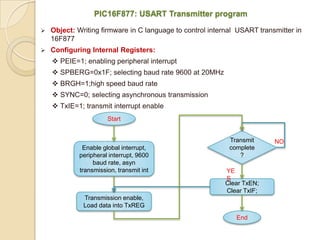
PIC16F877: USART Transmitter program

   Object: Writing firmware in C language to control internal USART transmitter in
    16F877
   Configuring Internal Registers:
     PEIE=1; enabling peripheral interrupt
     SPBERG=0x1F; selecting baud rate 9600 at 20MHz
     BRGH=1;high speed baud rate
     SYNC=0; selecting asynchronous transmission
     TxIE=1; transmit interrupt enable
                       Start


                                                            Transmit      NO
              Enable global interrupt,                      complete
             peripheral interrupt, 9600                        ?
                  baud rate, asyn
             transmission, transmit int                   YE
                                                          S
                                                          Clear TxEN;
                                                          Clear TxIF;
              Transmission enable,
              Load data into TxREG
                                                              End
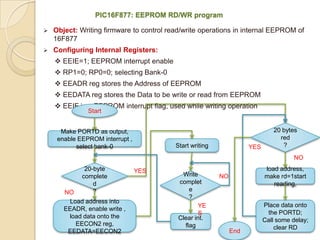
PIC16F877: EEPROM RD/WR program

   Object: Writing firmware to control read/write operations in internal EEPROM of
    16F877
   Configuring Internal Registers:
     EEIE=1; EEPROM interrupt enable
     RP1=0; RP0=0; selecting Bank-0
     EEADR reg stores the Address of EEPROM
     EEDATA reg stores the Data to be write or read from EEPROM
     EEIF is a EEPROM interrupt flag, used while writing operation
               Start


      Make PORTD as output,                                                   20 bytes
     enable EEPROM interrupt ,                                                  red
           select bank-0                  Start writing              YES         ?

                                                                                     NO
              20-byte            YES                                       load address,
             complete                       Write         NO               make rd=1start
                 d                         complet                            reading,
       NO        ?                             e
                                               ?
        Load address into
                                                   YE                      Place data onto
       EEADR, enable write ,
                                                   S                        the PORTD;
        load data onto the                 Clear int.                      Call some delay;
          EECON2 reg,                        flag                              clear RD
        EEDATA=EECON2                                          End
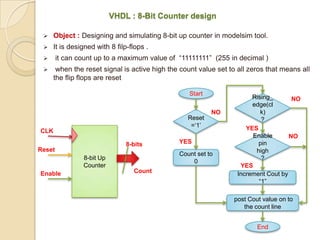
VHDL : 8-Bit Counter design

     Object : Designing and simulating 8-bit up counter in modelsim tool.
     It is designed with 8 filp-flops .
       it can count up to a maximum value of “11111111” (255 in decimal )
      when the reset signal is active high the count value set to all zeros that means all
      the flip flops are reset

                                                   Start
                                                                        Rising_       NO
                                                                        edge(cl
                                                           NO              k)
                                                  Reset                    ?
                                                   =„1‟               YES
CLK
                                                                        Enable       NO
                                8-bits         YES                        pin
Reset                                                                    high
                                               Count set to
                8-bit Up                                                   ?
                                                   0
                Counter                                             YES
Enable                            Count                            Increment Cout by
                                                                          “1”

                                                                 post Cout value on to
                                                                    the count line


                                                                         End
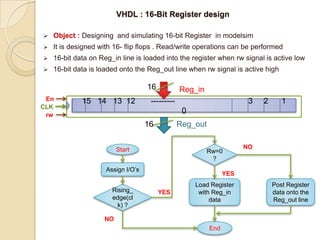
VHDL : 16-Bit Register design

   Object : Designing and simulating 16-bit Register in modelsim
   It is designed with 16- flip flops . Read/write operations can be performed
   16-bit data on Reg_in line is loaded into the register when rw signal is active low
   16-bit data is loaded onto the Reg_out line when rw signal is active high

                                    16           Reg_in
 En          15 14 13 12             ---------                          3   2      1
CLK
 rw
                                                  0
                                    16           Reg_out


                         Start                                         NO
                                                           Rw=0
                                                            ?
                     Assign I/O‟s
                                                                 YES
                                                      Load Register             Post Register
                       Rising_           YES           with Reg_in              data onto the
                       edge(cl                             data                 Reg_out line
                         k) ?

                    NO
                                                           End
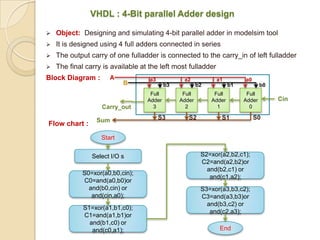
VHDL : 4-Bit parallel Adder design

   Object: Designing and simulating 4-bit parallel adder in modelsim tool
   It is designed using 4 full adders connected in series
   The output carry of one fulladder is connected to the carry_in of left fulladder
   The final carry is available at the left most fulladder
Block Diagram :       A             a3           a2           a1          a0
                           B               b3           b2           b1           b0
                                    Full         Full         Full         Full
                                   Adder        Adder        Adder        Adder        Cin
                   Carry_out         3            2            1            0

                 Sum                     S3        S2           S1             S0
Flow chart :
                   Start

                Select I/O s                             S2=xor(a2,b2,c1);
                                                         C2=and(a2,b2)or
                                                           and(b2,c1) or
             S0=xor(a0,b0,cin);
                                                            and(c1,a2);
             C0=and(a0,b0)or
               and(b0,cin) or                            S3=xor(a3,b3,c2);
                and(cin,a0);                             C3=and(a3,b3)or
                                                           and(b3,c2) or
             S1=xor(a1,b1,c0);
                                                            and(c2,a3);
             C1=and(a1,b1)or
               and(b1,c0) or
                and(c0,a1);                                    End
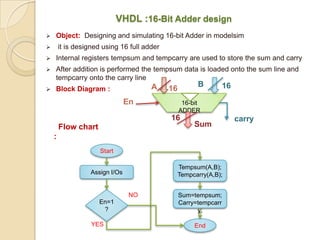
VHDL :16-Bit Adder design
   Object: Designing and simulating 16-bit Adder in modelsim
       it is designed using 16 full adder
   Internal registers tempsum and tempcarry are used to store the sum and carry
   After addition is performed the tempsum data is loaded onto the sum line and
    tempcarry onto the carry line
                                       A                B       16
   Block Diagram :                          16
                                 En                16-bit
                                                  ADDER
                                             16                      carry
        Flow chart                                     Sum
    :
                      Start

                                                  Tempsum(A,B);
                   Assign I/Os                    Tempcarry(A,B);


                                  NO              Sum=tempsum;
                     En=1                         Carry=tempcarr
                      ?                                 y;

                   YES                                 End
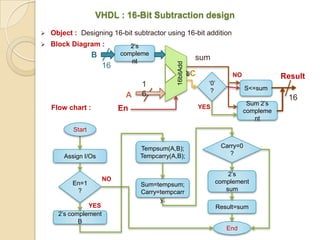
VHDL : 16-Bit Subtraction design
   Object : Designing 16-bit subtractor using 16-bit addition
   Block Diagram :            2‟s
                   B        compleme
                               nt                       sum


                                             16bitAdd
                       16
                                                    C


                                                er
                                        -
                                                                     NO              Result
                                  1                       „0‟
                                                           ?               S<=sum
                             A    6                                                   16
                                                                           Sum 2‟s
    Flow chart :            En                          YES
                                                                          compleme
                                                                             nt
           Start


                                 Tempsum(A,B);                   Carry=0
        Assign I/Os              Tempcarry(A,B);                    ?


                                                                  2‟s
                       NO                                     complement
           En=1                  Sum=tempsum;
            ?                    Carry=tempcarr                  sum
                                       y;
                YES                                             Result=sum
      2‟s complement
             B
                                                                   End
Thank You

Presentation

  • 1.
  • 2.
    Key Assignments &Highlights SPI Controller – implementation in VHDL  ADC interfacing using FPGA  Notch Filter Design & simulation using MATLAB ATmega169 projects – Atmel Studio tool  ADC configuration program using C-language USART configuration program using C-language PIC16f877 projects – Microchip MPLABx tool  ADC configuration program using C-language USART configuration program using C-language EEPROM RD/WR program using C-language  VHDL Assignments  8-Bit Counter design and simulation using ModelSim  16-Bit Register design and simulation using ModelSim  4-Bit parallel Adder design and simulation using ModelSim  16-Bit Adder design and simulation using ModelSim  16-Bit Subtraction design and simulation using ModelSim
  • 3.
    SPI Controller –implementation in VHDL Object: Implementing the SPI master device in VHDL Flow chart : Start Slave YES Req or NO T_buf_ Send SCLK ful high 24-bits ? load master complet YES buffer with ed transmit data Master NO ? Save Rxd buffer data empty NO ? Make T_buf_full bit YES Select slave, send End high MSB bit to MOSI line Make T_buf_full bit low Left shift Master buffer Rising _edg NO (clk) Load LSB bit with ? received MISO line YE S
  • 4.
    16-bit ADC interfacingusing FPGA Object : interfacing 16-bit ADC to FPGA NO Flow Chart : Rising_edg e (clk) Start YES ? Send SCLK Slave req NO ? Operate ADC in YES frame_sync discrete mode, select sampling rate 52ksps YES Rxd 16- Select normal operation, bits and sync mode, enable ? channel-1 NO Save received data Load slave buff with MISO bit End
  • 5.
    Notch Filter Design& simulation using MATLAB Object: Designing NOTCH filter such that it can stop the 60Hz noise signal High level block Diagram 60Hz noise signal Message Signal Notch filter signal + 60Hz without 60Hz  “filter” is a function in matlab which filters input by taking coefficients and sig y=filter(b,a,signal); Filter Magnitude and phase response
  • 6.
    ATmega169 : ADCconfiguration program Object : writing firmware to control internal ADC in Atmega169 Configuring Internal Registers:  Load SREG|=0x80; global interrupt enable ; ADMUX|=0xC0 internal 1.1v reference; ADCSRA|=0x84; AD enable, AD interrupt enable; ADCSRA|=0x20; positive edge trigger; ADCSRB|=0x40; free running mode;  ADCSRA|=0x40; start conversion Flow Chart : Start Make PORT-B,-C NO output Conversion complete enable AD interrupt, YES AD conversion ,select 1.1v reference Load higher byte into port-b, lower into port-c Operate in free running mode, start conversion End
  • 7.
    USART Receiver programusing C-language Object : Writing firmware to control USART receiver  Configuring Internal Registers:  UCSRB|=0xB6; UBRR|=0x67; UCSRC|=0x26 1-stop bit, data size-8bit Flow chart : Start Enable RX complete Receiver interrupt, usart data reg function empty interrupt, Rx Start enable, receive 8-bits Make PORTB Select baudrate 9600 at output 16MHz, asyn even parity 1-stop ,data bits-8 Byte NO Call rx_data() NO received ? YES 10 bytes Load Data reg with UDR received data, post data on to the ? portB YES End End
  • 8.
    USART Transmitter programusing C-language  Object : Writing firmware to control USART Transmitter  Configuring Internal Registers:  UCSRB|=0x69;  UBRR|=0x67; baud rate 9600 at f=16MHz  UCSRC|=0x26; aysn, evenparity,1-stopbit, data size 8-bit  Flow chart : Tx_data() Start Start Enable TX complete Load byte in UDR interrupt, usart data reg register empty interrupt, Tx enable, Txt 8-bits Byte NO transmitted Select baudrate 9600 at 10 ? 16MHz, asyn even parity bytes NO txd ? YE 1-stop ,data bits-8 S YES Make TXC bit zero Call Tx_data(data[i]) End End
  • 9.
    PIC16F877: ADC configurationprogram  Object: Writing firmware to control internal Analog to Digital convertor in PIC16F877  Configuring Internal Registers:  ADIE=1; this bit enables ADC interrupt  GIE=1; enables global interrupt  ADCON0=0x00; selecting channel-0 fosc/2;  ADCON1=0x8F; select ing analog AN0 input  ADON=1; start ADC  GODONE=1 start conversion Start Conversio Make port-c,b n NO output; enable ADC completed interrupt ? YES select AN0 input; Load higher byte on to Start operating AD; port-B, lower byte on to port-C Start conversion End
  • 10.
    PIC16F877: USART Receiverprogram  Object: Writing firmware in C language to control internal USART receiver in 16F877  Configuring Internal Registers:  SPBRG=0b00011111; setting baud rate 9600 at 20MHz  TxSTA=0x04;high speed baud rate  SPEN=1; serial port enable  RCIE=1; receive interrupt enable  PEIE=1; peripheral interrupt enable Start Rx flag NO high ? Baudrate 9600, YE enable serial port, Load RCREG S data in receive int, Data reg, peripheral int. Post data onto PORTC Clear CREN; clear Start receiving RCIF; End
  • 11.
    PIC16F877: USART Transmitterprogram  Object: Writing firmware in C language to control internal USART transmitter in 16F877  Configuring Internal Registers:  PEIE=1; enabling peripheral interrupt  SPBERG=0x1F; selecting baud rate 9600 at 20MHz  BRGH=1;high speed baud rate  SYNC=0; selecting asynchronous transmission  TxIE=1; transmit interrupt enable Start Transmit NO Enable global interrupt, complete peripheral interrupt, 9600 ? baud rate, asyn transmission, transmit int YE S Clear TxEN; Clear TxIF; Transmission enable, Load data into TxREG End
  • 12.
    PIC16F877: EEPROM RD/WRprogram  Object: Writing firmware to control read/write operations in internal EEPROM of 16F877  Configuring Internal Registers:  EEIE=1; EEPROM interrupt enable  RP1=0; RP0=0; selecting Bank-0  EEADR reg stores the Address of EEPROM  EEDATA reg stores the Data to be write or read from EEPROM  EEIF is a EEPROM interrupt flag, used while writing operation Start Make PORTD as output, 20 bytes enable EEPROM interrupt , red select bank-0 Start writing YES ? NO 20-byte YES load address, complete Write NO make rd=1start d complet reading, NO ? e ? Load address into YE Place data onto EEADR, enable write , S the PORTD; load data onto the Clear int. Call some delay; EECON2 reg, flag clear RD EEDATA=EECON2 End
  • 13.
    VHDL : 8-BitCounter design  Object : Designing and simulating 8-bit up counter in modelsim tool.  It is designed with 8 filp-flops .  it can count up to a maximum value of “11111111” (255 in decimal )  when the reset signal is active high the count value set to all zeros that means all the flip flops are reset Start Rising_ NO edge(cl NO k) Reset ? =„1‟ YES CLK Enable NO 8-bits YES pin Reset high Count set to 8-bit Up ? 0 Counter YES Enable Count Increment Cout by “1” post Cout value on to the count line End
  • 14.
    VHDL : 16-BitRegister design  Object : Designing and simulating 16-bit Register in modelsim  It is designed with 16- flip flops . Read/write operations can be performed  16-bit data on Reg_in line is loaded into the register when rw signal is active low  16-bit data is loaded onto the Reg_out line when rw signal is active high 16 Reg_in En 15 14 13 12 --------- 3 2 1 CLK rw 0 16 Reg_out Start NO Rw=0 ? Assign I/O‟s YES Load Register Post Register Rising_ YES with Reg_in data onto the edge(cl data Reg_out line k) ? NO End
  • 15.
    VHDL : 4-Bitparallel Adder design  Object: Designing and simulating 4-bit parallel adder in modelsim tool  It is designed using 4 full adders connected in series  The output carry of one fulladder is connected to the carry_in of left fulladder  The final carry is available at the left most fulladder Block Diagram : A a3 a2 a1 a0 B b3 b2 b1 b0 Full Full Full Full Adder Adder Adder Adder Cin Carry_out 3 2 1 0 Sum S3 S2 S1 S0 Flow chart : Start Select I/O s S2=xor(a2,b2,c1); C2=and(a2,b2)or and(b2,c1) or S0=xor(a0,b0,cin); and(c1,a2); C0=and(a0,b0)or and(b0,cin) or S3=xor(a3,b3,c2); and(cin,a0); C3=and(a3,b3)or and(b3,c2) or S1=xor(a1,b1,c0); and(c2,a3); C1=and(a1,b1)or and(b1,c0) or and(c0,a1); End
  • 16.
    VHDL :16-Bit Adderdesign  Object: Designing and simulating 16-bit Adder in modelsim  it is designed using 16 full adder  Internal registers tempsum and tempcarry are used to store the sum and carry  After addition is performed the tempsum data is loaded onto the sum line and tempcarry onto the carry line A B 16  Block Diagram : 16 En 16-bit ADDER 16 carry Flow chart Sum : Start Tempsum(A,B); Assign I/Os Tempcarry(A,B); NO Sum=tempsum; En=1 Carry=tempcarr ? y; YES End
  • 17.
    VHDL : 16-BitSubtraction design  Object : Designing 16-bit subtractor using 16-bit addition  Block Diagram : 2‟s B compleme nt sum 16bitAdd 16 C er - NO Result 1 „0‟ ? S<=sum A 6 16 Sum 2‟s Flow chart : En YES compleme nt Start Tempsum(A,B); Carry=0 Assign I/Os Tempcarry(A,B); ? 2‟s NO complement En=1 Sum=tempsum; ? Carry=tempcarr sum y; YES Result=sum 2‟s complement B End
  • 18.