A r  and M r
Let’s try counting the number of rice particles in a bucket of rice. Is it easy?
Relative atomic mass, A r   Atoms are  very tiny particles .  Atoms have  very small masses . For example, mass of hydrogen atom = 1.4 X 10 -24  g mass of lead atom = 2.9 x 10 -22 g Mass of carbon – 12 atom = 1.7 X 10 -23 g It is not practical to use actual masses of atoms in calculations.     Chemists often  compare  masses of different atoms with each other.
In 1961… Scientists decided to adopt carbon – 12 as the standard for defining the relative atomic mass of the other elements. Scientists gave carbon – 12 a basic mass value of  12  units. Masses of all other atoms are compared to  one-twelfth ( 1/12)  of carbon – 12.
Why carbon – 12? Carbon – 12 means the carbon has a mass number (protons + neutrons) of 12. Carbon – 12 has a mass of 12 units which can be accurately determined. Large abundance of carbon – 12
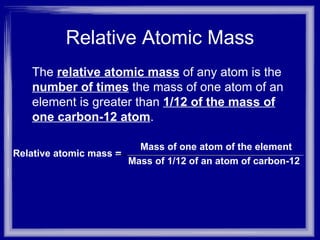
Relative Atomic Mass The  relative atomic mass   of any atom is the  number of times  the mass of one atom of an element is greater than  1/12 of the mass of one carbon-12 atom .  Relative atomic mass = Mass of 1/12 of an atom of carbon-12 Mass of one atom of the element
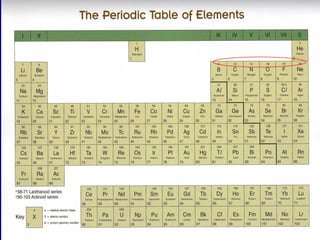
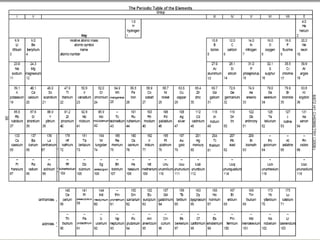
Relative Atomic Mass The symbol for relative atomic mass is  A r . Relative atomic mass is a  ratio  and has no  unit . The  relative atomic mass  of each element is given in the Periodic Table.
 
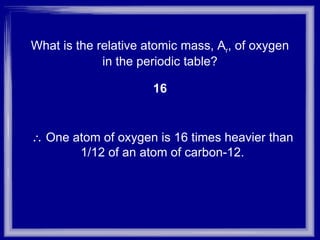
What is the relative atomic mass, A r , of oxygen in the periodic table? 16    One atom of oxygen is 16 times heavier than 1/12 of an atom of carbon-12.
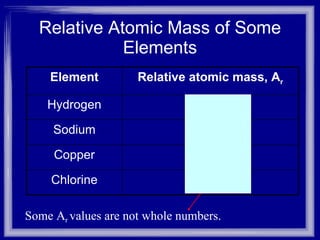
Relative Atomic Mass of Some Elements Some A r   values are not whole numbers. 35.5 Chlorine 64 Copper 23 Sodium 1 Hydrogen Relative atomic mass, A r Element
 
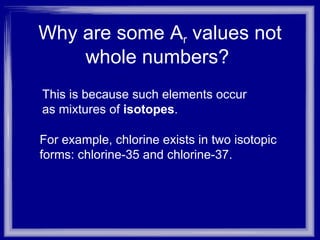
Why are some A r  values not whole numbers?  This is because such elements occur as mixtures of  isotopes . For example, chlorine exists in two isotopic forms: chlorine-35 and chlorine-37.
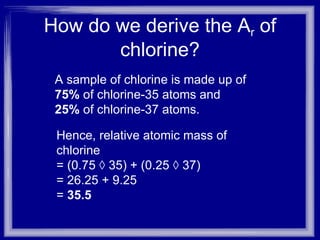
How do we derive the A r  of chlorine? Hence, relative atomic mass of chlorine  = (0.75 × 35) + (0.25 × 37)  = 26.25 + 9.25  =  35.5  A sample of chlorine is made up of  75%  of chlorine-35 atoms and  25%  of chlorine-37 atoms.
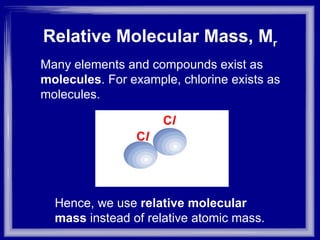
Relative Molecular Mass, M r Many elements and compounds exist as  molecules . For example, chlorine exists as molecules.  Hence, we use  relative molecular mass  instead of relative atomic mass. C l C l
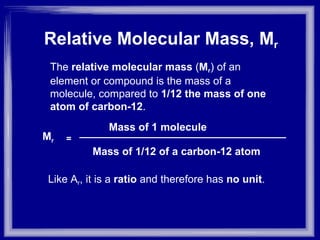
The  relative molecular mass  ( M r ) of an element or compound is the mass of a molecule, compared to  1/12 the mass of one atom of carbon-12 . Like A r , it is a  ratio  and therefore has  no unit . Relative Molecular Mass, M r M r Mass of 1 molecule Mass of 1/12 of a carbon-12 atom =
Relative molecular mass of a molecule = sum of relative atomic mass,  A r  of all atoms in a molecule Relative Molecular Mass, M r
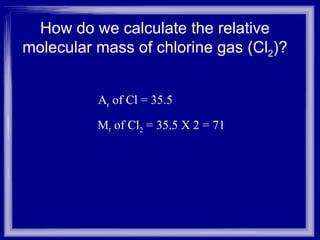
How do we calculate the relative molecular mass of chlorine gas (Cl 2 )? A r  of Cl = 35.5 M r  of Cl 2  = 35.5 X 2 = 71
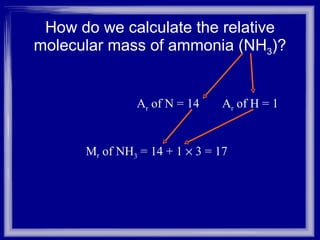
How do we calculate the relative molecular mass of ammonia (NH 3 )? A r  of N = 14 A r  of H = 1 M r  of NH 3  = 14 + 1    3 = 17
Relative Formula Mass, M r   Many substances such as water are covalent and exist as molecules. However, substances like sodium chloride, NaCl, are ionic and do not exist as molecules. The ‘relative molecular mass’ of an ionic compound is more accurately known as  relative formula mass, M r .
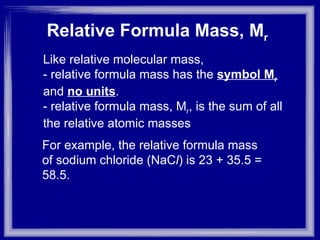
Relative Formula Mass, M r   Like relative molecular mass,  - relative formula mass has the  symbol M r   and  no units .  - relative formula mass, M r , is the sum of all the relative atomic masses For example, the relative formula mass of sodium chloride (NaC l ) is 23 + 35.5 = 58.5.
Relative Formula Mass  Many substances such as water are covalent and exist as molecules. However, substances like sodium chloride are ionic and  do not exist as molecules. The ‘relative molecular mass’ of an ionic compound  is more accurately known as  relative formula mass .
Relative Formula Mass  Like relative molecular mass,  relative formula mass has the symbol  M r   and  relative formula mass has no units.  For example, the relative formula mass of sodium chloride (NaC l ) is 23 + 35.5 = 58.5.
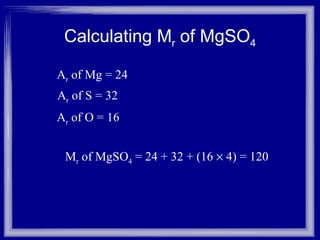
Calculating M r  of MgSO 4 A r  of Mg = 24 A r  of S = 32 M r  of MgSO 4  = 24 + 32 + (16    4) = 120 A r  of O = 16
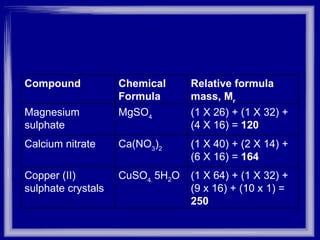
(1 X 64) + (1 X 32) + (9 x 16) + (10 x 1) =  250 CuSO 4.  5H 2 O Copper (II) sulphate crystals (1 X 40) + (2 X 14) + (6 X 16) =  164 Ca(NO 3 ) 2  Calcium nitrate  (1 X 26) + (1 X 32) + (4 X 16) =  120 MgSO 4 Magnesium sulphate  Relative formula mass, M r Chemical Formula Compound

The Mole Ar And Mr

  • 1.
    A r and M r
  • 2.
    Let’s try countingthe number of rice particles in a bucket of rice. Is it easy?
  • 3.
    Relative atomic mass,A r Atoms are very tiny particles . Atoms have very small masses . For example, mass of hydrogen atom = 1.4 X 10 -24 g mass of lead atom = 2.9 x 10 -22 g Mass of carbon – 12 atom = 1.7 X 10 -23 g It is not practical to use actual masses of atoms in calculations.  Chemists often compare masses of different atoms with each other.
  • 4.
    In 1961… Scientistsdecided to adopt carbon – 12 as the standard for defining the relative atomic mass of the other elements. Scientists gave carbon – 12 a basic mass value of 12 units. Masses of all other atoms are compared to one-twelfth ( 1/12) of carbon – 12.
  • 5.
    Why carbon –12? Carbon – 12 means the carbon has a mass number (protons + neutrons) of 12. Carbon – 12 has a mass of 12 units which can be accurately determined. Large abundance of carbon – 12
  • 6.
    Relative Atomic MassThe relative atomic mass of any atom is the number of times the mass of one atom of an element is greater than 1/12 of the mass of one carbon-12 atom . Relative atomic mass = Mass of 1/12 of an atom of carbon-12 Mass of one atom of the element
  • 7.
    Relative Atomic MassThe symbol for relative atomic mass is A r . Relative atomic mass is a ratio and has no unit . The relative atomic mass of each element is given in the Periodic Table.
  • 8.
  • 9.
    What is therelative atomic mass, A r , of oxygen in the periodic table? 16  One atom of oxygen is 16 times heavier than 1/12 of an atom of carbon-12.
  • 10.
    Relative Atomic Massof Some Elements Some A r values are not whole numbers. 35.5 Chlorine 64 Copper 23 Sodium 1 Hydrogen Relative atomic mass, A r Element
  • 11.
  • 12.
    Why are someA r values not whole numbers? This is because such elements occur as mixtures of isotopes . For example, chlorine exists in two isotopic forms: chlorine-35 and chlorine-37.
  • 13.
    How do wederive the A r of chlorine? Hence, relative atomic mass of chlorine = (0.75 × 35) + (0.25 × 37) = 26.25 + 9.25 = 35.5 A sample of chlorine is made up of 75% of chlorine-35 atoms and 25% of chlorine-37 atoms.
  • 14.
    Relative Molecular Mass,M r Many elements and compounds exist as molecules . For example, chlorine exists as molecules. Hence, we use relative molecular mass instead of relative atomic mass. C l C l
  • 15.
    The relativemolecular mass ( M r ) of an element or compound is the mass of a molecule, compared to 1/12 the mass of one atom of carbon-12 . Like A r , it is a ratio and therefore has no unit . Relative Molecular Mass, M r M r Mass of 1 molecule Mass of 1/12 of a carbon-12 atom =
  • 16.
    Relative molecular massof a molecule = sum of relative atomic mass, A r of all atoms in a molecule Relative Molecular Mass, M r
  • 17.
    How do wecalculate the relative molecular mass of chlorine gas (Cl 2 )? A r of Cl = 35.5 M r of Cl 2 = 35.5 X 2 = 71
  • 18.
    How do wecalculate the relative molecular mass of ammonia (NH 3 )? A r of N = 14 A r of H = 1 M r of NH 3 = 14 + 1  3 = 17
  • 19.
    Relative Formula Mass,M r Many substances such as water are covalent and exist as molecules. However, substances like sodium chloride, NaCl, are ionic and do not exist as molecules. The ‘relative molecular mass’ of an ionic compound is more accurately known as relative formula mass, M r .
  • 20.
    Relative Formula Mass,M r Like relative molecular mass, - relative formula mass has the symbol M r and no units . - relative formula mass, M r , is the sum of all the relative atomic masses For example, the relative formula mass of sodium chloride (NaC l ) is 23 + 35.5 = 58.5.
  • 21.
    Relative Formula Mass Many substances such as water are covalent and exist as molecules. However, substances like sodium chloride are ionic and do not exist as molecules. The ‘relative molecular mass’ of an ionic compound is more accurately known as relative formula mass .
  • 22.
    Relative Formula Mass Like relative molecular mass, relative formula mass has the symbol M r and relative formula mass has no units. For example, the relative formula mass of sodium chloride (NaC l ) is 23 + 35.5 = 58.5.
  • 23.
    Calculating M r of MgSO 4 A r of Mg = 24 A r of S = 32 M r of MgSO 4 = 24 + 32 + (16  4) = 120 A r of O = 16
  • 24.
    (1 X 64)+ (1 X 32) + (9 x 16) + (10 x 1) = 250 CuSO 4. 5H 2 O Copper (II) sulphate crystals (1 X 40) + (2 X 14) + (6 X 16) = 164 Ca(NO 3 ) 2 Calcium nitrate (1 X 26) + (1 X 32) + (4 X 16) = 120 MgSO 4 Magnesium sulphate Relative formula mass, M r Chemical Formula Compound