Here is the filled diagram with terms for the stages of star formation where heavy elements are formed:
Main Sequence Star
|
|
|
Red Giant
|
|
|
Planetary Nebula
|
|
|
Supernova - R-process, supernova nucleosynthesis
Prayer
Heavenly Father
Grant meeach day the desire to do my best,
To grow mentally and morally as well as physically,
To be kind and helpful to my classmates and teachers,
To be honest with myself as well as with others,
Help me to be a good sport and smile when I lose as well as when
I win,
Teach me the value of true friendship
Help me always to conduct myself so as to bring credit to my
school.
Amen
3.
Give evidence forand
describe the formation of
heavier elements during
star formation and
evolution.S11/12PS-IIIa-1
Objective:
4.
Specific Objective:
Explain stellarnucleosynthesis;
Describe the different stages of life
cycle of stars;
Cite the different heavy elements
formed in each stages of Star Cycle;
STELLAR NUCLEOSYNTHESIS
Process bywhich elements are
formed within the stars as a result
of nuclear fusion.
NUCLEAR FUSION
Process by which multiple
nuclei joined together to form
a heavier nucleus.
7.
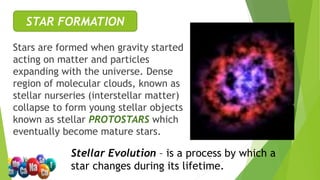
Stars are formedwhen gravity started
acting on matter and particles
expanding with the universe. Dense
region of molecular clouds, known as
stellar nurseries (interstellar matter)
collapse to form young stellar objects
known as stellar PROTOSTARS which
eventually become mature stars.
Stellar Evolution – is a process by which a
star changes during its lifetime.
STAR FORMATION
8.
All starsare born from clouds of
gas called nebulae or molecular
clouds that collapsed due to
gravity.
As the cloud collapses, it breaks
into smaller fragments which
contract to form a superhot
stellar core called PROTOSTAR.
9.
The protostarcontinues to accumulate gas and
dust from the molecular cloud, and continues
to contract while the temperature increases.
Hydrogen will start combining with one another
when the temperature reached 10,000 K in a
series of proton-proton fusion reactions. These
nuclear reactions release positrons and
neutrinons which increase pressure and stop
the contractions.
10.
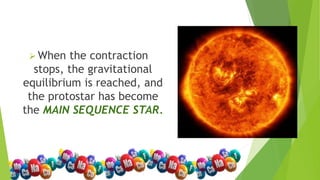
When thecontraction
stops, the gravitational
equilibrium is reached, and
the protostar has become
the MAIN SEQUENCE STAR.
A starspend most of its lifetime at this stage.
Star condition during this period is referred to as
stable main sequence star. Hot stars at this phase
are luminous blue, while cool stars are faint red.
The sun being intermediate in temperature, gives
a yellow color. A yellow star remains a main
sequence star for about 10 billion years.
13.
2. Carbon FusionCycle or CNO Cycle
ᵧ Gamma Ray
𝑽 Neutrino
Proton
Neutron
Positron
⁴He
¹He
¹He
ᵧ
ᵧ
ᵧ
𝑽
C
𝑽
C
N
13
12
13
N
N
15
14
15
1
H
O
H
1
14.
The proton-protonchain reactions will exhaust all
hydrogen in the core of a main sequence star.
Hydrogen fusion becomes significant on the outer
shell, while some of it is also fused to the core`s
surface.
When most of the hydrogen in the core
is fused into helium, fusion stops and
the pressure in the core decreases.
Helium is converted to carbon in the
core via alpha processes, increasing
the star`s core density and
temperature and subsequently
creating a RED GIANT.
15.
The rateof alpha fusion processes
decreases as carbon is formed in the
core.
Gravity again squeezes the star.
The stars fuel is depleted and over time
the outer material of the star is blown
off into space as planetary nebula.
The only thing that remains is the hot
and inert carbon. The star becomes a
white dwarf.
16.
Life Cycle ofa Star
Stellar
Nebula
Average
Star
Red
Giant
Planetary
Nebula
White
Dwarf
Proto
star
Main Sequence
Star
17.
The stargoes through a series of
stages where heavier elements are
fused in the core and the shells
around the core. The element oxygen
is formed from carbon fusion; neon
from oxygen fusion, silicon from neon
fusion; and iron from silicon fusion.
The stars become a multiple-shell
red-giant
18.
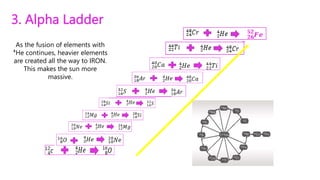
3. Alpha Ladder
Asthe fusion of elements with
⁴He continues, heavier elements
are created all the way to IRON.
This makes the sun more
massive.
19.
When thecore can no longer produce
energy to resist gravity, the star is
doomed.
Gravity squeezes the core until the star
explodes and releases a large amount of
energy.
The star explosion is called a supernova.
The explosion also releases massive
amount of high energy neutrinos which,
in turn, breaks nucleons and release
neutrons. These neutrons are picked up by nearby
stars and lead the creation of elements
heavier than Iron.
20.
Elements heavier thanIron
are formed during supernova
explosion
Supernova releases tremendous
amount of energy enough to
synthesize elements heavier
than Iron
21.
After supernovaexplosion, it is
believed that a NEUTRON STAR is
formed. Which is also known as the
smallest star.
Black hole is a region in space where
gravity is too strong that no matter can
escape from it.
22.
Life Cycle ofa Star
Stellar
Nebula
Neutron
Star
Supernova
Red
Supergiant
Massive
Star
Black
Hole
Proto
star
Main Sequence
Star
23.
As the energyat the core of the stars decreases, nuclear fusion
cannot produce elements higher than Iron, Because fusion reaction
becomes unfavorable.
This is because the
NUCLEAR BINDING ENERGY
PER NUCLEON, the energy
that holds the nucleus
intact, decreases after
Iron.
Therefore, different pathways
is needed for heavier elements
to be formed.
24.
Life Cycle
of aStar
Stellar
Nebula
Average
Star
Red
Giant
Planetary
Nebula White
Dwarf
Neutron
Star
Supernova
Red
Supergiant
Massive
Star
Black Hole
Proto
star Main Sequence
Star
25.
Synthesis of heavierelements
happens via NEUTRON CAPTURE
Neutron capture, a neutron is added to a
seed nucleus. The addition of neutron
produces a heavier isotope of the elements.
Neutron capture can be
slow or rapid.
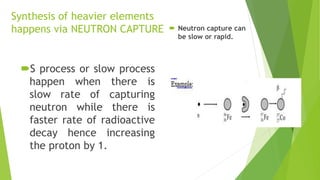
26.
Synthesis of heavierelements
happens via NEUTRON CAPTURE Neutron capture can
be slow or rapid.
S process or slow process
happen when there is
slow rate of capturing
neutron while there is
faster rate of radioactive
decay hence increasing
the proton by 1.
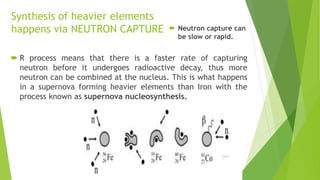
27.
Synthesis of heavierelements
happens via NEUTRON CAPTURE Neutron capture can
be slow or rapid.
R process means that there is a faster rate of capturing
neutron before it undergoes radioactive decay, thus more
neutron can be combined at the nucleus. This is what happens
in a supernova forming heavier elements than Iron with the
process known as supernova nucleosynthesis.
28.
Activity 3. Fillin the diagram with the correct
term used during the stages of star formation
where heavy elements are formed.
Direction: Fill in the diagram with the correct term used during
the stages of star formation where heavy elements are formed.












![2023.M1.PS.Formation of heavy elements [Autosaved].pptx](https://cdn.slidesharecdn.com/ss_thumbnails/2023-240807233550-cdb62ffa-thumbnail.jpg?width=640&height=640&fit=bounds)


