Chapter 9.6 Finding the formula of a Compound
How can we work out the formula of a compound? We can conduct experiments to find out the formula of a compound.  1.  First , we find out the  mass  of the reactants taking part in the reaction.  2.  Next , we work out the relative numbers of  moles  of the reactants used.
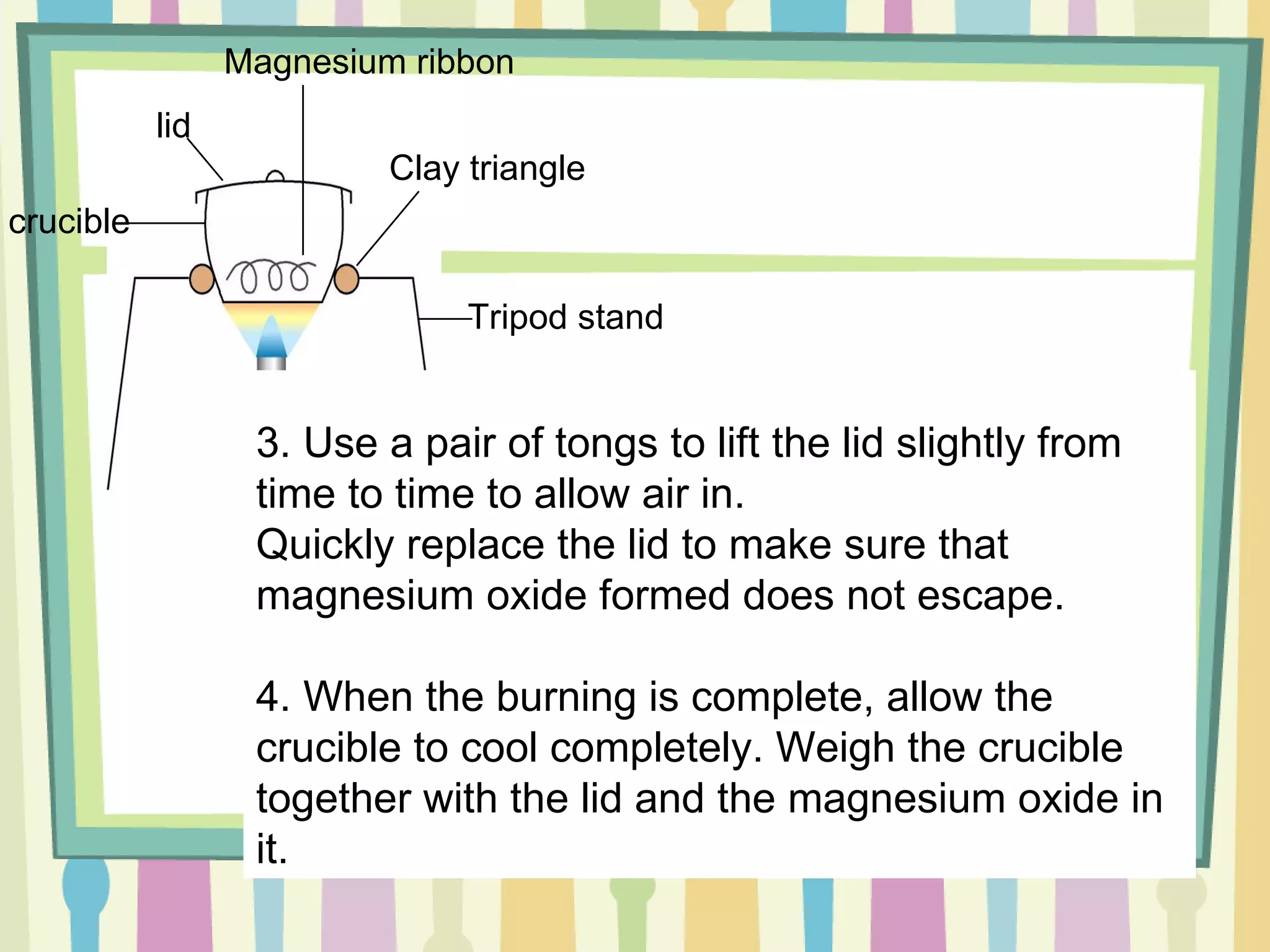
Example: Working Out the Formula of Magnesium Oxide To work out the formula of magnesium oxide produced by the combustion of magnesium, the following apparatus is used. Magnesium ribbon Clay triangle Tripod stand lid crucible
Procedure  1. Weigh a crucible together with the lid. Put a coil of magnesium ribbon in it and weigh again. 2. Put the lid on the crucible and heat the crucible gently.  When the magnesium catches fire (you will see a white glow through the crucible), heat it more strongly. Magnesium ribbon Clay triangle Tripod stand lid crucible
3. Use a pair of tongs to lift the lid slightly from time to time to allow air in.  Quickly replace the lid to make sure that magnesium oxide formed does not escape. 4. When the burning is complete, allow the crucible to cool completely. Weigh the crucible together with the lid and the magnesium oxide in it. Magnesium ribbon Clay triangle Tripod stand lid crucible
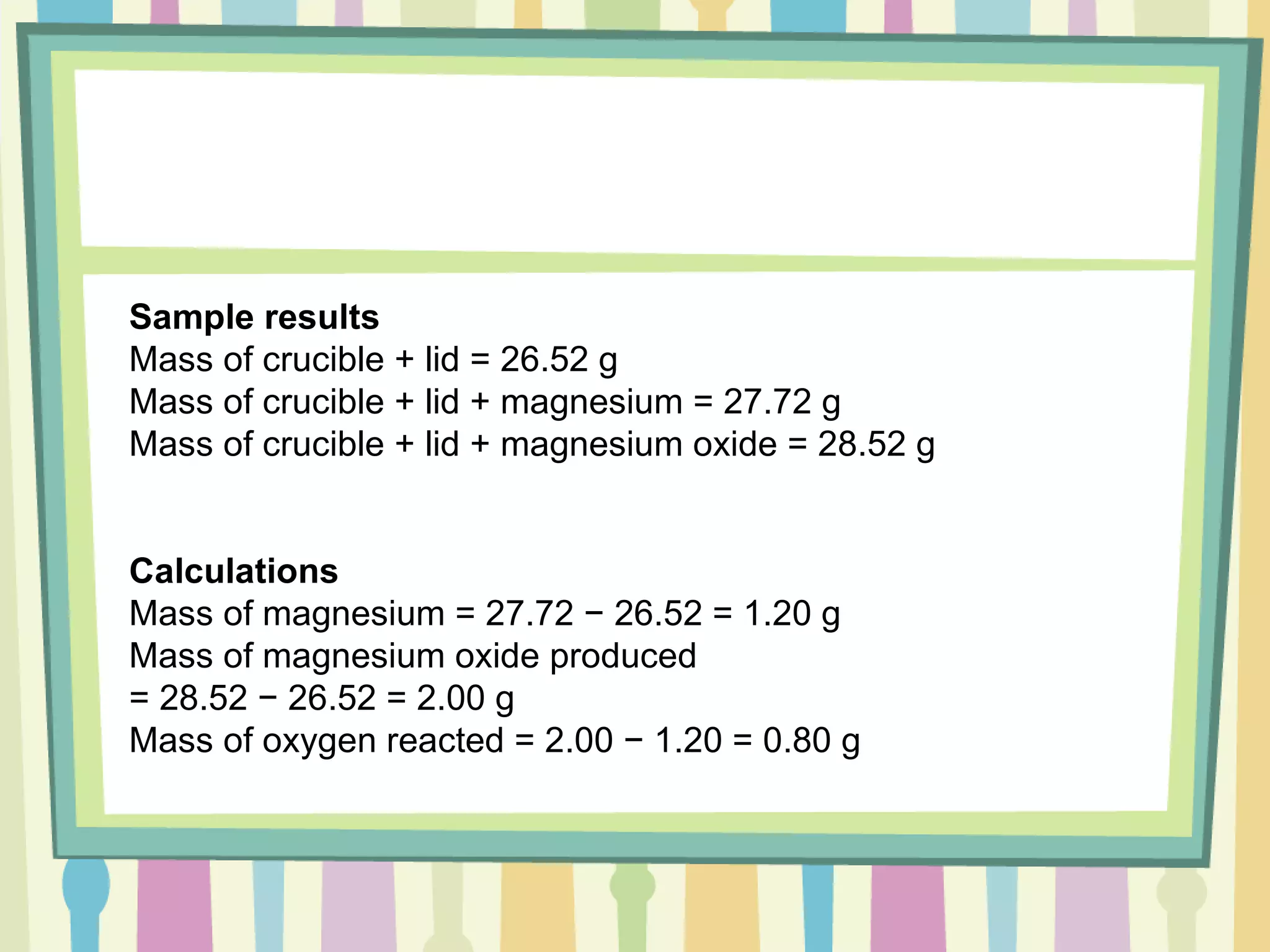
Sample results Mass of crucible + lid = 26.52 g Mass of crucible + lid + magnesium = 27.72 g Mass of crucible + lid + magnesium oxide = 28.52 g Calculations Mass of magnesium = 27.72 − 26.52 = 1.20 g Mass of magnesium oxide produced  = 28.52 − 26.52 = 2.00 g Mass of oxygen reacted = 2.00 − 1.20 = 0.80 g
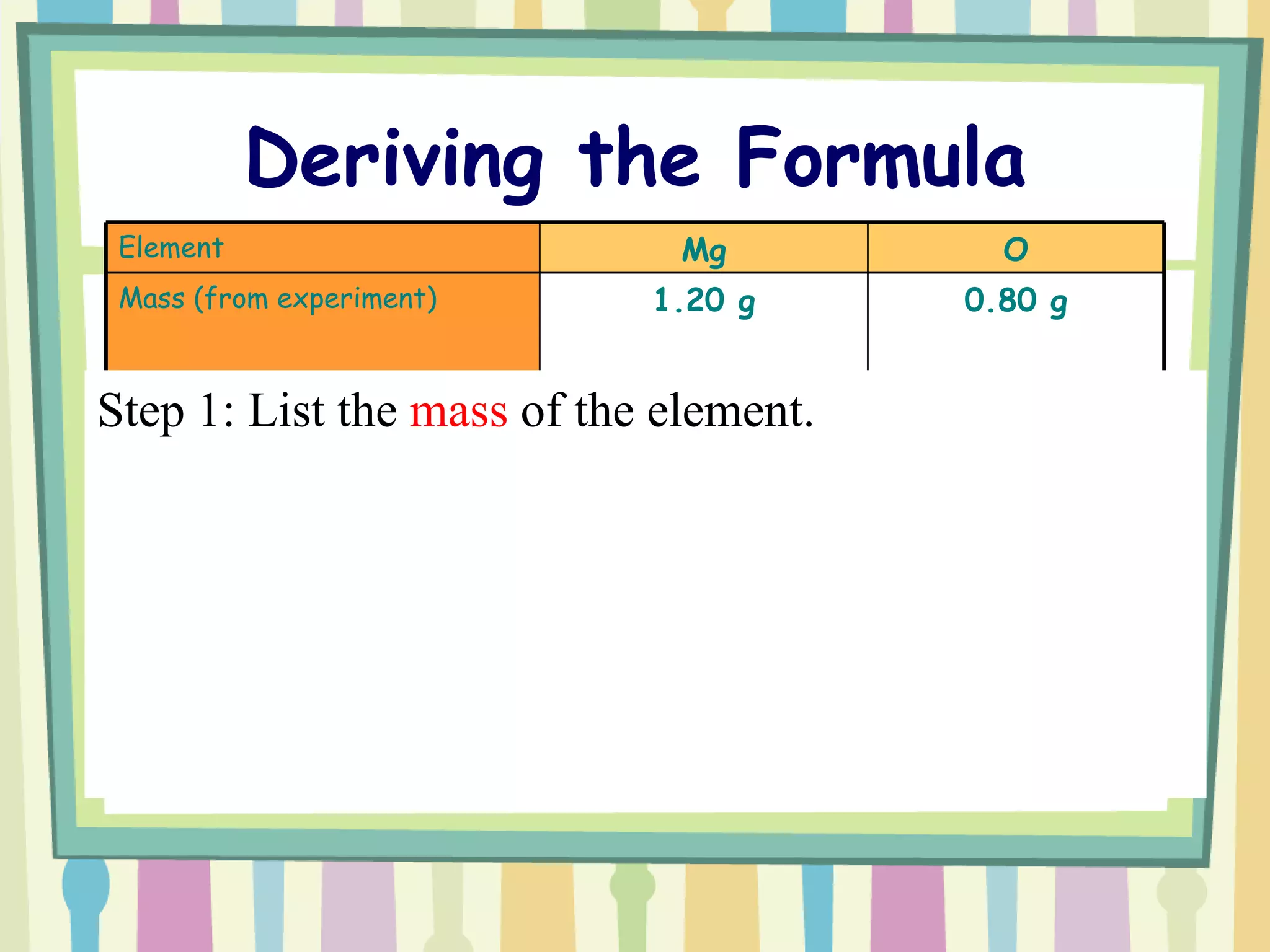
Deriving the Formula Step 1: List the  mass  of the element. Element Mg O Mass (from experiment) 1.20 g 0.80 g Relative atomic mass 24 16 Number of moles Molar ratio (divide by the smallest number from the previous row) 1.20 24 = 0.05 0.05 0.05 = 1 0.05 0.05 = 1 0.80 16 = 0.05
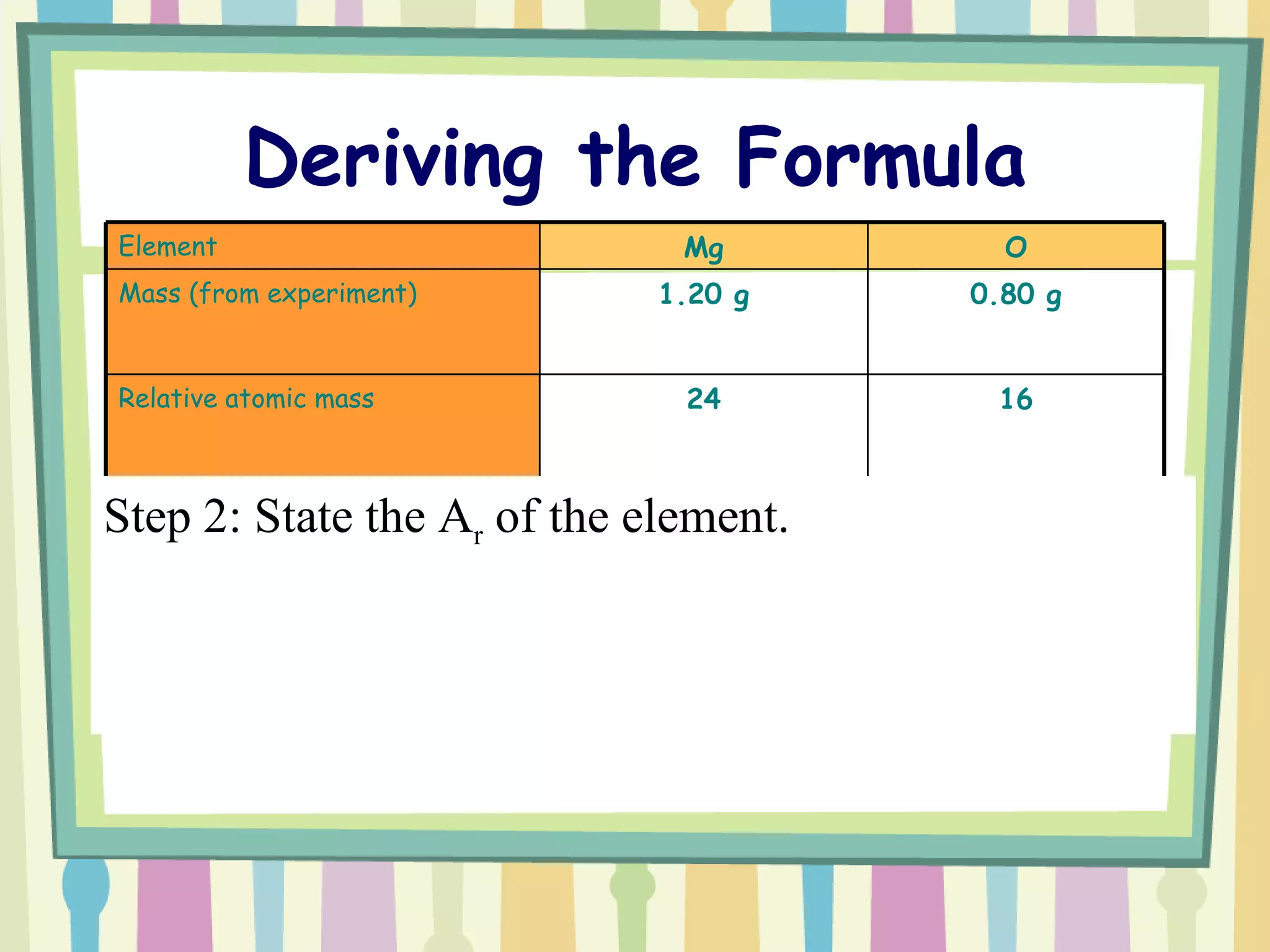
Deriving the Formula Step 2: State the A r  of the element. Molar ratio (divide by the smallest number from the previous row) Number of moles 16 24 Relative atomic mass 0.80 g 1.20 g Mass (from experiment) O Mg Element 1.20 24 = 0.05 0.05 0.05 = 1 0.05 0.05 = 1 0.80 16 = 0.05
Deriving the Formula Step 3: Derive the number of moles by dividing the mass with A r . Molar ratio (divide by the smallest number from the previous row) Number of moles 16 24 Relative atomic mass 0.80 g 1.20 g Mass (from experiment) O Mg Element 1.20 24 = 0.05 0.05 0.05 = 1 0.05 0.05 = 1 0.80 16 = 0.05
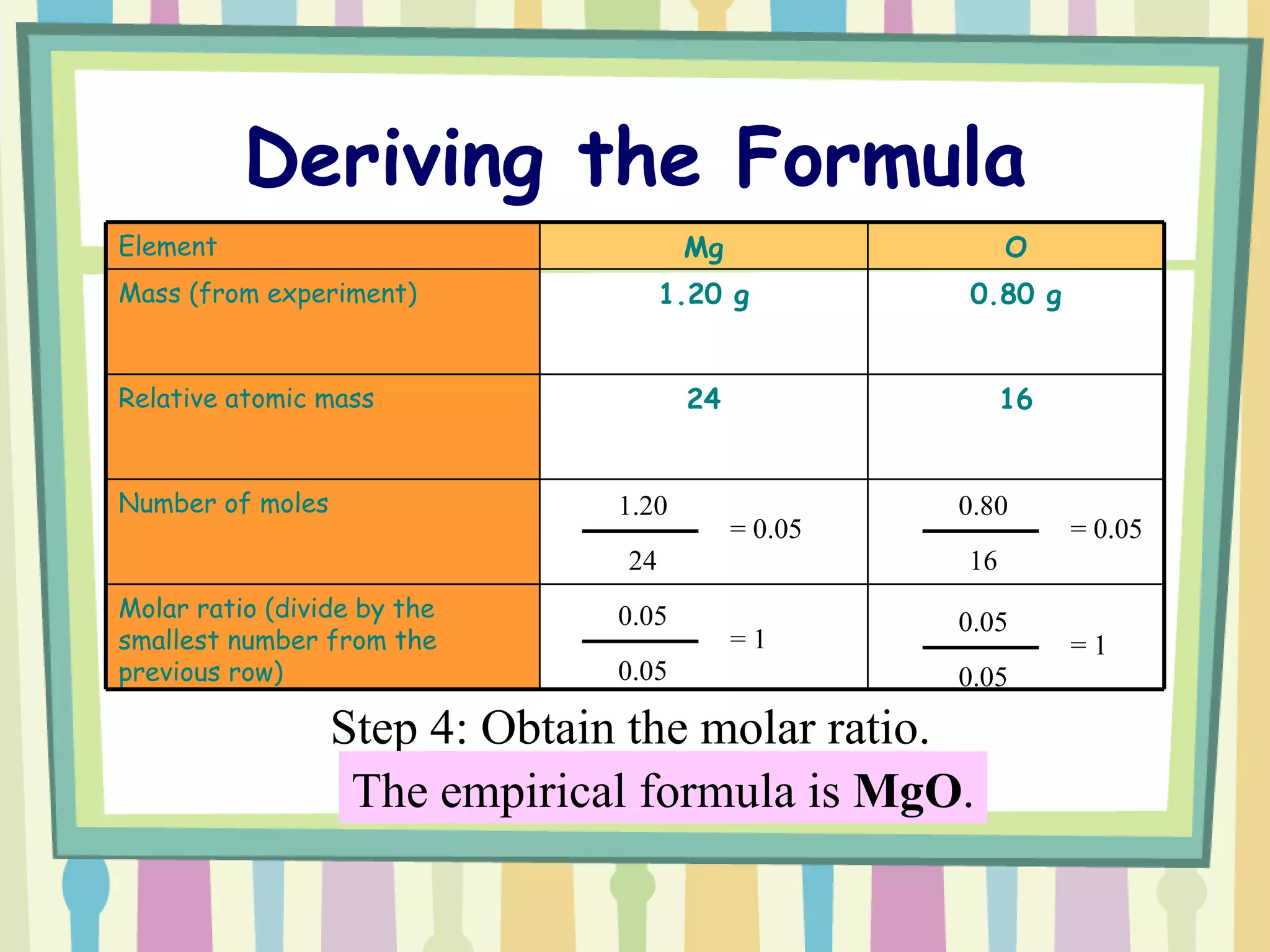
Deriving the Formula Step 4: Obtain the molar ratio. The empirical formula is  MgO . Molar ratio (divide by the smallest number from the previous row) Number of moles 16 24 Relative atomic mass 0.80 g 1.20 g Mass (from experiment) O Mg Element 1.20 24 = 0.05 0.05 0.05 = 1 0.05 0.05 = 1 0.80 16 = 0.05
Empirical Formula  simplest formula of a compound shows the types of element present in the compound  And the simplest ratio of the number of the different type of atoms in it
Worked Example 1 A sample of an oxide of copper contains 8g of copper combined with 1g of oxygen. Find the empirical formula of the compound .  Empirical formula of the compound is Cu 2 O 1   or usually written as this Cu 2 O. Element Cu O Step 1 Mass of element  8 1 Step 2: A r   64 16 Step 3: No. of Moles (Mass/ A r ) 8  = 0.125 64  1  = 0.0625 16  Step 4: Molar ratio  (Divide by smallest number) 0.125  = 2 0.0625 0.0625   = 1 0.0625
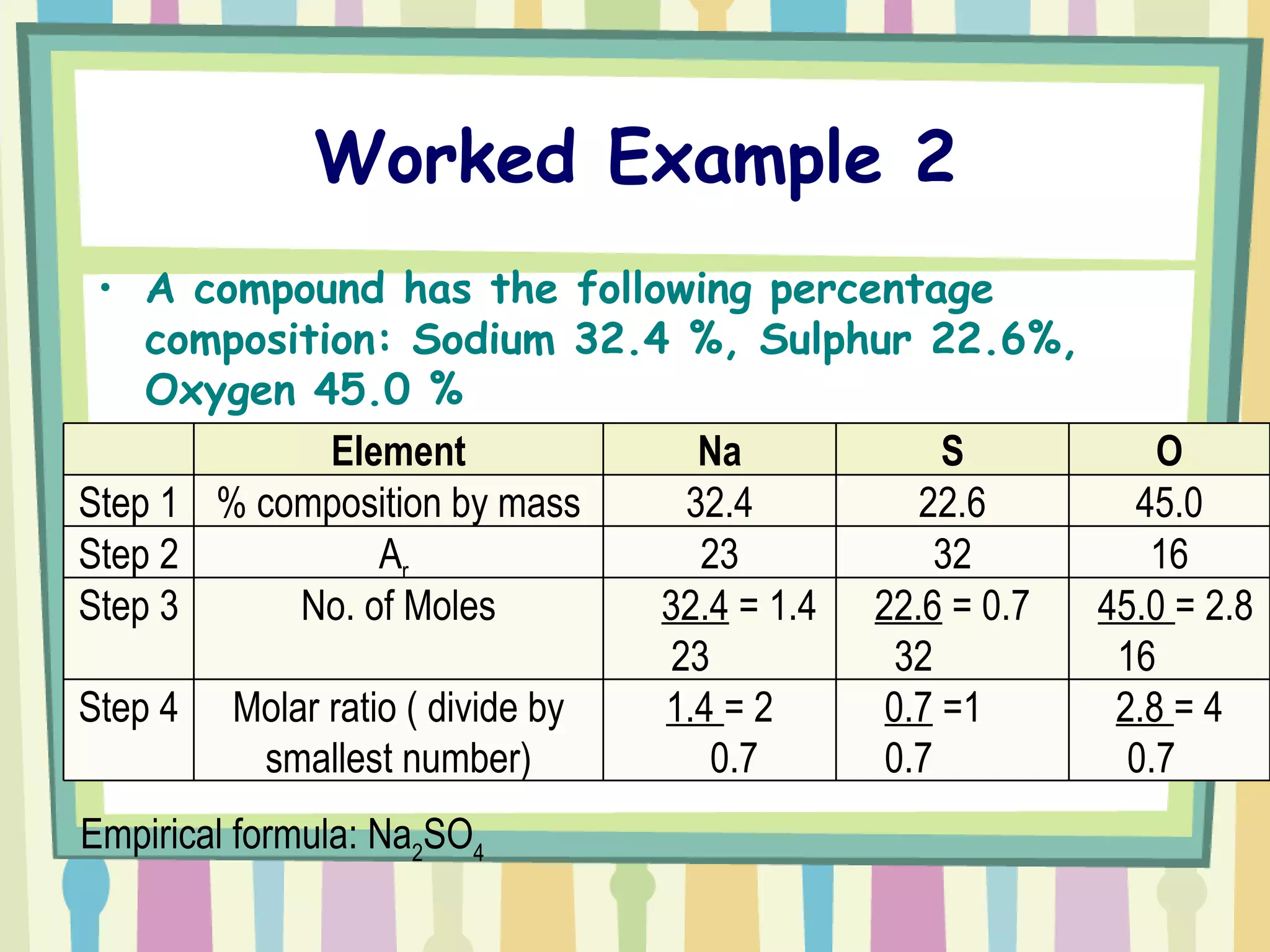
Worked Example 2 A compound has the following percentage composition: Sodium 32.4 %, Sulphur 22.6%, Oxygen 45.0 % Empirical formula: Na 2 SO 4 Element Na S O Step 1 % composition by mass 32.4 22.6 45.0 Step 2 A r   23 32 16 Step 3 No. of Moles 32.4  = 1.4 23 22.6  = 0.7 32 45.0  = 2.8 16 Step 4 Molar ratio ( divide by smallest number) 1.4  = 2 0.7 0.7  =1 0.7 2.8  = 4 0.7
Molecular Formula
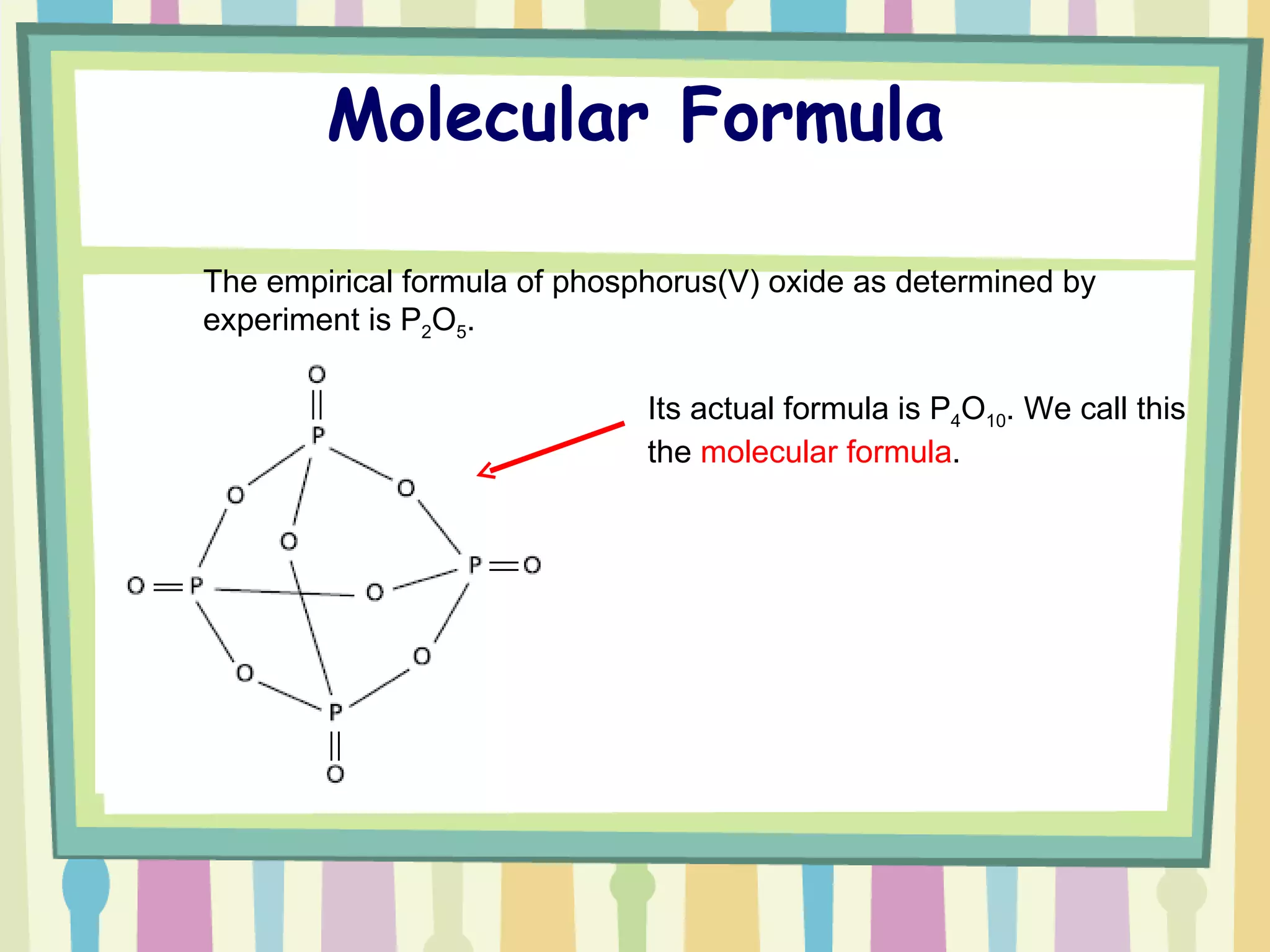
Molecular Formula Its actual formula is P 4 O 10 . We call this the  molecular formula . The empirical formula of phosphorus(V) oxide as determined by experiment is P 2 O 5 .
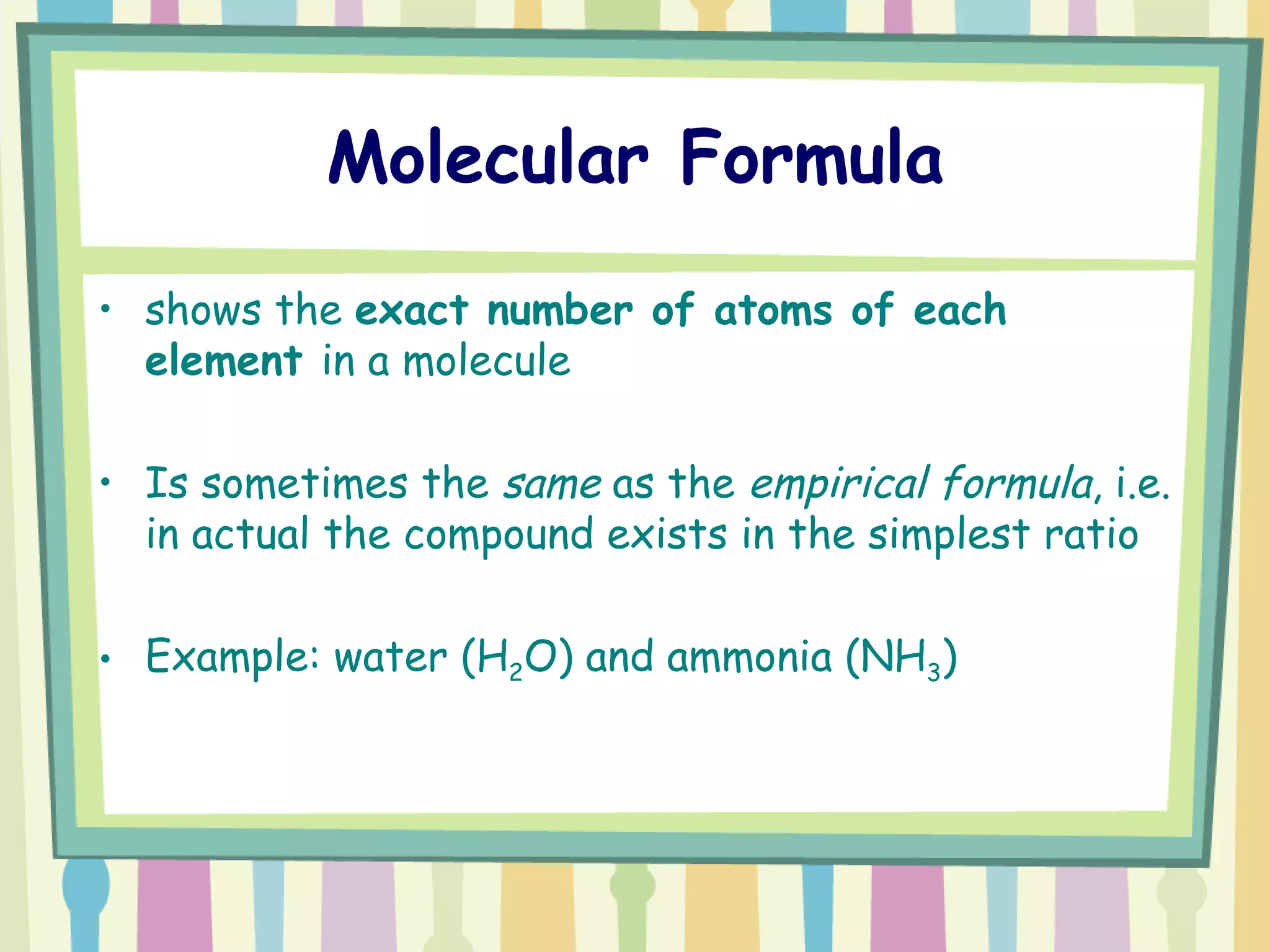
Molecular Formula shows the  exact number of atoms of each element  in a molecule  Is sometimes the  same  as the  empirical formula , i.e. in actual the compound exists in the simplest ratio  Example: water (H 2 O) and ammonia (NH 3 )
Molecular Formula However most of the compounds do not have a molecular formula that is similar to the empirical formula. If the compound’s molecular formula and empirical formula are different, the molecular formula is just a multiple of the empirical formula For example, the molecular formula and empirical formula of phosphorus(V) oxide are  P 4 O 10  and  P 2 O 5  respectively.  The multiple is 2.
Molecular Formula possible for  different compound s to have  same empirical formula .  For example: ethane has a molecular formula of C 2 H 4  propane has a molecular formula of C 3 H 6 ,  Therefore, they have the same empirical formula which is CH 2 .
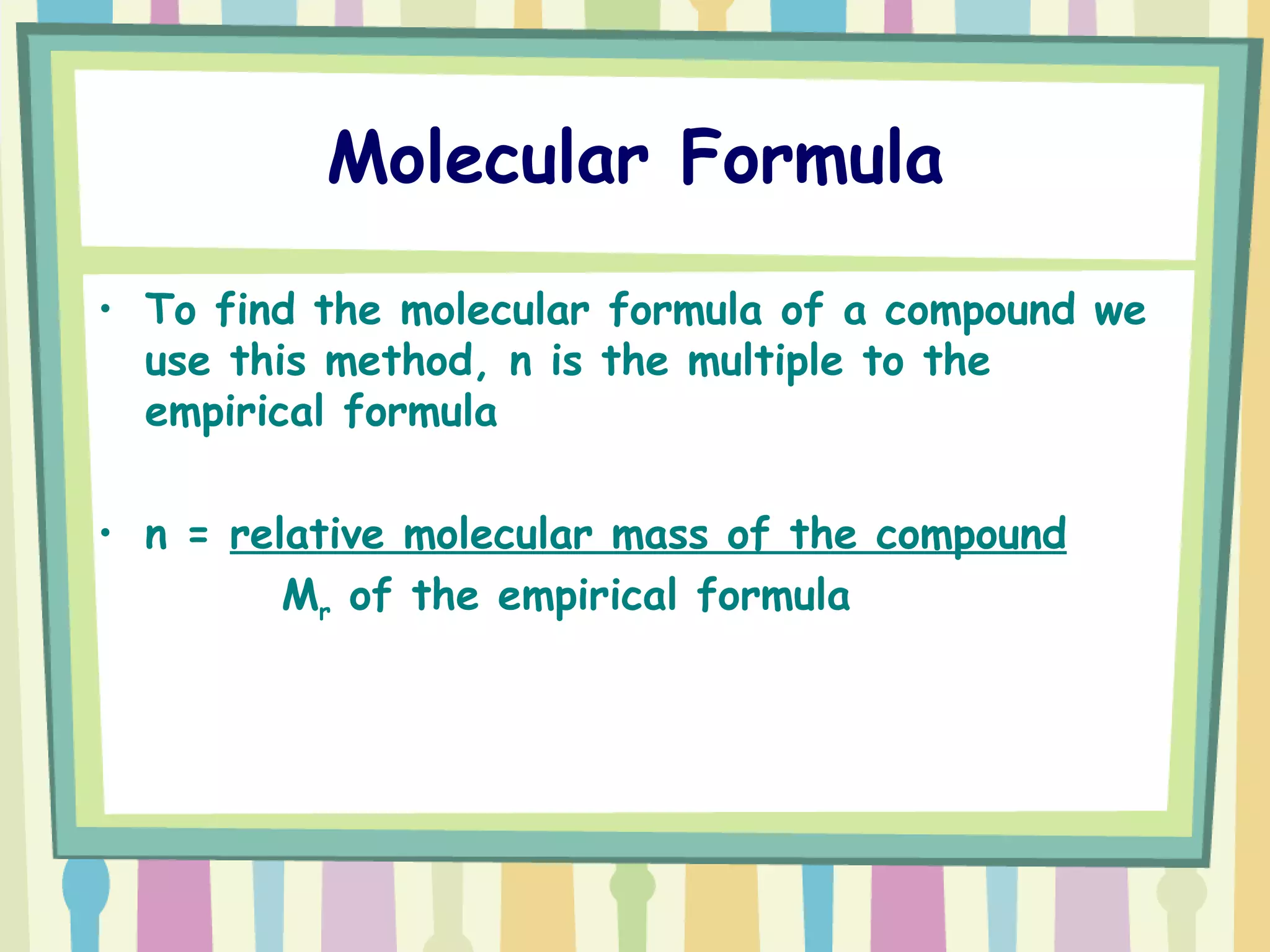
Molecular Formula To find the molecular formula of a compound we use this method, n is the multiple to the empirical formula  n =  relative molecular mass of the compound   M r  of the empirical formula
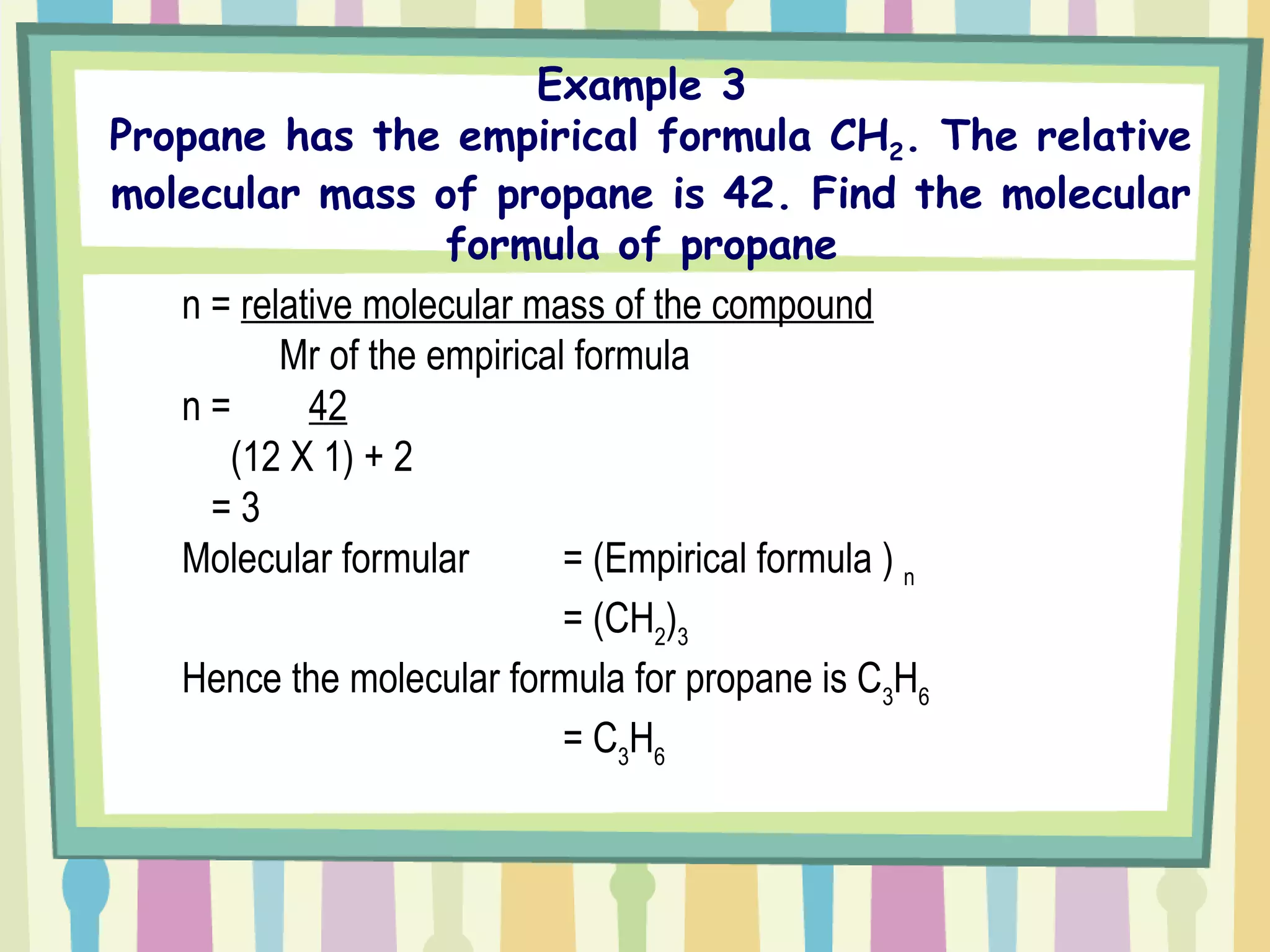
Example 3  Propane has the empirical formula CH 2 . The relative molecular mass of propane is 42. Find the molecular formula of propane  n =  relative molecular mass of the compound   Mr of the empirical formula n =  42 (12 X 1) + 2   = 3 Molecular formular  = (Empirical formula )  n = (CH 2 ) 3 Hence the molecular formula for propane is C 3 H 6 = C 3 H 6
Example 4  Compound X contains 40.0% carbon, 6.6% hydrogen and 53.3% oxygen. Its relative molecular mass is 180. What is the molecular formula of X? Molar ratio  Number of moles 16 1 12 Relative atomic mass 53.3 6.6 40.0 Percentage in compound O H C Element = 3.3 12 40.0 = 3.3 16 53.3 = 1 16 3.52 = 2 16 3.52 = 6.6 1 6.6 = 1 3.3 3.3
Example 2  (continued) Compound X contains 40.0% carbon, 6.6% hydrogen and 53.3% oxygen. Its relative molecular mass is 180. What is the molecular formula of X? The empirical formula of X is  CH 2 O . = M r  from empirical formula Relative molecular mass 180 30 =  6 Hence, the molecular formula of X =  (CH 2 O) 6  =  C 6 H 12 O 6 M r  of CH 2 O = 12 + (2 x 1) + 16 = 30 n =

The Mole 9.6

  • 1.
    Chapter 9.6 Findingthe formula of a Compound
  • 2.
    How can wework out the formula of a compound? We can conduct experiments to find out the formula of a compound. 1. First , we find out the mass of the reactants taking part in the reaction. 2. Next , we work out the relative numbers of moles of the reactants used.
  • 3.
    Example: Working Outthe Formula of Magnesium Oxide To work out the formula of magnesium oxide produced by the combustion of magnesium, the following apparatus is used. Magnesium ribbon Clay triangle Tripod stand lid crucible
  • 4.
    Procedure 1.Weigh a crucible together with the lid. Put a coil of magnesium ribbon in it and weigh again. 2. Put the lid on the crucible and heat the crucible gently. When the magnesium catches fire (you will see a white glow through the crucible), heat it more strongly. Magnesium ribbon Clay triangle Tripod stand lid crucible
  • 5.
    3. Use apair of tongs to lift the lid slightly from time to time to allow air in. Quickly replace the lid to make sure that magnesium oxide formed does not escape. 4. When the burning is complete, allow the crucible to cool completely. Weigh the crucible together with the lid and the magnesium oxide in it. Magnesium ribbon Clay triangle Tripod stand lid crucible
  • 6.
    Sample results Massof crucible + lid = 26.52 g Mass of crucible + lid + magnesium = 27.72 g Mass of crucible + lid + magnesium oxide = 28.52 g Calculations Mass of magnesium = 27.72 − 26.52 = 1.20 g Mass of magnesium oxide produced = 28.52 − 26.52 = 2.00 g Mass of oxygen reacted = 2.00 − 1.20 = 0.80 g
  • 7.
    Deriving the FormulaStep 1: List the mass of the element. Element Mg O Mass (from experiment) 1.20 g 0.80 g Relative atomic mass 24 16 Number of moles Molar ratio (divide by the smallest number from the previous row) 1.20 24 = 0.05 0.05 0.05 = 1 0.05 0.05 = 1 0.80 16 = 0.05
  • 8.
    Deriving the FormulaStep 2: State the A r of the element. Molar ratio (divide by the smallest number from the previous row) Number of moles 16 24 Relative atomic mass 0.80 g 1.20 g Mass (from experiment) O Mg Element 1.20 24 = 0.05 0.05 0.05 = 1 0.05 0.05 = 1 0.80 16 = 0.05
  • 9.
    Deriving the FormulaStep 3: Derive the number of moles by dividing the mass with A r . Molar ratio (divide by the smallest number from the previous row) Number of moles 16 24 Relative atomic mass 0.80 g 1.20 g Mass (from experiment) O Mg Element 1.20 24 = 0.05 0.05 0.05 = 1 0.05 0.05 = 1 0.80 16 = 0.05
  • 10.
    Deriving the FormulaStep 4: Obtain the molar ratio. The empirical formula is MgO . Molar ratio (divide by the smallest number from the previous row) Number of moles 16 24 Relative atomic mass 0.80 g 1.20 g Mass (from experiment) O Mg Element 1.20 24 = 0.05 0.05 0.05 = 1 0.05 0.05 = 1 0.80 16 = 0.05
  • 11.
    Empirical Formula simplest formula of a compound shows the types of element present in the compound And the simplest ratio of the number of the different type of atoms in it
  • 12.
    Worked Example 1A sample of an oxide of copper contains 8g of copper combined with 1g of oxygen. Find the empirical formula of the compound . Empirical formula of the compound is Cu 2 O 1 or usually written as this Cu 2 O. Element Cu O Step 1 Mass of element 8 1 Step 2: A r 64 16 Step 3: No. of Moles (Mass/ A r ) 8 = 0.125 64 1 = 0.0625 16 Step 4: Molar ratio (Divide by smallest number) 0.125 = 2 0.0625 0.0625 = 1 0.0625
  • 13.
    Worked Example 2A compound has the following percentage composition: Sodium 32.4 %, Sulphur 22.6%, Oxygen 45.0 % Empirical formula: Na 2 SO 4 Element Na S O Step 1 % composition by mass 32.4 22.6 45.0 Step 2 A r 23 32 16 Step 3 No. of Moles 32.4 = 1.4 23 22.6 = 0.7 32 45.0 = 2.8 16 Step 4 Molar ratio ( divide by smallest number) 1.4 = 2 0.7 0.7 =1 0.7 2.8 = 4 0.7
  • 14.
  • 15.
    Molecular Formula Itsactual formula is P 4 O 10 . We call this the molecular formula . The empirical formula of phosphorus(V) oxide as determined by experiment is P 2 O 5 .
  • 16.
    Molecular Formula showsthe exact number of atoms of each element in a molecule Is sometimes the same as the empirical formula , i.e. in actual the compound exists in the simplest ratio Example: water (H 2 O) and ammonia (NH 3 )
  • 17.
    Molecular Formula Howevermost of the compounds do not have a molecular formula that is similar to the empirical formula. If the compound’s molecular formula and empirical formula are different, the molecular formula is just a multiple of the empirical formula For example, the molecular formula and empirical formula of phosphorus(V) oxide are P 4 O 10 and P 2 O 5 respectively. The multiple is 2.
  • 18.
    Molecular Formula possiblefor different compound s to have same empirical formula . For example: ethane has a molecular formula of C 2 H 4 propane has a molecular formula of C 3 H 6 , Therefore, they have the same empirical formula which is CH 2 .
  • 19.
    Molecular Formula Tofind the molecular formula of a compound we use this method, n is the multiple to the empirical formula n = relative molecular mass of the compound M r of the empirical formula
  • 20.
    Example 3 Propane has the empirical formula CH 2 . The relative molecular mass of propane is 42. Find the molecular formula of propane n = relative molecular mass of the compound Mr of the empirical formula n = 42 (12 X 1) + 2 = 3 Molecular formular = (Empirical formula ) n = (CH 2 ) 3 Hence the molecular formula for propane is C 3 H 6 = C 3 H 6
  • 21.
    Example 4 Compound X contains 40.0% carbon, 6.6% hydrogen and 53.3% oxygen. Its relative molecular mass is 180. What is the molecular formula of X? Molar ratio Number of moles 16 1 12 Relative atomic mass 53.3 6.6 40.0 Percentage in compound O H C Element = 3.3 12 40.0 = 3.3 16 53.3 = 1 16 3.52 = 2 16 3.52 = 6.6 1 6.6 = 1 3.3 3.3
  • 22.
    Example 2 (continued) Compound X contains 40.0% carbon, 6.6% hydrogen and 53.3% oxygen. Its relative molecular mass is 180. What is the molecular formula of X? The empirical formula of X is CH 2 O . = M r from empirical formula Relative molecular mass 180 30 = 6 Hence, the molecular formula of X = (CH 2 O) 6 = C 6 H 12 O 6 M r of CH 2 O = 12 + (2 x 1) + 16 = 30 n =