The Mole
Copyright © 2006-2011 Marshall Cavendish International (Singapore) Pte. Ltd.
How can we measure the mass of an
atom?
Chemists often compare masses of different atoms
with the carbon-12 atom (an isotope of carbon).
Atoms also have very small masses,
so it is not practical to use the actual masses of
atoms in calculations.
The masses of all other atoms are compared with
one-twelfth the mass of one carbon-12 atom.
Copyright © 2006-2011 Marshall Cavendish International (Singapore) Pte. Ltd.
Relative Atomic Mass
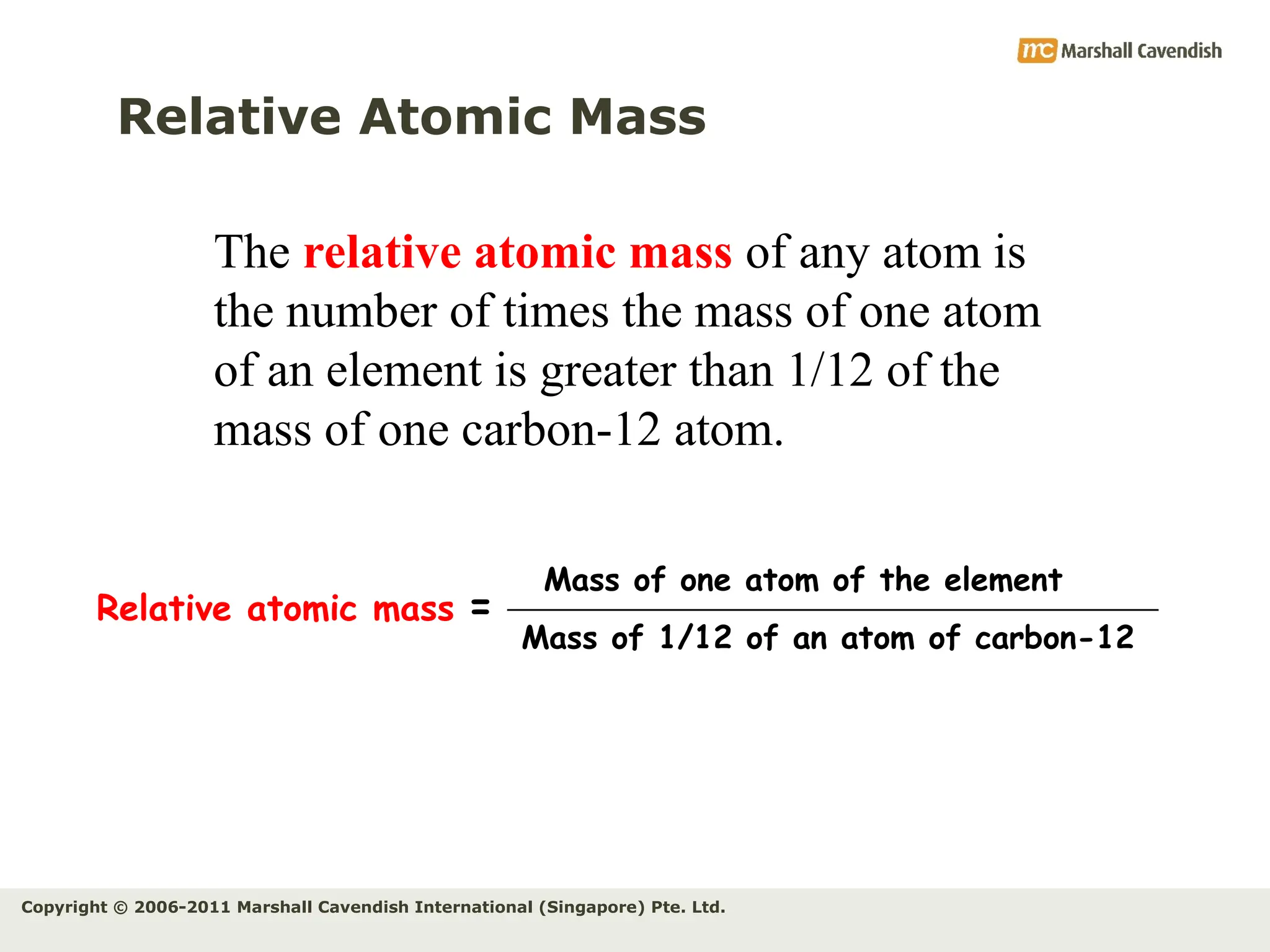
The relative atomic mass of any atom is
the number of times the mass of one atom
of an element is greater than 1/12 of the
mass of one carbon-12 atom.
Relative atomic mass =
Mass of 1/12 of an atom of carbon-12
Mass of one atom of the element
Copyright © 2006-2011 Marshall Cavendish International (Singapore) Pte. Ltd.
Relative Atomic Mass
The symbol for relative atomic mass is Ar.
Relative atomic mass is a ratio and has no unit.
The relative atomic mass of each element is
given in the Periodic Table.
Copyright © 2006-2011 Marshall Cavendish International (Singapore) Pte. Ltd.
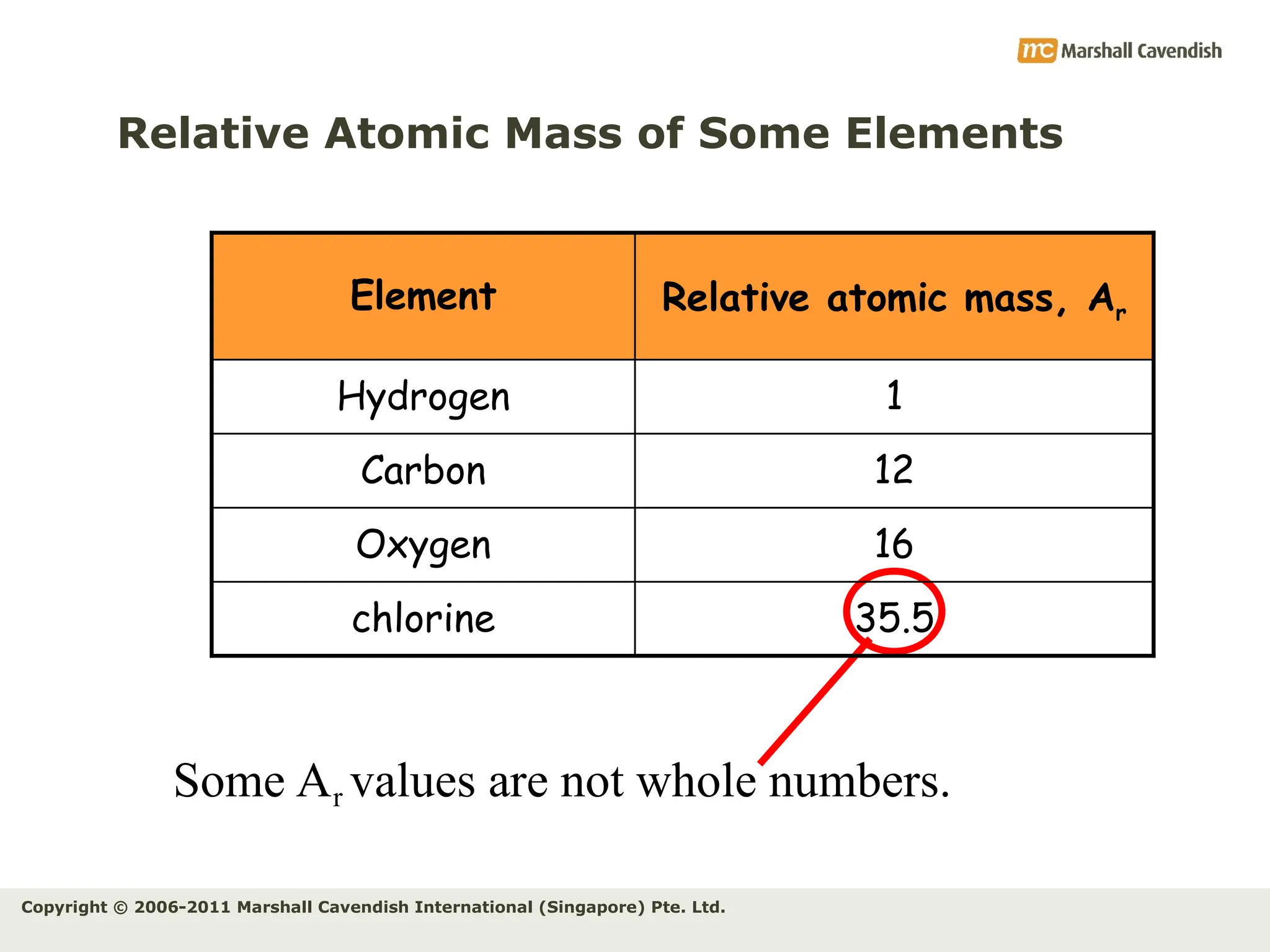
Relative Atomic Mass of Some Elements
Some Ar values are not whole numbers.
35.5
chlorine
16
Oxygen
12
Carbon
1
Hydrogen
Relative atomic mass, Ar
Element
Copyright © 2006-2011 Marshall Cavendish International (Singapore) Pte. Ltd.
Why are some Ar values not whole
numbers?
This is because such elements occur as
mixtures of isotopes.
For example, chlorine exists in two isotopic
forms: chlorine-35 and chlorine-37.
Copyright © 2006-2011 Marshall Cavendish International (Singapore) Pte. Ltd.
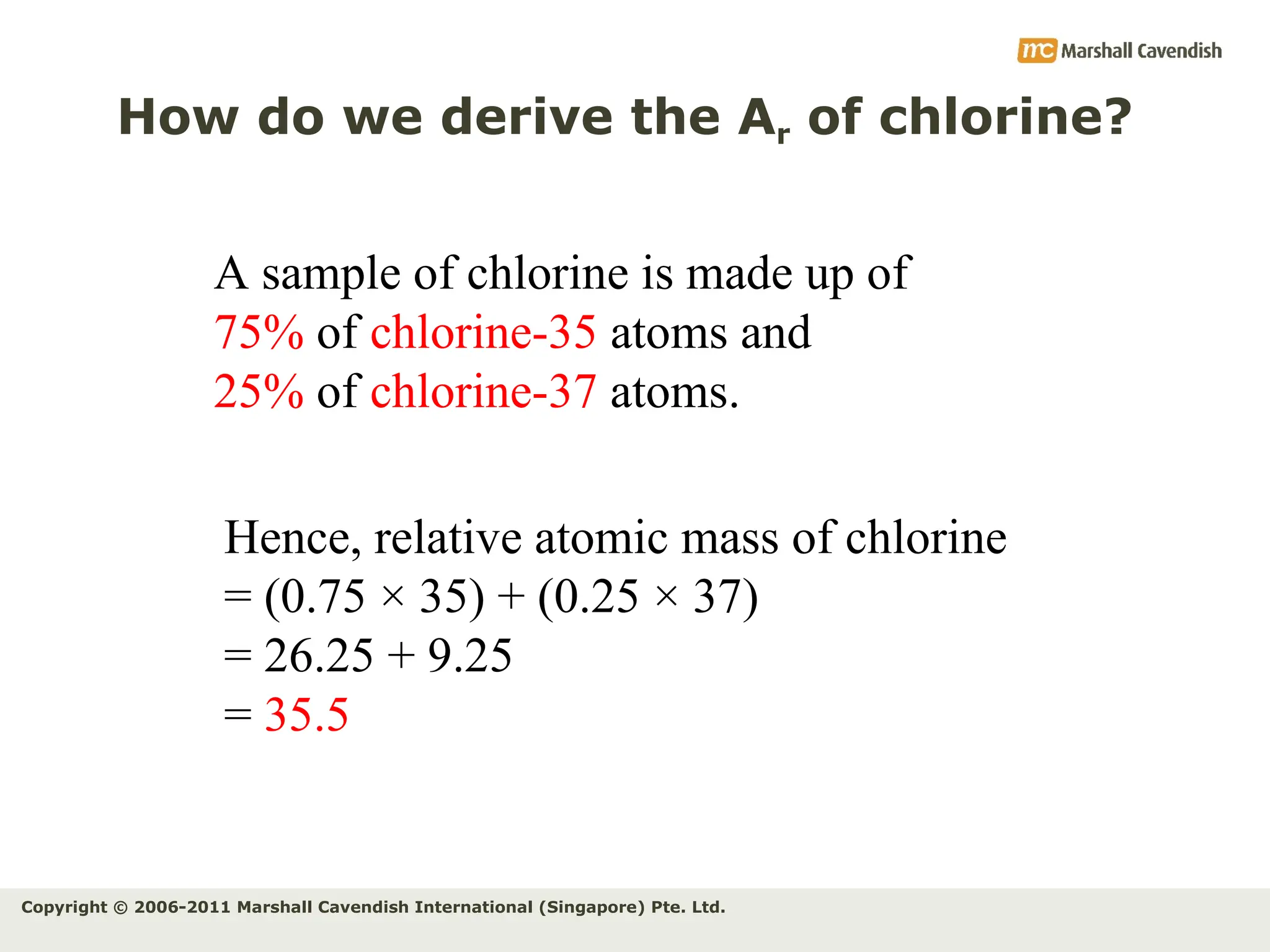
How do we derive the Ar of chlorine?
Hence, relative atomic mass of chlorine
= (0.75 × 35) + (0.25 × 37)
= 26.25 + 9.25
= 35.5
A sample of chlorine is made up of
75% of chlorine-35 atoms and
25% of chlorine-37 atoms.
Copyright © 2006-2011 Marshall Cavendish International (Singapore) Pte. Ltd.
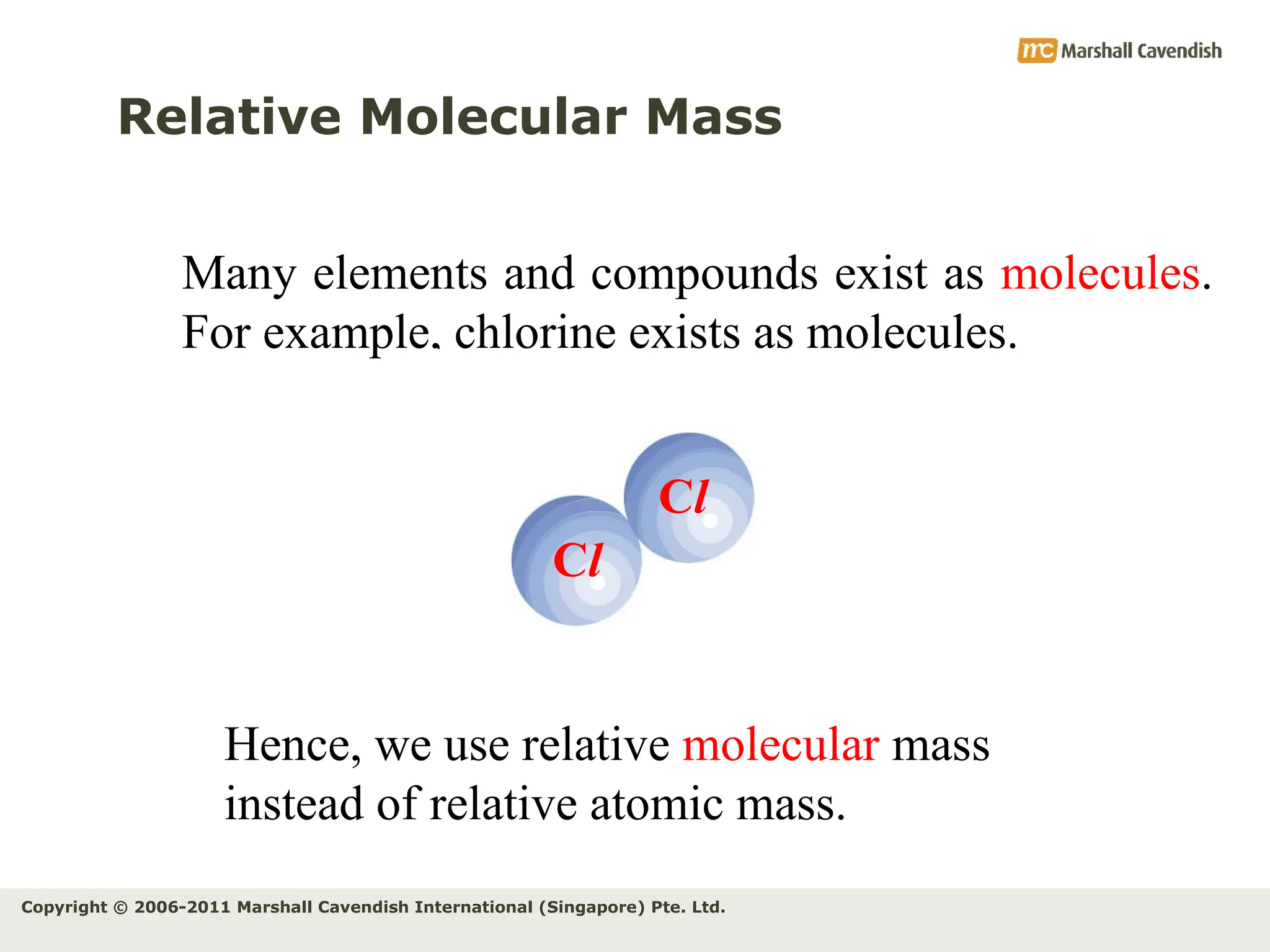
Relative Molecular Mass
Many elements and compounds exist as molecules.
For example, chlorine exists as molecules.
Cl
Cl
Hence, we use relative molecular mass
instead of relative atomic mass.
Copyright © 2006-2011 Marshall Cavendish International (Singapore) Pte. Ltd.
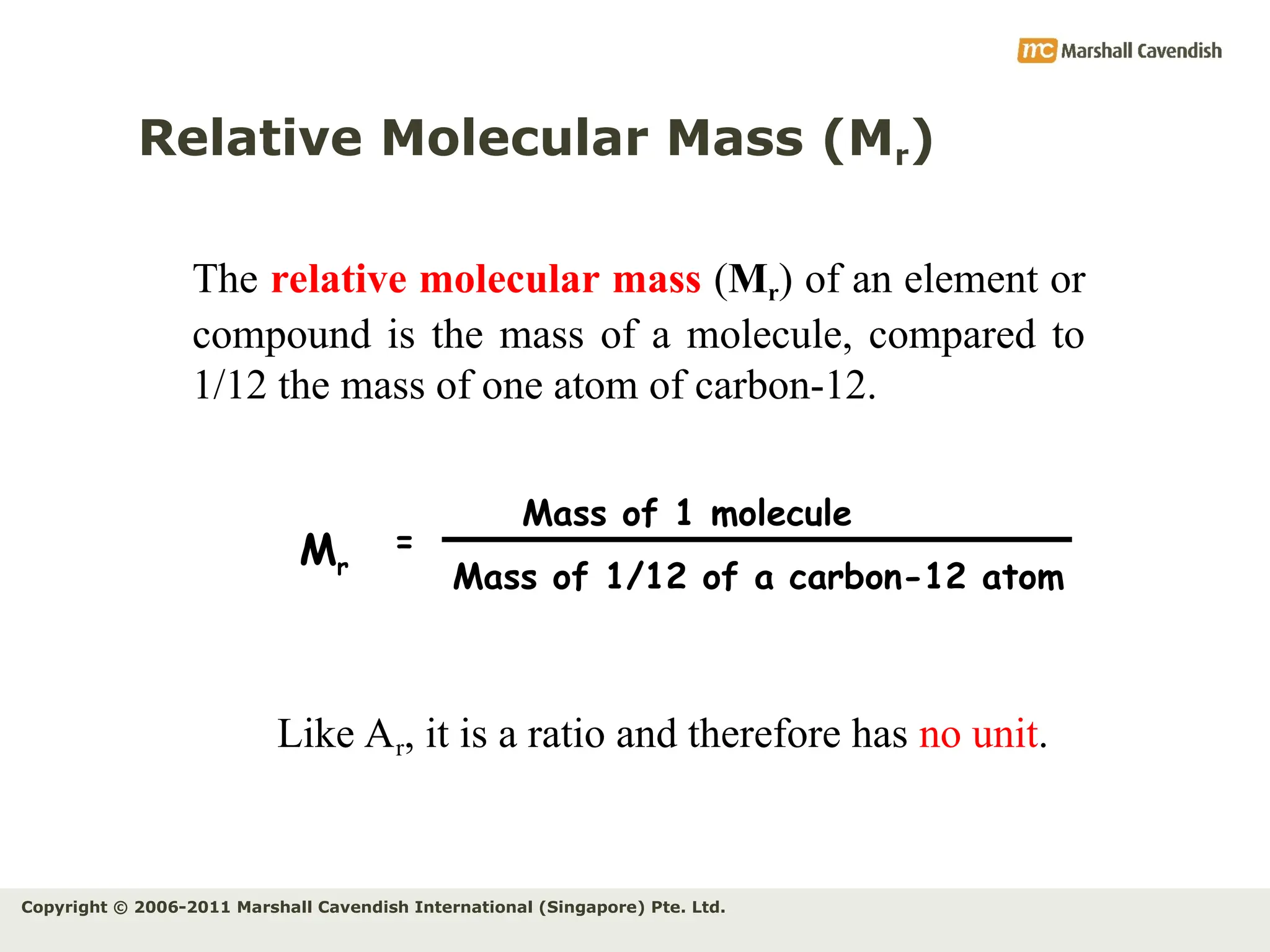
The relative molecular mass (Mr) of an element or
compound is the mass of a molecule, compared to
1/12 the mass of one atom of carbon-12.
Like Ar, it is a ratio and therefore has no unit.
Relative Molecular Mass (Mr)
Mr
Mass of 1 molecule
Mass of 1/12 of a carbon-12 atom
=
Copyright © 2006-2011 Marshall Cavendish International (Singapore) Pte. Ltd.
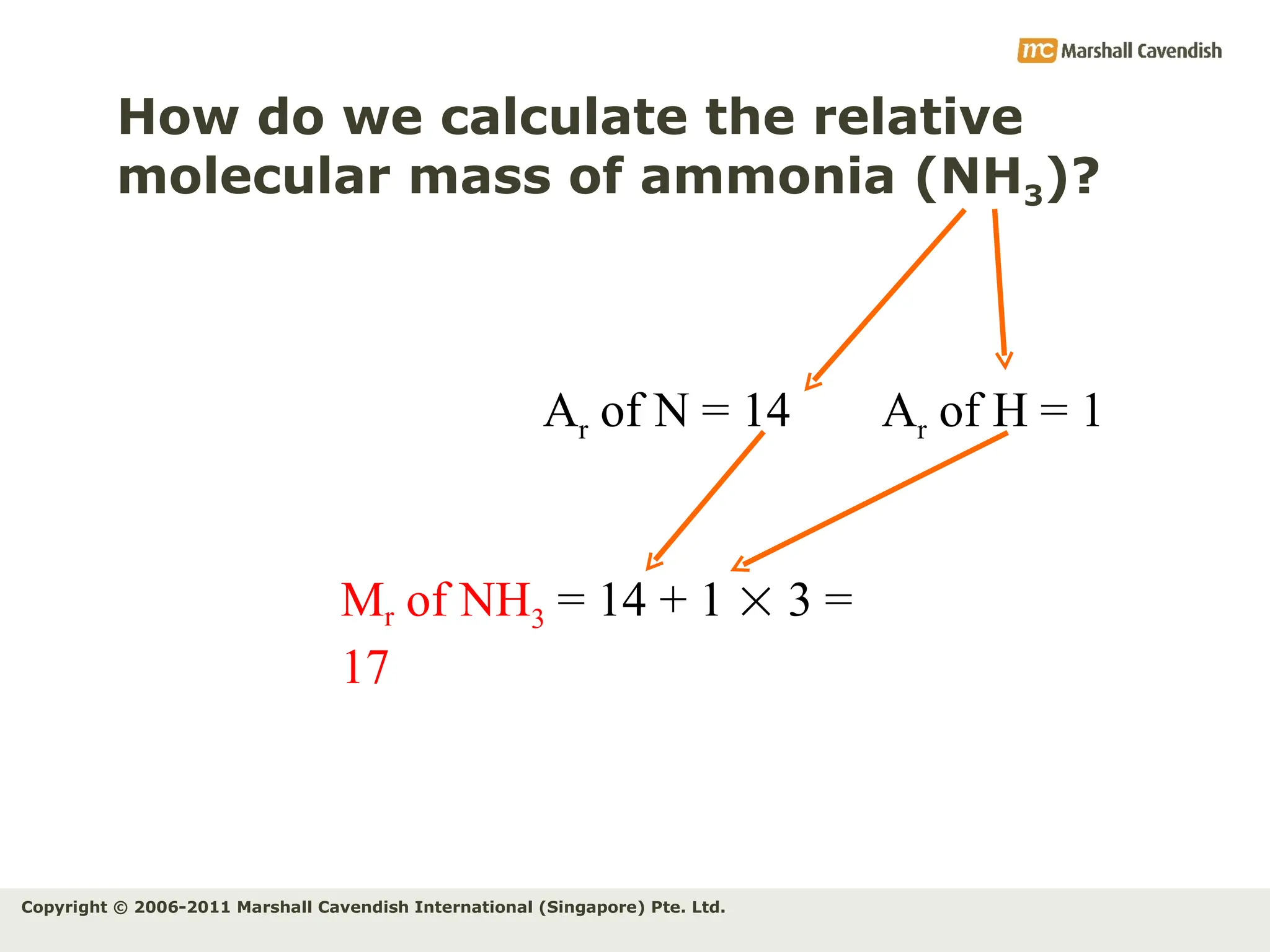
How do we calculate the relative
molecular mass of ammonia (NH3)?
Ar of N = 14 Ar of H = 1
Mr of NH3 = 14 + 1  3 =
17
Copyright © 2006-2011 Marshall Cavendish International (Singapore) Pte. Ltd.
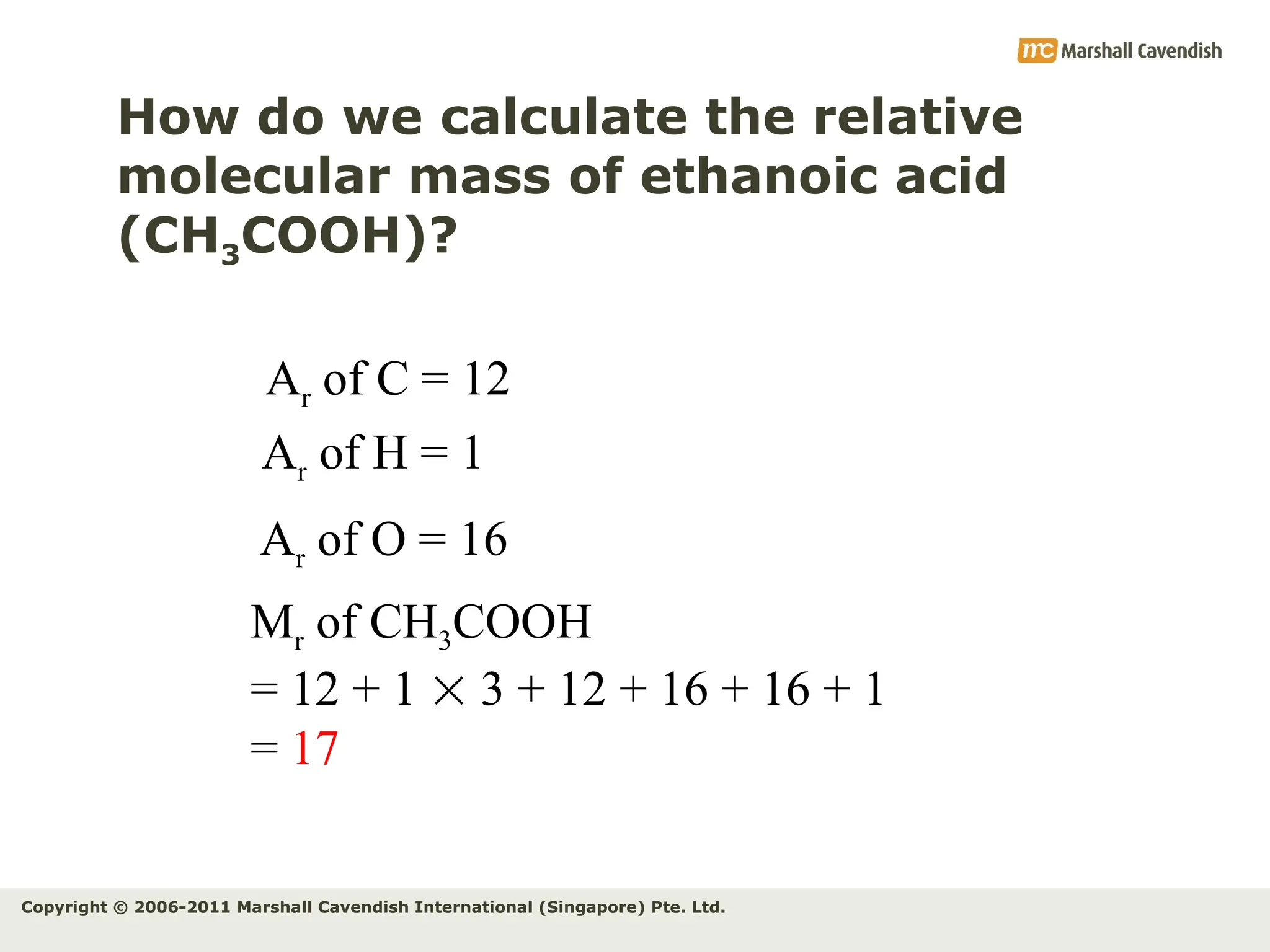
How do we calculate the relative
molecular mass of ethanoic acid
(CH3COOH)?
Ar of C = 12
Ar of H = 1
Mr of CH3COOH
= 12 + 1  3 + 12 + 16 + 16 + 1
= 17
Ar of O = 16
Copyright © 2006-2011 Marshall Cavendish International (Singapore) Pte. Ltd.
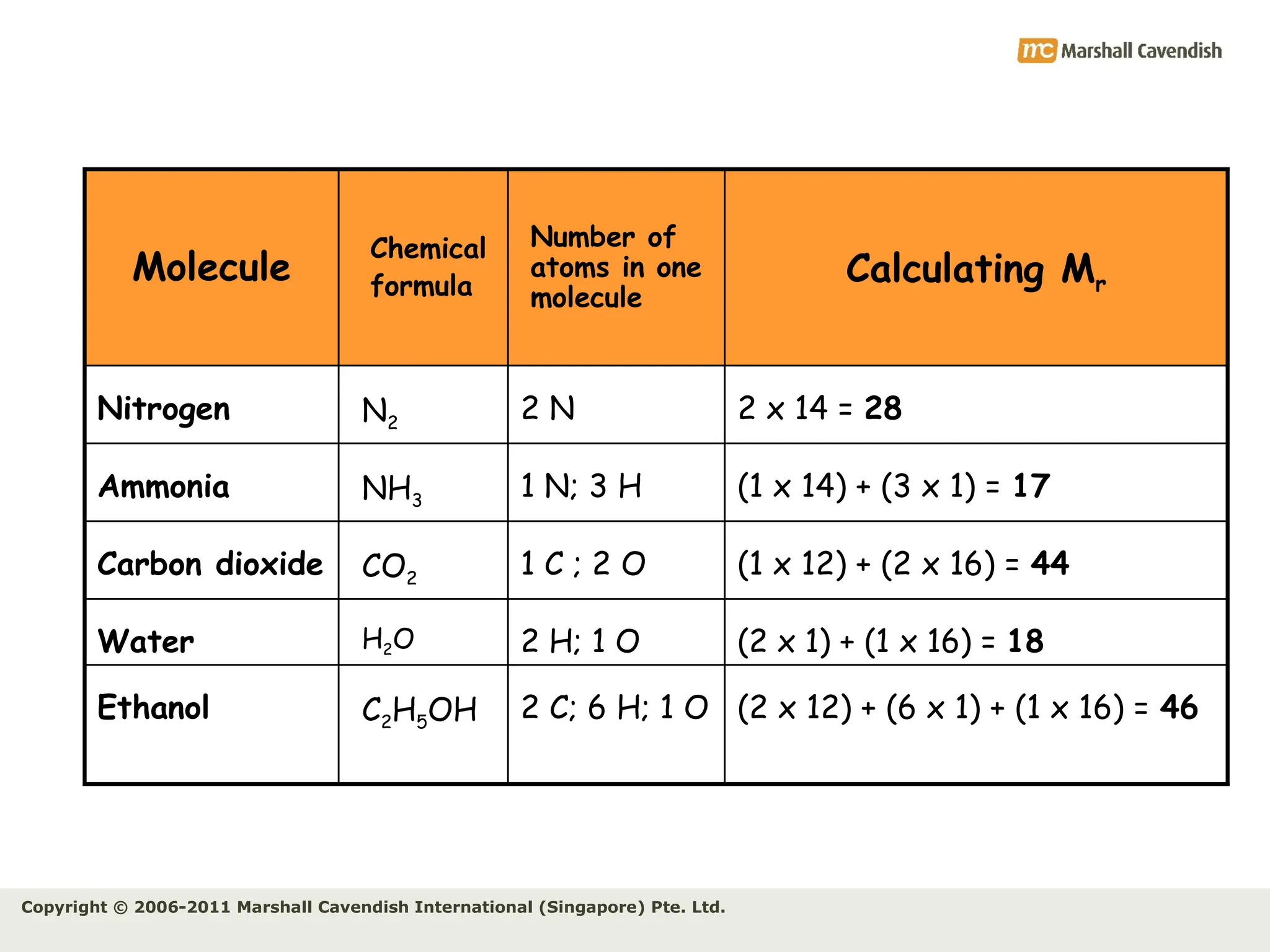
(2 x 12) + (6 x 1) + (1 x 16) = 46
2 C; 6 H; 1 O
C2H5OH
Ethanol
(2 x 1) + (1 x 16) = 18
2 H; 1 O
H2O
Water
(1 x 12) + (2 x 16) = 44
1 C ; 2 O
CO2
Carbon dioxide
(1 x 14) + (3 x 1) = 17
1 N; 3 H
NH3
Ammonia
2 x 14 = 28
2 N
N2
Nitrogen
Calculating Mr
Number of
atoms in one
molecule
Chemical
formula
Molecule
Copyright © 2006-2011 Marshall Cavendish International (Singapore) Pte. Ltd.
Relative Formula Mass
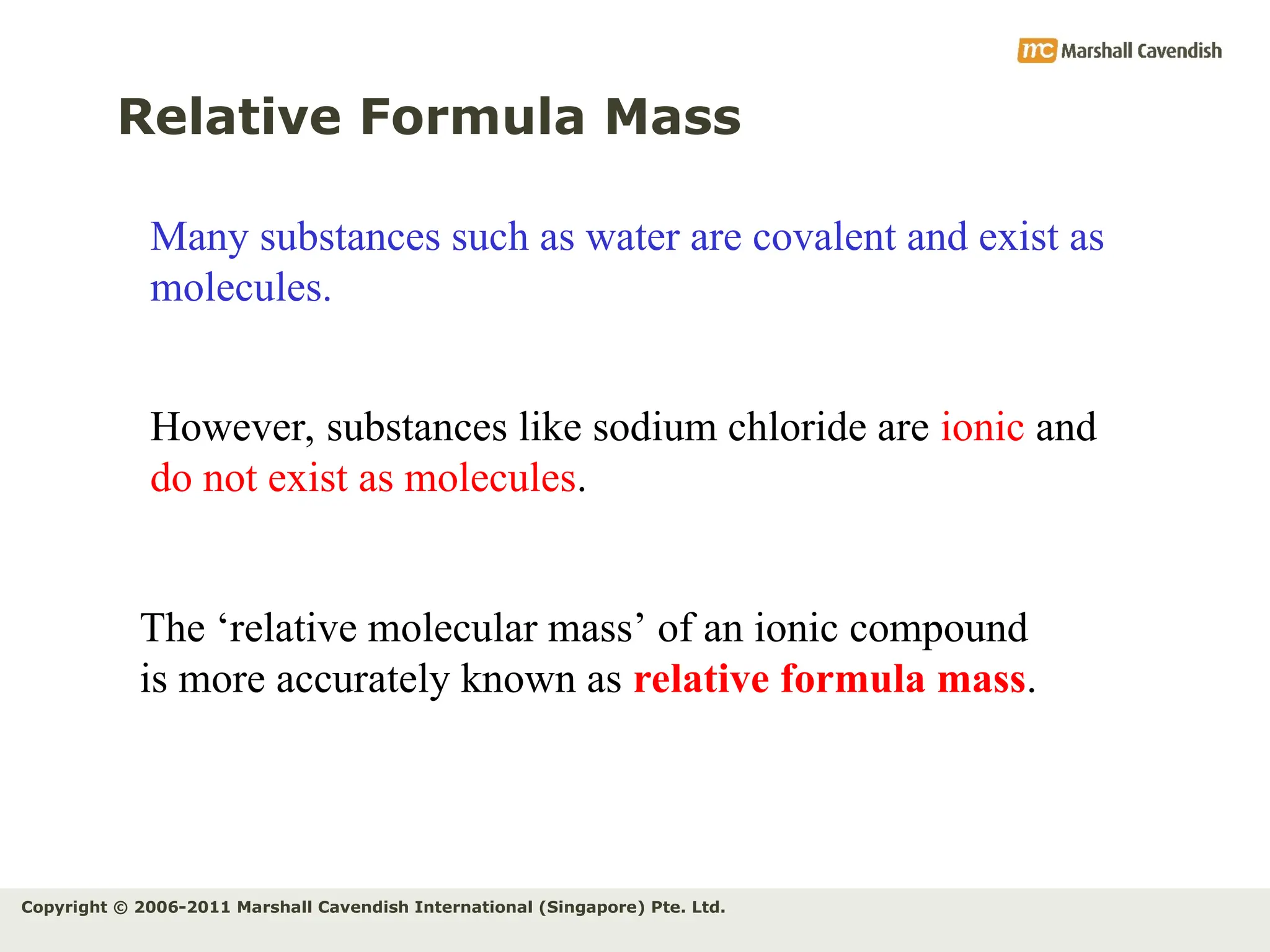
Many substances such as water are covalent and exist as
molecules.
However, substances like sodium chloride are ionic and
do not exist as molecules.
The ‘relative molecular mass’ of an ionic compound
is more accurately known as relative formula mass.
Copyright © 2006-2011 Marshall Cavendish International (Singapore) Pte. Ltd.
Relative Formula Mass
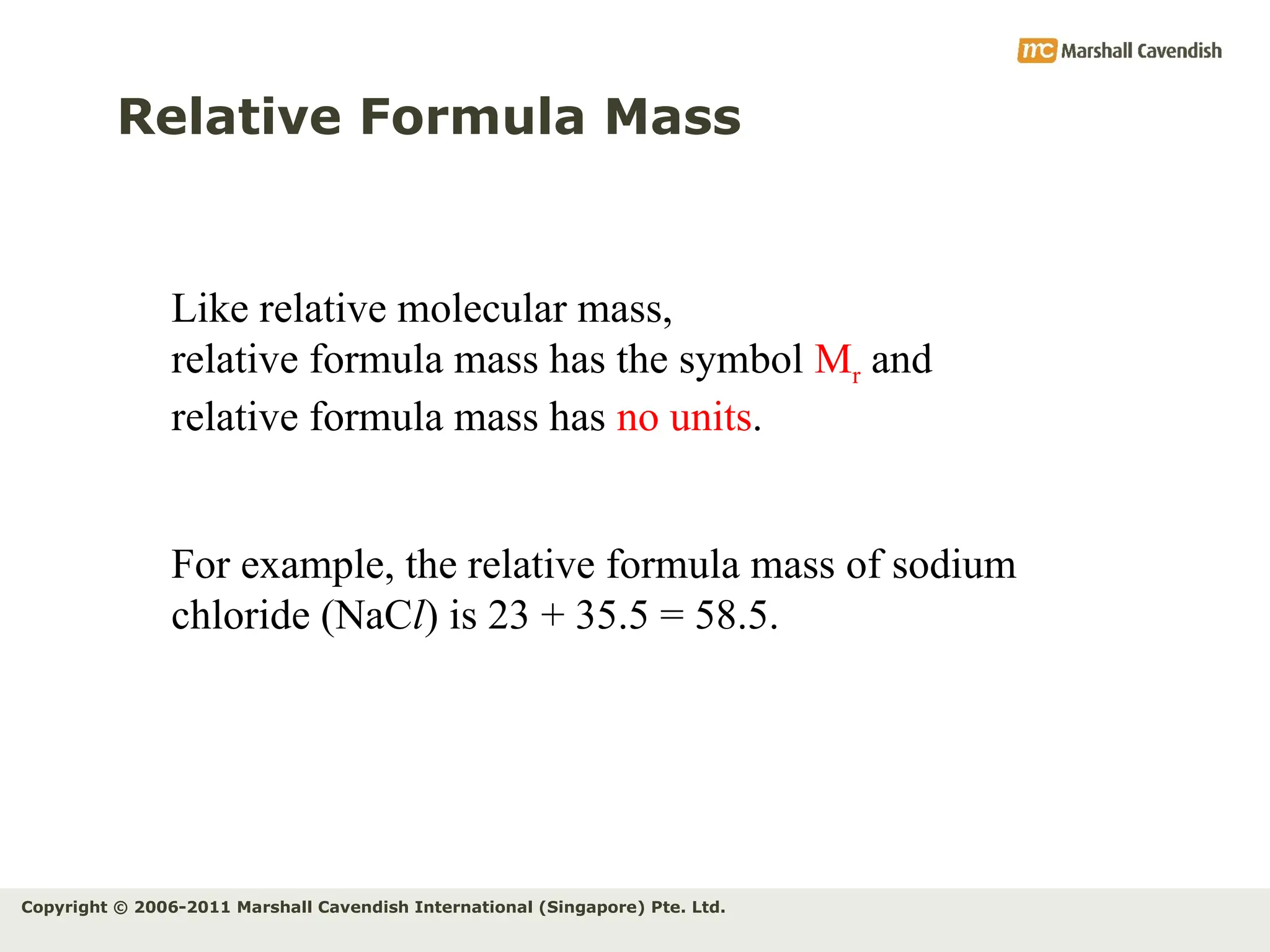
Like relative molecular mass,
relative formula mass has the symbol Mr and
relative formula mass has no units.
For example, the relative formula mass of sodium
chloride (NaCl) is 23 + 35.5 = 58.5.
Copyright © 2006-2011 Marshall Cavendish International (Singapore) Pte. Ltd.
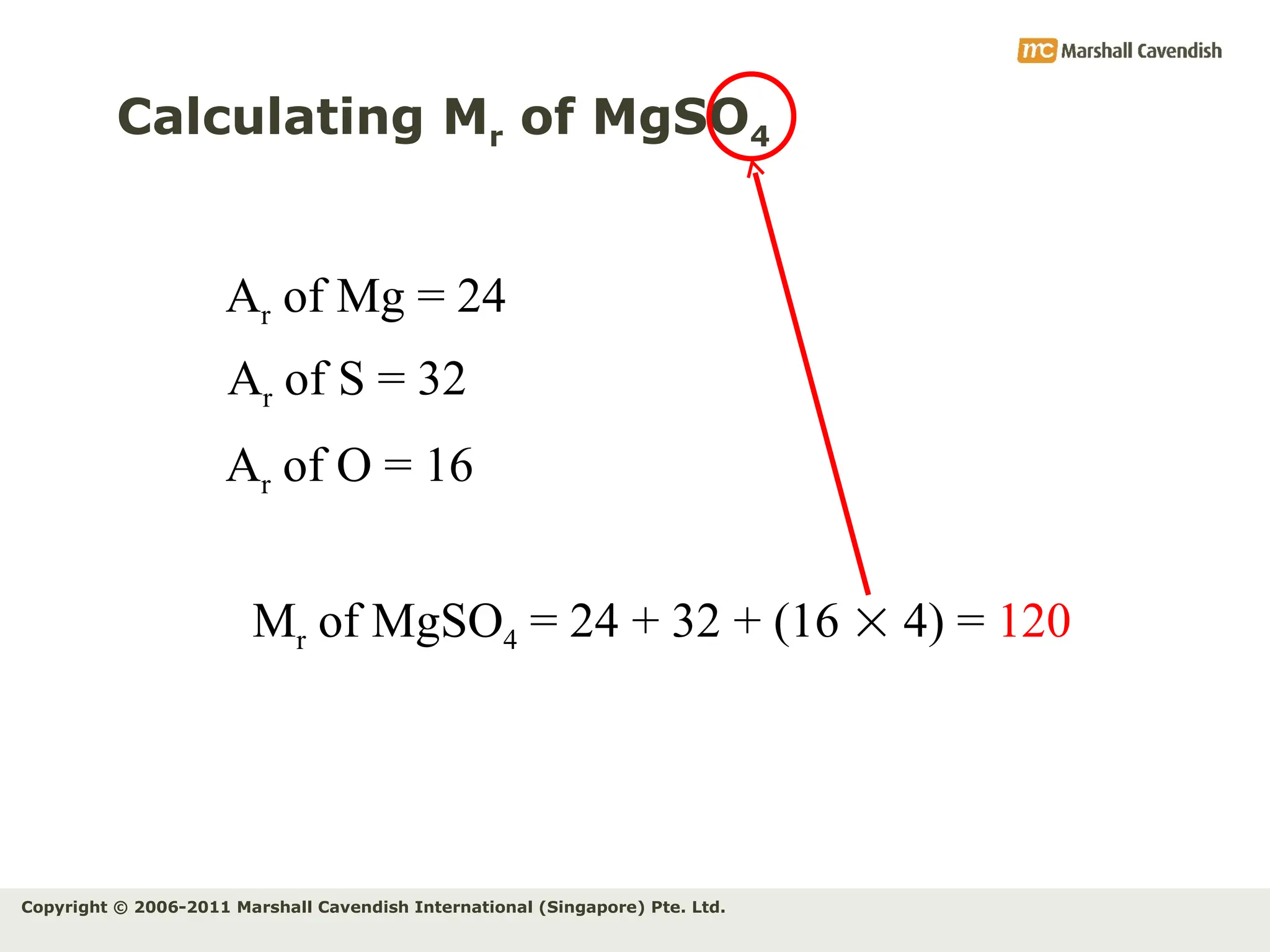
Calculating Mr of MgSO4
Ar of Mg = 24
Ar of S = 32
Mr of MgSO4 = 24 + 32 + (16  4) = 120
Ar of O = 16
Copyright © 2006-2011 Marshall Cavendish International (Singapore) Pte. Ltd.
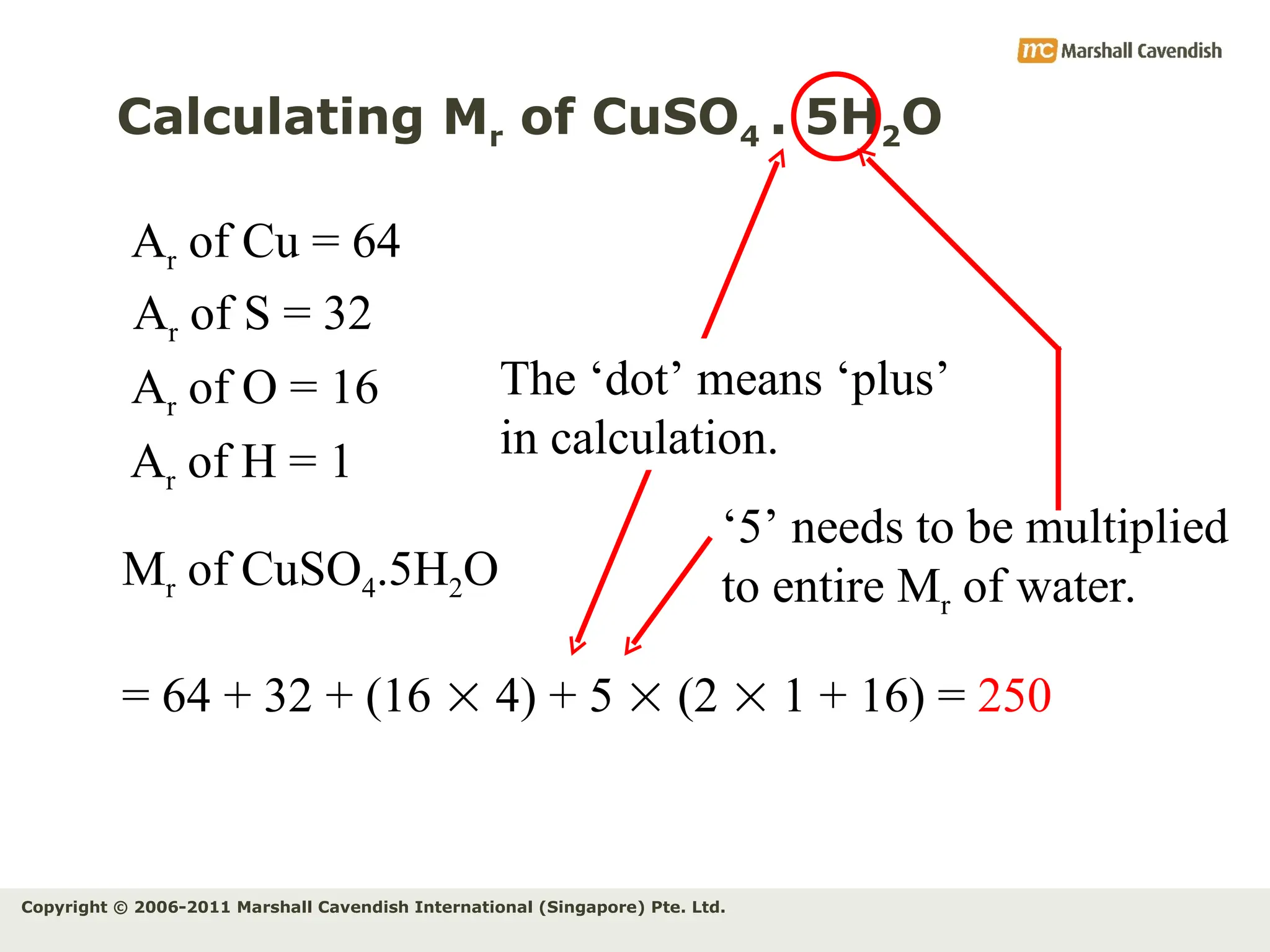
Calculating Mr of CuSO4 . 5H2O
Ar of Cu = 64
Ar of S = 32
Mr of CuSO4.5H2O
= 64 + 32 + (16  4) + 5  (2  1 + 16) = 250
Ar of O = 16
Ar of H = 1
The ‘dot’ means ‘plus’
in calculation.
‘5’ needs to be multiplied
to entire Mr of water.
Copyright © 2006-2011 Marshall Cavendish International (Singapore) Pte. Ltd.
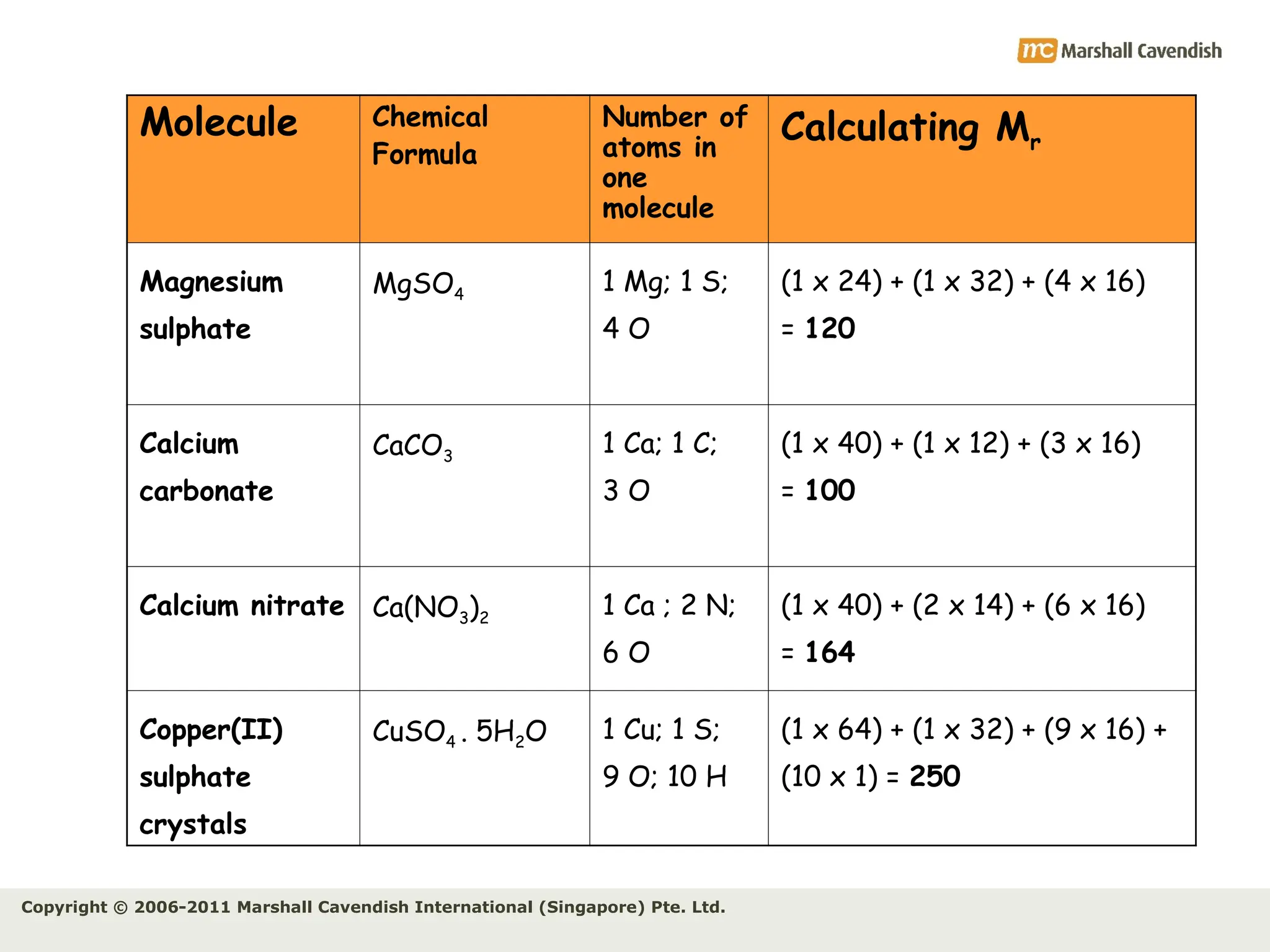
Molecule Chemical
Formula
Number of
atoms in
one
molecule
Calculating Mr
Magnesium
sulphate
MgSO4
1 Mg; 1 S;
4 O
(1 x 24) + (1 x 32) + (4 x 16)
= 120
Calcium
carbonate
CaCO3
1 Ca; 1 C;
3 O
(1 x 40) + (1 x 12) + (3 x 16)
= 100
Calcium nitrate Ca(NO3)2
1 Ca ; 2 N;
6 O
(1 x 40) + (2 x 14) + (6 x 16)
= 164
Copper(II)
sulphate
crystals
CuSO4 . 5H2O 1 Cu; 1 S;
9 O; 10 H
(1 x 64) + (1 x 32) + (9 x 16) +
(10 x 1) = 250
Copyright © 2006-2011 Marshall Cavendish International (Singapore) Pte. Ltd.
The Mole
Atoms are too small and numerous to be counted
one at a time.
Instead, the quantity of atoms is measured by mass.
The unit of measurement for atoms and molecules is
the mole.
The symbol for the mole is mol.
Copyright © 2006-2011 Marshall Cavendish International (Singapore) Pte. Ltd.
The Mole
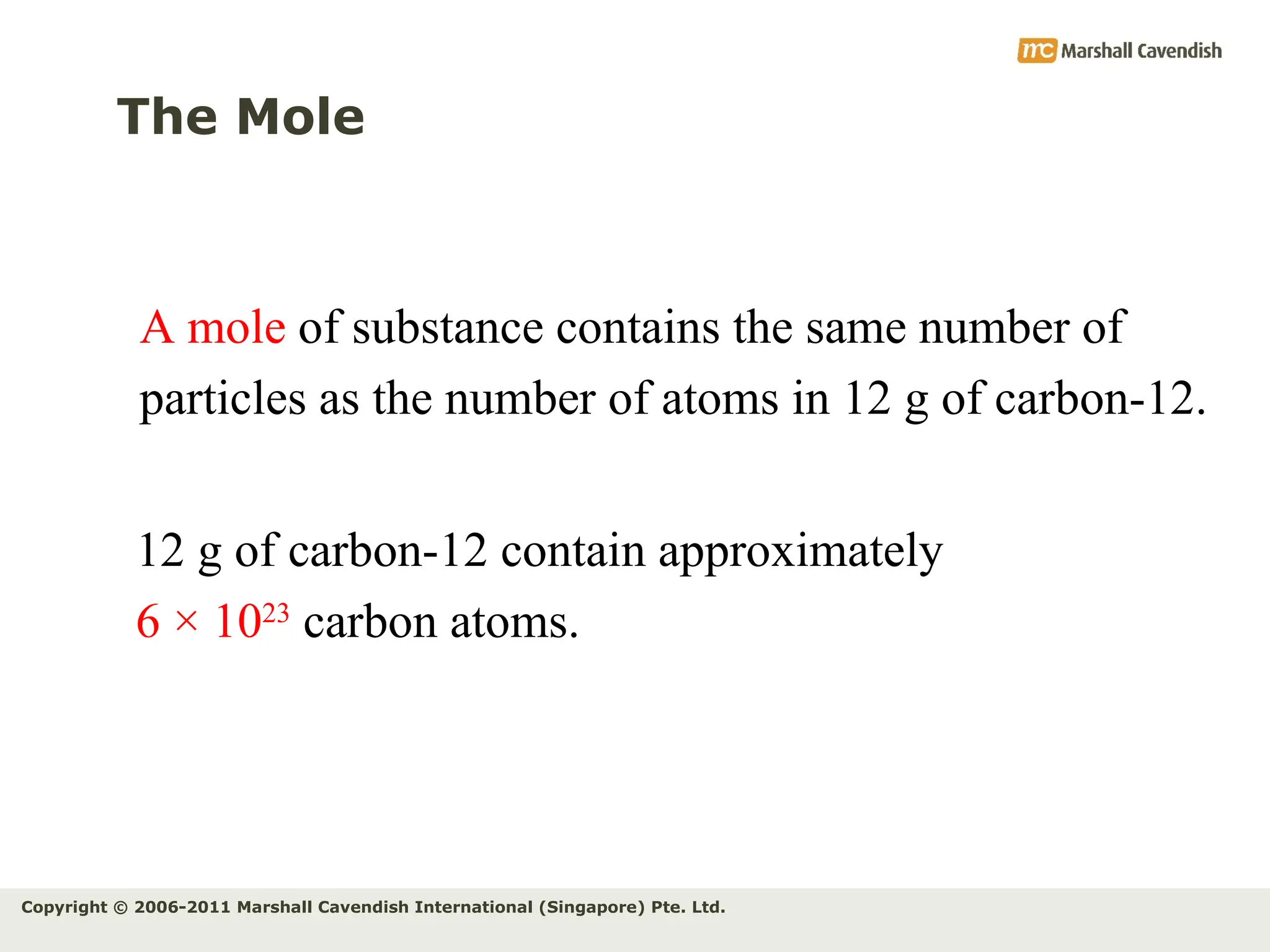
A mole of substance contains the same number of
particles as the number of atoms in 12 g of carbon-12.
12 g of carbon-12 contain approximately
6 × 10²³
carbon atoms.
Copyright © 2006-2011 Marshall Cavendish International (Singapore) Pte. Ltd.
How many particles are there in a
mole?
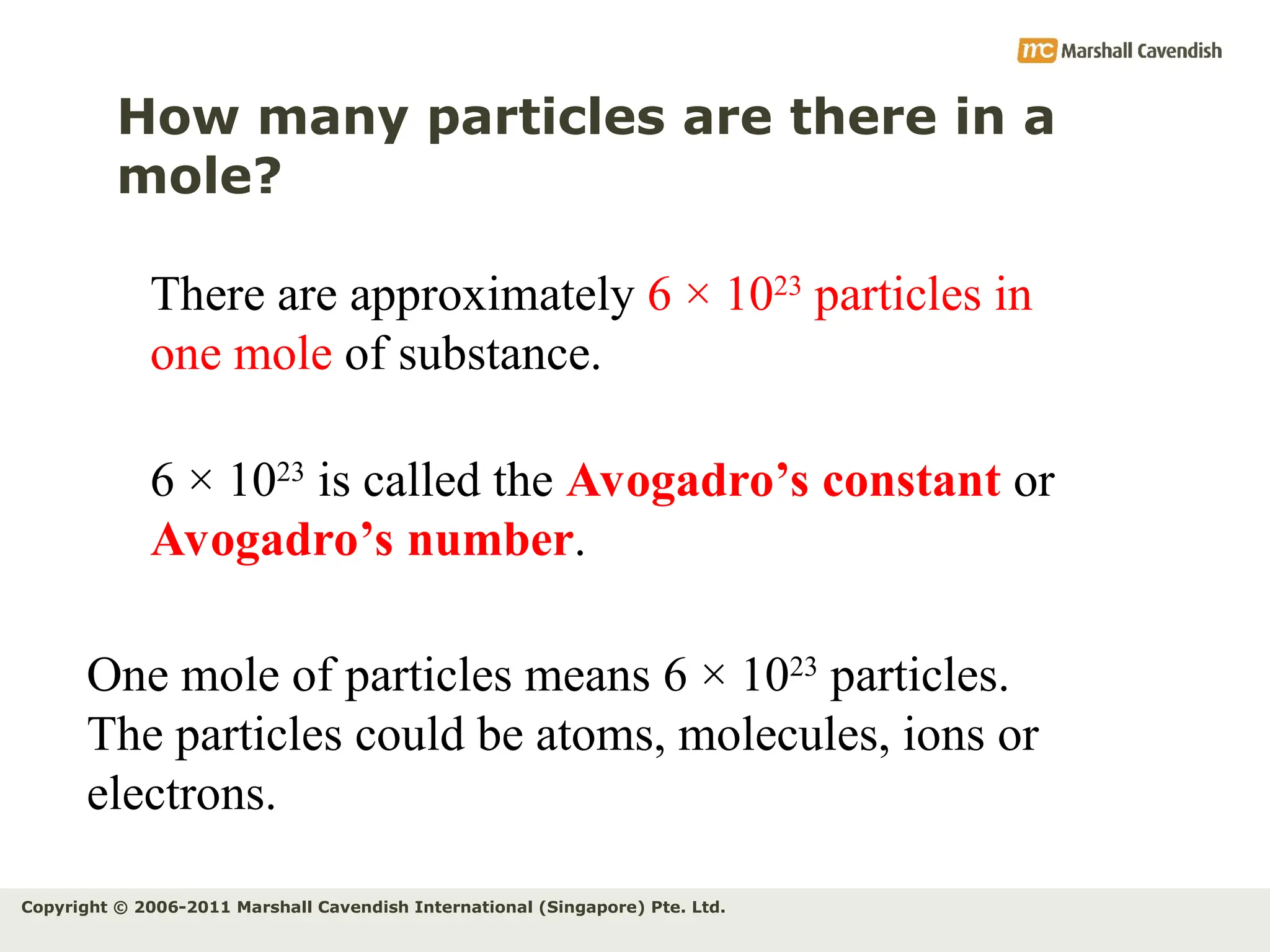
There are approximately 6 × 10²³
particles in
one mole of substance.
6 × 10²³
is called the Avogadro’s constant or
Avogadro’s number.
One mole of particles means 6 × 10²³
particles.
The particles could be atoms, molecules, ions or
electrons.
Copyright © 2006-2011 Marshall Cavendish International (Singapore) Pte. Ltd.
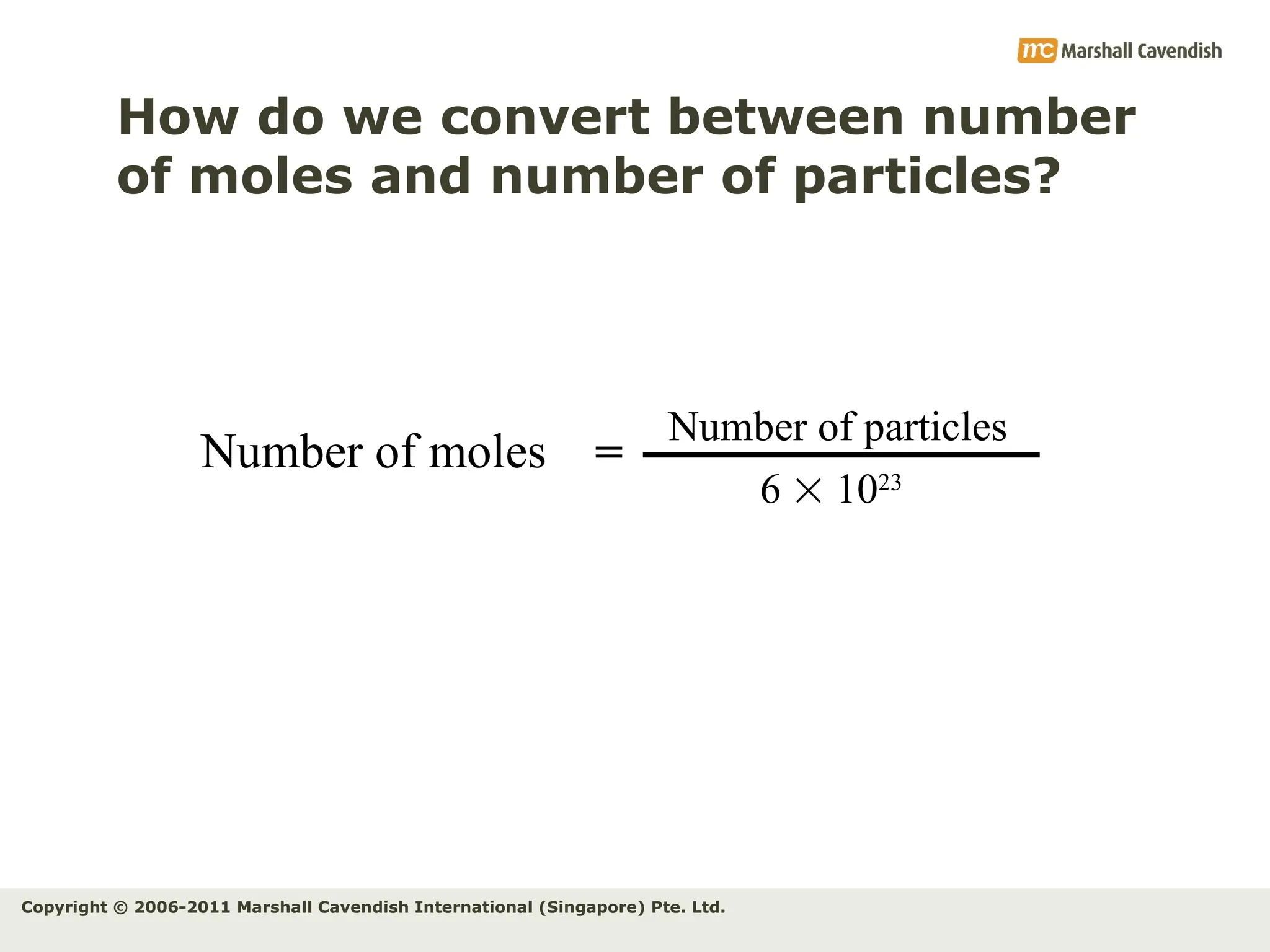
How do we convert between number
of moles and number of particles?
Number of moles
Number of particles
6  1023
=
Copyright © 2006-2011 Marshall Cavendish International (Singapore) Pte. Ltd.
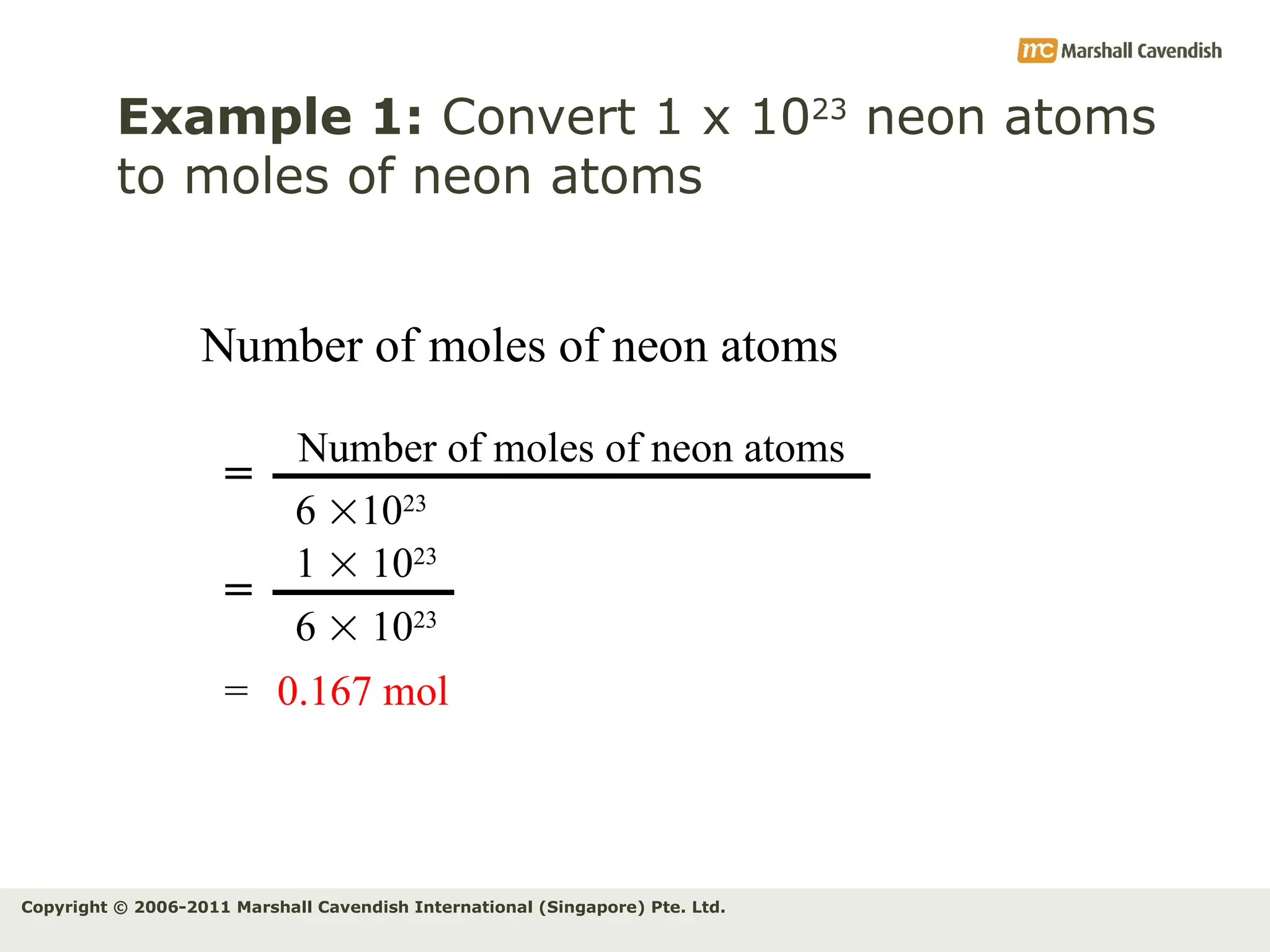
Example 1: Convert 1 x 10²³
neon atoms
to moles of neon atoms
Number of moles of neon atoms
6 1023
=
1  1023
6  1023
=
= 0.167 mol
Copyright © 2006-2011 Marshall Cavendish International (Singapore) Pte. Ltd.
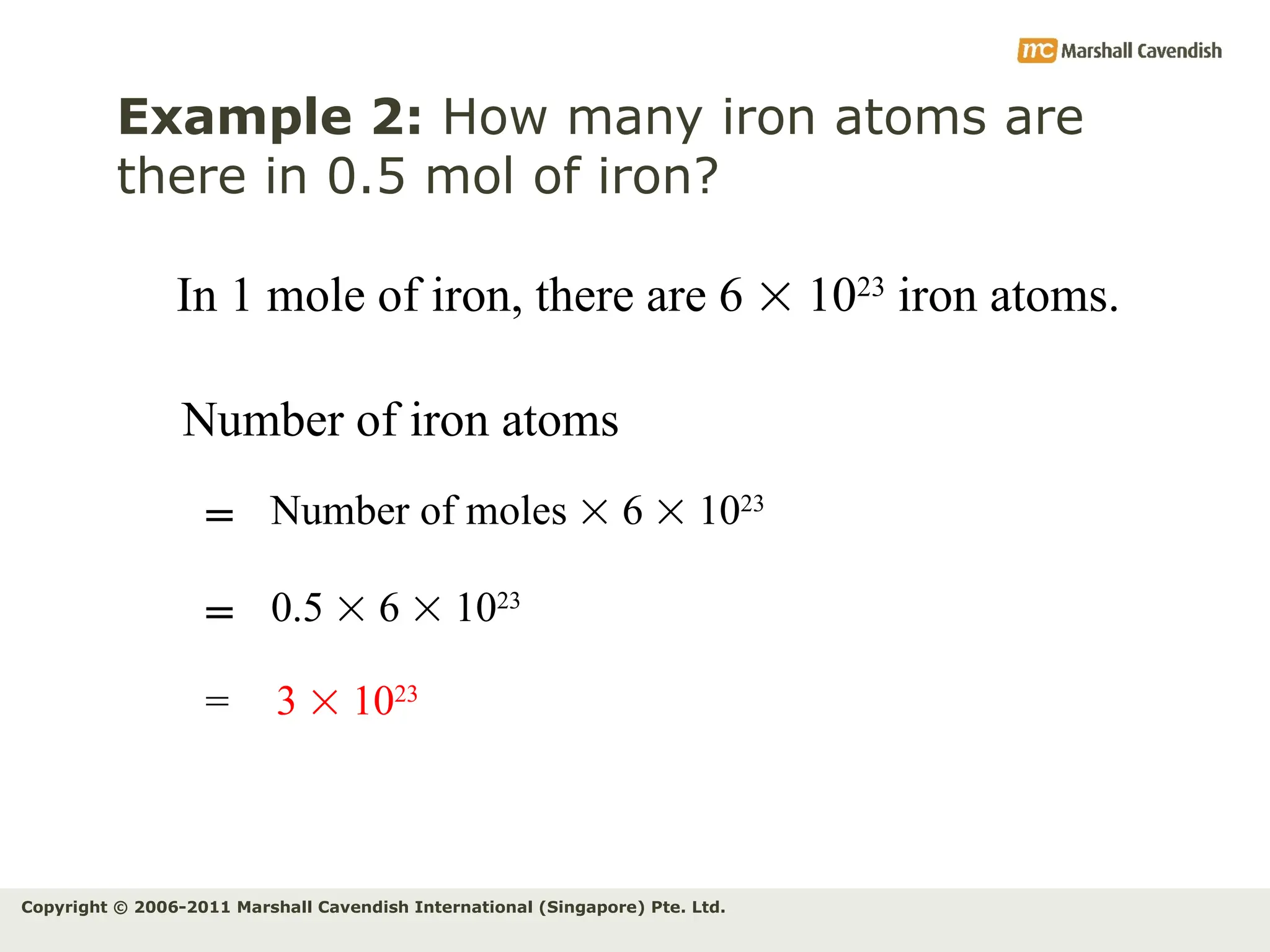
Example 2: How many iron atoms are
there in 0.5 mol of iron?
Number of iron atoms
Number of moles  6  1023
=
= 3  1023
In 1 mole of iron, there are 6  1023
iron atoms.
0.5  6  1023
=
Copyright © 2006-2011 Marshall Cavendish International (Singapore) Pte. Ltd.
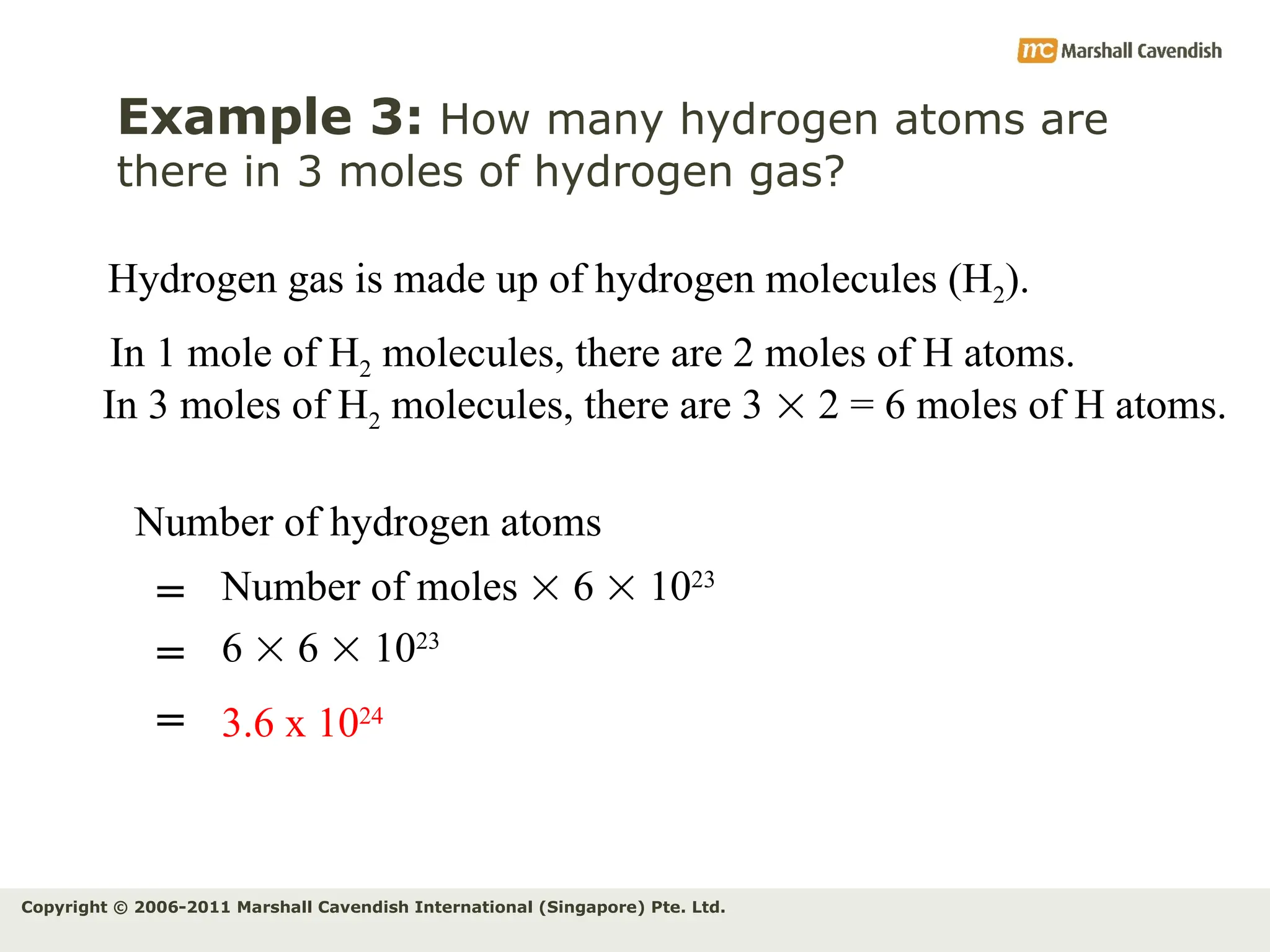
Example 3: How many hydrogen atoms are
there in 3 moles of hydrogen gas?
Hydrogen gas is made up of hydrogen molecules (H2).
In 3 moles of H2 molecules, there are 3  2 = 6 moles of H atoms.
In 1 mole of H2 molecules, there are 2 moles of H atoms.
Number of hydrogen atoms
Number of moles  6  1023
=
= 3.6 x 1024
6  6  1023
=
Copyright © 2006-2011 Marshall Cavendish International (Singapore) Pte. Ltd.
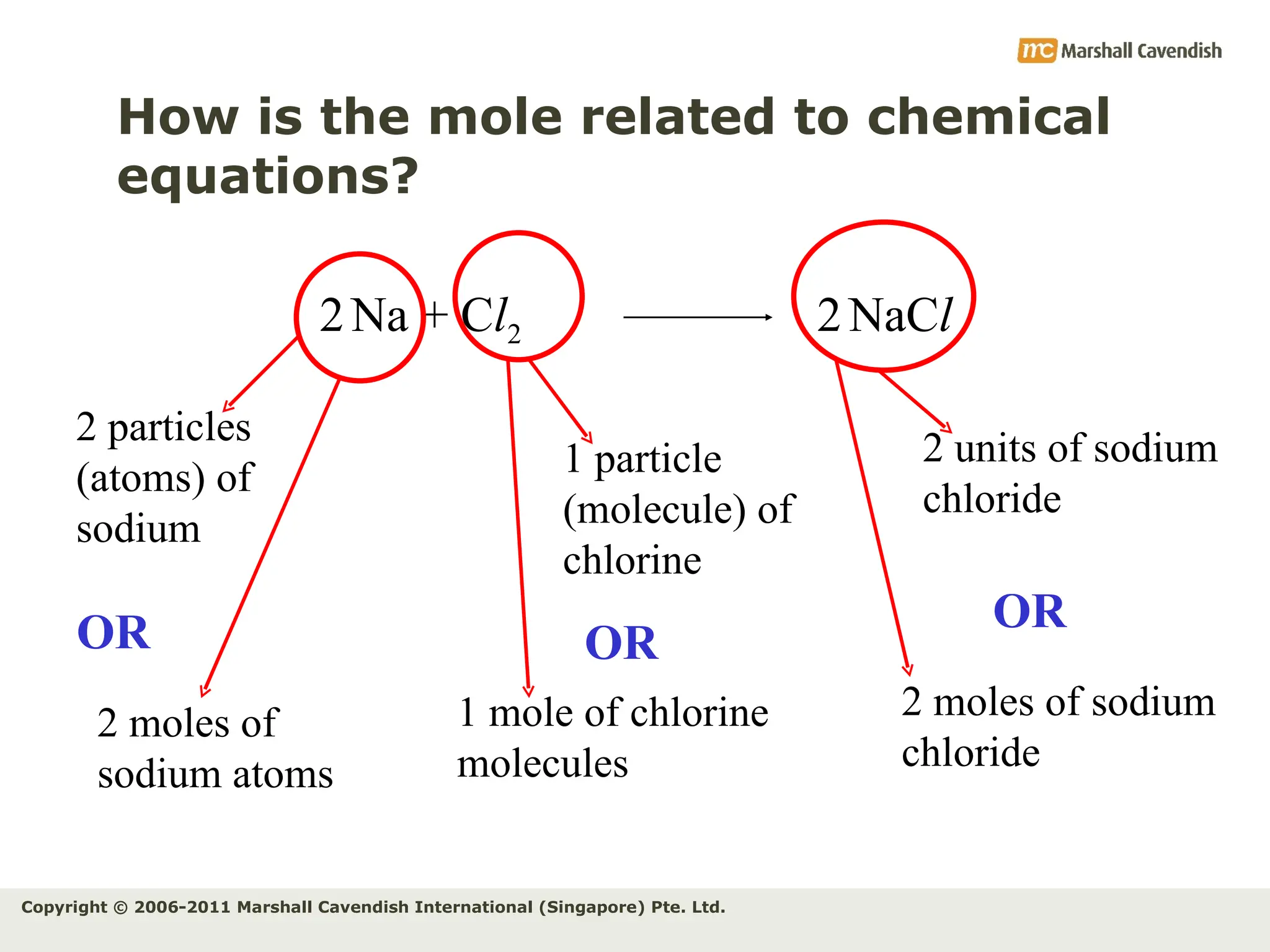
How is the mole related to chemical
equations?
2 particles
(atoms) of
sodium
1 particle
(molecule) of
chlorine
2 moles of
sodium atoms
1 mole of chlorine
molecules
Na + Cl2 NaCl
2
2
OR OR
2 units of sodium
chloride
2 moles of sodium
chloride
OR
Copyright © 2006-2011 Marshall Cavendish International (Singapore) Pte. Ltd.
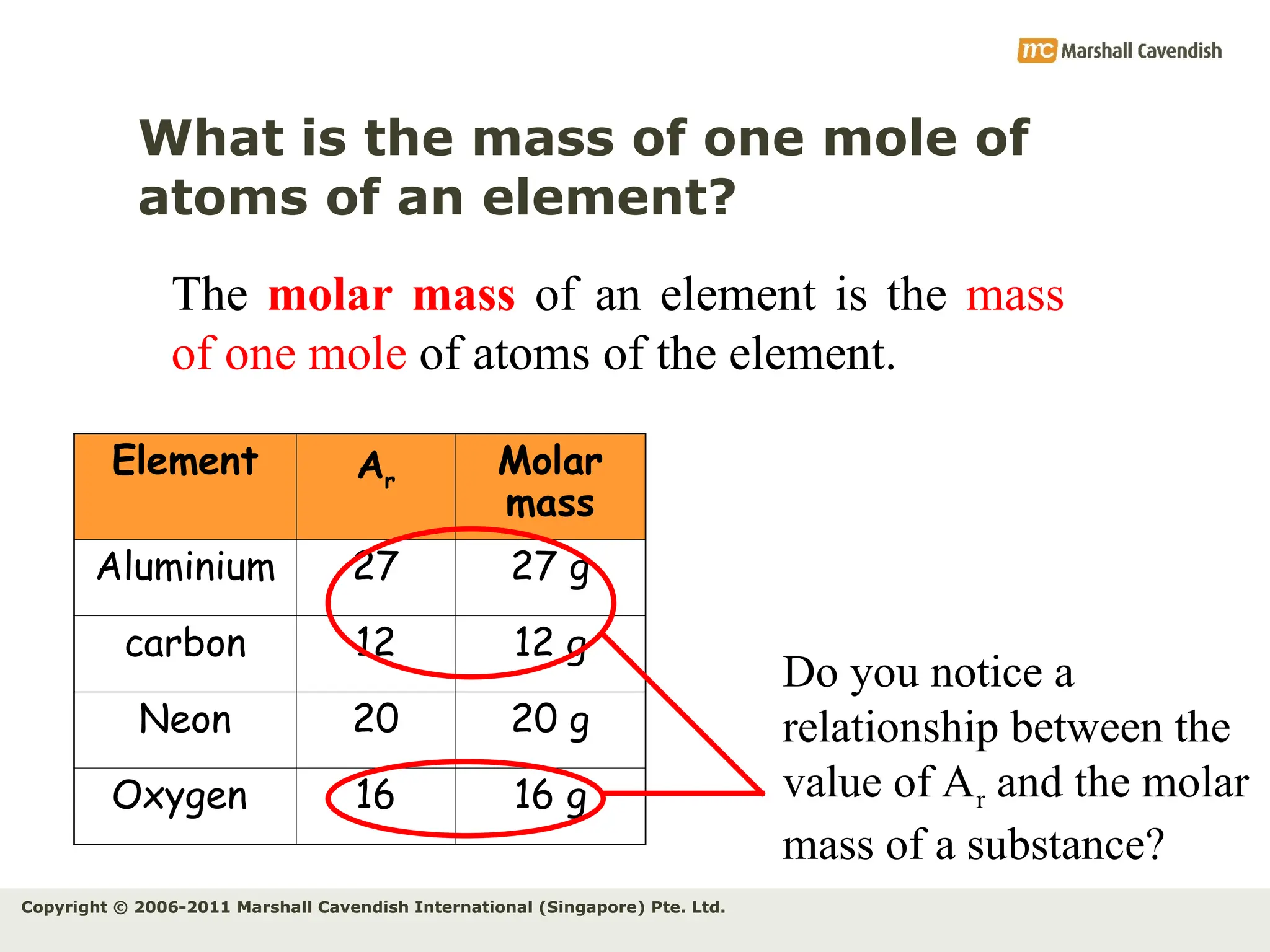
The molar mass of an element is the mass
of one mole of atoms of the element.
What is the mass of one mole of
atoms of an element?
Do you notice a
relationship between the
value of Ar and the molar
mass of a substance?
Element Ar
Molar
mass
Aluminium 27 27 g
carbon 12 12 g
Neon 20 20 g
Oxygen 16 16 g
Copyright © 2006-2011 Marshall Cavendish International (Singapore) Pte. Ltd.
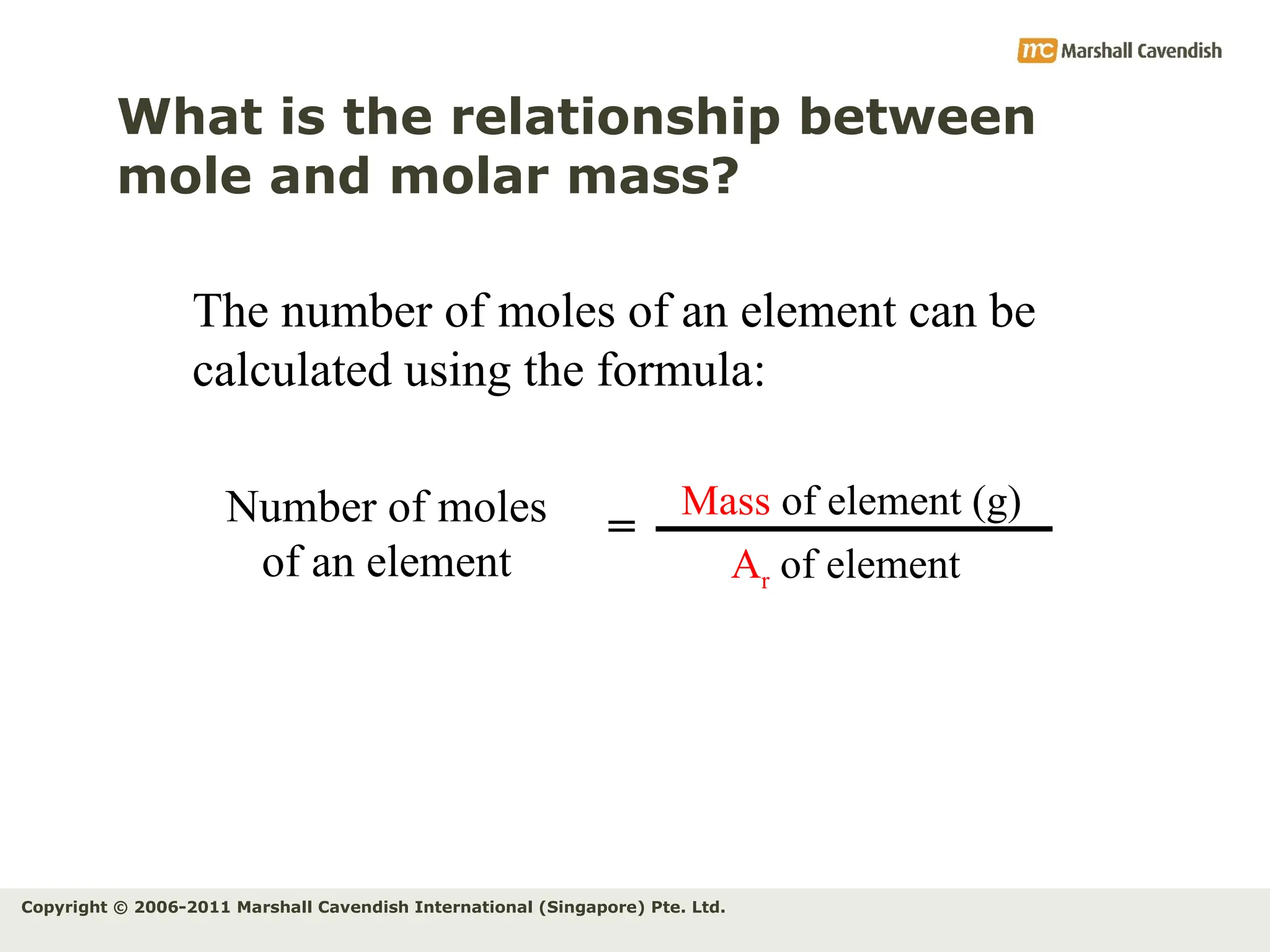
What is the relationship between
mole and molar mass?
The number of moles of an element can be
calculated using the formula:
Number of moles
of an element
Mass of element (g)
Ar of element
=
Copyright © 2006-2011 Marshall Cavendish International (Singapore) Pte. Ltd.
Example 1 Determine the number of
moles in 0.196 kg of iron. (Ar: Fe = 56)
Number of moles of iron
mass of iron in grams
Ar of iron
=
0.196 × 1000
56
=
= 3.5 mol
Copyright © 2006-2011 Marshall Cavendish International (Singapore) Pte. Ltd.
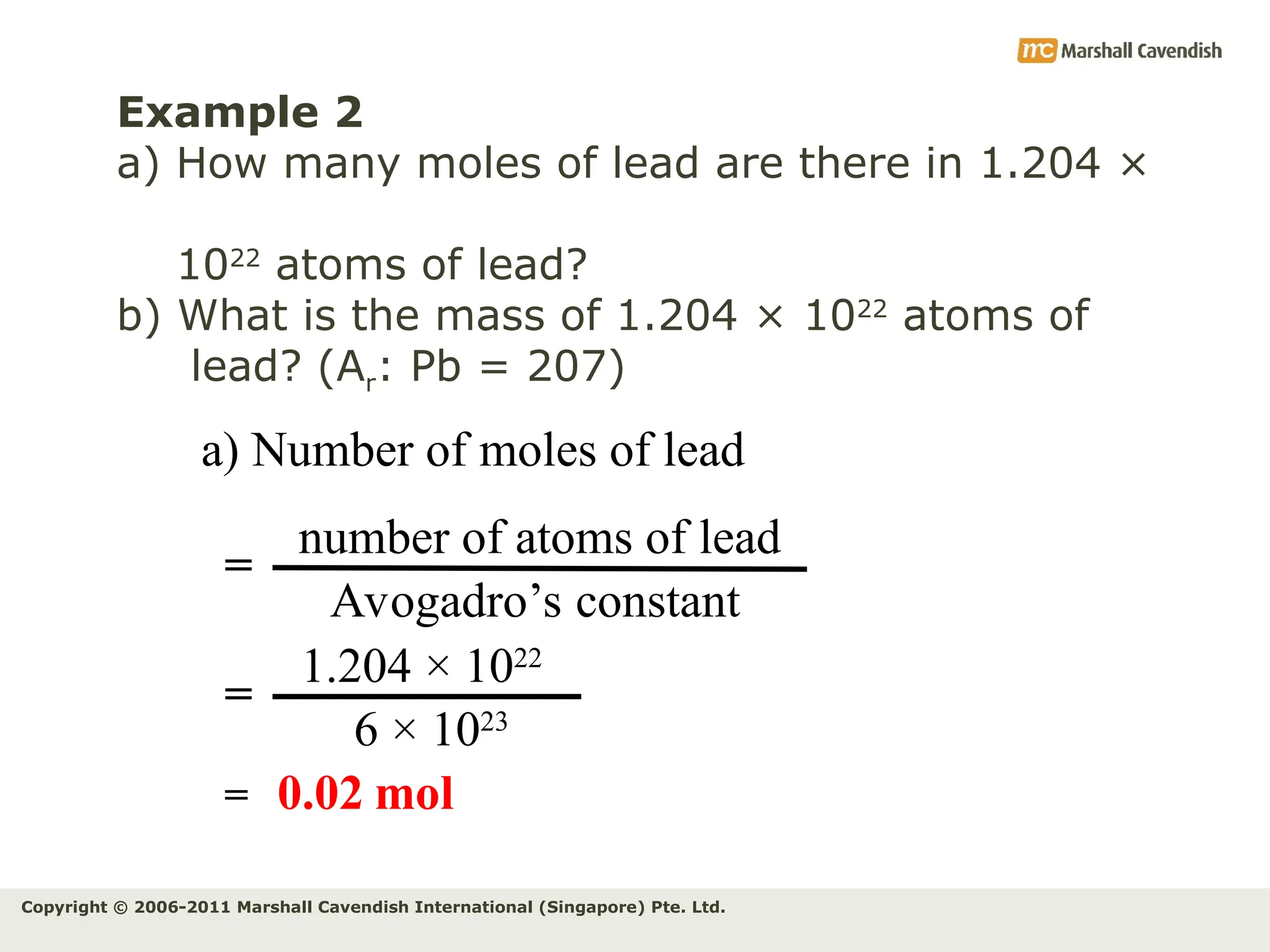
Example 2
a) How many moles of lead are there in 1.204 ×
1022
atoms of lead?
b) What is the mass of 1.204 × 10²²
atoms of
lead? (Ar: Pb = 207)
a) Number of moles of lead
number of atoms of lead
Avogadro’s constant
=
1.204 × 10²²
6 × 1023
=
= 0.02 mol
Copyright © 2006-2011 Marshall Cavendish International (Singapore) Pte. Ltd.
Example 2 (continued)
a) How many moles of lead are there in 1.204 ×
1022
atoms of lead?
b) What is the mass of 1.204 × 10²²
atoms of
lead? (Ar: Pb = 207)
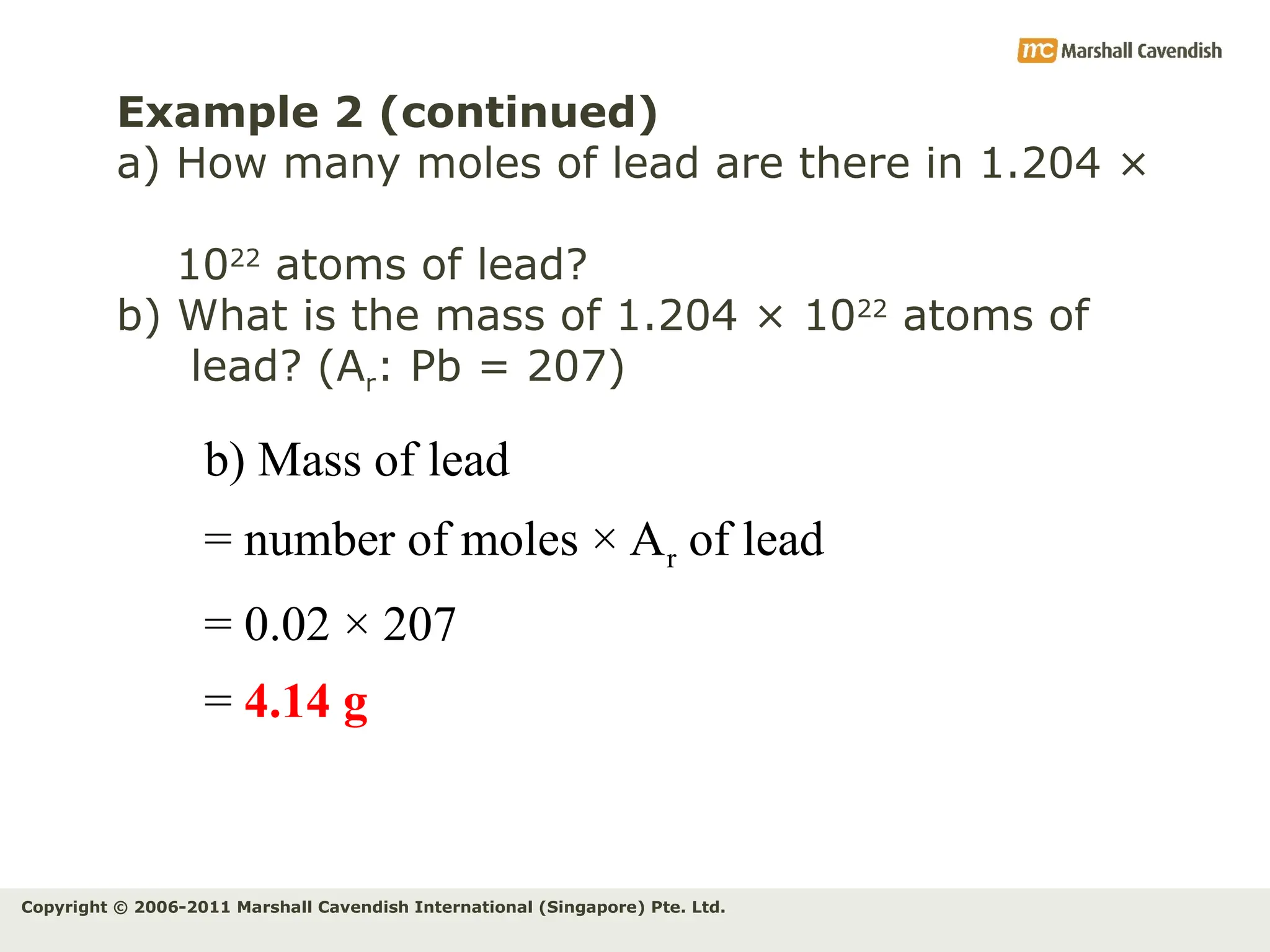
b) Mass of lead
= number of moles × Ar of lead
= 0.02 × 207
= 4.14 g
Copyright © 2006-2011 Marshall Cavendish International (Singapore) Pte. Ltd.
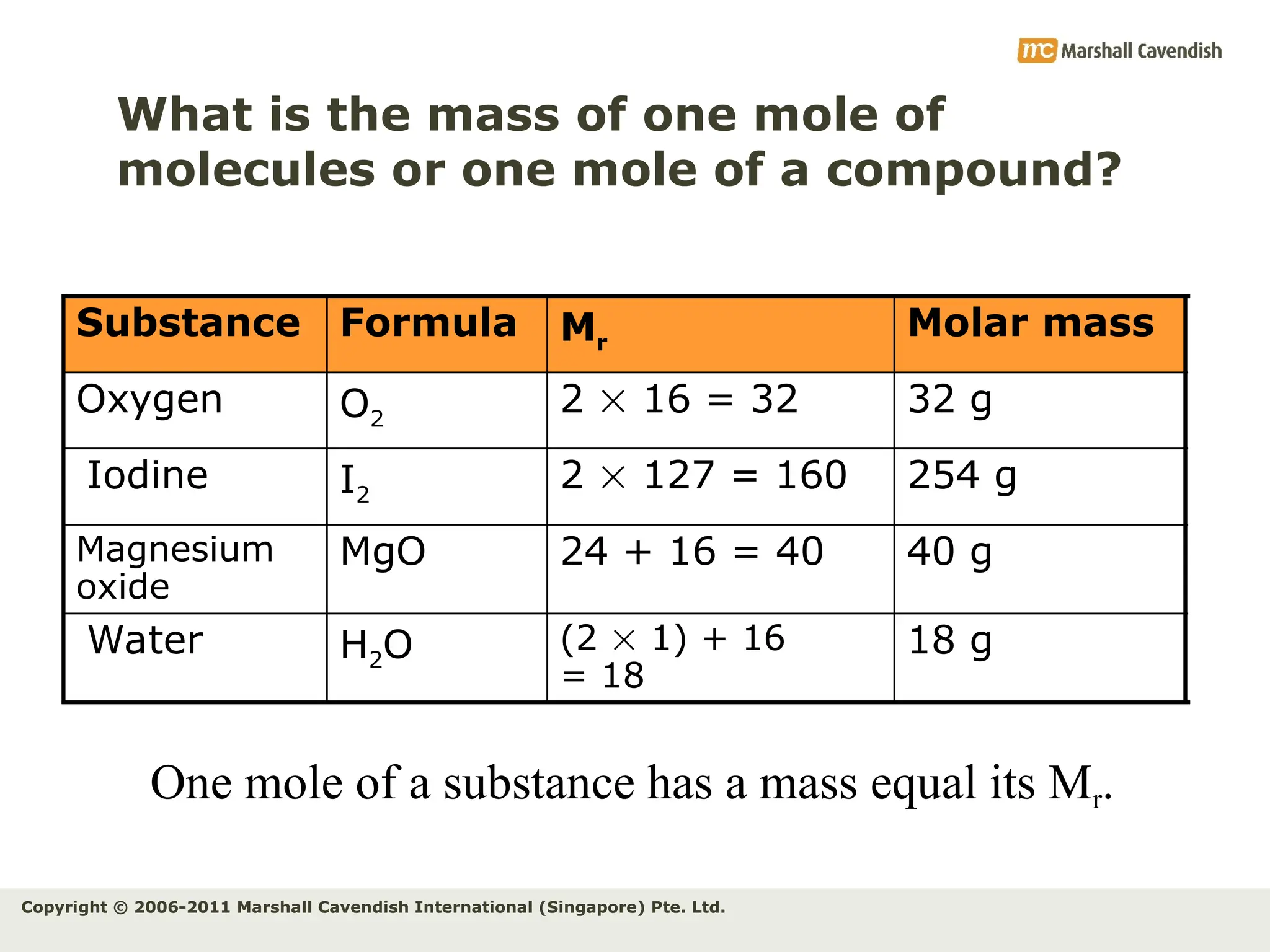
What is the mass of one mole of
molecules or one mole of a compound?
One mole of a substance has a mass equal its Mr.
18 g
(2  1) + 16
= 18
H2O
Water
40 g
24 + 16 = 40
MgO
Magnesium
oxide
254 g
2  127 = 160
I2
Iodine
32 g
2  16 = 32
O2
Oxygen
Molar mass
Mr
Formula
Substance
Copyright © 2006-2011 Marshall Cavendish International (Singapore) Pte. Ltd.
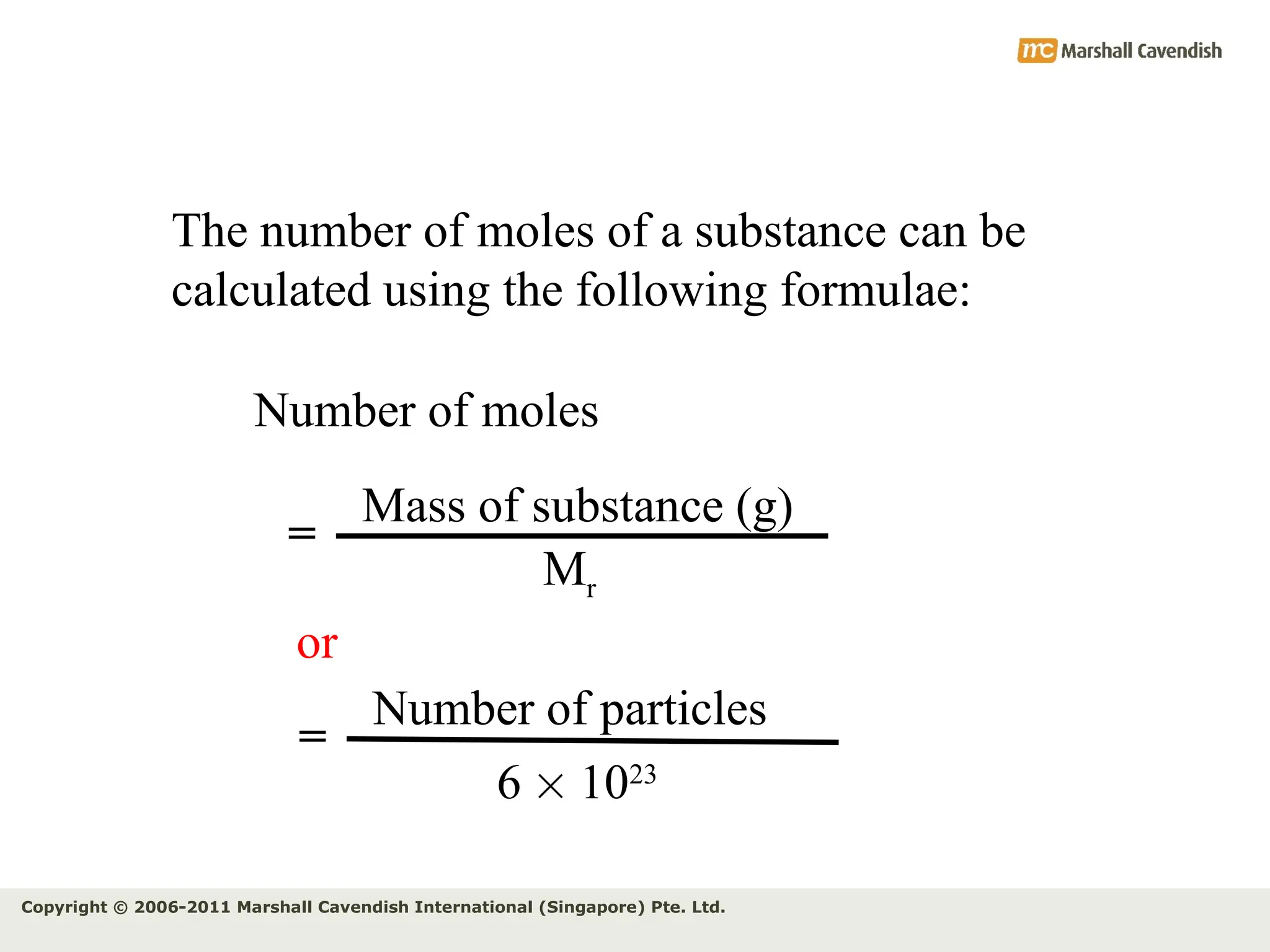
The number of moles of a substance can be
calculated using the following formulae:
Number of moles
Mass of substance (g)
Mr
=
or
Number of particles
6  1023
=
Copyright © 2006-2011 Marshall Cavendish International (Singapore) Pte. Ltd.
Example 1
A conical flask contains 68.4 g of octane (C8H18).
How many molecules of octane are there in the
flask?
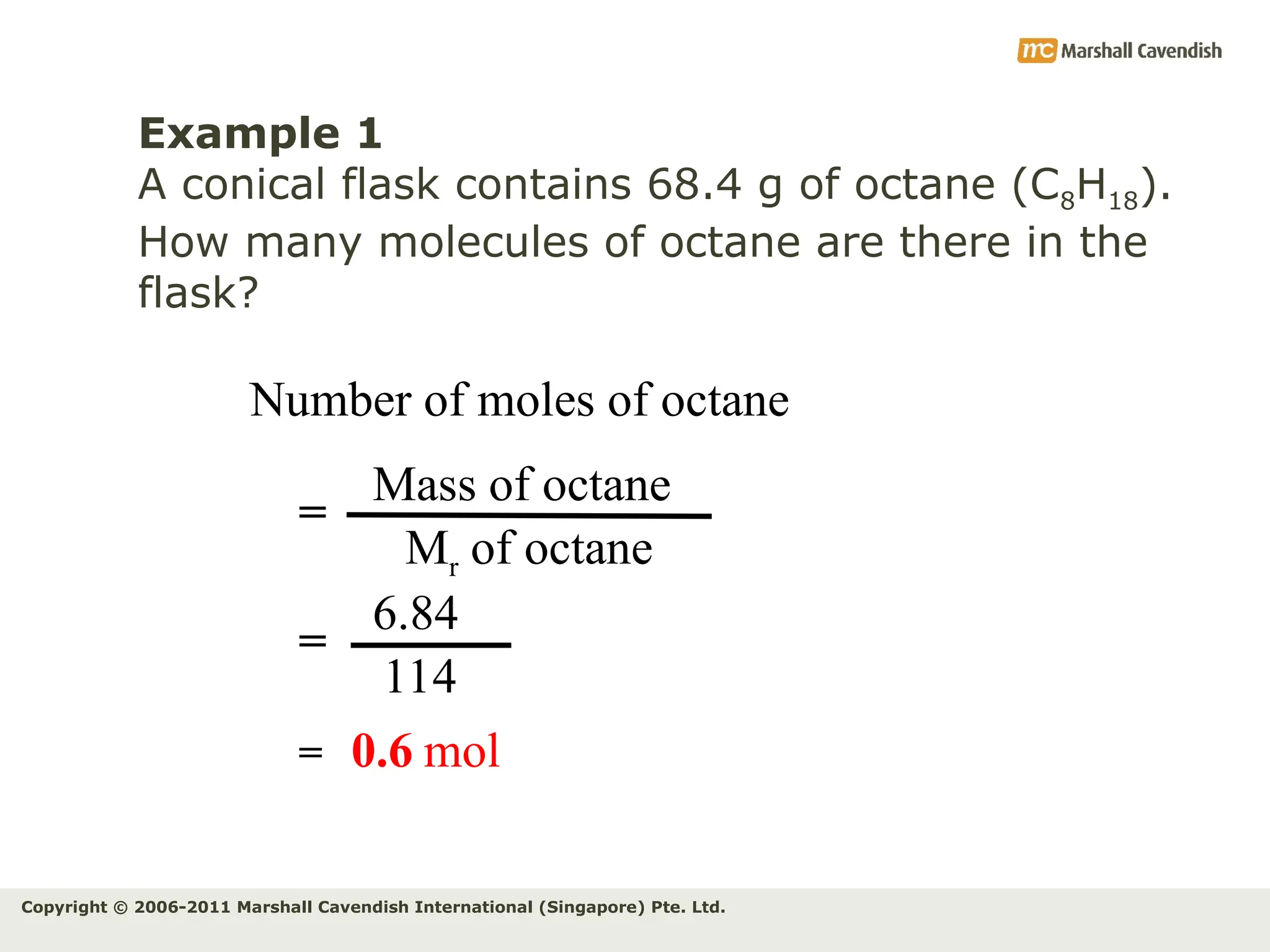
Number of moles of octane
Mass of octane
Mr of octane
=
6.84
114
=
= 0.6 mol
Copyright © 2006-2011 Marshall Cavendish International (Singapore) Pte. Ltd.
Example 1 (continued)
A conical flask contains 68.4 g of octane (C8H18).
How many molecules of octane are there in the
flask?
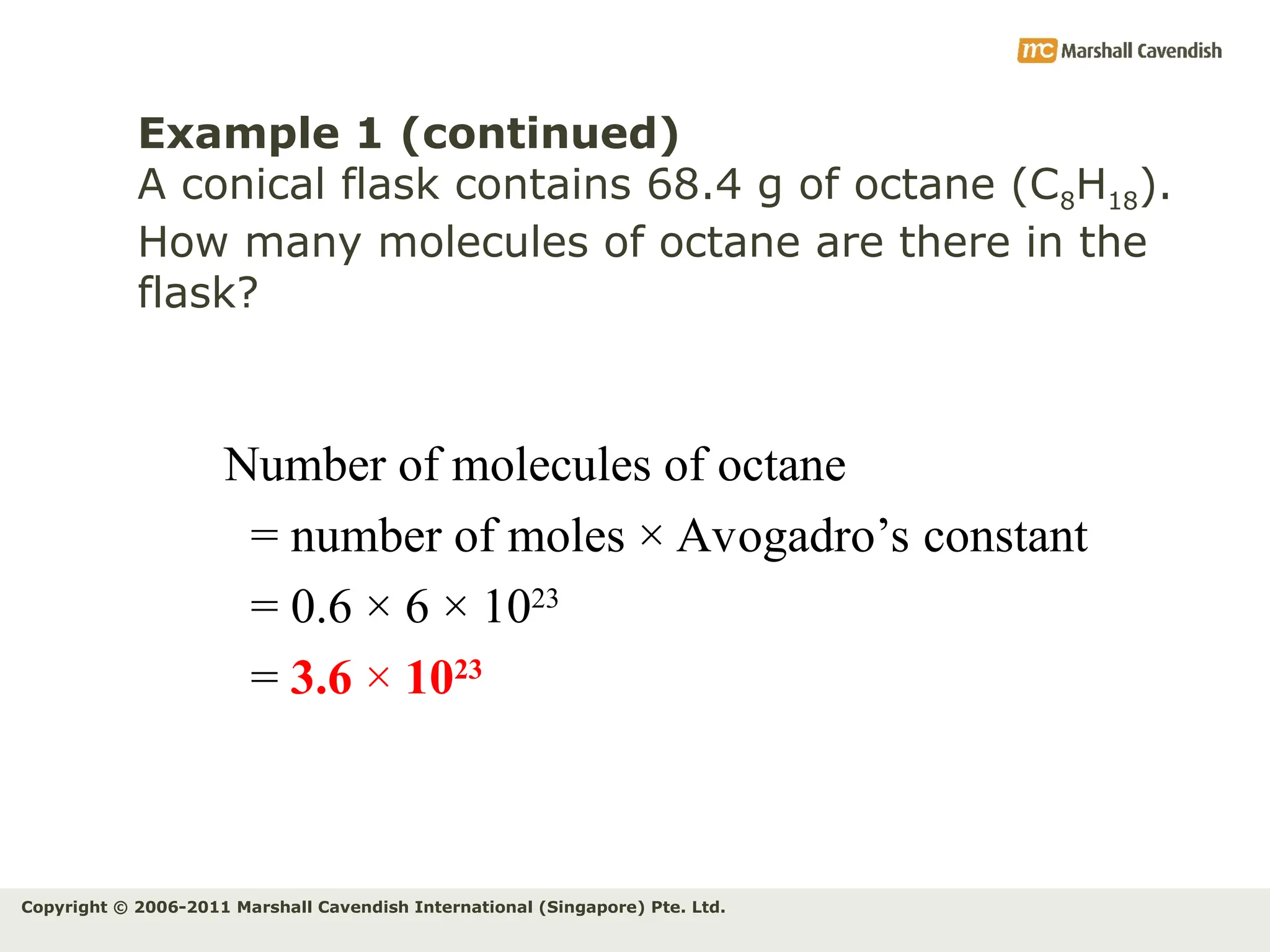
Number of molecules of octane
= number of moles × Avogadro’s constant
= 0.6 × 6 × 1023
= 3.6 × 10²³
Copyright © 2006-2011 Marshall Cavendish International (Singapore) Pte. Ltd.
Example 2
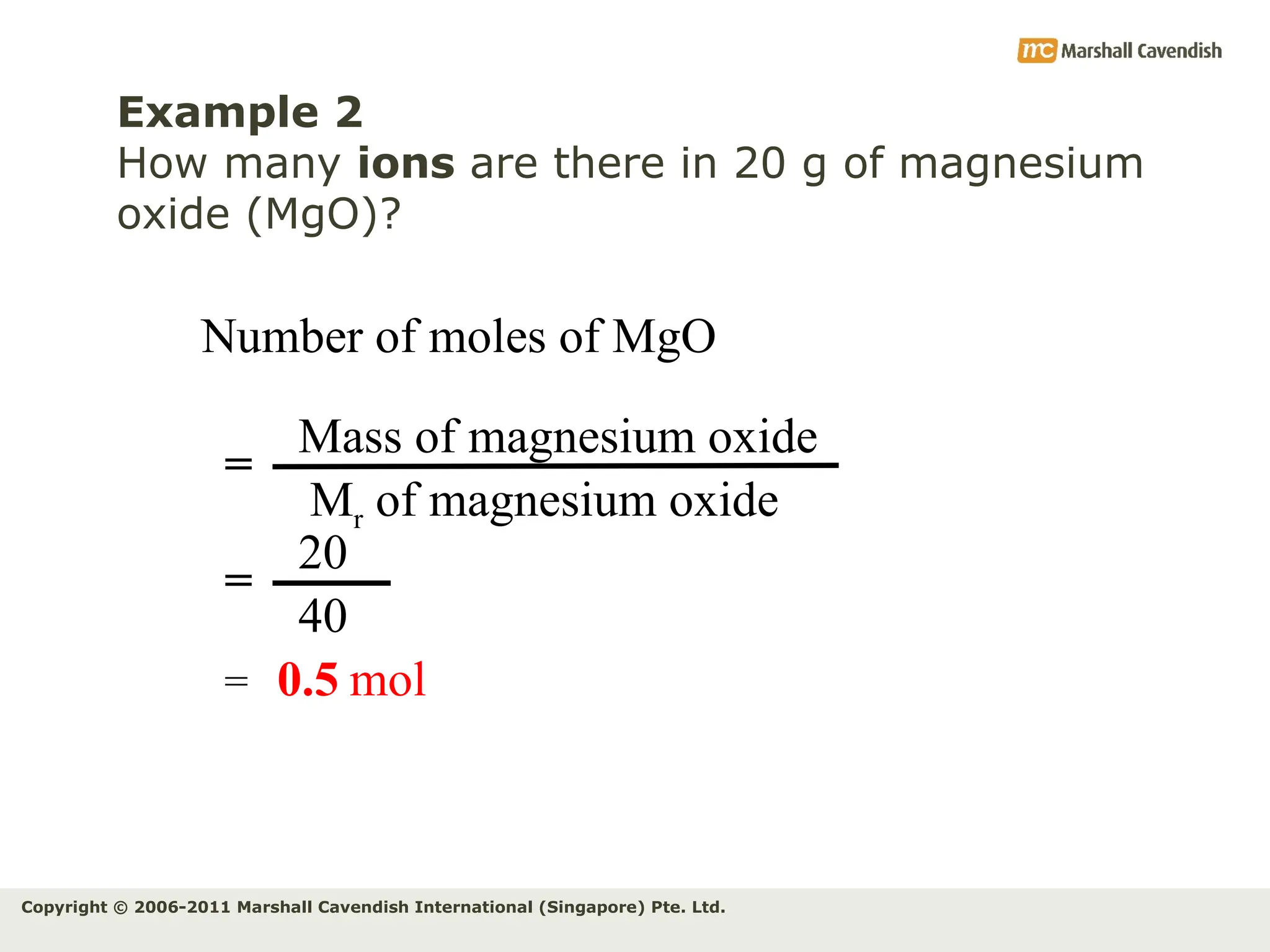
How many ions are there in 20 g of magnesium
oxide (MgO)?
Number of moles of MgO
Mass of magnesium oxide
Mr of magnesium oxide
=
20
40
=
= 0.5 mol
Copyright © 2006-2011 Marshall Cavendish International (Singapore) Pte. Ltd.
Example 2 (continued)
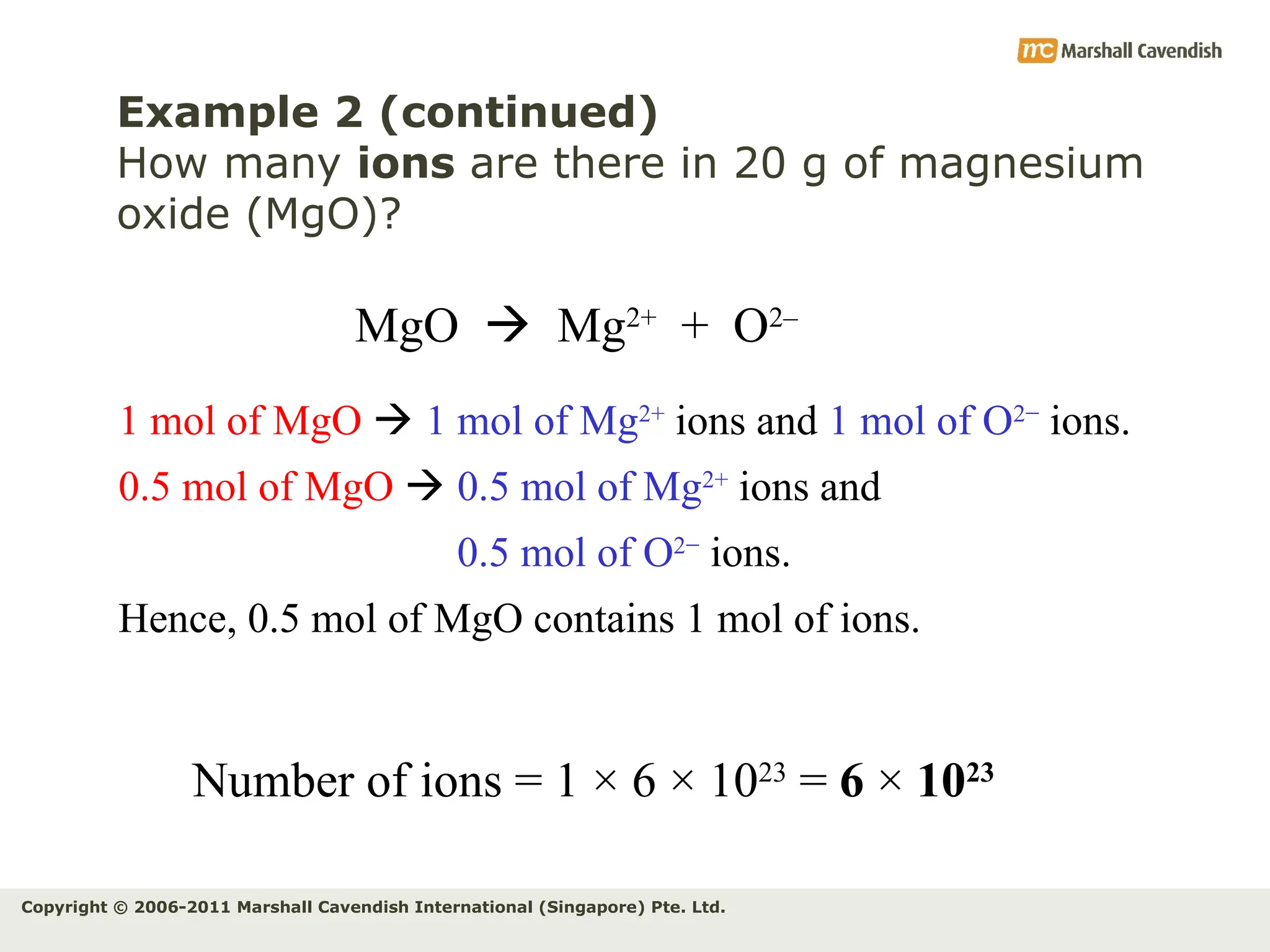
How many ions are there in 20 g of magnesium
oxide (MgO)?
MgO  Mg2+
+ O2–
1 mol of MgO  1 mol of Mg2+
ions and 1 mol of O2−
ions.
0.5 mol of MgO  0.5 mol of Mg2+
ions and
0.5 mol of O2−
ions.
Hence, 0.5 mol of MgO contains 1 mol of ions.
Number of ions = 1 × 6 × 1023
= 6 × 10²³
Copyright © 2006-2011 Marshall Cavendish International (Singapore) Pte. Ltd.
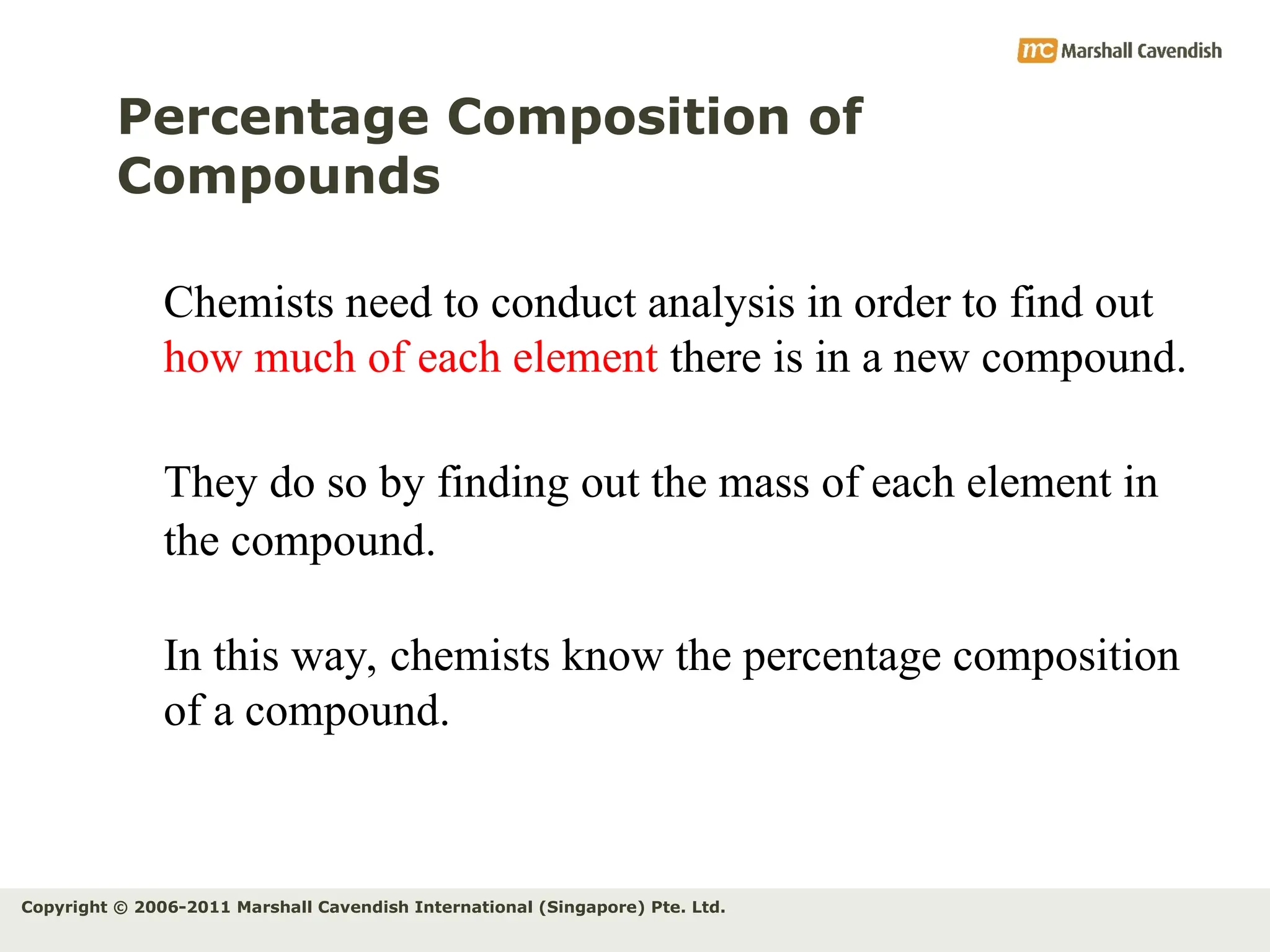
Percentage Composition of
Compounds
Chemists need to conduct analysis in order to find out
how much of each element there is in a new compound.
They do so by finding out the mass of each element in
the compound.
In this way, chemists know the percentage composition
of a compound.
Copyright © 2006-2011 Marshall Cavendish International (Singapore) Pte. Ltd.
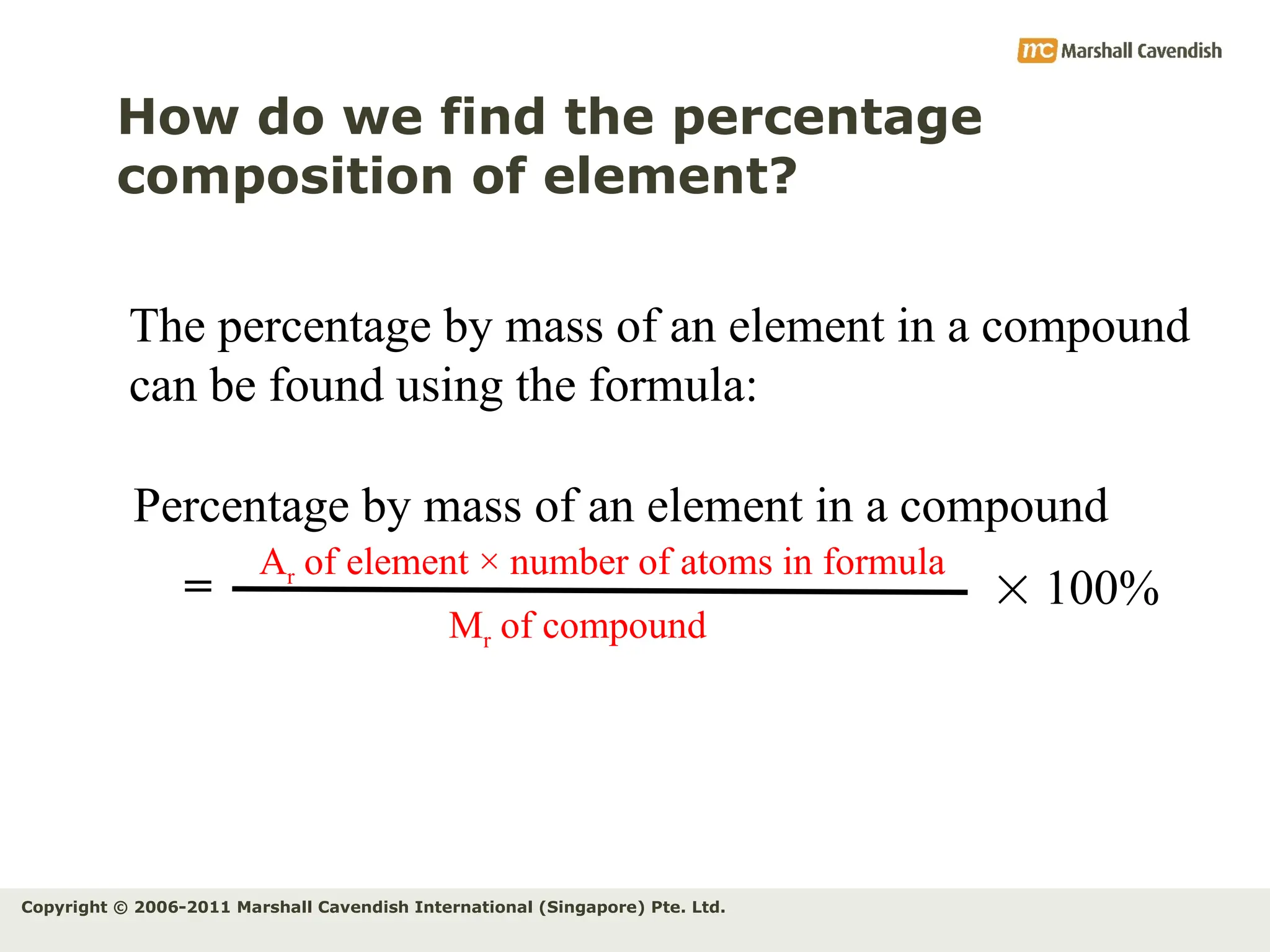
How do we find the percentage
composition of element?
Percentage by mass of an element in a compound
Ar of element × number of atoms in formula
Mr of compound
=  100%
The percentage by mass of an element in a compound
can be found using the formula:
Copyright © 2006-2011 Marshall Cavendish International (Singapore) Pte. Ltd.
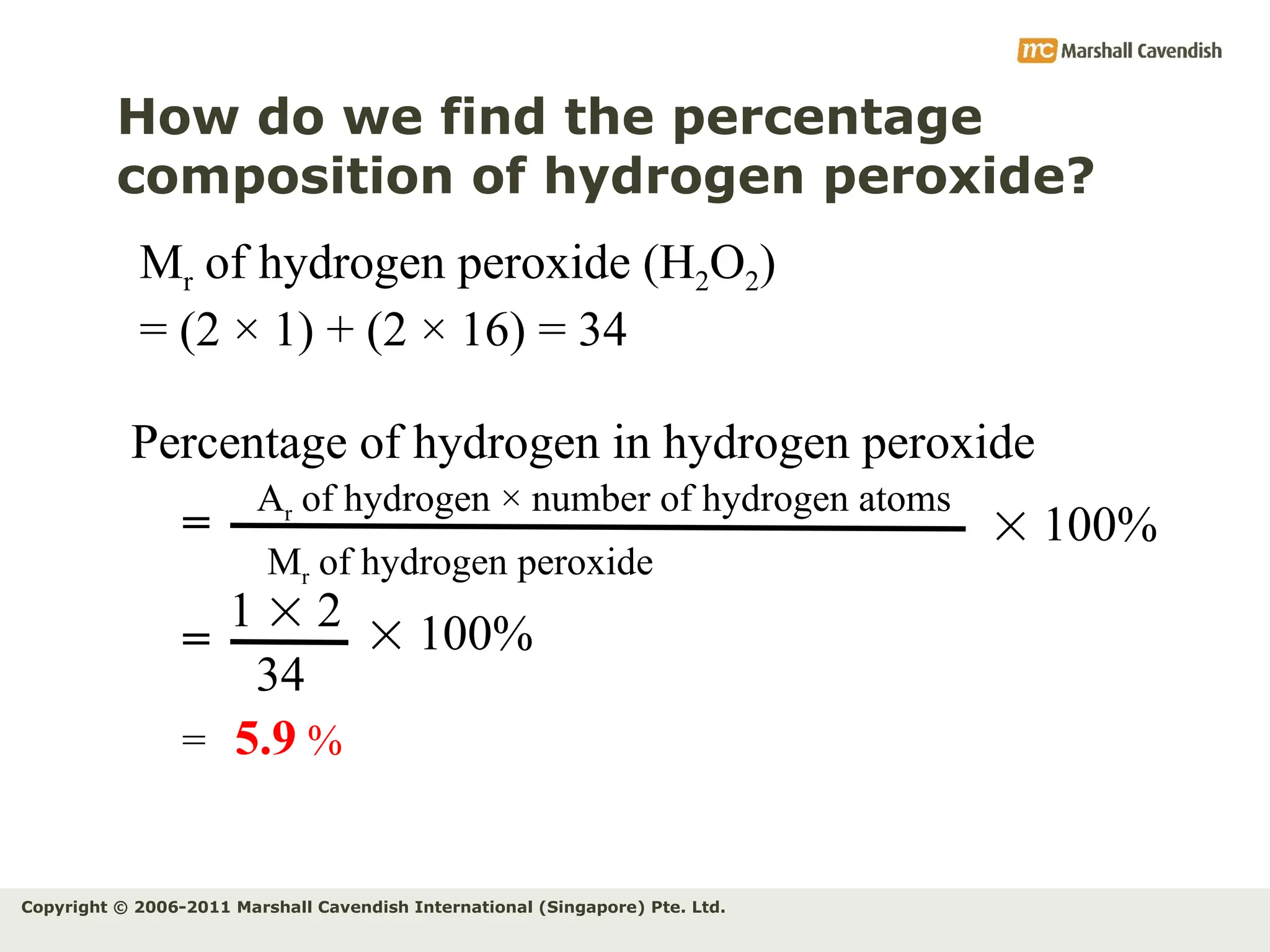
How do we find the percentage
composition of hydrogen peroxide?
Mr of hydrogen peroxide (H2O2)
= (2 × 1) + (2 × 16) = 34
Percentage of hydrogen in hydrogen peroxide
Ar of hydrogen × number of hydrogen atoms
Mr of hydrogen peroxide
=
1  2
34
=
= 5.9 %
 100%
 100%
Copyright © 2006-2011 Marshall Cavendish International (Singapore) Pte. Ltd.
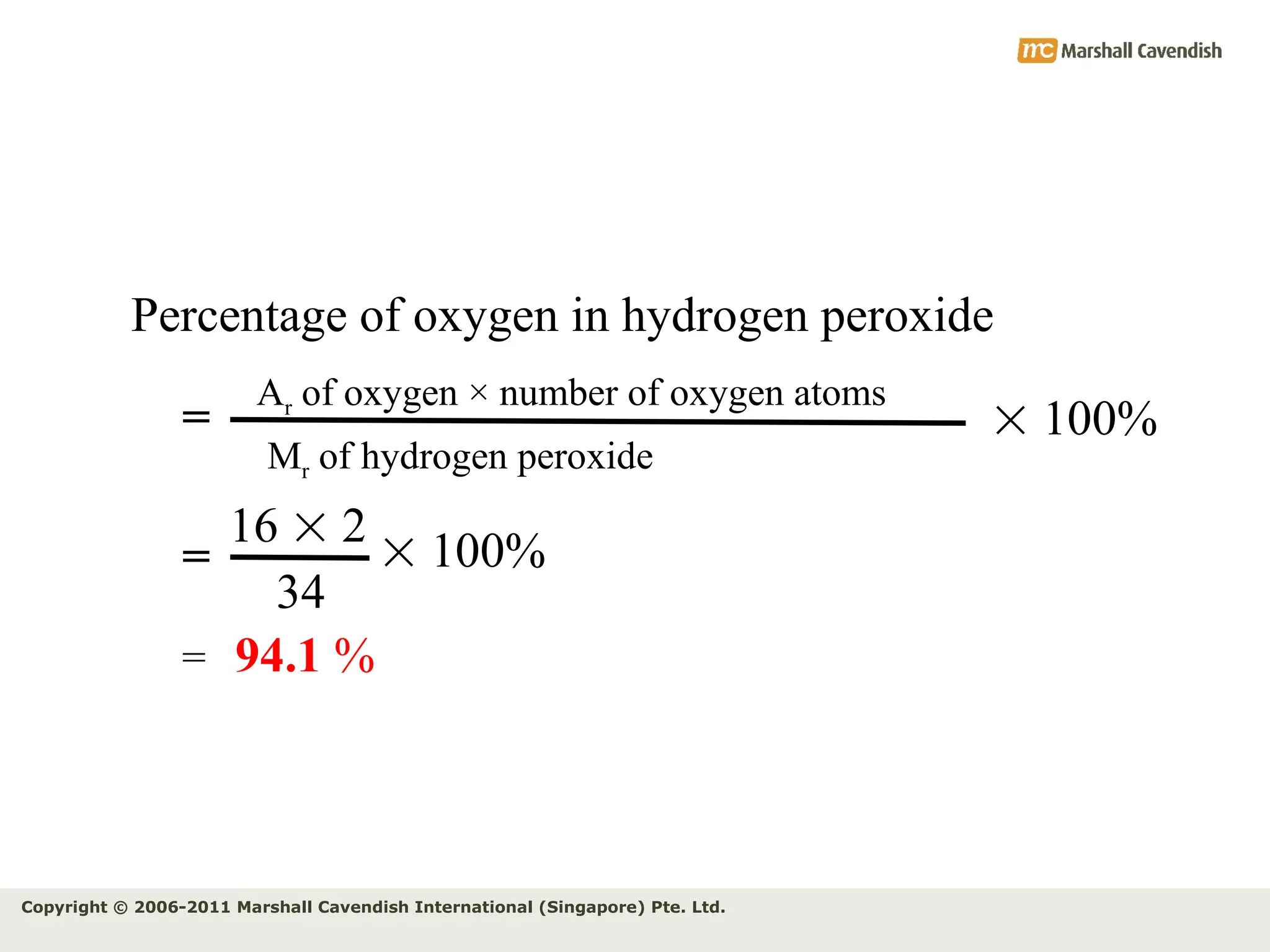
Percentage of oxygen in hydrogen peroxide
Ar of oxygen × number of oxygen atoms
Mr of hydrogen peroxide
=
16  2
34
=
= 94.1 %
 100%
 100%
Copyright © 2006-2011 Marshall Cavendish International (Singapore) Pte. Ltd.
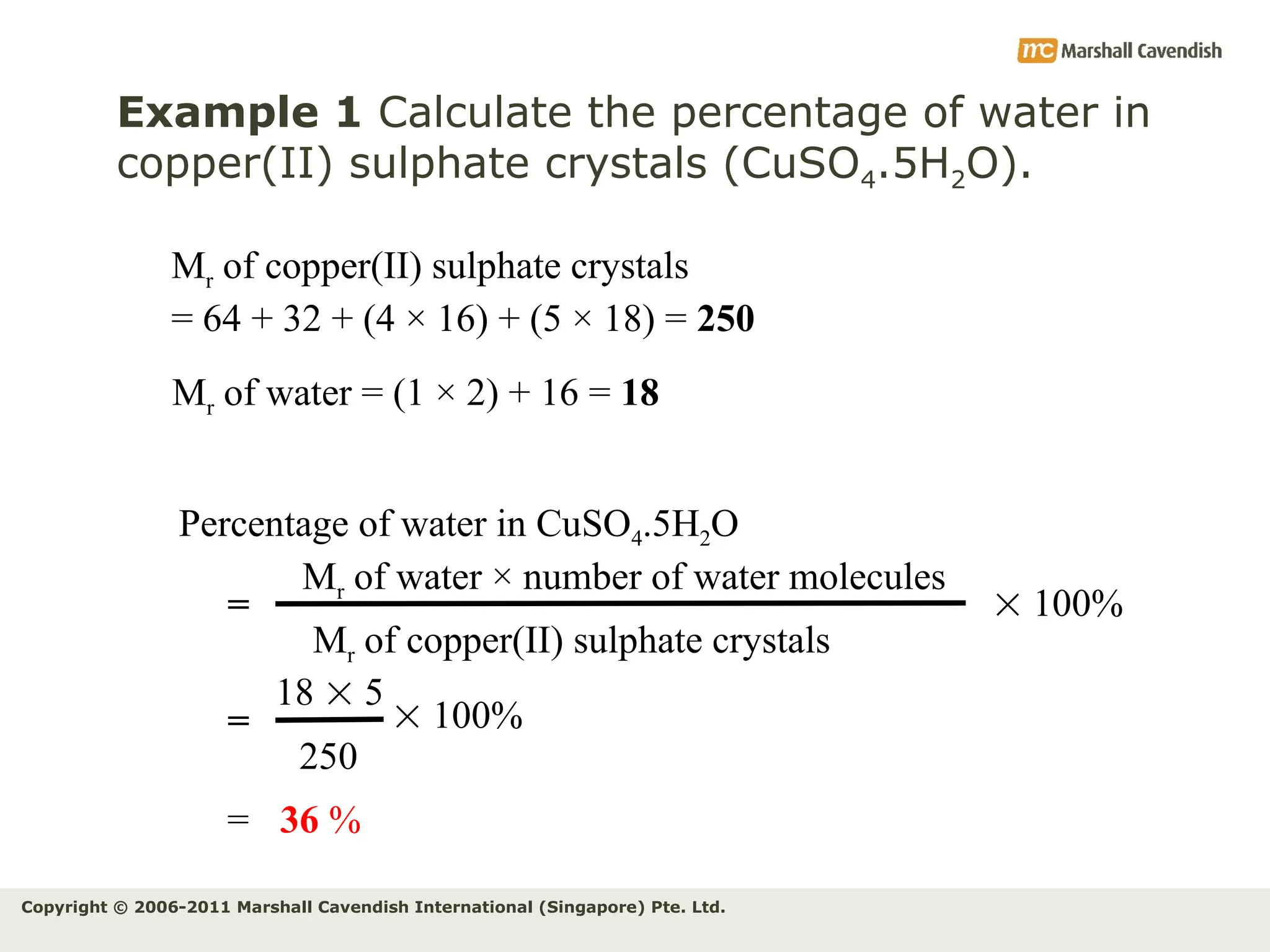
Example 1 Calculate the percentage of water in
copper(II) sulphate crystals (CuSO4.5H2O).
Mr of copper(II) sulphate crystals
= 64 + 32 + (4 × 16) + (5 × 18) = 250
Mr of water = (1 × 2) + 16 = 18
Percentage of water in CuSO4.5H2O
Mr of water × number of water molecules
Mr of copper(II) sulphate crystals
=
18  5
250
=
= 36 %
 100%
 100%
Copyright © 2006-2011 Marshall Cavendish International (Singapore) Pte. Ltd.
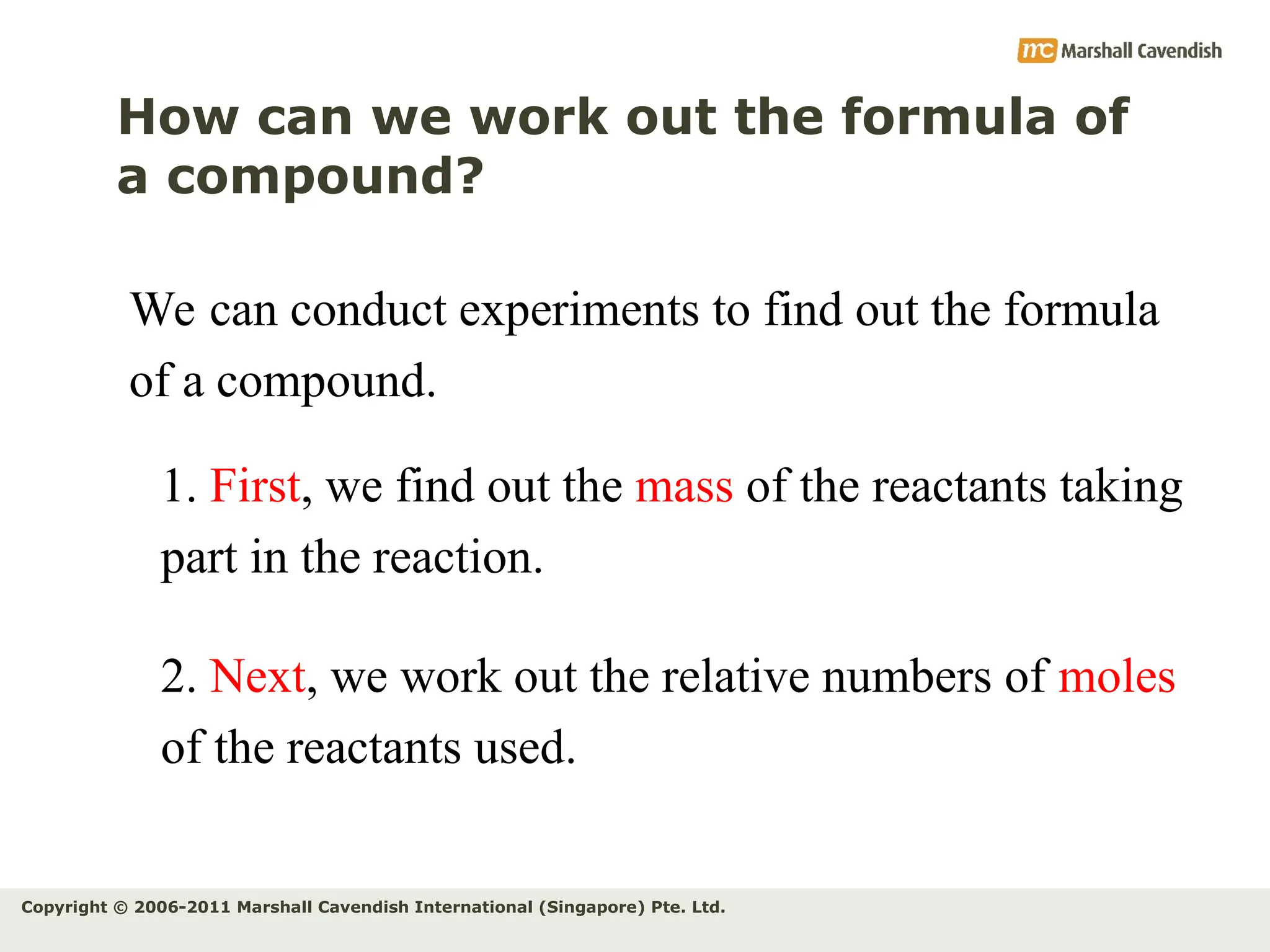
How can we work out the formula of
a compound?
We can conduct experiments to find out the formula
of a compound.
1. First, we find out the mass of the reactants taking
part in the reaction.
2. Next, we work out the relative numbers of moles
of the reactants used.
Copyright © 2006-2011 Marshall Cavendish International (Singapore) Pte. Ltd.
Working Out the Formula of
Magnesium Oxide
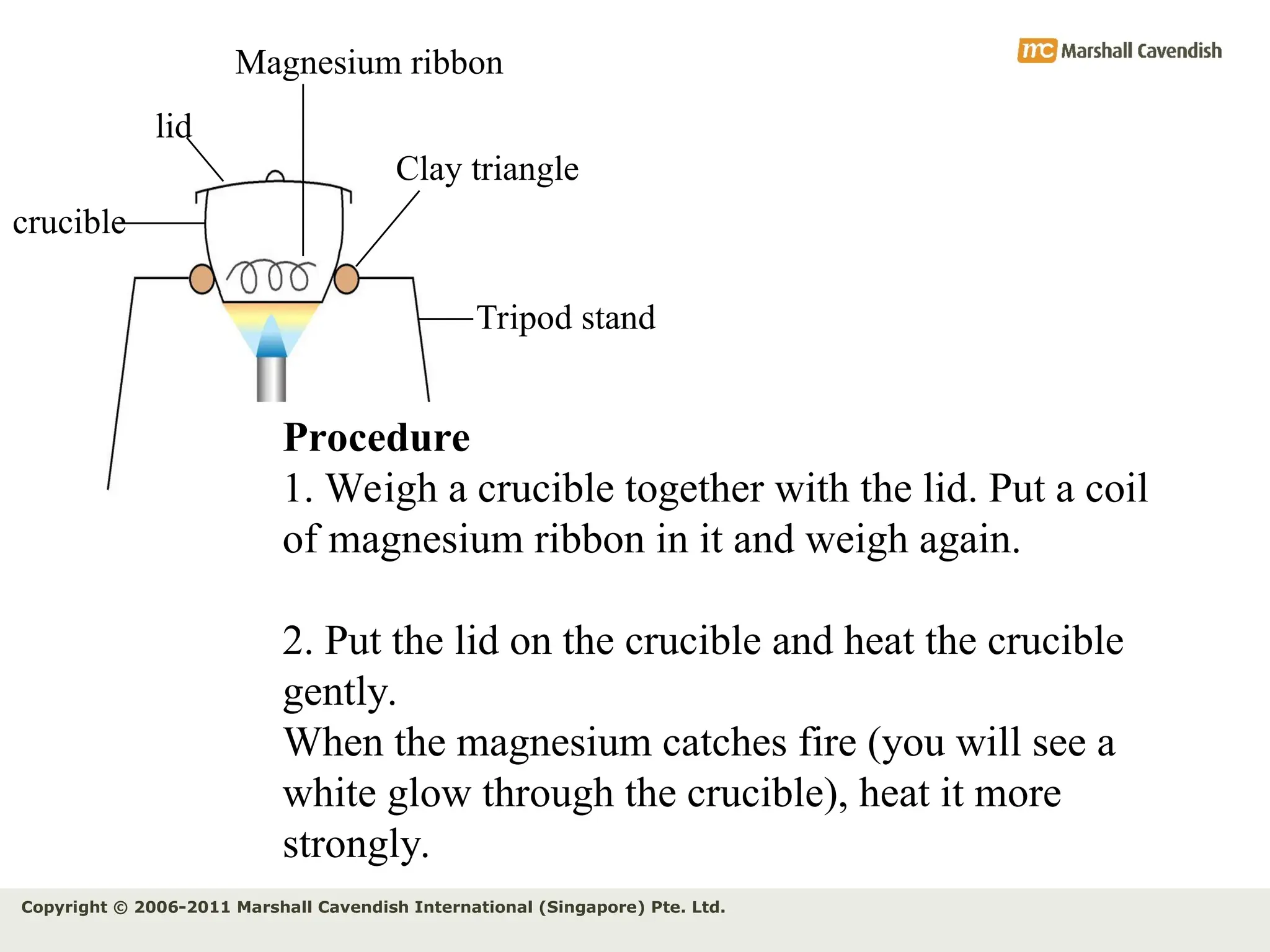
To work out the formula of magnesium oxide produced by
the combustion of magnesium, the following apparatus is
used.
Magnesium ribbon
Clay triangle
Tripod stand
lid
crucible
Copyright © 2006-2011 Marshall Cavendish International (Singapore) Pte. Ltd.
Magnesium ribbon
Clay triangle
Tripod stand
lid
crucible
Procedure
1. Weigh a crucible together with the lid. Put a coil
of magnesium ribbon in it and weigh again.
2. Put the lid on the crucible and heat the crucible
gently.
When the magnesium catches fire (you will see a
white glow through the crucible), heat it more
strongly.
Copyright © 2006-2011 Marshall Cavendish International (Singapore) Pte. Ltd.
Magnesium ribbon
Clay triangle
Tripod stand
lid
crucible
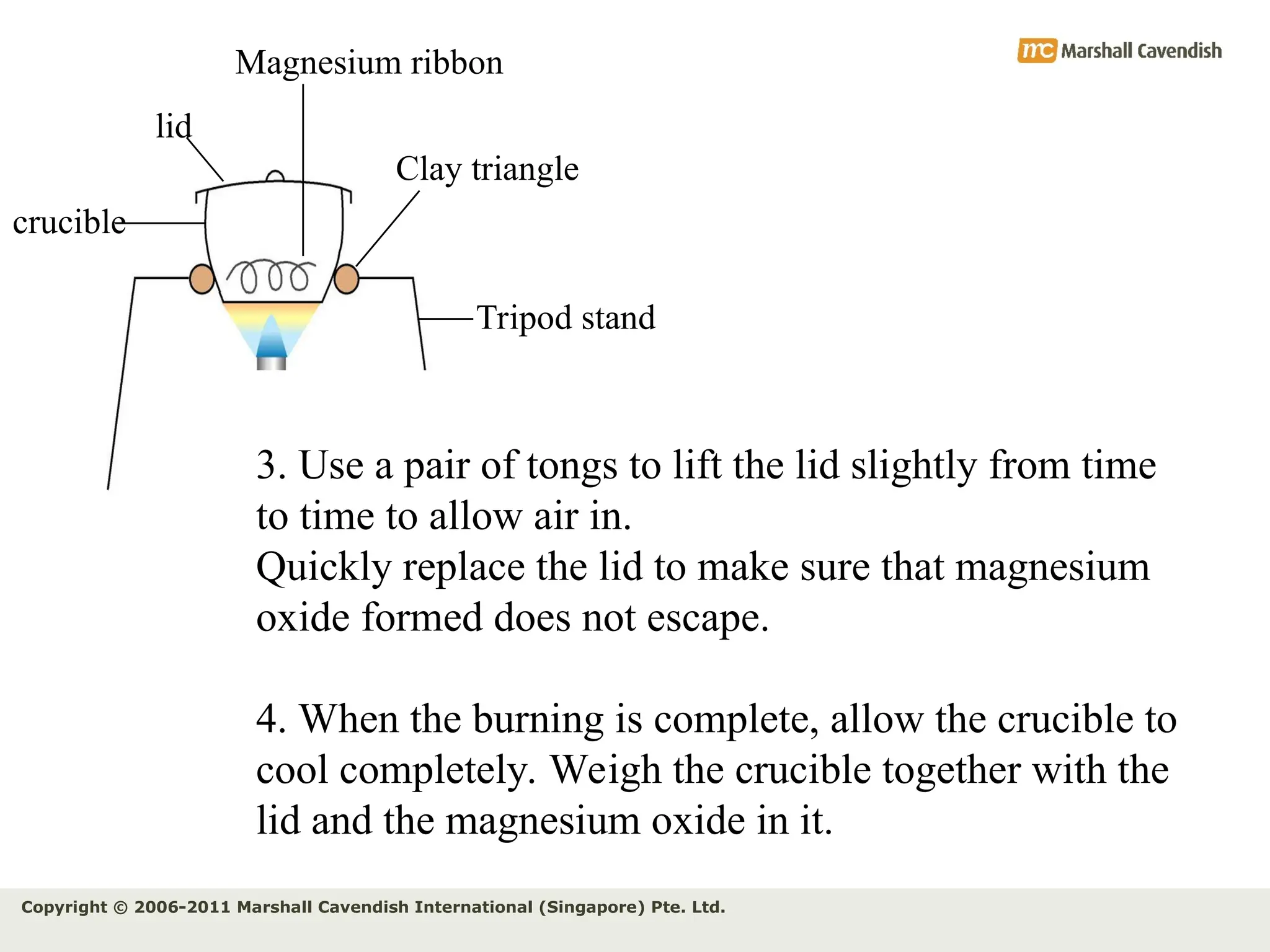
3. Use a pair of tongs to lift the lid slightly from time
to time to allow air in.
Quickly replace the lid to make sure that magnesium
oxide formed does not escape.
4. When the burning is complete, allow the crucible to
cool completely. Weigh the crucible together with the
lid and the magnesium oxide in it.
Copyright © 2006-2011 Marshall Cavendish International (Singapore) Pte. Ltd.
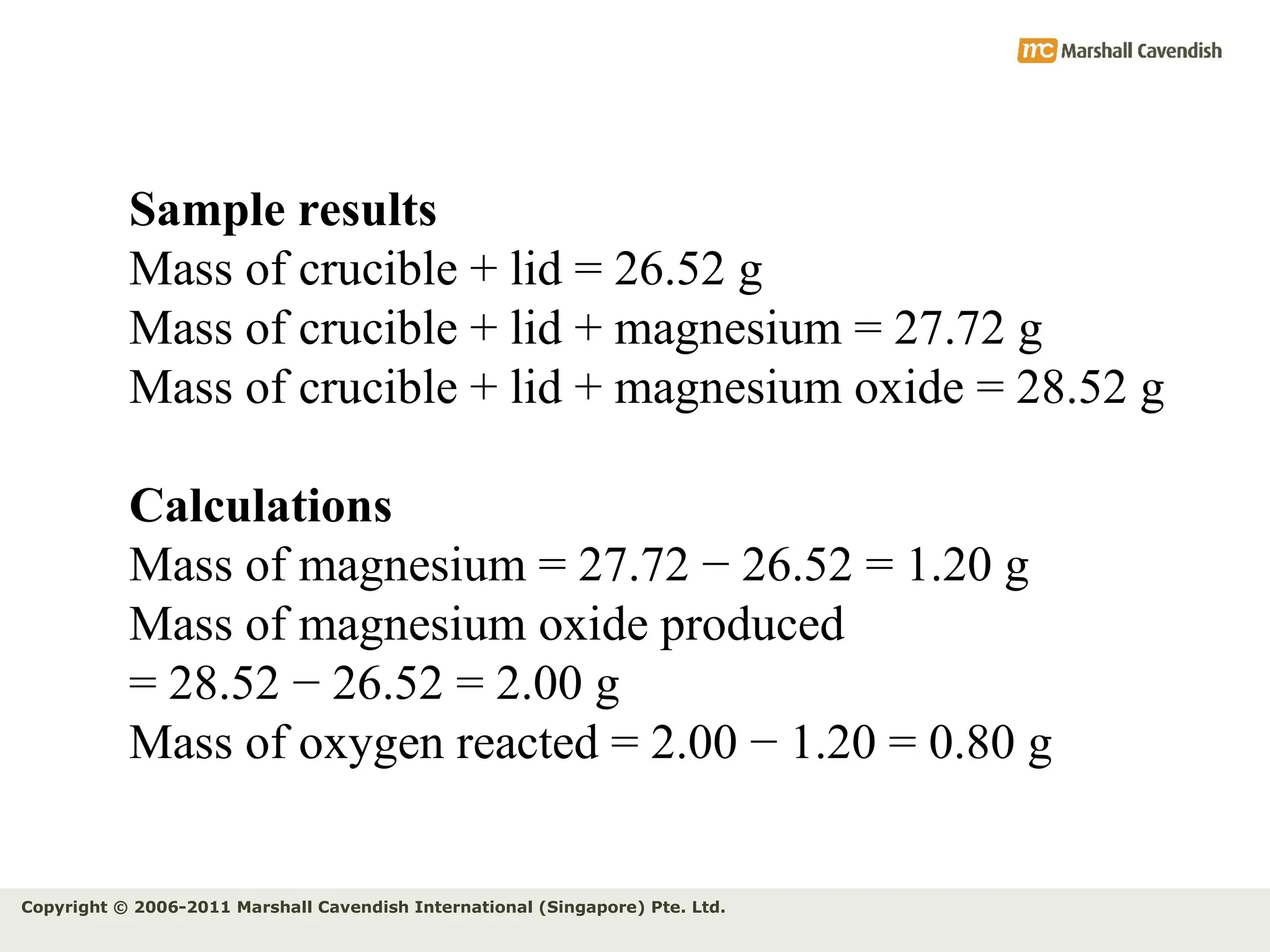
Sample results
Mass of crucible + lid = 26.52 g
Mass of crucible + lid + magnesium = 27.72 g
Mass of crucible + lid + magnesium oxide = 28.52 g
Calculations
Mass of magnesium = 27.72 − 26.52 = 1.20 g
Mass of magnesium oxide produced
= 28.52 − 26.52 = 2.00 g
Mass of oxygen reacted = 2.00 − 1.20 = 0.80 g
Copyright © 2006-2011 Marshall Cavendish International (Singapore) Pte. Ltd.
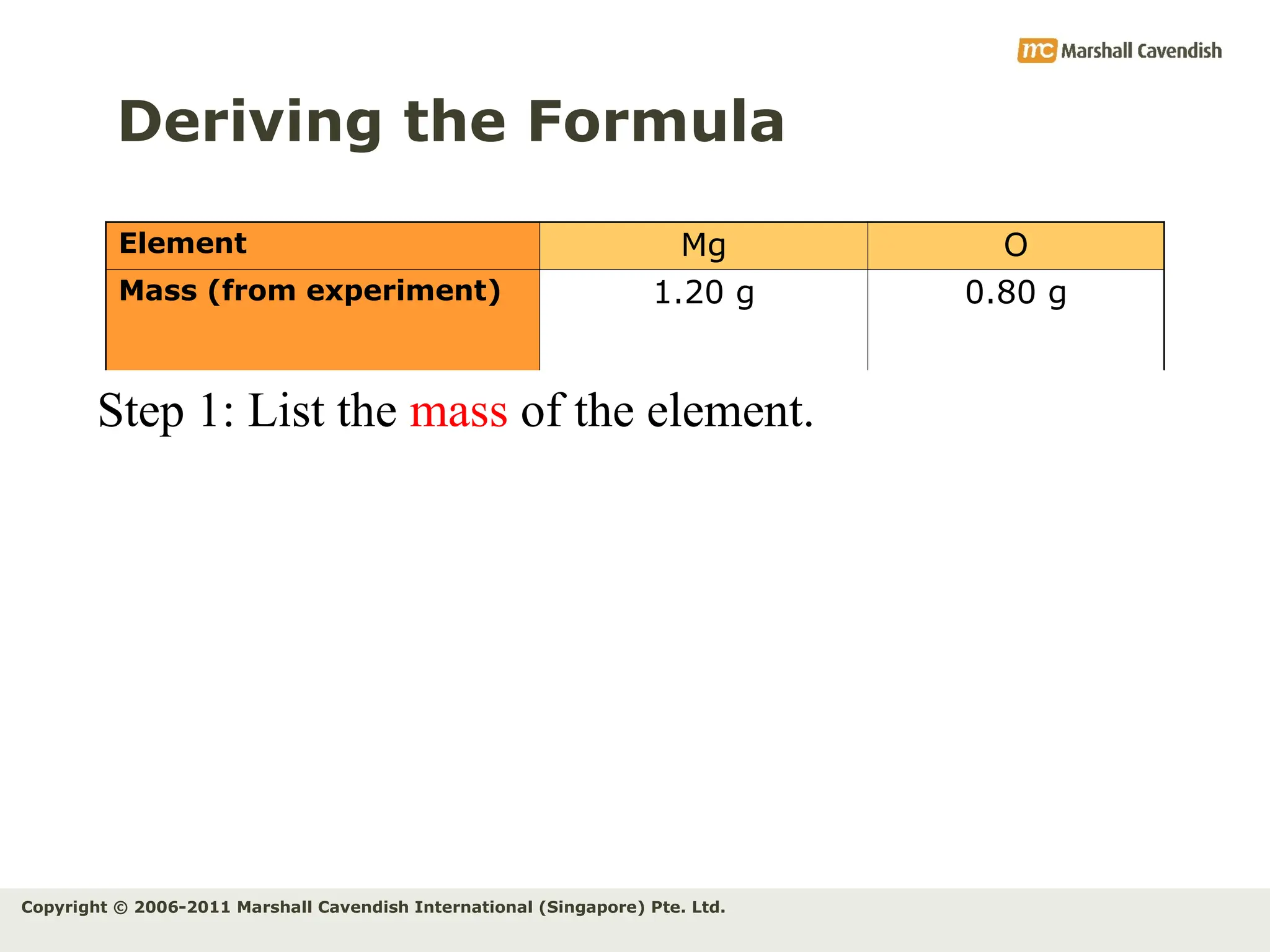
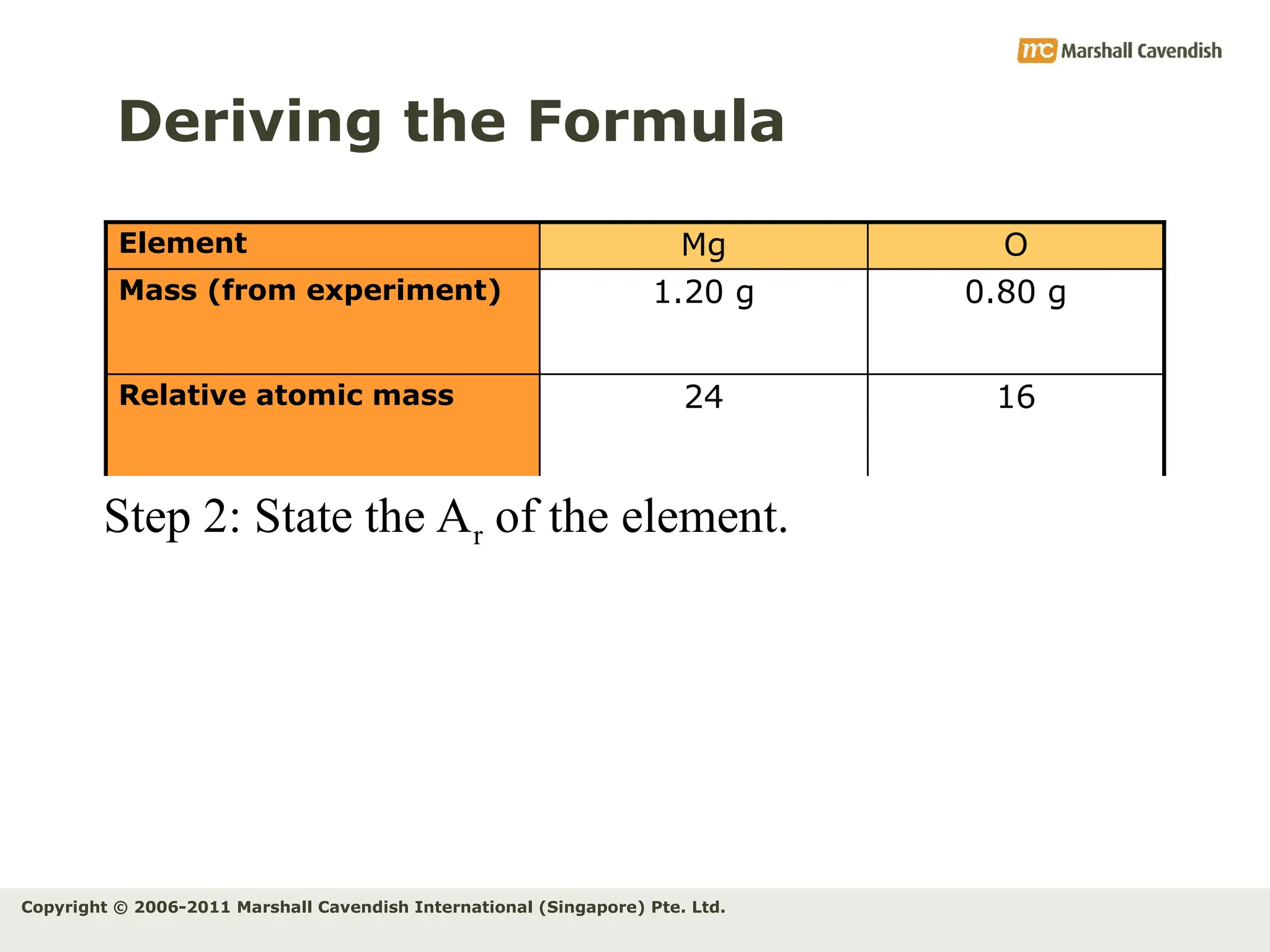
Deriving the Formula
Element Mg O
Mass (from experiment) 1.20 g 0.80 g
Relative atomic mass 24 16
Number of moles
Molar ratio (divide by the
smallest number from
the previous row)
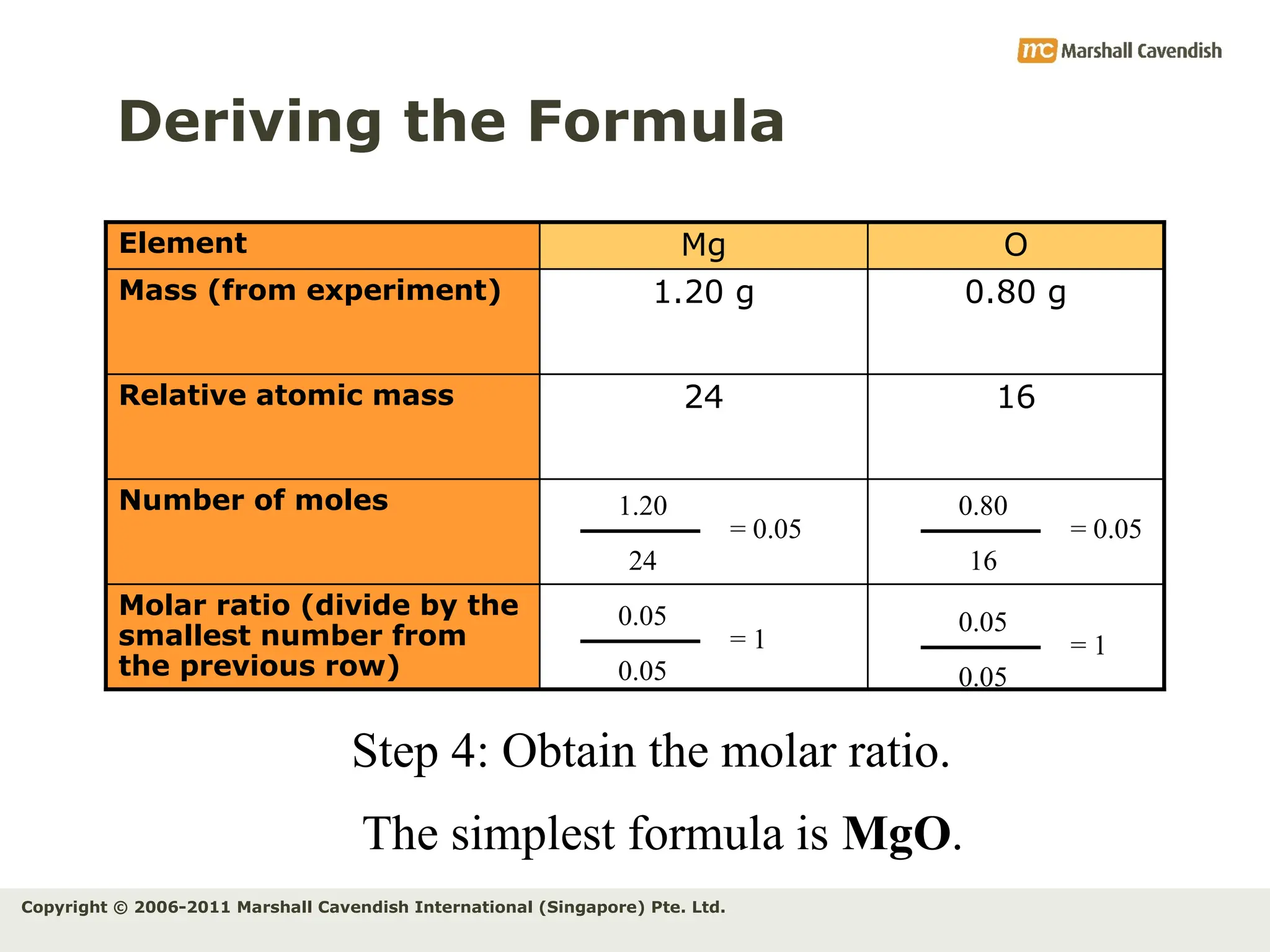
1.20
24
= 0.05
0.05
0.05
= 1
0.05
0.05
= 1
0.80
16
= 0.05
Step 1: List the mass of the element.
Copyright © 2006-2011 Marshall Cavendish International (Singapore) Pte. Ltd.
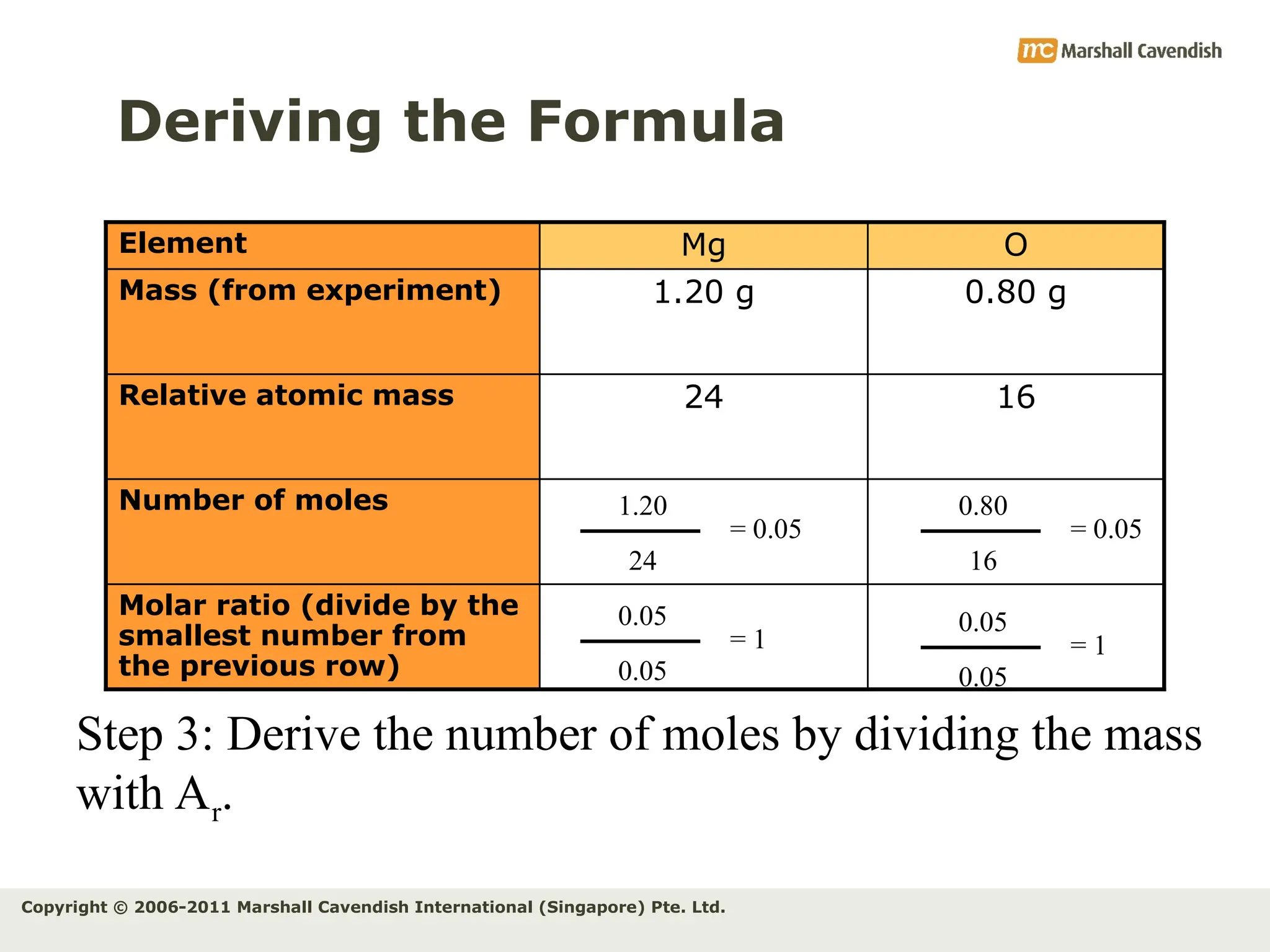
Deriving the Formula
Molar ratio (divide by the
smallest number from
the previous row)
Number of moles
16
24
Relative atomic mass
0.80 g
1.20 g
Mass (from experiment)
O
Mg
Element
1.20
24
= 0.05
0.05
0.05
= 1
0.05
0.05
= 1
0.80
16
= 0.05
Step 2: State the Ar of the element.
Copyright © 2006-2011 Marshall Cavendish International (Singapore) Pte. Ltd.
Deriving the Formula
Step 3: Derive the number of moles by dividing the mass
with Ar.
Molar ratio (divide by the
smallest number from
the previous row)
Number of moles
16
24
Relative atomic mass
0.80 g
1.20 g
Mass (from experiment)
O
Mg
Element
1.20
24
= 0.05
0.05
0.05
= 1
0.05
0.05
= 1
0.80
16
= 0.05
Copyright © 2006-2011 Marshall Cavendish International (Singapore) Pte. Ltd.
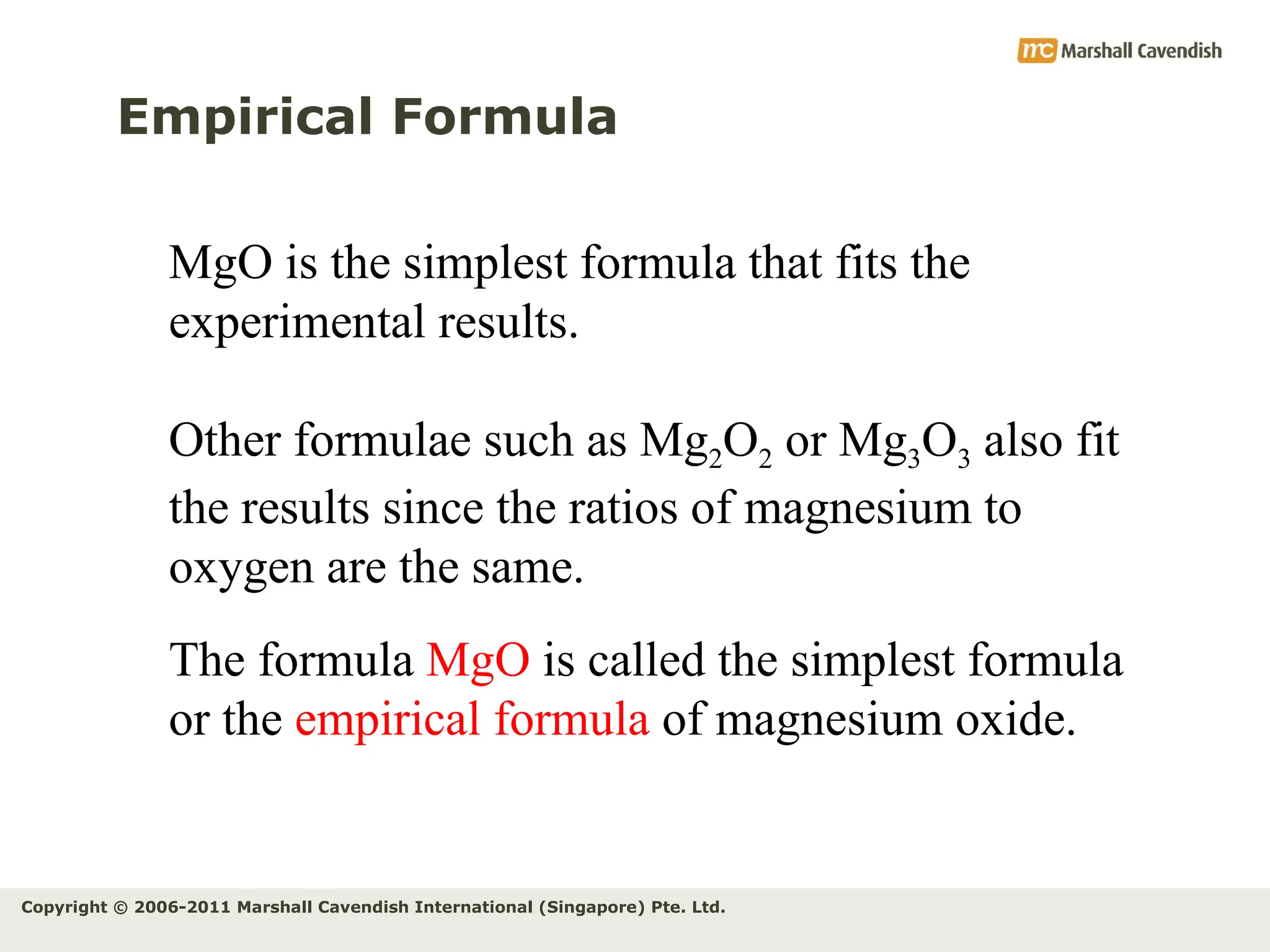
Step 4: Obtain the molar ratio.
Deriving the Formula
The simplest formula is MgO.
Molar ratio (divide by the
smallest number from
the previous row)
Number of moles
16
24
Relative atomic mass
0.80 g
1.20 g
Mass (from experiment)
O
Mg
Element
1.20
24
= 0.05
0.05
0.05
= 1
0.05
0.05
= 1
0.80
16
= 0.05
Copyright © 2006-2011 Marshall Cavendish International (Singapore) Pte. Ltd.
Empirical Formula
MgO is the simplest formula that fits the
experimental results.
Other formulae such as Mg2O2 or Mg3O3 also fit
the results since the ratios of magnesium to
oxygen are the same.
The formula MgO is called the simplest formula
or the empirical formula of magnesium oxide.
Copyright © 2006-2011 Marshall Cavendish International (Singapore) Pte. Ltd.
Empirical Formula
The empirical formula of a compound shows
• the types of elements present in it,
• the simplest ratio of the different types of atoms
in it.
Copyright © 2006-2011 Marshall Cavendish International (Singapore) Pte. Ltd.
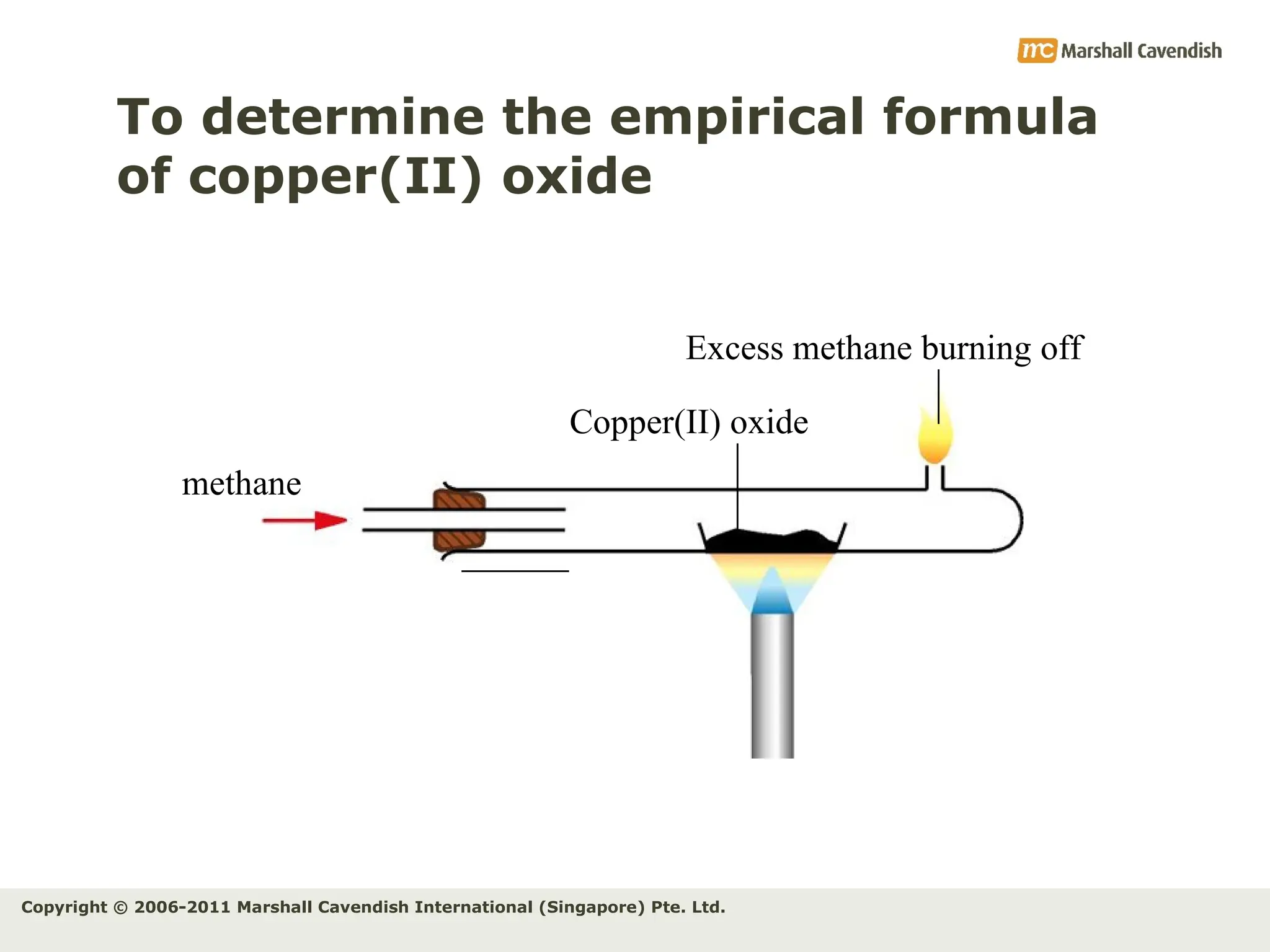
To determine the empirical formula
of copper(II) oxide
Excess methane burning off
Copper(II) oxide
methane
Copyright © 2006-2011 Marshall Cavendish International (Singapore) Pte. Ltd.
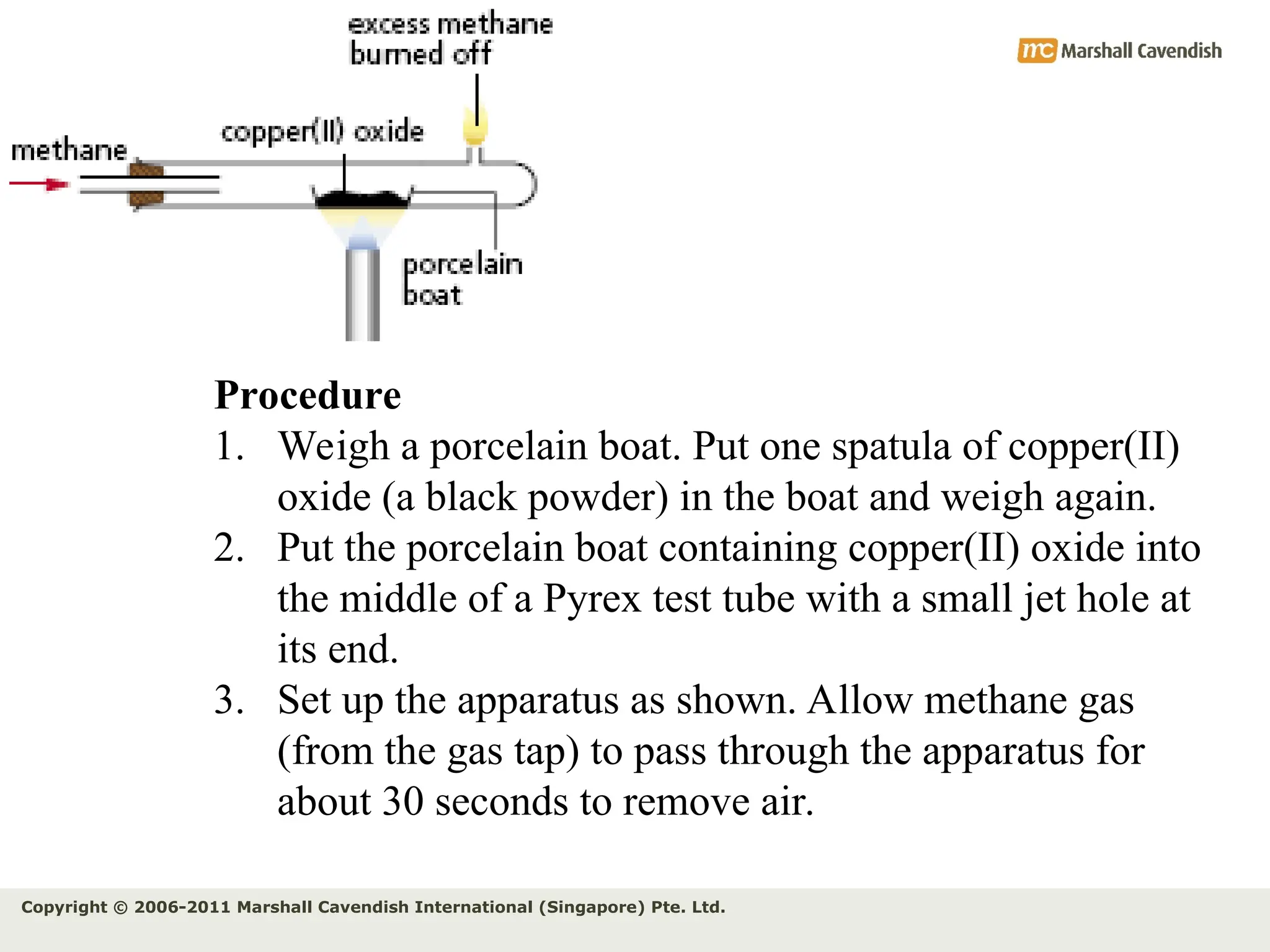
Procedure
1. Weigh a porcelain boat. Put one spatula of copper(II)
oxide (a black powder) in the boat and weigh again.
2. Put the porcelain boat containing copper(II) oxide into
the middle of a Pyrex test tube with a small jet hole at
its end.
3. Set up the apparatus as shown. Allow methane gas
(from the gas tap) to pass through the apparatus for
about 30 seconds to remove air.
Copyright © 2006-2011 Marshall Cavendish International (Singapore) Pte. Ltd.
4. Light the gas that escapes through the hole in the test
tube. Then heat the copper(II) oxide until no further
colour change is observed.
5. Turn off the Bunsen burner but allow the methane gas to
flow through the apparatus while the apparatus is cooling.
6. Turn off the gas supply when the apparatus is completely
cool. Weigh the porcelain boat and its contents.
Copyright © 2006-2011 Marshall Cavendish International (Singapore) Pte. Ltd.
Sample results
Mass of porcelain boat = 18.40 g
Mass of porcelain boat + copper(II) oxide = 35.89 g
Mass of porcelain boat + copper = 32.37 g
Calculations
Mass of copper = 32.37 − 18.40 = 13.97 g
Mass of oxygen = 35.89 − 32.37 = 3.52 g
Copyright © 2006-2011 Marshall Cavendish International (Singapore) Pte. Ltd.
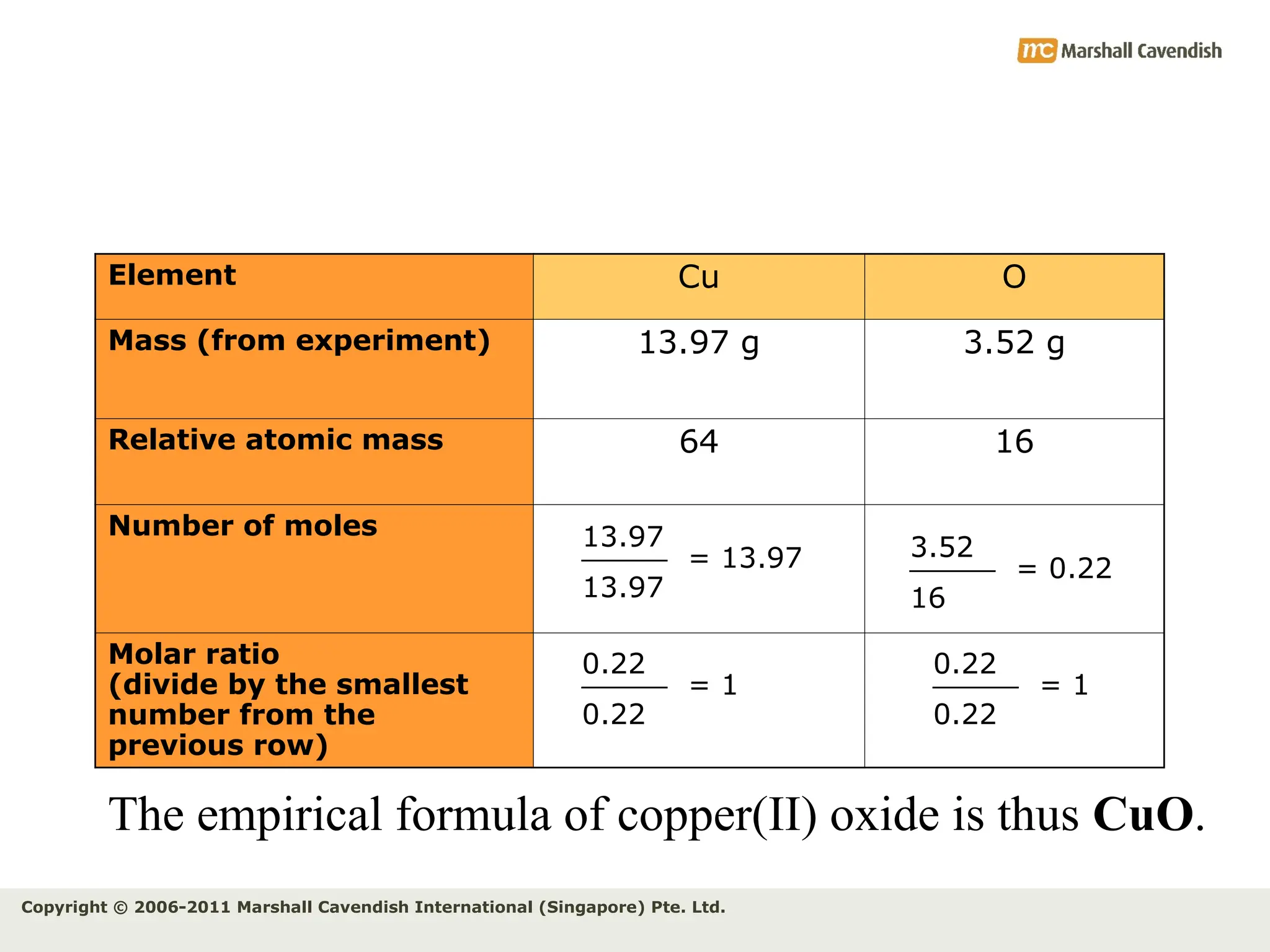
The empirical formula of copper(II) oxide is thus CuO.
Element Cu O
Mass (from experiment) 13.97 g 3.52 g
Relative atomic mass 64 16
Number of moles
Molar ratio
(divide by the smallest
number from the
previous row)
= 13.97
13.97
13.97
= 1
0.22
0.22
= 0.22
16
3.52
= 1
0.22
0.22
Copyright © 2006-2011 Marshall Cavendish International (Singapore) Pte. Ltd.
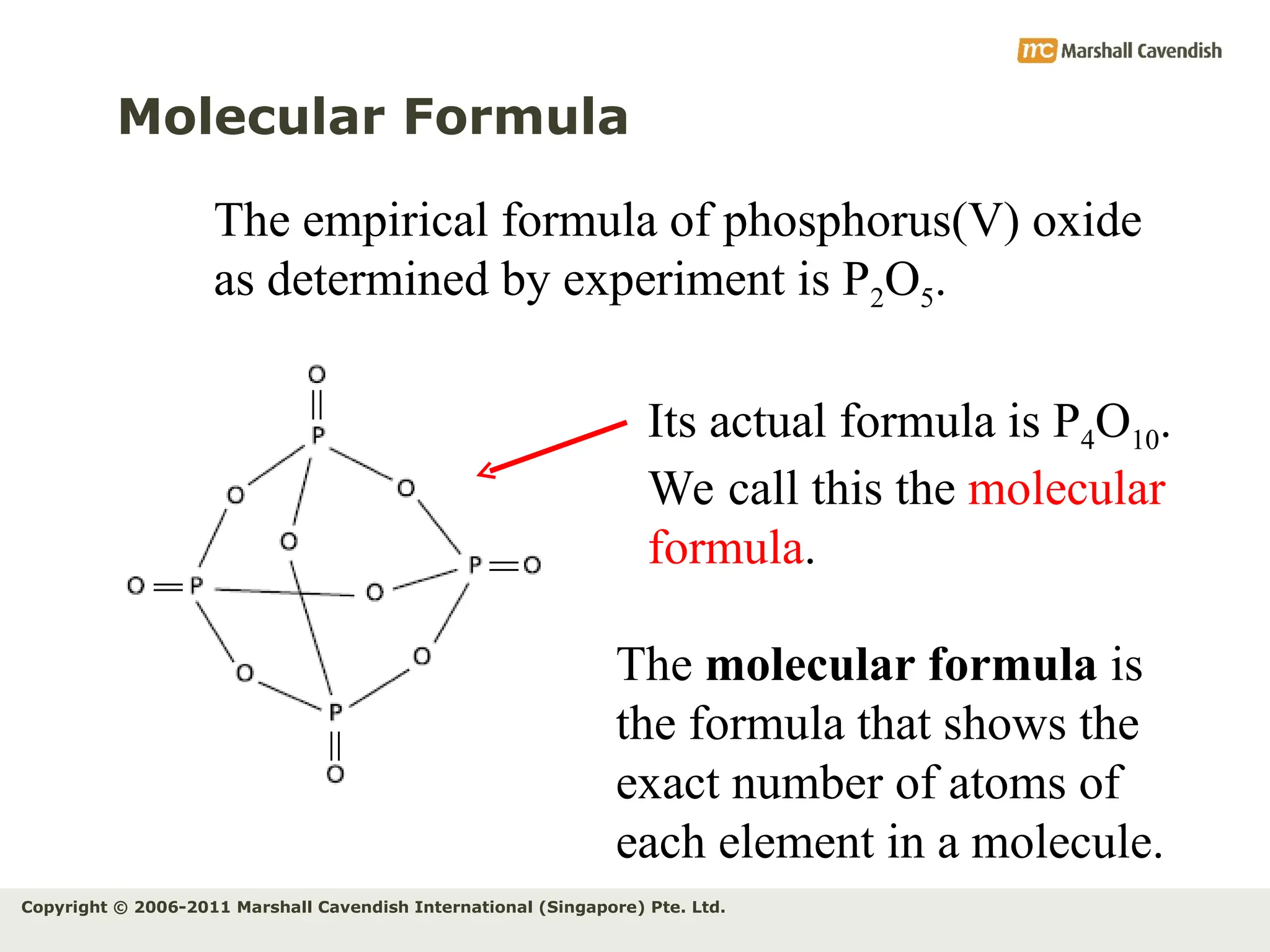
Molecular Formula
Its actual formula is P4O10.
We call this the molecular
formula.
The molecular formula is
the formula that shows the
exact number of atoms of
each element in a molecule.
The empirical formula of phosphorus(V) oxide
as determined by experiment is P2O5.
Copyright © 2006-2011 Marshall Cavendish International (Singapore) Pte. Ltd.
What is the relationship between
empirical formula and molecular
formula?
For many compounds, such as water and
ammonia, the empirical formula and
molecular formula are the same.
However, there are also many compounds
(especially organic compounds) whose
molecular formulae differ from their
empirical formulae.
Copyright © 2006-2011 Marshall Cavendish International (Singapore) Pte. Ltd.
What is the relationship between
empirical formula and molecular
formula?
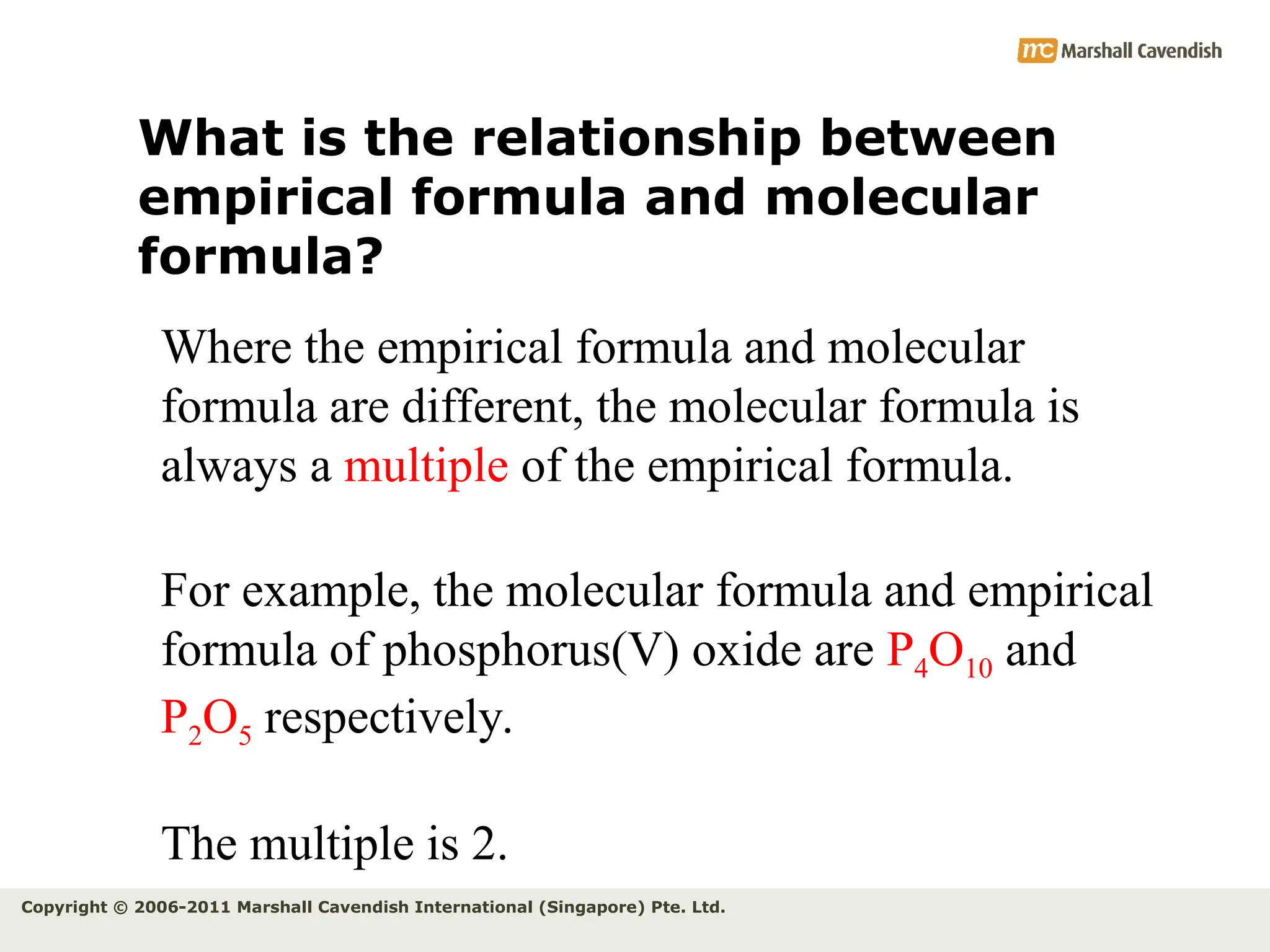
Where the empirical formula and molecular
formula are different, the molecular formula is
always a multiple of the empirical formula.
For example, the molecular formula and empirical
formula of phosphorus(V) oxide are P4O10 and
P2O5 respectively.
The multiple is 2.
Copyright © 2006-2011 Marshall Cavendish International (Singapore) Pte. Ltd.
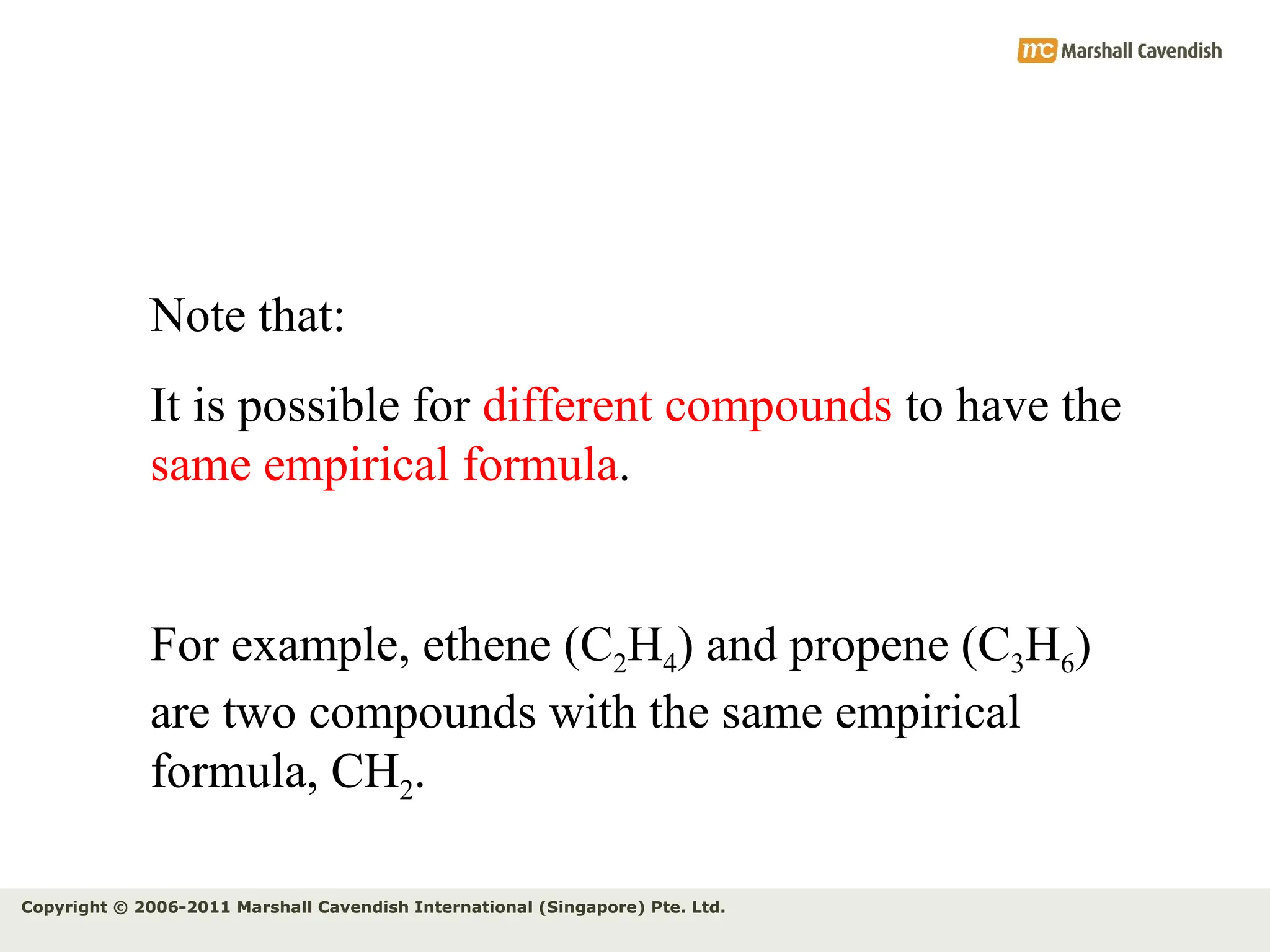
Note that:
It is possible for different compounds to have the
same empirical formula.
For example, ethene (C2H4) and propene (C3H6)
are two compounds with the same empirical
formula, CH2.
Copyright © 2006-2011 Marshall Cavendish International (Singapore) Pte. Ltd.
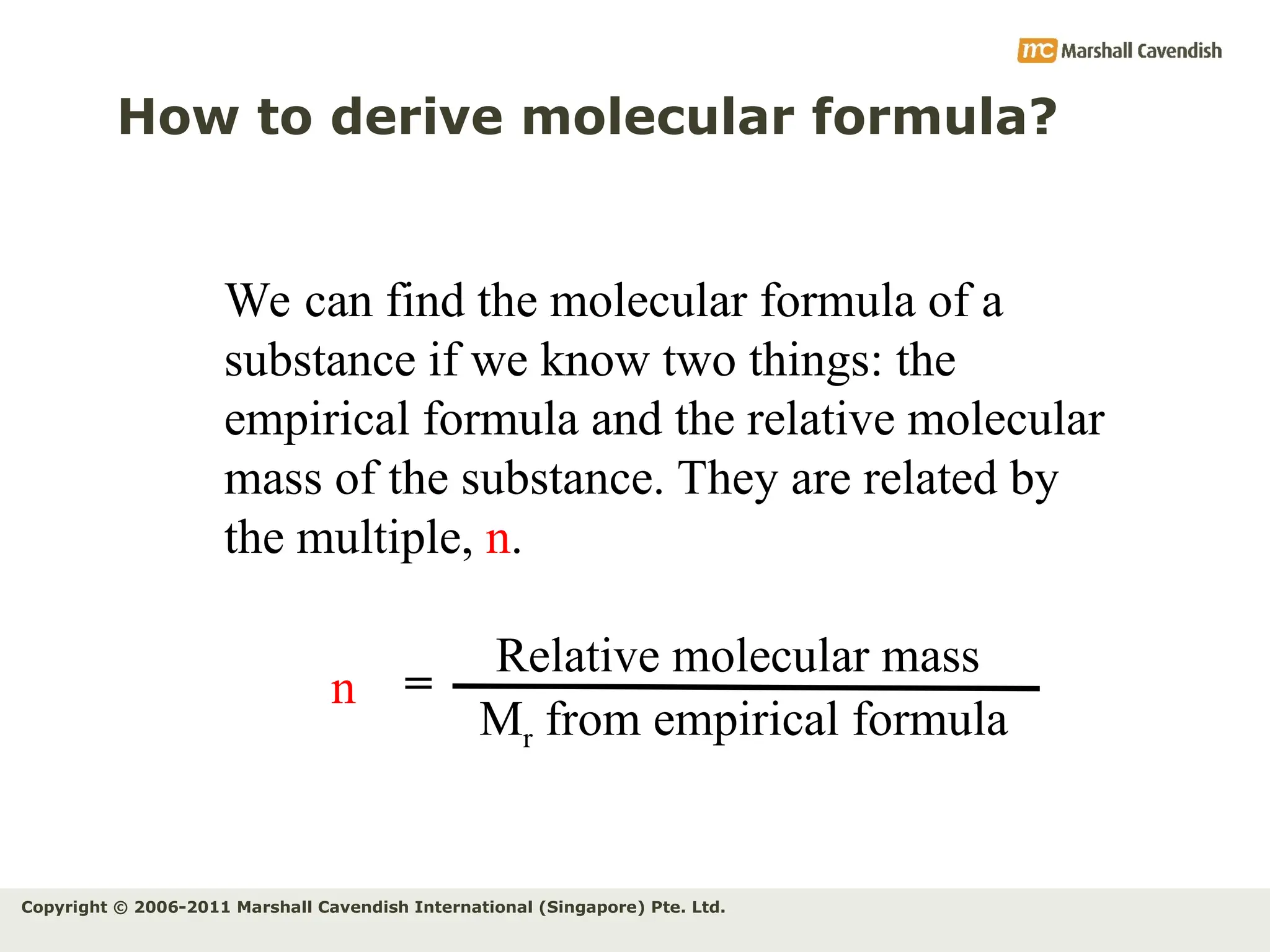
How to derive molecular formula?
We can find the molecular formula of a
substance if we know two things: the
empirical formula and the relative molecular
mass of the substance. They are related by
the multiple, n.
n
Relative molecular mass
Mr from empirical formula
=
Copyright © 2006-2011 Marshall Cavendish International (Singapore) Pte. Ltd.
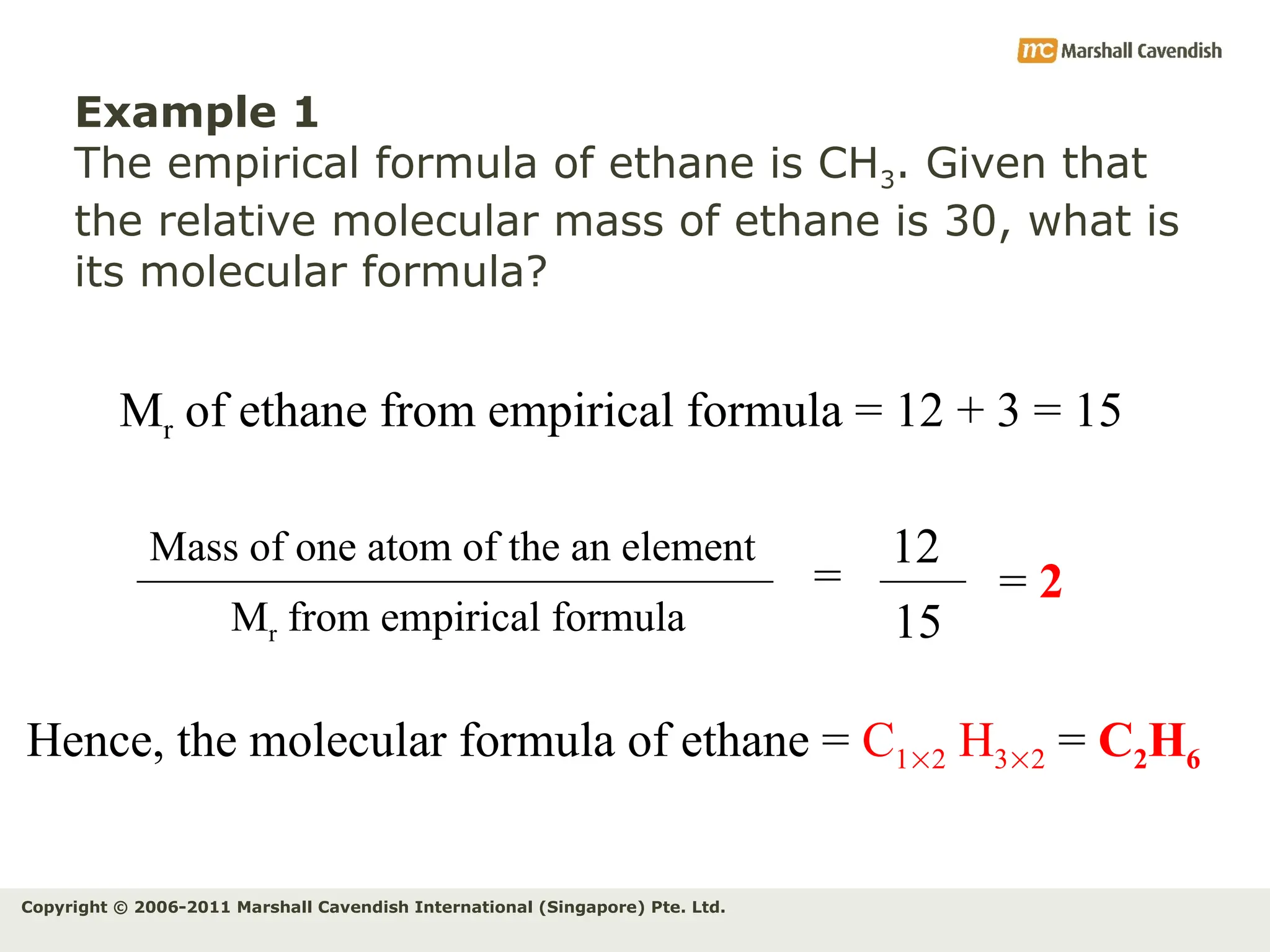
Example 1
The empirical formula of ethane is CH3. Given that
the relative molecular mass of ethane is 30, what is
its molecular formula?
Mr of ethane from empirical formula = 12 + 3 = 15
=
Mr from empirical formula
Mass of one atom of the an element 12
15
= 2
Hence, the molecular formula of ethane = C12 H32 = C2H6
Copyright © 2006-2011 Marshall Cavendish International (Singapore) Pte. Ltd.
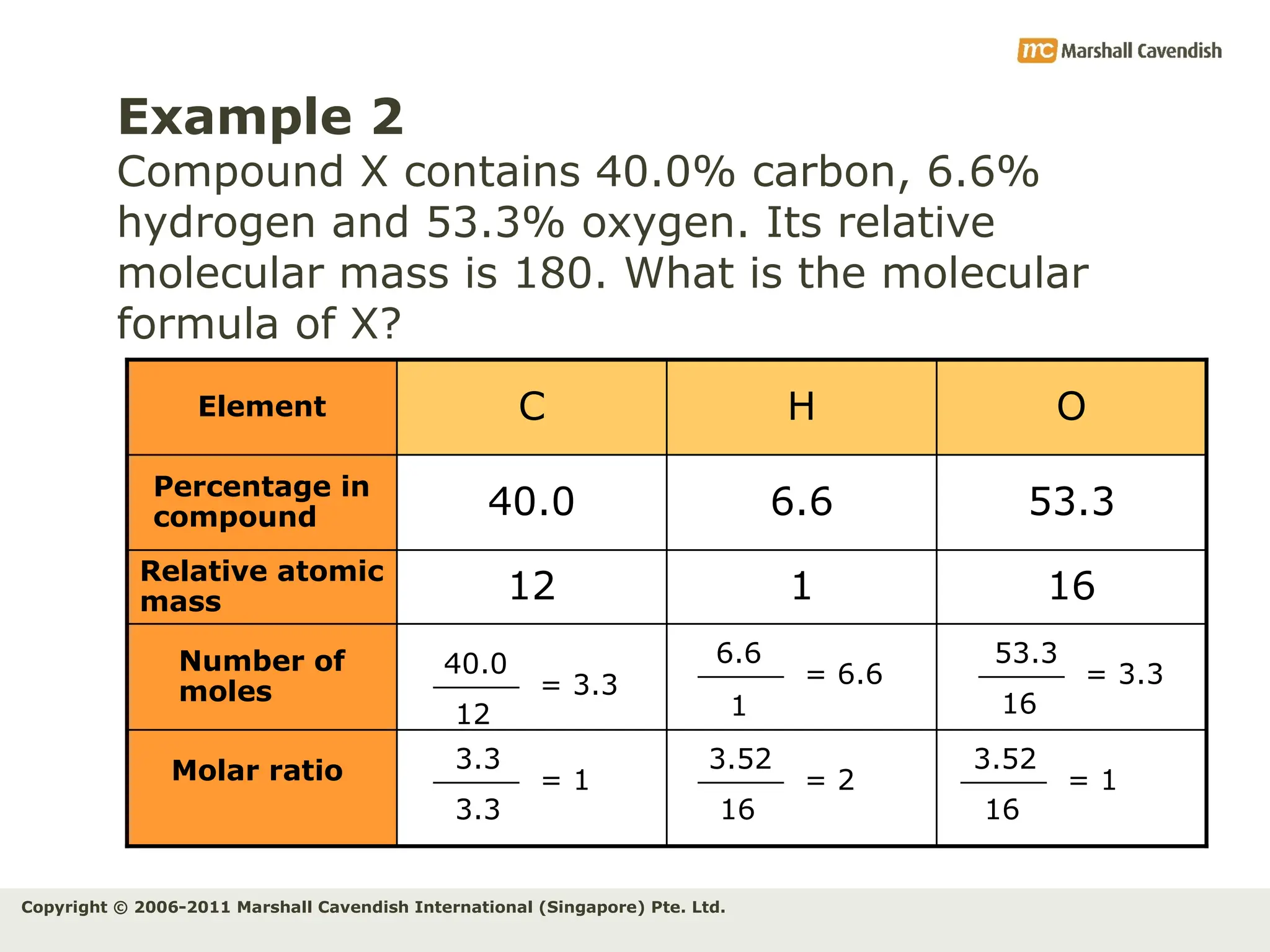
Example 2
Compound X contains 40.0% carbon, 6.6%
hydrogen and 53.3% oxygen. Its relative
molecular mass is 180. What is the molecular
formula of X?
Molar ratio
Number of
moles
16
1
12
Relative atomic
mass
53.3
6.6
40.0
Percentage in
compound
O
H
C
Element
= 3.3
12
40.0 = 3.3
16
53.3
= 1
16
3.52
= 2
16
3.52
= 6.6
1
6.6
= 1
3.3
3.3
Copyright © 2006-2011 Marshall Cavendish International (Singapore) Pte. Ltd.
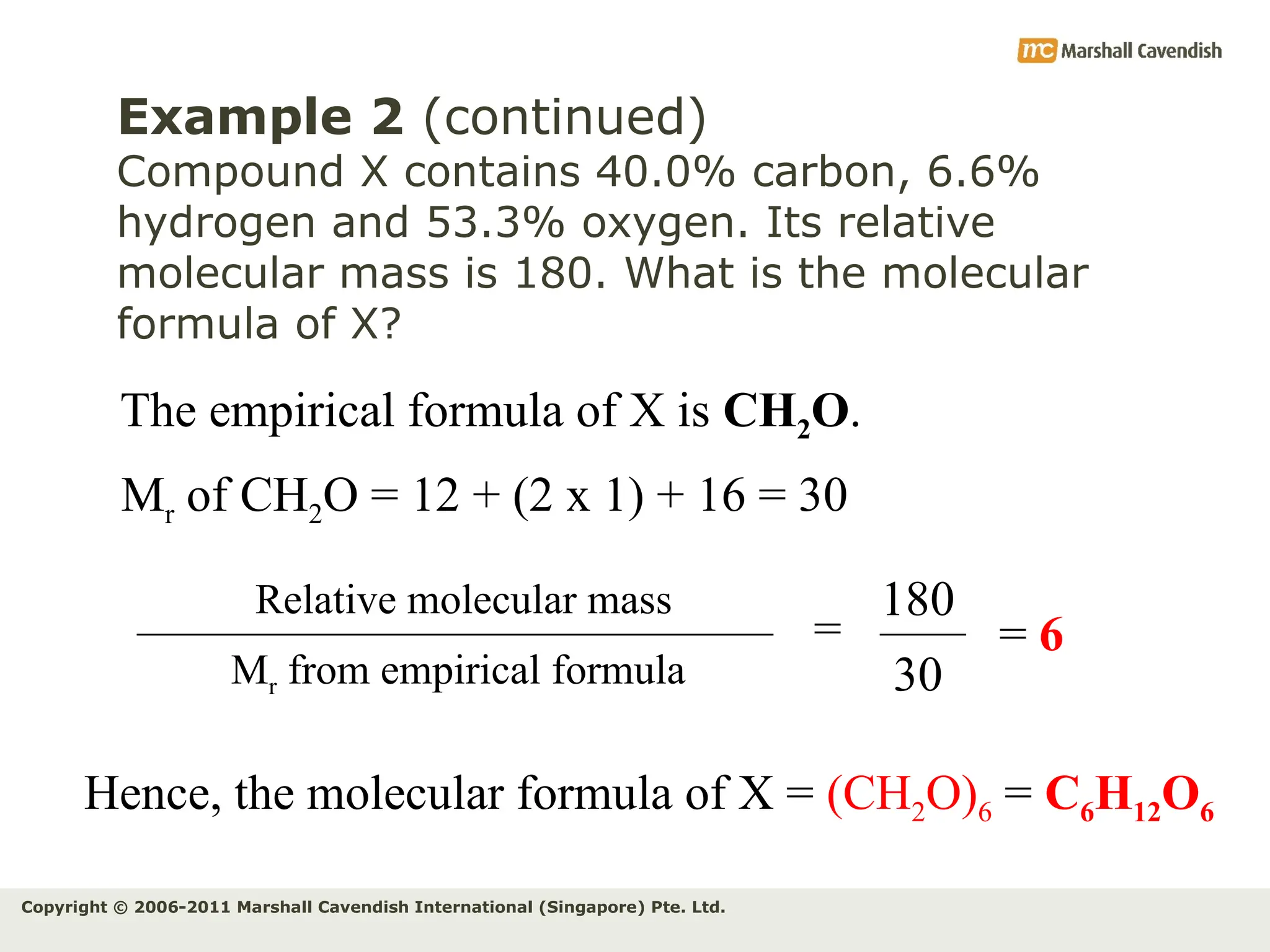
Example 2 (continued)
Compound X contains 40.0% carbon, 6.6%
hydrogen and 53.3% oxygen. Its relative
molecular mass is 180. What is the molecular
formula of X?
The empirical formula of X is CH2O.
=
Mr from empirical formula
Relative molecular mass 180
30
= 6
Hence, the molecular formula of X = (CH2O)6 = C6H12O6
Mr of CH2O = 12 + (2 x 1) + 16 = 30
Copyright © 2006-2011 Marshall Cavendish International (Singapore) Pte. Ltd.
Molar Gas Volume
Unlike solids and liquids, gases weigh very
little.
It is easier to measure the volume of a gas
than its mass.
Is there a way to relate moles to the volumes
of gases?
Copyright © 2006-2011 Marshall Cavendish International (Singapore) Pte. Ltd.
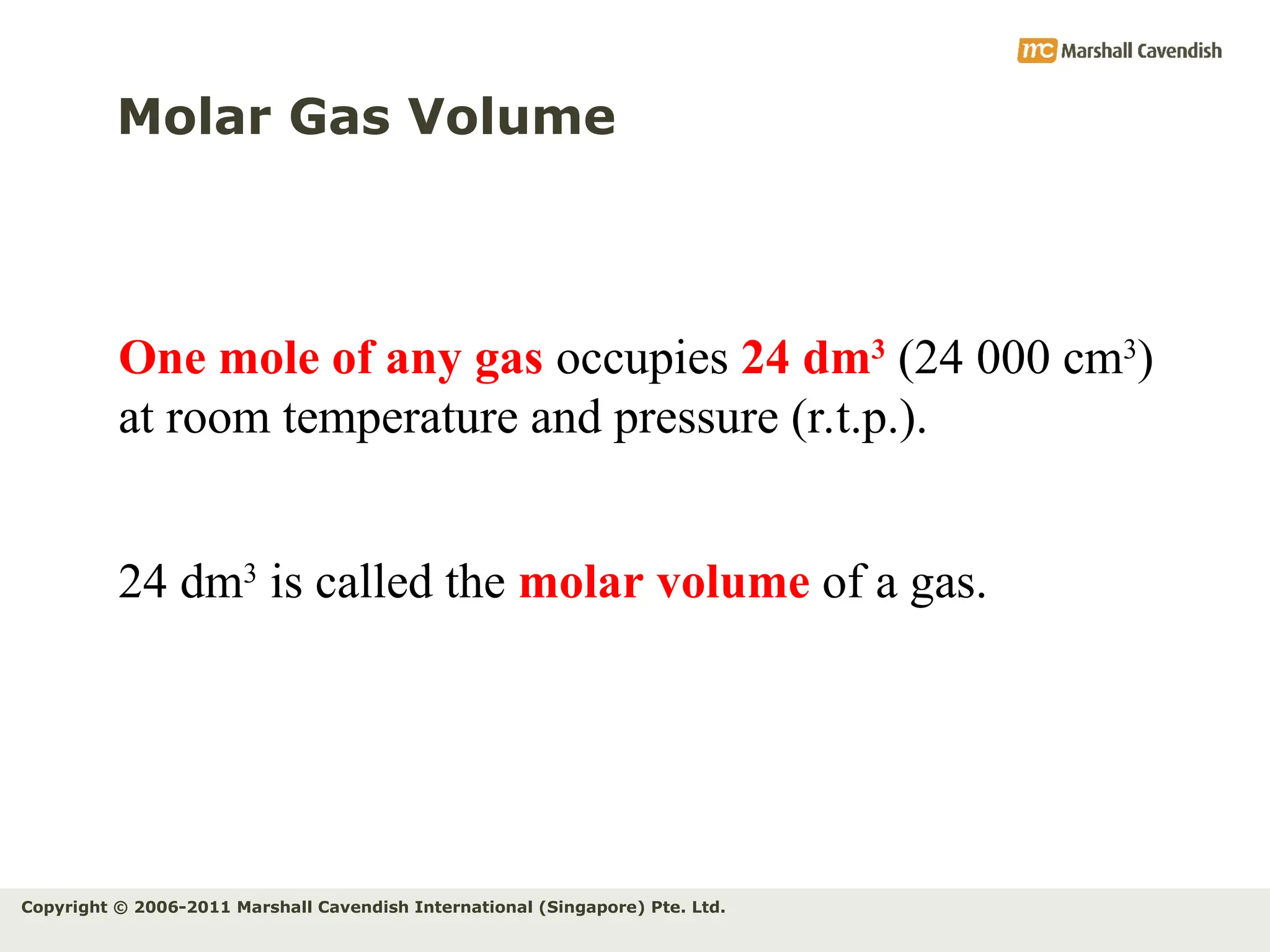
Molar Gas Volume
One mole of any gas occupies 24 dm3
(24 000 cm3
)
at room temperature and pressure (r.t.p.).
24 dm3
is called the molar volume of a gas.
Copyright © 2006-2011 Marshall Cavendish International (Singapore) Pte. Ltd.
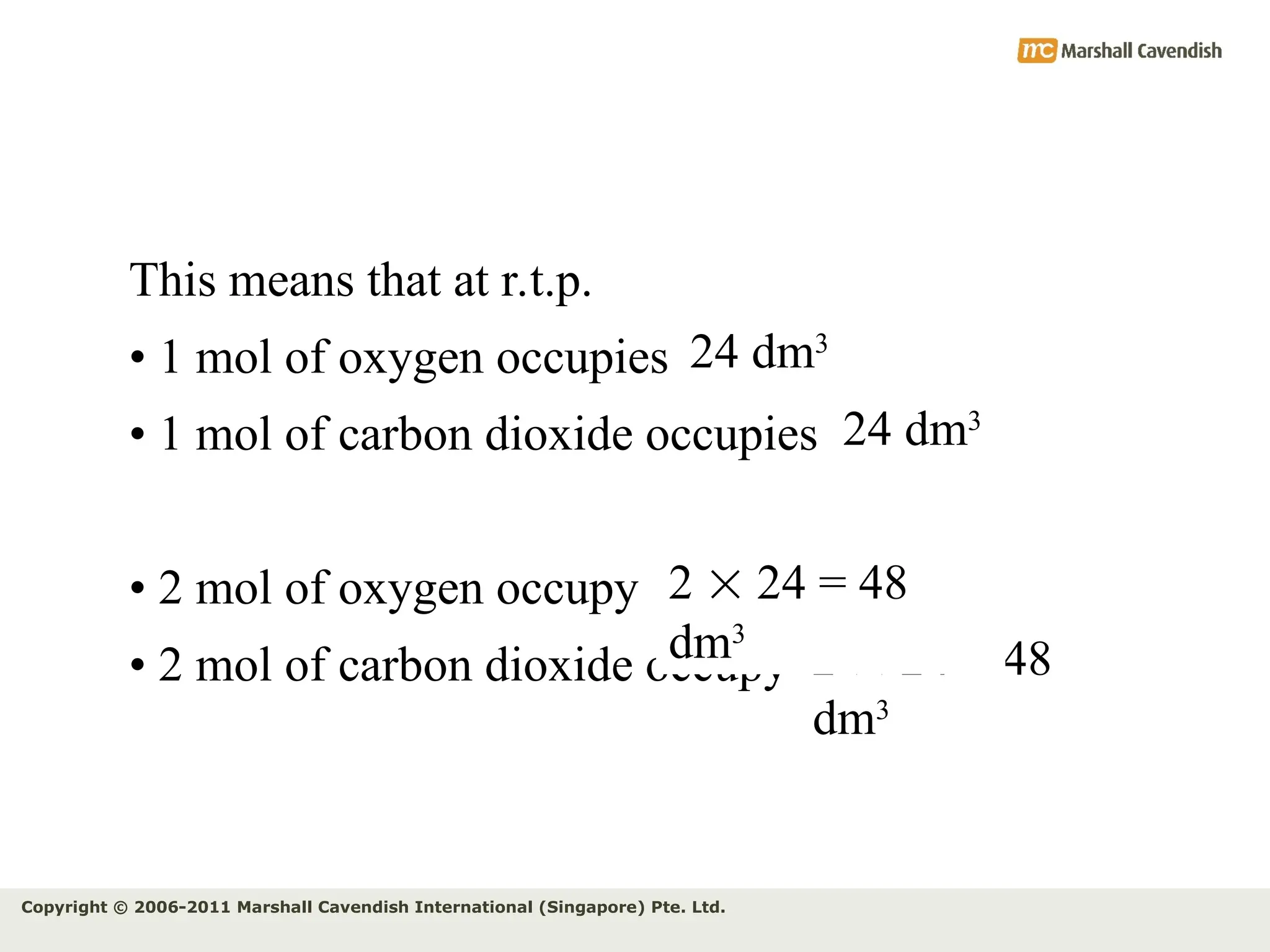
This means that at r.t.p.
• 1 mol of oxygen occupies 24 dm3
,
• 1 mol of carbon dioxide occupies 24 dm3
,
• 2 mol of oxygen occupy 2 × 24 = 48 dm3
,
• 2 mol of carbon dioxide occupy 2 × 24 = 48 dm3
.
how many dm3
?
how many dm3
?
how many dm3
?
how many dm3
?
2  24 = 48
dm3
24 dm3
2  24 = 48
dm3
24 dm3
Copyright © 2006-2011 Marshall Cavendish International (Singapore) Pte. Ltd.
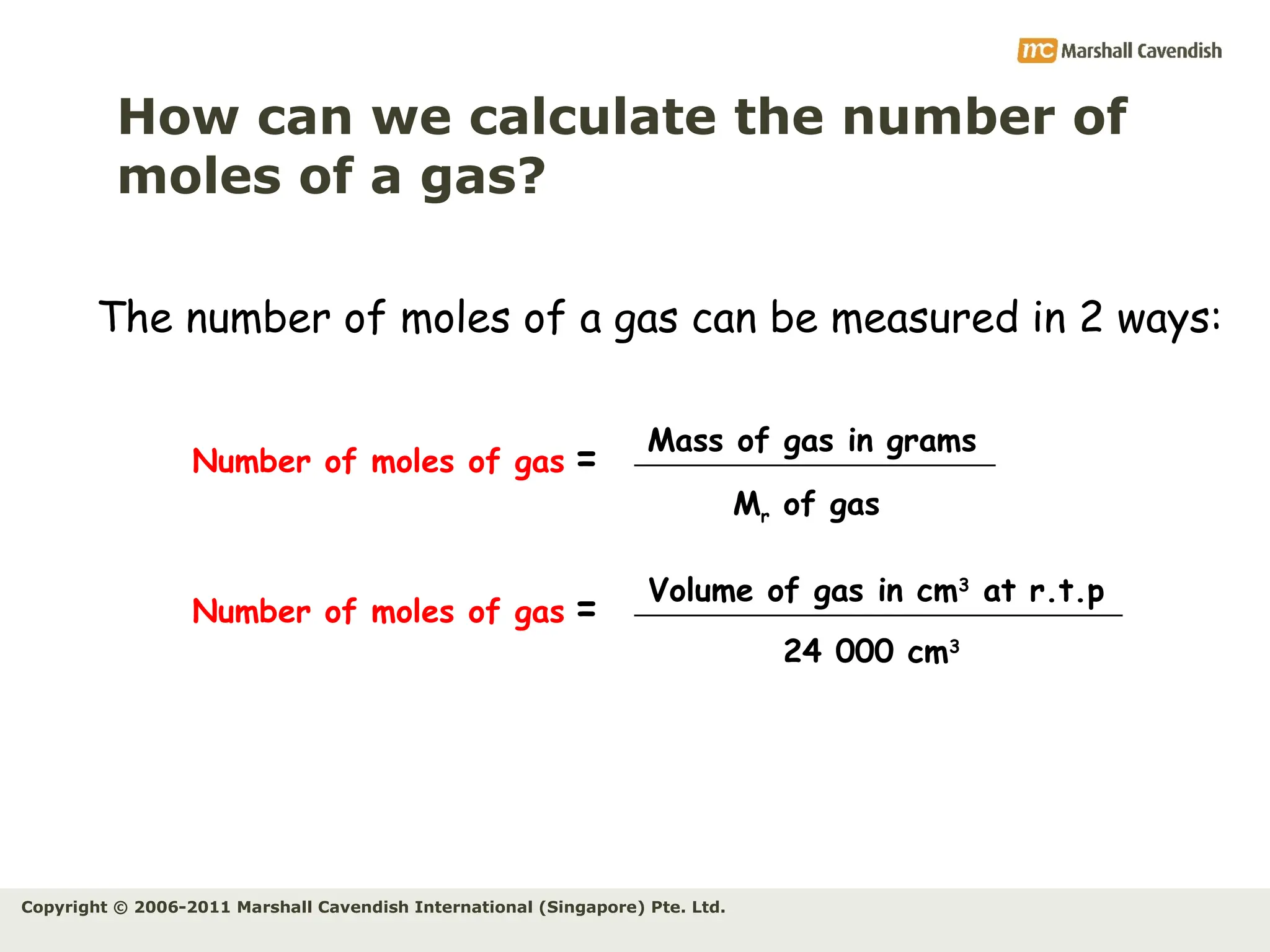
How can we calculate the number of
moles of a gas?
The number of moles of a gas can be measured in 2 ways:
Number of moles of gas =
Mr of gas
Mass of gas in grams
Number of moles of gas =
24 000 cm3
Volume of gas in cm3
at r.t.p
Copyright © 2006-2011 Marshall Cavendish International (Singapore) Pte. Ltd.
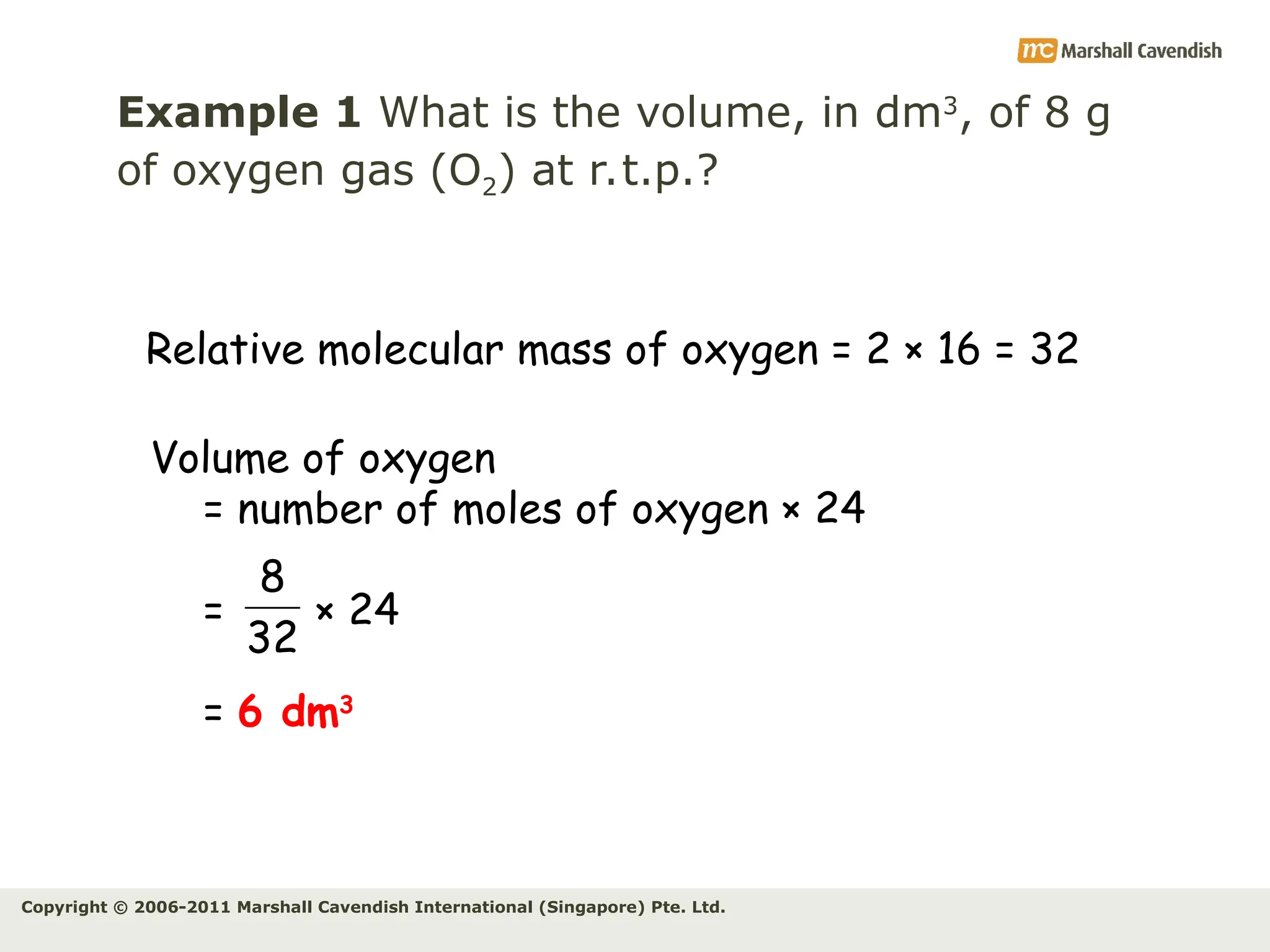
Example 1 What is the volume, in dm3
, of 8 g
of oxygen gas (O2) at r.t.p.?
Relative molecular mass of oxygen = 2 × 16 = 32
Volume of oxygen
= number of moles of oxygen × 24
= × 24
= 6 dm3
32
8
Copyright © 2006-2011 Marshall Cavendish International (Singapore) Pte. Ltd.
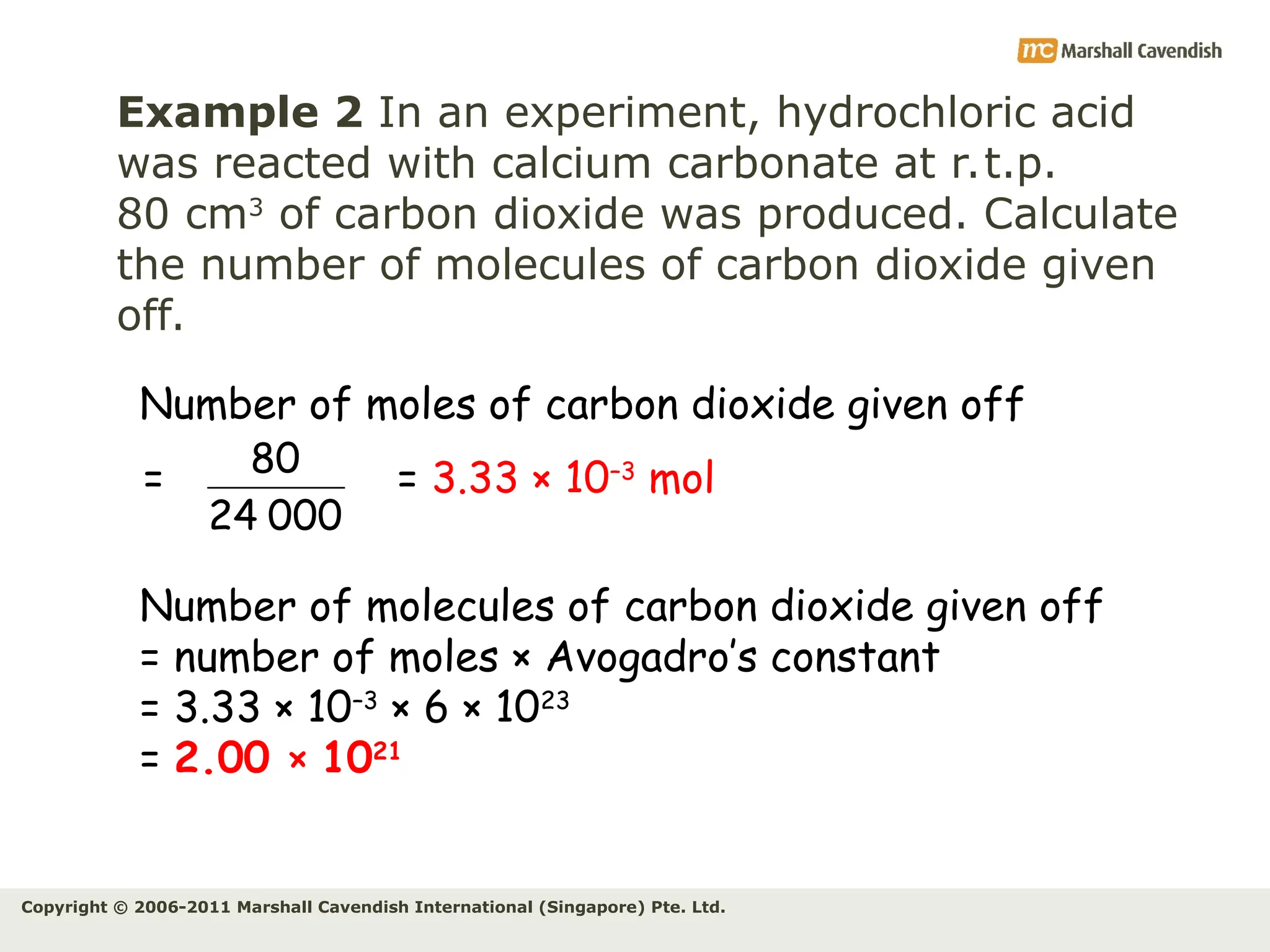
Example 2 In an experiment, hydrochloric acid
was reacted with calcium carbonate at r.t.p.
80 cm3
of carbon dioxide was produced. Calculate
the number of molecules of carbon dioxide given
off.
Number of moles of carbon dioxide given off
Number of molecules of carbon dioxide given off
= number of moles × Avogadro’s constant
= 3.33 × 10–3
× 6 × 1023
= 2.00 × 1021
= = 3.33 × 10⁻³
mol
000
24
80
Copyright © 2006-2011 Marshall Cavendish International (Singapore) Pte. Ltd.
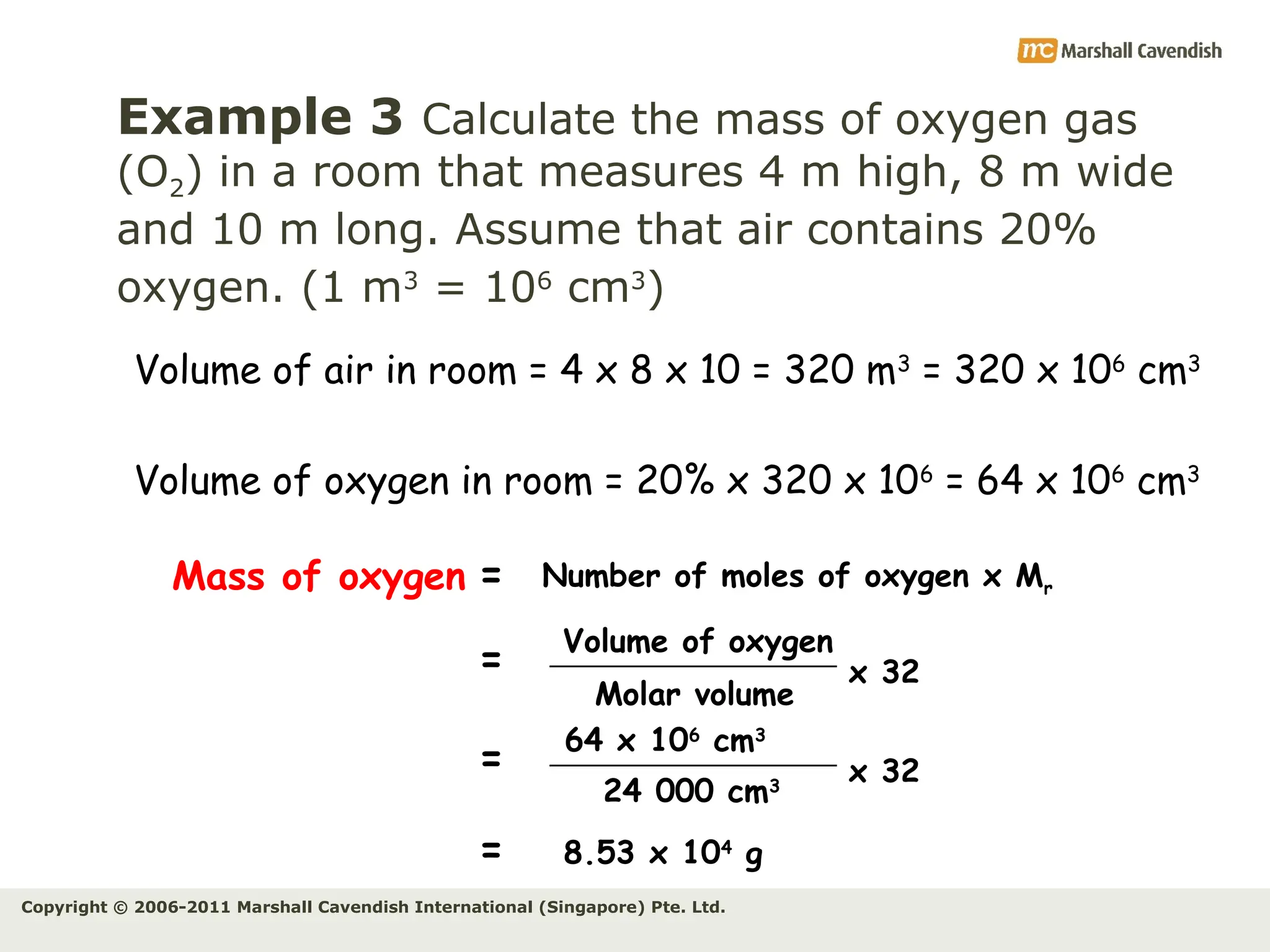
Example 3 Calculate the mass of oxygen gas
(O2) in a room that measures 4 m high, 8 m wide
and 10 m long. Assume that air contains 20%
oxygen. (1 m3
= 106
cm3
)
Volume of air in room = 4 x 8 x 10 = 320 m3
= 320 x 106
cm3
Volume of oxygen in room = 20% x 320 x 106
= 64 x 106
cm3
Mass of oxygen =
24 000 cm3
Volume of oxygen
Number of moles of oxygen x Mr
Molar volume
=
=
x 32
64 x 106
cm3
8.53 x 10⁴
g
= x 32
Copyright © 2006-2011 Marshall Cavendish International (Singapore) Pte. Ltd.
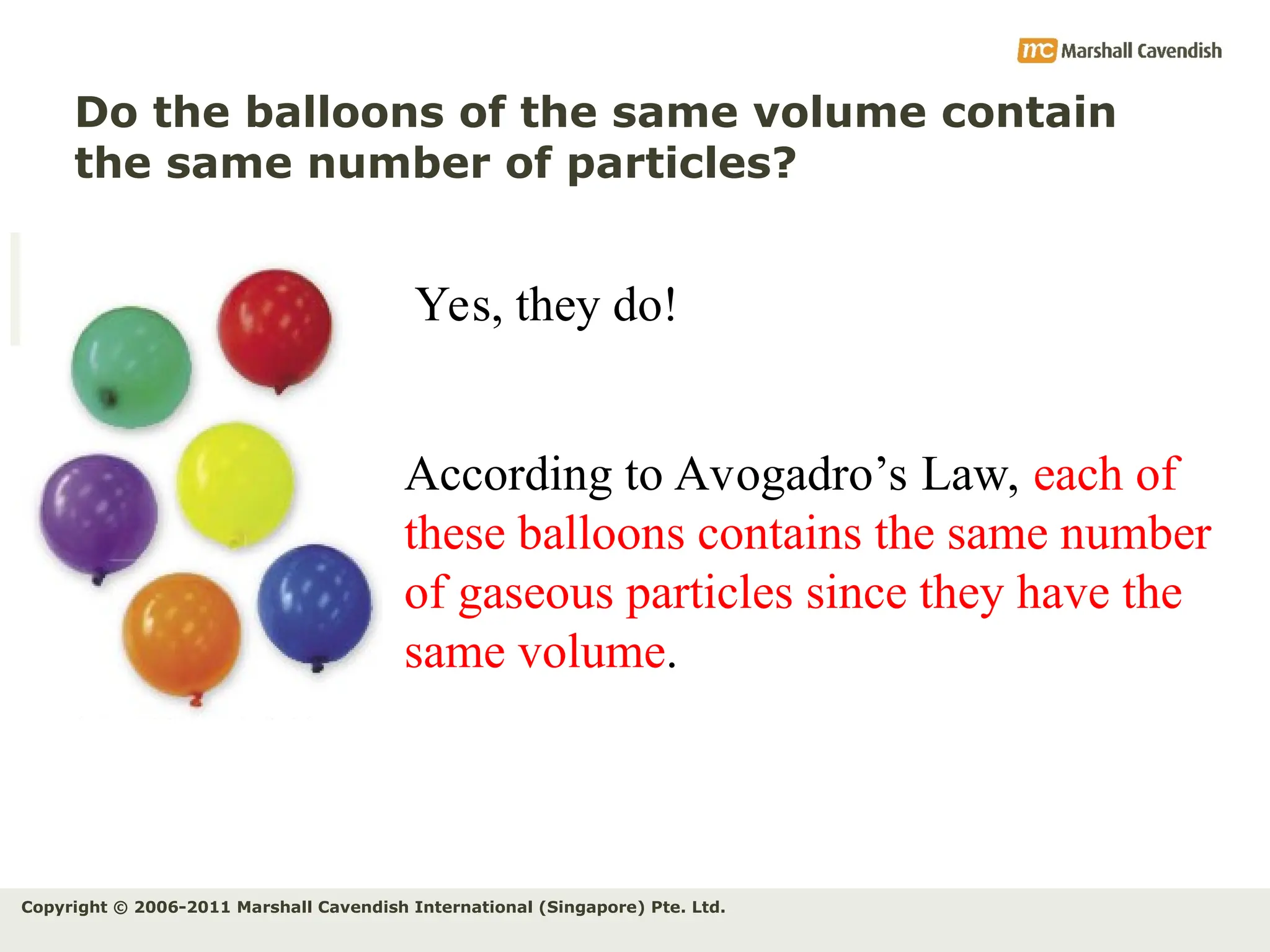
Do the balloons of the same volume contain
the same number of particles?
According to Avogadro’s Law, each of
these balloons contains the same number
of gaseous particles since they have the
same volume.
Yes, they do!
Copyright © 2006-2011 Marshall Cavendish International (Singapore) Pte. Ltd.
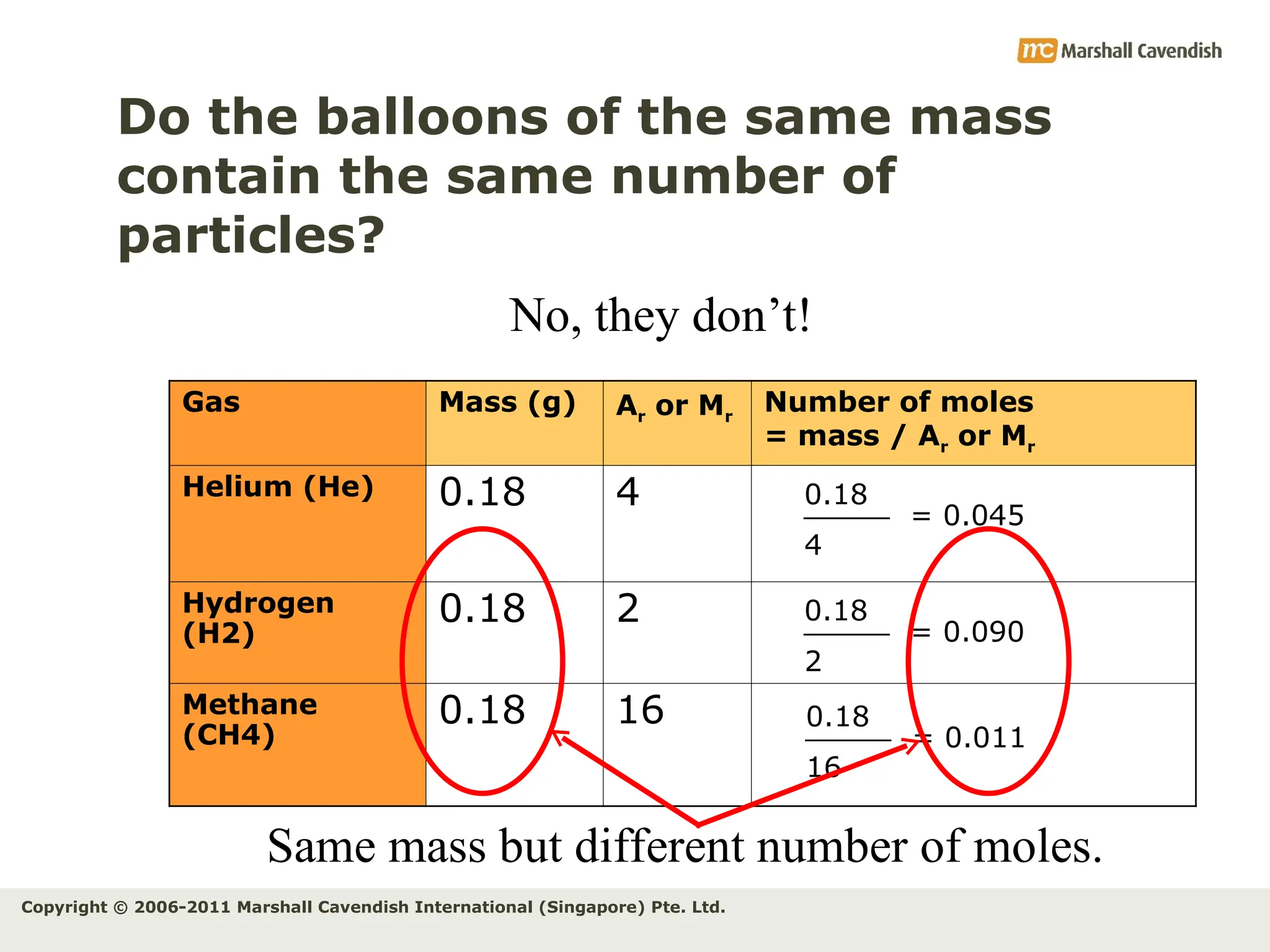
Do the balloons of the same mass
contain the same number of
particles?
No, they don’t!
Same mass but different number of moles.
Gas Mass (g) Ar or Mr
Number of moles
= mass / Ar or Mr
Helium (He) 0.18 4
Hydrogen
(H2)
0.18 2
Methane
(CH4)
0.18 16
= 0.011
16
0.18
= 0.090
2
0.18
= 0.045
4
0.18

Relative atomic and molecular masses.ppt

  • 1.
  • 2.
    Copyright © 2006-2011Marshall Cavendish International (Singapore) Pte. Ltd. How can we measure the mass of an atom? Chemists often compare masses of different atoms with the carbon-12 atom (an isotope of carbon). Atoms also have very small masses, so it is not practical to use the actual masses of atoms in calculations. The masses of all other atoms are compared with one-twelfth the mass of one carbon-12 atom.
  • 3.
    Copyright © 2006-2011Marshall Cavendish International (Singapore) Pte. Ltd. Relative Atomic Mass The relative atomic mass of any atom is the number of times the mass of one atom of an element is greater than 1/12 of the mass of one carbon-12 atom. Relative atomic mass = Mass of 1/12 of an atom of carbon-12 Mass of one atom of the element
  • 4.
    Copyright © 2006-2011Marshall Cavendish International (Singapore) Pte. Ltd. Relative Atomic Mass The symbol for relative atomic mass is Ar. Relative atomic mass is a ratio and has no unit. The relative atomic mass of each element is given in the Periodic Table.
  • 5.
    Copyright © 2006-2011Marshall Cavendish International (Singapore) Pte. Ltd. Relative Atomic Mass of Some Elements Some Ar values are not whole numbers. 35.5 chlorine 16 Oxygen 12 Carbon 1 Hydrogen Relative atomic mass, Ar Element
  • 6.
    Copyright © 2006-2011Marshall Cavendish International (Singapore) Pte. Ltd. Why are some Ar values not whole numbers? This is because such elements occur as mixtures of isotopes. For example, chlorine exists in two isotopic forms: chlorine-35 and chlorine-37.
  • 7.
    Copyright © 2006-2011Marshall Cavendish International (Singapore) Pte. Ltd. How do we derive the Ar of chlorine? Hence, relative atomic mass of chlorine = (0.75 × 35) + (0.25 × 37) = 26.25 + 9.25 = 35.5 A sample of chlorine is made up of 75% of chlorine-35 atoms and 25% of chlorine-37 atoms.
  • 8.
    Copyright © 2006-2011Marshall Cavendish International (Singapore) Pte. Ltd. Relative Molecular Mass Many elements and compounds exist as molecules. For example, chlorine exists as molecules. Cl Cl Hence, we use relative molecular mass instead of relative atomic mass.
  • 9.
    Copyright © 2006-2011Marshall Cavendish International (Singapore) Pte. Ltd. The relative molecular mass (Mr) of an element or compound is the mass of a molecule, compared to 1/12 the mass of one atom of carbon-12. Like Ar, it is a ratio and therefore has no unit. Relative Molecular Mass (Mr) Mr Mass of 1 molecule Mass of 1/12 of a carbon-12 atom =
  • 10.
    Copyright © 2006-2011Marshall Cavendish International (Singapore) Pte. Ltd. How do we calculate the relative molecular mass of ammonia (NH3)? Ar of N = 14 Ar of H = 1 Mr of NH3 = 14 + 1  3 = 17
  • 11.
    Copyright © 2006-2011Marshall Cavendish International (Singapore) Pte. Ltd. How do we calculate the relative molecular mass of ethanoic acid (CH3COOH)? Ar of C = 12 Ar of H = 1 Mr of CH3COOH = 12 + 1  3 + 12 + 16 + 16 + 1 = 17 Ar of O = 16
  • 12.
    Copyright © 2006-2011Marshall Cavendish International (Singapore) Pte. Ltd. (2 x 12) + (6 x 1) + (1 x 16) = 46 2 C; 6 H; 1 O C2H5OH Ethanol (2 x 1) + (1 x 16) = 18 2 H; 1 O H2O Water (1 x 12) + (2 x 16) = 44 1 C ; 2 O CO2 Carbon dioxide (1 x 14) + (3 x 1) = 17 1 N; 3 H NH3 Ammonia 2 x 14 = 28 2 N N2 Nitrogen Calculating Mr Number of atoms in one molecule Chemical formula Molecule
  • 13.
    Copyright © 2006-2011Marshall Cavendish International (Singapore) Pte. Ltd. Relative Formula Mass Many substances such as water are covalent and exist as molecules. However, substances like sodium chloride are ionic and do not exist as molecules. The ‘relative molecular mass’ of an ionic compound is more accurately known as relative formula mass.
  • 14.
    Copyright © 2006-2011Marshall Cavendish International (Singapore) Pte. Ltd. Relative Formula Mass Like relative molecular mass, relative formula mass has the symbol Mr and relative formula mass has no units. For example, the relative formula mass of sodium chloride (NaCl) is 23 + 35.5 = 58.5.
  • 15.
    Copyright © 2006-2011Marshall Cavendish International (Singapore) Pte. Ltd. Calculating Mr of MgSO4 Ar of Mg = 24 Ar of S = 32 Mr of MgSO4 = 24 + 32 + (16  4) = 120 Ar of O = 16
  • 16.
    Copyright © 2006-2011Marshall Cavendish International (Singapore) Pte. Ltd. Calculating Mr of CuSO4 . 5H2O Ar of Cu = 64 Ar of S = 32 Mr of CuSO4.5H2O = 64 + 32 + (16  4) + 5  (2  1 + 16) = 250 Ar of O = 16 Ar of H = 1 The ‘dot’ means ‘plus’ in calculation. ‘5’ needs to be multiplied to entire Mr of water.
  • 17.
    Copyright © 2006-2011Marshall Cavendish International (Singapore) Pte. Ltd. Molecule Chemical Formula Number of atoms in one molecule Calculating Mr Magnesium sulphate MgSO4 1 Mg; 1 S; 4 O (1 x 24) + (1 x 32) + (4 x 16) = 120 Calcium carbonate CaCO3 1 Ca; 1 C; 3 O (1 x 40) + (1 x 12) + (3 x 16) = 100 Calcium nitrate Ca(NO3)2 1 Ca ; 2 N; 6 O (1 x 40) + (2 x 14) + (6 x 16) = 164 Copper(II) sulphate crystals CuSO4 . 5H2O 1 Cu; 1 S; 9 O; 10 H (1 x 64) + (1 x 32) + (9 x 16) + (10 x 1) = 250
  • 18.
    Copyright © 2006-2011Marshall Cavendish International (Singapore) Pte. Ltd.
  • 19.
    Copyright © 2006-2011Marshall Cavendish International (Singapore) Pte. Ltd. The Mole Atoms are too small and numerous to be counted one at a time. Instead, the quantity of atoms is measured by mass. The unit of measurement for atoms and molecules is the mole. The symbol for the mole is mol.
  • 20.
    Copyright © 2006-2011Marshall Cavendish International (Singapore) Pte. Ltd. The Mole A mole of substance contains the same number of particles as the number of atoms in 12 g of carbon-12. 12 g of carbon-12 contain approximately 6 × 10²³ carbon atoms.
  • 21.
    Copyright © 2006-2011Marshall Cavendish International (Singapore) Pte. Ltd. How many particles are there in a mole? There are approximately 6 × 10²³ particles in one mole of substance. 6 × 10²³ is called the Avogadro’s constant or Avogadro’s number. One mole of particles means 6 × 10²³ particles. The particles could be atoms, molecules, ions or electrons.
  • 22.
    Copyright © 2006-2011Marshall Cavendish International (Singapore) Pte. Ltd. How do we convert between number of moles and number of particles? Number of moles Number of particles 6  1023 =
  • 23.
    Copyright © 2006-2011Marshall Cavendish International (Singapore) Pte. Ltd. Example 1: Convert 1 x 10²³ neon atoms to moles of neon atoms Number of moles of neon atoms Number of moles of neon atoms 6 1023 = 1  1023 6  1023 = = 0.167 mol
  • 24.
    Copyright © 2006-2011Marshall Cavendish International (Singapore) Pte. Ltd. Example 2: How many iron atoms are there in 0.5 mol of iron? Number of iron atoms Number of moles  6  1023 = = 3  1023 In 1 mole of iron, there are 6  1023 iron atoms. 0.5  6  1023 =
  • 25.
    Copyright © 2006-2011Marshall Cavendish International (Singapore) Pte. Ltd. Example 3: How many hydrogen atoms are there in 3 moles of hydrogen gas? Hydrogen gas is made up of hydrogen molecules (H2). In 3 moles of H2 molecules, there are 3  2 = 6 moles of H atoms. In 1 mole of H2 molecules, there are 2 moles of H atoms. Number of hydrogen atoms Number of moles  6  1023 = = 3.6 x 1024 6  6  1023 =
  • 26.
    Copyright © 2006-2011Marshall Cavendish International (Singapore) Pte. Ltd. How is the mole related to chemical equations? 2 particles (atoms) of sodium 1 particle (molecule) of chlorine 2 moles of sodium atoms 1 mole of chlorine molecules Na + Cl2 NaCl 2 2 OR OR 2 units of sodium chloride 2 moles of sodium chloride OR
  • 27.
    Copyright © 2006-2011Marshall Cavendish International (Singapore) Pte. Ltd. The molar mass of an element is the mass of one mole of atoms of the element. What is the mass of one mole of atoms of an element? Do you notice a relationship between the value of Ar and the molar mass of a substance? Element Ar Molar mass Aluminium 27 27 g carbon 12 12 g Neon 20 20 g Oxygen 16 16 g
  • 28.
    Copyright © 2006-2011Marshall Cavendish International (Singapore) Pte. Ltd. What is the relationship between mole and molar mass? The number of moles of an element can be calculated using the formula: Number of moles of an element Mass of element (g) Ar of element =
  • 29.
    Copyright © 2006-2011Marshall Cavendish International (Singapore) Pte. Ltd. Example 1 Determine the number of moles in 0.196 kg of iron. (Ar: Fe = 56) Number of moles of iron mass of iron in grams Ar of iron = 0.196 × 1000 56 = = 3.5 mol
  • 30.
    Copyright © 2006-2011Marshall Cavendish International (Singapore) Pte. Ltd. Example 2 a) How many moles of lead are there in 1.204 × 10²² atoms of lead? b) What is the mass of 1.204 × 10²² atoms of lead? (Ar: Pb = 207) a) Number of moles of lead number of atoms of lead Avogadro’s constant = 1.204 × 10²² 6 × 1023 = = 0.02 mol
  • 31.
    Copyright © 2006-2011Marshall Cavendish International (Singapore) Pte. Ltd. Example 2 (continued) a) How many moles of lead are there in 1.204 × 10²² atoms of lead? b) What is the mass of 1.204 × 10²² atoms of lead? (Ar: Pb = 207) b) Mass of lead = number of moles × Ar of lead = 0.02 × 207 = 4.14 g
  • 32.
    Copyright © 2006-2011Marshall Cavendish International (Singapore) Pte. Ltd. What is the mass of one mole of molecules or one mole of a compound? One mole of a substance has a mass equal its Mr. 18 g (2  1) + 16 = 18 H2O Water 40 g 24 + 16 = 40 MgO Magnesium oxide 254 g 2  127 = 160 I2 Iodine 32 g 2  16 = 32 O2 Oxygen Molar mass Mr Formula Substance
  • 33.
    Copyright © 2006-2011Marshall Cavendish International (Singapore) Pte. Ltd. The number of moles of a substance can be calculated using the following formulae: Number of moles Mass of substance (g) Mr = or Number of particles 6  1023 =
  • 34.
    Copyright © 2006-2011Marshall Cavendish International (Singapore) Pte. Ltd. Example 1 A conical flask contains 68.4 g of octane (C8H18). How many molecules of octane are there in the flask? Number of moles of octane Mass of octane Mr of octane = 6.84 114 = = 0.6 mol
  • 35.
    Copyright © 2006-2011Marshall Cavendish International (Singapore) Pte. Ltd. Example 1 (continued) A conical flask contains 68.4 g of octane (C8H18). How many molecules of octane are there in the flask? Number of molecules of octane = number of moles × Avogadro’s constant = 0.6 × 6 × 1023 = 3.6 × 10²³
  • 36.
    Copyright © 2006-2011Marshall Cavendish International (Singapore) Pte. Ltd. Example 2 How many ions are there in 20 g of magnesium oxide (MgO)? Number of moles of MgO Mass of magnesium oxide Mr of magnesium oxide = 20 40 = = 0.5 mol
  • 37.
    Copyright © 2006-2011Marshall Cavendish International (Singapore) Pte. Ltd. Example 2 (continued) How many ions are there in 20 g of magnesium oxide (MgO)? MgO  Mg2+ + O2– 1 mol of MgO  1 mol of Mg2+ ions and 1 mol of O2− ions. 0.5 mol of MgO  0.5 mol of Mg2+ ions and 0.5 mol of O2− ions. Hence, 0.5 mol of MgO contains 1 mol of ions. Number of ions = 1 × 6 × 1023 = 6 × 10²³
  • 38.
    Copyright © 2006-2011Marshall Cavendish International (Singapore) Pte. Ltd.
  • 39.
    Copyright © 2006-2011Marshall Cavendish International (Singapore) Pte. Ltd. Percentage Composition of Compounds Chemists need to conduct analysis in order to find out how much of each element there is in a new compound. They do so by finding out the mass of each element in the compound. In this way, chemists know the percentage composition of a compound.
  • 40.
    Copyright © 2006-2011Marshall Cavendish International (Singapore) Pte. Ltd. How do we find the percentage composition of element? Percentage by mass of an element in a compound Ar of element × number of atoms in formula Mr of compound =  100% The percentage by mass of an element in a compound can be found using the formula:
  • 41.
    Copyright © 2006-2011Marshall Cavendish International (Singapore) Pte. Ltd. How do we find the percentage composition of hydrogen peroxide? Mr of hydrogen peroxide (H2O2) = (2 × 1) + (2 × 16) = 34 Percentage of hydrogen in hydrogen peroxide Ar of hydrogen × number of hydrogen atoms Mr of hydrogen peroxide = 1  2 34 = = 5.9 %  100%  100%
  • 42.
    Copyright © 2006-2011Marshall Cavendish International (Singapore) Pte. Ltd. Percentage of oxygen in hydrogen peroxide Ar of oxygen × number of oxygen atoms Mr of hydrogen peroxide = 16  2 34 = = 94.1 %  100%  100%
  • 43.
    Copyright © 2006-2011Marshall Cavendish International (Singapore) Pte. Ltd. Example 1 Calculate the percentage of water in copper(II) sulphate crystals (CuSO4.5H2O). Mr of copper(II) sulphate crystals = 64 + 32 + (4 × 16) + (5 × 18) = 250 Mr of water = (1 × 2) + 16 = 18 Percentage of water in CuSO4.5H2O Mr of water × number of water molecules Mr of copper(II) sulphate crystals = 18  5 250 = = 36 %  100%  100%
  • 44.
    Copyright © 2006-2011Marshall Cavendish International (Singapore) Pte. Ltd.
  • 45.
    Copyright © 2006-2011Marshall Cavendish International (Singapore) Pte. Ltd. How can we work out the formula of a compound? We can conduct experiments to find out the formula of a compound. 1. First, we find out the mass of the reactants taking part in the reaction. 2. Next, we work out the relative numbers of moles of the reactants used.
  • 46.
    Copyright © 2006-2011Marshall Cavendish International (Singapore) Pte. Ltd. Working Out the Formula of Magnesium Oxide To work out the formula of magnesium oxide produced by the combustion of magnesium, the following apparatus is used. Magnesium ribbon Clay triangle Tripod stand lid crucible
  • 47.
    Copyright © 2006-2011Marshall Cavendish International (Singapore) Pte. Ltd. Magnesium ribbon Clay triangle Tripod stand lid crucible Procedure 1. Weigh a crucible together with the lid. Put a coil of magnesium ribbon in it and weigh again. 2. Put the lid on the crucible and heat the crucible gently. When the magnesium catches fire (you will see a white glow through the crucible), heat it more strongly.
  • 48.
    Copyright © 2006-2011Marshall Cavendish International (Singapore) Pte. Ltd. Magnesium ribbon Clay triangle Tripod stand lid crucible 3. Use a pair of tongs to lift the lid slightly from time to time to allow air in. Quickly replace the lid to make sure that magnesium oxide formed does not escape. 4. When the burning is complete, allow the crucible to cool completely. Weigh the crucible together with the lid and the magnesium oxide in it.
  • 49.
    Copyright © 2006-2011Marshall Cavendish International (Singapore) Pte. Ltd. Sample results Mass of crucible + lid = 26.52 g Mass of crucible + lid + magnesium = 27.72 g Mass of crucible + lid + magnesium oxide = 28.52 g Calculations Mass of magnesium = 27.72 − 26.52 = 1.20 g Mass of magnesium oxide produced = 28.52 − 26.52 = 2.00 g Mass of oxygen reacted = 2.00 − 1.20 = 0.80 g
  • 50.
    Copyright © 2006-2011Marshall Cavendish International (Singapore) Pte. Ltd. Deriving the Formula Element Mg O Mass (from experiment) 1.20 g 0.80 g Relative atomic mass 24 16 Number of moles Molar ratio (divide by the smallest number from the previous row) 1.20 24 = 0.05 0.05 0.05 = 1 0.05 0.05 = 1 0.80 16 = 0.05 Step 1: List the mass of the element.
  • 51.
    Copyright © 2006-2011Marshall Cavendish International (Singapore) Pte. Ltd. Deriving the Formula Molar ratio (divide by the smallest number from the previous row) Number of moles 16 24 Relative atomic mass 0.80 g 1.20 g Mass (from experiment) O Mg Element 1.20 24 = 0.05 0.05 0.05 = 1 0.05 0.05 = 1 0.80 16 = 0.05 Step 2: State the Ar of the element.
  • 52.
    Copyright © 2006-2011Marshall Cavendish International (Singapore) Pte. Ltd. Deriving the Formula Step 3: Derive the number of moles by dividing the mass with Ar. Molar ratio (divide by the smallest number from the previous row) Number of moles 16 24 Relative atomic mass 0.80 g 1.20 g Mass (from experiment) O Mg Element 1.20 24 = 0.05 0.05 0.05 = 1 0.05 0.05 = 1 0.80 16 = 0.05
  • 53.
    Copyright © 2006-2011Marshall Cavendish International (Singapore) Pte. Ltd. Step 4: Obtain the molar ratio. Deriving the Formula The simplest formula is MgO. Molar ratio (divide by the smallest number from the previous row) Number of moles 16 24 Relative atomic mass 0.80 g 1.20 g Mass (from experiment) O Mg Element 1.20 24 = 0.05 0.05 0.05 = 1 0.05 0.05 = 1 0.80 16 = 0.05
  • 54.
    Copyright © 2006-2011Marshall Cavendish International (Singapore) Pte. Ltd. Empirical Formula MgO is the simplest formula that fits the experimental results. Other formulae such as Mg2O2 or Mg3O3 also fit the results since the ratios of magnesium to oxygen are the same. The formula MgO is called the simplest formula or the empirical formula of magnesium oxide.
  • 55.
    Copyright © 2006-2011Marshall Cavendish International (Singapore) Pte. Ltd. Empirical Formula The empirical formula of a compound shows • the types of elements present in it, • the simplest ratio of the different types of atoms in it.
  • 56.
    Copyright © 2006-2011Marshall Cavendish International (Singapore) Pte. Ltd. To determine the empirical formula of copper(II) oxide Excess methane burning off Copper(II) oxide methane
  • 57.
    Copyright © 2006-2011Marshall Cavendish International (Singapore) Pte. Ltd. Procedure 1. Weigh a porcelain boat. Put one spatula of copper(II) oxide (a black powder) in the boat and weigh again. 2. Put the porcelain boat containing copper(II) oxide into the middle of a Pyrex test tube with a small jet hole at its end. 3. Set up the apparatus as shown. Allow methane gas (from the gas tap) to pass through the apparatus for about 30 seconds to remove air.
  • 58.
    Copyright © 2006-2011Marshall Cavendish International (Singapore) Pte. Ltd. 4. Light the gas that escapes through the hole in the test tube. Then heat the copper(II) oxide until no further colour change is observed. 5. Turn off the Bunsen burner but allow the methane gas to flow through the apparatus while the apparatus is cooling. 6. Turn off the gas supply when the apparatus is completely cool. Weigh the porcelain boat and its contents.
  • 59.
    Copyright © 2006-2011Marshall Cavendish International (Singapore) Pte. Ltd. Sample results Mass of porcelain boat = 18.40 g Mass of porcelain boat + copper(II) oxide = 35.89 g Mass of porcelain boat + copper = 32.37 g Calculations Mass of copper = 32.37 − 18.40 = 13.97 g Mass of oxygen = 35.89 − 32.37 = 3.52 g
  • 60.
    Copyright © 2006-2011Marshall Cavendish International (Singapore) Pte. Ltd. The empirical formula of copper(II) oxide is thus CuO. Element Cu O Mass (from experiment) 13.97 g 3.52 g Relative atomic mass 64 16 Number of moles Molar ratio (divide by the smallest number from the previous row) = 13.97 13.97 13.97 = 1 0.22 0.22 = 0.22 16 3.52 = 1 0.22 0.22
  • 61.
    Copyright © 2006-2011Marshall Cavendish International (Singapore) Pte. Ltd. Molecular Formula Its actual formula is P4O10. We call this the molecular formula. The molecular formula is the formula that shows the exact number of atoms of each element in a molecule. The empirical formula of phosphorus(V) oxide as determined by experiment is P2O5.
  • 62.
    Copyright © 2006-2011Marshall Cavendish International (Singapore) Pte. Ltd. What is the relationship between empirical formula and molecular formula? For many compounds, such as water and ammonia, the empirical formula and molecular formula are the same. However, there are also many compounds (especially organic compounds) whose molecular formulae differ from their empirical formulae.
  • 63.
    Copyright © 2006-2011Marshall Cavendish International (Singapore) Pte. Ltd. What is the relationship between empirical formula and molecular formula? Where the empirical formula and molecular formula are different, the molecular formula is always a multiple of the empirical formula. For example, the molecular formula and empirical formula of phosphorus(V) oxide are P4O10 and P2O5 respectively. The multiple is 2.
  • 64.
    Copyright © 2006-2011Marshall Cavendish International (Singapore) Pte. Ltd. Note that: It is possible for different compounds to have the same empirical formula. For example, ethene (C2H4) and propene (C3H6) are two compounds with the same empirical formula, CH2.
  • 65.
    Copyright © 2006-2011Marshall Cavendish International (Singapore) Pte. Ltd. How to derive molecular formula? We can find the molecular formula of a substance if we know two things: the empirical formula and the relative molecular mass of the substance. They are related by the multiple, n. n Relative molecular mass Mr from empirical formula =
  • 66.
    Copyright © 2006-2011Marshall Cavendish International (Singapore) Pte. Ltd. Example 1 The empirical formula of ethane is CH3. Given that the relative molecular mass of ethane is 30, what is its molecular formula? Mr of ethane from empirical formula = 12 + 3 = 15 = Mr from empirical formula Mass of one atom of the an element 12 15 = 2 Hence, the molecular formula of ethane = C12 H32 = C2H6
  • 67.
    Copyright © 2006-2011Marshall Cavendish International (Singapore) Pte. Ltd. Example 2 Compound X contains 40.0% carbon, 6.6% hydrogen and 53.3% oxygen. Its relative molecular mass is 180. What is the molecular formula of X? Molar ratio Number of moles 16 1 12 Relative atomic mass 53.3 6.6 40.0 Percentage in compound O H C Element = 3.3 12 40.0 = 3.3 16 53.3 = 1 16 3.52 = 2 16 3.52 = 6.6 1 6.6 = 1 3.3 3.3
  • 68.
    Copyright © 2006-2011Marshall Cavendish International (Singapore) Pte. Ltd. Example 2 (continued) Compound X contains 40.0% carbon, 6.6% hydrogen and 53.3% oxygen. Its relative molecular mass is 180. What is the molecular formula of X? The empirical formula of X is CH2O. = Mr from empirical formula Relative molecular mass 180 30 = 6 Hence, the molecular formula of X = (CH2O)6 = C6H12O6 Mr of CH2O = 12 + (2 x 1) + 16 = 30
  • 69.
    Copyright © 2006-2011Marshall Cavendish International (Singapore) Pte. Ltd.
  • 70.
    Copyright © 2006-2011Marshall Cavendish International (Singapore) Pte. Ltd. Molar Gas Volume Unlike solids and liquids, gases weigh very little. It is easier to measure the volume of a gas than its mass. Is there a way to relate moles to the volumes of gases?
  • 71.
    Copyright © 2006-2011Marshall Cavendish International (Singapore) Pte. Ltd. Molar Gas Volume One mole of any gas occupies 24 dm3 (24 000 cm3 ) at room temperature and pressure (r.t.p.). 24 dm3 is called the molar volume of a gas.
  • 72.
    Copyright © 2006-2011Marshall Cavendish International (Singapore) Pte. Ltd. This means that at r.t.p. • 1 mol of oxygen occupies 24 dm3 , • 1 mol of carbon dioxide occupies 24 dm3 , • 2 mol of oxygen occupy 2 × 24 = 48 dm3 , • 2 mol of carbon dioxide occupy 2 × 24 = 48 dm3 . how many dm3 ? how many dm3 ? how many dm3 ? how many dm3 ? 2  24 = 48 dm3 24 dm3 2  24 = 48 dm3 24 dm3
  • 73.
    Copyright © 2006-2011Marshall Cavendish International (Singapore) Pte. Ltd. How can we calculate the number of moles of a gas? The number of moles of a gas can be measured in 2 ways: Number of moles of gas = Mr of gas Mass of gas in grams Number of moles of gas = 24 000 cm3 Volume of gas in cm3 at r.t.p
  • 74.
    Copyright © 2006-2011Marshall Cavendish International (Singapore) Pte. Ltd. Example 1 What is the volume, in dm3 , of 8 g of oxygen gas (O2) at r.t.p.? Relative molecular mass of oxygen = 2 × 16 = 32 Volume of oxygen = number of moles of oxygen × 24 = × 24 = 6 dm3 32 8
  • 75.
    Copyright © 2006-2011Marshall Cavendish International (Singapore) Pte. Ltd. Example 2 In an experiment, hydrochloric acid was reacted with calcium carbonate at r.t.p. 80 cm3 of carbon dioxide was produced. Calculate the number of molecules of carbon dioxide given off. Number of moles of carbon dioxide given off Number of molecules of carbon dioxide given off = number of moles × Avogadro’s constant = 3.33 × 10–3 × 6 × 1023 = 2.00 × 1021 = = 3.33 × 10⁻³ mol 000 24 80
  • 76.
    Copyright © 2006-2011Marshall Cavendish International (Singapore) Pte. Ltd. Example 3 Calculate the mass of oxygen gas (O2) in a room that measures 4 m high, 8 m wide and 10 m long. Assume that air contains 20% oxygen. (1 m3 = 106 cm3 ) Volume of air in room = 4 x 8 x 10 = 320 m3 = 320 x 106 cm3 Volume of oxygen in room = 20% x 320 x 106 = 64 x 106 cm3 Mass of oxygen = 24 000 cm3 Volume of oxygen Number of moles of oxygen x Mr Molar volume = = x 32 64 x 106 cm3 8.53 x 10⁴ g = x 32
  • 77.
    Copyright © 2006-2011Marshall Cavendish International (Singapore) Pte. Ltd. Do the balloons of the same volume contain the same number of particles? According to Avogadro’s Law, each of these balloons contains the same number of gaseous particles since they have the same volume. Yes, they do!
  • 78.
    Copyright © 2006-2011Marshall Cavendish International (Singapore) Pte. Ltd. Do the balloons of the same mass contain the same number of particles? No, they don’t! Same mass but different number of moles. Gas Mass (g) Ar or Mr Number of moles = mass / Ar or Mr Helium (He) 0.18 4 Hydrogen (H2) 0.18 2 Methane (CH4) 0.18 16 = 0.011 16 0.18 = 0.090 2 0.18 = 0.045 4 0.18