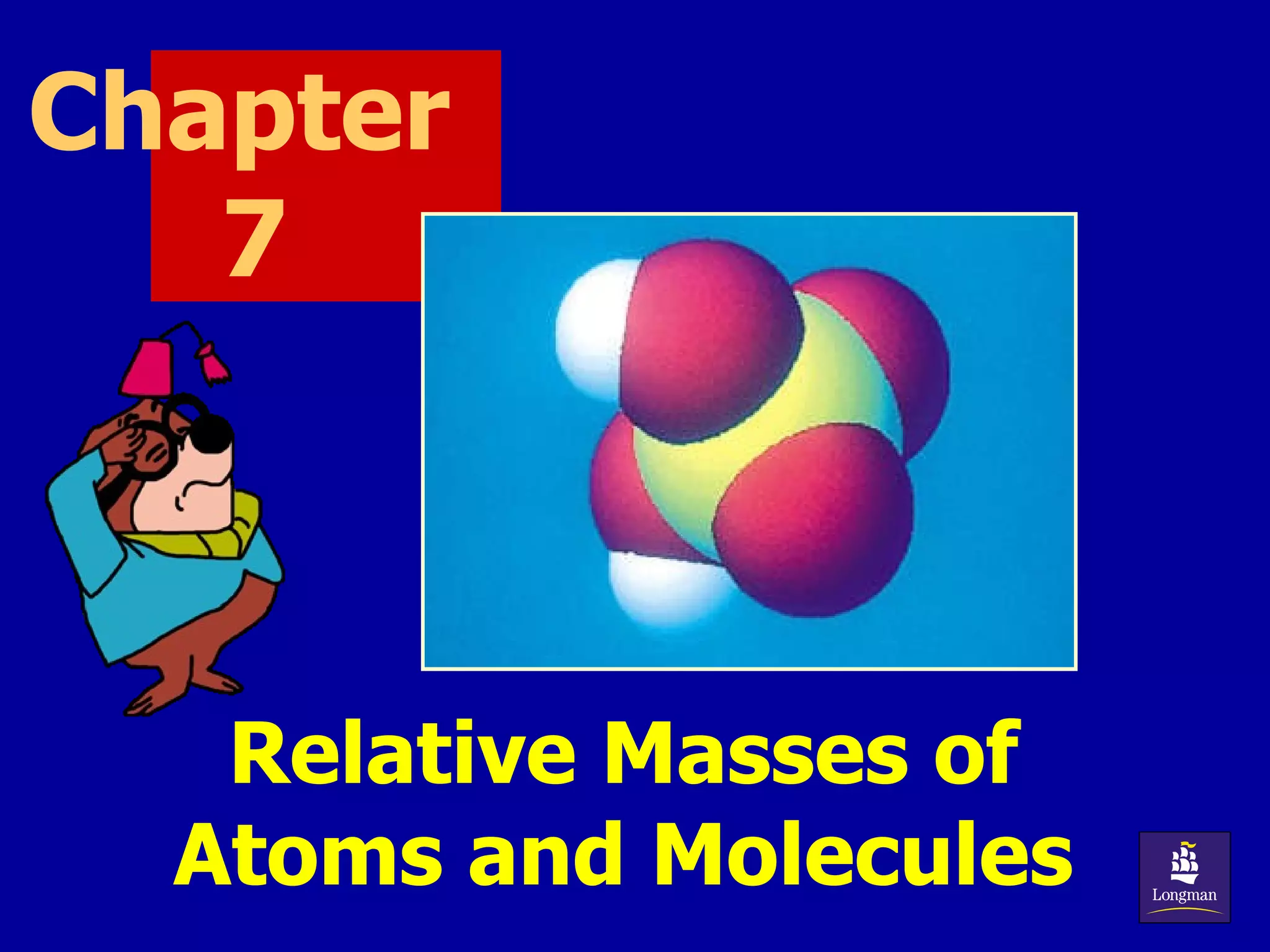
Chapter  7 Relative Masses of Atoms and Molecules
contents You will learn about: Relative atomic mass Relative molecular mass The formula of a compound
Objectives  At the end of the lesson, students should be able to: define  relative atomic mass ,  A r   define  relative molecular mass ,  M r   calculate relative atomic mass, relative molecular mass and relative formula mass
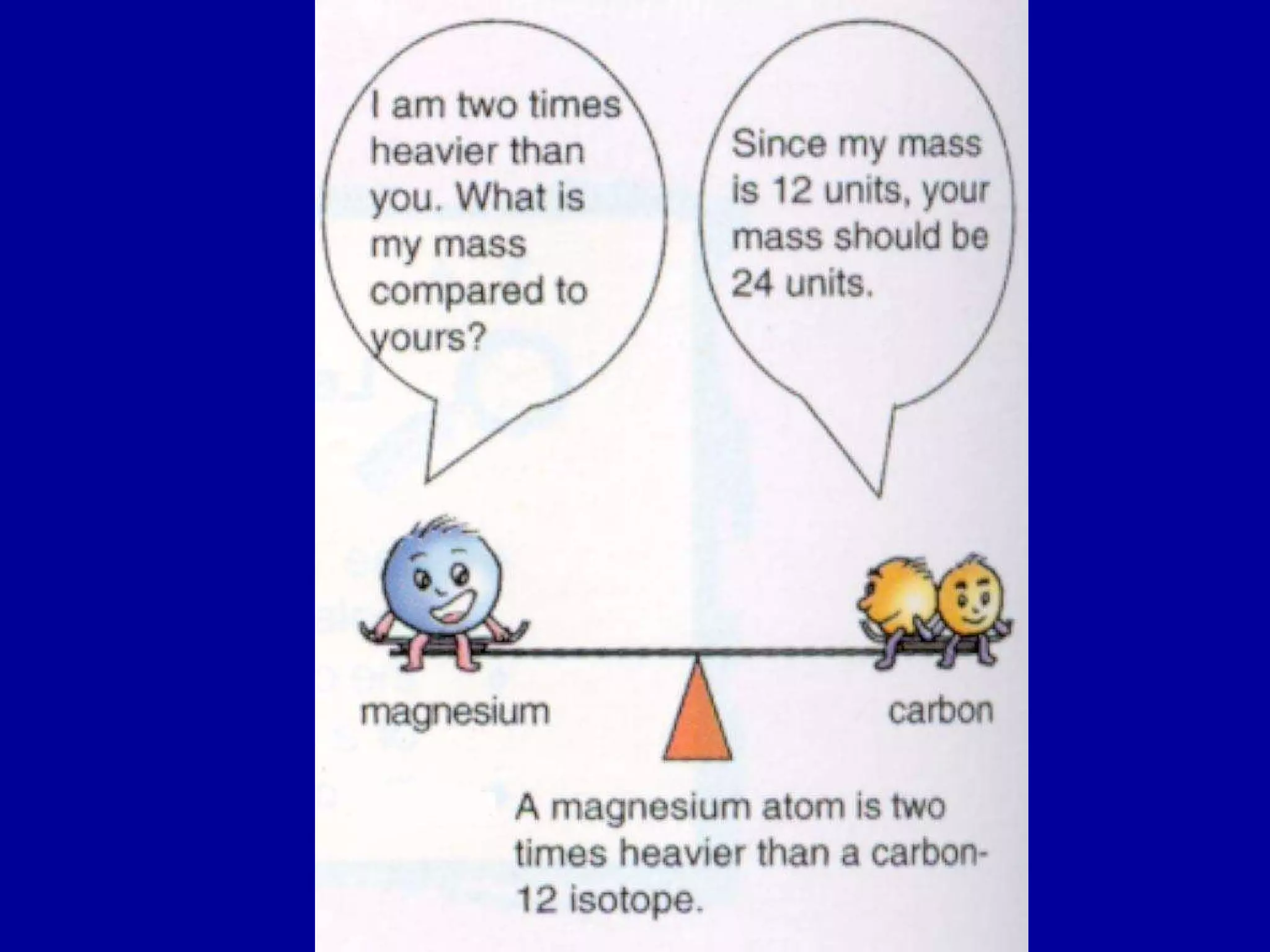
Introduction  Atoms are  soooo  small and their masses are so small! Is there a way to measure them conveniently??? Since atoms are so small, let’s compare them to each other on the atomic scale.
We can compare every element to H or 1/12 of C-12
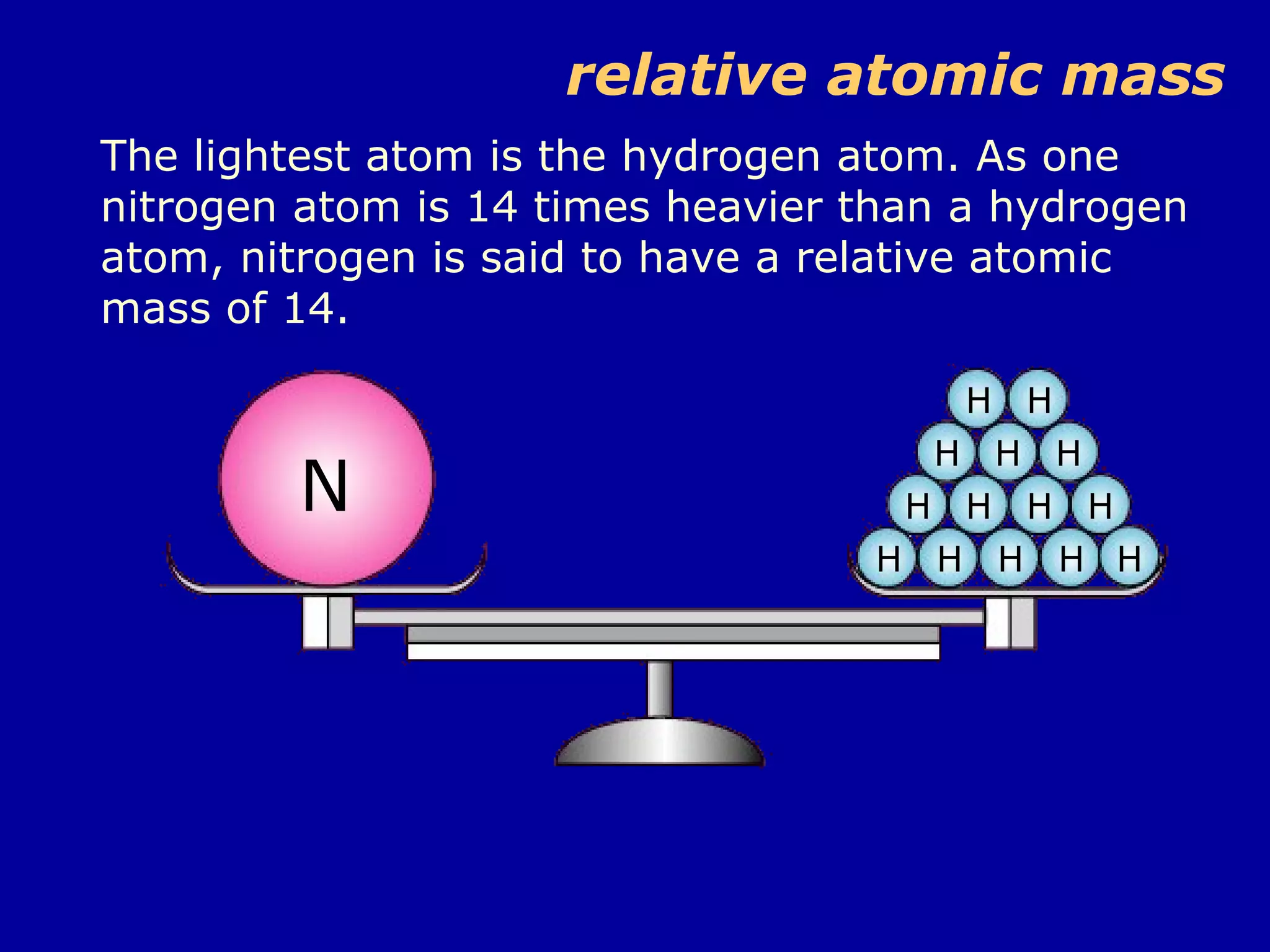
relative atomic mass The lightest atom is the hydrogen atom. As one nitrogen atom is 14 times heavier than a hydrogen atom, nitrogen is said to have a relative atomic mass of 14. N H H H H H H H H H H H H H H
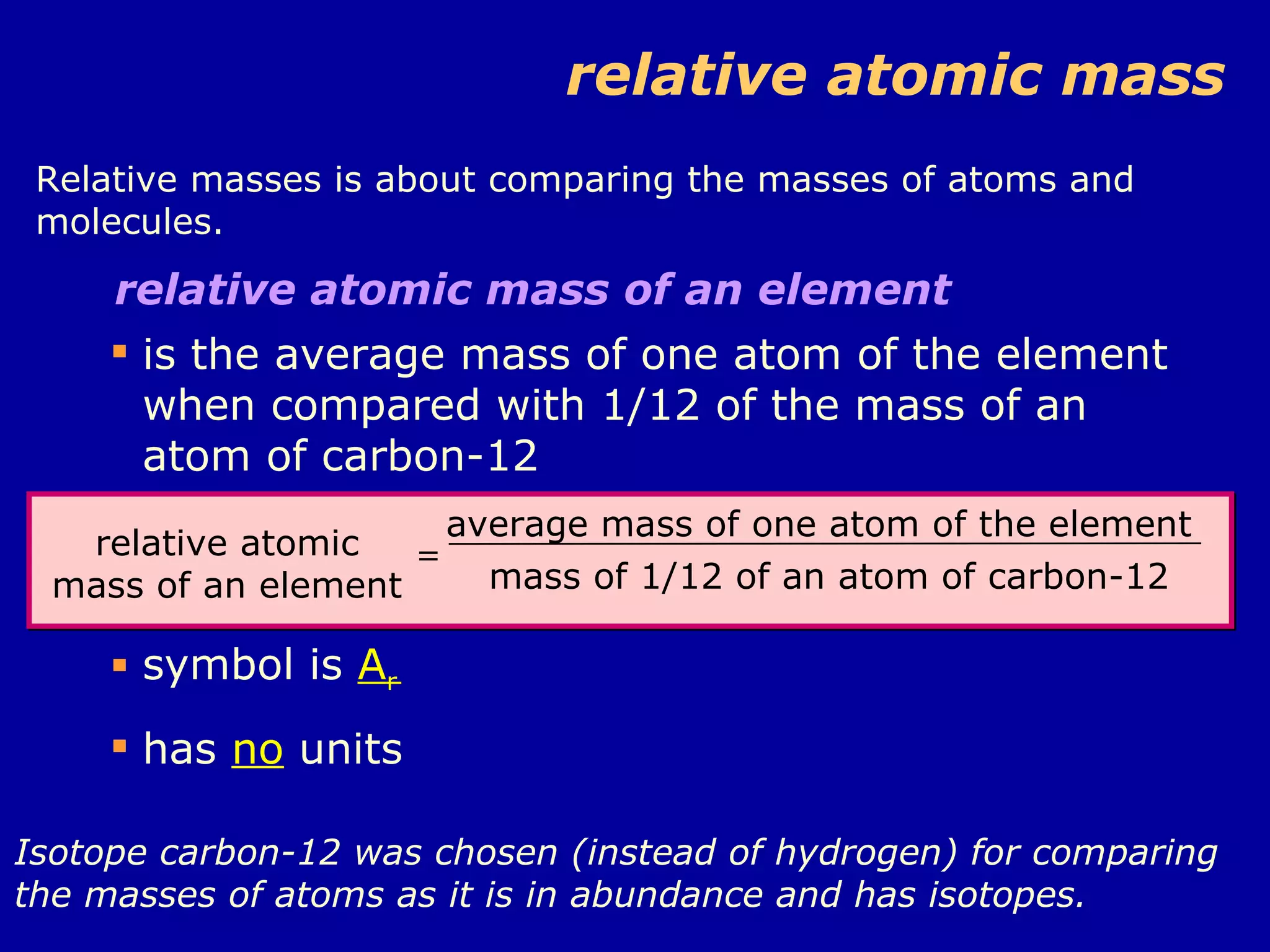
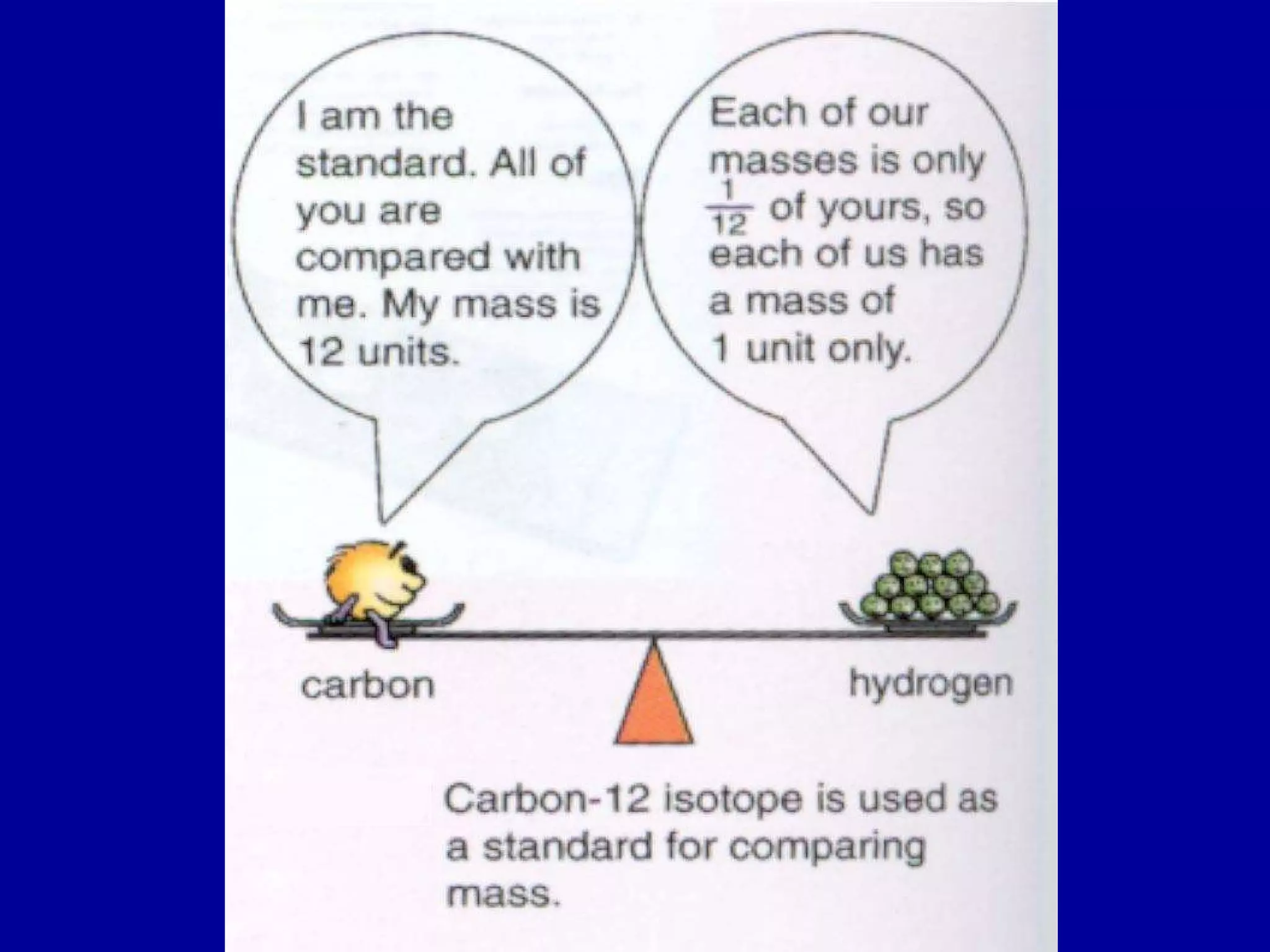
relative atomic mass Relative masses is about comparing the masses of atoms and molecules.  relative atomic mass of an element  is the average mass of one atom of the element when compared with 1/12 of the mass of an atom of carbon-12 symbol is  A r has  no  units Isotope carbon-12 was chosen (instead of hydrogen) for comparing the masses of atoms as it is in abundance and has isotopes. relative atomic mass of an element = average mass of one atom of the element mass of 1/12 of an atom of carbon-12
 
 
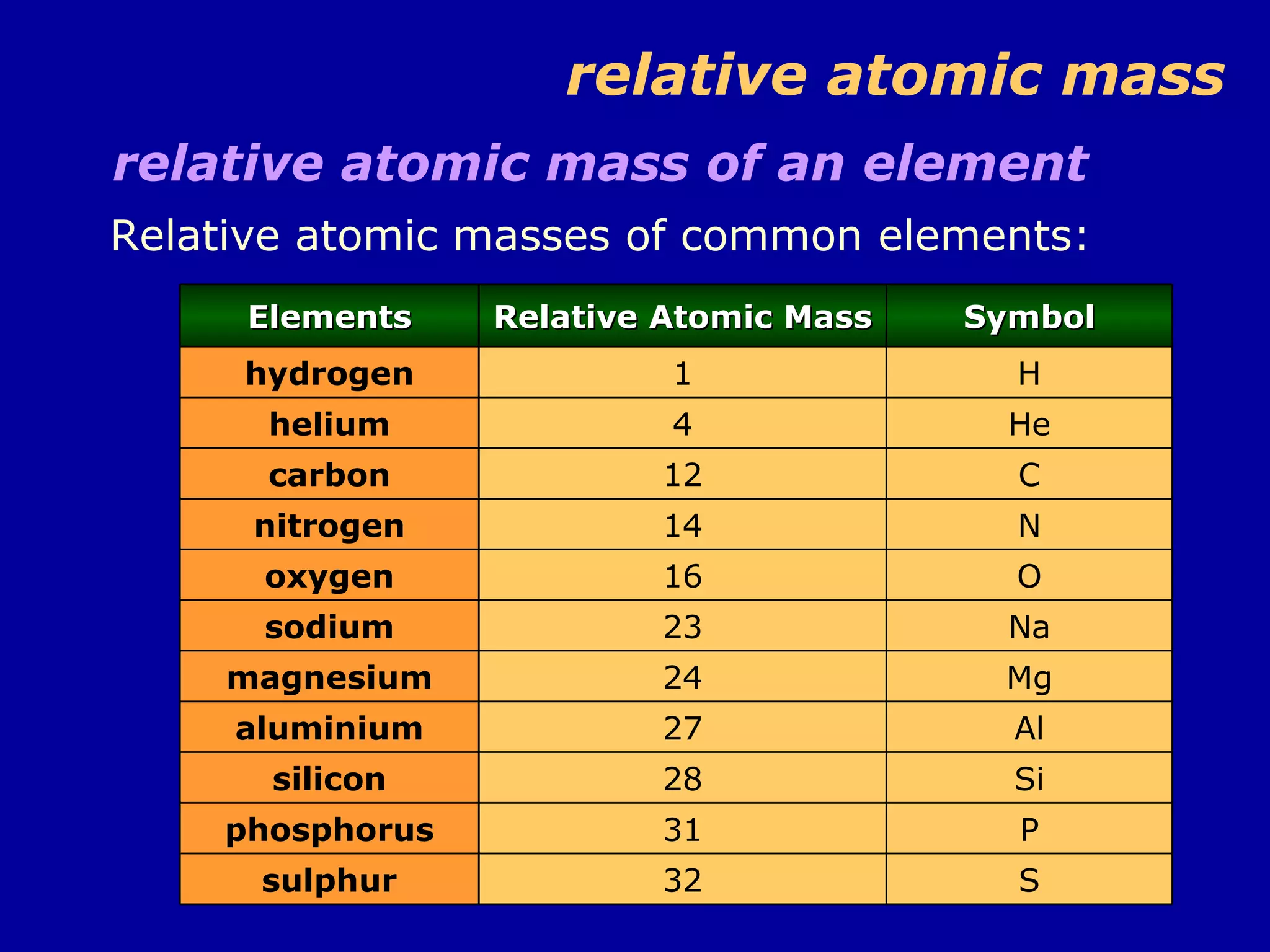
relative atomic mass of an element Relative atomic masses of common elements: relative atomic mass Si 28 silicon O 16 oxygen N 14 nitrogen Mg 24 magnesium Na 23 sodium Al 27 aluminium P 31 phosphorus He 4 helium S 32 sulphur carbon hydrogen Elements 12 1 Relative Atomic Mass C H Symbol
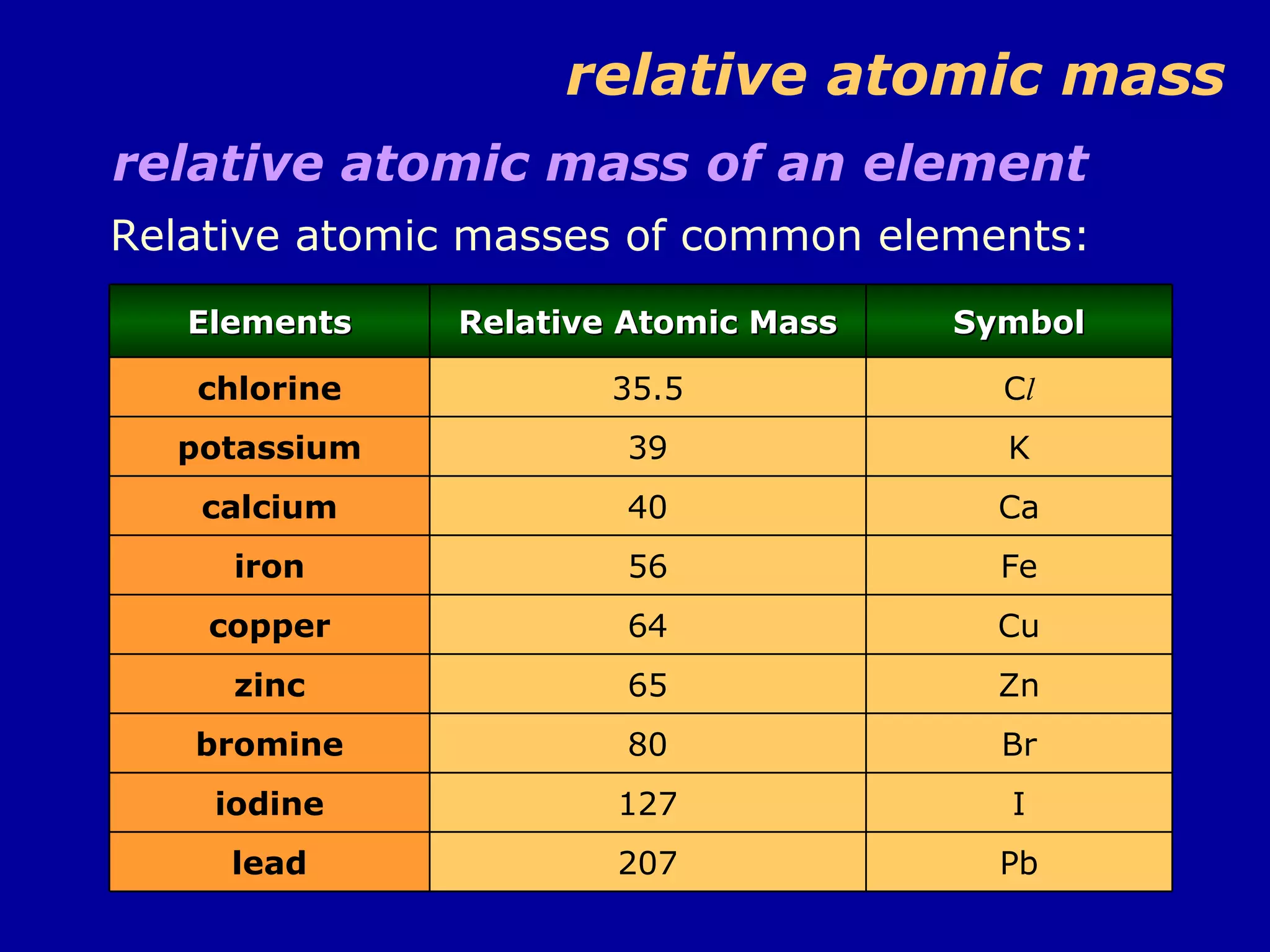
relative atomic mass of an element Relative atomic masses of common elements: relative atomic mass Cu 64 copper Zn 65 zinc Br 80 bromine I 127 iodine K 39 potassium Ca 40 calcium C l 35.5 chlorine Fe 56 iron lead Elements 207 Relative Atomic Mass Pb Symbol
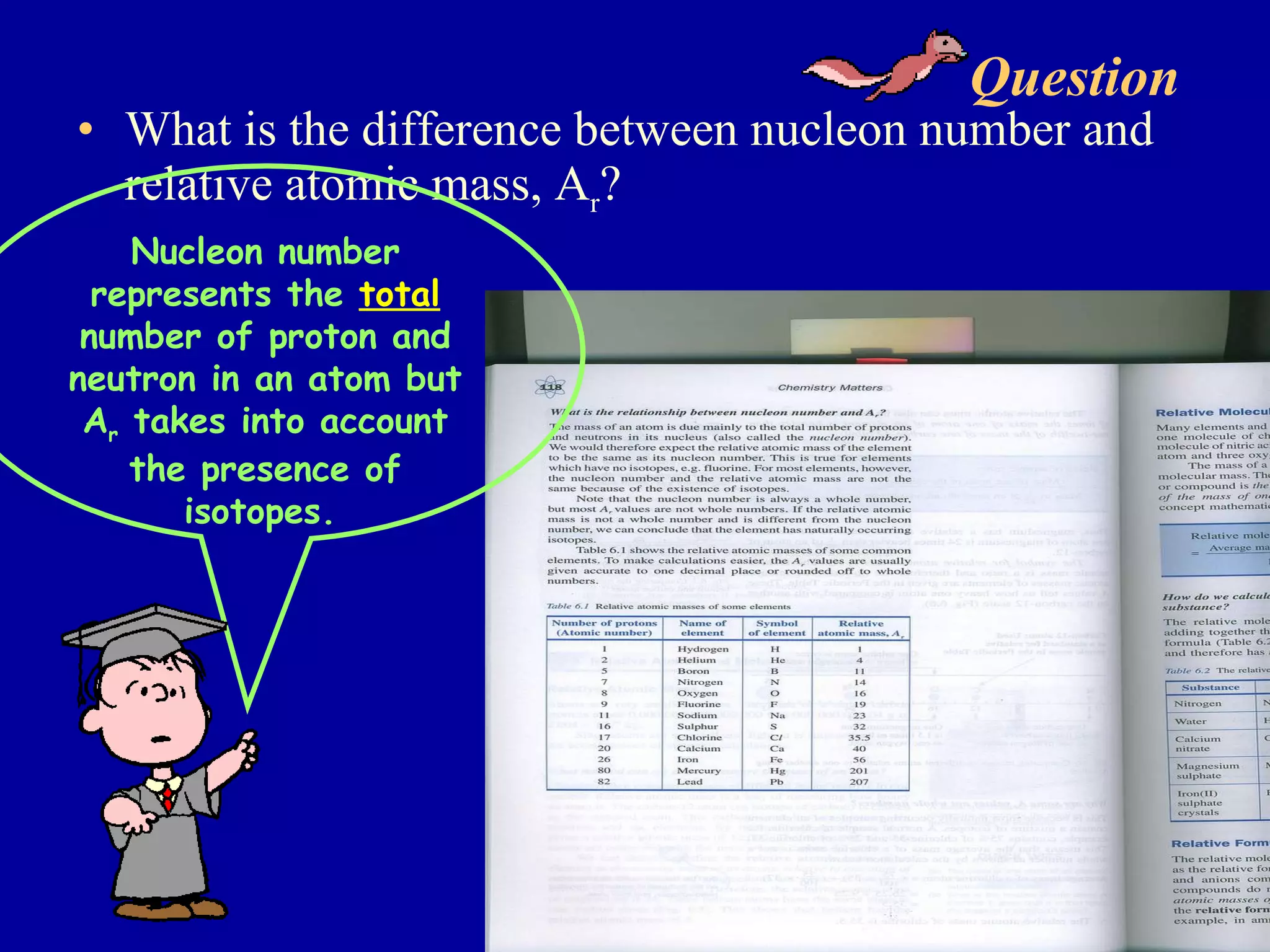
Question  What is the difference between nucleon number and relative atomic mass, A r ? Nucleon number represents the  total  number of proton and neutron in an atom but A r  takes into account the presence of isotopes.
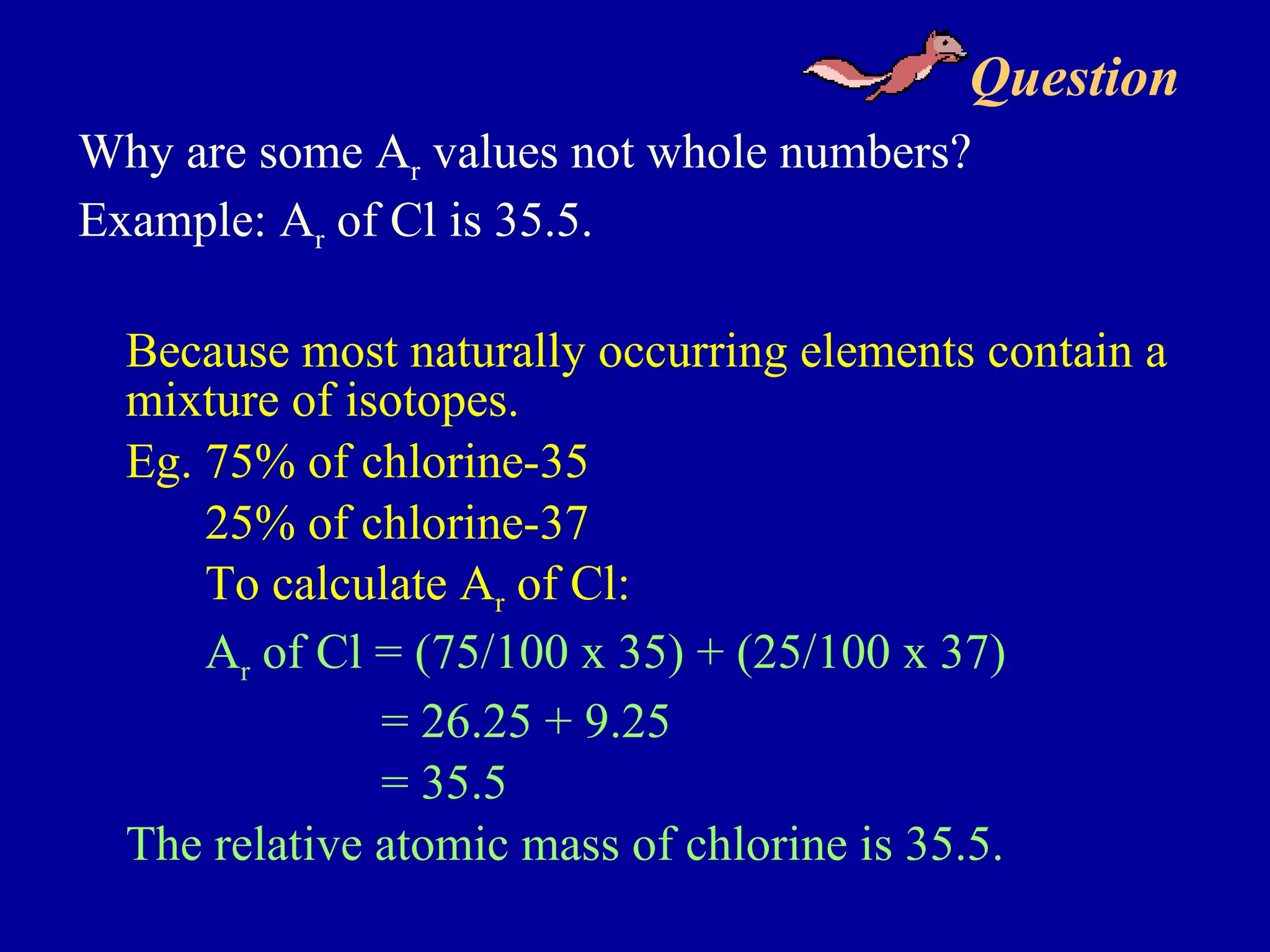
Question  Why are some A r  values not whole numbers? Example: A r  of Cl is 35.5. Because most naturally occurring elements contain a mixture of isotopes. Eg. 75% of chlorine-35 25% of chlorine-37 To calculate A r  of Cl: A r  of Cl = (75/100 x 35) + (25/100 x 37)   = 26.25 + 9.25   = 35.5 The relative atomic mass of chlorine is 35.5.
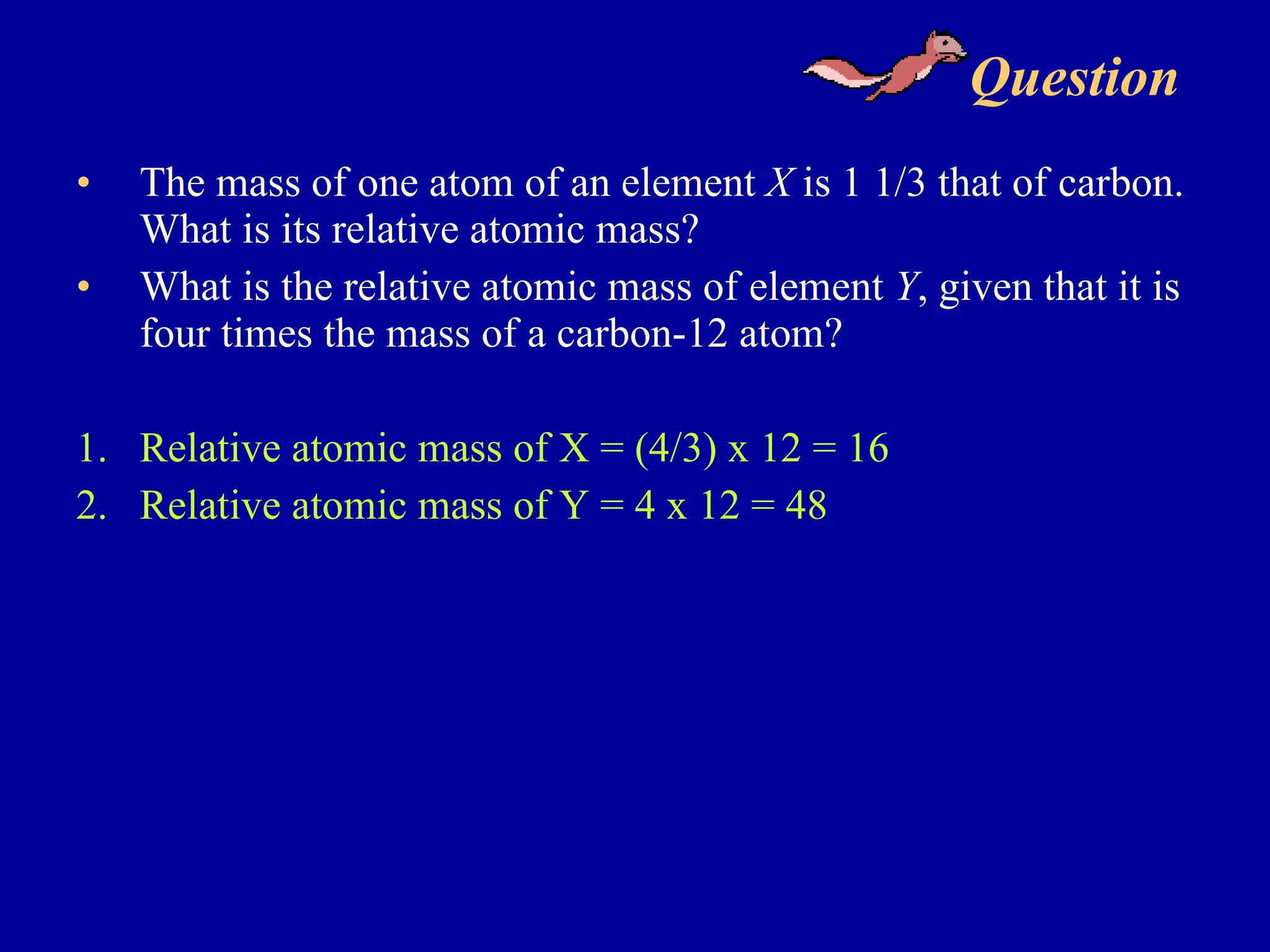
Question  The mass of one atom of an element  X  is 1 1/3 that of carbon. What is its relative atomic mass? What is the relative atomic mass of element  Y , given that it is four times the mass of a carbon-12 atom? 1. Relative atomic mass of X = (4/3) x 12 = 16 2. Relative atomic mass of Y = 4 x 12 = 48
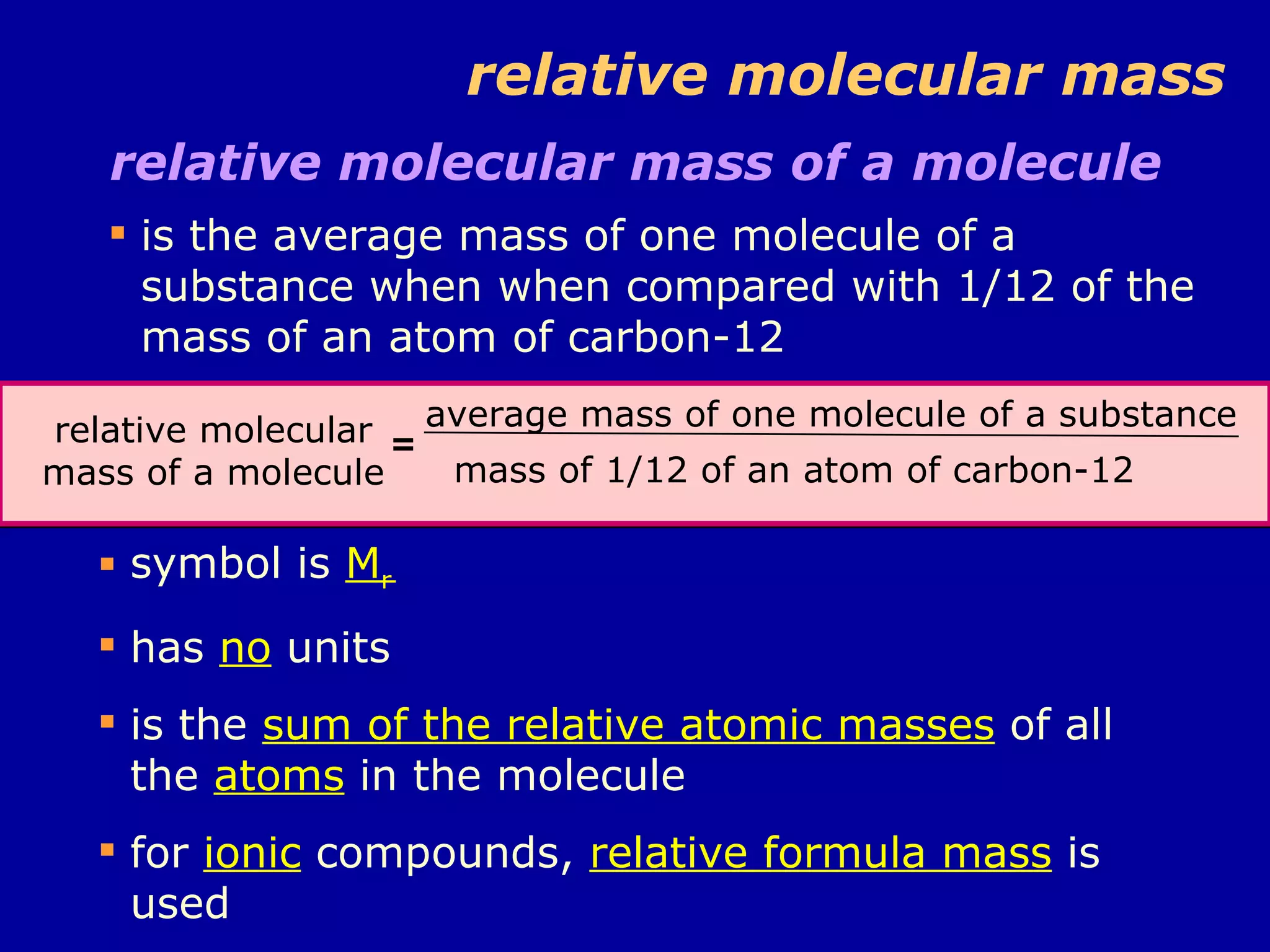
relative molecular mass relative molecular mass of a molecule  is the average mass of one molecule of a substance when when compared with 1/12 of the mass of an atom of carbon-12 relative molecular mass of a molecule = average mass of one molecule of a substance mass of 1/12 of an atom of carbon-12 symbol is  M r has  no  units is the  sum of the relative atomic masses  of all the  atoms  in the molecule for  ionic  compounds,  relative formula mass  is used
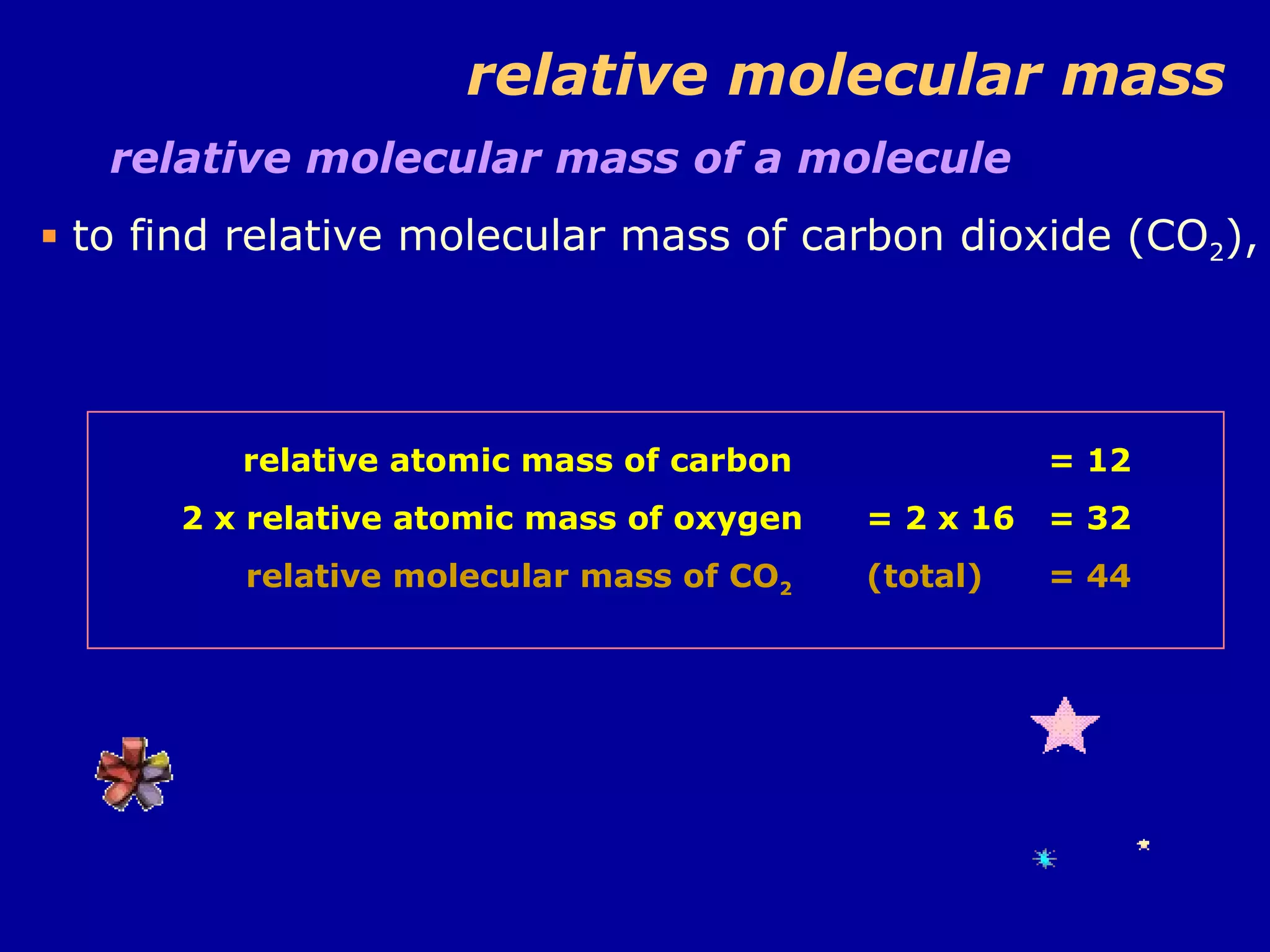
relative molecular mass relative molecular mass of a molecule  to find relative molecular mass of carbon dioxide (CO 2 ), relative atomic mass of carbon  2 x relative atomic mass of oxygen relative molecular mass of CO 2   = 12 = 2 x 16 = 32 (total) = 44
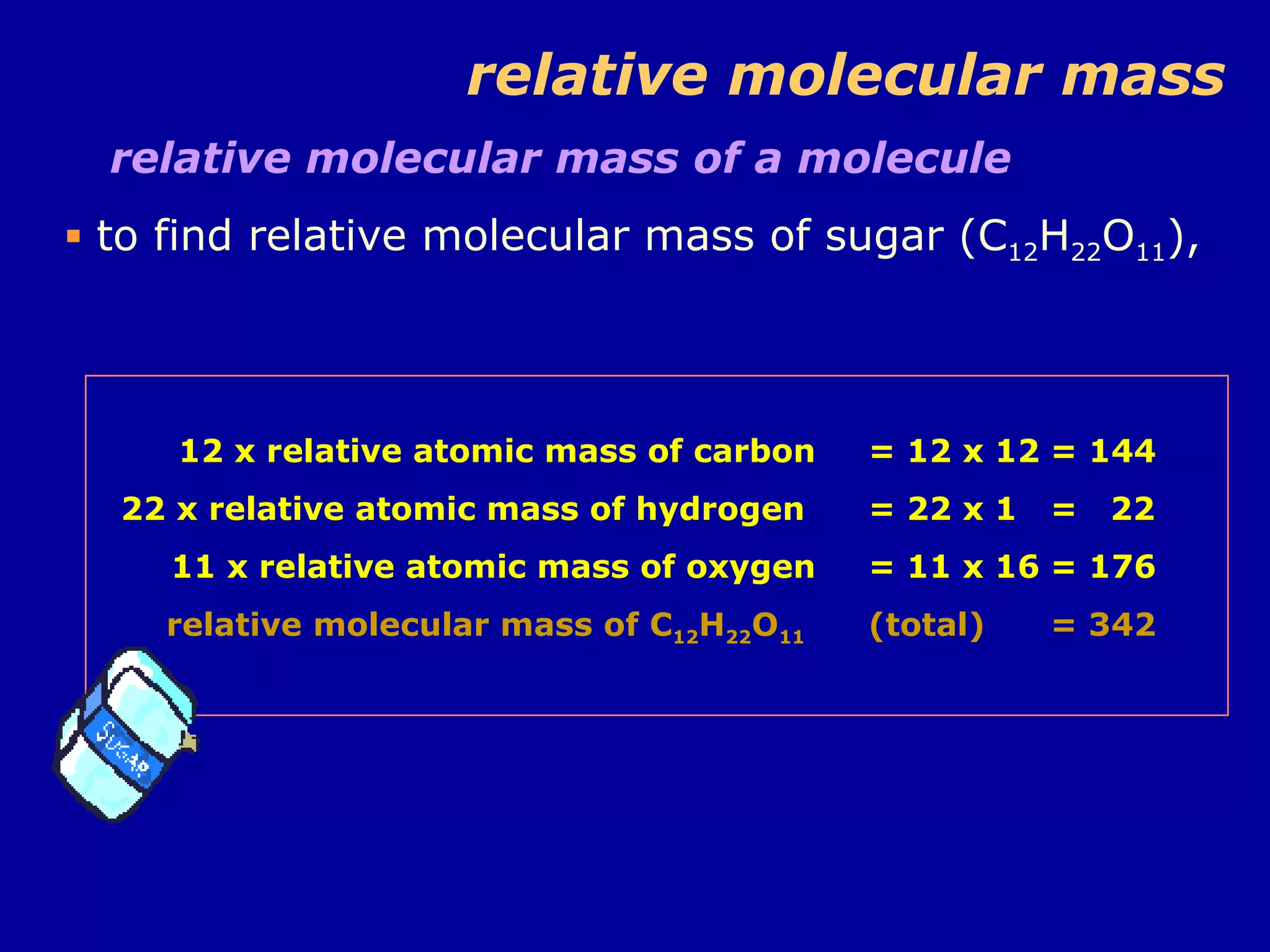
relative molecular mass relative molecular mass of a molecule  to find relative molecular mass of sugar (C 12 H 22 O 11 ), 12 x relative atomic mass of carbon 22 x relative atomic mass of hydrogen  11 x relative atomic mass of oxygen relative molecular mass of C 12 H 22 O 11   = 12 x 12 = 144 = 22 x 1 =  22 = 11 x 16 = 176 (total) = 342
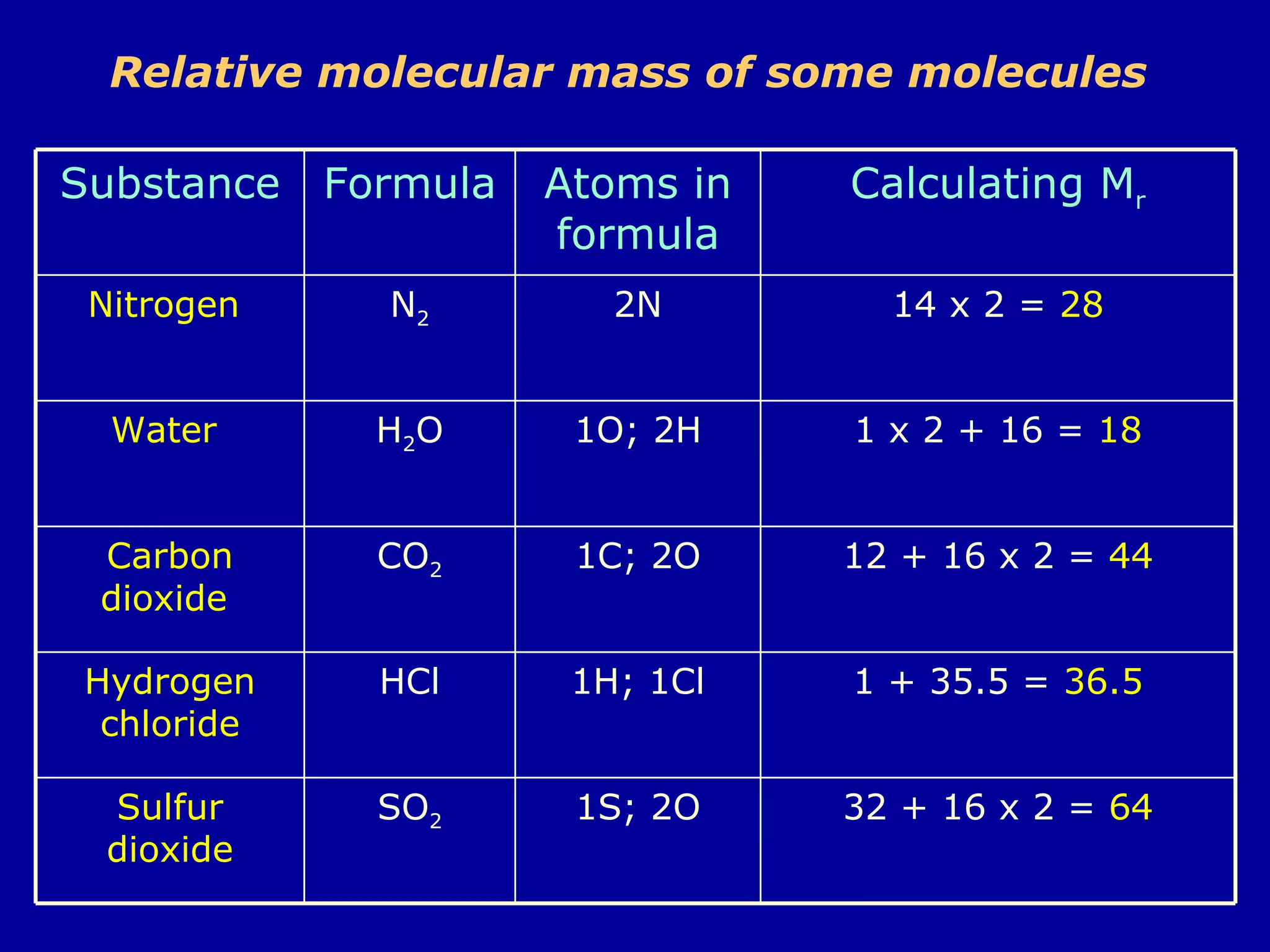
Relative molecular mass of some molecules 1 + 35.5 =  36.5 1H; 1Cl HCl Hydrogen chloride 32 + 16 x 2 =  64 1S; 2O SO 2 Sulfur dioxide 12 + 16 x 2 =  44 1C; 2O CO 2 Carbon dioxide  1 x 2 + 16 =  18 1O; 2H H 2 O Water  14 x 2 =  28 2N N 2 Nitrogen  Calculating M r Atoms in formula Formula Substance
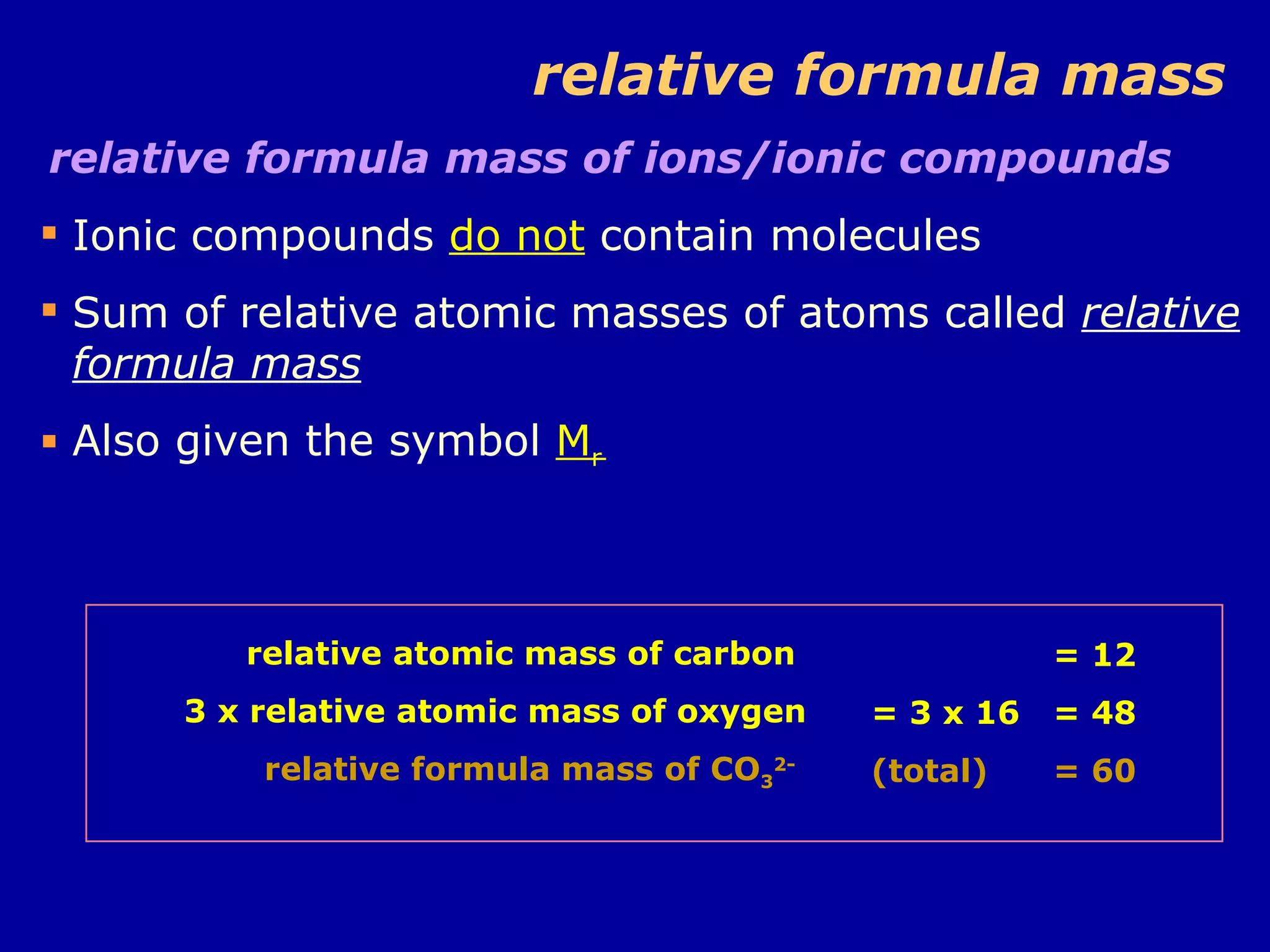
relative formula mass relative formula mass of ions/ionic compounds Ionic compounds  do not  contain molecules Sum of relative atomic masses of atoms called  relative formula mass Also given the symbol  M r = 12 = 3 x 16 = 48 (total) = 60 relative atomic mass of carbon  3 x relative atomic mass of oxygen relative formula mass of CO 3 2-
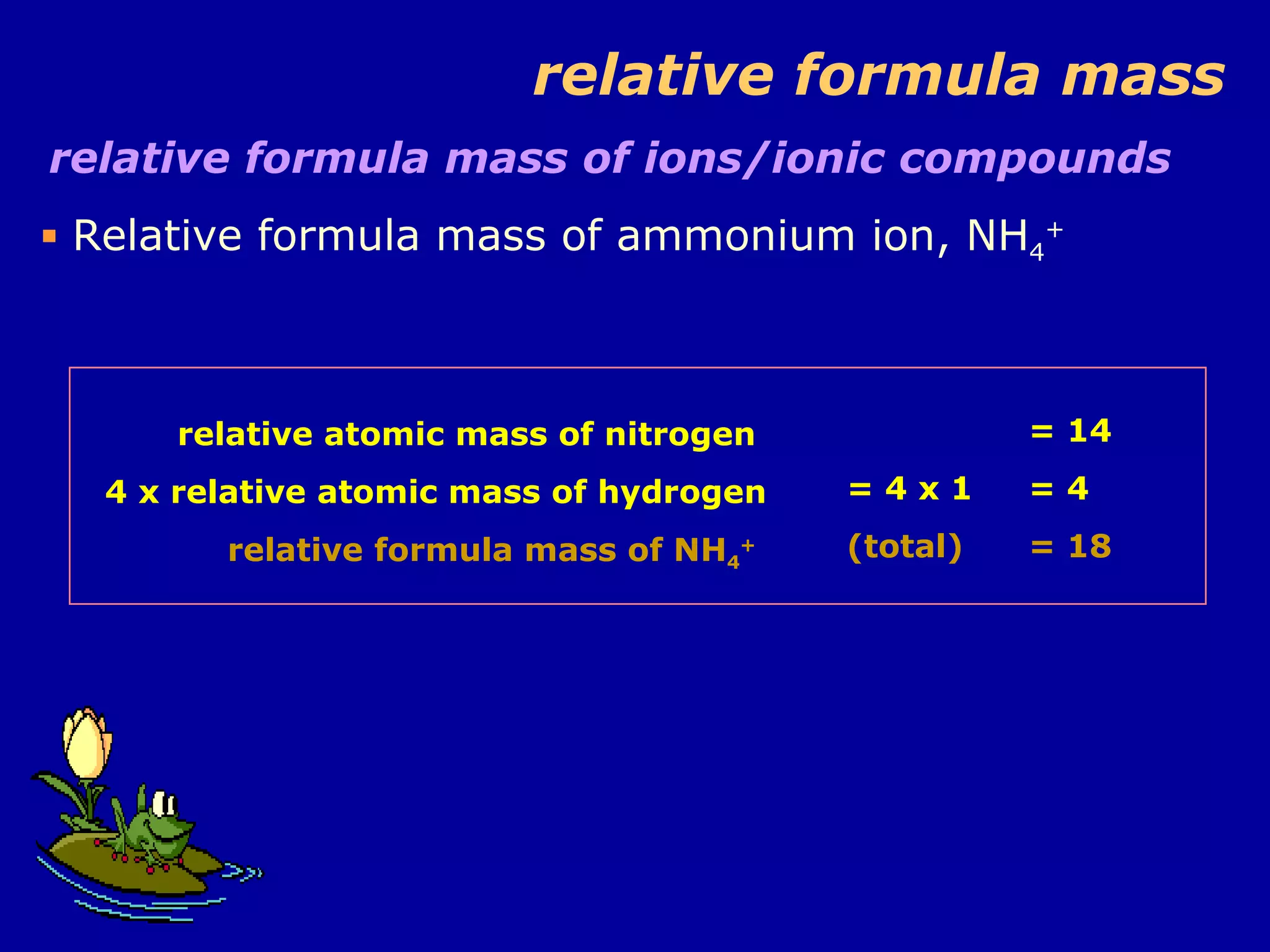
relative formula mass relative formula mass of ions/ionic compounds Relative formula mass of ammonium ion, NH 4 + relative atomic mass of nitrogen  4 x relative atomic mass of hydrogen relative formula mass of NH 4 +   = 14 = 4 x 1 = 4 (total) = 18
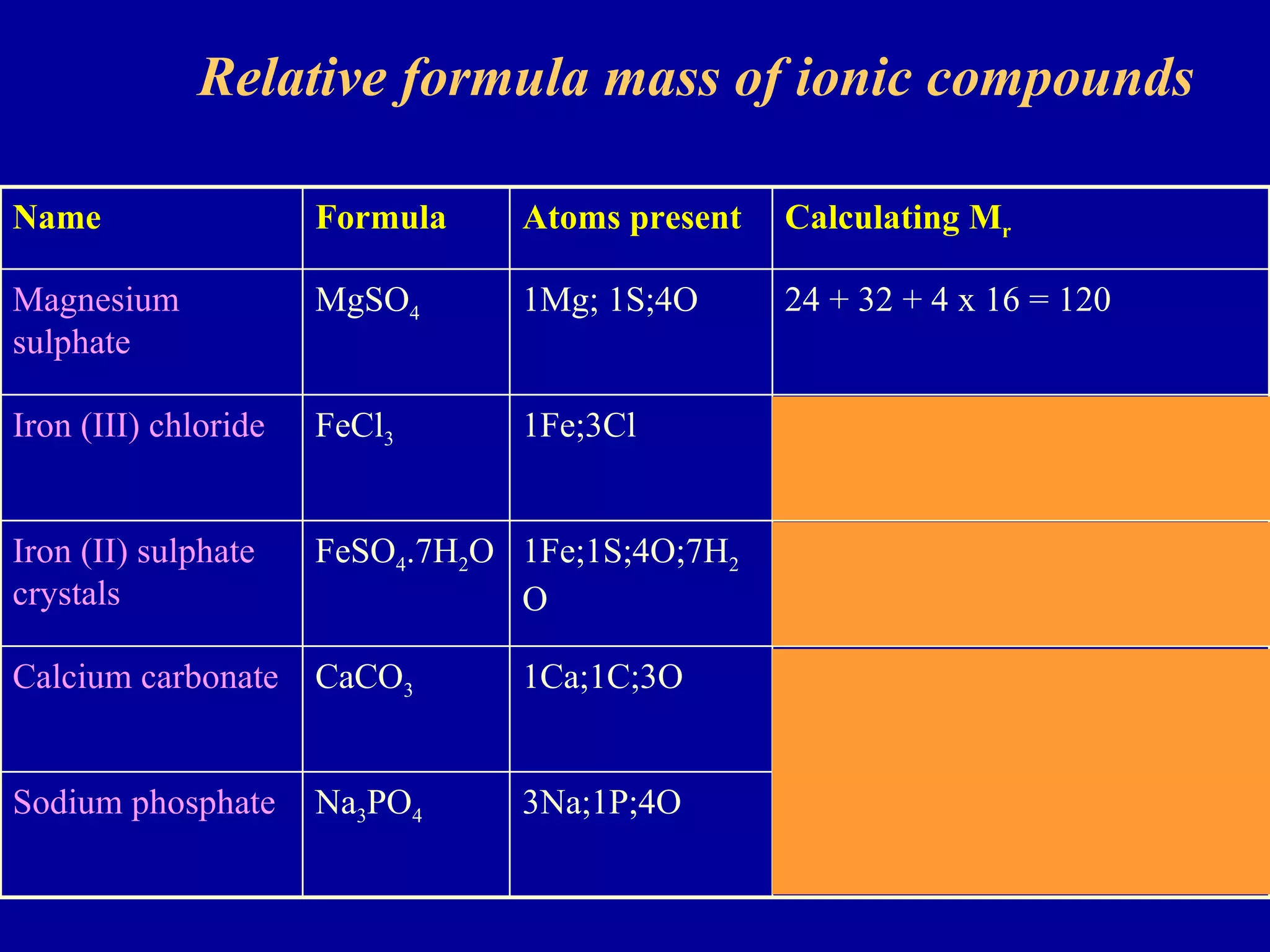
Relative formula mass of ionic compounds 40 + 12 + 16 x 3 = 100 1Ca;1C;3O CaCO 3 Calcium carbonate 23 x 3 + 31 + 16 x 4 = 164 3Na;1P;4O Na 3 PO 4 Sodium phosphate 56 + 32 + 16 x 4 + 7(1 x 2 + 16) = 278 1Fe;1S;4O;7H 2 O FeSO 4 .7H 2 O Iron (II) sulphate crystals 56 + 3 x 35.5 = 162.5 1Fe;3Cl FeCl 3 Iron (III) chloride 24 + 32 + 4 x 16 = 120 1Mg; 1S;4O MgSO 4 Magnesium sulphate Calculating M r Atoms present Formula Name
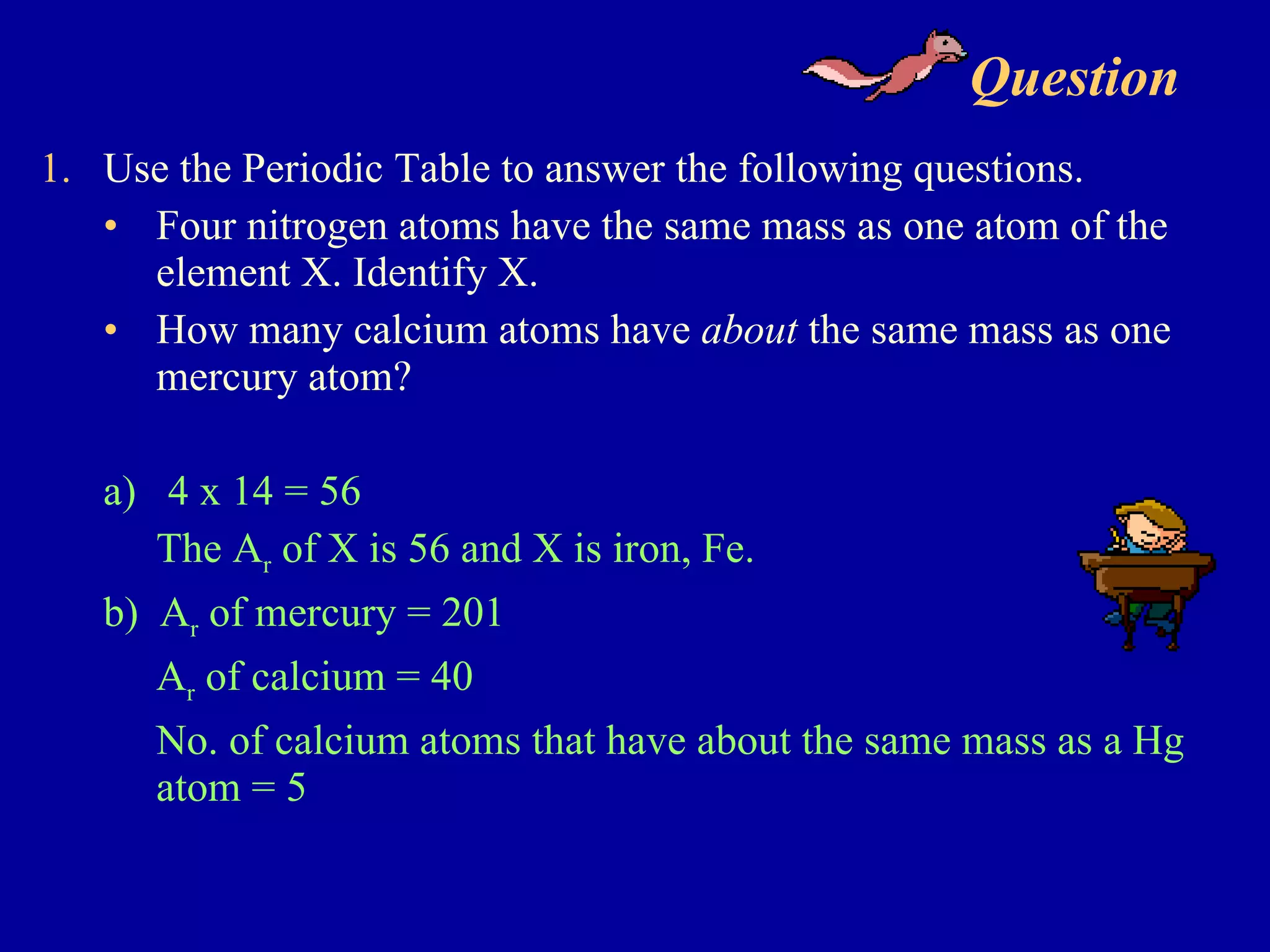
Question  Use the Periodic Table to answer the following questions. Four nitrogen atoms have the same mass as one atom of the element X. Identify X. How many calcium atoms have  about  the same mass as one mercury atom? a)  4 x 14 = 56 The A r  of X is 56 and X is iron, Fe. b)  A r  of mercury = 201 A r  of calcium = 40 No. of calcium atoms that have about the same mass as a Hg atom = 5

3 na calculating_mr

  • 1.
    Chapter 7Relative Masses of Atoms and Molecules
  • 2.
    contents You willlearn about: Relative atomic mass Relative molecular mass The formula of a compound
  • 3.
    Objectives Atthe end of the lesson, students should be able to: define relative atomic mass , A r define relative molecular mass , M r calculate relative atomic mass, relative molecular mass and relative formula mass
  • 4.
    Introduction Atomsare soooo small and their masses are so small! Is there a way to measure them conveniently??? Since atoms are so small, let’s compare them to each other on the atomic scale.
  • 5.
    We can compareevery element to H or 1/12 of C-12
  • 6.
    relative atomic massThe lightest atom is the hydrogen atom. As one nitrogen atom is 14 times heavier than a hydrogen atom, nitrogen is said to have a relative atomic mass of 14. N H H H H H H H H H H H H H H
  • 7.
    relative atomic massRelative masses is about comparing the masses of atoms and molecules. relative atomic mass of an element is the average mass of one atom of the element when compared with 1/12 of the mass of an atom of carbon-12 symbol is A r has no units Isotope carbon-12 was chosen (instead of hydrogen) for comparing the masses of atoms as it is in abundance and has isotopes. relative atomic mass of an element = average mass of one atom of the element mass of 1/12 of an atom of carbon-12
  • 8.
  • 9.
  • 10.
    relative atomic massof an element Relative atomic masses of common elements: relative atomic mass Si 28 silicon O 16 oxygen N 14 nitrogen Mg 24 magnesium Na 23 sodium Al 27 aluminium P 31 phosphorus He 4 helium S 32 sulphur carbon hydrogen Elements 12 1 Relative Atomic Mass C H Symbol
  • 11.
    relative atomic massof an element Relative atomic masses of common elements: relative atomic mass Cu 64 copper Zn 65 zinc Br 80 bromine I 127 iodine K 39 potassium Ca 40 calcium C l 35.5 chlorine Fe 56 iron lead Elements 207 Relative Atomic Mass Pb Symbol
  • 12.
    Question Whatis the difference between nucleon number and relative atomic mass, A r ? Nucleon number represents the total number of proton and neutron in an atom but A r takes into account the presence of isotopes.
  • 13.
    Question Whyare some A r values not whole numbers? Example: A r of Cl is 35.5. Because most naturally occurring elements contain a mixture of isotopes. Eg. 75% of chlorine-35 25% of chlorine-37 To calculate A r of Cl: A r of Cl = (75/100 x 35) + (25/100 x 37) = 26.25 + 9.25 = 35.5 The relative atomic mass of chlorine is 35.5.
  • 14.
    Question Themass of one atom of an element X is 1 1/3 that of carbon. What is its relative atomic mass? What is the relative atomic mass of element Y , given that it is four times the mass of a carbon-12 atom? 1. Relative atomic mass of X = (4/3) x 12 = 16 2. Relative atomic mass of Y = 4 x 12 = 48
  • 15.
    relative molecular massrelative molecular mass of a molecule is the average mass of one molecule of a substance when when compared with 1/12 of the mass of an atom of carbon-12 relative molecular mass of a molecule = average mass of one molecule of a substance mass of 1/12 of an atom of carbon-12 symbol is M r has no units is the sum of the relative atomic masses of all the atoms in the molecule for ionic compounds, relative formula mass is used
  • 16.
    relative molecular massrelative molecular mass of a molecule to find relative molecular mass of carbon dioxide (CO 2 ), relative atomic mass of carbon 2 x relative atomic mass of oxygen relative molecular mass of CO 2 = 12 = 2 x 16 = 32 (total) = 44
  • 17.
    relative molecular massrelative molecular mass of a molecule to find relative molecular mass of sugar (C 12 H 22 O 11 ), 12 x relative atomic mass of carbon 22 x relative atomic mass of hydrogen 11 x relative atomic mass of oxygen relative molecular mass of C 12 H 22 O 11 = 12 x 12 = 144 = 22 x 1 = 22 = 11 x 16 = 176 (total) = 342
  • 18.
    Relative molecular massof some molecules 1 + 35.5 = 36.5 1H; 1Cl HCl Hydrogen chloride 32 + 16 x 2 = 64 1S; 2O SO 2 Sulfur dioxide 12 + 16 x 2 = 44 1C; 2O CO 2 Carbon dioxide 1 x 2 + 16 = 18 1O; 2H H 2 O Water 14 x 2 = 28 2N N 2 Nitrogen Calculating M r Atoms in formula Formula Substance
  • 19.
    relative formula massrelative formula mass of ions/ionic compounds Ionic compounds do not contain molecules Sum of relative atomic masses of atoms called relative formula mass Also given the symbol M r = 12 = 3 x 16 = 48 (total) = 60 relative atomic mass of carbon 3 x relative atomic mass of oxygen relative formula mass of CO 3 2-
  • 20.
    relative formula massrelative formula mass of ions/ionic compounds Relative formula mass of ammonium ion, NH 4 + relative atomic mass of nitrogen 4 x relative atomic mass of hydrogen relative formula mass of NH 4 + = 14 = 4 x 1 = 4 (total) = 18
  • 21.
    Relative formula massof ionic compounds 40 + 12 + 16 x 3 = 100 1Ca;1C;3O CaCO 3 Calcium carbonate 23 x 3 + 31 + 16 x 4 = 164 3Na;1P;4O Na 3 PO 4 Sodium phosphate 56 + 32 + 16 x 4 + 7(1 x 2 + 16) = 278 1Fe;1S;4O;7H 2 O FeSO 4 .7H 2 O Iron (II) sulphate crystals 56 + 3 x 35.5 = 162.5 1Fe;3Cl FeCl 3 Iron (III) chloride 24 + 32 + 4 x 16 = 120 1Mg; 1S;4O MgSO 4 Magnesium sulphate Calculating M r Atoms present Formula Name
  • 22.
    Question Usethe Periodic Table to answer the following questions. Four nitrogen atoms have the same mass as one atom of the element X. Identify X. How many calcium atoms have about the same mass as one mercury atom? a) 4 x 14 = 56 The A r of X is 56 and X is iron, Fe. b) A r of mercury = 201 A r of calcium = 40 No. of calcium atoms that have about the same mass as a Hg atom = 5