PRIYADARSHINI INSTITUTE OF TECHNOLOGY
AUGMENTED REALITY
BY
B VENUGOPAL
(103P1A0507)
AUGMENTED REALITY
“Reality is merely an illusion, albeit a very persistent one.”
– Albert Einstein
What Is Augmented Reality (AR)?
• A combination of
– a real scene viewed by
a user and
– a virtual scene
generated by a
computer that
augments the scene
with additional
information.
– ARToolkit demo movie
– T-immersion 2004
video
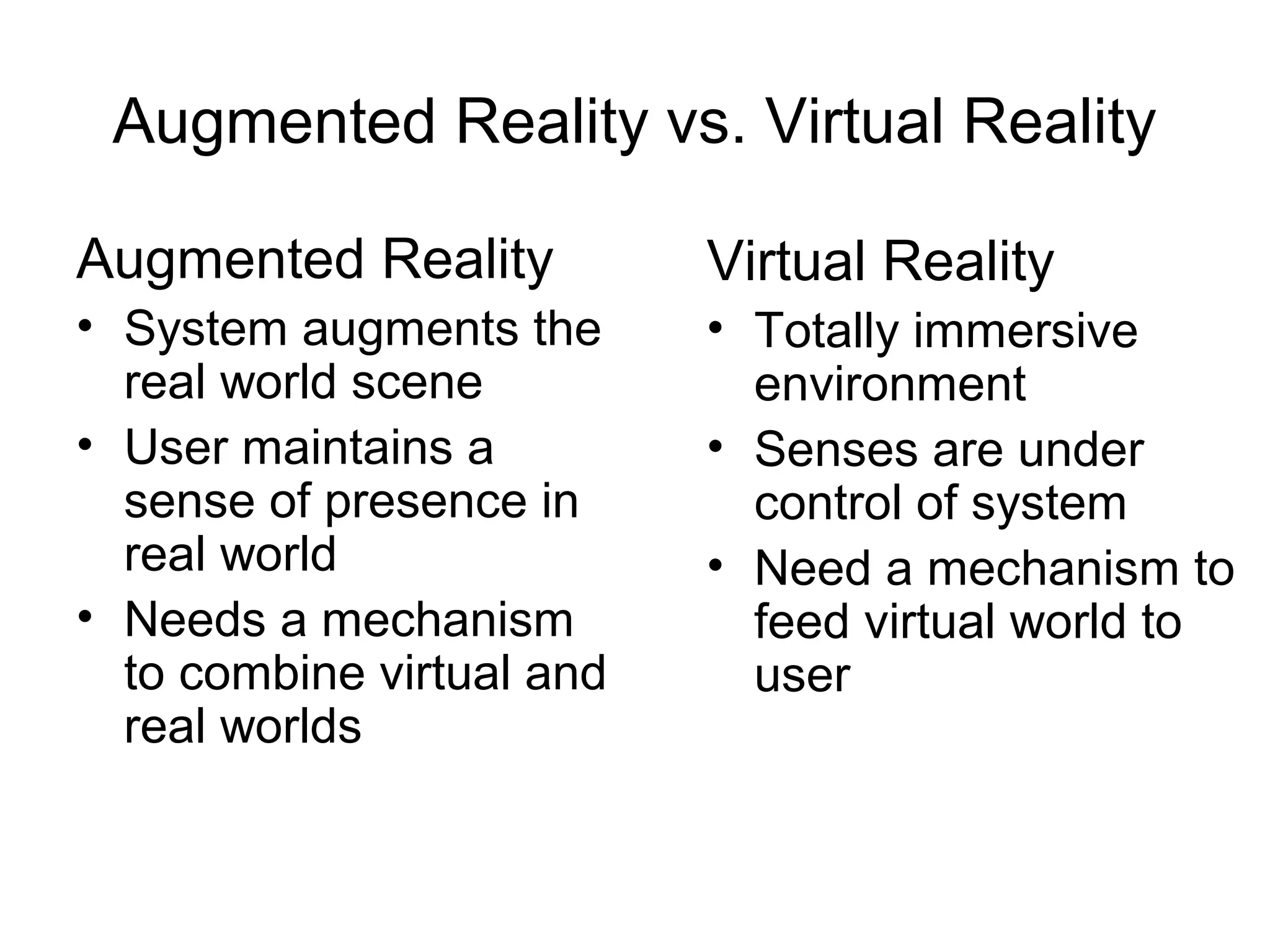
Augmented Reality vs. Virtual Reality
Augmented Reality
• System augments the
real world scene
• User maintains a
sense of presence in
real world
• Needs a mechanism
to combine virtual and
real worlds
Virtual Reality
• Totally immersive
environment
• Senses are under
control of system
• Need a mechanism to
feed virtual world to
user
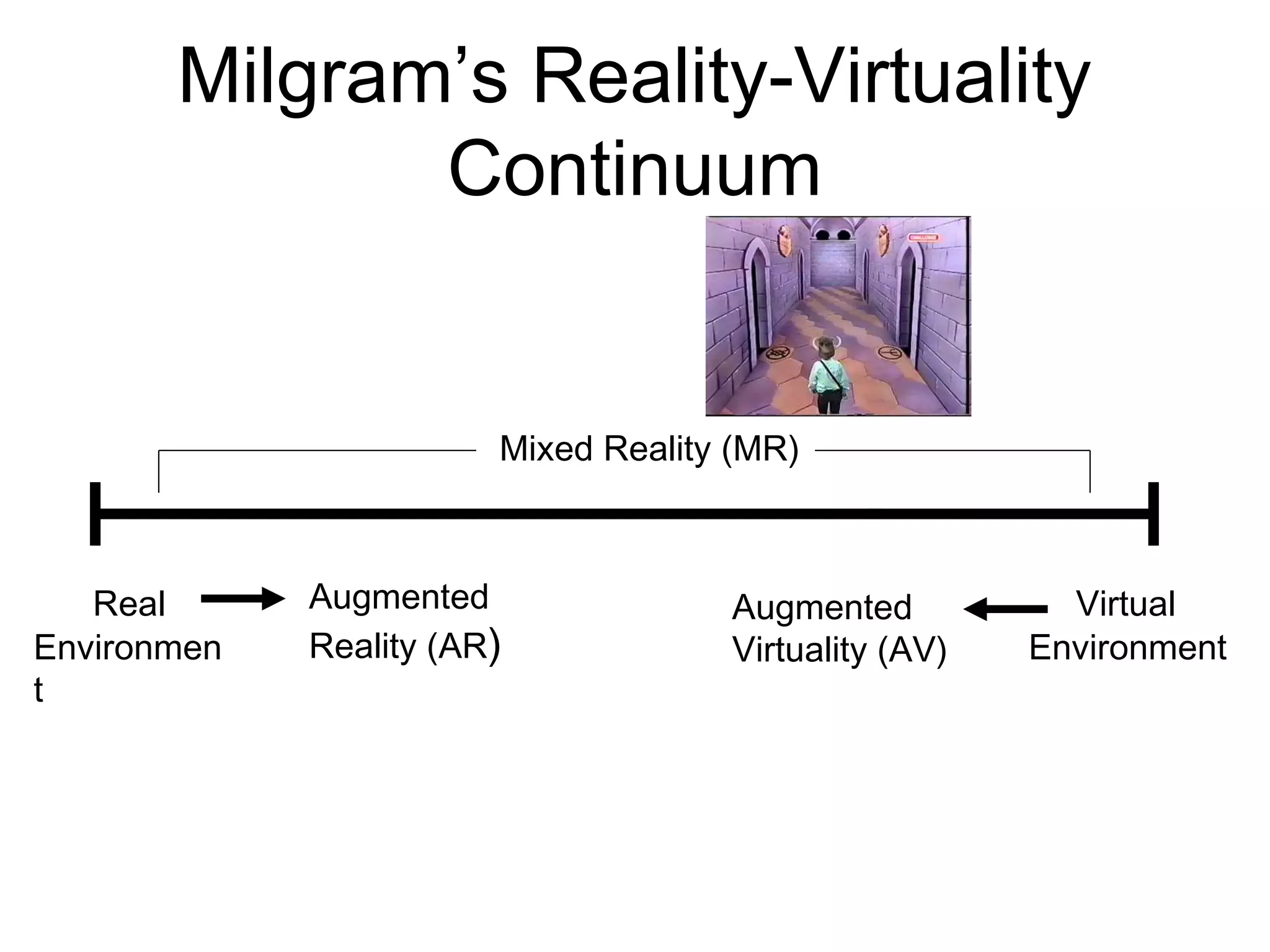
Milgram’s Reality-Virtuality
Continuum
Mixed Reality (MR)
Real
Environmen
t
Virtual
Environment
Augmented
Reality (AR)
Augmented
Virtuality (AV)
Combining the Real and Virtual
Worlds (cont)
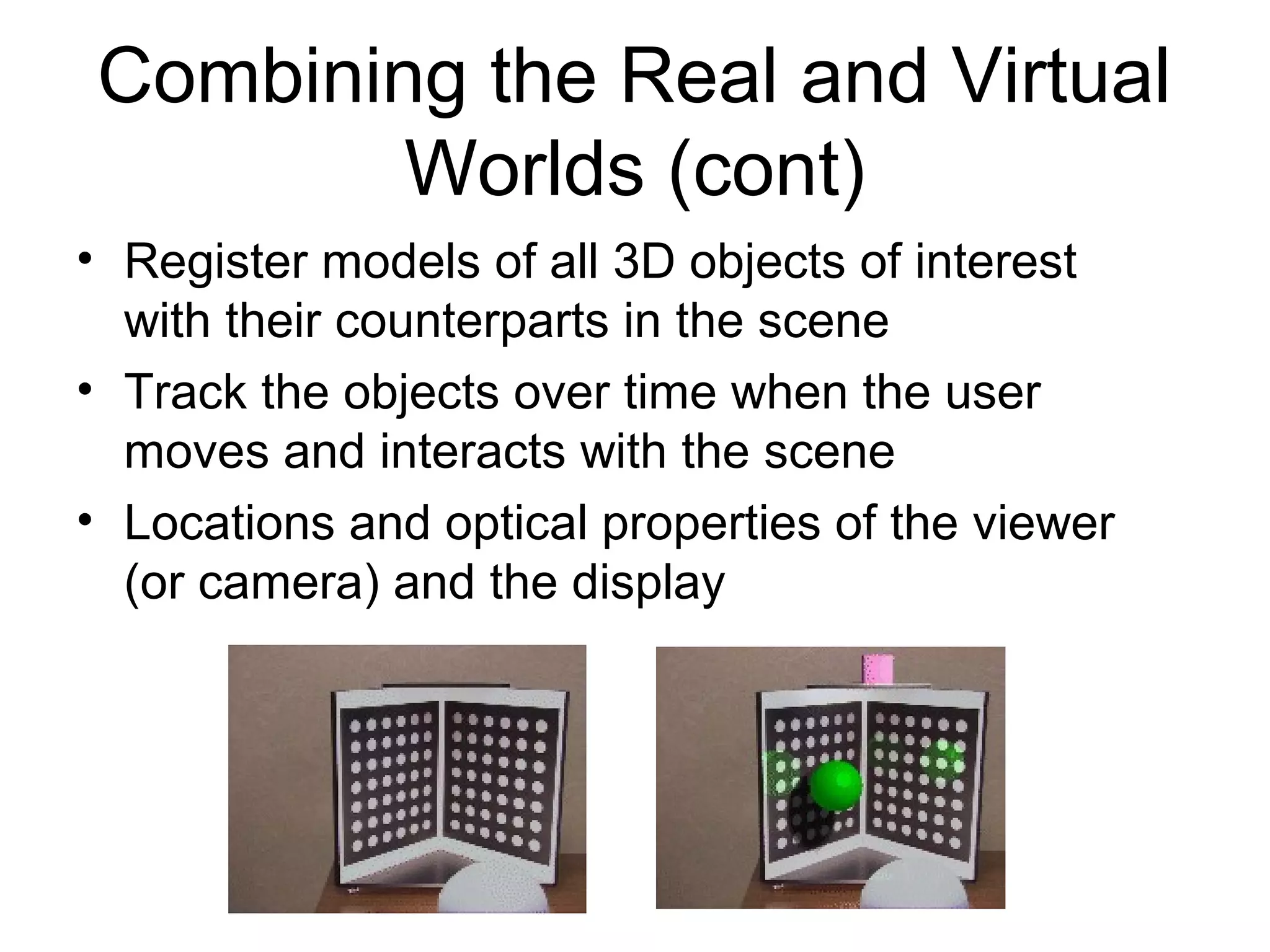
• Register models of all 3D objects of interest
with their counterparts in the scene
• Track the objects over time when the user
moves and interacts with the scene
• Locations and optical properties of the viewer
(or camera) and the display
Research Activities
• Develop methods to register the two
distinct sets (real, virtual) of images and
keep them registered in real-time
– This often reduces to finding the position of a
camera relative to some fiducial markers
• Develop new display technologies for
merging the two images
Performance Issues
Two performance criteria are placed on the
system:
• Update rate for generating the augmenting
image
• Accuracy of the registration of the real and
virtual image
Display Technologies
• Monitor Based Technology
– Laptops
– Cell phones
– Projectors
• Head Mounted Displays Technology
– Video see-through
– Optical see-through
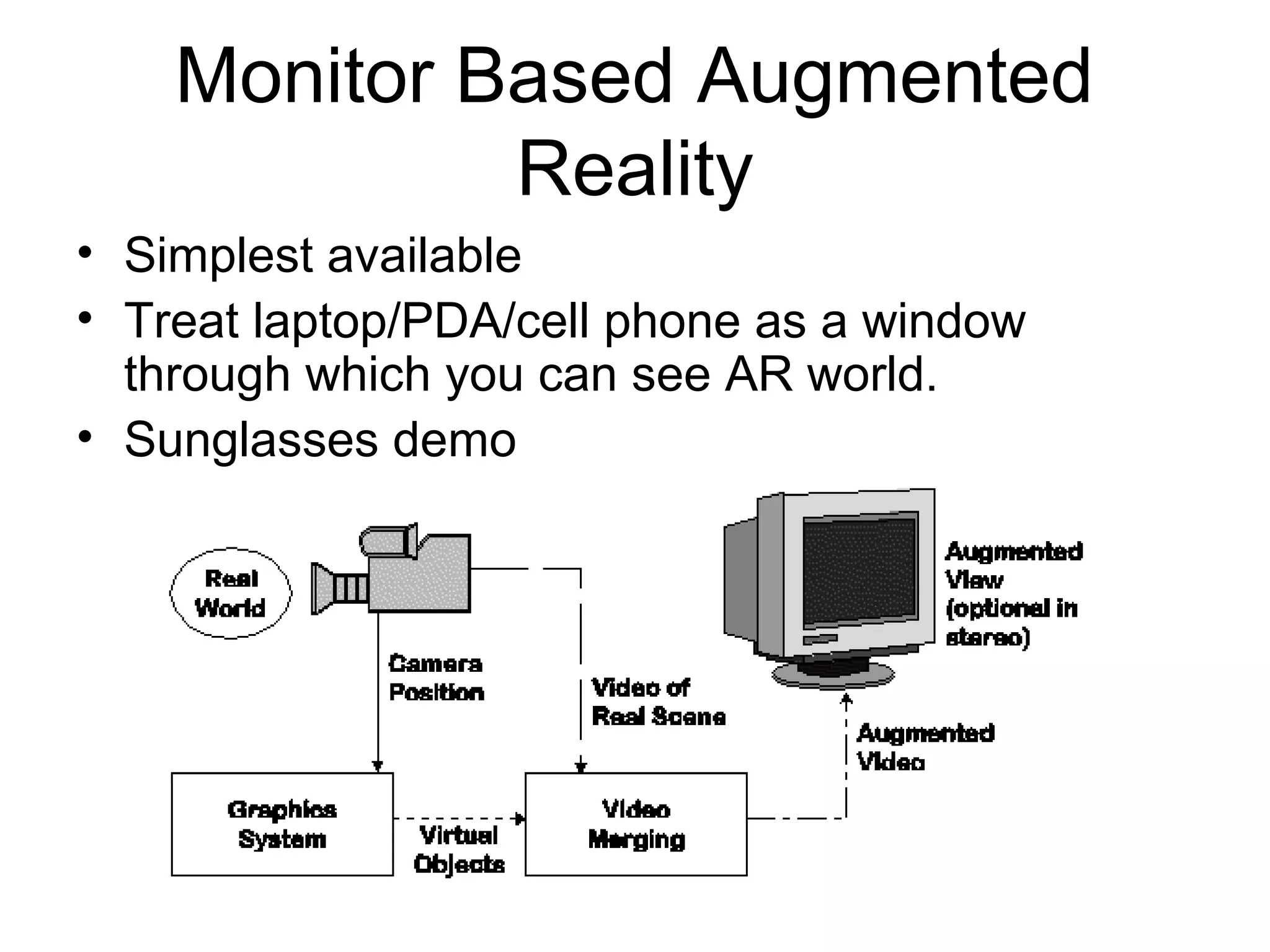
Monitor Based Augmented
Reality
• Simplest available
• Treat laptop/PDA/cell phone as a window
through which you can see AR world.
• Sunglasses demo
Monitor Based AR
• Successful commercialization
– Yellow line in football broadcasts
– Glowing hockey stick
– Baseball cards
– Tennis
– Ad campaigns
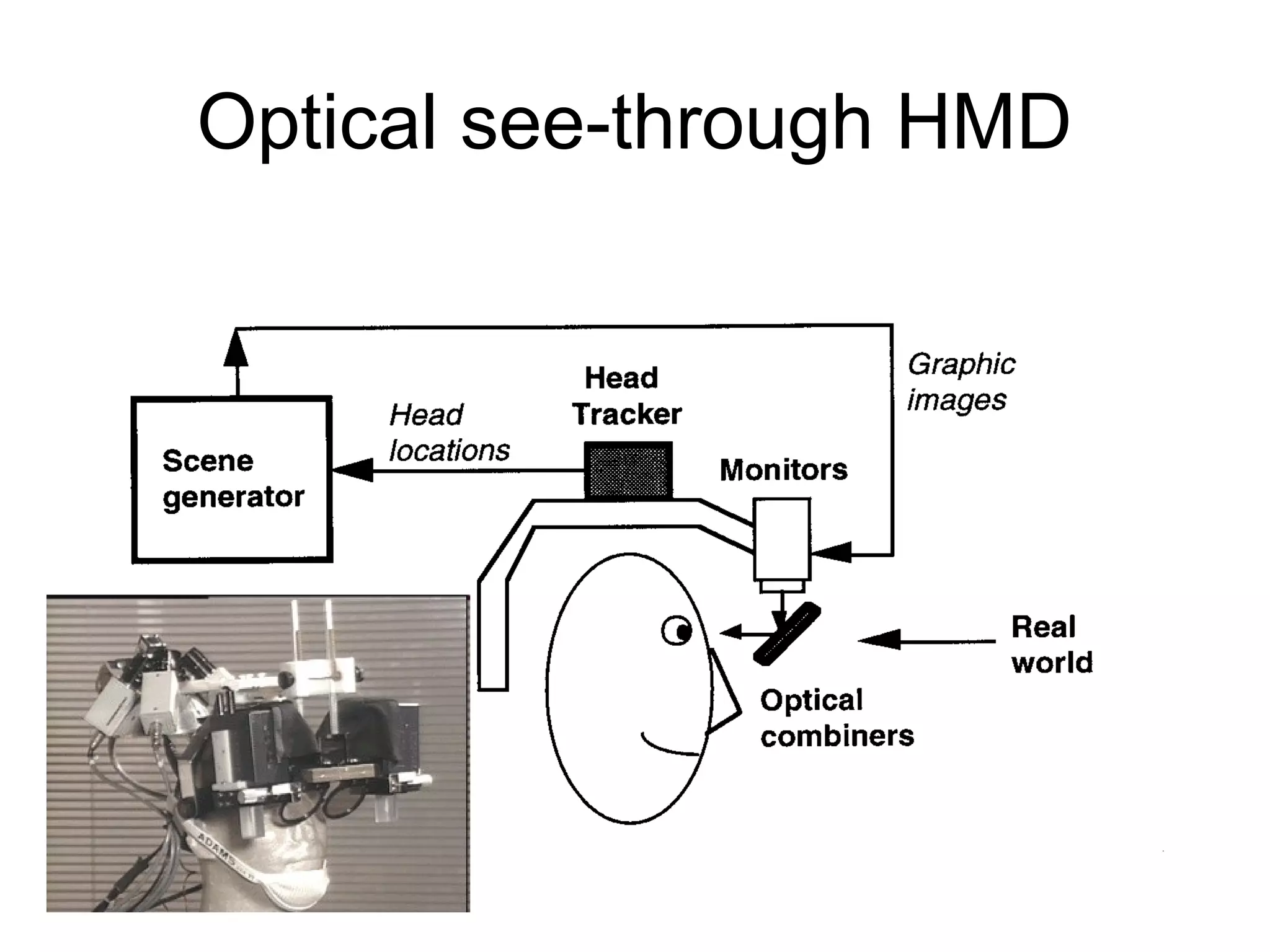
Optical see-through HMD
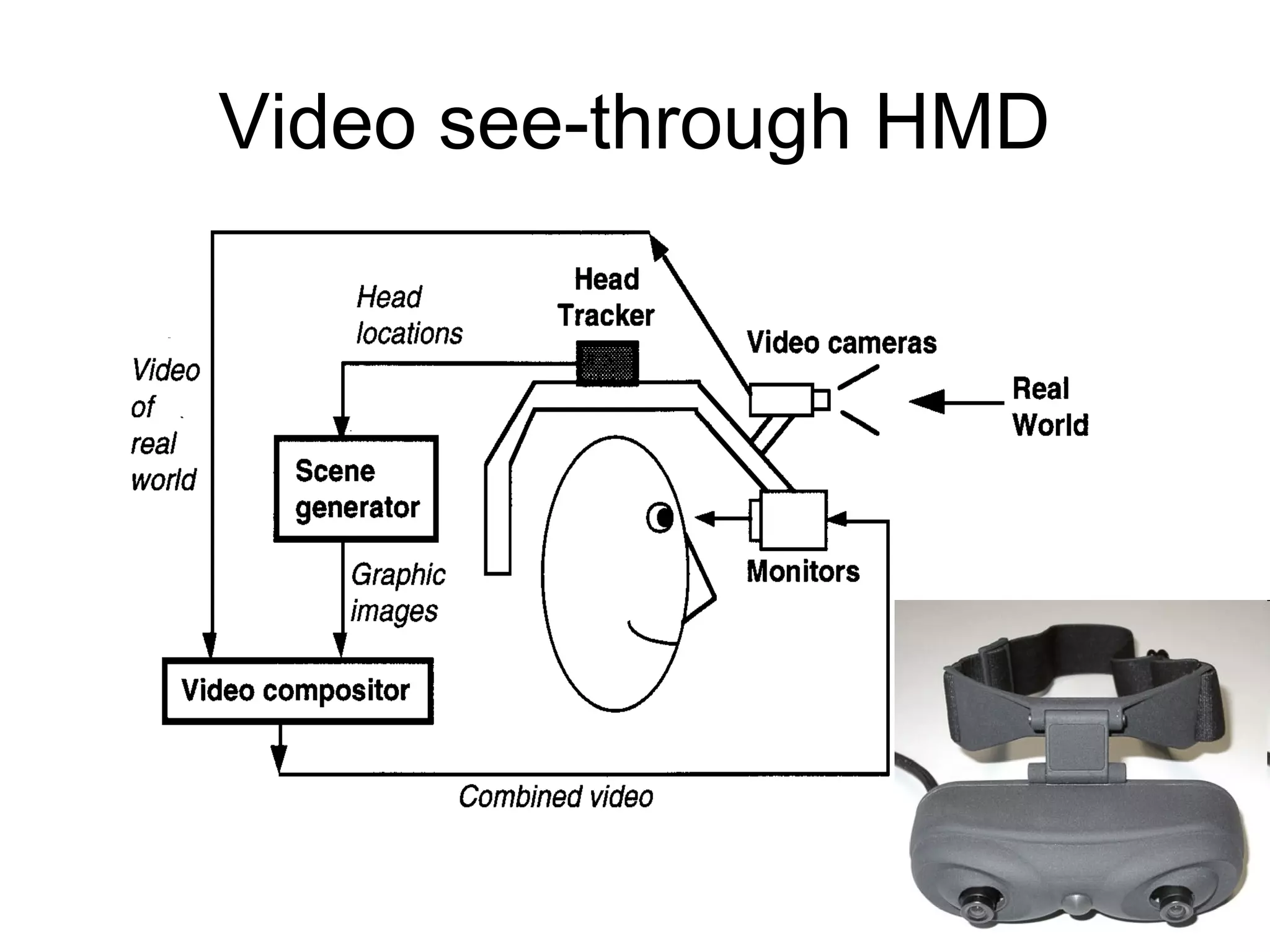
Video see-through HMD
Advantages of
Video see-through HMD
• Flexibility in composition strategies
• Real and virtual view delays can be
matched
Advantages of
Optical see-through HMD
• Simplicity
• Resolution
• No eye offset
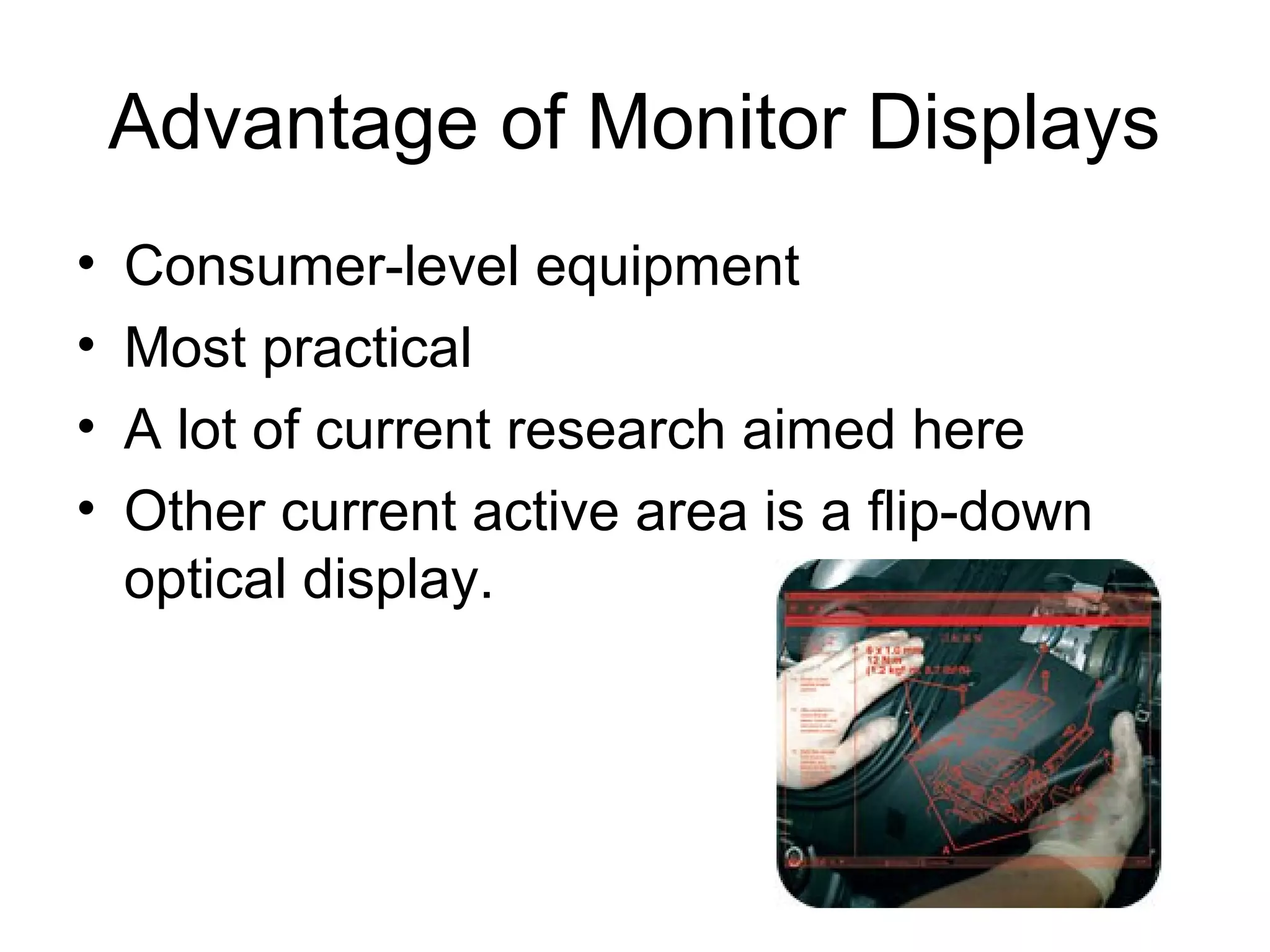
Advantage of Monitor Displays
• Consumer-level equipment
• Most practical
• A lot of current research aimed here
• Other current active area is a flip-down
optical display.
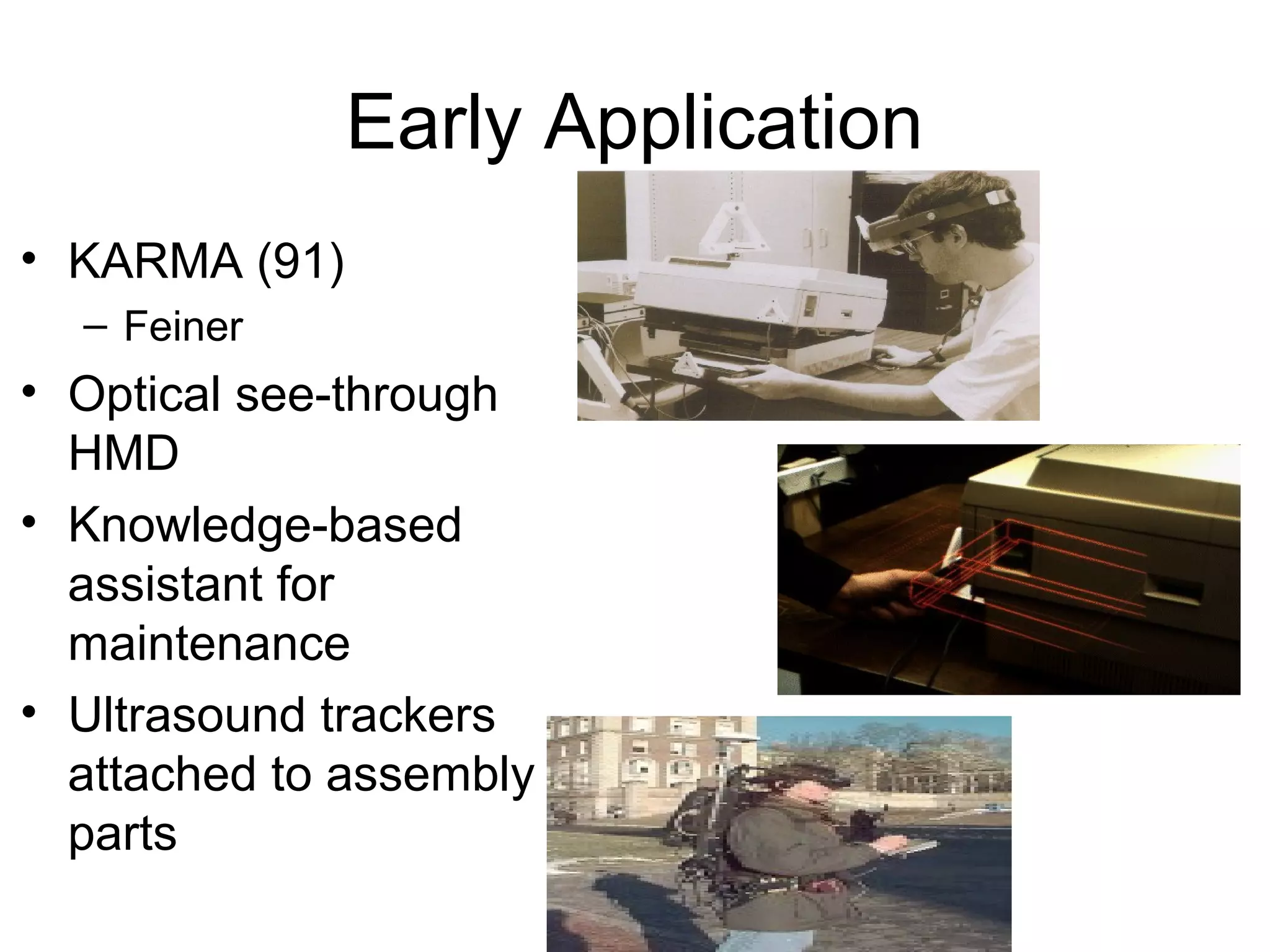
Early Application
• KARMA (91)
– Feiner
• Optical see-through
HMD
• Knowledge-based
assistant for
maintenance
• Ultrasound trackers
attached to assembly
parts
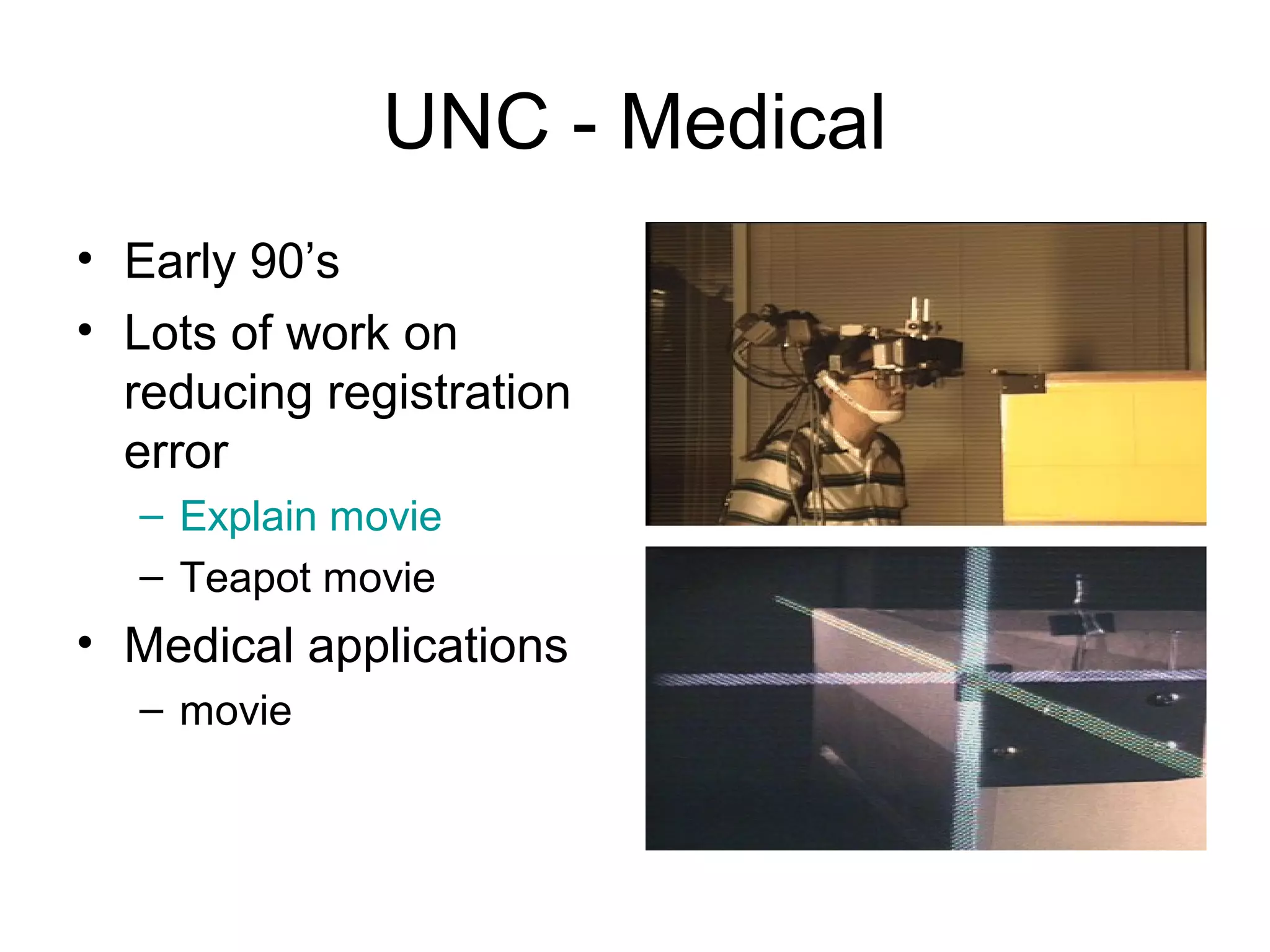
UNC - Medical
• Early 90’s
• Lots of work on
reducing registration
error
– Explain movie
– Teapot movie
• Medical applications
– movie
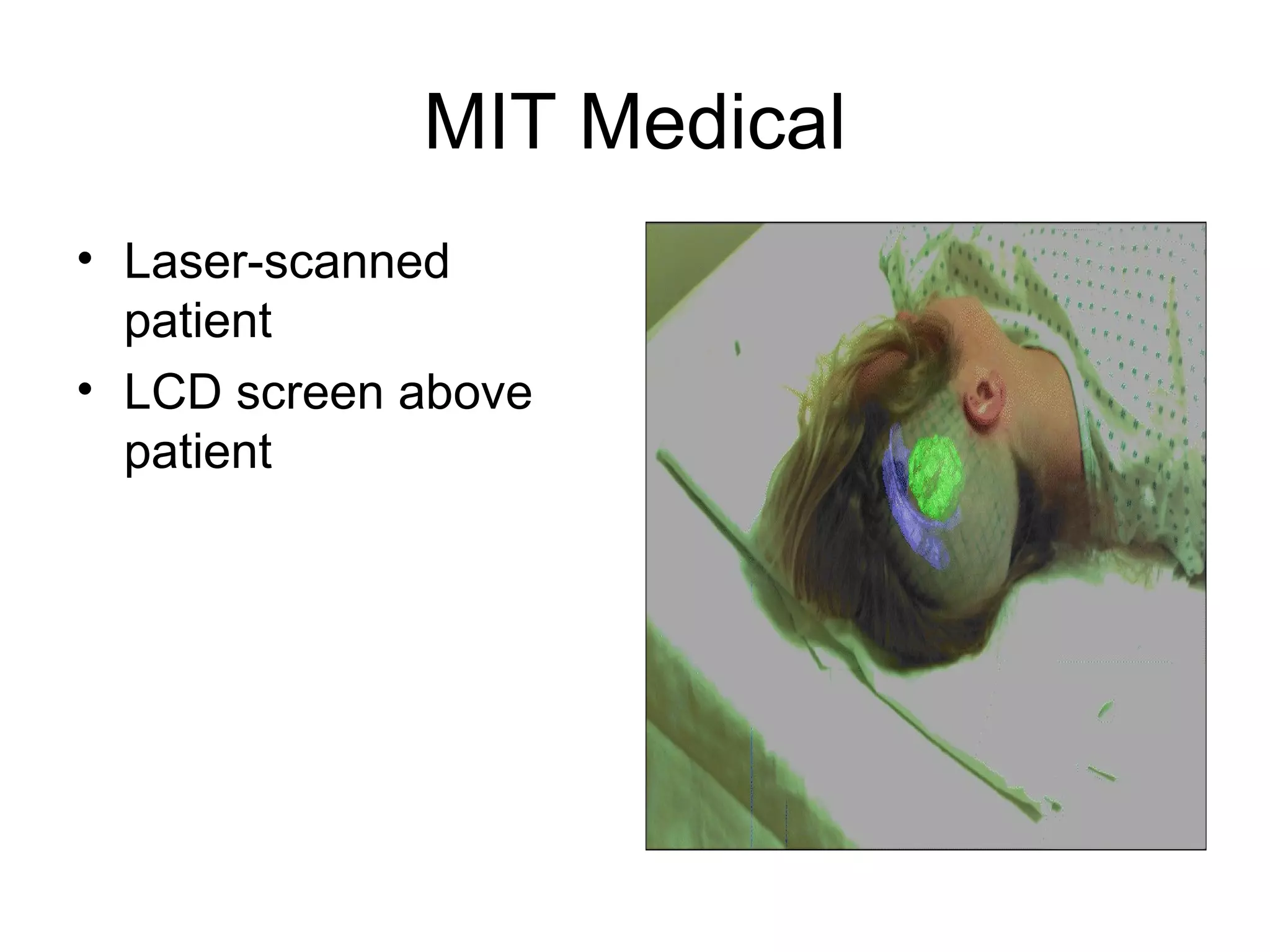
MIT Medical
• Laser-scanned
patient
• LCD screen above
patient
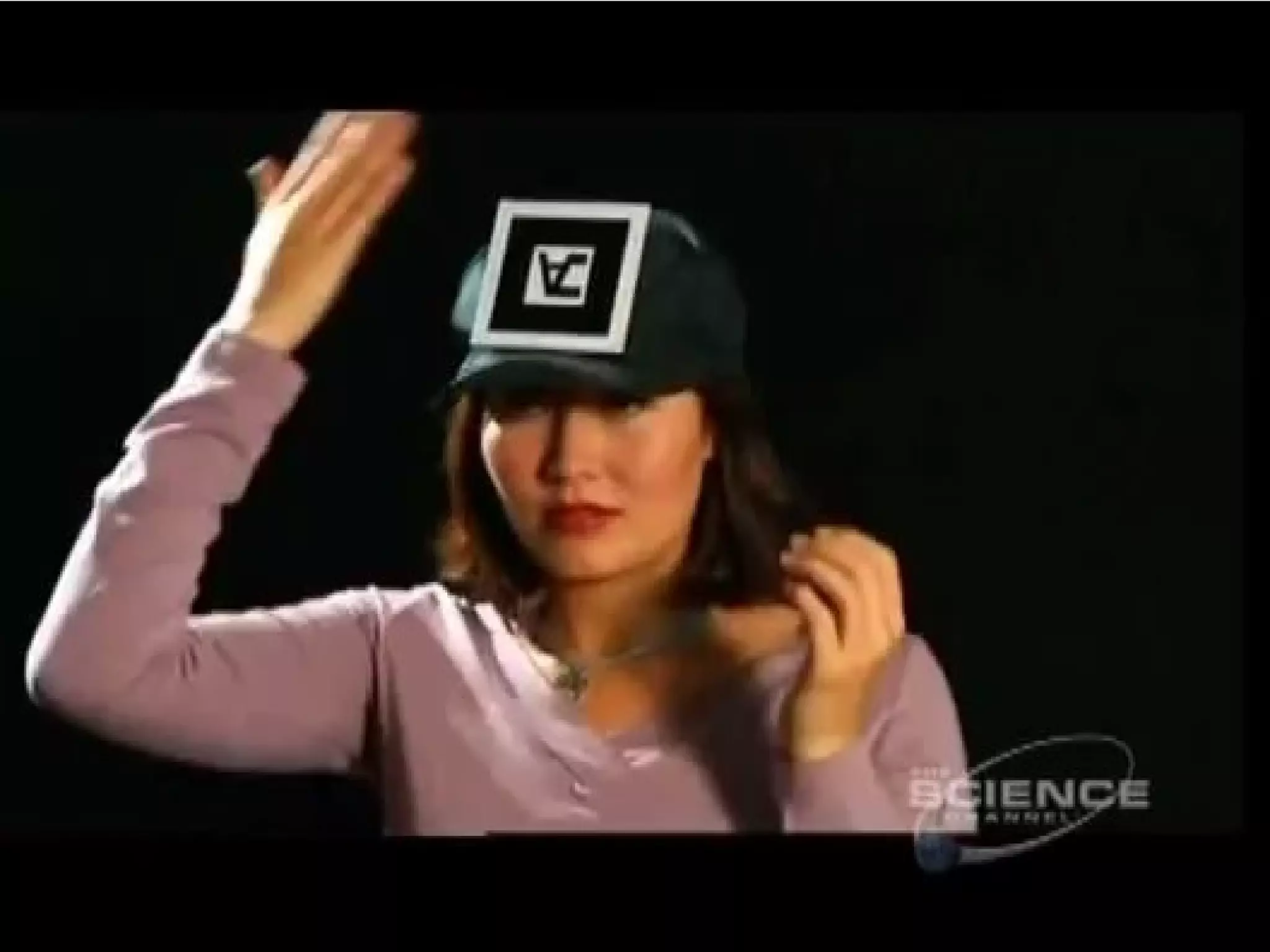
AR Instructional
• Reality provides a natural interface
– MagicBook movie
AR Games
• ARQuake
AR
• Lots of new applications
• Will discuss some tracking systems next class
AUGMENTED REALITY PPT's

AUGMENTED REALITY PPT's

  • 1.
    PRIYADARSHINI INSTITUTE OFTECHNOLOGY AUGMENTED REALITY BY B VENUGOPAL (103P1A0507)
  • 2.
    AUGMENTED REALITY “Reality ismerely an illusion, albeit a very persistent one.” – Albert Einstein
  • 3.
    What Is AugmentedReality (AR)? • A combination of – a real scene viewed by a user and – a virtual scene generated by a computer that augments the scene with additional information. – ARToolkit demo movie – T-immersion 2004 video
  • 4.
    Augmented Reality vs.Virtual Reality Augmented Reality • System augments the real world scene • User maintains a sense of presence in real world • Needs a mechanism to combine virtual and real worlds Virtual Reality • Totally immersive environment • Senses are under control of system • Need a mechanism to feed virtual world to user
  • 5.
    Milgram’s Reality-Virtuality Continuum Mixed Reality(MR) Real Environmen t Virtual Environment Augmented Reality (AR) Augmented Virtuality (AV)
  • 6.
    Combining the Realand Virtual Worlds (cont) • Register models of all 3D objects of interest with their counterparts in the scene • Track the objects over time when the user moves and interacts with the scene • Locations and optical properties of the viewer (or camera) and the display
  • 7.
    Research Activities • Developmethods to register the two distinct sets (real, virtual) of images and keep them registered in real-time – This often reduces to finding the position of a camera relative to some fiducial markers • Develop new display technologies for merging the two images
  • 8.
    Performance Issues Two performancecriteria are placed on the system: • Update rate for generating the augmenting image • Accuracy of the registration of the real and virtual image
  • 9.
    Display Technologies • MonitorBased Technology – Laptops – Cell phones – Projectors • Head Mounted Displays Technology – Video see-through – Optical see-through
  • 10.
    Monitor Based Augmented Reality •Simplest available • Treat laptop/PDA/cell phone as a window through which you can see AR world. • Sunglasses demo
  • 11.
    Monitor Based AR •Successful commercialization – Yellow line in football broadcasts – Glowing hockey stick – Baseball cards – Tennis – Ad campaigns
  • 12.
  • 13.
  • 14.
    Advantages of Video see-throughHMD • Flexibility in composition strategies • Real and virtual view delays can be matched Advantages of Optical see-through HMD • Simplicity • Resolution • No eye offset
  • 15.
    Advantage of MonitorDisplays • Consumer-level equipment • Most practical • A lot of current research aimed here • Other current active area is a flip-down optical display.
  • 16.
    Early Application • KARMA(91) – Feiner • Optical see-through HMD • Knowledge-based assistant for maintenance • Ultrasound trackers attached to assembly parts
  • 17.
    UNC - Medical •Early 90’s • Lots of work on reducing registration error – Explain movie – Teapot movie • Medical applications – movie
  • 18.
  • 19.
    AR Instructional • Realityprovides a natural interface – MagicBook movie AR Games • ARQuake AR • Lots of new applications • Will discuss some tracking systems next class

Editor's Notes

  • #5 Computer generated virtual objects must be accurately registers with the real in all dimensions. Errors in registration prevent the real and virtual images from being seen as fused. Registration must be maintained while the user moves around in the virtual environment. Changes in registration can be distracting or physically disturbing.
  • #6 Augmented reality is closest to the real world because mainly a user is perceiving the real world with just a little computer generated data. This distinction will probably fade as technology improves.
  • #7 1st picture - real world 2nd picture - real world with virtual objects and inter-reflections and virtual shading
  • #11 Sometimes referred to as “Windows on the World” or “Fish Tank VR” Other display technologies are used to increase the sense of presence.
  • #13 Works by placing optical combiners in front of the user’s eyes. Combiners are partially transmissive - so user can look directly through them and see the real world. Combiners are partially reflective - so user can also see virtual images bounced off the combiners from head-mounted monitors. Similar to Head-Up Displays (HUDs) commonly used in military aircraft. Can see through the display even if the power is turned off.
  • #14 Works by combining a closed-view HMD with one or two head-mounted video cameras Video cameras provide the user’s view of the real world. Video from cameras is combined with graphics images by the scene generator to blend the two worlds. Result is sent to the monitors in from on the user’s eyes in the closed-view HMD. User has no direct view of the real world. If power is off, the user is “blind.”
  • #15 Flexibility in composition strategies Basic Problem with optical is the virtual objects do not completely obscure real- world objects because combiners allow light from both the virtual and real sources. Virtual objects appear ghost-like and semi-transparent, damaging the illusion of reality because occlusion is a strong depth cue. Video see-through is much more flexible about how it merges real and virtual - they are both in digitized form so compositors can do a pixel-by-pixel comparison. Produces more compelling environments. Wide Field of View Distortions in optical systems are a function of the radial distance away from the optical axis - the further you look away from the center of the view, the more distorted it gets. A digitized image taken through a distorted optical system can be undistorted by applying image processing techniques to unwarp the image. This requires significant amounts of computation - but this constraint will lessen as computers become faster. It is harder to build wide FOV displays with optical see-through constraints. Distortions of the user’s view of the real world could be corrected optically, but complex optics are expensive and make the HMD heavier. Real and Virtual delays can be matched Delay the video of the real world to match the delay in the virtual image stream. (can’t be done in optical because it gives the user a direct view of the real world.) Disadvantage: eliminating dynamic error comes at the cost of delaying both the real and virtual scenes - user sees everything lagging behind.