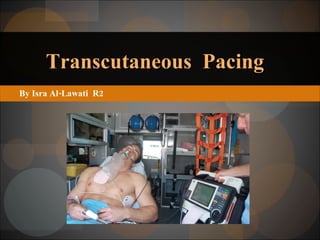
By Isra Al-Lawati  R2 Transcutaneous  Pacing
OutLine   Procedure principle  Indication Contra-Indication  Material & pre –Procedure requirements Procedure & Techqunic Complication
Procedure principle  Transcutaneous pacing (TCP) electrical stimulation from electrode pads to induce cardiac depolarization. Rapid, safe, and Non invasive. Increase  HR and improves  cardiac output Short periods
Indications Hemodynamically significant  Bradydysrhythmias  unresponsive to atropine . Witnessed Asystole
Contraindications VF Awake, hemodynamically stable patients Severe hypothermia Nonintact skin at the site of pacemaker pad placement
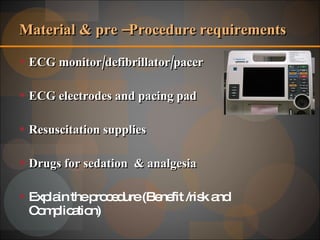
Material & pre –Procedure requirements ECG monitor/defibrillator/pacer ECG electrodes and pacing pad Resuscitation supplies Drugs for sedation  & analgesia  Explain the procedure (Benefit /risk and Complication)
Procedure & Technique  Pacer pads  Skin prep cleaned/dried or shaved  Anterior –Posterior “sandwiches” Anterior pad : just to the left of the sternum or below the left breast Posterior pad : to the left of the spine, just below the inferior pole of the left scapula
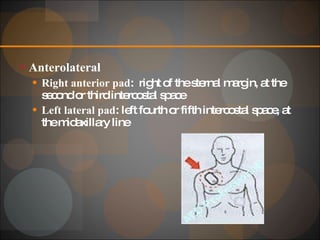
Anterolateral Right anterior pad :  right of the sternal margin, at the second or third intercostal space Left lateral pad : left fourth or fifth intercostal space, at the midaxillary line
Set The Machine Mode: Fixed  (asynchronous)  Demand  (synchronous) avoids electrical impulse output during the repolarization phase which could cause VT/VF Rate  Set the rate 20 Bpm above Pt intrinsic rate. If no intrinsic rate, set to 100 Bpm.
Energy  Pacemaker  initial output of 0 mA. Increase the output until each pacer spike is followed by a wide QRS complex (electrical capture). Decrease the output mA to maintain capture at the lowest possible energy .  In cardiac arrest  start at max energy and decrease the output after capture is achieved
Post Pacing  Assess Pt pulse :  right femoral, right brachial, or right radial artery Observe  for signs of improved Co e.g mental status, blood pressure & O2 Sat Evaluate pads  every 30 minutes to avoid skin burns and change place after few hrs
Assure adequate sedation and analgesia if hemodynamics  allows Treat arrhythmia & plan for definitive pacing if medical intervention is not successful.
Complication Failure to detect VF  VF/VT Pain Skin Burn
Thank You
Symptomatic sinus bradycardia, sinus arrest, or brady-tachy syndrome Mobitz II second- and third-degree heart block Symptomatic AF with slow ventricular response Escape rhythms not responding to drug therapy BBB in the setting of AMI  New-onset left bundle branch block Right bundle branch block with left axis deviation Bifascicular block Alternating bundle branch block

Transcutaneous Pacing

  • 1.
    By Isra Al-Lawati R2 Transcutaneous Pacing
  • 2.
    OutLine Procedure principle Indication Contra-Indication Material & pre –Procedure requirements Procedure & Techqunic Complication
  • 3.
    Procedure principle Transcutaneous pacing (TCP) electrical stimulation from electrode pads to induce cardiac depolarization. Rapid, safe, and Non invasive. Increase HR and improves cardiac output Short periods
  • 4.
    Indications Hemodynamically significant Bradydysrhythmias unresponsive to atropine . Witnessed Asystole
  • 5.
    Contraindications VF Awake,hemodynamically stable patients Severe hypothermia Nonintact skin at the site of pacemaker pad placement
  • 6.
    Material & pre–Procedure requirements ECG monitor/defibrillator/pacer ECG electrodes and pacing pad Resuscitation supplies Drugs for sedation & analgesia Explain the procedure (Benefit /risk and Complication)
  • 7.
    Procedure & Technique Pacer pads Skin prep cleaned/dried or shaved Anterior –Posterior “sandwiches” Anterior pad : just to the left of the sternum or below the left breast Posterior pad : to the left of the spine, just below the inferior pole of the left scapula
  • 8.
    Anterolateral Right anteriorpad : right of the sternal margin, at the second or third intercostal space Left lateral pad : left fourth or fifth intercostal space, at the midaxillary line
  • 9.
    Set The MachineMode: Fixed (asynchronous) Demand (synchronous) avoids electrical impulse output during the repolarization phase which could cause VT/VF Rate Set the rate 20 Bpm above Pt intrinsic rate. If no intrinsic rate, set to 100 Bpm.
  • 10.
    Energy Pacemaker initial output of 0 mA. Increase the output until each pacer spike is followed by a wide QRS complex (electrical capture). Decrease the output mA to maintain capture at the lowest possible energy . In cardiac arrest start at max energy and decrease the output after capture is achieved
  • 11.
    Post Pacing Assess Pt pulse : right femoral, right brachial, or right radial artery Observe for signs of improved Co e.g mental status, blood pressure & O2 Sat Evaluate pads every 30 minutes to avoid skin burns and change place after few hrs
  • 12.
    Assure adequate sedationand analgesia if hemodynamics allows Treat arrhythmia & plan for definitive pacing if medical intervention is not successful.
  • 13.
    Complication Failure todetect VF VF/VT Pain Skin Burn
  • 14.
  • 15.
    Symptomatic sinus bradycardia,sinus arrest, or brady-tachy syndrome Mobitz II second- and third-degree heart block Symptomatic AF with slow ventricular response Escape rhythms not responding to drug therapy BBB in the setting of AMI New-onset left bundle branch block Right bundle branch block with left axis deviation Bifascicular block Alternating bundle branch block