Adenosine
Endothelium independent vasodilator
Coronary hyperaemia: The life thread
1. Coronary blood flow can increase up to 5 times the basal flow to
meet increased demand
2. Increase in blood flow is referred to as a hyperemia
3. Observed in response to ischemia and exercise
4. Quantifying the hyperemic response is a critical step in
understanding the coronary circulation and is applied in most
physiological assessments of myocardial blood flow
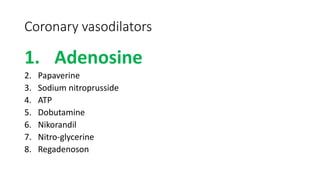
Coronary vasodilators
1. Adenosine
2. Papaverine
3. Sodium nitroprusside
4. ATP
5. Dobutamine
6. Nikorandil
7. Nitro-glycerine
8. Regadenoson
3 Receptors
Stood the test of time
1. Coronary vasodilator for microcirculation hyperaemia FFR is really
only used for intermediate stenosis (40% to 70%)
2. Popular SVT Rx
5 actions
1. Negative Chronotropic
2. Negative Dromotropic
3. Negative Inotropic
4. Antithrombotic
5. Bronchospasm
2 Uses
1. Diagnostic -FFR
2. Therapeutic-SVT/Coronary vasodilator
2 Ways to increase extracellular level
1. Inhibiting adenosine kinase during ischemia because ATP depletion
2. Inhibiting adenosine deaminase by dipyradamole
Within, across and out
1. In the intracellular space, adenosine can be synthesized de novo
during purine biosynthesis or accumulate as a result of ATP
breakdown. Intracellular adenosine concentrations increase when
there is a mismatch between ATP synthesis and use as in ischemia
or hypoxia
2. Not freely pass across the cell membrane and requires the use of
nucleoside transporters to facilitate the process.
3. Extracellular adenosine arises from active transport of intracellular
stores or from breakdown of adenine nucleotides outside the cell
Cell surface G-receptors
A1 A2 A3
A B
 Gi protein–bound A1 receptors
reduces adenyl cyclase activity
and decreases intracellular
cAMP Adenosine
 Highest affinity for the A1 and
A2a receptors
 Mostly neural transmittor
regulation in heart and other
 Gs protein–bound increases
adenyl cyclase activity and
cAMP levels
 Vasodilation of most vascular
beds including the coronary
circulation
 Produces vasoconstriction in
renal afferent arterioles and
hepatic veins
Activation of the Gi protein–bound
A3 receptors reduces adenyl
cyclase activity and decreases
intracellular cAMP
Difference
A1 Receptor A2-A and -B A3
1. Generally have an inhibitory
function
2. Negative inotropic
3. Negative Chronotropic
4. Negative Dromotropic
5. Inhibition of atrioventricular
(AV) node conduction and
prolongation of the refractory
period via inhibition of cAMP-
mediated calcium influx and
enhances potassium
conduction
A2A
1. Coronary artery
vasodilator
2. Anti-inflammatory effects
3. A major target of caffeine
A2B receptors
1. Mast cells and are thought
to produce mast cell
degranulation and
bronchial constriction
A3
1. Peripherally located but
are thought to play a role
in mediating pre-
conditioning
2 Concerns
1. Hypotension
2. Heart block
3-compartment model
R1 R2 R3
The large epicardial vessels (0.5- to
5.0-mm diameter) make up the first
compartment
Small coronary arteries/pre-
arterioles (100- to 500-mm
diameter)
Arterioles (<100-mm diameter)
branch into intramyocardial
capillaries to create the third
compartment
Dynamic ceilling
1. 60% of resistance is provided at the arteriolar level,
2. 25% at the capillary level
3. 15% in the venular compartment
4. During hyperaemia, total resistance decreases across the coronary
circulation by 70%
5. In the arteriolar and venular compartments, resistance decreases
by 86% and 98%, respectively, resulting in minimal alteration of
capillary hydrostatic pressure such that the capillaries offer the
most resistance to coronary blood flow at hyperaemia
6. Capillaries provide the ceiling for the hyperaemic response
Different vasodilator
Adenosine Nitroglycerine
Adenosine exerts its predominant vasodilatory effect
on coronary microvessels <150 mm in diameter .
Whether this is an endothelium-dependent process is
unclear. An intact endothelium is not necessary for an
adenosine response in vitro . However, work
performed in humans in vivo has demonstrated that
the vasodilator effect of adenosine in the forearm can
be inhibited by a nitric oxide synthase inhibitor .
Endothelium dependent
2 Methods of Administration
Intravenous Intra coronary
1. Femoral/brachial
2. Sustained
3. Dose is 140-mg/kg/min infusion
4. Greater efficacy for achieving maximal hyperemia
compared with the conventional IC dosing
5. Added advantage that FFRpullback and
more complex physiological assessments can be
made
1. Its peak effect occurs <10 s
2. Duration of effect is 20 sec
3. Current recommendations for IC
adenosine dosing are 40 mg in the right coronary
artery and 60 mg in the left coronary artery, increasing
the doses incrementally by 30 mg to a maximum of
150 mg . We suggest a higher bolus dose of IC
adenosine (100–150 mg) to ensure an adequate
hyperemic response
4. No reflow phenomenon
2 studies in PPCI
1. AMISTAD I
2. AMISTAD II
3. Reduced infarct size, but did not reduce the primary clinical
endpoint, with in-hospital and 6-month clinical outcome being
similar to those in the placebo group
2 Guidelines support
1. European Society of Cardiology
2. American Heart Association
3. Treatment of no-reflow using IC adenosine is recommended
2 Conditionings
Pre-conditioning Post-conditioning
 A1 and A3 receptors
 10-min IV adenosine infusion (dose of 2 mg/min)
administered before the PCI pre-conditioned the
myocardium
 improve outcomes in elective PCI and CABG
 A2a and A3 receptor
 a protocol :consisted of 4 cycles of 1 min of balloon
inflation followed by 1 min of balloon deflation
within 1 min of reflow after coronary stent
deployment
 Reduces CPK/CPK-MB
Novel Agents for Achieving Hyperaemia
Cyclosporine Regadenoson
 The most promising pharmacological post-
conditioning mimetic drug InhibitS formation of the
mitochondrial permeability transition pore, a key
component of lethal reperfusion injury . The
mitochondrial permeability transition pore appears
to form in the early stages of reperfusion in
response to the calcium overload and reactive
oxygen species generation that develops with
reperfusion
 Selective adenosine a2a receptor agonist
And in theory should produce hyperemic effects
similar to those of adenosine without the additional
side effects often seen with A1, a2b, and A3 receptor
activation
 IV bolus
 FFR study
Arrhythmia
1. IV adenosine in a bolus dose of 6 to 12 mg (or higher) slows AV nodal
conduction and by this mechanism interrupts re-entrant pathways involving
the AV node and restores sinus rhythm in most patients with SVT
2. Typical AV nodal re-entrant tachycardia
3. AV reciprocating tachycardia with a concealed bypass tract, and AV
reciprocating tachycardia in Wolff-Parkinson-White syndrome
4. Unmask atrial flutter/atrial fibrillation
5. Correct diagnosis of broad complex tachycardia
6. Terminate VT of triggered activity
Side effects
1. Ubiquitous action
2. IV>IC
3. Flushing -36.5%
4. Dyspnoea-35.2%
5. Chest pain-34.6%
6. Gastrointestinal discomfort -14%
7. Headache-11%
8. AV block - 7.6%
9. Arrhythmia -0.36%
10. Bronchospasm - 0.1%
Tomorrow ,You are my treating physician

Adenosine

  • 1.
  • 2.
    Coronary hyperaemia: Thelife thread 1. Coronary blood flow can increase up to 5 times the basal flow to meet increased demand 2. Increase in blood flow is referred to as a hyperemia 3. Observed in response to ischemia and exercise 4. Quantifying the hyperemic response is a critical step in understanding the coronary circulation and is applied in most physiological assessments of myocardial blood flow
  • 3.
    Coronary vasodilators 1. Adenosine 2.Papaverine 3. Sodium nitroprusside 4. ATP 5. Dobutamine 6. Nikorandil 7. Nitro-glycerine 8. Regadenoson
  • 4.
  • 5.
    Stood the testof time 1. Coronary vasodilator for microcirculation hyperaemia FFR is really only used for intermediate stenosis (40% to 70%) 2. Popular SVT Rx
  • 6.
    5 actions 1. NegativeChronotropic 2. Negative Dromotropic 3. Negative Inotropic 4. Antithrombotic 5. Bronchospasm
  • 7.
    2 Uses 1. Diagnostic-FFR 2. Therapeutic-SVT/Coronary vasodilator
  • 8.
    2 Ways toincrease extracellular level 1. Inhibiting adenosine kinase during ischemia because ATP depletion 2. Inhibiting adenosine deaminase by dipyradamole
  • 9.
    Within, across andout 1. In the intracellular space, adenosine can be synthesized de novo during purine biosynthesis or accumulate as a result of ATP breakdown. Intracellular adenosine concentrations increase when there is a mismatch between ATP synthesis and use as in ischemia or hypoxia 2. Not freely pass across the cell membrane and requires the use of nucleoside transporters to facilitate the process. 3. Extracellular adenosine arises from active transport of intracellular stores or from breakdown of adenine nucleotides outside the cell
  • 10.
    Cell surface G-receptors A1A2 A3 A B  Gi protein–bound A1 receptors reduces adenyl cyclase activity and decreases intracellular cAMP Adenosine  Highest affinity for the A1 and A2a receptors  Mostly neural transmittor regulation in heart and other  Gs protein–bound increases adenyl cyclase activity and cAMP levels  Vasodilation of most vascular beds including the coronary circulation  Produces vasoconstriction in renal afferent arterioles and hepatic veins Activation of the Gi protein–bound A3 receptors reduces adenyl cyclase activity and decreases intracellular cAMP
  • 11.
    Difference A1 Receptor A2-Aand -B A3 1. Generally have an inhibitory function 2. Negative inotropic 3. Negative Chronotropic 4. Negative Dromotropic 5. Inhibition of atrioventricular (AV) node conduction and prolongation of the refractory period via inhibition of cAMP- mediated calcium influx and enhances potassium conduction A2A 1. Coronary artery vasodilator 2. Anti-inflammatory effects 3. A major target of caffeine A2B receptors 1. Mast cells and are thought to produce mast cell degranulation and bronchial constriction A3 1. Peripherally located but are thought to play a role in mediating pre- conditioning
  • 12.
  • 13.
    3-compartment model R1 R2R3 The large epicardial vessels (0.5- to 5.0-mm diameter) make up the first compartment Small coronary arteries/pre- arterioles (100- to 500-mm diameter) Arterioles (<100-mm diameter) branch into intramyocardial capillaries to create the third compartment
  • 14.
    Dynamic ceilling 1. 60%of resistance is provided at the arteriolar level, 2. 25% at the capillary level 3. 15% in the venular compartment 4. During hyperaemia, total resistance decreases across the coronary circulation by 70% 5. In the arteriolar and venular compartments, resistance decreases by 86% and 98%, respectively, resulting in minimal alteration of capillary hydrostatic pressure such that the capillaries offer the most resistance to coronary blood flow at hyperaemia 6. Capillaries provide the ceiling for the hyperaemic response
  • 15.
    Different vasodilator Adenosine Nitroglycerine Adenosineexerts its predominant vasodilatory effect on coronary microvessels <150 mm in diameter . Whether this is an endothelium-dependent process is unclear. An intact endothelium is not necessary for an adenosine response in vitro . However, work performed in humans in vivo has demonstrated that the vasodilator effect of adenosine in the forearm can be inhibited by a nitric oxide synthase inhibitor . Endothelium dependent
  • 16.
    2 Methods ofAdministration Intravenous Intra coronary 1. Femoral/brachial 2. Sustained 3. Dose is 140-mg/kg/min infusion 4. Greater efficacy for achieving maximal hyperemia compared with the conventional IC dosing 5. Added advantage that FFRpullback and more complex physiological assessments can be made 1. Its peak effect occurs <10 s 2. Duration of effect is 20 sec 3. Current recommendations for IC adenosine dosing are 40 mg in the right coronary artery and 60 mg in the left coronary artery, increasing the doses incrementally by 30 mg to a maximum of 150 mg . We suggest a higher bolus dose of IC adenosine (100–150 mg) to ensure an adequate hyperemic response 4. No reflow phenomenon
  • 17.
    2 studies inPPCI 1. AMISTAD I 2. AMISTAD II 3. Reduced infarct size, but did not reduce the primary clinical endpoint, with in-hospital and 6-month clinical outcome being similar to those in the placebo group
  • 18.
    2 Guidelines support 1.European Society of Cardiology 2. American Heart Association 3. Treatment of no-reflow using IC adenosine is recommended
  • 19.
    2 Conditionings Pre-conditioning Post-conditioning A1 and A3 receptors  10-min IV adenosine infusion (dose of 2 mg/min) administered before the PCI pre-conditioned the myocardium  improve outcomes in elective PCI and CABG  A2a and A3 receptor  a protocol :consisted of 4 cycles of 1 min of balloon inflation followed by 1 min of balloon deflation within 1 min of reflow after coronary stent deployment  Reduces CPK/CPK-MB
  • 20.
    Novel Agents forAchieving Hyperaemia Cyclosporine Regadenoson  The most promising pharmacological post- conditioning mimetic drug InhibitS formation of the mitochondrial permeability transition pore, a key component of lethal reperfusion injury . The mitochondrial permeability transition pore appears to form in the early stages of reperfusion in response to the calcium overload and reactive oxygen species generation that develops with reperfusion  Selective adenosine a2a receptor agonist And in theory should produce hyperemic effects similar to those of adenosine without the additional side effects often seen with A1, a2b, and A3 receptor activation  IV bolus  FFR study
  • 21.
    Arrhythmia 1. IV adenosinein a bolus dose of 6 to 12 mg (or higher) slows AV nodal conduction and by this mechanism interrupts re-entrant pathways involving the AV node and restores sinus rhythm in most patients with SVT 2. Typical AV nodal re-entrant tachycardia 3. AV reciprocating tachycardia with a concealed bypass tract, and AV reciprocating tachycardia in Wolff-Parkinson-White syndrome 4. Unmask atrial flutter/atrial fibrillation 5. Correct diagnosis of broad complex tachycardia 6. Terminate VT of triggered activity
  • 22.
    Side effects 1. Ubiquitousaction 2. IV>IC 3. Flushing -36.5% 4. Dyspnoea-35.2% 5. Chest pain-34.6% 6. Gastrointestinal discomfort -14% 7. Headache-11% 8. AV block - 7.6% 9. Arrhythmia -0.36% 10. Bronchospasm - 0.1%
  • 23.
    Tomorrow ,You aremy treating physician