Dr. D. K. Brahma
Associate Professor
Department of Pharmacology
NEIGRIHMS, Shillong
Prostaglandins and Leukotrienes
• Prostaglandins (PGs) and Leukotrienes (LTs): Biologically
active 20 carbon atom polyunsaturated essential fatty
acids released from cell membrane fatty acids – lipid
derived autacoids
• Eicosanoids: PG, Thromboxanes (TX) and LTs - derived
from “eicosa”penta enoic acid - referring to 20 carbon
atoms (“enoic” – double bonds)
• The eicosanoids are considered "local hormones"
• Most universally distributed autacoids – practically all tissues
can synthesize 1 or 2 PG or LT
• They have specific effects on target cells close to their site of
formation
• They are rapidly degraded, so they are not transported to
distal sites within the body
Eicosanoids - Background
1930: Human semen – contracts uterus and other
smooth muscles (SM) – fall in BP
Prostaglandin – derived from prostate (!)
1960: Mixture of closely related compounds (a family)
1970: Aspirin like drugs inhibit PG synthesis
• Thromboxanes (TX) and Prostacyclin (PGI)
Chemistry
Chemically, PGs are derivative of Prostanoic acid –
does not occur naturally in body
PGs are designated in series as – A, B, C ….I etc.
depending on ring structure and substitution
Each series is named 1,2,3 indicating no. of double
bonds
LTs are also similarly – A, B, C …..F and 1, 2, 3, 4
Chemistry of eicosanoids – contd.
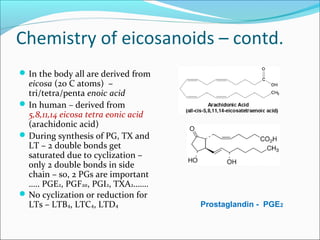
In the body all are derived from
eicosa (20 C atoms) –
tri/tetra/penta enoic acid
In human – derived from
5,8,11,14 eicosa tetra eonic acid
(arachidonic acid)
During synthesis of PG, TX and
LT – 2 double bonds get
saturated due to cyclization –
only 2 double bonds in side
chain – so, 2 PGs are important
….. PGE2, PGF2α, PGI2, TXA2…….
No cyclization or reduction for
LTs – LTB4, LTC4, LTD4 Prostaglandin - PGE2
Biosynthesis of Eicosanoids - Pathway
Cyclic
endoperoxides
•Name based on
separation
technique – Ether
and fosfat
•PGA, B and C
not found in body
In platelet
TXB2
6-keto PGF1α
SRS-A
Five lipoxygenase
Activating protein
(FLAP)
Stimuli
The Cycloxygenages (Cox)
1. Cox-1 (‘the good guy’):
• Constitutively expressed
• Synthesized in basal states – not changed even if cell is fully grown
• Credited for ‘house-keeping functions’ – secretion of mucus in Gastric
mucosa, haemostasis and renal function
1. Cox-2 (‘the bad guy’): Normally, in tissues I insignificant amount
• Inducible by inflammatory mediators (cytokines, interleukin-1, tumor
necrosis factor (TNF) - Induction inhibited by corticosteroids
• Blamed for inflammation / pain / fever
• Exception: Kidney, brain and foetus
1. Cox-3 (‘the dark horse’):
• Very recently discovered in dog brain
• Splice variant of Cox-1 (intron 1 remains in mRNA) - genesis of fever
• Inhibited by acetaminophen – which acts only weakly on Cox-1 and
Cox-2
Synthesis inhibitors & Degradation
NSAIDS – Mostly non-selective (both COX-1 and COX-2)
 Aspirin – acetylates COX at serine site – irreversible inhibition
 Other NSAIDs - competitive and reversible inhibition
 Selective Cox 1 inhibitors – celecoxib, etoricoxib
Zileuton – Inhibits LOX – was used in asthma
Glucocorticoides – inhibit release of arachidonic acid – produces
protein annexin – inhibits Phospholipase A2
 Also inhibits induction of COX-2
Degradation: Most tissues – rapidly – fastest in Lungs
 Most PGs, TXA2 and Prostacyclins (PGI2) – half life of few seconds only
 Carrier mediated uptake into cells followed by – side chains are oxidized and
so on ….
PGs & TXAs: Pathophysiological - CVS
Both PGE2 and PGF2α : Mostly vasodilators - but PGF2α
constricts Pulmonary vein and artery
 PGI2 – uniform vasodilator and potent hypotensive > PGE2
 PGG2 and PGH2 – biphasic response (actually vasoconstrictor)
 TXA – vasoconstrictor
Heart: Stimulates: PGE2 and PGF2α – direct weak and reflex
action
Role: No role in systemic Vascular regulation – but PGI2
(COX-2 generated) – local vascular tone (dilator)
PGE₂ keeps ductus arteriosus patent (Aspirin & Indomethacin)
Exudation: PGs generated by COX-2 with LTs and other autacoids
- inflammation
Pathophysiological Roles - Uterus
PGE2 and PGF2α – uniformly contracts uterus – pregnant and
non-pregnant … higher as the pregnancy progresses
 Consistent contraction – PGF2α but PGE2 – relaxes not-pregnant and
contracts pregnant uterus
 At term – softens uterus
Role:
 Initiation and progression of labour by PGF2α (Aspirin delays)
 Semen in high PGs – movement of female genital tract, transport of
sperm and facilitation of fertilization
 Dysmenorrhoea – Uncoordinated uterine contraction – ischemia –
pain (Aspirin effective)
Roles – Bronchial Muscles
PGF2α, PGD2 ,TXA2 and LTs – Potent
bronchoconstrictor
PGE2>PGI2 – dilators + inhibit release of Histamine –
but no clinical use (irritation)
Role: Asthma – imbalance between the above
Aspirin: induces asthma – diverts arachidonic acid to
produce more LTs (LTC4 and LTD4)
In allergic asthma – Leukotriene
Pathophysiological Roles – GIT
Intestine: PGs (PGE2) – increased propulsive activity – colic and
watery diarrhoea
 PGE2 – increases water, electrolyte and mucus secretion …. PGI2 opposes
 Role: Toxin induced increased fluid movements in secretary diarrhoea
(aspirin reduces fluid volume)
 Colonic polyps and Cancer – reduced colonic cancer and reduced polyp
formation
Stomach: PGE2>PGI2 reduces all gastric acid secretions (also pepsin)
– Gastrin also reduced - even histamine, gastrin and other induced
ones
 Mucus, HCO3 secretion increased with increased blood flow -
Antiulcerogenic
 Role: PGI2 – regulation of gastric mucosal blood flow – natural ulcer
protective …. NSAID induced ulcers – due to loss of protective function
 Gastric mucosal PGs are produced by COX -1 – selective COX-2
inhibitors are NOT ULCEROGENIC
Pathophysiological Roles – contd.
Kidneys: PGE2 & PGI2 – Diuretic effect
Renal vasodilatation and inhibit tubular reabsorption (Furosemide
like – inhibits Cl- reabsorption
TXA2 – renal vasoconstriction
Role: PGE2 & PGI2 (produced by COX-2) in kidney – intrarenal
blood flow regulation and tubular reabsorption (less) …. NSAIDs -
retain salt and water
 Renin release – PGE2 and PGI2
CNS: Poor penetration; injected directly – PGE2 – sedation,
rigidity and behavioural changes; PGI2 – fever
Role: PGE2-Hypothalamus: pyrogen induced fever and malaise
(COX-2 involved – selective COX-2 inhibitors – antipyrretic
Neuromodulator – pain perception, sleep and other
functions
Pathophysiological Roles – contd.
ANS: Inhibition as well as augmentation of NA release –
depends on PG, species and tissue
Role: modulate sympathetic neurotransmission
Peripheral nerves: Sensitize afferent nerve endings to
pain inducing chemical and mechanical stimuli – irritate
mucous membrane
Role: algesic during inflammation (aspirin cause analgesia)
Eye: PGF2α – induces ocular inflammation and lowers IOP
– enhances uveoscleral and tubular outflow (latanoprost)
Role: Local PGs facilitate aqueous humor drainage (less COX-2 in
glaucoma)
Pathophysiological Roles – contd.
Endocrine: Facilitate release of Anterior Pituitary
hormones – GH, Prolactin, ACTH, FSH, LH --- also
Insulin and steroids
Role: terminate early pregnancy in women (luteolysis)
Metabolism: Antilipolytic – Insuline like effect -
mobilize Ca++ from Bone
Pathophysiological Roles - Platelets
TXA2 >PGG2>PGH2 – pro-aggregator…… PGI2 and PGD2
– anti-aggregator ….. PGE2 – inconsistent effect
Role: TXA2 and PGI2 – mutual antagonists – prevent
aggregation in circulation, but induces aggregation
during injury
TXA2 – produced by COX-1 – amplify aggregation
Aspirin (low dose): haemostasis interference by inhibiting
platelet aggregation (COX-1 inhibition at portal circulation)
– PGI2 not interfered (endothelium)
Straight chain lipoxygenase products
Limited number of tissues
LTB4 – Neutrophils
LTC4 and LTD4 - Macrophages
Leukotrienes –Roles
CVS and Blood: Injection of LTC4 and LTD4 – brief rise in
BP followed by prolonged fall (not due to vasodilatation)
Due to coronary constriction – due to decreased cardiac output -
reduction in circulating volume - increased capillary permeability
More potent than histamine - in Local oedema
LTB4 – chemotactic for neutrophils and monocytes (also HETE) –
also migration of neutrophils through capillaries and clumping
LTC4 and LTD4 – chemotactic for eosinophils
Role: Important mediators of inflammation (with PGs)
LTC4 and LTD4 – exudation of plasma
LTB4 – attracts the inflammatory cells
5-HPETE and 5-HETE – facilitate release of histamine from mast
cells
Pathophysiological Roles - LTs
Smooth Muscles: LTC4 and LTD4 contracts smooth
muscles – potent bronchoconstrictor and spastic
contraction of GIT
Also increase in mucus secretion
Roles: Mediator of human allergic asthma
Released with PGs and other autacoids during AG:AB reaction
More potent than others and metabolized slowly in lungs
Responsible for abdominal colics in anaphylaxis
Afferent Nerves:
LTB4 - sensitizes afferent nerves to pain mediators – Pain (like
PGs) – pain and tenderness of inflammation
Prostanoid Receptors
PGs, TX and Prostacyclin
act by their specific
receptors
Five families –
corresponding to natural
PGs
All are GPCRs
Functionally – excitatory
or contractile and
inhibitory or relaxants
Contractile group: EP1,
FP and TP
Gq – PLC and IP3/DAG
Ca++ release intracellularly
Functions: SM contraction
and Platelet aggregation
Relaxant group: DP1, EP2,
EP4 and IP
Gs – adenylyl cyclase –
cAMP
Functions: SM relaxation
and inhibition of Platelet
aggregation
Leukotriene Receptors
Separate receptors for LTB4; and LTC4 and LTD4
LTB4 – BLT1 and BLT2
Cysteinyl: LTC4 and LTD4 – cysLT1 and cysLT2
All are GPCRs – IP3/DAG
BLT – chemotactic – in spleen and leucocytes
cysLT1 – bronchial and intestinal muscles (Zafirlukast
and Montelukast )
cysLT2 – leukocytes and spleen
Therapeutic Uses –
PGs and analogoues
 Limited availability, short lasting action, cost and frequent side effects
 Abortion: First trimester abortion - Suction evacuation plus PGE2
intravaginal pessary (before 3 hours)
 Now upto 7 weeks - 600 mg Mifepristone (antiprogestin) + misoprostol 400 µg
… provoked uterine contraction
 Intravaginal application or sublingual administration – lesser side effects
 Rule out ectopic pregnancy
 ADRs: Uterine cramps, vaginal bleeding, nausea, vomiting and diarrhoea …
also incomplete evacuation
 Methotrexate + Misoprostol
Midterm abortion: missed abortion, molar abortion --- erratic action
and incomplete abortion ….. Oxytocin resistant to responsive
 Extraamniotic injection of single dose PGE2 – IV oxytocin or PGF2α with
hypertonic saline – high success rate
Uses of PGs & analogoues –
contd.
Induction of Labour: less reliable and inter-individual
variation - Oxytocin is preferred drug
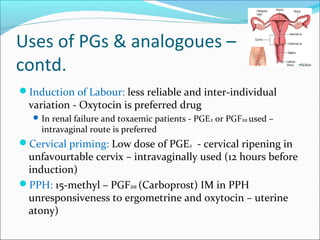
In renal failure and toxaemic patients - PGE2 or PGF2α used –
intravaginal route is preferred
Cervical priming: Low dose of PGE2 - cervical ripening in
unfavourtable cervix – intravaginally used (12 hours before
induction)
PPH: 15-methyl – PGF2α (Carboprost) IM in PPH
unresponsiveness to ergometrine and oxytocin – uterine
atony)
Other uses of PGs and
analogoues
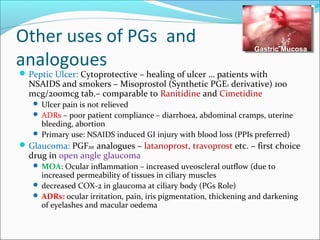
Peptic Ulcer: Cytoprotective – healing of ulcer … patients with
NSAIDS and smokers – Misoprostol (Synthetic PGE1 derivative) 100
mcg/200mcg tab.– comparable to Ranitidine and Cimetidine
 Ulcer pain is not relieved
 ADRs – poor patient compliance – diarrhoea, abdominal cramps, uterine
bleeding, abortion
 Primary use: NSAIDS induced GI injury with blood loss (PPIs preferred)
Glaucoma: PGF2α analogues – latanoprost, travoprost etc. – first choice
drug in open angle glaucoma
 MOA: Ocular inflammation – increased uveoscleral outflow (due to
increased permeability of tissues in ciliary muscles
 decreased COX-2 in glaucoma at ciliary body (PGs Role)
 ADRs: ocular irritation, pain, iris pigmentation, thickening and darkening
of eyelashes and macular oedema
Gastric Mucosa
Other uses of PGs
and analogoues
To maintain Patency of Ductus arteriosus: PGE1
alpha – Alprostadil – in congenital heart diseases –
till surgery
To avoid platelet damage: PGI2 – Epoprostenol –
in haemodialysis and Cardio-pulmonary bypass
surgery – also in harvesting platelets
Peripheral vascular disease: IV injection of PGI2 –
for healing of ischaemic ulcers
Impotence – Alprostadil – injected into the penis
PREPARATIONS, DOSES &
PLACEMENTS of PGs
 PGE₂: Dinoprostone – for Induction/augmentation of labour, midterm
abortion .. (Prostine-E)
• Vaginal Gel: 1 mg inserted into posterior fronix followed by 1-2 mg after 6 hour
if required
• Vaginal Tab: 3 mg inserted into posterior fornix, followed by another 3 mg if
labour does not start within 6 hour
• Oral Tablet: Primiprost 0.5 mg tab, one tab. Hourly till induction, maximum
1.5 mg per hr. ---- rarely used
• Cervical Gel: Cerviprime 0.5 mg inserted into cervical canal for preinduction
cervical softening and dilatation in patients with poor Bishop’s score.
• Gemeprost: 1mg vaginal pessary for softening of cervix in first trimester – 1 mg
3 hr before attempting dilatation, for 2nd trimester abortion/molar gestation –
1 mg every 3 hours, max. 5 doses
• Extraamniotic solution and Intravenous solution – Rarely used
PREPARATIONS & DOSES of PGs –
contd.
PGF₂α: Dinoprost
• Prostin F₂ Alpha intraamniotic injection 5 mg/ml in 4
ml. amp. for midterm abortion/induction of labour –
rarely used
• 15 – methyl PGF₂α (carboprost) …. Prostodin 0.25 mg in 1
ml ampoule IM every 30 - 120 minutes for PPH
(Acetyl-glyceryl ether phosphoryl choline)
• Cell membrane polar lipid – intense biological
activity
• Active at subnanomolar concentration
• Important signal molecule
Synthesized in - WBCs, Platelets and Vascular endothelium
From Phospholipids present in cell membrane
Membrane Acyl-
glycero-
phosphocoline
Lyso PAF PAF
Phospholipase A2
Fatty acid
Acetyl CoA CoA
PAF-acetyl
transferase
PAF - Actions
Platelets: Aggregation and Release reaction – also release TXA2
WBC: Chemotactic for Neutrophils, eosinophils and macrophages
 Stimulates neutrophils to stick on endothelium and migrate across to site
of infection – release of lysosomal enzymes and LTs by polymorphs
 Releases – LTB4 …… Induces degranulation of eosinophils
Blood vessels: Vasodilator mediated by EDRF – Fall in BP
 Vascular permeability increase
 Intracoronary injection – decreased coronary flow – Thrombus and TXA
formation
 Injection in renal artery – constriction and decrease in Na+ excretion
Visceral SM: Contraction – direct and through LTC4, TXA2 and PGs –
potent bronchoconstrictor – oedema, bronchial hyperresponsiveness
Stomach: Ulcerogenic – mucosal erosion and bleeding
PAF - Physiological Roles
Many pathological states – also physiological process - Cell
to cell interaction
Inflammation: Generated by leucocytes – vasodilatation,
exudation, cellular infiltration and hyperalgesia
Bronchial asthma: Bronchoconstriction, mucosal oedema,
recruitment of eosinophils and provoking secretion …..
Prolonged hyperreactivity
Anaphylactic conditions: High circulating PAF levels
Haemostasis and thrombosis: Platelet aggregation
Rupture of mature Graffian follicles and implantation:
Early embryo produces PAF – Implantation
PAF Antagonists
MOA: Membrane bound specific PAF receptors
Gq type GPCR --- IP3/DAG – Ca++ release …. (also Gi)
TXA2, PGs and LTs are extracellular mediators
Intracellularly - Endothelial cells – rise in PAF causes exposure of
neutrophil binding sites
Proaggregatory – unmasking of fibrinogen binding sites
Uses:
Ginkgolide B (chinese plant)
Potential: Treatment of stroke, intermittent claudication, sepsis
MI, shock, gastric ulceration, asthma and contraception
Alprazolam and Triazoloam
Apafan - anti-inflammatory, antiangiogenic and anticancer activity
Summary
Biosynthesis of PGs – Cox-1 and Cox-2
Prostaglandins and their Pathophysiological Roles –
especially in Uterus, Respiratory muscles, GIT and Kidneys
Mechanism of NSAIDS in causation of Peptic ulcer – Role
of selective COX-2 inhibitors
Uses of PGs – Gynaecological uses, Glaucoma, Ductus
arteriosus and peptic ulcer
Role of LTs and its antagonists in Bronchial asthma
PAF
NEXT CLASS
NSAIDS……………….

EICOSANOIDS

  • 1.
    Dr. D. K.Brahma Associate Professor Department of Pharmacology NEIGRIHMS, Shillong
  • 2.
    Prostaglandins and Leukotrienes •Prostaglandins (PGs) and Leukotrienes (LTs): Biologically active 20 carbon atom polyunsaturated essential fatty acids released from cell membrane fatty acids – lipid derived autacoids • Eicosanoids: PG, Thromboxanes (TX) and LTs - derived from “eicosa”penta enoic acid - referring to 20 carbon atoms (“enoic” – double bonds) • The eicosanoids are considered "local hormones" • Most universally distributed autacoids – practically all tissues can synthesize 1 or 2 PG or LT • They have specific effects on target cells close to their site of formation • They are rapidly degraded, so they are not transported to distal sites within the body
  • 3.
    Eicosanoids - Background 1930:Human semen – contracts uterus and other smooth muscles (SM) – fall in BP Prostaglandin – derived from prostate (!) 1960: Mixture of closely related compounds (a family) 1970: Aspirin like drugs inhibit PG synthesis • Thromboxanes (TX) and Prostacyclin (PGI)
  • 4.
    Chemistry Chemically, PGs arederivative of Prostanoic acid – does not occur naturally in body PGs are designated in series as – A, B, C ….I etc. depending on ring structure and substitution Each series is named 1,2,3 indicating no. of double bonds LTs are also similarly – A, B, C …..F and 1, 2, 3, 4
  • 5.
    Chemistry of eicosanoids– contd. In the body all are derived from eicosa (20 C atoms) – tri/tetra/penta enoic acid In human – derived from 5,8,11,14 eicosa tetra eonic acid (arachidonic acid) During synthesis of PG, TX and LT – 2 double bonds get saturated due to cyclization – only 2 double bonds in side chain – so, 2 PGs are important ….. PGE2, PGF2α, PGI2, TXA2……. No cyclization or reduction for LTs – LTB4, LTC4, LTD4 Prostaglandin - PGE2
  • 6.
    Biosynthesis of Eicosanoids- Pathway Cyclic endoperoxides •Name based on separation technique – Ether and fosfat •PGA, B and C not found in body In platelet TXB2 6-keto PGF1α SRS-A Five lipoxygenase Activating protein (FLAP) Stimuli
  • 7.
    The Cycloxygenages (Cox) 1.Cox-1 (‘the good guy’): • Constitutively expressed • Synthesized in basal states – not changed even if cell is fully grown • Credited for ‘house-keeping functions’ – secretion of mucus in Gastric mucosa, haemostasis and renal function 1. Cox-2 (‘the bad guy’): Normally, in tissues I insignificant amount • Inducible by inflammatory mediators (cytokines, interleukin-1, tumor necrosis factor (TNF) - Induction inhibited by corticosteroids • Blamed for inflammation / pain / fever • Exception: Kidney, brain and foetus 1. Cox-3 (‘the dark horse’): • Very recently discovered in dog brain • Splice variant of Cox-1 (intron 1 remains in mRNA) - genesis of fever • Inhibited by acetaminophen – which acts only weakly on Cox-1 and Cox-2
  • 8.
    Synthesis inhibitors &Degradation NSAIDS – Mostly non-selective (both COX-1 and COX-2)  Aspirin – acetylates COX at serine site – irreversible inhibition  Other NSAIDs - competitive and reversible inhibition  Selective Cox 1 inhibitors – celecoxib, etoricoxib Zileuton – Inhibits LOX – was used in asthma Glucocorticoides – inhibit release of arachidonic acid – produces protein annexin – inhibits Phospholipase A2  Also inhibits induction of COX-2 Degradation: Most tissues – rapidly – fastest in Lungs  Most PGs, TXA2 and Prostacyclins (PGI2) – half life of few seconds only  Carrier mediated uptake into cells followed by – side chains are oxidized and so on ….
  • 9.
    PGs & TXAs:Pathophysiological - CVS Both PGE2 and PGF2α : Mostly vasodilators - but PGF2α constricts Pulmonary vein and artery  PGI2 – uniform vasodilator and potent hypotensive > PGE2  PGG2 and PGH2 – biphasic response (actually vasoconstrictor)  TXA – vasoconstrictor Heart: Stimulates: PGE2 and PGF2α – direct weak and reflex action Role: No role in systemic Vascular regulation – but PGI2 (COX-2 generated) – local vascular tone (dilator) PGE₂ keeps ductus arteriosus patent (Aspirin & Indomethacin) Exudation: PGs generated by COX-2 with LTs and other autacoids - inflammation
  • 10.
    Pathophysiological Roles -Uterus PGE2 and PGF2α – uniformly contracts uterus – pregnant and non-pregnant … higher as the pregnancy progresses  Consistent contraction – PGF2α but PGE2 – relaxes not-pregnant and contracts pregnant uterus  At term – softens uterus Role:  Initiation and progression of labour by PGF2α (Aspirin delays)  Semen in high PGs – movement of female genital tract, transport of sperm and facilitation of fertilization  Dysmenorrhoea – Uncoordinated uterine contraction – ischemia – pain (Aspirin effective)
  • 11.
    Roles – BronchialMuscles PGF2α, PGD2 ,TXA2 and LTs – Potent bronchoconstrictor PGE2>PGI2 – dilators + inhibit release of Histamine – but no clinical use (irritation) Role: Asthma – imbalance between the above Aspirin: induces asthma – diverts arachidonic acid to produce more LTs (LTC4 and LTD4) In allergic asthma – Leukotriene
  • 12.
    Pathophysiological Roles –GIT Intestine: PGs (PGE2) – increased propulsive activity – colic and watery diarrhoea  PGE2 – increases water, electrolyte and mucus secretion …. PGI2 opposes  Role: Toxin induced increased fluid movements in secretary diarrhoea (aspirin reduces fluid volume)  Colonic polyps and Cancer – reduced colonic cancer and reduced polyp formation Stomach: PGE2>PGI2 reduces all gastric acid secretions (also pepsin) – Gastrin also reduced - even histamine, gastrin and other induced ones  Mucus, HCO3 secretion increased with increased blood flow - Antiulcerogenic  Role: PGI2 – regulation of gastric mucosal blood flow – natural ulcer protective …. NSAID induced ulcers – due to loss of protective function  Gastric mucosal PGs are produced by COX -1 – selective COX-2 inhibitors are NOT ULCEROGENIC
  • 13.
    Pathophysiological Roles –contd. Kidneys: PGE2 & PGI2 – Diuretic effect Renal vasodilatation and inhibit tubular reabsorption (Furosemide like – inhibits Cl- reabsorption TXA2 – renal vasoconstriction Role: PGE2 & PGI2 (produced by COX-2) in kidney – intrarenal blood flow regulation and tubular reabsorption (less) …. NSAIDs - retain salt and water  Renin release – PGE2 and PGI2 CNS: Poor penetration; injected directly – PGE2 – sedation, rigidity and behavioural changes; PGI2 – fever Role: PGE2-Hypothalamus: pyrogen induced fever and malaise (COX-2 involved – selective COX-2 inhibitors – antipyrretic Neuromodulator – pain perception, sleep and other functions
  • 14.
    Pathophysiological Roles –contd. ANS: Inhibition as well as augmentation of NA release – depends on PG, species and tissue Role: modulate sympathetic neurotransmission Peripheral nerves: Sensitize afferent nerve endings to pain inducing chemical and mechanical stimuli – irritate mucous membrane Role: algesic during inflammation (aspirin cause analgesia) Eye: PGF2α – induces ocular inflammation and lowers IOP – enhances uveoscleral and tubular outflow (latanoprost) Role: Local PGs facilitate aqueous humor drainage (less COX-2 in glaucoma)
  • 15.
    Pathophysiological Roles –contd. Endocrine: Facilitate release of Anterior Pituitary hormones – GH, Prolactin, ACTH, FSH, LH --- also Insulin and steroids Role: terminate early pregnancy in women (luteolysis) Metabolism: Antilipolytic – Insuline like effect - mobilize Ca++ from Bone
  • 16.
    Pathophysiological Roles -Platelets TXA2 >PGG2>PGH2 – pro-aggregator…… PGI2 and PGD2 – anti-aggregator ….. PGE2 – inconsistent effect Role: TXA2 and PGI2 – mutual antagonists – prevent aggregation in circulation, but induces aggregation during injury TXA2 – produced by COX-1 – amplify aggregation Aspirin (low dose): haemostasis interference by inhibiting platelet aggregation (COX-1 inhibition at portal circulation) – PGI2 not interfered (endothelium)
  • 17.
    Straight chain lipoxygenaseproducts Limited number of tissues LTB4 – Neutrophils LTC4 and LTD4 - Macrophages
  • 18.
    Leukotrienes –Roles CVS andBlood: Injection of LTC4 and LTD4 – brief rise in BP followed by prolonged fall (not due to vasodilatation) Due to coronary constriction – due to decreased cardiac output - reduction in circulating volume - increased capillary permeability More potent than histamine - in Local oedema LTB4 – chemotactic for neutrophils and monocytes (also HETE) – also migration of neutrophils through capillaries and clumping LTC4 and LTD4 – chemotactic for eosinophils Role: Important mediators of inflammation (with PGs) LTC4 and LTD4 – exudation of plasma LTB4 – attracts the inflammatory cells 5-HPETE and 5-HETE – facilitate release of histamine from mast cells
  • 19.
    Pathophysiological Roles -LTs Smooth Muscles: LTC4 and LTD4 contracts smooth muscles – potent bronchoconstrictor and spastic contraction of GIT Also increase in mucus secretion Roles: Mediator of human allergic asthma Released with PGs and other autacoids during AG:AB reaction More potent than others and metabolized slowly in lungs Responsible for abdominal colics in anaphylaxis Afferent Nerves: LTB4 - sensitizes afferent nerves to pain mediators – Pain (like PGs) – pain and tenderness of inflammation
  • 20.
    Prostanoid Receptors PGs, TXand Prostacyclin act by their specific receptors Five families – corresponding to natural PGs All are GPCRs Functionally – excitatory or contractile and inhibitory or relaxants Contractile group: EP1, FP and TP Gq – PLC and IP3/DAG Ca++ release intracellularly Functions: SM contraction and Platelet aggregation Relaxant group: DP1, EP2, EP4 and IP Gs – adenylyl cyclase – cAMP Functions: SM relaxation and inhibition of Platelet aggregation
  • 21.
    Leukotriene Receptors Separate receptorsfor LTB4; and LTC4 and LTD4 LTB4 – BLT1 and BLT2 Cysteinyl: LTC4 and LTD4 – cysLT1 and cysLT2 All are GPCRs – IP3/DAG BLT – chemotactic – in spleen and leucocytes cysLT1 – bronchial and intestinal muscles (Zafirlukast and Montelukast ) cysLT2 – leukocytes and spleen
  • 22.
    Therapeutic Uses – PGsand analogoues  Limited availability, short lasting action, cost and frequent side effects  Abortion: First trimester abortion - Suction evacuation plus PGE2 intravaginal pessary (before 3 hours)  Now upto 7 weeks - 600 mg Mifepristone (antiprogestin) + misoprostol 400 µg … provoked uterine contraction  Intravaginal application or sublingual administration – lesser side effects  Rule out ectopic pregnancy  ADRs: Uterine cramps, vaginal bleeding, nausea, vomiting and diarrhoea … also incomplete evacuation  Methotrexate + Misoprostol Midterm abortion: missed abortion, molar abortion --- erratic action and incomplete abortion ….. Oxytocin resistant to responsive  Extraamniotic injection of single dose PGE2 – IV oxytocin or PGF2α with hypertonic saline – high success rate
  • 23.
    Uses of PGs& analogoues – contd. Induction of Labour: less reliable and inter-individual variation - Oxytocin is preferred drug In renal failure and toxaemic patients - PGE2 or PGF2α used – intravaginal route is preferred Cervical priming: Low dose of PGE2 - cervical ripening in unfavourtable cervix – intravaginally used (12 hours before induction) PPH: 15-methyl – PGF2α (Carboprost) IM in PPH unresponsiveness to ergometrine and oxytocin – uterine atony)
  • 24.
    Other uses ofPGs and analogoues Peptic Ulcer: Cytoprotective – healing of ulcer … patients with NSAIDS and smokers – Misoprostol (Synthetic PGE1 derivative) 100 mcg/200mcg tab.– comparable to Ranitidine and Cimetidine  Ulcer pain is not relieved  ADRs – poor patient compliance – diarrhoea, abdominal cramps, uterine bleeding, abortion  Primary use: NSAIDS induced GI injury with blood loss (PPIs preferred) Glaucoma: PGF2α analogues – latanoprost, travoprost etc. – first choice drug in open angle glaucoma  MOA: Ocular inflammation – increased uveoscleral outflow (due to increased permeability of tissues in ciliary muscles  decreased COX-2 in glaucoma at ciliary body (PGs Role)  ADRs: ocular irritation, pain, iris pigmentation, thickening and darkening of eyelashes and macular oedema Gastric Mucosa
  • 25.
    Other uses ofPGs and analogoues To maintain Patency of Ductus arteriosus: PGE1 alpha – Alprostadil – in congenital heart diseases – till surgery To avoid platelet damage: PGI2 – Epoprostenol – in haemodialysis and Cardio-pulmonary bypass surgery – also in harvesting platelets Peripheral vascular disease: IV injection of PGI2 – for healing of ischaemic ulcers Impotence – Alprostadil – injected into the penis
  • 26.
    PREPARATIONS, DOSES & PLACEMENTSof PGs  PGE₂: Dinoprostone – for Induction/augmentation of labour, midterm abortion .. (Prostine-E) • Vaginal Gel: 1 mg inserted into posterior fronix followed by 1-2 mg after 6 hour if required • Vaginal Tab: 3 mg inserted into posterior fornix, followed by another 3 mg if labour does not start within 6 hour • Oral Tablet: Primiprost 0.5 mg tab, one tab. Hourly till induction, maximum 1.5 mg per hr. ---- rarely used • Cervical Gel: Cerviprime 0.5 mg inserted into cervical canal for preinduction cervical softening and dilatation in patients with poor Bishop’s score. • Gemeprost: 1mg vaginal pessary for softening of cervix in first trimester – 1 mg 3 hr before attempting dilatation, for 2nd trimester abortion/molar gestation – 1 mg every 3 hours, max. 5 doses • Extraamniotic solution and Intravenous solution – Rarely used
  • 27.
    PREPARATIONS & DOSESof PGs – contd. PGF₂α: Dinoprost • Prostin F₂ Alpha intraamniotic injection 5 mg/ml in 4 ml. amp. for midterm abortion/induction of labour – rarely used • 15 – methyl PGF₂α (carboprost) …. Prostodin 0.25 mg in 1 ml ampoule IM every 30 - 120 minutes for PPH
  • 28.
    (Acetyl-glyceryl ether phosphorylcholine) • Cell membrane polar lipid – intense biological activity • Active at subnanomolar concentration • Important signal molecule
  • 29.
    Synthesized in -WBCs, Platelets and Vascular endothelium From Phospholipids present in cell membrane Membrane Acyl- glycero- phosphocoline Lyso PAF PAF Phospholipase A2 Fatty acid Acetyl CoA CoA PAF-acetyl transferase
  • 30.
    PAF - Actions Platelets:Aggregation and Release reaction – also release TXA2 WBC: Chemotactic for Neutrophils, eosinophils and macrophages  Stimulates neutrophils to stick on endothelium and migrate across to site of infection – release of lysosomal enzymes and LTs by polymorphs  Releases – LTB4 …… Induces degranulation of eosinophils Blood vessels: Vasodilator mediated by EDRF – Fall in BP  Vascular permeability increase  Intracoronary injection – decreased coronary flow – Thrombus and TXA formation  Injection in renal artery – constriction and decrease in Na+ excretion Visceral SM: Contraction – direct and through LTC4, TXA2 and PGs – potent bronchoconstrictor – oedema, bronchial hyperresponsiveness Stomach: Ulcerogenic – mucosal erosion and bleeding
  • 31.
    PAF - PhysiologicalRoles Many pathological states – also physiological process - Cell to cell interaction Inflammation: Generated by leucocytes – vasodilatation, exudation, cellular infiltration and hyperalgesia Bronchial asthma: Bronchoconstriction, mucosal oedema, recruitment of eosinophils and provoking secretion ….. Prolonged hyperreactivity Anaphylactic conditions: High circulating PAF levels Haemostasis and thrombosis: Platelet aggregation Rupture of mature Graffian follicles and implantation: Early embryo produces PAF – Implantation
  • 32.
    PAF Antagonists MOA: Membranebound specific PAF receptors Gq type GPCR --- IP3/DAG – Ca++ release …. (also Gi) TXA2, PGs and LTs are extracellular mediators Intracellularly - Endothelial cells – rise in PAF causes exposure of neutrophil binding sites Proaggregatory – unmasking of fibrinogen binding sites Uses: Ginkgolide B (chinese plant) Potential: Treatment of stroke, intermittent claudication, sepsis MI, shock, gastric ulceration, asthma and contraception Alprazolam and Triazoloam Apafan - anti-inflammatory, antiangiogenic and anticancer activity
  • 33.
    Summary Biosynthesis of PGs– Cox-1 and Cox-2 Prostaglandins and their Pathophysiological Roles – especially in Uterus, Respiratory muscles, GIT and Kidneys Mechanism of NSAIDS in causation of Peptic ulcer – Role of selective COX-2 inhibitors Uses of PGs – Gynaecological uses, Glaucoma, Ductus arteriosus and peptic ulcer Role of LTs and its antagonists in Bronchial asthma PAF
  • 34.

Editor's Notes

  • #7 HPETE – hydroxyperoxyepoxytetraeonic acid …. HETE – hydroxyepoxttetraeonic acid