Eicosanoids
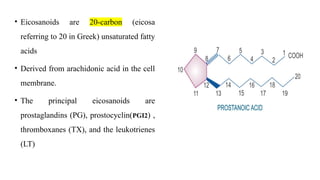
• Eicosanoids are 20-carbon (eicosa
referring to 20 in Greek) unsaturated fatty
acids
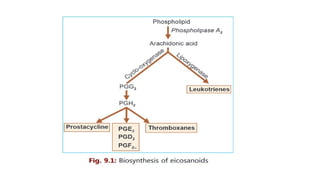
• Derived from arachidonic acid in the cell
membrane.
• The principal eicosanoids are
prostaglandins (PG), prostocyclin(PGI2) ,
thromboxanes (TX), and the leukotrienes
(LT)
Biosynthesis
• Eicosanoids are synthesized locally in most tissues from arachidonic acid.
• The cyclo-oxygenase (COX) pathway generates PGs and TXs
• while lipoxygenase (LOX) pathway generates LTs.
• There are 2 cyclo-oxygenase isozymes, 1. COX-1 and 2.COX-2.
• COX-1 is present in ----- most all cells and prostanoids (PGs and TXs)
obtained from COX-1 mainly take part in physiological functions.
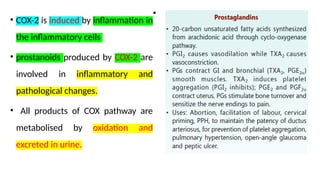
• COX-2 is induced by inflammation in
the inflammatory cells
• prostanoids produced by COX-2 are
involved in inflammatory and
pathological changes.
• All products of COX pathway are
metabolised by oxidation and
excreted in urine.
•
PROSTAGLANDINS AND THROMBOXANES
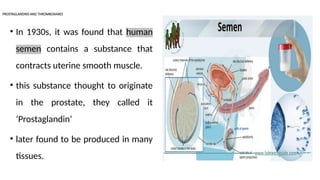
• In 1930s, it was found that human
semen contains a substance that
contracts uterine smooth muscle.
• this substance thought to originate
in the prostate, they called it
‘Prostaglandin’
• later found to be produced in many
tissues.
Prostanoid Receptors
• The prostanoids acting on prostanoid receptors, which are all G-protein-coupled
receptors.
• Some of them act through cAMP and others via inositol triphosphate pathway.
• There are five classes of prostanoid receptors.
• DP (for PGD 2 )—subtypes DP 1 and DP 2
• EP (for PGE 2)—subtypes EP 1 to EP 4
• FP (for PGF 2α)
• IP (for PGI 2)
• TP (for TXA 2)
Actions
1. CVS:
• Prostacyclin and PGE2 cause vasodilation
• TXA 2 causes vasoconstriction.
• PGE2 and PGF2α are weak cardiac stimulants.
• The vasodilator prostaglandins PGE2 and PGI2 are produced in the
ductus arteriosus during foetal life which could be responsible for
maintaining the patency of the ductus arteriosus during this period.
GIT
• Most PGs and TXs stimulate gastrointestinal smooth muscle resulting
in colic and watery diarrhea.
• PGE 2 inhibits gastric acid secretion and enhances mucus
production.
• Thus they have a protective effect on gastric mucosa.(ULCER)
Airways:
• PGE 2 and PGI 2 relax bronchial smooth muscle
• TXA 2 and PGF 2Alpha contract them.
• TXA 2 and PGF 2Alpha may have a role in the pathophysiology of bronchial
asthma.
Platelets:
• TXA 2 induces platelet aggregation while PGI 2 inhibits platelet
aggregation.
• In low concentrations, PGE 2enhances platelet aggregation
• higher concentrations it inihibits platelet aggregation.
• TXA 2 biosynthesis in the platelets is irreversibly inhibited by long- term
administration of low dose ASPIRIN
Female reproductive system Male reproductive system
• Uterus: PGE 2 and PGF 2alpha contract
human uterus which is more sensitive
to PGs during pregnancy.
• They also soften the cervix.
• PGs may be involved in the initiation
and progression of labour.
• PGs are produced by foetal tissues
during labour.
• They also play a role in dysmenorrhea
and menorrhagia.
• PGs present in the semen may facilitate
movement of sperms and fertilization by
coordinating the movement of the uterus.
• large amount of PGs in the seminal
vesicle a
• small amount in the prostate and testes.
• PGs also have a role in penile erection as
they relax the smooth muscle of the
corpora cavernosa
Kidneys:
• PGE 2 and PGI 2 cause renal vasodilation and have a diuretic effect.
• PGs also oppose the action of ADH.
• PGs are synthesized both in the medulla and the cortex and regulate the renal function particularly
during states of renal impairment.
• PGs also play an important role in maintaining the BP. They regulate the excretion of sodium and
water.
• They enhance renal blood flow and also have direct effects on renal tubules which are responsible for
most of their actions on the kidney.
• PGE 2 also stimulates renin release. NSAIDs inhibit PG synthesis and their long-term use can result in
renal dysfunction
Central and peripheral nervous system:
• PGs increase body temperature when administered into cerebral ventricles. PGD
2 also induces sleep.
• Nerves: PGs sensitize sensory nerve endings to pain and on intradermal injection
cause pain.
• They enhance the excitability of the nerve membrane and also modulate pain
centrally.
• PGs inhibit the release of the neurotransmitter noradrenaline from the
sympathetic nerve endings
Inflammation and immunity:
• PGs have a major role in the genesis of inflammation—they enhance the
blood flow in the inflamed area,
• facilitate leukocyte infiltration and development of edema.
• They also suppress lymphocyte function , proliferation and cytokine release
to inhibit the immunologic response
Bone:
• PGs stimulate bone resorption and formation through osteoclastic and osteoblastic
activities.
Endocrine system:
• PGs stimulate the release of insulin and growth hormone, has thyrotropin like effects
on the thyroid and also stimulate the production of steroids by the adrenals.
Eye:
• PGE and PGF2α reduce the intraocular pressure probably by facilitating the drainage
of aqueous humour through the uveoscleral pathway.
Cancer
• PGs may have a role in the genesis of cancer.
• PGE 2 is considered the prooncogenic prostanoid and is found to
promote the growth and metastasis of cancers.
• Use of NSAIDs particularly COX-2 inhibitors has shown to restrict
tumour formation.
Adverse Effects
• Diarrhoea,
• nausea,
• vomiting,
• fever,
• hypotension and pain due to uterine contractions are common.
Uses
1. Gynaecological and obstetrical
• Abortion: For I and II trimester abortion and ripening of the cervix during
abortion, PGE 2 and PGF 2α are used.
• mifepristone to ensure complete expulsion of the products of conception in
early pregnancy.
• Dinoprostone, a synthetic PGE 2 analog,has been used as a vaginal pessary
for second trimester abortion.
• Facilitation of labour: As an alternative to oxytocics in patients with
renal failure, PGE 2 is used for induction of labour as it does not cause
fluid retention. PGE 2 may be used intravaginally for this purpose.
• Cervical priming: Intravaginal PGE 2 is used as a gel to soften the
cervix and make it more compliant.
• Postpartum hemorrhage: PGF 2α (IM) is used as an alternative to
ergometrine
Gastrointestinal
• Peptic ulcer: PGE 1 (analog—misoprostol) and PGE 2 (analog—
enprostil) are used for the prevention of peptic ulcer in patients on
high dose NSAIDs
3. Cardiovascular
• Patent ductus arteriosus: Patency of fetal ductus arteriosus depends on local
PG synthesis and at birth the ductus arteriosus closes.
• In neonates with some congenital heart diseases, patency of the ductus
arteriosus needs to be maintained even after birth and is maintained with PGs
until surgical correction is done.
• Alprostadil is given as an IV infusion.
• To prevent platelet aggregation during hemodialysis and cardiopulmonary
bypass
Glaucoma
• Glaucoma: PGF2α analog latanoprost is the first-line drug to lower the
intraocular pressure in glaucoma.
• Peripheral vascular diseases: Raynaud’s disease
• Pulmonary hypertension: Epoprostenol(PGI 2) has been used to lower
pulmonary hypertension
• because it reduces pulmonary resistance (also decreases peripheral
and coronary resistance
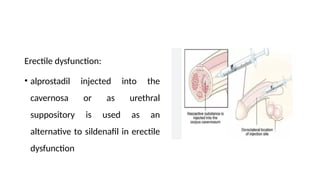
Erectile dysfunction:
• alprostadil injected into the
cavernosa or as urethral
suppository is used as an
alternative to sildenafil in erectile
dysfunction
LEUKOTRIENES
• Leukotrienes (LT) are products of arachidonic acid metabolism synthesized by the
lipoxygenase pathway and are found in the lungs, platelets, mast cells and white blood
cells.
• (‘Leuko’—because they are found in white cells; ‘trienes’—they contain three double
bonds).
• LTA 4 is the precursor from which LTB 4 , LTC 4, LTD 4 , LTE 4 and LTF 4 are derived.
• LTC 4 , LTD 4 and LTE 4 are together known as slow reacting substances (SRS-A) of
anaphylaxis.
• The LTs produce their effects through specific receptors
Actions
• Leukotrienes cause vasoconstriction, alter vascular permeability leading to
edema, increase airway mucus secretion and are potent bronchiolar
spasmogens.
• Leukotrienes have a role in inflammation including rheumatoid arthritis,
psoriasis and ulcerative colitis.
• treatment of bronchial asthma and allergic rhinitis
Leukotriene Receptor Antagonists
• Montelukast, zafirlukast and pranlukast block the actions of LTC 4 and
LTD 4 on the bronchial and vascular smooth muscles.
• They are useful as adjuvants in bronchial asthma
PLATELET ACTIVATING FACTOR
• is an important mediator in acute and chronic, allergic and inflammatory
phenomena.
• PAF is a lipid released from inflammatory cells on stimulation and acts on specific
receptors.
• It causes local vasodilatation resulting in edema, hyperalgesia and wheal formation.
• It is a potent chemotaxin for leukocytes and a spasmogen on bronchial and
intestinal smooth muscles.
• It is a mediator of inflammation
THANK YOU

DETAILS ABOUT THE Eicosanoids .pptx

  • 1.
  • 2.
    • Eicosanoids are20-carbon (eicosa referring to 20 in Greek) unsaturated fatty acids • Derived from arachidonic acid in the cell membrane. • The principal eicosanoids are prostaglandins (PG), prostocyclin(PGI2) , thromboxanes (TX), and the leukotrienes (LT)
  • 3.
    Biosynthesis • Eicosanoids aresynthesized locally in most tissues from arachidonic acid. • The cyclo-oxygenase (COX) pathway generates PGs and TXs • while lipoxygenase (LOX) pathway generates LTs. • There are 2 cyclo-oxygenase isozymes, 1. COX-1 and 2.COX-2. • COX-1 is present in ----- most all cells and prostanoids (PGs and TXs) obtained from COX-1 mainly take part in physiological functions.
  • 4.
    • COX-2 isinduced by inflammation in the inflammatory cells • prostanoids produced by COX-2 are involved in inflammatory and pathological changes. • All products of COX pathway are metabolised by oxidation and excreted in urine. •
  • 5.
    PROSTAGLANDINS AND THROMBOXANES •In 1930s, it was found that human semen contains a substance that contracts uterine smooth muscle. • this substance thought to originate in the prostate, they called it ‘Prostaglandin’ • later found to be produced in many tissues.
  • 6.
    Prostanoid Receptors • Theprostanoids acting on prostanoid receptors, which are all G-protein-coupled receptors. • Some of them act through cAMP and others via inositol triphosphate pathway. • There are five classes of prostanoid receptors. • DP (for PGD 2 )—subtypes DP 1 and DP 2 • EP (for PGE 2)—subtypes EP 1 to EP 4 • FP (for PGF 2α) • IP (for PGI 2) • TP (for TXA 2)
  • 8.
    Actions 1. CVS: • Prostacyclinand PGE2 cause vasodilation • TXA 2 causes vasoconstriction. • PGE2 and PGF2α are weak cardiac stimulants. • The vasodilator prostaglandins PGE2 and PGI2 are produced in the ductus arteriosus during foetal life which could be responsible for maintaining the patency of the ductus arteriosus during this period.
  • 9.
    GIT • Most PGsand TXs stimulate gastrointestinal smooth muscle resulting in colic and watery diarrhea. • PGE 2 inhibits gastric acid secretion and enhances mucus production. • Thus they have a protective effect on gastric mucosa.(ULCER)
  • 10.
    Airways: • PGE 2and PGI 2 relax bronchial smooth muscle • TXA 2 and PGF 2Alpha contract them. • TXA 2 and PGF 2Alpha may have a role in the pathophysiology of bronchial asthma.
  • 11.
    Platelets: • TXA 2induces platelet aggregation while PGI 2 inhibits platelet aggregation. • In low concentrations, PGE 2enhances platelet aggregation • higher concentrations it inihibits platelet aggregation. • TXA 2 biosynthesis in the platelets is irreversibly inhibited by long- term administration of low dose ASPIRIN
  • 12.
    Female reproductive systemMale reproductive system • Uterus: PGE 2 and PGF 2alpha contract human uterus which is more sensitive to PGs during pregnancy. • They also soften the cervix. • PGs may be involved in the initiation and progression of labour. • PGs are produced by foetal tissues during labour. • They also play a role in dysmenorrhea and menorrhagia. • PGs present in the semen may facilitate movement of sperms and fertilization by coordinating the movement of the uterus. • large amount of PGs in the seminal vesicle a • small amount in the prostate and testes. • PGs also have a role in penile erection as they relax the smooth muscle of the corpora cavernosa
  • 13.
    Kidneys: • PGE 2and PGI 2 cause renal vasodilation and have a diuretic effect. • PGs also oppose the action of ADH. • PGs are synthesized both in the medulla and the cortex and regulate the renal function particularly during states of renal impairment. • PGs also play an important role in maintaining the BP. They regulate the excretion of sodium and water. • They enhance renal blood flow and also have direct effects on renal tubules which are responsible for most of their actions on the kidney. • PGE 2 also stimulates renin release. NSAIDs inhibit PG synthesis and their long-term use can result in renal dysfunction
  • 14.
    Central and peripheralnervous system: • PGs increase body temperature when administered into cerebral ventricles. PGD 2 also induces sleep. • Nerves: PGs sensitize sensory nerve endings to pain and on intradermal injection cause pain. • They enhance the excitability of the nerve membrane and also modulate pain centrally. • PGs inhibit the release of the neurotransmitter noradrenaline from the sympathetic nerve endings
  • 15.
    Inflammation and immunity: •PGs have a major role in the genesis of inflammation—they enhance the blood flow in the inflamed area, • facilitate leukocyte infiltration and development of edema. • They also suppress lymphocyte function , proliferation and cytokine release to inhibit the immunologic response
  • 16.
    Bone: • PGs stimulatebone resorption and formation through osteoclastic and osteoblastic activities. Endocrine system: • PGs stimulate the release of insulin and growth hormone, has thyrotropin like effects on the thyroid and also stimulate the production of steroids by the adrenals. Eye: • PGE and PGF2α reduce the intraocular pressure probably by facilitating the drainage of aqueous humour through the uveoscleral pathway.
  • 17.
    Cancer • PGs mayhave a role in the genesis of cancer. • PGE 2 is considered the prooncogenic prostanoid and is found to promote the growth and metastasis of cancers. • Use of NSAIDs particularly COX-2 inhibitors has shown to restrict tumour formation.
  • 18.
    Adverse Effects • Diarrhoea, •nausea, • vomiting, • fever, • hypotension and pain due to uterine contractions are common.
  • 19.
    Uses 1. Gynaecological andobstetrical • Abortion: For I and II trimester abortion and ripening of the cervix during abortion, PGE 2 and PGF 2α are used. • mifepristone to ensure complete expulsion of the products of conception in early pregnancy. • Dinoprostone, a synthetic PGE 2 analog,has been used as a vaginal pessary for second trimester abortion.
  • 20.
    • Facilitation oflabour: As an alternative to oxytocics in patients with renal failure, PGE 2 is used for induction of labour as it does not cause fluid retention. PGE 2 may be used intravaginally for this purpose. • Cervical priming: Intravaginal PGE 2 is used as a gel to soften the cervix and make it more compliant. • Postpartum hemorrhage: PGF 2α (IM) is used as an alternative to ergometrine
  • 21.
    Gastrointestinal • Peptic ulcer:PGE 1 (analog—misoprostol) and PGE 2 (analog— enprostil) are used for the prevention of peptic ulcer in patients on high dose NSAIDs
  • 22.
    3. Cardiovascular • Patentductus arteriosus: Patency of fetal ductus arteriosus depends on local PG synthesis and at birth the ductus arteriosus closes. • In neonates with some congenital heart diseases, patency of the ductus arteriosus needs to be maintained even after birth and is maintained with PGs until surgical correction is done. • Alprostadil is given as an IV infusion. • To prevent platelet aggregation during hemodialysis and cardiopulmonary bypass
  • 23.
    Glaucoma • Glaucoma: PGF2αanalog latanoprost is the first-line drug to lower the intraocular pressure in glaucoma.
  • 24.
    • Peripheral vasculardiseases: Raynaud’s disease • Pulmonary hypertension: Epoprostenol(PGI 2) has been used to lower pulmonary hypertension • because it reduces pulmonary resistance (also decreases peripheral and coronary resistance
  • 25.
    Erectile dysfunction: • alprostadilinjected into the cavernosa or as urethral suppository is used as an alternative to sildenafil in erectile dysfunction
  • 26.
    LEUKOTRIENES • Leukotrienes (LT)are products of arachidonic acid metabolism synthesized by the lipoxygenase pathway and are found in the lungs, platelets, mast cells and white blood cells. • (‘Leuko’—because they are found in white cells; ‘trienes’—they contain three double bonds). • LTA 4 is the precursor from which LTB 4 , LTC 4, LTD 4 , LTE 4 and LTF 4 are derived. • LTC 4 , LTD 4 and LTE 4 are together known as slow reacting substances (SRS-A) of anaphylaxis. • The LTs produce their effects through specific receptors
  • 27.
    Actions • Leukotrienes causevasoconstriction, alter vascular permeability leading to edema, increase airway mucus secretion and are potent bronchiolar spasmogens. • Leukotrienes have a role in inflammation including rheumatoid arthritis, psoriasis and ulcerative colitis. • treatment of bronchial asthma and allergic rhinitis
  • 28.
    Leukotriene Receptor Antagonists •Montelukast, zafirlukast and pranlukast block the actions of LTC 4 and LTD 4 on the bronchial and vascular smooth muscles. • They are useful as adjuvants in bronchial asthma
  • 29.
    PLATELET ACTIVATING FACTOR •is an important mediator in acute and chronic, allergic and inflammatory phenomena. • PAF is a lipid released from inflammatory cells on stimulation and acts on specific receptors. • It causes local vasodilatation resulting in edema, hyperalgesia and wheal formation. • It is a potent chemotaxin for leukocytes and a spasmogen on bronchial and intestinal smooth muscles. • It is a mediator of inflammation
  • 30.