5-Hydroxy tryptamine

(5-HT ;
Serotonin)
• 5-Hydroxytryptamine (5-HT) has important
pharmacological and physiological role in
the body:– Neurotransmitter in CNS
– Regulator of smooth muscle in CVS,GIT
– Regulation of platelet aggregation.
Biosynthesis
Tryptophan (From diet)
Tryptophan hydroxylase

5Hydroxytryptophan
Aromatic L-A.A decardoxylase

5-Hydroxy tryptamine
Monoamine oxidase(MAO)

5 Hydroxyindole acetaldehyde
Aldehyde dehydrogenase

5Hydroxyindole acetic acid (5HIAA)
Distribution
• GIT enterochromaffin cells (90%)and
myentric plexus.
• Platelets
– diffuse inside from plasma by active
transport , released at site of damage

• Lungs, bone marrow, pineal gland, CNS
Serotonin Receptors

• seven main types
• (5-HT1 to 5-HT7).
• 5-HT1, 5-HT2 subdivided
• Total 14 types of 5-HT receptors
present.
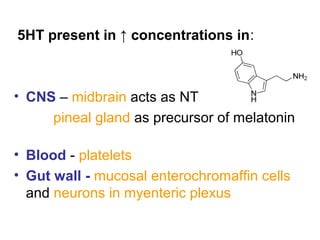
5HT present in ↑ concentrations in:

• CNS – midbrain acts as NT
pineal gland as precursor of melatonin
• Blood - platelets
• Gut wall - mucosal enterochromaffin cells
and neurons in myenteric plexus
Storage and release
• Stored in storage granules just like catecholamines
• Diffuses over a relatively large region and activate
5-HT receptors located on
dendrites
cell bodies
presynaptic terminals of adjacent neurons
Reuptake

• Uptake of 5-HT from the synapse by
specific monoamine transporter
(5-HT reuptake transporter) on presynaptic
neuron.
• There are several different monoamine
transporters.
dopamine transporter
norepinephrine transporter
serotonin transporter
Various agents can inhibit 5-HT reuptake
including
•
Cocaine
•
Tricyclic antidepressants
•
Selective serotonin reuptake
inhibitors(SSRIs)
e.g. Fluoxetine
Elimination
• Metabolized by MAO and then
Aldehyde dehydrogenase to form
5-hydroxyindole acetic acid(5-HIAA)
• 5-HIAA is excreted in urine
Receptors
• 5-HT receptors are located on the cell
membrane of nerve.
• 5-HT3 receptor a ligand gated ion
channel,
all other 5-HT receptors are G-protein
coupled receptors
Receptor Sites
• CNS –
All
• Cerebral vessels – 5HT1D
• Nerve endings (PNS) -Nociceptive 5HT 3
Enteric mucosal 5HT3
Myenteric plexus 5HT4
• Smooth muscles – 5HT2A (vessels, bronchi)
• Gastric fundus –

2B

• Platelets –

2A
13
Receptor sites & actions
• 5-HT1A – CNS
– CNS
1D – CNS
1B

Neuronal inhibition (auto receptor)
Behavioral effects
Presynaptic inhibition(auto receptor)
Behavioral effects
Cerebral Vasoconstriction
Locomotion

Neuronal excitation
• 5HT2A- CNS
CSF secretion
2C – choroid plexus

14
• 5HT3 – CNS
Sensory neuron
Enteric neurons
• 5HT4 – CNS

Excitation, Anxiety
Pain and itching
Emesis
Neuronal excitation

Myenteric neurons

GI motility

• 5HT5-6 – CNS

• 5HT7 – CNS, GI tract, blood vessels
15
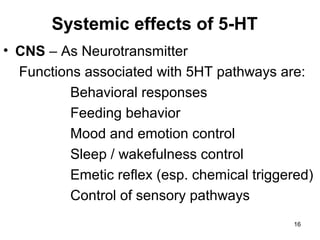
Systemic effects of 5-HT
• CNS – As Neurotransmitter
Functions associated with 5HT pathways are:
Behavioral responses
Feeding behavior
Mood and emotion control
Sleep / wakefulness control
Emetic reflex (esp. chemical triggered)
Control of sensory pathways
16
• CVS –
Vasodilation in skeletal ms., coronary bed,
arterioles
Vasoconstriction in all other vessels
B P Triphasic response :
fall – Coronary chemoreflex
rise – Vasoconstriction,↑co
fall - Vasodilation in skeletal M.& arterioles

17
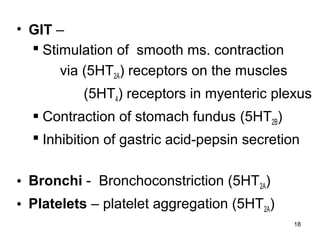
• GIT –
 Stimulation of smooth ms. contraction
via (5HT2A) receptors on the muscles
(5HT4) receptors in myenteric plexus
 Contraction of stomach fundus (5HT2B)
 Inhibition of gastric acid-pepsin secretion
• Bronchi - Bronchoconstriction (5HT2A)
• Platelets – platelet aggregation (5HT2A)
18
Agonists & Antagonists
• 5HT1A – Buspirone

Ergotamine

• 5HT1D – Sumtriptan

Ergotamine

• 5HT2A – LSD

Ketanserin
Methisergide
Cyproheptadine

• 5HT3 – α-methyl-5HT

Ondansetron
Granisetron
19
Clinical utility
• Migraine – Sumatriptan
Ergotamine
• Anxiety • Control of vomiting • Gastric stasis & GERD
• Raynaud’s disease • Carcinoid tumor -

Methisergide
Cyproheptadine
Buspirone
Ondansetron
Cisapride
Ketanserin
Methisergide
Cyproheptadine
20
There are indications that
5-HT1A and 5-HT4 agonists as well as
5-HT2, 5-HT3 antagonists and 5-HT uptake
inhibitors may have a role in treatment of
Alzheimer's disease & Amnesia
Serotonin reuptake inhibitors are useful as
antidepressant drugs (non-selective Tricyclic
antidepressants or SSRIs)
21
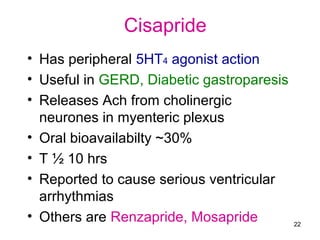
Cisapride
• Has peripheral 5HT4 agonist action
• Useful in GERD, Diabetic gastroparesis
• Releases Ach from cholinergic
neurones in myenteric plexus
• Oral bioavailabilty ~30%
• T ½ 10 hrs
• Reported to cause serious ventricular
arrhythmias
• Others are Renzapride, Mosapride

22
Sumatriptan
Selective agonist for 5HT1D and 5HT1B
Useful in acute migraine attack
Bioavailability ~ 15%
Half life 2-3 hrs
Can be given orally, S.C or as nasal
spray
• Can cause chest pain in 5% patients
• Zolmitriptan, Naratriptan can be given
orally, longer acting, safer
•
•
•
•
•

23
Buspirone
• Partial agonist at presynaptic 5HT1A
receptors
• Weak D2 blocker
• Useful as anxiolytic
• Rapidly absorbed , undergoes
extensive first pass metabolism
• t ½ 2-4 hrs
• Excreted in urine and faeces
24
Ketanserin
• Selective 5HT2 blocker (Stronger for 2A)
• No partial agonistic activity
• Weak α1, H1, Dopaminergic blocker
• Useful in Raynaud’s diasease
• Has antihypertensive activity
• Congener is Ritanserin which is more
selective for 5HT2A
25
Cyproheptadine
• 5HT2A antagonist
• Has additional H1 blocking as well as
anticholinergic activity
• Useful in
Carcinoid tumor
Post-gastrectomy dumping
syndrome
Pruritis
Allergies
↑Appetite in children

26
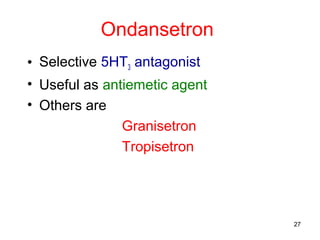
Ondansetron
• Selective 5HT3 antagonist
• Useful as antiemetic agent
• Others are
Granisetron
Tropisetron

27
Methysergide
•
•
•
•
•

Chemically related to ergot alkaloids
Potent 5HT2A/2C antagonist
Acts on 5HT1 receptors also
Has agonist activity in some tissues
Useful in
Migraine prophylaxis
Carcinoid tumor
Post-gastrectomy dumping syndrome
Prolonged use endocardial, pulmonary
fibrosis
28
Ergotamine
• 5HT1 and 5HT2 antagonist

• α-adrenergic antagonist
• Partial agonist activity at both types of
receptors
• Useful in acute migraine attack
• Has emetic and oxytocic action as well

29
SEROTONIN (VK)

SEROTONIN (VK)

  • 1.
  • 2.
    • 5-Hydroxytryptamine (5-HT)has important pharmacological and physiological role in the body:– Neurotransmitter in CNS – Regulator of smooth muscle in CVS,GIT – Regulation of platelet aggregation.
  • 3.
    Biosynthesis Tryptophan (From diet) Tryptophanhydroxylase 5Hydroxytryptophan Aromatic L-A.A decardoxylase 5-Hydroxy tryptamine Monoamine oxidase(MAO) 5 Hydroxyindole acetaldehyde Aldehyde dehydrogenase 5Hydroxyindole acetic acid (5HIAA)
  • 4.
    Distribution • GIT enterochromaffincells (90%)and myentric plexus. • Platelets – diffuse inside from plasma by active transport , released at site of damage • Lungs, bone marrow, pineal gland, CNS
  • 5.
    Serotonin Receptors • sevenmain types • (5-HT1 to 5-HT7). • 5-HT1, 5-HT2 subdivided • Total 14 types of 5-HT receptors present.
  • 6.
    5HT present in↑ concentrations in: • CNS – midbrain acts as NT pineal gland as precursor of melatonin • Blood - platelets • Gut wall - mucosal enterochromaffin cells and neurons in myenteric plexus
  • 7.
    Storage and release •Stored in storage granules just like catecholamines • Diffuses over a relatively large region and activate 5-HT receptors located on dendrites cell bodies presynaptic terminals of adjacent neurons
  • 8.
    Reuptake • Uptake of5-HT from the synapse by specific monoamine transporter (5-HT reuptake transporter) on presynaptic neuron. • There are several different monoamine transporters. dopamine transporter norepinephrine transporter serotonin transporter
  • 9.
    Various agents caninhibit 5-HT reuptake including • Cocaine • Tricyclic antidepressants • Selective serotonin reuptake inhibitors(SSRIs) e.g. Fluoxetine
  • 10.
    Elimination • Metabolized byMAO and then Aldehyde dehydrogenase to form 5-hydroxyindole acetic acid(5-HIAA) • 5-HIAA is excreted in urine
  • 12.
    Receptors • 5-HT receptorsare located on the cell membrane of nerve. • 5-HT3 receptor a ligand gated ion channel, all other 5-HT receptors are G-protein coupled receptors
  • 13.
    Receptor Sites • CNS– All • Cerebral vessels – 5HT1D • Nerve endings (PNS) -Nociceptive 5HT 3 Enteric mucosal 5HT3 Myenteric plexus 5HT4 • Smooth muscles – 5HT2A (vessels, bronchi) • Gastric fundus – 2B • Platelets – 2A 13
  • 14.
    Receptor sites &actions • 5-HT1A – CNS – CNS 1D – CNS 1B Neuronal inhibition (auto receptor) Behavioral effects Presynaptic inhibition(auto receptor) Behavioral effects Cerebral Vasoconstriction Locomotion Neuronal excitation • 5HT2A- CNS CSF secretion 2C – choroid plexus 14
  • 15.
    • 5HT3 –CNS Sensory neuron Enteric neurons • 5HT4 – CNS Excitation, Anxiety Pain and itching Emesis Neuronal excitation Myenteric neurons GI motility • 5HT5-6 – CNS • 5HT7 – CNS, GI tract, blood vessels 15
  • 16.
    Systemic effects of5-HT • CNS – As Neurotransmitter Functions associated with 5HT pathways are: Behavioral responses Feeding behavior Mood and emotion control Sleep / wakefulness control Emetic reflex (esp. chemical triggered) Control of sensory pathways 16
  • 17.
    • CVS – Vasodilationin skeletal ms., coronary bed, arterioles Vasoconstriction in all other vessels B P Triphasic response : fall – Coronary chemoreflex rise – Vasoconstriction,↑co fall - Vasodilation in skeletal M.& arterioles 17
  • 18.
    • GIT – Stimulation of smooth ms. contraction via (5HT2A) receptors on the muscles (5HT4) receptors in myenteric plexus  Contraction of stomach fundus (5HT2B)  Inhibition of gastric acid-pepsin secretion • Bronchi - Bronchoconstriction (5HT2A) • Platelets – platelet aggregation (5HT2A) 18
  • 19.
    Agonists & Antagonists •5HT1A – Buspirone Ergotamine • 5HT1D – Sumtriptan Ergotamine • 5HT2A – LSD Ketanserin Methisergide Cyproheptadine • 5HT3 – α-methyl-5HT Ondansetron Granisetron 19
  • 20.
    Clinical utility • Migraine– Sumatriptan Ergotamine • Anxiety • Control of vomiting • Gastric stasis & GERD • Raynaud’s disease • Carcinoid tumor - Methisergide Cyproheptadine Buspirone Ondansetron Cisapride Ketanserin Methisergide Cyproheptadine 20
  • 21.
    There are indicationsthat 5-HT1A and 5-HT4 agonists as well as 5-HT2, 5-HT3 antagonists and 5-HT uptake inhibitors may have a role in treatment of Alzheimer's disease & Amnesia Serotonin reuptake inhibitors are useful as antidepressant drugs (non-selective Tricyclic antidepressants or SSRIs) 21
  • 22.
    Cisapride • Has peripheral5HT4 agonist action • Useful in GERD, Diabetic gastroparesis • Releases Ach from cholinergic neurones in myenteric plexus • Oral bioavailabilty ~30% • T ½ 10 hrs • Reported to cause serious ventricular arrhythmias • Others are Renzapride, Mosapride 22
  • 23.
    Sumatriptan Selective agonist for5HT1D and 5HT1B Useful in acute migraine attack Bioavailability ~ 15% Half life 2-3 hrs Can be given orally, S.C or as nasal spray • Can cause chest pain in 5% patients • Zolmitriptan, Naratriptan can be given orally, longer acting, safer • • • • • 23
  • 24.
    Buspirone • Partial agonistat presynaptic 5HT1A receptors • Weak D2 blocker • Useful as anxiolytic • Rapidly absorbed , undergoes extensive first pass metabolism • t ½ 2-4 hrs • Excreted in urine and faeces 24
  • 25.
    Ketanserin • Selective 5HT2blocker (Stronger for 2A) • No partial agonistic activity • Weak α1, H1, Dopaminergic blocker • Useful in Raynaud’s diasease • Has antihypertensive activity • Congener is Ritanserin which is more selective for 5HT2A 25
  • 26.
    Cyproheptadine • 5HT2A antagonist •Has additional H1 blocking as well as anticholinergic activity • Useful in Carcinoid tumor Post-gastrectomy dumping syndrome Pruritis Allergies ↑Appetite in children 26
  • 27.
    Ondansetron • Selective 5HT3antagonist • Useful as antiemetic agent • Others are Granisetron Tropisetron 27
  • 28.
    Methysergide • • • • • Chemically related toergot alkaloids Potent 5HT2A/2C antagonist Acts on 5HT1 receptors also Has agonist activity in some tissues Useful in Migraine prophylaxis Carcinoid tumor Post-gastrectomy dumping syndrome Prolonged use endocardial, pulmonary fibrosis 28
  • 29.
    Ergotamine • 5HT1 and5HT2 antagonist • α-adrenergic antagonist • Partial agonist activity at both types of receptors • Useful in acute migraine attack • Has emetic and oxytocic action as well 29

Editor's Notes

  • #7 Is a hormone produced by the p. gland in darkness but not in bright light It is a derivative of 5ht with which it works to regulate sleep cycle ,used insomnia in shift workers & elderly
  • #13 G-pr 5HT1 linked to AC their act ↓camp,5HT2 linked to IP3&DAG production instead of camp,5HT3 directly without inv of 2nd mesngr,5HT4 stimu AC ↑Camp forman
  • #18 Triphasic response seen on I.V inj 5HT in animals
  • #20 d-lysergic acid diethylamide it has hallucinogenic property,supresses the electrical activity in 5htenergic raphe neurons wch tonically (-) da visual,sensory inputs - Cisapride ↑GITmotility , used in GERD
  • #21 Condition of unnown cause in wch da arteries of da fingers r unduly reactive nd enter spasm(angio/vaso) wn da hands r cold.
  • #30 Any agent that induces or accelerates labour by stimulating the muscles of uterus to contract.