Dr. Nikhilkumar S Sakle
Assistant Professor
Department of Pharmacology
Y. B. Chavan College of Pharmacy, Aurangabad
Prostaglandins, Thromboxanes and
Leukotrienes
PROSTAGLANDINS AND
LEUKOTRIENES
(Eicosanoids)
 Prostaglandins (PGs) and Leukotrienes (LTs)
are biologically active derivatives of 20 carbon
atom polyunsaturated essential fatty acids that
are released from cell membrane
phospholipids.
 They are the major lipid derived autacoids.
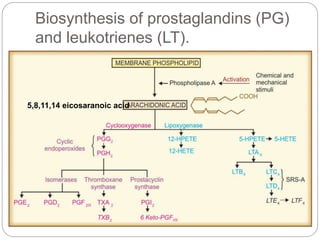
Biosynthesis of prostaglandins (PG)
and leukotrienes (LT).
5,8,11,14 eicosaranoic acid
ACTIONS AND
PATHOPHYSIOLOGICAL
ROLES
 Produce a wide variety of actions depending
upon the particular PG.
 All cells and tissues are capable of forming one or
more PGs, these autacoids have been implicated
as mediators or modulators of a number of
physiological processes and pathological states.
1. CVS
 PGE2 and PGF2α cause vasodilatation.
 Fall in BP occurs when PGE2 is injected i.v., but
PGF2α has little effect on BP.
 PGI2 is uniformly vasodilatory and is more potent
hypotensive than PGE2.
 TXA2 consistently produces vasoconstriction.
 PG endoperoxides (G2 and H2) are inherently
vasoconstrictor, but often produce vasodilatation or a
biphasic response due to rapid conversion to other
PGs, especially PGI2 in the blood vessels themselves.
 PGE2 and F2α stimulate heart by weak direct but more
prominent reflex action due to fall in BP. The cardiac
output increases.
Role
 (i) PGs do not circulate in blood and have no role in
regulating systemic vascular resistance. However,
PGI2 generated in the vascular endothelium, mainly
by COX-2, appears to be involved in the regulation
of local vascular tone as a dilator.
 (ii) PGE2 is continuously produced locally in the
ductus arteriosus by COX-2 during foetal life—keeps
it patent; at birth its synthesis stops and closure
occurs. Aspirin and indomethacin induce closure
when it fails to occur spontaneously. These PGs
may also be important in maintaining placental
blood flow.
 (iii) PGs, generated mainly by COX-2, along with LTs
and other autacoids may mediate vasodilatation and
exudation at the site of inflammation.
2. Platelets
 TXA2, which can be produced locally by platelets,
is a potent inducer of aggregation and release
reaction.
 The endoperoxides PGG2 and PGH2 are also
proaggregatory. On the other hand PGI2
(generated by vascular endothelium) is a potent
inhibitor of platelet aggregation.
 PGD2 has antiaggregatory action, but much less
potent than PGI2.
 PGE2 has dose dependent and inconsistent
effects.
Role
 TXA2 produced by platelets and PGI2 produced by
vascular endothelium probably constitute a mutually
antagonistic system: preventing aggregation of
platelets while in circulation and inducing aggregation
on injury, when plugging and thrombosis are needed.
 Aspirin interferes with haemostasis by inhibiting platelet
aggregation. TXA2 produced by platelet COX-1 plays an
important role in amplifying aggregation. Before it is
deacetylated in liver, aspirin acetylates COX-1 in platelets
while they are in portal circulation.
 Further, platelets are unable to regenerate fresh COX-1
(lack nucleus: do not synthesize protein), while vessel wall
is able to do so (fresh enzyme is synthesized within hours).
Thus, in low doses, aspirin selectively inhibits TXA2
production and has antithrombotic effect lasting > 3
days.
3. Uterus
 PGE2 and PGF2α uniformly contract human
uterus, in vivo, both pregnant as well as non-
pregnant. The sensitivity is higher during
pregnancy and there is progressive modest
increase with the advance of pregnancy.
However, even during early stages, uterus is
quite sensitive to PGs though not to oxytocin.
PGs increase basal tone as well as amplitude
of uterine contractions. When tested in vitro,
PGF2α consistently produces contraction while
PGE2 relaxes nonpregnant but contracts pregnant
human uterine strips. At term, PGs soften the
cervix at low doses and make it more compliant.
Role
 (i) Foetal tissues produce PGs. At term PGF2α has been
detected in maternal blood. It is postulated that PGs
mediate initiation and progression of labour. Aspirin has
been found to delay the initiation of labour and also
prolong its duration.
 (ii) Because PGs are present in high concentration in
semen and can be rapidly absorbed when lodged in the
vagina at coitus, it is believed that they so coordinate
movements of the female genital tract that transport of
sperms and fertilization is facilitated.
 (iii) Dysmenorrhoea in many women is associated with
increased PG synthesis by the endometrium. This
apparently induces uncoordinated uterine contractions
which compress blood vessels → uterine ischaemia →
PAIN. Aspirin group of drugs are highly effective in
relieving dysmenorrhoea in most women.
4. Bronchial muscle
 PGF2α, PGD2 and TXA2 are potent
bronchoconstrictors (more potent than
histamine) while PGE2 is a powerful
bronchodilator. PGI2 produces mild dilatation.
Asthmatics are more sensitive to constrictor as
well as dilator effects of PGs. PGE2 and PGI2 also
inhibit histamine release and are effective by
aerosol. However, these anti-asthmatic effects of
PGE2 and PGI2 cannot be exploited clinically
because they produce irritation of the
respiratory tract and have a brief action.
Role
 Asthma may be due to an imbalance between
constrictor PGs (F2α, PGD2, TXA2) and LTs on
one hand and dilator ones (PGE2, PGI2) on the
other. In few individuals aspirin-like drugs
consistently induce asthma, possibly by diverting
arachidonic acid to produce excess LTC4 and
D4. This sensitivity is not shared by selective
COX-2 inhibitors, indicating that suppression of
COX-1 at the pulmonary site is responsible for
the reaction. In allergic human asthma, LTs
play a more important role, and COX inhibitors
are without any effect in most patients.
5. GIT
 (i) In isolated preparations, the longitudinal
muscle of gut is contracted by PGE2 and PGF2α
while the circular muscle is either contracted
(usually by PGF2α) or relaxed (usually by PGE2).
Propulsive activity is enhanced in man, especially
by PGE2 → colic and watery diarrhoea are
important side effects. PGE2 acts directly on the
intestinal mucosa and increases water, electrolyte
and mucus secretion. PGI2 does not produce
diarrhoea and infact opposes PGE2 and toxin
induced fluid movement.
Role
 PGs may be involved in mediating toxin induced
increased fluid movement in secretory diarrhoeas. In
certain diarrhoeas, aspirin can reduce stool volume,
but is not uniformly effective. PGs appear to play a
role in the growth of colonic polyps and cancer.
Association of lower incidence of colon cancer with
regular intake of aspirin is now established. NSAIDs
afford relief in familial colonic polyposis by reducing
polyp formation.
 (ii) PGE2 markedly reduces acid secretion in the
stomach. Volume of juice and pepsin content are also
decreased. It inhibits fasting as well as stimulated
secretion (by feeding, histamine, gastrin). Release of
gastrin is suppressed. The gastric pH may rise upto
7.0. PGI2 also inhibits gastric secretion, but is less
potent. Secretion of mucus and HCO3¯ by gastric
mucosal epithelial cells as well as mucosal blood flow
are increased. Thus, PGs are antiulcerogenic.
Role
 PGs (especially PGI2) appear to be involved in
the regulation of gastric mucosal blood flow.
They may be functioning as natural ulcer
protectives by enhancing gastric mucus and
HCO3 ¯ production, as well as by improving
mucosal circulation and health. The ulcerogenic
action of NSAIDs may be due to loss of this
protective influence.
6. Kidney
 PGE2 and PGI2 increase water, Na+ and K+
excretion and have a diuretic effect. PGE2 has
been shown to have a furosemide-like inhibitory
effect on Cl¯ reabsorption as well. They cause
renal vasodilatation and inhibit tubular
reabsorption. PGE2 antagonizes ADH action, and
this adds to the diuretic effect. In contrast, TXA2
causes renal vasoconstriction. PGI2, PGE2 and
PGD2 evoke release of renin.
Role
 (i) PGE2 and PGI2 produced mainly by COX-2 in the
kidney appear to function as intrarenal regulators of
blood flow as well as tubular reabsorption in kidney.
Accordingly, the NSAIDs, including selective COX-2
inhibitors, tend to retain salt and water. The diuretic
action of furosemide is blunted by indomethacin—
indicating a facilitatory role of PGs by increasing renal
blood flow and/ or augmenting inhibition of tubular
reabsorption.
 (ii) Renin release in response to sympathetic
stimulation and other influences may be facilitated by
PGs.
 (iii) Bartter’s syndrome, characterized by decreased
sensitivity to angiotensin II is associated with
increased PG production; many of the manifestations
are improved by prolonged use of NSAIDs.
7. CNS
 PGs injected i.v. penetrate brain poorly, so that
central actions are not prominent. However,
injected intracerebroventricularly PGE2 produces
a variety of effects—sedation, rigidity, behavioral
changes and marked rise in body temperature.
PGI2 also induces fever, but TXA2 is not
pyrogenic.
Role
 (i) PGE2 may mediate pyrogen induced fever and
malaise. Aspirin and other inhibitors of PG
synthesis are antipyretic. Pyrogens, including
cytokines released during bacterial infection,
trigger synthesis of PGE2 in the hypothalamus,
which resets the thermostat to cause fever. COX-
2 is the major isoenzyme involved; selective
COX-2 inhibitors are equally efficacious
antipyretics. A role of COX-3 has also been
proposed.
 (ii) PGs may be functioning as neuromodulators
in the brain by regulating neuronal excitability. A
role in pain perception, sleep andsome other
8. ANS
 Depending on the PG, species and tissue, both
inhibition as well as augmentation of NA release
from adrenergic nerve endings has been
observed.
Role
 PGs may modulate sympathetic
neurotransmission in the periphery.
9. Peripheral nerves
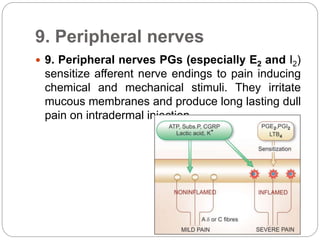
 9. Peripheral nerves PGs (especially E2 and I2)
sensitize afferent nerve endings to pain inducing
chemical and mechanical stimuli. They irritate
mucous membranes and produce long lasting dull
pain on intradermal injection.
Role
 PGs appear to serve as algesic agents during
inflammation. They cause tenderness and amplify
the action of other algesics. Inhibition of PG
synthesis is a major antiinflammatory mechanism.
Aspirin injected locally decreases pain produced
by injection of bradykinin at the same site.
10. Eye
 PGF2α induces ocular inflammation and lowers
i.o.t by enhancing uveoscleral and trabecular
outflow. Non irritating congeners like latanoprost
are now first line drugs in wide angle glaucoma.
Role
 Locally produced PGs appear to facilitate
aqueous humor drainage. The finding that COX-2
expression in the ciliary body is deficient in wide
angle glaucoma patients supports this cotention.
11. Endocrine system
 PGE2 facilitates the release of anterior pituitary
hormones—growth hormone, prolactin, ACTH,
FSH and LH as well as that of insulin and adrenal
steroids. It has a TSH-like effect on the thyroid.
PGF2α causes luteolysis and terminates early
pregnancy in many mammals, but this effect is
not significant in humans. Though PGs can
terminate early pregnancy in women, this is not
associated with fall in progesterone levels.
12. Metabolism
 PGEs are antilipolytic, exert an insulin like effect
on carbohydrate metabolism and mobilize Ca2+
from bone. They may mediate hypercalcaemia
due to bony metastasis.
Leukotrienes
 The straight chain lipoxygenase products of
arachidonic acid are produced by a more limited
number of tissues (LTB4 mainly by neutrophils;
LTC4 and LTD4—the cysteinyl LTs—mainly by
macrophages), but probably they are
pathophysiologically as important as PGs.
1. CVS and blood
 LTC4 and LTD4 injected i.v. evoke a brief rise in BP
followed by a more prolonged fall. The fall in BP is not
due to vasodilatation because no relaxant action has
been seen on blood vessels. It is probably a result of
coronary constriction induced decrease in cardiac
output and reduction in circulating volume due to
increased capillary permeability. These LTs markedly
increase capillary permeability and are more potent
than histamine in causing local edema formation.
LTB4 is highly chemotactic for neutrophils and
monocytes; this property is shared by HETE but not
by other LTs. Migration of neutrophils through
capillaries and their clumping at sites of inflammation
in tissues is also promoted by LTB4. The cysteinyl LTs
(C4, D4) are chemotactic for eosinophils.
Role
 LTs are important mediators of inflammation.
They are produced (along with PGs) locally at the
site of injury. While LTC4 and D4 cause exudation
of plasma, LTB4 attracts the inflammatory cells
which reinforce the reaction. 5-HPETE and 5-
HETE may facilitate local release of histamine
from mast cells.
2. Smooth muscle
 LTC4 and D4 contract most smooth muscles.
They are potent bronchoconstrictors and induce
spastic contraction of g.i.t. at low concentrations.
They also increase mucus secretion in the
airways.
 Role The cysteinyl LTs (C4 and D4) are the most
important mediators of human allergic asthma.
They are released along with PGs and other
autacoids during AG: AB reaction in the lungs. In
comparison to other mediators, they are more
potent and are metabolized slowly in the lungs,
exert a long lasting action. LTs may also be
responsible for abdominal colics during systemic
anaphylaxis.
3. Afferent nerves
 Like PGE2 and I2, the LTB4 also sensitizes
afferents carrying pain impulses—contributes to
pain and tenderness of inflammation.
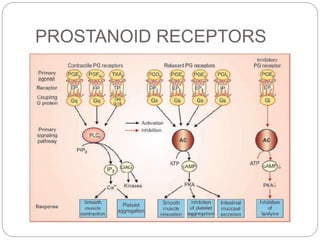
PROSTANOID RECEPTORS
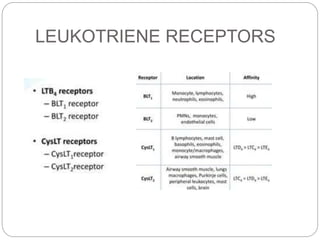
LEUKOTRIENE RECEPTORS
USES
 1. Abortion
 2. Induction/augmentation of labour
 3. Cervical priming (ripening)
 4. Postpartum haemorrhage (PPH)
 5. Peptic ulcer
 6. Glaucoma
 7. To maintain patency of ductus arteriosus
 8. To avoid platelet damage
SIDE EFFECTS
 Side effects are common in the use of PGs, but
their intensity varies with the PG, the dose and
the route.
 These are: nausea, vomiting, watery diarrhoea,
uterine cramps, unduly forceful uterine
contractions, vaginal bleeding, flushing, shivering,
fever, malaise, fall in BP, tachycardia, chest pain.