AUTACOIDS
Mr.Manikanta
TMC
Autacoids- Local hormones
Means self remedies
Localized in tissue
Don't normally circulate
Has physio- pathological activities
Differ from hormones & N.T
Short duration of action
 Involved in response to injury
Site of action is restricted to the
synthesis area.
Sever as neuromodulators/ transmitters.
TYPES OF Autacoids
• Amines
-Histamine,
-Serotonin (5-HT)
• Lipid derived
- PG’s, TXA2, LT’s & PAF.
• Peptides
-Angiotensin &Bradykinin
- Cytokine, Gastrin, somatostatin & VIP etc.,
Lipid derived Autacoids
Prostaglandins, Thromboxanes,
Leukotrienes, Platelet Activating
Factor
History
 Prostaglandins were 1st discovered in human semen
by Ulf Von Euler.
 Bergstrom, Samuelsson & Vane- Noble prize.
 Prostaglandins derived from Prostanoic acid.
 Leukotrienes - obtained from leukocytes.
 P.G’s, LTs ,TXA2 & PAF - Eicosanoids.
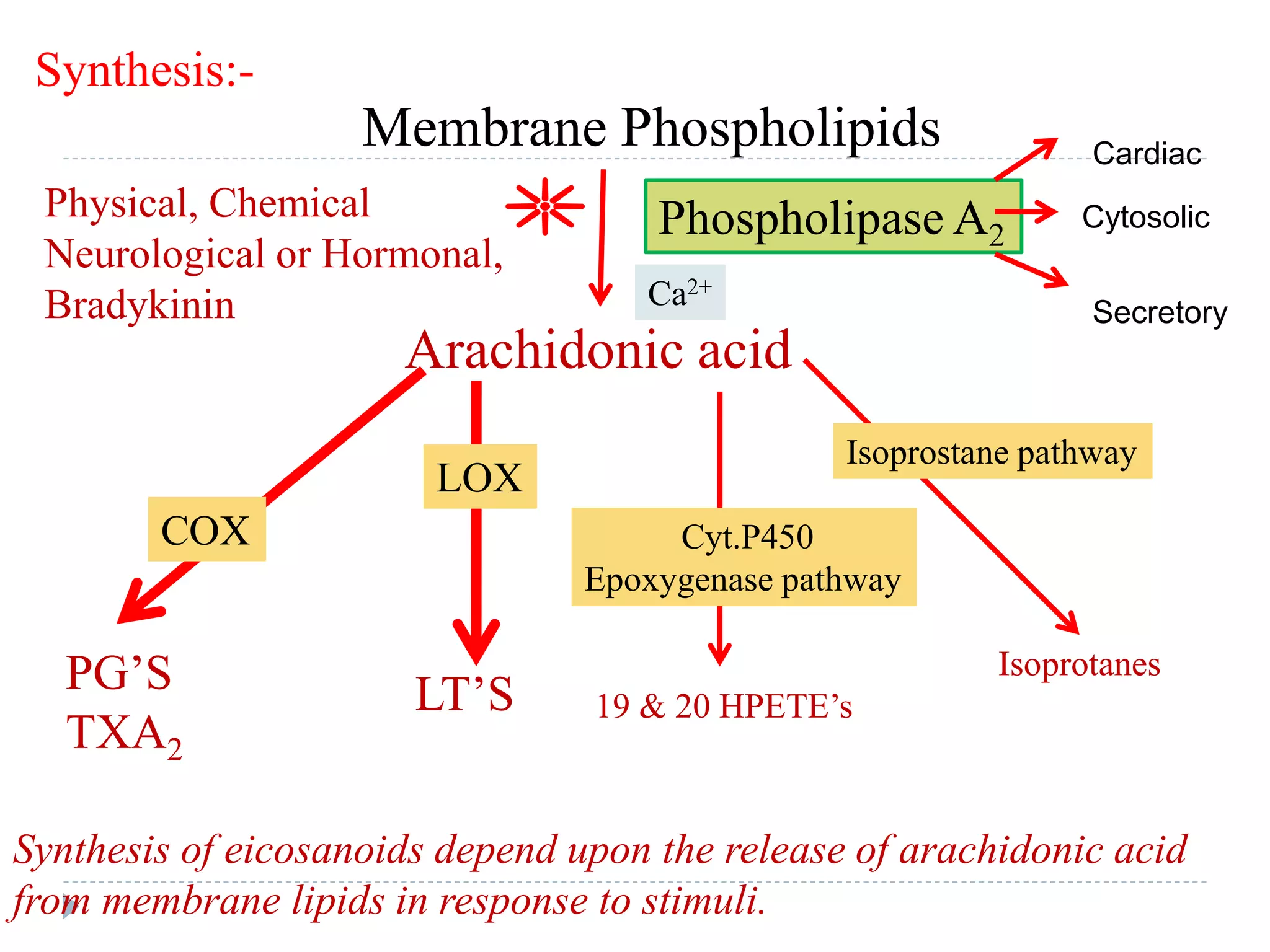
 Eicosanoids are derived from Arachidonic acid.
 P.G’s & TXA2- Prostanoids.
Arachidonic acid
Membrane Phospholipids
Phospholipase A2
PG’S
TXA2
LT’S
COX
LOX
Cyt.P450
Epoxygenase pathway
Isoprostane pathway
Isoprotanes
19 & 20 HPETE’s
Cardiac
Cytosolic
Secretory
Physical, Chemical
Neurological or Hormonal,
Bradykinin
Synthesis:-
Synthesis of eicosanoids depend upon the release of arachidonic acid
from membrane lipids in response to stimuli.
Ca2+
Membrane Phospholipid
Arachidonic acid
5-HPETE
Leukotrienes
PGD2
PGE2
PGF2α
PGI2
TXA2 ---B2
Phospholipase A2Stimulus
Ring structure compounds
Open structure compounds
5,8,11,14-eicostetraenoic acid
Non selective &
Selective COX2
inhibitors
Non-Selective
COX inhibitor
COX2- Bacteria, Lipopolysaccharides, IL, TNF,
Epidermal / Platelet derived growth factors
Constitutive Inducible
COX-1 COX-2 COX-3
Constitutive
enzymes
(always present in
cells)
Constitutive in brain
endothelium & kidney
Recently isolated
from cerebral cortex
Serves as house
keeping function-
e.g.-
gastro protective,
Inducible-synthesis is
stimulated by endotoxins &
other inflammatory
mediators
Involved in pain
perception & fever
Haemostasis
Reno protective
Participates in inflammation Not involved in
inflammation
Pro-carcinogenic due to
inhibition of cell apoptosis,
stimulation of cell migration
angiogenesis,& invasiveness
Paracetamol targets
COX-3
Membrane
Phospholipid
Arachidonic acid
cyclooxygenase
PGG2
PGH2
TXA2 PGE2 PGF2α
PGI2PGD2
PGI Synthase
TXA Synthase
PGH Synthase
PG Synthase
Vascular
endothelium
Platelets GIT, LUNGs,
Uterus, B.V’s
Mast
cells
PLA2
PG’s & TXA2 Metabolism-
 PG’s are rapidly inactivated.
 Inactivation occurs through specific enzymes & oxidation.
 PGI & TXA2 are metabolised by non enzymatically.
 Short t ½ life.
Prostanoid receptors
 All are G-protein coupled receptors.
 IP3/DAG or CAMP transducer mechanism.
PGD2 PGF2α PGI2 TXA2 PGE2
TP EP1-4IPFPDP
PG Receptor Functions
PGD2, DP X P. aggregation, Vasodilatation, Relaxation of GIT
& uterus, regulates Sleep-wake cycle.
PGF2 FP Contractions Uterus & Bronchi.
PGI2 IP X platelet aggregation, Vasodilatation, Renin
release & Natriuresis
TXA2 TP P. aggregation, Vasoconstriction,
Bronchoconstriction.
PGE2
EP1
PEF2
Bronchonstrction, GIT motility, increases colon
cancer.
EP2 Br.dilation, Vasodilatation, GIT relaxation,
Intestinal fluid secretion, Ovulation & Fertilization
EP3 X gastric acid secretion, Cytoprotective action,
contraction of pregnant uterus & GIT muscle, X
lipolysis & ANS neurotransmitter release.
-Maintains patency of ductus arteriosus.EP4
Drugs inhibiting P.G & LT synthesis-
Membrane phospholipids
Arachidonic acid
PGG2/H2 LTA4
PGE2
PGF2α
PGD2
PGI2
TXA2
LTB4 LTC4
LTD4
LTE4
Act on Cys-LT receptors
Bronchoconstriction
NSAIDS
COX1,2 5-LOX Zileuton
Montelukast
zafirlukast
PLPA2Steroids
 Pharmacological actions-
1.CVS:-
PGE2/PGI2
-Vasodilation- B.P, weak +ve inotropic, C.O slightly .
- Capillary permeability
- Maintains patent ducts arteriosus (D.A).
- NSAIDs - during labour & child with D.A ?
PGF2α- Vasoconstrictor.
- Mild effect on H.R/B.P/F.O.C/Capillary permeability.
TXA2- Vasoconstrictor, Smooth muscle mitogen-Testosterone.
PGF2α
PGE2/I2
2.Platelets-
 PGI2/ PGD2- X Platelet aggregation.
 TXA2 - Platelet aggregation (P.A)
-both maintains integrity of vascular endothelium
-Prevents P.A & stick to arteriolar wall.
 Platelets- No nuclei(DNA), No COX-1 synthesis.
-limited amount of COX-1 & TXA2 persist.
-L.Dose Aspirin-prevention of coronary thrombosis.
-H.Dose NASID’s -X PGI2 & TXA2.
 Vascular endothelium-
-Has nuclei & continuous synthesis of COX-1—PGI2.
PGI
COX
Bloodvessel
COX
PGI2
TXA2
P.Aggregation
Vascular endothelium
Platelet
L.D-ASPIRIN
Aspirin antiplatelet effect persists till the life span of platelet 7 to 10days.
Aspirin- administered O.D/ alternative days.
Nuclei
3.Uterus- (In vivo)
 PGE2 & PGF2α -contracts Pregnant/Non-pregnant uterus
In Vitro- PGE2 relax non.preg & contracts preg.uterus.
PGF2α - contracts both.
PG’s At term - soften cervix.
Foetus- involves initiation & progression of labour.
 Dysmenorrhoea- PGE2 & PGF2α during menstruation.
-Uterine contractions- ischaemic pain.
 Aspirin-effective in Rx dysmenorrhoea & to delay the labour.
 P.G’s analogues – Rx uterine inertia.
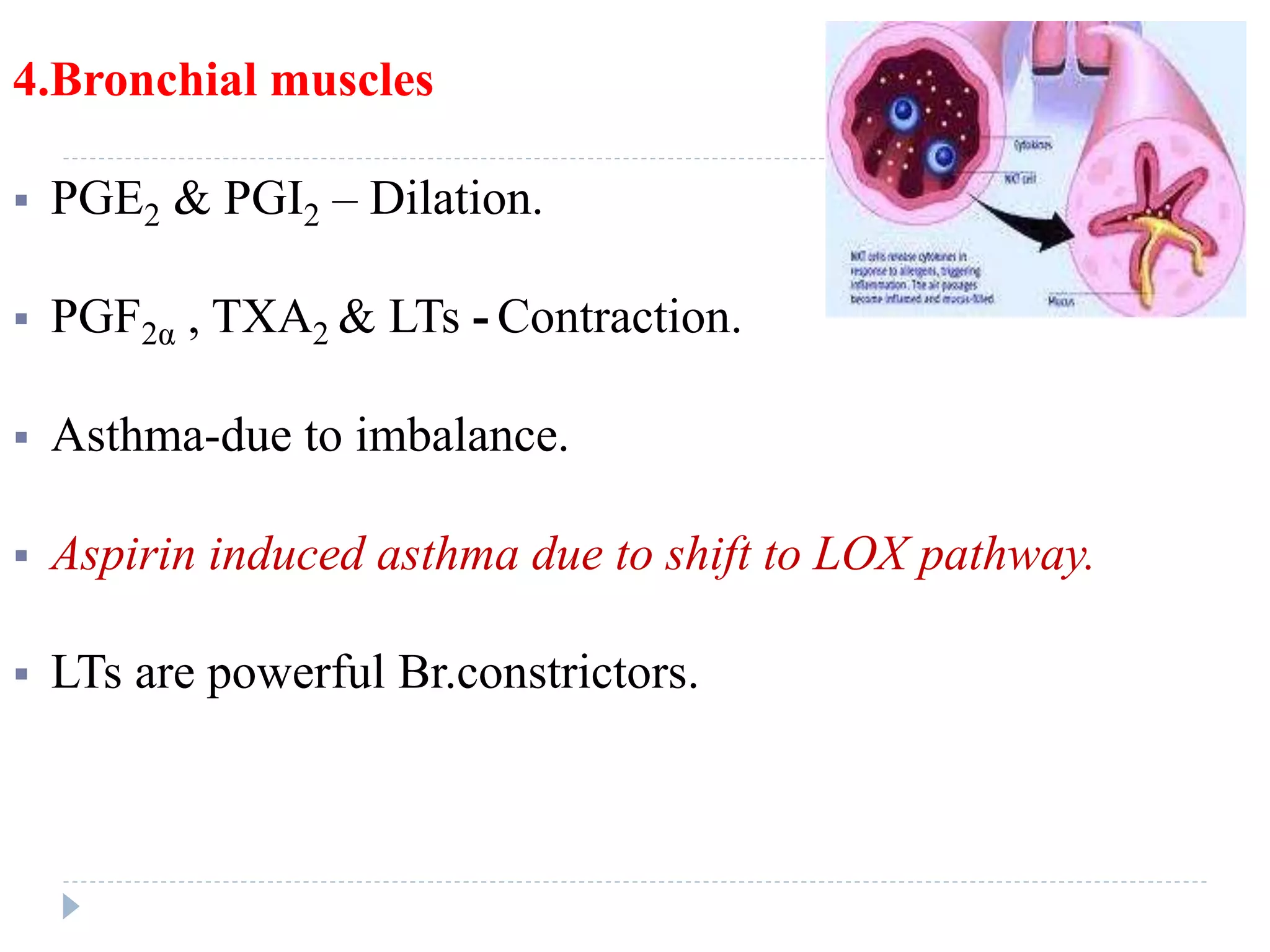
4.Bronchial muscles
 PGE2 & PGI2 – Dilation.
 PGF2α , TXA2 & LTs - Contraction.
 Asthma-due to imbalance.
 Aspirin induced asthma due to shift to LOX pathway.
 LTs are powerful Br.constrictors.
6.GIT - Anti-ulcerogenic.
 PGE2 & PGI2 - gastric acid & pepsin secretion.
- Mucous production & Blood flow.
 Aspirin- Cytoprotective action is lost.
 PGE2 & PGF2α - Contracts longitudinal muscle.
- H20 & Electrolyte secretions- Colic & diarrhoea as S/E.
 PGI2 - opposes propulsive movements.
 P.G’s - imp role in colonic cancer.
 Aspirin- risk of colon cancer & PGE2 induced diarrhoea.
6.kidney-
 PGE2 & PGI2 – Natriuresis, Renal vasodilation & Cl-
ion.
- X ADH action to promote H20 clearance.
- β1+ R- Renin release.
 Bartter’s syndrome - Rx Indomethacin.
 TXA2 - Renal vasoconstriction (ADH like action)
 Furosemide - + COX activity to produce vasodilators PG’s.
 Indomethacin - X Furosemide diuretic action.
7.CNS-
 PGE1,2 -pyrogenic. PGD2 & TXA2- n’t pyrogenic.
 Aspirin blocks P.G actions i.e. antipyretic
 PGD2- sleep.
 P.G’s X NE release.
 P’G’s – headache due to vasodilation.
8.Males-
 PGE1,2 - fertile semen , sperm motility, penile erection.
 Fertilization by coordinating uterine contractions.
 Testosterone promotes P.G synthesis.
 Aspirin the P.G content in semen.
9.Pheripheral nerve endings-
 PGE2 & PGI2- sensitize the receptors to pain &
inflammatory mediators -amplify algesia.
10. Endocrine-
 PGE2 promotes the release of GH/ACTH/FSH/LH &
Prolactin.
11.Bone metabolism-
 PGE2- Osteoporosis due + of bone resorption.
12.Eye- PGE2 , PGF2α - IOP by uveoscleral out flow
13.Cancer- PGE2 is a pro-carcinogen-colon cancer.
Uses of Prostaglandin analogues-
1.Abortion-
Dinoprostone - PGE2.
 Induction of mid-term abortion
 Cervical ripening & induction of labour at full term.
 Not used for menstrual regulation/early abortion.
Carboprost - PGF2α
 Used for mid-term abortion.
Misoprostol -PGE1
 used for abortion-200μg.BD/orally.
 along with mifepristone to induce abortion in 1
st
few wks of
pregnancy.
2.Facilitation of labour, cervical priming & PPH-
1.Dinoprostone - PGE2.
 Orally - to augmenting labour & to check PPH.
 Vaginally- softens the cervix before labour induction.
 Preferred over oxytocin for labour induction in pre-
eclampsia, eclampsia, cardiac & renal disease.
 Intrauterine foetal deaths / along with oxytocin.
2. Carboprost - PGF2α - RX PPH-intra-amniotic inj.
3.Ulcer healing-
 Misoprostol -PGE1
 Ulcer protective agent-200μg orally QID
 Enprostil - PGE2.
 Used in NSAID’s induced P.U & Chronic smokers.
4) To prevent platelet aggregation-
 Epoprostenol-
 PGI2- Haemodialysis & Cardiopulmonary bypass.
 PGE2 & PGI2- used to store platelets for transfusion.
5.To treat pulmonary HTN-
 Epoprostenol (PGI2)-I.V - pulmonary & coronary resistance.
 Treprostinil -longer acting.
6.Patency of Ductus arteriosus-
 Epoprostenol (PGI2) or Alprostadil (PGE1)- I.V infusion.
7.P.V.D-
 Beraprost (PGI2)-orally ,T.I.D.
8.Glaucoma-
 Latanoprost (PGF2α) - Reduces I.O.P.
9.Male impotence- Alprostadil to RX E.D.
-2.5-25mcg intracavernosal inj.
10.To reduce infract size- iloprost- in post-MI. Period.
11.Asthma- areosolised PGE2- Rx A/C attacks.
A patient come to you complaining that when ever he takes
aspirin for headache, he develops sever shortness of breath.
What might be the reason?
A lady with 2 children and history of amenorrhea for 35
days went to a doctor for termination of pregnancy. The
obstetrician advised her Misoprostol 400μg stat
1. Comment on prescription?
2. Which analogue is used for midterm abortion?
3. Name one non-obstetric use of Misoprostol?
MCQ’s
A new born baby was diagnosed as having a congenital
abnormality that result in transportation of great vessels. While
preparing for the surgery, the medical team needed to keep the
ducts arteriosus open. They did this by infusion ?
A ) Corticsol b) Indomethacin
c) Alprostadil d) Tacrolimus
S/E-
 Hypotension, Syncope & Flushing
 Carboprost-mid term abortion- Anaphylactic shock & CVS
collapse.
 Alprostadil- Ductus fragility & rupture.
 PGF2-GIT toxicity & Bronchoconstriction.
 Misoprostol/Enprostil-Diarrhoea.
 Long term use-PGE2-EP4 R mediated increase in osteoclast
& osteoblast activity.
 Renal Ca2+ oxalate stone- hypercalciuria.
LEUKOTRIENES
Zileuton
Arachidonic acid
5HPETE
LTA4
LTC4
LTD4
LTE4
LTB4
5-Lipooxygenase
5-Lipooxygenase
LTB4 SynthaseLTC4 Synthase
Glutanyl Transpetidase,
Glutanyl Leucotrienase
Dipeptidase
SRS-A
FLAP
Zafirlukast
 Blood-
 LTB4 – Neutrophil chemotaxis, lymphocyte proliferation.
 LTC4 & LTD4 -Eosinophils chemotaxis , Degranulation &
O2 radical formation.
 Heart & B.V-
 LTC4 & LTD4 - contractility & coronary blood flow.
 Play imp role in myointimal proliferation-angioplasty.
 GIT smooth muscles-
 LTB4- causes neutrophil chemotaxis - IBD’s.
 Bronchial smooth muscle-
 LTC4, LTD4 & LTE4
 Bronchoconstriction
 Increased permeability
 Increased mucus secretion.
 Inflammation –LTB4
- Imp mediator of all types of inflammations like R.A,
Psoriasis & Ulcerative colitis.
 LT receptors- (LT.R)
 LTB4- BLT receptors
 LTC4/LTD4/LTE4- cyst LT receptors.
 LT R are G-protein coupled & function through IP3/DAG
transduction mechanism.
LT inhibitor-
 Zileuton LOX inhibitor, X LT induced responses.
LT receptor antagonists-
 Zafirlukast, Montelukast & Iralukast.
 Antiasthmatic & Anti-inflammatory agent.
Platelet Activating Factor (PAF)
Membrane Acyl-Glycero phosphocholine
Lyso PAF
PAF
PAF-Acetyl transferase
PL A2Fatty acid
Acetyl CoA
Acetyl hydroxylase
Lyso PAF
Acyl-Glycero phosphocholine
Acetate
Fatty acid
Synthesis
Degradation
Pharmacological actions-
 Vasodilation, vascular permeability
 Chemotactic to neutrophil & eosinophils.
 Activation of leucocytes
 Promotes platelet aggregation
 Involved in inflammation & bronchial hyper-responsiveness
 Foetus- involved in progression labour at term
 Potent peptic ulcerogen.
M.O.A- G-ptn R - IP3/DAG---Ca2+ pathway.
 Some of it actions are mediated through the release of P/G’s,
TXA2 & LT’s.
PAF antagonist-
 Ginkgolide -B & structural analogues of PAF.
 Alprazolam & Triazolam antagonize PAF actions.
 Used in Rx of shock, M.I, P.U, intermittent claudication,
asthma, sepsis & contraceptives.
Thank U
Prostaglandins and leucotrienes   mani

Prostaglandins and leucotrienes mani

  • 1.
  • 2.
    Autacoids- Local hormones Meansself remedies Localized in tissue Don't normally circulate Has physio- pathological activities Differ from hormones & N.T Short duration of action  Involved in response to injury Site of action is restricted to the synthesis area. Sever as neuromodulators/ transmitters.
  • 3.
    TYPES OF Autacoids •Amines -Histamine, -Serotonin (5-HT) • Lipid derived - PG’s, TXA2, LT’s & PAF. • Peptides -Angiotensin &Bradykinin - Cytokine, Gastrin, somatostatin & VIP etc.,
  • 4.
    Lipid derived Autacoids Prostaglandins,Thromboxanes, Leukotrienes, Platelet Activating Factor
  • 5.
    History  Prostaglandins were1st discovered in human semen by Ulf Von Euler.  Bergstrom, Samuelsson & Vane- Noble prize.  Prostaglandins derived from Prostanoic acid.  Leukotrienes - obtained from leukocytes.  P.G’s, LTs ,TXA2 & PAF - Eicosanoids.  Eicosanoids are derived from Arachidonic acid.  P.G’s & TXA2- Prostanoids.
  • 6.
    Arachidonic acid Membrane Phospholipids PhospholipaseA2 PG’S TXA2 LT’S COX LOX Cyt.P450 Epoxygenase pathway Isoprostane pathway Isoprotanes 19 & 20 HPETE’s Cardiac Cytosolic Secretory Physical, Chemical Neurological or Hormonal, Bradykinin Synthesis:- Synthesis of eicosanoids depend upon the release of arachidonic acid from membrane lipids in response to stimuli. Ca2+
  • 7.
  • 8.
    Ring structure compounds Openstructure compounds 5,8,11,14-eicostetraenoic acid
  • 9.
    Non selective & SelectiveCOX2 inhibitors Non-Selective COX inhibitor COX2- Bacteria, Lipopolysaccharides, IL, TNF, Epidermal / Platelet derived growth factors Constitutive Inducible
  • 10.
    COX-1 COX-2 COX-3 Constitutive enzymes (alwayspresent in cells) Constitutive in brain endothelium & kidney Recently isolated from cerebral cortex Serves as house keeping function- e.g.- gastro protective, Inducible-synthesis is stimulated by endotoxins & other inflammatory mediators Involved in pain perception & fever Haemostasis Reno protective Participates in inflammation Not involved in inflammation Pro-carcinogenic due to inhibition of cell apoptosis, stimulation of cell migration angiogenesis,& invasiveness Paracetamol targets COX-3
  • 11.
    Membrane Phospholipid Arachidonic acid cyclooxygenase PGG2 PGH2 TXA2 PGE2PGF2α PGI2PGD2 PGI Synthase TXA Synthase PGH Synthase PG Synthase Vascular endothelium Platelets GIT, LUNGs, Uterus, B.V’s Mast cells PLA2
  • 12.
    PG’s & TXA2Metabolism-  PG’s are rapidly inactivated.  Inactivation occurs through specific enzymes & oxidation.  PGI & TXA2 are metabolised by non enzymatically.  Short t ½ life.
  • 13.
    Prostanoid receptors  Allare G-protein coupled receptors.  IP3/DAG or CAMP transducer mechanism. PGD2 PGF2α PGI2 TXA2 PGE2 TP EP1-4IPFPDP
  • 14.
    PG Receptor Functions PGD2,DP X P. aggregation, Vasodilatation, Relaxation of GIT & uterus, regulates Sleep-wake cycle. PGF2 FP Contractions Uterus & Bronchi. PGI2 IP X platelet aggregation, Vasodilatation, Renin release & Natriuresis TXA2 TP P. aggregation, Vasoconstriction, Bronchoconstriction. PGE2 EP1 PEF2 Bronchonstrction, GIT motility, increases colon cancer. EP2 Br.dilation, Vasodilatation, GIT relaxation, Intestinal fluid secretion, Ovulation & Fertilization EP3 X gastric acid secretion, Cytoprotective action, contraction of pregnant uterus & GIT muscle, X lipolysis & ANS neurotransmitter release. -Maintains patency of ductus arteriosus.EP4
  • 15.
    Drugs inhibiting P.G& LT synthesis- Membrane phospholipids Arachidonic acid PGG2/H2 LTA4 PGE2 PGF2α PGD2 PGI2 TXA2 LTB4 LTC4 LTD4 LTE4 Act on Cys-LT receptors Bronchoconstriction NSAIDS COX1,2 5-LOX Zileuton Montelukast zafirlukast PLPA2Steroids
  • 16.
     Pharmacological actions- 1.CVS:- PGE2/PGI2 -Vasodilation-B.P, weak +ve inotropic, C.O slightly . - Capillary permeability - Maintains patent ducts arteriosus (D.A). - NSAIDs - during labour & child with D.A ? PGF2α- Vasoconstrictor. - Mild effect on H.R/B.P/F.O.C/Capillary permeability. TXA2- Vasoconstrictor, Smooth muscle mitogen-Testosterone. PGF2α PGE2/I2
  • 17.
    2.Platelets-  PGI2/ PGD2-X Platelet aggregation.  TXA2 - Platelet aggregation (P.A) -both maintains integrity of vascular endothelium -Prevents P.A & stick to arteriolar wall.  Platelets- No nuclei(DNA), No COX-1 synthesis. -limited amount of COX-1 & TXA2 persist. -L.Dose Aspirin-prevention of coronary thrombosis. -H.Dose NASID’s -X PGI2 & TXA2.  Vascular endothelium- -Has nuclei & continuous synthesis of COX-1—PGI2.
  • 18.
    PGI COX Bloodvessel COX PGI2 TXA2 P.Aggregation Vascular endothelium Platelet L.D-ASPIRIN Aspirin antiplateleteffect persists till the life span of platelet 7 to 10days. Aspirin- administered O.D/ alternative days. Nuclei
  • 19.
    3.Uterus- (In vivo) PGE2 & PGF2α -contracts Pregnant/Non-pregnant uterus In Vitro- PGE2 relax non.preg & contracts preg.uterus. PGF2α - contracts both. PG’s At term - soften cervix. Foetus- involves initiation & progression of labour.  Dysmenorrhoea- PGE2 & PGF2α during menstruation. -Uterine contractions- ischaemic pain.  Aspirin-effective in Rx dysmenorrhoea & to delay the labour.  P.G’s analogues – Rx uterine inertia.
  • 20.
    4.Bronchial muscles  PGE2& PGI2 – Dilation.  PGF2α , TXA2 & LTs - Contraction.  Asthma-due to imbalance.  Aspirin induced asthma due to shift to LOX pathway.  LTs are powerful Br.constrictors.
  • 21.
    6.GIT - Anti-ulcerogenic. PGE2 & PGI2 - gastric acid & pepsin secretion. - Mucous production & Blood flow.  Aspirin- Cytoprotective action is lost.  PGE2 & PGF2α - Contracts longitudinal muscle. - H20 & Electrolyte secretions- Colic & diarrhoea as S/E.  PGI2 - opposes propulsive movements.  P.G’s - imp role in colonic cancer.  Aspirin- risk of colon cancer & PGE2 induced diarrhoea.
  • 22.
    6.kidney-  PGE2 &PGI2 – Natriuresis, Renal vasodilation & Cl- ion. - X ADH action to promote H20 clearance. - β1+ R- Renin release.  Bartter’s syndrome - Rx Indomethacin.  TXA2 - Renal vasoconstriction (ADH like action)  Furosemide - + COX activity to produce vasodilators PG’s.  Indomethacin - X Furosemide diuretic action.
  • 23.
    7.CNS-  PGE1,2 -pyrogenic.PGD2 & TXA2- n’t pyrogenic.  Aspirin blocks P.G actions i.e. antipyretic  PGD2- sleep.  P.G’s X NE release.  P’G’s – headache due to vasodilation. 8.Males-  PGE1,2 - fertile semen , sperm motility, penile erection.  Fertilization by coordinating uterine contractions.  Testosterone promotes P.G synthesis.  Aspirin the P.G content in semen.
  • 24.
    9.Pheripheral nerve endings- PGE2 & PGI2- sensitize the receptors to pain & inflammatory mediators -amplify algesia.
  • 25.
    10. Endocrine-  PGE2promotes the release of GH/ACTH/FSH/LH & Prolactin. 11.Bone metabolism-  PGE2- Osteoporosis due + of bone resorption. 12.Eye- PGE2 , PGF2α - IOP by uveoscleral out flow 13.Cancer- PGE2 is a pro-carcinogen-colon cancer.
  • 26.
    Uses of Prostaglandinanalogues- 1.Abortion- Dinoprostone - PGE2.  Induction of mid-term abortion  Cervical ripening & induction of labour at full term.  Not used for menstrual regulation/early abortion. Carboprost - PGF2α  Used for mid-term abortion. Misoprostol -PGE1  used for abortion-200μg.BD/orally.  along with mifepristone to induce abortion in 1 st few wks of pregnancy.
  • 27.
    2.Facilitation of labour,cervical priming & PPH- 1.Dinoprostone - PGE2.  Orally - to augmenting labour & to check PPH.  Vaginally- softens the cervix before labour induction.  Preferred over oxytocin for labour induction in pre- eclampsia, eclampsia, cardiac & renal disease.  Intrauterine foetal deaths / along with oxytocin. 2. Carboprost - PGF2α - RX PPH-intra-amniotic inj.
  • 28.
    3.Ulcer healing-  Misoprostol-PGE1  Ulcer protective agent-200μg orally QID  Enprostil - PGE2.  Used in NSAID’s induced P.U & Chronic smokers. 4) To prevent platelet aggregation-  Epoprostenol-  PGI2- Haemodialysis & Cardiopulmonary bypass.  PGE2 & PGI2- used to store platelets for transfusion.
  • 29.
    5.To treat pulmonaryHTN-  Epoprostenol (PGI2)-I.V - pulmonary & coronary resistance.  Treprostinil -longer acting. 6.Patency of Ductus arteriosus-  Epoprostenol (PGI2) or Alprostadil (PGE1)- I.V infusion. 7.P.V.D-  Beraprost (PGI2)-orally ,T.I.D. 8.Glaucoma-  Latanoprost (PGF2α) - Reduces I.O.P.
  • 30.
    9.Male impotence- Alprostadilto RX E.D. -2.5-25mcg intracavernosal inj. 10.To reduce infract size- iloprost- in post-MI. Period. 11.Asthma- areosolised PGE2- Rx A/C attacks.
  • 31.
    A patient cometo you complaining that when ever he takes aspirin for headache, he develops sever shortness of breath. What might be the reason?
  • 32.
    A lady with2 children and history of amenorrhea for 35 days went to a doctor for termination of pregnancy. The obstetrician advised her Misoprostol 400μg stat 1. Comment on prescription? 2. Which analogue is used for midterm abortion? 3. Name one non-obstetric use of Misoprostol?
  • 33.
    MCQ’s A new bornbaby was diagnosed as having a congenital abnormality that result in transportation of great vessels. While preparing for the surgery, the medical team needed to keep the ducts arteriosus open. They did this by infusion ? A ) Corticsol b) Indomethacin c) Alprostadil d) Tacrolimus
  • 34.
    S/E-  Hypotension, Syncope& Flushing  Carboprost-mid term abortion- Anaphylactic shock & CVS collapse.  Alprostadil- Ductus fragility & rupture.  PGF2-GIT toxicity & Bronchoconstriction.  Misoprostol/Enprostil-Diarrhoea.  Long term use-PGE2-EP4 R mediated increase in osteoclast & osteoblast activity.  Renal Ca2+ oxalate stone- hypercalciuria.
  • 35.
  • 36.
    Zileuton Arachidonic acid 5HPETE LTA4 LTC4 LTD4 LTE4 LTB4 5-Lipooxygenase 5-Lipooxygenase LTB4 SynthaseLTC4Synthase Glutanyl Transpetidase, Glutanyl Leucotrienase Dipeptidase SRS-A FLAP Zafirlukast
  • 37.
     Blood-  LTB4– Neutrophil chemotaxis, lymphocyte proliferation.  LTC4 & LTD4 -Eosinophils chemotaxis , Degranulation & O2 radical formation.  Heart & B.V-  LTC4 & LTD4 - contractility & coronary blood flow.  Play imp role in myointimal proliferation-angioplasty.  GIT smooth muscles-  LTB4- causes neutrophil chemotaxis - IBD’s.
  • 38.
     Bronchial smoothmuscle-  LTC4, LTD4 & LTE4  Bronchoconstriction  Increased permeability  Increased mucus secretion.  Inflammation –LTB4 - Imp mediator of all types of inflammations like R.A, Psoriasis & Ulcerative colitis.
  • 39.
     LT receptors-(LT.R)  LTB4- BLT receptors  LTC4/LTD4/LTE4- cyst LT receptors.  LT R are G-protein coupled & function through IP3/DAG transduction mechanism. LT inhibitor-  Zileuton LOX inhibitor, X LT induced responses. LT receptor antagonists-  Zafirlukast, Montelukast & Iralukast.  Antiasthmatic & Anti-inflammatory agent.
  • 41.
    Platelet Activating Factor(PAF) Membrane Acyl-Glycero phosphocholine Lyso PAF PAF PAF-Acetyl transferase PL A2Fatty acid Acetyl CoA Acetyl hydroxylase Lyso PAF Acyl-Glycero phosphocholine Acetate Fatty acid Synthesis Degradation
  • 42.
    Pharmacological actions-  Vasodilation,vascular permeability  Chemotactic to neutrophil & eosinophils.  Activation of leucocytes  Promotes platelet aggregation  Involved in inflammation & bronchial hyper-responsiveness  Foetus- involved in progression labour at term  Potent peptic ulcerogen. M.O.A- G-ptn R - IP3/DAG---Ca2+ pathway.  Some of it actions are mediated through the release of P/G’s, TXA2 & LT’s.
  • 43.
    PAF antagonist-  Ginkgolide-B & structural analogues of PAF.  Alprazolam & Triazolam antagonize PAF actions.  Used in Rx of shock, M.I, P.U, intermittent claudication, asthma, sepsis & contraceptives. Thank U