OCCUPATIONAL HAEMATOLOGICAL DISORDERS
Dr. Dalia Abdallah El-Shafei
Lecturer, Community medicine department, Zagazig University
#Haem synthesis
(Pb)
# cell production
(Benzene)
++ leukemia
(IR)
Haemolysis
(As + Naphthalen+
others)
# O2 delivery
(MetHb, SulfHb,
COHb)
ScreeningHistory
Physical
examination
Blood
examination
Bone marrow
examination
Other studies
HISTORY
 Usually, Non-specific symptoms.
• Anemia.
• Jaundice.
• Pica.
• Infections.
• Thrombocytopenia.
• Drug history.
 Detailed work history
PHYSICAL EXAMINATION
 Pallor, jaundice, cyanosis.
 Abnormal bleeding.
 Infections.
 Bone tenderness (sternum)
BLOOD EXAMINATION
 HB, Hematocrit value
 MCV, MCHC, MCH
 Peripheral blood smear ( RBCs morphology)
 Leucocytes differential count.
 Reticulocytes.
BONE MARROW EXAMINATION
 Iliac crest or sternum.
• Tumor cells
• Abnormal hematopoietic cells
• Chromosomal studies (proto-
oncogenes- philadelphia chromosome)
OTHER STUDIES
 Bleeding disorders (platelet count + PT +
PTT)
 Iron stores estimation (serum iron + TIBC +
serum ferritin)
 Hemolysis (LDH, Indirect bilirubin).
 Rapid cell turnover → ↑ serum Uric acid
INHIBITION OF HB SYNTHESIS
LEAD POISONING
"Lead makes the mind
give way."
ANCIENT AWARENESS
Greek
Dioscerides - 2nd BC
150
10
20
30
40
50
100
Death
Encephalopathy
Nephropathy
Frank Anemia
Colic
Hemoglobin Synthesis
Vitamin D Metabolism
Encephalopathy
Frank Anemia
Decreased Longevity
Hemoglobin Synthesis
Nephropathy
Peripheral Neuropathies
Infertility (MEN)
Systolic Blood Pressure (MEN)
Hearing Acuity
Erythrocyte Protoporphyrin
(Women)
Hypertension (?)
Nerve Conduction Velocity
Erythrocyte Protoporphyrin
Vitamin D Metabolism(?)
DEVELOPMENTAL TOXICITY
IQ
HEARING
GROWTH
Transplacental Transfer
Blood Lead
(ug Pb/dl)
- Low birth weight
- Miscarriages, Stillbirth
- Premature birth
CHILDREN ADULTS
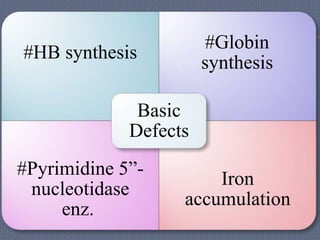
#HB synthesis
#Globin
synthesis
#Pyrimidine 5”-
nucleotidase
enz.
Iron
accumulation
Basic
Defects
ANEMIA AND LEAD TOXICITY (90%)
 Normochromichypochromic,
normocyticmicrocytic
 Reduced RBCs survival time
 Compensatory reticulocytes production
 reticulocytosis
 Basophilic stippling (70%)
 ↑ urinary excretion of ALA +
Coproporpherine III +Uroporphyrin +lead
MICROCYTIC ANEMIA
WITH BASOPHILIC STIPPLING
LEAD PROVOCATION TEST
 CaEDTA infusion “1g in 500ml 5%dextrose”
over 6 hs → 24-hs urinary lead.
• Normally < 0.5 mg
• Lead toxicity → ≥ 1 mg
INHIBITION OF CELL PRODUCTION
BENZENE POISONING
DESCRIPTION
 Colorless or light yellow liquid
 Sweet odor (Conc. Below threshold of
smell associated with toxicity)
 Highly flammable.
 Evaporates into the air very quickly. Its
vapor is heavier than air and may sink into
low-lying areas.
Glues, Paints,
Furniture wax,
Detergents
Tobacco smoke,
Gas stations, MV
exhaust, Industrial
emissions
HIGH-RISK BENZENE EXPOSURE JOBS
 Adhesive production
 Aircraft engine & fuel workers
 Automotive mechanics
 Brake technicians
 Chemical plant workers
 Engine & turbine workers
 Gasoline distribution workers
 House painters
 Newspaper press workers
 Painters
 Paper and pulp
 Pesticide
manufacturing
 Pipefitters
 Printers & print shop
 Refinery workers
 Shoe / leather workers
 Solvent workers
 Synthetic rubber
 Tankermen
 Truck drivers
MECHANISM OF TOXICITY
 Benzen induces pancytopenia by
disrupting cell production from the
pluripotent stem-cell stage to the
functional stage.
 There is good evidence that benzene is
cancerogenic.
GENETIC SUSCEPTIBILITY
Genetic variations of Myeloperoxidase
& NADPH quinine oxidoreductase
 Euphoria,
 Dizziness,
 Headache,
 Blurring of vision,
 Mucous membrane irritation,
 Tremor,
 Chest tightness,
 Respiratory depression,
 Cardiac arrhythmia,
 Coma
 Convulsion.
 Direct skin contact → Marked irritation due to
defeating action of the solvent.
ACUTE POISONING
 # BM cell proliferation:
 Anemia (including aplastic anemia),
leucopenia, thrombocytopenia, pancytopenia;
CHRONIC EXPOSURE
 Mutagenic effect:
 Leukemia (particularly of the myelomonocytic
type),
 Chromosomal abnormalities
 A dry, scaly dermatitis may developed on
prolonged or repeated skin exposure to liquid
benzene.
BM ASPIRATION
 Hypocellular with lymphocyte predominance
 + Immature cells
 No fibrosis
 Acute myelogenous leukemias (AML)
 Myeloma, CLL, CML
MANAGEMENT
 Blood transfusion
 Neutrophil transfusion
 Stem-cell transplantation from HLA identical
siblings:
 Sever aplastic anemia
 Young pt.
 Need immunosuppression
OTHER AGENTS # BM GROWTH
Aplastic anemia
Insecticides
“lindane”
Solvents
“glues, kerosesn,
”TNT, CCL4
IR
INDUCTION OF LEUKEMIA
IONIZING RADIATION
TYPES OR PRODUCTS OF IONIZING
RADIATION


or X-rayNeutron
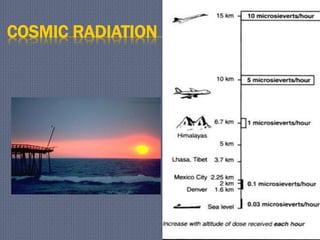
COSMIC RADIATION
2ry ionizing
effects
Indirect
ionization
Direct
ionization
• Neutrons
• x, rays
• α,
• Cosmic rays
Radiation interacting with cell molecules
IONIZING RADIATION AT THE CELLULAR
LEVEL
 Causes breaks in one or
both DNA strands or;
 Causes Free Radical
formation
OH
.
(hydroxyl radical)
H
.
Radiation Damage
water molecule
-ray
2 OH
.
 H2O2
What happens
when the water
molecule is
struck by the
gamma ray?
PENETRATION ABILITIES OF DIFFERENT
TYPES OF RADIATION
Alpha Particles
Stopped by a sheet of paper
Beta Particles
Stopped by a layer of clothing
or less than an inch of a substance
(e.g. plastic)
Gamma Rays
Stopped by inches to feet of concrete
or less than an inch of lead
Radiation
Source
Neutrons
Stopped by a few feet of concrete::
1:100:10,000
DOSE RESPONSE TISSUE
Very High White blood cells (bone marrow)
Intestinal epithelium
Reproductive cells
High Optic lens epithelium
Esophageal epithelium
Mucous membranes
Medium Brain – Glial cells
Lung, kidney, liver, thyroid, pancreatic
epithelium
Low Mature red blood cells
Muscle cells
Mature bone and cartilage
MYELODYSPLASTIC SYNDROME
Cytomenia +
remarkably cellular
BM
Dyserthropoiesis
Rigid sideroblasts
Variable no. of
blasts (<leukemia)
MDS
“pre-leukemic”
ACUTE RADIATION SYNDROME
(A SPECTRUM OF DISEASE)
ACUTE HEALTH EFFECTS
 Changes in the blood
cells
 Vascular changes
 Skin irritation
 Gastrointestinal effects
 Radiation sickness:
• Diarrhea
• Nausea
• Vomiting
• High fever
 Hair loss
 Burns
58
MONITORING INSTRUMENTS
 Personal monitoring:
Film badges, bracelet, rings
Pocket dosimeter
Alpha Survey Meter
Detecting Radiation
Beta & Gamma
Survey Meter
LABORATORY FINDING
 CML, CLL.
 BM →↑ cellularity “ mainly Neutrophils”
 Chromosomal analysis:
Philadelphia chromosome
 Auer rods.
“King of Poisons, Poison of Kings”
HEMOLYTIC DISEASE
ARSINE POISONING
Industrial processes
 Semiconductor
manufacturing (gallium
arsenide)
 Fossil fuels
 Wood treated with arsenic
preservatives
 Metallurgy
 Smelting (copper, zinc,
lead) & refining of metals
& ores
 Glass manufacturing
 Commercial products
 Wood preservatives
 Pesticides
 Herbicides
 Fungicides
 Food
 Seafood and fish
 Others
 Antiparasitic drugs
 Folk remedies
OTHER HEMOLYTIC DISEASES
MARCH HEMOGLOBINURIA “FOOTSTRIKE
HEMOLYSIS” “RUNNER’S ANEMIA”
Repeated force (trauma) to the foot cause
the breakdown of RBCs in blood vessels.
CAUSES
Hard surfaces, long distances, Worn out
shoes, Inherited RBCs problem
(hereditary spherocytosis).
IMMUNE MEDIATED HEMOLYTIC ANEMIA
AGENTS INTERFERE WITH
O2 DELIVERY
METHEMOHLOBINEMIA
SULFHEMOGLOBINEMIA
CARBOB MONOXIDE
Hematological disorders

Hematological disorders