Dr. Dalia El-Shafei
Ass. Prof., CEOM Department, Zagazig University
http://www.slideshare.net/daliaelshafei
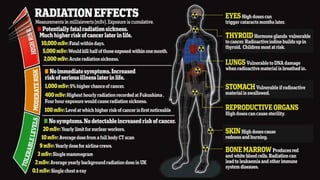
Radiation is the straight line transport of energy through space or matter
Electromagnetic or particulate
radiation capable of producing
ions, directly or indirectly when
passing through matter.
Ionizing radiation
“IR”
Electromagnetic radiation with
a wave length not sufficient for
ionization.
Non ionizing
radiation “NIR”
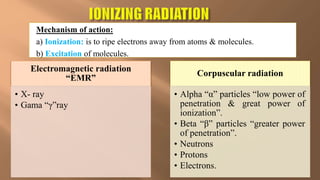
Mechanism of action:
a) Ionization: is to ripe electrons away from atoms & molecules.
b) Excitation of molecules.
Electromagnetic radiation
“EMR”
• X- ray
• Gama “γ”ray
Corpuscular radiation
• Alpha “α” particles “low power of
penetration & great power of
ionization”.
• Beta “β” particles “greater power
of penetration”.
• Neutrons
• Protons
• Electrons.


or X-ray
Neutron
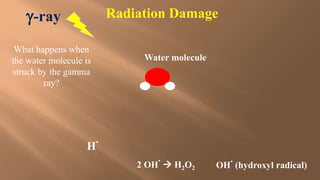
OH
.
(hydroxyl radical)
H
.
Radiation Damage
Water molecule
-ray
2 OH
.
 H2O2
What happens when
the water molecule is
struck by the gamma
ray?
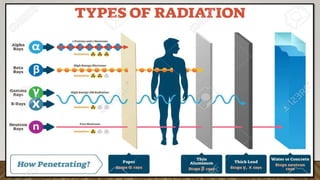
Alpha Particles
Stopped by a sheet of paper
Beta Particles
Stopped by a layer of clothing
or <1 inch of a substance (e.g. plastic)
Gamma Rays
Stopped by inches to feet of concrete
or <1 inch of lead
Radiation
Source
Neutrons
Stopped by a few feet of concrete
::
1:100:10,000
Radiation Damage
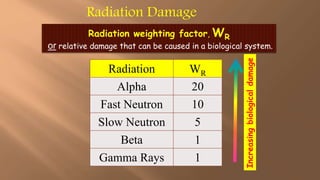
Radiation weighting factor, WR
or relative damage that can be caused in a biological system.
Radiation WR
Alpha 20
Fast Neutron 10
Slow Neutron 5
Beta 1
Gamma Rays 1
Increasing
biological
damage
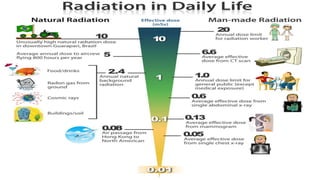
Annual Dose from Background Radiation
Total US average dose equivalent = 360 mrem/year
Total exposure Man-made sources
Radon
Internal 11%
Cosmic 8% Terrestrial 6%
Man-Made 18%
55.0%
Medical X-Rays
Nuclear
Medicine 4%
Consumer
Products 3%
Other 1%
11%
Uranium
miners &
atomic millers
Nuclear
reactors &
atomic energy
plant
Radiologist Scientists using
radioactive
materials
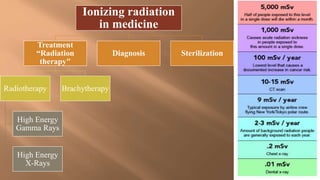
Ionizing radiation
in medicine
Treatment
“Radiation
therapy"
Radiotherapy
High Energy
Gamma Rays
High Energy
X-Rays
Brachytherapy
Diagnosis Sterilization
Radiation
effect Early (Deterministic
only)
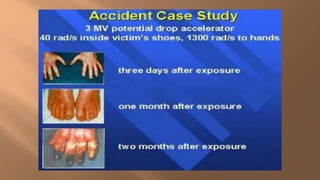
Local Radiation injury
General
Acute radiation syndrome
Acute radiation sickness
Late
Deterministic
Radiation dermatitis
Radiation cataracta
Teratogenic effects
Stochastic
Tumors
Leukaemia
Genetic effects
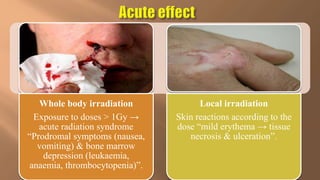
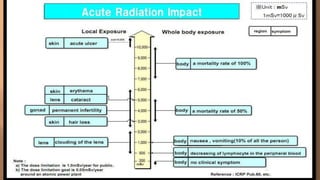
Whole body irradiation
Exposure to doses > 1Gy →
acute radiation syndrome
“Prodromal symptoms (nausea,
vomiting) & bone marrow
depression (leukaemia,
anaemia, thrombocytopenia)”.
Local irradiation
Skin reactions according to the
dose “mild erythema → tissue
necrosis & ulceration”.
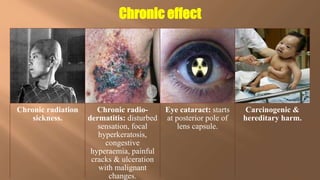
Chronic radiation
sickness.
Chronic radio-
dermatitis: disturbed
sensation, focal
hyperkeratosis,
congestive
hyperaemia, painful
cracks & ulceration
with malignant
changes.
Eye cataract: starts
at posterior pole of
lens capsule.
Carcinogenic &
hereditary harm.
Chronic effect
Radiation
Radiation
Radiation
Radiation

Radiation

  • 1.
    Dr. Dalia El-Shafei Ass.Prof., CEOM Department, Zagazig University http://www.slideshare.net/daliaelshafei
  • 2.
    Radiation is thestraight line transport of energy through space or matter Electromagnetic or particulate radiation capable of producing ions, directly or indirectly when passing through matter. Ionizing radiation “IR” Electromagnetic radiation with a wave length not sufficient for ionization. Non ionizing radiation “NIR”
  • 4.
    Mechanism of action: a)Ionization: is to ripe electrons away from atoms & molecules. b) Excitation of molecules. Electromagnetic radiation “EMR” • X- ray • Gama “γ”ray Corpuscular radiation • Alpha “α” particles “low power of penetration & great power of ionization”. • Beta “β” particles “greater power of penetration”. • Neutrons • Protons • Electrons.
  • 6.
  • 7.
    OH . (hydroxyl radical) H . Radiation Damage Watermolecule -ray 2 OH .  H2O2 What happens when the water molecule is struck by the gamma ray?
  • 8.
    Alpha Particles Stopped bya sheet of paper Beta Particles Stopped by a layer of clothing or <1 inch of a substance (e.g. plastic) Gamma Rays Stopped by inches to feet of concrete or <1 inch of lead Radiation Source Neutrons Stopped by a few feet of concrete :: 1:100:10,000
  • 9.
    Radiation Damage Radiation weightingfactor, WR or relative damage that can be caused in a biological system. Radiation WR Alpha 20 Fast Neutron 10 Slow Neutron 5 Beta 1 Gamma Rays 1 Increasing biological damage
  • 11.
    Annual Dose fromBackground Radiation Total US average dose equivalent = 360 mrem/year Total exposure Man-made sources Radon Internal 11% Cosmic 8% Terrestrial 6% Man-Made 18% 55.0% Medical X-Rays Nuclear Medicine 4% Consumer Products 3% Other 1% 11%
  • 13.
    Uranium miners & atomic millers Nuclear reactors& atomic energy plant Radiologist Scientists using radioactive materials
  • 14.
    Ionizing radiation in medicine Treatment “Radiation therapy" Radiotherapy HighEnergy Gamma Rays High Energy X-Rays Brachytherapy Diagnosis Sterilization
  • 16.
    Radiation effect Early (Deterministic only) LocalRadiation injury General Acute radiation syndrome Acute radiation sickness Late Deterministic Radiation dermatitis Radiation cataracta Teratogenic effects Stochastic Tumors Leukaemia Genetic effects
  • 20.
    Whole body irradiation Exposureto doses > 1Gy → acute radiation syndrome “Prodromal symptoms (nausea, vomiting) & bone marrow depression (leukaemia, anaemia, thrombocytopenia)”. Local irradiation Skin reactions according to the dose “mild erythema → tissue necrosis & ulceration”.
  • 24.
    Chronic radiation sickness. Chronic radio- dermatitis:disturbed sensation, focal hyperkeratosis, congestive hyperaemia, painful cracks & ulceration with malignant changes. Eye cataract: starts at posterior pole of lens capsule. Carcinogenic & hereditary harm. Chronic effect