Dr. Dalia El-Shafei
Assistant professor, Community Medicine Department, Zagazig University
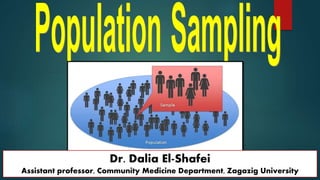
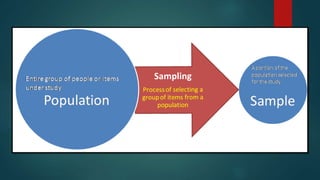
Sample
ļ‚§ Group of individuals or things selected from the entire population to
be representative to this population.
ļ‚§ Each member of the population is called the sampling unit.
Epidemiological Study
SampleComprehensive
Study a sample selected from
the population.
Study the whole population.
Sampling frame
A list of all the units in the population from which a
sample will be selected
Sampling
Non-probability
Accessibility
(convenience)
Quota
Judgmental
(Purposive)
Snowball sample
(friend of friend)
Probability
Simple random
Systematic
random
Stratified
random
Cluster
Multi-stage
random
Probability sample:
probability of selecting
an individual is 50%
ā€œno selection biasā€.
Types of sample
Probability SampleNon- probability Sample
Investigator has minimal role in
selection.
Sample is representative (each
individual has an equal chance of being
in the sample).
We can generalize the results.
Investigator has a role in selection.
Sample is not representative (not
each individual has an equal chance
of being in the sample).
We cannot generalize the results
Non-probability Sample
Sampling
Non-probability
Accessibility
(convenience)
Quota
Judgmental
(Purposive)
Snowball sample
(friend of friend)
Probability
Simple random
Systematic
random
Stratified
random
Cluster
Multi-stage
random
Probability sample:
probability of selecting
an individual is 50%
ā€œno selection biasā€.
Types of sample
Not every
individual has
an equal chance
of being in the
sample.
The investigator
has a role in
selection.
Sample is not
representative
We cannot
generalize the
results.
Advantages
• Cheap
• Quick
• Not require a
sampling frame
Disadvantages
• Not a good
representation of
the population
• Great variability
between persons
in sample.
Accessibility (convenience) sample
Most common of all sampling techniques.
The samples are selected because they are
accessible to the researcher.
Subjects are chosen simply because they
are easy to recruit.
Easiest, cheapest & least time consuming.
Used in: Mass media & pilot study.
Quota sampling
The researcher ensures equal or proportionate representation
of subjects depending on which trait is considered as basis of
the quota.
For example, if basis of the quota is college year level and the
researcher needs equal representation
with a sample size of 100,
he must select 25 1st year students, another 25 2nd year
students, 25 3rd year and 25 4th year students.
The bases of the quota are usually age, gender, education, race,
religion and socioeconomic status.
ļ‚§ Example: interview of all persons passing in a certain street at
certain time.
ļ‚§ The sample is complete when the desired number of population is
reached.
ļ‚§ This can be done in T.V. to known public opinion for the preferable
programs but it is seldom used in scientific medical researchers.
Judgmental (Purposive) sample
Subjects are chosen to
be part of the sample
with a specific purpose
in mind (previous
knowledge or
professional
experience).
The researcher believes
that some subjects are
fit for the research
compared to other
individuals.
Snowball sample
(friend of friend) It is usually done when there
is a very small population
size.
The researcher asks the
initial subject to identify
another potential subject
who also meets the criteria
of the research.
Hardly representative of the
population.
Probability Sampling
Sampling
Non-probability
Accessibility
(convenience)
Quota
Judgmental
(Purposive)
Snowball sample
(friend of friend)
Probability
Simple random
Systematic
random
Stratified
random
Cluster
Multi-stage
random
Probability sample:
probability of selecting
an individual is 50%
ā€œno selection biasā€.
Types of sample
Every individual
has an equal
chance of being
in the sample.
The investigator
has minimal
role in selection.
Sample is
representative
We can
generalize the
results.
Simple random sample
 Suitable in small population.
 Not suitable in large population.
 Process:
• Construct ā€œSample frameā€.
• Decide ā€œSample sizeā€.
• Select the sampling units randomly ā€œlottery or random table or
computerā€.
For example: if we want to select 5 individuals out of 15. We
need first to give number for each individual(15)(sampling
frame) ,then randomly select the needed sample (5 unit) by
lottery from a box containing numbers from 1 till 15.
If we need 50 pupils to be our sample, we can select them
randomly from school list records (our frame is the school).
If the sample will be chosen from a large population (as
government) framing is difficult as enlistment of the whole
population living there is difficult, therefore we have to use
other sampling methods.
Systematic random sampling
ļ‚§ Characteristics:
- Does not require sample frame.
- We can select from large population
The selection depends on constant interval (k interval)
Sampling interval= Total population/sample size.
1st number is selected randomly.
Then add the sampling interval to the random start to select
subsequent units.
Advantages
No selection bias Not require sample frame Used for large population
Example:
We need 5 persons from 15.
Sampling interval = 15/5.
We take every 3rd person starting from a random number selected
from the first 3 numbers.
Example:
• We need to select individuals from outpatient clinic. No frame, no of total
population is unknown.
• We decide the sample size.
• We start by a random no from (1-10).
• If we start with no 7, we select every 7th person come to clinic till reach the
sample size.
Stratified random sampling
 Characteristics:
- Every character appears (is
represented) in the sample.
 Process:
- Population divided into
strata according to some
characteristics.
- From each stratum, select
the units by using random
method
Example:
Population is classified into 2 strata (male & female).
Select the same number from male & female.
If the age is different, divide the sample of each sex into age groups.
Select equal number from each age group randomly.
Cluster samplingProcess
The area is divided into clusters
One or 2 clusters are selected
randomly
All individuals in each cluster
are included
Cluster: a group of individuals present in certain locality or geographic area.
Example:
We need to select 5000 individuals live in rural areas in
Sharkia Governorate.
We suspect that this no. will be found in 2 villages.
We select 2 villages randomly.
All individuals in the 2 villages are included.
Multistage sampling
• Used in national or widespread study.
• Selection process is arranged in stages.
• From each stage, select a sample randomly.
Example:
 Select 2 from 28 governorates randomly.
 Select 2 cities from each governorate (4 cities).
 Select one or more district from each city.
 Select the desired number of houses from each district & so on individuals.
Factors affecting sample size
Sample size
The number of individuals or things to be included in the study.
Large sample will increase the significance of minor
difference.
Determinants of sample size
Available resources.
Number of variables affecting the disease.
Prevalence of the disease.
Effect size (the smallest effect worth detecting) or it
is the difference between case & control groups.
The type of the study.
The cost of each sample.
Sample size is
calculated by many
computer packages
but you have to fill
some information in
these statistical
programs.
The needed
information is
specific for each type
of study.
Sampling

Sampling

  • 1.
    Dr. Dalia El-Shafei Assistantprofessor, Community Medicine Department, Zagazig University
  • 2.
    Sample ļ‚§ Group ofindividuals or things selected from the entire population to be representative to this population. ļ‚§ Each member of the population is called the sampling unit.
  • 4.
    Epidemiological Study SampleComprehensive Study asample selected from the population. Study the whole population.
  • 5.
    Sampling frame A listof all the units in the population from which a sample will be selected
  • 7.
    Sampling Non-probability Accessibility (convenience) Quota Judgmental (Purposive) Snowball sample (friend offriend) Probability Simple random Systematic random Stratified random Cluster Multi-stage random Probability sample: probability of selecting an individual is 50% ā€œno selection biasā€. Types of sample
  • 8.
    Probability SampleNon- probabilitySample Investigator has minimal role in selection. Sample is representative (each individual has an equal chance of being in the sample). We can generalize the results. Investigator has a role in selection. Sample is not representative (not each individual has an equal chance of being in the sample). We cannot generalize the results
  • 9.
  • 10.
    Sampling Non-probability Accessibility (convenience) Quota Judgmental (Purposive) Snowball sample (friend offriend) Probability Simple random Systematic random Stratified random Cluster Multi-stage random Probability sample: probability of selecting an individual is 50% ā€œno selection biasā€. Types of sample
  • 11.
    Not every individual has anequal chance of being in the sample. The investigator has a role in selection. Sample is not representative We cannot generalize the results.
  • 12.
    Advantages • Cheap • Quick •Not require a sampling frame Disadvantages • Not a good representation of the population • Great variability between persons in sample.
  • 13.
    Accessibility (convenience) sample Mostcommon of all sampling techniques. The samples are selected because they are accessible to the researcher. Subjects are chosen simply because they are easy to recruit. Easiest, cheapest & least time consuming. Used in: Mass media & pilot study.
  • 14.
    Quota sampling The researcherensures equal or proportionate representation of subjects depending on which trait is considered as basis of the quota.
  • 15.
    For example, ifbasis of the quota is college year level and the researcher needs equal representation with a sample size of 100, he must select 25 1st year students, another 25 2nd year students, 25 3rd year and 25 4th year students. The bases of the quota are usually age, gender, education, race, religion and socioeconomic status.
  • 16.
    ļ‚§ Example: interviewof all persons passing in a certain street at certain time. ļ‚§ The sample is complete when the desired number of population is reached. ļ‚§ This can be done in T.V. to known public opinion for the preferable programs but it is seldom used in scientific medical researchers.
  • 17.
    Judgmental (Purposive) sample Subjectsare chosen to be part of the sample with a specific purpose in mind (previous knowledge or professional experience). The researcher believes that some subjects are fit for the research compared to other individuals.
  • 18.
    Snowball sample (friend offriend) It is usually done when there is a very small population size. The researcher asks the initial subject to identify another potential subject who also meets the criteria of the research. Hardly representative of the population.
  • 19.
  • 20.
    Sampling Non-probability Accessibility (convenience) Quota Judgmental (Purposive) Snowball sample (friend offriend) Probability Simple random Systematic random Stratified random Cluster Multi-stage random Probability sample: probability of selecting an individual is 50% ā€œno selection biasā€. Types of sample
  • 21.
    Every individual has anequal chance of being in the sample. The investigator has minimal role in selection. Sample is representative We can generalize the results.
  • 22.
    Simple random sample Suitable in small population.  Not suitable in large population.  Process: • Construct ā€œSample frameā€. • Decide ā€œSample sizeā€. • Select the sampling units randomly ā€œlottery or random table or computerā€.
  • 23.
    For example: ifwe want to select 5 individuals out of 15. We need first to give number for each individual(15)(sampling frame) ,then randomly select the needed sample (5 unit) by lottery from a box containing numbers from 1 till 15. If we need 50 pupils to be our sample, we can select them randomly from school list records (our frame is the school). If the sample will be chosen from a large population (as government) framing is difficult as enlistment of the whole population living there is difficult, therefore we have to use other sampling methods.
  • 25.
    Systematic random sampling ļ‚§Characteristics: - Does not require sample frame. - We can select from large population The selection depends on constant interval (k interval) Sampling interval= Total population/sample size. 1st number is selected randomly. Then add the sampling interval to the random start to select subsequent units.
  • 26.
    Advantages No selection biasNot require sample frame Used for large population
  • 27.
    Example: We need 5persons from 15. Sampling interval = 15/5. We take every 3rd person starting from a random number selected from the first 3 numbers.
  • 28.
    Example: • We needto select individuals from outpatient clinic. No frame, no of total population is unknown. • We decide the sample size. • We start by a random no from (1-10). • If we start with no 7, we select every 7th person come to clinic till reach the sample size.
  • 29.
    Stratified random sampling Characteristics: - Every character appears (is represented) in the sample.  Process: - Population divided into strata according to some characteristics. - From each stratum, select the units by using random method
  • 30.
    Example: Population is classifiedinto 2 strata (male & female). Select the same number from male & female. If the age is different, divide the sample of each sex into age groups. Select equal number from each age group randomly.
  • 32.
    Cluster samplingProcess The areais divided into clusters One or 2 clusters are selected randomly All individuals in each cluster are included Cluster: a group of individuals present in certain locality or geographic area.
  • 33.
    Example: We need toselect 5000 individuals live in rural areas in Sharkia Governorate. We suspect that this no. will be found in 2 villages. We select 2 villages randomly. All individuals in the 2 villages are included.
  • 35.
    Multistage sampling • Usedin national or widespread study. • Selection process is arranged in stages. • From each stage, select a sample randomly.
  • 36.
    Example:  Select 2from 28 governorates randomly.  Select 2 cities from each governorate (4 cities).  Select one or more district from each city.  Select the desired number of houses from each district & so on individuals.
  • 37.
  • 38.
    Sample size The numberof individuals or things to be included in the study. Large sample will increase the significance of minor difference.
  • 39.
    Determinants of samplesize Available resources. Number of variables affecting the disease. Prevalence of the disease. Effect size (the smallest effect worth detecting) or it is the difference between case & control groups. The type of the study. The cost of each sample.
  • 40.
    Sample size is calculatedby many computer packages but you have to fill some information in these statistical programs. The needed information is specific for each type of study.