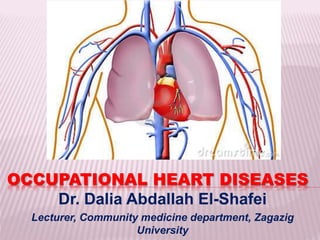
OCCUPATIONAL HEART DISEASES
Dr. Dalia Abdallah El-Shafei
Lecturer, Community medicine department, Zagazig
University
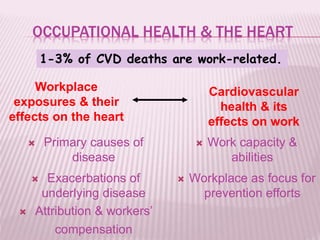
OCCUPATIONAL HEALTH & THE HEART
 Primary causes of
disease
 Exacerbations of
underlying disease
 Attribution & workers’
compensation
 Work capacity &
abilities
 Workplace as focus for
prevention efforts
Workplace
exposures & their
effects on the heart
Cardiovascular
health & its
effects on work
1-3% of CVD deaths are work-related.
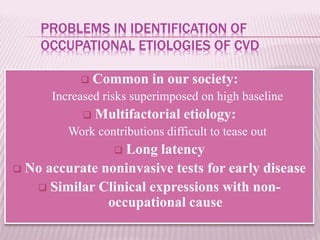
PROBLEMS IN IDENTIFICATION OF
OCCUPATIONAL ETIOLOGIES OF CVD
 Common in our society:
Increased risks superimposed on high baseline
 Multifactorial etiology:
Work contributions difficult to tease out
 Long latency
 No accurate noninvasive tests for early disease
 Similar Clinical expressions with non-
occupational cause
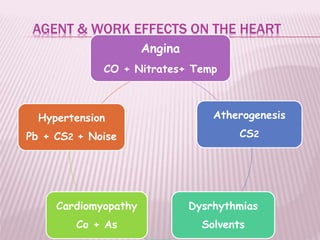
AGENT & WORK EFFECTS ON THE HEART
Angina
CO + Nitrates+ Temp
Atherogenesis
CS2
Dysrhythmias
Solvents
Cardiomyopathy
Co + As
Hypertension
Pb + CS2 + Noise
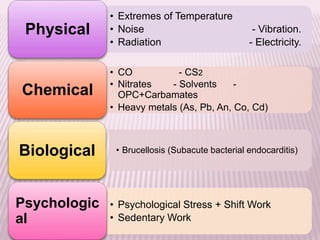
• Extremes of Temperature
• Noise - Vibration.
• Radiation - Electricity.
Physical
• CO - CS2
• Nitrates - Solvents -
OPC+Carbamates
• Heavy metals (As, Pb, An, Co, Cd)
Chemical
Biological
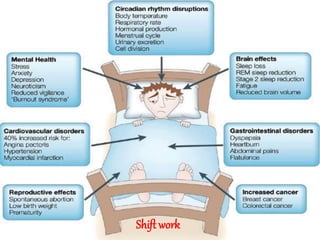
• Psychological Stress + Shift Work
• Sedentary Work
Psychologic
al
• Brucellosis (Subacute bacterial endocarditis)
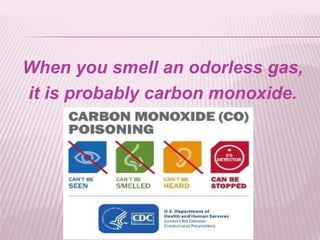
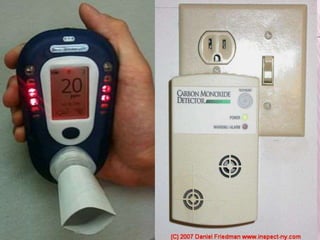
When you smell an odorless gas,
it is probably carbon monoxide.
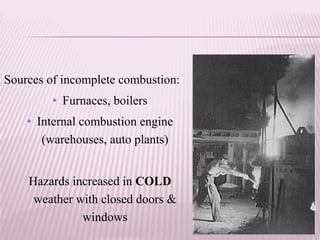
Sources of incomplete combustion:
• Furnaces, boilers
• Internal combustion engine
(warehouses, auto plants)
Hazards increased in COLD
weather with closed doors &
windows
AT RISK OCCUPATIONS
 Fire fighters
 Garage mechanics
 Aircraft refuelers
 Truck Drivers
 Kiln & furnace operators
 Forklift operators
 Janitorial staff
 Disaster relief workers
 Miners
 Parking garage attendants
 Agricultural workers
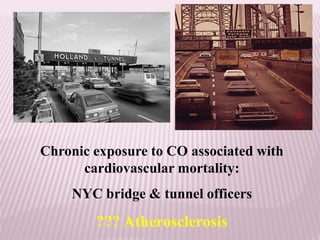
Chronic exposure to CO associated with
cardiovascular mortality:
NYC bridge & tunnel officers
??? Atherosclerosis
DIHALOMETHANES
”“METHYLENE CHLORIDE & BROMIDE
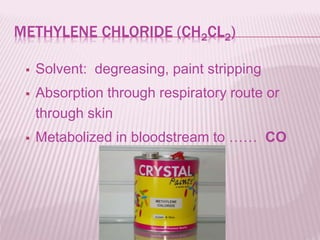
 Solvent: degreasing, paint stripping
 Absorption through respiratory route or
through skin
 Metabolized in bloodstream to …… CO
METHYLENE CHLORIDE (CH2CL2)
May elevate COHb to 10% or more especially in
poorly ventilated space
Probably not significant to healthy person; may
become mildly symptomatic
Cigarette smokers, those with angina or current CHD
a concern: excess CO may trigger symptoms
METHYLENE CHLORIDE
Methylene Chloride
OSHA Standard: 25 ppm/ TWA8: STEL 125 ppm
NIOSH: As low as can be achieved (carcinogen)
Because of metabolic conversion to
CO, the biological life of COHb from
methylene chloride is longer than that
from direct CO exposure
!
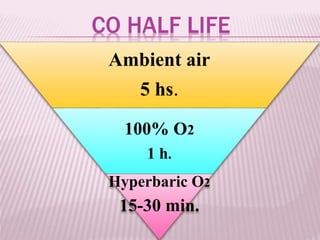
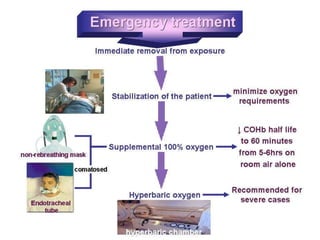
CO HALF LIFE
Ambient air
5 hs.
100% O2
1 h.
Hyperbaric O2
15-30 min.
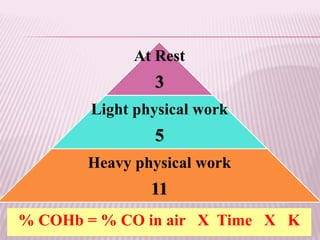
% COHb = % CO in air X Time X K
At Rest
3
Light physical work
5
Heavy physical work
11
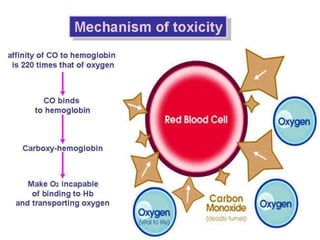
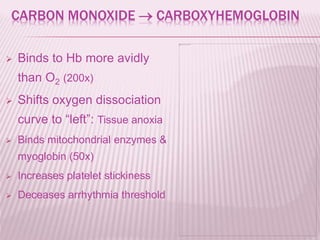
CARBON MONOXIDE  CARBOXYHEMOGLOBIN
 Binds to Hb more avidly
than O2 (200x)
 Shifts oxygen dissociation
curve to “left”: Tissue anoxia
 Binds mitochondrial enzymes &
myoglobin (50x)
 Increases platelet stickiness
 Deceases arrhythmia threshold
CARDIOVASCULAR PHYSIOLOGICAL CHANGES
↓COP + Threshold for
VF.
↑Myocardial LDH
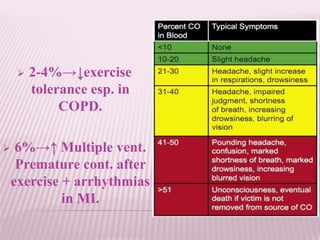
 2-4%→↓exercise
tolerance esp. in
COPD.
 6%→↑ Multiple vent.
Premature cont. after
exercise + arrhythmias
in MI.
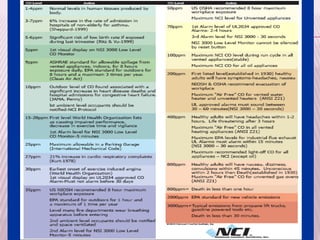
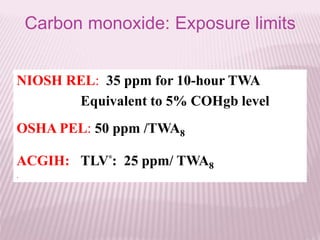
Carbon monoxide: Exposure limits
NIOSH REL: 35 ppm for 10-hour TWA
Equivalent to 5% COHgb level
OSHA PEL: 50 ppm /TWA8
ACGIH: TLV®
: 25 ppm/ TWA8
.
NITRATES
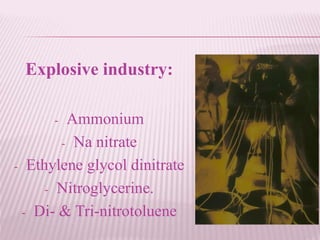
Explosive industry:
- Ammonium
- Na nitrate
- Ethylene glycol dinitrate
- Nitroglycerine.
- Di- & Tri-nitrotoluene
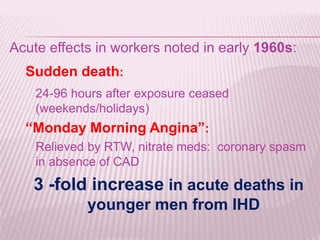
Acute effects in workers noted in early 1960s:
Sudden death:
24-96 hours after exposure ceased
(weekends/holidays)
“Monday Morning Angina”:
Relieved by RTW, nitrate meds: coronary spasm
in absence of CAD
3 -fold increase in acute deaths in
younger men from IHD
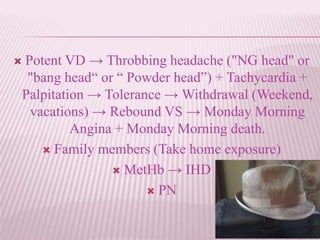
 Potent VD → Throbbing headache ("NG head" or
"bang head“ or “ Powder head”) + Tachycardia +
Palpitation → Tolerance → Withdrawal (Weekend,
vacations) → Rebound VS → Monday Morning
Angina + Monday Morning death.
 Family members (Take home exposure)
 MetHb → IHD
 PN
CARBON DISULFIDE (CS2)
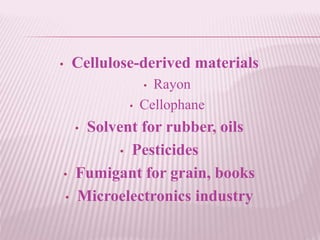
• Cellulose-derived materials
• Rayon
• Cellophane
• Solvent for rubber, oils
• Pesticides
• Fumigant for grain, books
• Microelectronics industry
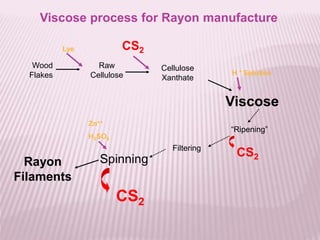
Wood
Flakes
Raw
Cellulose
Cellulose
Xanthate
Viscose
Filtering
“Ripening”
SpinningRayon
Filaments
Zn++
H2SO4
CS2
CS2Lye
CS2
H + Solution
Viscose process for Rayon manufacture
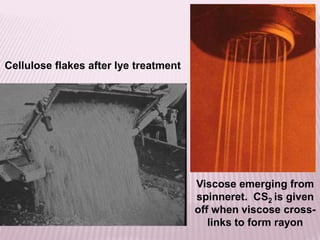
Cellulose flakes after lye treatment
Viscose emerging from
spinneret. CS2 is given
off when viscose cross-
links to form rayon
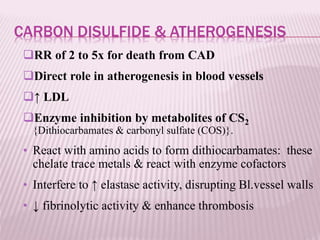
RR of 2 to 5x for death from CAD
Direct role in atherogenesis in blood vessels
↑ LDL
Enzyme inhibition by metabolites of CS2
{Dithiocarbamates & carbonyl sulfate (COS)}.
• React with amino acids to form dithiocarbamates: these
chelate trace metals & react with enzyme cofactors
• Interfere to ↑ elastase activity, disrupting Bl.vessel walls
• ↓ fibrinolytic activity & enhance thrombosis
CARBON DISULFIDE & ATHEROGENESIS
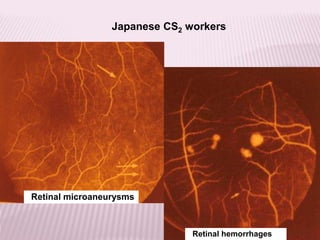
Japanese CS2 workers
Retinal hemorrhages
Retinal microaneurysms
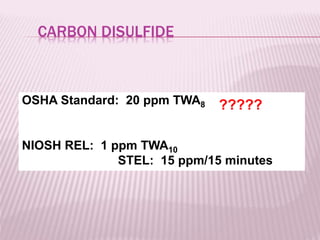
CARBON DISULFIDE
OSHA Standard: 20 ppm TWA8 ?????
NIOSH REL: 1 ppm TWA10
STEL: 15 ppm/15 minutes
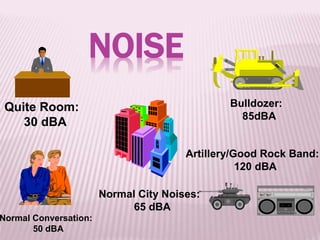
NOISE
Bulldozer:
85dBA
Quite Room:
30 dBA
Normal Conversation:
50 dBA
Normal City Noises:
65 dBA
Artillery/Good Rock Band:
120 dBA
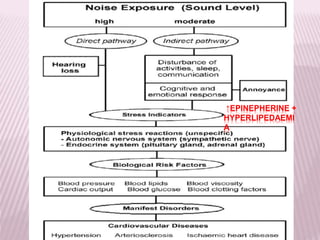
↑EPINEPHERINE +
HYPERLIPEDAEMI
A
Each ↑5 dB → ↑ 0.5 mmHg in systolic Bl.pr
42
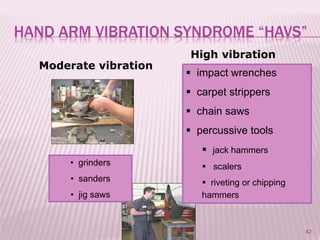
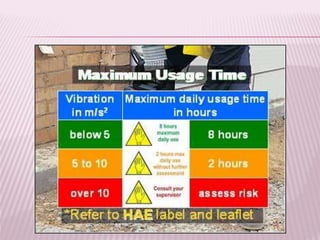
Moderate vibration
High vibration
 impact wrenches
 carpet strippers
 chain saws
 percussive tools
 jack hammers
 scalers
 riveting or chipping
hammers
• grinders
• sanders
• jig saws
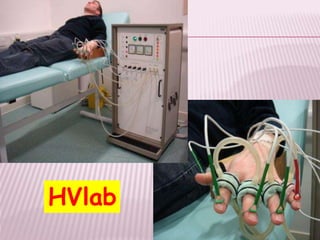
HAND ARM VIBRATION SYNDROME “HAVS”
43
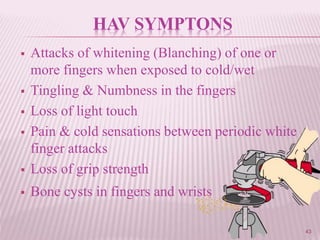
HAV SYMPTONS
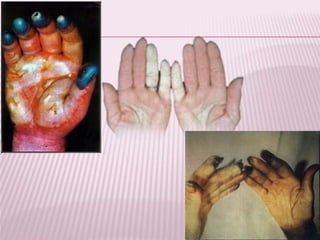
 Attacks of whitening (Blanching) of one or
more fingers when exposed to cold/wet
 Tingling & Numbness in the fingers
 Loss of light touch
 Pain & cold sensations between periodic white
finger attacks
 Loss of grip strength
 Bone cysts in fingers and wrists
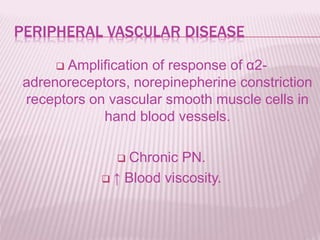
PERIPHERAL VASCULAR DISEASE
 Amplification of response of α2-
adrenoreceptors, norepinepherine constriction
receptors on vascular smooth muscle cells in
hand blood vessels.
 Chronic PN.
 ↑ Blood viscosity.
HVlab
EXTREMES OF TEMPERATURE
 Acute coronary artery disease
→ IHD → Angina + MI
 Exacerbate heart problems.
 Atherosclerosis
 Idiopathic dilated cardiomyopathy.
 Cold → Slow myocardial repolarization +
VF
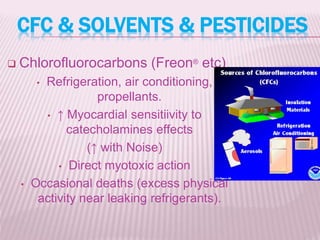
CFC & SOLVENTS & PESTICIDES
 Chlorofluorocarbons (Freon® etc)
• Refrigeration, air conditioning,
propellants.
• ↑ Myocardial sensitiivity to
catecholamines effects
(↑ with Noise)
• Direct myotoxic action
• Occasional deaths (excess physical
activity near leaking refrigerants).
 Other solvents implicated in sudden death
(first noted in solvent abusers & glue
sniffers):
 Trichloroethylene, Trichloromethan,
Perchloroethylene, Toluene, Benzene, Xylene,
Gasoline.
 Halogenated derivatives of aliphatic
hydrocarbons are more active than corresponding
hydrocarbons (Tetrachloroethan more active than
Ethan)
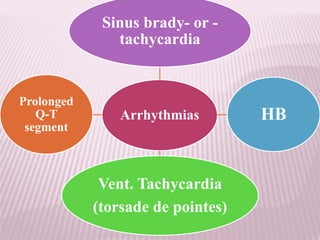
Arrhythmias
Sinus brady- or -
tachycardia
HB
Vent. Tachycardia
(torsade de pointes)
Prolonged
Q-T
segment
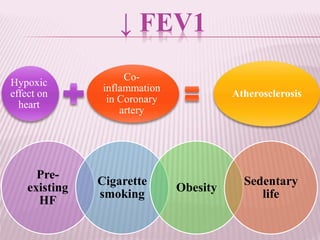
↓ FEV1
Hypoxic
effect on
heart
Co-
inflammation
in Coronary
artery
Atherosclerosis
Pre-
existing
HF
Cigarette
smoking
Obesity
Sedentary
life
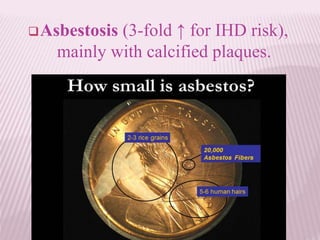
Asbestosis (3-fold ↑ for IHD risk),
mainly with calcified plaques.
COBALT
 Cobalt: used to stabilize beer foam
(1960’s: Canada, Belgium)
 Cardiomyopathy reported in beer
drinkers several months afterward
(Quebecois beer drinkers)
Dose-related: seen in heavy drinkers
greatest risk in those drinking >10L/day (!)
22 - 50% mortality in some series
Why this group?????
CM not seen in cobalt therapy for
anemia
Probable synergistic effect with Alcohol
& Poor Diet
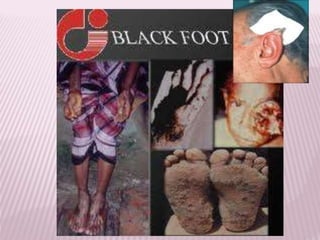
ARSENIC
 Cardiomyopathy (beer drinkers of As contaminated
beer “2-4 ppm”) → congestive HF
 Peripheral vascular disease:
- 0.8-1.8 ppm As contamination of drinking water in
Chile & Taiwan “Normal <0.01” → Black foot
syndrome “Arteriosclerosis + Thrombangitis
obliterans + Hyperpigmentations + Keratosis +
Gangrene”
 HTN
 IHD “2-3 fold ↑”
 Vasospastic “Raynaud” disease.
 Arrhythmias “ Torsade de pointes”
ANTIMONY&CADMIUM&LEAD
Lead:
 HTN, probable mechanism is via renal injury
 May also increase vascular tone and
resistance
Chelation may improve HTN in acute
intoxication, but not reverse with longstanding
renal damage Cadmium
 HTN; occur at levels below nephrotoxic dose
Antimony
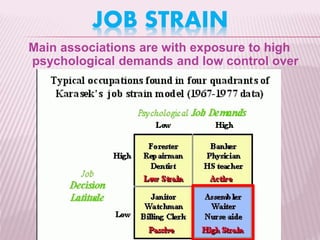
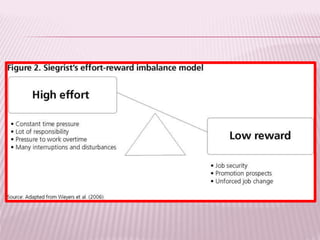
JOB STRAIN
Main associations are with exposure to high
psychological demands and low control over
job
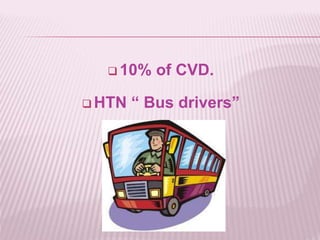
 10% of CVD.
 HTN “ Bus drivers”
Shift work
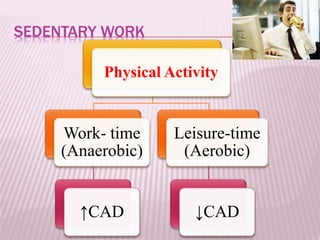
SEDENTARY WORK
Physical Activity
Work- time
(Anaerobic)
↑CAD
Leisure-time
(Aerobic)
↓CAD
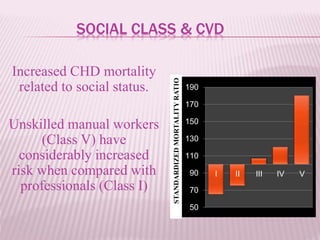
SOCIAL CLASS & CVD
Increased CHD mortality
related to social status.
Unskilled manual workers
(Class V) have
considerably increased
risk when compared with
professionals (Class I)
50
70
90
110
130
150
170
190
I II III IV VSTANDARDIZEDMORTALITYRATIO
Occupational heart diseases

Occupational heart diseases

  • 1.
    OCCUPATIONAL HEART DISEASES Dr.Dalia Abdallah El-Shafei Lecturer, Community medicine department, Zagazig University
  • 2.
    OCCUPATIONAL HEALTH &THE HEART  Primary causes of disease  Exacerbations of underlying disease  Attribution & workers’ compensation  Work capacity & abilities  Workplace as focus for prevention efforts Workplace exposures & their effects on the heart Cardiovascular health & its effects on work 1-3% of CVD deaths are work-related.
  • 3.
    PROBLEMS IN IDENTIFICATIONOF OCCUPATIONAL ETIOLOGIES OF CVD  Common in our society: Increased risks superimposed on high baseline  Multifactorial etiology: Work contributions difficult to tease out  Long latency  No accurate noninvasive tests for early disease  Similar Clinical expressions with non- occupational cause
  • 4.
    AGENT & WORKEFFECTS ON THE HEART Angina CO + Nitrates+ Temp Atherogenesis CS2 Dysrhythmias Solvents Cardiomyopathy Co + As Hypertension Pb + CS2 + Noise
  • 5.
    • Extremes ofTemperature • Noise - Vibration. • Radiation - Electricity. Physical • CO - CS2 • Nitrates - Solvents - OPC+Carbamates • Heavy metals (As, Pb, An, Co, Cd) Chemical Biological • Psychological Stress + Shift Work • Sedentary Work Psychologic al • Brucellosis (Subacute bacterial endocarditis)
  • 7.
    When you smellan odorless gas, it is probably carbon monoxide.
  • 9.
    Sources of incompletecombustion: • Furnaces, boilers • Internal combustion engine (warehouses, auto plants) Hazards increased in COLD weather with closed doors & windows
  • 10.
    AT RISK OCCUPATIONS Fire fighters  Garage mechanics  Aircraft refuelers  Truck Drivers  Kiln & furnace operators  Forklift operators  Janitorial staff  Disaster relief workers  Miners  Parking garage attendants  Agricultural workers
  • 11.
    Chronic exposure toCO associated with cardiovascular mortality: NYC bridge & tunnel officers ??? Atherosclerosis
  • 12.
  • 13.
     Solvent: degreasing,paint stripping  Absorption through respiratory route or through skin  Metabolized in bloodstream to …… CO METHYLENE CHLORIDE (CH2CL2)
  • 14.
    May elevate COHbto 10% or more especially in poorly ventilated space Probably not significant to healthy person; may become mildly symptomatic Cigarette smokers, those with angina or current CHD a concern: excess CO may trigger symptoms METHYLENE CHLORIDE
  • 15.
    Methylene Chloride OSHA Standard:25 ppm/ TWA8: STEL 125 ppm NIOSH: As low as can be achieved (carcinogen) Because of metabolic conversion to CO, the biological life of COHb from methylene chloride is longer than that from direct CO exposure !
  • 16.
    CO HALF LIFE Ambientair 5 hs. 100% O2 1 h. Hyperbaric O2 15-30 min.
  • 18.
    % COHb =% CO in air X Time X K At Rest 3 Light physical work 5 Heavy physical work 11
  • 19.
    CARBON MONOXIDE CARBOXYHEMOGLOBIN  Binds to Hb more avidly than O2 (200x)  Shifts oxygen dissociation curve to “left”: Tissue anoxia  Binds mitochondrial enzymes & myoglobin (50x)  Increases platelet stickiness  Deceases arrhythmia threshold
  • 22.
    CARDIOVASCULAR PHYSIOLOGICAL CHANGES ↓COP+ Threshold for VF. ↑Myocardial LDH
  • 23.
     2-4%→↓exercise tolerance esp.in COPD.  6%→↑ Multiple vent. Premature cont. after exercise + arrhythmias in MI.
  • 25.
    Carbon monoxide: Exposurelimits NIOSH REL: 35 ppm for 10-hour TWA Equivalent to 5% COHgb level OSHA PEL: 50 ppm /TWA8 ACGIH: TLV® : 25 ppm/ TWA8 .
  • 27.
  • 28.
    Explosive industry: - Ammonium -Na nitrate - Ethylene glycol dinitrate - Nitroglycerine. - Di- & Tri-nitrotoluene
  • 29.
    Acute effects inworkers noted in early 1960s: Sudden death: 24-96 hours after exposure ceased (weekends/holidays) “Monday Morning Angina”: Relieved by RTW, nitrate meds: coronary spasm in absence of CAD 3 -fold increase in acute deaths in younger men from IHD
  • 30.
     Potent VD→ Throbbing headache ("NG head" or "bang head“ or “ Powder head”) + Tachycardia + Palpitation → Tolerance → Withdrawal (Weekend, vacations) → Rebound VS → Monday Morning Angina + Monday Morning death.  Family members (Take home exposure)  MetHb → IHD  PN
  • 31.
  • 32.
    • Cellulose-derived materials •Rayon • Cellophane • Solvent for rubber, oils • Pesticides • Fumigant for grain, books • Microelectronics industry
  • 33.
  • 34.
    Cellulose flakes afterlye treatment Viscose emerging from spinneret. CS2 is given off when viscose cross- links to form rayon
  • 35.
    RR of 2to 5x for death from CAD Direct role in atherogenesis in blood vessels ↑ LDL Enzyme inhibition by metabolites of CS2 {Dithiocarbamates & carbonyl sulfate (COS)}. • React with amino acids to form dithiocarbamates: these chelate trace metals & react with enzyme cofactors • Interfere to ↑ elastase activity, disrupting Bl.vessel walls • ↓ fibrinolytic activity & enhance thrombosis CARBON DISULFIDE & ATHEROGENESIS
  • 36.
    Japanese CS2 workers Retinalhemorrhages Retinal microaneurysms
  • 37.
    CARBON DISULFIDE OSHA Standard:20 ppm TWA8 ????? NIOSH REL: 1 ppm TWA10 STEL: 15 ppm/15 minutes
  • 38.
    NOISE Bulldozer: 85dBA Quite Room: 30 dBA NormalConversation: 50 dBA Normal City Noises: 65 dBA Artillery/Good Rock Band: 120 dBA
  • 40.
  • 41.
    Each ↑5 dB→ ↑ 0.5 mmHg in systolic Bl.pr
  • 42.
    42 Moderate vibration High vibration impact wrenches  carpet strippers  chain saws  percussive tools  jack hammers  scalers  riveting or chipping hammers • grinders • sanders • jig saws HAND ARM VIBRATION SYNDROME “HAVS”
  • 43.
    43 HAV SYMPTONS  Attacksof whitening (Blanching) of one or more fingers when exposed to cold/wet  Tingling & Numbness in the fingers  Loss of light touch  Pain & cold sensations between periodic white finger attacks  Loss of grip strength  Bone cysts in fingers and wrists
  • 45.
    PERIPHERAL VASCULAR DISEASE Amplification of response of α2- adrenoreceptors, norepinepherine constriction receptors on vascular smooth muscle cells in hand blood vessels.  Chronic PN.  ↑ Blood viscosity.
  • 46.
  • 48.
    EXTREMES OF TEMPERATURE Acute coronary artery disease → IHD → Angina + MI  Exacerbate heart problems.  Atherosclerosis  Idiopathic dilated cardiomyopathy.  Cold → Slow myocardial repolarization + VF
  • 49.
    CFC & SOLVENTS& PESTICIDES  Chlorofluorocarbons (Freon® etc) • Refrigeration, air conditioning, propellants. • ↑ Myocardial sensitiivity to catecholamines effects (↑ with Noise) • Direct myotoxic action • Occasional deaths (excess physical activity near leaking refrigerants).
  • 50.
     Other solventsimplicated in sudden death (first noted in solvent abusers & glue sniffers):  Trichloroethylene, Trichloromethan, Perchloroethylene, Toluene, Benzene, Xylene, Gasoline.  Halogenated derivatives of aliphatic hydrocarbons are more active than corresponding hydrocarbons (Tetrachloroethan more active than Ethan)
  • 51.
    Arrhythmias Sinus brady- or- tachycardia HB Vent. Tachycardia (torsade de pointes) Prolonged Q-T segment
  • 52.
    ↓ FEV1 Hypoxic effect on heart Co- inflammation inCoronary artery Atherosclerosis Pre- existing HF Cigarette smoking Obesity Sedentary life
  • 53.
    Asbestosis (3-fold ↑for IHD risk), mainly with calcified plaques.
  • 54.
    COBALT  Cobalt: usedto stabilize beer foam (1960’s: Canada, Belgium)  Cardiomyopathy reported in beer drinkers several months afterward (Quebecois beer drinkers)
  • 55.
    Dose-related: seen inheavy drinkers greatest risk in those drinking >10L/day (!) 22 - 50% mortality in some series Why this group????? CM not seen in cobalt therapy for anemia Probable synergistic effect with Alcohol & Poor Diet
  • 56.
    ARSENIC  Cardiomyopathy (beerdrinkers of As contaminated beer “2-4 ppm”) → congestive HF  Peripheral vascular disease: - 0.8-1.8 ppm As contamination of drinking water in Chile & Taiwan “Normal <0.01” → Black foot syndrome “Arteriosclerosis + Thrombangitis obliterans + Hyperpigmentations + Keratosis + Gangrene”  HTN  IHD “2-3 fold ↑”  Vasospastic “Raynaud” disease.  Arrhythmias “ Torsade de pointes”
  • 58.
    ANTIMONY&CADMIUM&LEAD Lead:  HTN, probablemechanism is via renal injury  May also increase vascular tone and resistance Chelation may improve HTN in acute intoxication, but not reverse with longstanding renal damage Cadmium  HTN; occur at levels below nephrotoxic dose Antimony
  • 59.
    JOB STRAIN Main associationsare with exposure to high psychological demands and low control over job
  • 61.
     10% ofCVD.  HTN “ Bus drivers”
  • 62.
  • 63.
    SEDENTARY WORK Physical Activity Work-time (Anaerobic) ↑CAD Leisure-time (Aerobic) ↓CAD
  • 64.
    SOCIAL CLASS &CVD Increased CHD mortality related to social status. Unskilled manual workers (Class V) have considerably increased risk when compared with professionals (Class I) 50 70 90 110 130 150 170 190 I II III IV VSTANDARDIZEDMORTALITYRATIO