AMPHETAMINE
TOXICITY
S. Arunkumar, IVth Pharm.D.,
J.K.K. Nattraja College of Pharmacy,
Tamilnadu, India.
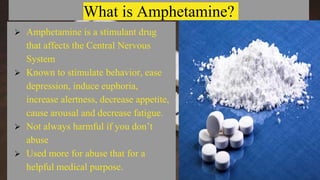
What is Amphetamine?
 Amphetamine is a stimulant drug
that affects the Central Nervous
System
 Known to stimulate behavior, ease
depression, induce euphoria,
increase alertness, decrease appetite,
cause arousal and decrease fatigue.
 Not always harmful if you don’t
abuse
 Used more for abuse that for a
helpful medical purpose.
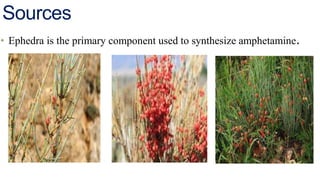
Sources
• Ephedra is the primary component used to synthesize amphetamine.
Mechanism of action
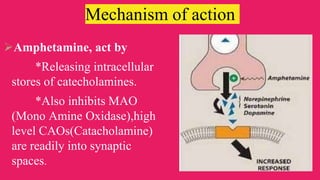
Amphetamine, act by
*Releasing intracellular
stores of catecholamines.
*Also inhibits MAO
(Mono Amine Oxidase),high
level CAOs(Catacholamine)
are readily into synaptic
spaces.
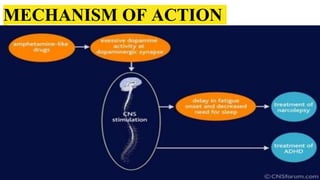
MECHANISM OF ACTION
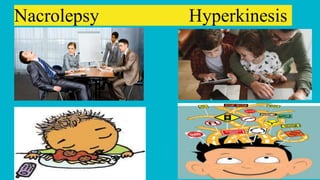
Nacrolepsy Hyperkinesis
Pharmacological class: CNS stimulants
Mechanism of Action:-
Activates noradrenergic neurons, causing CNS and respiratory stimulation;
stimulates satiety center in brain, causing appetite suppression.
Indications:-
Narcolepsy; attention deficit disorder with hyperactivity; short-term (ie, few
weeks) exogenous obesity adjunct used only when alternative therapy has been
ineffective.
Dose:-
Narcolepsy
ADULTS & CHILDREN > 12 YR: PO 10 mg/day; may be increased weekly
by 10 mg to max of 60 mg/day in divided doses. CHILDREN 6 TO 12 YR: PO
5 mg/day; may be increased weekly by 5 mg to max of 60 mg/day in divided
doses.
Summery:-
Contraindication:-
Advanced Arteriosclerosis; Symptomatic Cardiovascular Disease;
Moderate To Severe Hypertension; Hyperthyroidism; Hypersensitivity
Glaucoma; Agitated States; History Of Drug Abuse.
AMPHATAMINE TOXICITY
TOXICOKINETICS:-
ABSORPTION:- IV or IM – 30 minutes. In oral – 2-3 hours.
DISTRIBUTION:- In Plasma
METABOLISM :- Liver (Minor Amount)
EXCREATION:- Most commonly unchanged form. The excretion of
unchanged amphetamine is dependent on pH, and at urine pH less than
6.6, a range of 67 to 73% of unchanged drug is excreted in the urine.
Etiology of Amphetamine toxicity:
Social stress
Emotional behavior
Friends and relatives
Overdose
Improper counseling
Military
Sports
Pilots ( longer time working and short time sleep)
Students ( believe that increase concentration, alertness,
alert to studying).
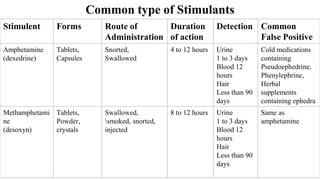
Stimulent Forms Route of
Administration
Duration
of action
Detection Common
False Positive
Amphetamine
(dexedrine)
Tablets,
Capsules
Snorted,
Swallowed
4 to 12 hours Urine
1 to 3 days
Blood 12
hours
Hair
Less than 90
days
Cold medications
containing
Pseudoephedrine,
Phenylephrine,
Herbal
supplements
containing ephedra
Methamphetami
ne
(desoxyn)
Tablets,
Powder,
crystals
Swallowed,
smoked, snorted,
injected
8 to 12 hours Urine
1 to 3 days
Blood 12
hours
Hair
Less than 90
days
Same as
amphetamine
Common type of Stimulants
Epidemiology:
The worldwide prevalence of amphetamine use is estimated to be 0.3%
to 1.1% as per the United Nations Office of Drugs and Crime data from
2013. Misuse of Amphetamine and METH has been increasing in the
United States as the hospital admissions increased by more than 500%
between 1992 and 2002. Men have a higher prevalence of amphetamine
misuse compared to women. The overall prevalence of amphetamine use
in the United States in individuals aged 12 or older was 4.7% in 2013 as
per the National Survey of Drug Use and Health.[5][5]
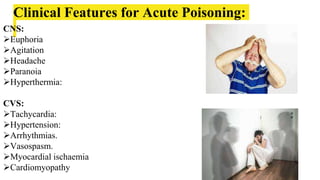
Clinical Features for Acute Poisoning:
CNS:
Euphoria
Agitation
Headache
Paranoia
Hyperthermia:
CVS:
Tachycardia:
Hypertension:
Arrhythmias.
Vasospasm.
Myocardial ischaemia
Cardiomyopathy
Clinical features for Chronic Poisoning
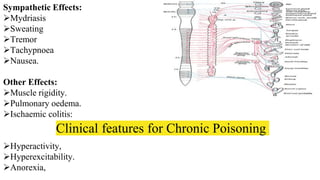
Sympathetic Effects:
Mydriasis
Sweating
Tremor
Tachypnoea
Nausea.
Other Effects:
Muscle rigidity.
Pulmonary oedema.
Ischaemic colitis:
Hyperactivity,
Hyperexcitability.
Anorexia,
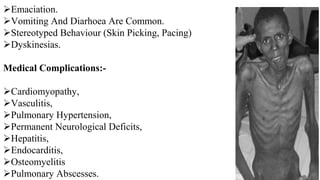
Emaciation.
Vomiting And Diarhoea Are Common.
Stereotyped Behaviour (Skin Picking, Pacing)
Dyskinesias.
Medical Complications:-
Cardiomyopathy,
Vasculitis,
Pulmonary Hypertension,
Permanent Neurological Deficits,
Hepatitis,
Endocarditis,
Osteomyelitis
Pulmonary Abscesses.
Usual Fatal Dose:-
Methamphetamine - 28 mg/Kg and for Amphetamine’s - 150 Mg To 2 Grams.
However, Because of Tolerance, Addicts Can Tolerate Up To 5 Grams (Single IV
Dose), Or 15 gm/Day (Smoke able Methamphetamine).
Death Due To Amphetamine Toxicity Most Commonly Results From Arrhythmias,
Hyperthermia, Or Intracerebral Damage.
Complication:-
Hyperthermia
Rhabdomyolysis
Liver and kidney damage
Cognitive deficit
Death
Diagnosis:-
1. Urine Is The Specimen of Choice. Levels Above 2 Mg/100 Ml
Indicate Acute Toxicity. Methods Of Analysis Include TLC, RIA,
HPLC, And GC-MS.
2. Hair Analysis May Provide Documentation Of Methamphetamine or
Other Drug Exposure For Several Months Or Longer.
3. A New Method (Electron-impact Mass Fragmentography)
Enables Detection And Even Quantitation Of Meth and amphetamine In
Hair, Nails, Sweat, And Saliva
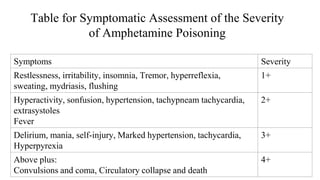
Symptoms Severity
Restlessness, irritability, insomnia, Tremor, hyperreflexia,
sweating, mydriasis, flushing
1+
Hyperactivity, sonfusion, hypertension, tachypneam tachycardia,
extrasystoles
Fever
2+
Delirium, mania, self-injury, Marked hypertension, tachycardia,
Hyperpyrexia
3+
Above plus:
Convulsions and coma, Circulatory collapse and death
4+
Table for Symptomatic Assessment of the Severity
of Amphetamine Poisoning
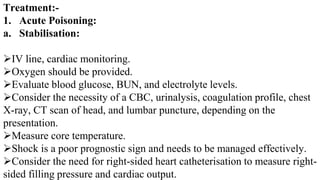
Treatment:-
1. Acute Poisoning:
a. Stabilisation:
IV line, cardiac monitoring.
Oxygen should be provided.
Evaluate blood glucose, BUN, and electrolyte levels.
Consider the necessity of a CBC, urinalysis, coagulation profile, chest
X-ray, CT scan of head, and lumbar puncture, depending on the
presentation.
Measure core temperature.
Shock is a poor prognostic sign and needs to be managed effectively.
Consider the need for right-sided heart catheterisation to measure right-
sided filling pressure and cardiac output.
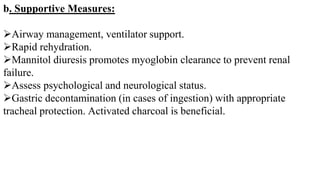
b. Supportive Measures:
Airway management, ventilator support.
Rapid rehydration.
Mannitol diuresis promotes myoglobin clearance to prevent renal
failure.
Assess psychological and neurological status.
Gastric decontamination (in cases of ingestion) with appropriate
tracheal protection. Activated charcoal is beneficial.
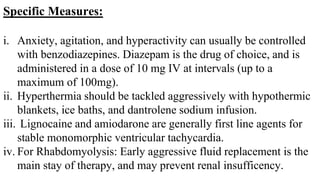
Specific Measures:
i. Anxiety, agitation, and hyperactivity can usually be controlled
with benzodiazepines. Diazepam is the drug of choice, and is
administered in a dose of 10 mg IV at intervals (up to a
maximum of 100mg).
ii. Hyperthermia should be tackled aggressively with hypothermic
blankets, ice baths, and dantrolene sodium infusion.
iii. Lignocaine and amiodarone are generally first line agents for
stable monomorphic ventricular tachycardia.
iv. For Rhabdomyolysis: Early aggressive fluid replacement is the
main stay of therapy, and may prevent renal insufficency.
v. Diazepam and chlorpromazine have been effective in
treating amphetamine-induced chorea.
vi. No specific antidotes for Amphetamine poisoning.
vii. The drugs like Imipramine and fluoxetine [adjuvent
pharmacological agents to treat the symptoms, but
results are disappointing.]
viii. Those with moderately dependence can be treated on an
Outpatient basis without using drugs.
Prevention:
Parents can help prevent teen drug abuse by speaking to their children
about the dangers of drugs and alcohol. Children whose parents speak to
them about the risks of substance abuse and parents who tell their
children their expectations are that drugs are not to be used are 50% less
likely to use than children whose parents never address the topic.
More than 50% of prescription medications that people abuse are
obtained from a friend or relative. Never give your prescription
medication to anyone else. Let teens know it's not safe to take another
person's prescription medication. Secure prescription medications at
home and discard any extra
medication no longer being used to lower the risk of misuse
and abuse by others..
Rehabilitation:-
 The Substance Abuse and Mental Health Services
Administration (SAMHSA) offers a Behavioral Health
Treatment Facility Locator to help you find alcohol and
substance abuse treatment facilities in your area can reach the
Suicide Prevention Lifeline for suicide prevention and other
problems. The phone number is1800-11-0031.
Reference:-
 Espelin, D. E., & Done, A. K. (1968). Amphetamine Poisoning.
New England Journal of Medicine, 278(25), 1364-1365.
 https://www.slideshare.net/obydullah/amphetaminefinalpptx
 https://www.slideshare.net/AngelYoanna/amphetamine-84673712
 https://www.slideshare.net/jameswheeler001/amphetamine-
toxicity
 Anand, Jacek & Krzyzanowski, Maciej & Jankowski, Zbigniew.
(2014). Acute methoxetamine and amphetamine poisoning with
fatal outcome: A case report. International journal of occupational
medicine and environmental health. 27. 10.2478/s13382-014-
0290-8.
References:-
Textbook of Substance Abuse written by Lowinson and Ruiz,
edition-5..
Textbook of modern medical toxicology written by V. V. Pilley,
4th edition.
Ellenhorn MJ. Amphetamines and designer drugs. In: Medical
Toxicology: Diagnosis and Treatment of Human Poisoning. 2nd edn,.
Lan KC, Lin YF, Yu FC: Clinical manifestations and prognostic
features of acute methamphetamine intoxication. J Formos Med
Assoc 1998;97:528-33.
Richards JR, Bretz SW, Johnson EB: Metamphetamine abuse and
emergency department utilization. West J Med 1999;170:198- 202.
Amphetamine toxicity slideshare

Amphetamine toxicity slideshare

  • 1.
    AMPHETAMINE TOXICITY S. Arunkumar, IVthPharm.D., J.K.K. Nattraja College of Pharmacy, Tamilnadu, India.
  • 2.
    What is Amphetamine? Amphetamine is a stimulant drug that affects the Central Nervous System  Known to stimulate behavior, ease depression, induce euphoria, increase alertness, decrease appetite, cause arousal and decrease fatigue.  Not always harmful if you don’t abuse  Used more for abuse that for a helpful medical purpose.
  • 3.
    Sources • Ephedra isthe primary component used to synthesize amphetamine.
  • 4.
    Mechanism of action Amphetamine,act by *Releasing intracellular stores of catecholamines. *Also inhibits MAO (Mono Amine Oxidase),high level CAOs(Catacholamine) are readily into synaptic spaces.
  • 5.
  • 6.
  • 7.
    Pharmacological class: CNSstimulants Mechanism of Action:- Activates noradrenergic neurons, causing CNS and respiratory stimulation; stimulates satiety center in brain, causing appetite suppression. Indications:- Narcolepsy; attention deficit disorder with hyperactivity; short-term (ie, few weeks) exogenous obesity adjunct used only when alternative therapy has been ineffective. Dose:- Narcolepsy ADULTS & CHILDREN > 12 YR: PO 10 mg/day; may be increased weekly by 10 mg to max of 60 mg/day in divided doses. CHILDREN 6 TO 12 YR: PO 5 mg/day; may be increased weekly by 5 mg to max of 60 mg/day in divided doses. Summery:-
  • 8.
    Contraindication:- Advanced Arteriosclerosis; SymptomaticCardiovascular Disease; Moderate To Severe Hypertension; Hyperthyroidism; Hypersensitivity Glaucoma; Agitated States; History Of Drug Abuse. AMPHATAMINE TOXICITY TOXICOKINETICS:- ABSORPTION:- IV or IM – 30 minutes. In oral – 2-3 hours. DISTRIBUTION:- In Plasma METABOLISM :- Liver (Minor Amount) EXCREATION:- Most commonly unchanged form. The excretion of unchanged amphetamine is dependent on pH, and at urine pH less than 6.6, a range of 67 to 73% of unchanged drug is excreted in the urine.
  • 9.
    Etiology of Amphetaminetoxicity: Social stress Emotional behavior Friends and relatives Overdose Improper counseling Military Sports Pilots ( longer time working and short time sleep) Students ( believe that increase concentration, alertness, alert to studying).
  • 10.
    Stimulent Forms Routeof Administration Duration of action Detection Common False Positive Amphetamine (dexedrine) Tablets, Capsules Snorted, Swallowed 4 to 12 hours Urine 1 to 3 days Blood 12 hours Hair Less than 90 days Cold medications containing Pseudoephedrine, Phenylephrine, Herbal supplements containing ephedra Methamphetami ne (desoxyn) Tablets, Powder, crystals Swallowed, smoked, snorted, injected 8 to 12 hours Urine 1 to 3 days Blood 12 hours Hair Less than 90 days Same as amphetamine Common type of Stimulants
  • 11.
    Epidemiology: The worldwide prevalenceof amphetamine use is estimated to be 0.3% to 1.1% as per the United Nations Office of Drugs and Crime data from 2013. Misuse of Amphetamine and METH has been increasing in the United States as the hospital admissions increased by more than 500% between 1992 and 2002. Men have a higher prevalence of amphetamine misuse compared to women. The overall prevalence of amphetamine use in the United States in individuals aged 12 or older was 4.7% in 2013 as per the National Survey of Drug Use and Health.[5][5]
  • 12.
    Clinical Features forAcute Poisoning: CNS: Euphoria Agitation Headache Paranoia Hyperthermia: CVS: Tachycardia: Hypertension: Arrhythmias. Vasospasm. Myocardial ischaemia Cardiomyopathy
  • 13.
    Clinical features forChronic Poisoning Sympathetic Effects: Mydriasis Sweating Tremor Tachypnoea Nausea. Other Effects: Muscle rigidity. Pulmonary oedema. Ischaemic colitis: Hyperactivity, Hyperexcitability. Anorexia,
  • 14.
    Emaciation. Vomiting And DiarhoeaAre Common. Stereotyped Behaviour (Skin Picking, Pacing) Dyskinesias. Medical Complications:- Cardiomyopathy, Vasculitis, Pulmonary Hypertension, Permanent Neurological Deficits, Hepatitis, Endocarditis, Osteomyelitis Pulmonary Abscesses.
  • 15.
    Usual Fatal Dose:- Methamphetamine- 28 mg/Kg and for Amphetamine’s - 150 Mg To 2 Grams. However, Because of Tolerance, Addicts Can Tolerate Up To 5 Grams (Single IV Dose), Or 15 gm/Day (Smoke able Methamphetamine). Death Due To Amphetamine Toxicity Most Commonly Results From Arrhythmias, Hyperthermia, Or Intracerebral Damage. Complication:- Hyperthermia Rhabdomyolysis Liver and kidney damage Cognitive deficit Death
  • 16.
    Diagnosis:- 1. Urine IsThe Specimen of Choice. Levels Above 2 Mg/100 Ml Indicate Acute Toxicity. Methods Of Analysis Include TLC, RIA, HPLC, And GC-MS. 2. Hair Analysis May Provide Documentation Of Methamphetamine or Other Drug Exposure For Several Months Or Longer. 3. A New Method (Electron-impact Mass Fragmentography) Enables Detection And Even Quantitation Of Meth and amphetamine In Hair, Nails, Sweat, And Saliva
  • 17.
    Symptoms Severity Restlessness, irritability,insomnia, Tremor, hyperreflexia, sweating, mydriasis, flushing 1+ Hyperactivity, sonfusion, hypertension, tachypneam tachycardia, extrasystoles Fever 2+ Delirium, mania, self-injury, Marked hypertension, tachycardia, Hyperpyrexia 3+ Above plus: Convulsions and coma, Circulatory collapse and death 4+ Table for Symptomatic Assessment of the Severity of Amphetamine Poisoning
  • 18.
    Treatment:- 1. Acute Poisoning: a.Stabilisation: IV line, cardiac monitoring. Oxygen should be provided. Evaluate blood glucose, BUN, and electrolyte levels. Consider the necessity of a CBC, urinalysis, coagulation profile, chest X-ray, CT scan of head, and lumbar puncture, depending on the presentation. Measure core temperature. Shock is a poor prognostic sign and needs to be managed effectively. Consider the need for right-sided heart catheterisation to measure right- sided filling pressure and cardiac output.
  • 19.
    b. Supportive Measures: Airwaymanagement, ventilator support. Rapid rehydration. Mannitol diuresis promotes myoglobin clearance to prevent renal failure. Assess psychological and neurological status. Gastric decontamination (in cases of ingestion) with appropriate tracheal protection. Activated charcoal is beneficial.
  • 20.
    Specific Measures: i. Anxiety,agitation, and hyperactivity can usually be controlled with benzodiazepines. Diazepam is the drug of choice, and is administered in a dose of 10 mg IV at intervals (up to a maximum of 100mg). ii. Hyperthermia should be tackled aggressively with hypothermic blankets, ice baths, and dantrolene sodium infusion. iii. Lignocaine and amiodarone are generally first line agents for stable monomorphic ventricular tachycardia. iv. For Rhabdomyolysis: Early aggressive fluid replacement is the main stay of therapy, and may prevent renal insufficency.
  • 21.
    v. Diazepam andchlorpromazine have been effective in treating amphetamine-induced chorea. vi. No specific antidotes for Amphetamine poisoning. vii. The drugs like Imipramine and fluoxetine [adjuvent pharmacological agents to treat the symptoms, but results are disappointing.] viii. Those with moderately dependence can be treated on an Outpatient basis without using drugs.
  • 22.
    Prevention: Parents can helpprevent teen drug abuse by speaking to their children about the dangers of drugs and alcohol. Children whose parents speak to them about the risks of substance abuse and parents who tell their children their expectations are that drugs are not to be used are 50% less likely to use than children whose parents never address the topic. More than 50% of prescription medications that people abuse are obtained from a friend or relative. Never give your prescription medication to anyone else. Let teens know it's not safe to take another person's prescription medication. Secure prescription medications at home and discard any extra
  • 23.
    medication no longerbeing used to lower the risk of misuse and abuse by others.. Rehabilitation:-  The Substance Abuse and Mental Health Services Administration (SAMHSA) offers a Behavioral Health Treatment Facility Locator to help you find alcohol and substance abuse treatment facilities in your area can reach the Suicide Prevention Lifeline for suicide prevention and other problems. The phone number is1800-11-0031.
  • 24.
    Reference:-  Espelin, D.E., & Done, A. K. (1968). Amphetamine Poisoning. New England Journal of Medicine, 278(25), 1364-1365.  https://www.slideshare.net/obydullah/amphetaminefinalpptx  https://www.slideshare.net/AngelYoanna/amphetamine-84673712  https://www.slideshare.net/jameswheeler001/amphetamine- toxicity  Anand, Jacek & Krzyzanowski, Maciej & Jankowski, Zbigniew. (2014). Acute methoxetamine and amphetamine poisoning with fatal outcome: A case report. International journal of occupational medicine and environmental health. 27. 10.2478/s13382-014- 0290-8.
  • 25.
    References:- Textbook of SubstanceAbuse written by Lowinson and Ruiz, edition-5.. Textbook of modern medical toxicology written by V. V. Pilley, 4th edition. Ellenhorn MJ. Amphetamines and designer drugs. In: Medical Toxicology: Diagnosis and Treatment of Human Poisoning. 2nd edn,. Lan KC, Lin YF, Yu FC: Clinical manifestations and prognostic features of acute methamphetamine intoxication. J Formos Med Assoc 1998;97:528-33. Richards JR, Bretz SW, Johnson EB: Metamphetamine abuse and emergency department utilization. West J Med 1999;170:198- 202.