Toxicology
Shamril
Pravin
Hanis
Table of Content
• Introduction
• History
• Definition of terms
• Route of exposure
• Classification
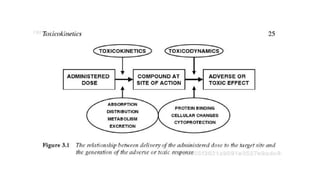
• Toxicokinetic & Toxicodynamic
• Risk Assessment
• Management
• Examples
Introduction
History
• Phillip von Hohenheim (1493 -1541),(Paracelcius) was an alchemist, physician,astrologer and
known as the“ father of toxicology“ “All things are poison and nothing is
without poison, only the dose permits something not to be
poisonous.”
Definition Of Terms
• Toxin
• Toxic substances that are produced naturally (nature origin)
• Toxic
• This term relates to poisonous or deadly effects on the body
• Toxicants
• Any chemical that can injure or kill humans, animals, or plants; a poison
• Toxicity
• Describes the degree to which a substance is poisonous or can cause injury.
The toxicity depends on a variety of factors: dose, duration and route of
exposure, shape and structure of the chemical itself, and individual human
factors.
What is Toxicology
• Science of poison The study of how natural or man-made poisons
cause undesirable effects in living organisms.
• Poison  any substance that can cause severe injury or death, with
excessive exposure
• Sub-disciplines of Toxicology
• Environmental Toxicology , Occupational (Industrial) Toxicology, Regulatory
Toxicology, Food Toxicology, Clinical Toxicology, Forensic Toxicology and
others.
Occupational Toxicology
• Involved with health effects from exposure to chemicals in the
workplace
• This field grew out of a need to save workers from toxic substances
and to make their work environment safe.
Exposure
• Exposure Concentration of chemical involved and frequency of its
interaction with people
• Degree of exposure determined during risk assessment
• Excessive Exposure The amount of exposure that lead to injury or
adverse effects e.g. Median Lethal Dose (LD50) of Ethanol is &7000
mg/kg, it means that by ingesting 7000 mg/kg Ethanol, half of the rat
population in the experiment died
Injury
• Adverse effects abnormal, undesirable harmful change following
exposure
• Irreversible Change & causes damage – 1. Toxic, 2. Harmful
• Reversible change – 3. Harmless
• Injury depends on = property of chemical + nature of exposure +
health & developmental state of the person
Route of Exposure
Routes of Exposure
• Skin & mucous membrane
• Lung (Inhalation)
• Ingestion
• Eye
Routes of Exposure
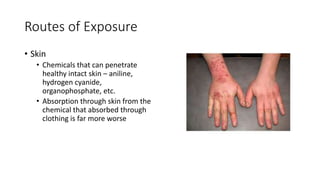
• Skin
• Chemicals that can penetrate
healthy intact skin – aniline,
hydrogen cyanide,
organophosphate, etc.
• Absorption through skin from the
chemical that absorbed through
clothing is far more worse
Routes of Exposure
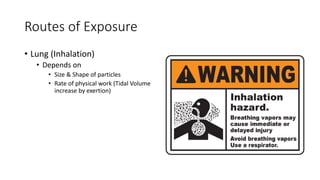
• Lung (Inhalation)
• Depends on
• Size & Shape of particles
• Rate of physical work (Tidal Volume
increase by exertion)
Routes of Exposure (Lung)
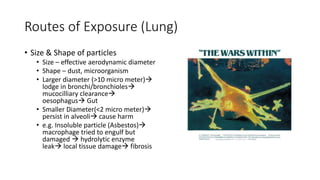
• Size & Shape of particles
• Size – effective aerodynamic diameter
• Shape – dust, microorganism
• Larger diameter (>10 micro meter)
lodge in bronchi/bronchioles
mucocilliary clearance
oesophagus Gut
• Smaller Diameter(<2 micro meter)
persist in alveoli cause harm
• e.g. Insoluble particle (Asbestos)
macrophage tried to engulf but
damaged  hydrolytic enzyme
leak local tissue damage fibrosis
Routes of Exposure (Lung)
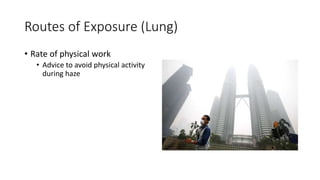
• Rate of physical work
• Advice to avoid physical activity
during haze
Routes of Exposure
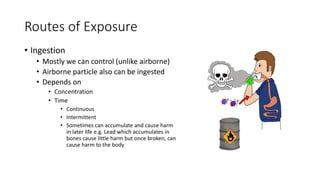
• Ingestion
• Mostly we can control (unlike airborne)
• Airborne particle also can be ingested
• Depends on
• Concentration
• Time
• Continuous
• Intermittent
• Sometimes can accumulate and cause harm
in later life e.g. Lead which accumulates in
bones cause little harm but once broken, can
cause harm to the body
Adverse effect
• Characteristics
• Local
• Systemic
• Both Local & Systemic e.g. Allergic reaction
• Accumulation
• Chemical e.g. Adipose tissue accumulate organochloride pesticide and does not
cause harm
• Damage e.g. death of nerve cell following repetitive exposure
• Factors
• Balance between Absorption and excretion
• Balance between injury and repair
• Immediate or delayed effect
• Reversible or irreversible
Adverse effect
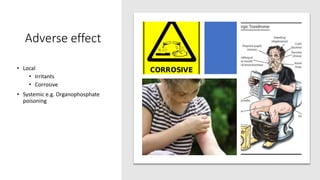
• Local
• Irritants
• Corrosive
• Systemic e.g. Organophosphate
poisoning
Chemical Interaction
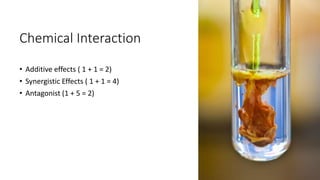
• Additive effects ( 1 + 1 = 2)
• Synergistic Effects ( 1 + 1 = 4)
• Antagonist (1 + 5 = 2)
Tolerance and resistance
• Decrease in sensitivity to a chemical following exposure
• Resistance  complete insensitivity towards chemical
Classification
Classification of toxic agents
• Toxic substances are classified into the following
1. Heavy Metals
2. Solvents and Vapours
3. Radiation and Radioactive Materials
4. Dioxin/Furans
5. Pesticides
6. Plant Toxins
7. Animal Toxins
Effect of toxic agents (Heavy metal)
• Arsenic
• Inorganic arsenic is a known carcinogen and can cause cancer of the skin,
lungs, liver and bladder
• Barium
• Barium is not known to cause cancer
• Short term exposure can cause vomiting, abdominal cramps, diarrhoea,
difficulties in breathing, increased or decreased blood pressure, numbness
around the face, and muscle weakness
• Large amounts of barium intake can cause, high blood pressure, changes in
heart rhythm or paralysis and possibly death.
Effect of toxic agents (Heavy metal)
• Cadmium
• Cadmium and cadmium compounds are known human carcinogens
• Smokers get exposed to significantly higher cadmium levels than non-smokers
• Severe damage to the lungs may occur through breathing high levels of
cadmium
• Lead
• Exposure to high lead levels can severely damage the brain and kidneys and
ultimately cause death
• In pregnant women, high levels of exposure to lead may cause miscarriage
• High level exposure in men can damage the organs responsible for sperm
production.
Effect of toxic agents (Heavy metal)
• Mercury
• Exposure to high levels can permanently damage the brain, kidneys, and
developing foetuses
• Effects on brain functioning may result in irritability, shyness, tremors,
changes in vision or hearing, and memory problems
• Selenium
• Chronic oral exposure to high concentrations can produce selenosis
• Major signs of selenosis are hair loss, nail brittleness, and neurological
abnormalities
• Brief exposures to high levels in air can result in respiratory tract irritation,
bronchitis, difficulty breathing, and stomach pains
• Longer-term exposure can cause respiratory irritation, bronchial spasms, and
coughing.
Effect of toxic agents (Solvent and vapours)
• Benzene
• Benzene enters the body through inhalation and it may pass through the skin
• Exposure to low concentrations may cause dizziness, lightheadedness,
headache, loss of appetite and stomach upset
• High exposures to benzene may cause irregularities in the heart beat which
can lead to death
• It has carcinogenic effect as well.
Effect of toxic agents (Solvent and vapours)
• carcinogens (e.g., benzene, carbon tetrachloride, trichloroethylene)
• reproductive hazards (e.g., 2-ethoxyethanol, 2-methoxyethanol,
methyl chloride)
• neurotoxins (e.g., n-hexane, tetrachloroethylene, toluene)
Effect of toxic agents (Radiation and
radioactive material)
• Short-Term Health Effects of Radiation Exposure and Contamination
• Acute Radiation Syndrome (ARS) a serious illness that can happen when a
person is exposed to very high levels of radiation, usually over a short period
of time.
• Symptoms of ARS may include nausea, vomiting, headache, and diarrhea
• Long-Term Health Effects of Radiation Exposure and Contamination
• Cancer
• Prenatal radiation exposure
• Mental health
Effect of toxic agents (Dioxin/ furans)
• Short-term exposure of humans to high levels of dioxins may result in
skin lesions, such as chloracne and patchy darkening of the skin, and
altered liver function
• Long-term exposure is linked to impairment of the immune system,
the developing nervous system, the endocrine system and
reproductive functions.
Effect of toxic agents (Pesticides)
• Organochlorines  cause a loss of sensation around the mouth,
hypersensitivity to light, sound, and touch, dizziness, tremors, nausea,
vomiting, nervousness, and confusion
• Organophosphates and Carbamates  causes signs and symptoms
of excess acetylcholine, such as increased salivation and perspiration,
narrowing of the pupils, nausea, diarrhea, decrease in blood pressure,
muscle weakness, and fatigue
• Pyrethroids  Pyrethroids can cause an allergic skin response, and
some pyrethroids may cause cancer, reproductive or developmental
effects, or endocrine system effects
Effect of toxic agents (Plant toxins)
Plants produce a range of chemicals designed to fend off predators or
discourage consumption by insects or animals.
• Philodendron, poison ivy, cashew  allergic dermatitis
• Grasses allergic rhinitis
• Lily family, glory lily, crocus, horse chestnut  affects the GIT tract
Effect of toxic agents (Plant toxins)
• Red alga (red tide), green alga, mushrooms, Coffee bean, tea, cola
nut mint family  affects the nervous system
• Fungus that grows on peanuts, walnuts  liver cancer
• Legumes (Astrogalus); bitter melon seeds (Momordica)  affects
the reproductive system
Effect of toxic agents (Animal toxins)
These toxins can result from venomous or poisonous animal releases
• For examples
• scorpions, spiders , ticks  produces neurotoxin
• Rattlesnakes, cobras, coral snakes  produces very complex enzyme-based
venoms and neurotoxin
Toxicokinetic & Toxicodynamic
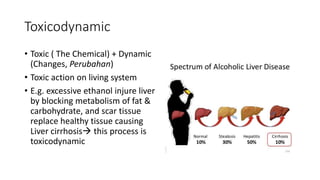
Toxicodynamic
• Toxic ( The Chemical) + Dynamic
(Changes, Perubahan)
• Toxic action on living system
• E.g. excessive ethanol injure liver
by blocking metabolism of fat &
carbohydrate, and scar tissue
replace healthy tissue causing
Liver cirrhosis this process is
toxicodynamic
Toxicodynamic
• Dose-Toxicity relationship
• Dose-effect relationship
• Biological effect monitoring
• Dose –Response relationship
• Acute & Chronic effects
• Toxicity testing & health risk
Toxicity Testing
• Dose-Response and Concentration response relationship
• Fixed dose testing
• Toxic
• Very Toxic
• Harmful
Dose-Response
relationship
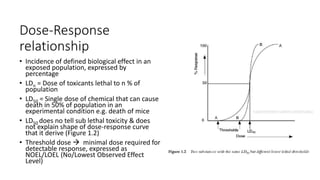
• Incidence of defined biological effect in an
exposed population, expressed by
percentage
• LDn = Dose of toxicants lethal to n % of
population
• LD50 = Single dose of chemical that can cause
death in 50% of population in an
experimental condition e.g. death of mice
• LD50 does no tell sub lethal toxicity & does
not explain shape of dose-response curve
that it derive (Figure 1.2)
• Threshold dose  minimal dose required for
detectable response, expressed as
NOEL/LOEL (No/Lowest Observed Effect
Level)
Toxicokinetic
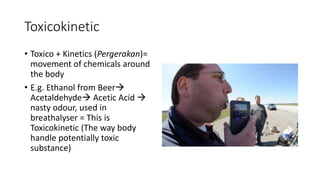
• Toxico + Kinetics (Pergerakan)=
movement of chemicals around
the body
• E.g. Ethanol from Beer
Acetaldehyde Acetic Acid 
nasty odour, used in
breathalyser = This is
Toxicokinetic (The way body
handle potentially toxic
substance)
Toxicokinetic
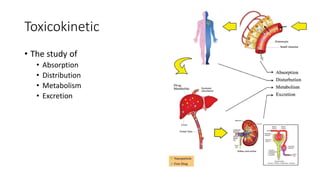
• The study of
• Absorption
• Distribution
• Metabolism
• Excretion
Toxicokinetic
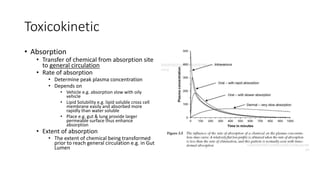
• Absorption
• Transfer of chemical from absorption site
to general circulation
• Rate of absorption
• Determine peak plasma concentration
• Depends on
• Vehicle e.g. absorption slow with oily
vehicle
• Lipid Solubility e.g. lipid soluble cross cell
membrane easily and absorbed more
rapidly than water soluble
• Place e.g. gut & lung provide larger
permeable surface thus enhance
absorption
• Extent of absorption
• The extent of chemical being transformed
prior to reach general circulation e.g. in Gut
Lumen
Toxicokinetic
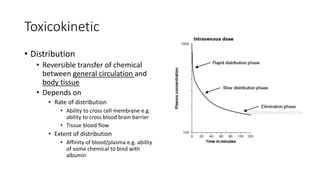
• Distribution
• Reversible transfer of chemical
between general circulation and
body tissue
• Depends on
• Rate of distribution
• Ability to cross cell membrane e.g.
ability to cross blood brain barrier
• Tissue blood flow
• Extent of distribution
• Affinity of blood/plasma e.g. ability
of some chemical to bind with
albumin
Toxicokinetic
• Metabolism
• Biotransformation (Usually Liver)
• Elimination
• Elimination rate – Half life
• What determine the rate
• Capacity & ability of the organ ( Liver,
Kidney, Lung)
• Extent of distribution
• Clearance = rate of
elimination/plasma concentration
Risk Asessment
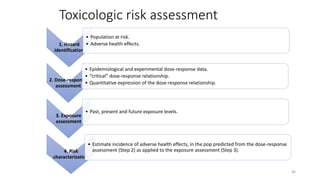
Toxicologic risk assessment
1. Hazard
identification
• Population at risk.
• Adverse health effects.
2. Dose-response
assessment
• Epidemiological and experimental dose-response data.
• “critical” dose-response relationship.
• Quantitative expression of the dose-response relationship.
3. Exposure
assessment
• Past, present and future exposure levels.
4. Risk
characterization
• Estimate incidence of adverse health effects, in the pop predicted from the dose-response
assessment (Step 2) as applied to the exposure assessment (Step 3).
46
Management
• At presentation
• History from all reliable source (patients, family,co-workers)
• Physical examination
• Lab investigation for suspected toxin
History Taking
• History is the most valuable tool.
• In some patient (comatose, drowsy, atered conciousness), family,
friends, relative,1st medical personel on scene should be questioned.
• All suspected possible toxins should not be missed
• When possible, patient’s house and workplace should be examined
(not only for toxins but also other things like recrational drugs, empty
medicine container or suicide note)
`
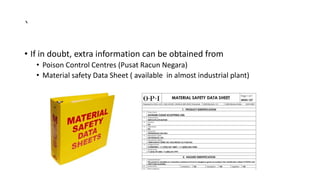
• If in doubt, extra information can be obtained from
• Poison Control Centres (Pusat Racun Negara)
• Material safety Data Sheet ( available in almost industrial plant)
Physical examination
• Starts with the examination of vital signs ( GCs, BP, HR etc).
• Then check for signs suggesting of toxicity
• Ingested/absorbed toxin –look for systemic manifestation
• Corrosive toxin –check for GI tract
• Skin contact- acute cutaneus syndrome (blister,rashes, pain)
• Inhalated toxin
• Water soluble ( eg ammonia ,Chlorine) –upper airways symptoms
• Less water soluble (phosgene)- look for lower airway symptoms
• In some cases of toxicity (especially chronic esposure to toxin), the altered
conciousness can be due to other causes like hepatic enchelopathy,
Wernicke encelopathy and hypoglycemia.
Labaratory testing
• Can be qualitative or quantitative
• Currently, lack of standard readily available test to identify all the
toxins
• Measurement of toxin blood level can help in maanagement
Management (not sure if all done in Malaysia
setting)
• Stabilization
• Maintain airway, breathing, circulation
• Pt without pulse, BP requird resuscitation
• Mechanical ventilation might be needed depending on cases
• IV fluids
• Topical Decontamination
• Any body surface (plus eyes) that are exposed to toxin is flushed with large
amount of saline or water
• Contaminated clothing, ewellery, accessories should be removed
• Acticated charcoal (in suspected oral toxicity)
• Should be given as early as possible
• Has not been proven to reduce mortality/morbididy
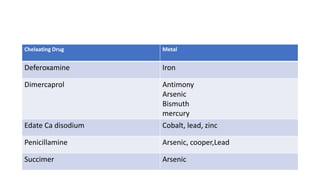
• Chelating agent-in metal toxicicty cases
Chelaating Drug Metal
Deferoxamine Iron
Dimercaprol Antimony
Arsenic
Bismuth
mercury
Edate Ca disodium Cobalt, lead, zinc
Penicillamine Arsenic, cooper,Lead
Succimer Arsenic
• Dialysis
• common in ethylene glycol, lithium,methanol,and salicylates poisoning
• Less effective if
• Toxin is large/charged molecule
• Bound strongly to protein
• Has large volume of distribution
• Intentional use of toxin need psychiatric evaluation
Examples
58
Farmers and Farm Personnel
Potential exposures to toxicants resulting from:
• Fertilizer use
• Equipment use
• The use of pesticides and fumigants
• Animal confinement facilities
• Silo
59
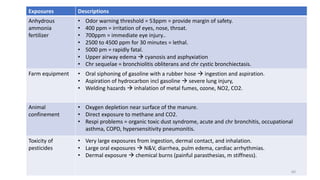
Exposures Descriptions
Anhydrous
ammonia
fertilizer
• Odor warning threshold = 53ppm = provide margin of safety.
• 400 ppm = irritation of eyes, nose, throat.
• 700ppm = immediate eye injury..
• 2500 to 4500 ppm for 30 minutes = lethal.
• 5000 pm = rapidly fatal.
• Upper airway edema  cyanosis and asphyxiation
• Chr sequelae = bronchiolitis obliterans and chr cystic bronchiectasis.
Farm equipment • Oral siphoning of gasoline with a rubber hose  ingestion and aspiration.
• Aspiration of hydrocarbon incl gasoline  severe lung injury,
• Welding hazards  inhalation of metal fumes, ozone, NO2, CO2.
Animal
confinement
• Oxygen depletion near surface of the manure.
• Direct exposure to methane and CO2.
• Respi problems = organic toxic dust syndrome, acute and chr bronchitis, occupational
asthma, COPD, hypersensitivity pneumonitis.
Toxicity of
pesticides
• Very large exposures from ingestion, dermal contact, and inhalation.
• Large oral exposures  N&V, diarrhea, pulm edema, cardiac arrhythmias.
• Dermal exposure  chemical burns (painful parasthesias, m stiffness).
60
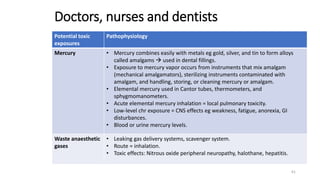
Doctors, nurses and dentists
Potential toxic
exposures
Pathophysiology
Mercury • Mercury combines easily with metals eg gold, silver, and tin to form alloys
called amalgams  used in dental fillings.
• Exposure to mercury vapor occurs from instruments that mix amalgam
(mechanical amalgamators), sterilizing instruments contaminated with
amalgam, and handling, storing, or cleaning mercury or amalgam.
• Elemental mercury used in Cantor tubes, thermometers, and
sphygmomanometers.
• Acute elemental mercury inhalation = local pulmonary toxicity.
• Low-level chr exposure = CNS effects eg weakness, fatigue, anorexia, GI
disturbances.
• Blood or urine mercury levels.
Waste anaesthetic
gases
• Leaking gas delivery systems, scavenger system.
• Route = inhalation.
• Toxic effects: Nitrous oxide peripheral neuropathy, halothane, hepatitis.
61
General Principals
• Elimination
• Subsitution
• Isolation
• Engineering control
• Admin Control
• PPE
• Legislation
62
Introduction to Toxicology

Introduction to Toxicology

  • 1.
  • 2.
    Table of Content •Introduction • History • Definition of terms • Route of exposure • Classification • Toxicokinetic & Toxicodynamic • Risk Assessment • Management • Examples
  • 3.
  • 4.
    History • Phillip vonHohenheim (1493 -1541),(Paracelcius) was an alchemist, physician,astrologer and known as the“ father of toxicology“ “All things are poison and nothing is without poison, only the dose permits something not to be poisonous.”
  • 5.
    Definition Of Terms •Toxin • Toxic substances that are produced naturally (nature origin) • Toxic • This term relates to poisonous or deadly effects on the body • Toxicants • Any chemical that can injure or kill humans, animals, or plants; a poison • Toxicity • Describes the degree to which a substance is poisonous or can cause injury. The toxicity depends on a variety of factors: dose, duration and route of exposure, shape and structure of the chemical itself, and individual human factors.
  • 6.
    What is Toxicology •Science of poison The study of how natural or man-made poisons cause undesirable effects in living organisms. • Poison  any substance that can cause severe injury or death, with excessive exposure • Sub-disciplines of Toxicology • Environmental Toxicology , Occupational (Industrial) Toxicology, Regulatory Toxicology, Food Toxicology, Clinical Toxicology, Forensic Toxicology and others.
  • 7.
    Occupational Toxicology • Involvedwith health effects from exposure to chemicals in the workplace • This field grew out of a need to save workers from toxic substances and to make their work environment safe.
  • 8.
    Exposure • Exposure Concentrationof chemical involved and frequency of its interaction with people • Degree of exposure determined during risk assessment • Excessive Exposure The amount of exposure that lead to injury or adverse effects e.g. Median Lethal Dose (LD50) of Ethanol is &7000 mg/kg, it means that by ingesting 7000 mg/kg Ethanol, half of the rat population in the experiment died
  • 9.
    Injury • Adverse effectsabnormal, undesirable harmful change following exposure • Irreversible Change & causes damage – 1. Toxic, 2. Harmful • Reversible change – 3. Harmless • Injury depends on = property of chemical + nature of exposure + health & developmental state of the person
  • 10.
  • 11.
    Routes of Exposure •Skin & mucous membrane • Lung (Inhalation) • Ingestion • Eye
  • 12.
    Routes of Exposure •Skin • Chemicals that can penetrate healthy intact skin – aniline, hydrogen cyanide, organophosphate, etc. • Absorption through skin from the chemical that absorbed through clothing is far more worse
  • 13.
    Routes of Exposure •Lung (Inhalation) • Depends on • Size & Shape of particles • Rate of physical work (Tidal Volume increase by exertion)
  • 14.
    Routes of Exposure(Lung) • Size & Shape of particles • Size – effective aerodynamic diameter • Shape – dust, microorganism • Larger diameter (>10 micro meter) lodge in bronchi/bronchioles mucocilliary clearance oesophagus Gut • Smaller Diameter(<2 micro meter) persist in alveoli cause harm • e.g. Insoluble particle (Asbestos) macrophage tried to engulf but damaged  hydrolytic enzyme leak local tissue damage fibrosis
  • 15.
    Routes of Exposure(Lung) • Rate of physical work • Advice to avoid physical activity during haze
  • 16.
    Routes of Exposure •Ingestion • Mostly we can control (unlike airborne) • Airborne particle also can be ingested • Depends on • Concentration • Time • Continuous • Intermittent • Sometimes can accumulate and cause harm in later life e.g. Lead which accumulates in bones cause little harm but once broken, can cause harm to the body
  • 17.
    Adverse effect • Characteristics •Local • Systemic • Both Local & Systemic e.g. Allergic reaction • Accumulation • Chemical e.g. Adipose tissue accumulate organochloride pesticide and does not cause harm • Damage e.g. death of nerve cell following repetitive exposure • Factors • Balance between Absorption and excretion • Balance between injury and repair • Immediate or delayed effect • Reversible or irreversible
  • 18.
    Adverse effect • Local •Irritants • Corrosive • Systemic e.g. Organophosphate poisoning
  • 19.
    Chemical Interaction • Additiveeffects ( 1 + 1 = 2) • Synergistic Effects ( 1 + 1 = 4) • Antagonist (1 + 5 = 2)
  • 20.
    Tolerance and resistance •Decrease in sensitivity to a chemical following exposure • Resistance  complete insensitivity towards chemical
  • 21.
  • 22.
    Classification of toxicagents • Toxic substances are classified into the following 1. Heavy Metals 2. Solvents and Vapours 3. Radiation and Radioactive Materials 4. Dioxin/Furans 5. Pesticides 6. Plant Toxins 7. Animal Toxins
  • 23.
    Effect of toxicagents (Heavy metal) • Arsenic • Inorganic arsenic is a known carcinogen and can cause cancer of the skin, lungs, liver and bladder • Barium • Barium is not known to cause cancer • Short term exposure can cause vomiting, abdominal cramps, diarrhoea, difficulties in breathing, increased or decreased blood pressure, numbness around the face, and muscle weakness • Large amounts of barium intake can cause, high blood pressure, changes in heart rhythm or paralysis and possibly death.
  • 24.
    Effect of toxicagents (Heavy metal) • Cadmium • Cadmium and cadmium compounds are known human carcinogens • Smokers get exposed to significantly higher cadmium levels than non-smokers • Severe damage to the lungs may occur through breathing high levels of cadmium • Lead • Exposure to high lead levels can severely damage the brain and kidneys and ultimately cause death • In pregnant women, high levels of exposure to lead may cause miscarriage • High level exposure in men can damage the organs responsible for sperm production.
  • 25.
    Effect of toxicagents (Heavy metal) • Mercury • Exposure to high levels can permanently damage the brain, kidneys, and developing foetuses • Effects on brain functioning may result in irritability, shyness, tremors, changes in vision or hearing, and memory problems • Selenium • Chronic oral exposure to high concentrations can produce selenosis • Major signs of selenosis are hair loss, nail brittleness, and neurological abnormalities • Brief exposures to high levels in air can result in respiratory tract irritation, bronchitis, difficulty breathing, and stomach pains • Longer-term exposure can cause respiratory irritation, bronchial spasms, and coughing.
  • 26.
    Effect of toxicagents (Solvent and vapours) • Benzene • Benzene enters the body through inhalation and it may pass through the skin • Exposure to low concentrations may cause dizziness, lightheadedness, headache, loss of appetite and stomach upset • High exposures to benzene may cause irregularities in the heart beat which can lead to death • It has carcinogenic effect as well.
  • 27.
    Effect of toxicagents (Solvent and vapours) • carcinogens (e.g., benzene, carbon tetrachloride, trichloroethylene) • reproductive hazards (e.g., 2-ethoxyethanol, 2-methoxyethanol, methyl chloride) • neurotoxins (e.g., n-hexane, tetrachloroethylene, toluene)
  • 28.
    Effect of toxicagents (Radiation and radioactive material) • Short-Term Health Effects of Radiation Exposure and Contamination • Acute Radiation Syndrome (ARS) a serious illness that can happen when a person is exposed to very high levels of radiation, usually over a short period of time. • Symptoms of ARS may include nausea, vomiting, headache, and diarrhea • Long-Term Health Effects of Radiation Exposure and Contamination • Cancer • Prenatal radiation exposure • Mental health
  • 29.
    Effect of toxicagents (Dioxin/ furans) • Short-term exposure of humans to high levels of dioxins may result in skin lesions, such as chloracne and patchy darkening of the skin, and altered liver function • Long-term exposure is linked to impairment of the immune system, the developing nervous system, the endocrine system and reproductive functions.
  • 30.
    Effect of toxicagents (Pesticides) • Organochlorines  cause a loss of sensation around the mouth, hypersensitivity to light, sound, and touch, dizziness, tremors, nausea, vomiting, nervousness, and confusion • Organophosphates and Carbamates  causes signs and symptoms of excess acetylcholine, such as increased salivation and perspiration, narrowing of the pupils, nausea, diarrhea, decrease in blood pressure, muscle weakness, and fatigue • Pyrethroids  Pyrethroids can cause an allergic skin response, and some pyrethroids may cause cancer, reproductive or developmental effects, or endocrine system effects
  • 31.
    Effect of toxicagents (Plant toxins) Plants produce a range of chemicals designed to fend off predators or discourage consumption by insects or animals. • Philodendron, poison ivy, cashew  allergic dermatitis • Grasses allergic rhinitis • Lily family, glory lily, crocus, horse chestnut  affects the GIT tract
  • 32.
    Effect of toxicagents (Plant toxins) • Red alga (red tide), green alga, mushrooms, Coffee bean, tea, cola nut mint family  affects the nervous system • Fungus that grows on peanuts, walnuts  liver cancer • Legumes (Astrogalus); bitter melon seeds (Momordica)  affects the reproductive system
  • 33.
    Effect of toxicagents (Animal toxins) These toxins can result from venomous or poisonous animal releases • For examples • scorpions, spiders , ticks  produces neurotoxin • Rattlesnakes, cobras, coral snakes  produces very complex enzyme-based venoms and neurotoxin
  • 34.
  • 35.
    Toxicodynamic • Toxic (The Chemical) + Dynamic (Changes, Perubahan) • Toxic action on living system • E.g. excessive ethanol injure liver by blocking metabolism of fat & carbohydrate, and scar tissue replace healthy tissue causing Liver cirrhosis this process is toxicodynamic
  • 36.
    Toxicodynamic • Dose-Toxicity relationship •Dose-effect relationship • Biological effect monitoring • Dose –Response relationship • Acute & Chronic effects • Toxicity testing & health risk
  • 37.
    Toxicity Testing • Dose-Responseand Concentration response relationship • Fixed dose testing • Toxic • Very Toxic • Harmful
  • 38.
    Dose-Response relationship • Incidence ofdefined biological effect in an exposed population, expressed by percentage • LDn = Dose of toxicants lethal to n % of population • LD50 = Single dose of chemical that can cause death in 50% of population in an experimental condition e.g. death of mice • LD50 does no tell sub lethal toxicity & does not explain shape of dose-response curve that it derive (Figure 1.2) • Threshold dose  minimal dose required for detectable response, expressed as NOEL/LOEL (No/Lowest Observed Effect Level)
  • 40.
    Toxicokinetic • Toxico +Kinetics (Pergerakan)= movement of chemicals around the body • E.g. Ethanol from Beer Acetaldehyde Acetic Acid  nasty odour, used in breathalyser = This is Toxicokinetic (The way body handle potentially toxic substance)
  • 41.
    Toxicokinetic • The studyof • Absorption • Distribution • Metabolism • Excretion
  • 42.
    Toxicokinetic • Absorption • Transferof chemical from absorption site to general circulation • Rate of absorption • Determine peak plasma concentration • Depends on • Vehicle e.g. absorption slow with oily vehicle • Lipid Solubility e.g. lipid soluble cross cell membrane easily and absorbed more rapidly than water soluble • Place e.g. gut & lung provide larger permeable surface thus enhance absorption • Extent of absorption • The extent of chemical being transformed prior to reach general circulation e.g. in Gut Lumen
  • 43.
    Toxicokinetic • Distribution • Reversibletransfer of chemical between general circulation and body tissue • Depends on • Rate of distribution • Ability to cross cell membrane e.g. ability to cross blood brain barrier • Tissue blood flow • Extent of distribution • Affinity of blood/plasma e.g. ability of some chemical to bind with albumin
  • 44.
    Toxicokinetic • Metabolism • Biotransformation(Usually Liver) • Elimination • Elimination rate – Half life • What determine the rate • Capacity & ability of the organ ( Liver, Kidney, Lung) • Extent of distribution • Clearance = rate of elimination/plasma concentration
  • 45.
  • 46.
    Toxicologic risk assessment 1.Hazard identification • Population at risk. • Adverse health effects. 2. Dose-response assessment • Epidemiological and experimental dose-response data. • “critical” dose-response relationship. • Quantitative expression of the dose-response relationship. 3. Exposure assessment • Past, present and future exposure levels. 4. Risk characterization • Estimate incidence of adverse health effects, in the pop predicted from the dose-response assessment (Step 2) as applied to the exposure assessment (Step 3). 46
  • 47.
  • 48.
    • At presentation •History from all reliable source (patients, family,co-workers) • Physical examination • Lab investigation for suspected toxin
  • 49.
    History Taking • Historyis the most valuable tool. • In some patient (comatose, drowsy, atered conciousness), family, friends, relative,1st medical personel on scene should be questioned. • All suspected possible toxins should not be missed • When possible, patient’s house and workplace should be examined (not only for toxins but also other things like recrational drugs, empty medicine container or suicide note)
  • 50.
    ` • If indoubt, extra information can be obtained from • Poison Control Centres (Pusat Racun Negara) • Material safety Data Sheet ( available in almost industrial plant)
  • 52.
    Physical examination • Startswith the examination of vital signs ( GCs, BP, HR etc). • Then check for signs suggesting of toxicity • Ingested/absorbed toxin –look for systemic manifestation • Corrosive toxin –check for GI tract • Skin contact- acute cutaneus syndrome (blister,rashes, pain) • Inhalated toxin • Water soluble ( eg ammonia ,Chlorine) –upper airways symptoms • Less water soluble (phosgene)- look for lower airway symptoms • In some cases of toxicity (especially chronic esposure to toxin), the altered conciousness can be due to other causes like hepatic enchelopathy, Wernicke encelopathy and hypoglycemia.
  • 53.
    Labaratory testing • Canbe qualitative or quantitative • Currently, lack of standard readily available test to identify all the toxins • Measurement of toxin blood level can help in maanagement
  • 54.
    Management (not sureif all done in Malaysia setting) • Stabilization • Maintain airway, breathing, circulation • Pt without pulse, BP requird resuscitation • Mechanical ventilation might be needed depending on cases • IV fluids
  • 55.
    • Topical Decontamination •Any body surface (plus eyes) that are exposed to toxin is flushed with large amount of saline or water • Contaminated clothing, ewellery, accessories should be removed • Acticated charcoal (in suspected oral toxicity) • Should be given as early as possible • Has not been proven to reduce mortality/morbididy • Chelating agent-in metal toxicicty cases
  • 56.
    Chelaating Drug Metal DeferoxamineIron Dimercaprol Antimony Arsenic Bismuth mercury Edate Ca disodium Cobalt, lead, zinc Penicillamine Arsenic, cooper,Lead Succimer Arsenic
  • 57.
    • Dialysis • commonin ethylene glycol, lithium,methanol,and salicylates poisoning • Less effective if • Toxin is large/charged molecule • Bound strongly to protein • Has large volume of distribution • Intentional use of toxin need psychiatric evaluation
  • 58.
  • 59.
    Farmers and FarmPersonnel Potential exposures to toxicants resulting from: • Fertilizer use • Equipment use • The use of pesticides and fumigants • Animal confinement facilities • Silo 59
  • 60.
    Exposures Descriptions Anhydrous ammonia fertilizer • Odorwarning threshold = 53ppm = provide margin of safety. • 400 ppm = irritation of eyes, nose, throat. • 700ppm = immediate eye injury.. • 2500 to 4500 ppm for 30 minutes = lethal. • 5000 pm = rapidly fatal. • Upper airway edema  cyanosis and asphyxiation • Chr sequelae = bronchiolitis obliterans and chr cystic bronchiectasis. Farm equipment • Oral siphoning of gasoline with a rubber hose  ingestion and aspiration. • Aspiration of hydrocarbon incl gasoline  severe lung injury, • Welding hazards  inhalation of metal fumes, ozone, NO2, CO2. Animal confinement • Oxygen depletion near surface of the manure. • Direct exposure to methane and CO2. • Respi problems = organic toxic dust syndrome, acute and chr bronchitis, occupational asthma, COPD, hypersensitivity pneumonitis. Toxicity of pesticides • Very large exposures from ingestion, dermal contact, and inhalation. • Large oral exposures  N&V, diarrhea, pulm edema, cardiac arrhythmias. • Dermal exposure  chemical burns (painful parasthesias, m stiffness). 60
  • 61.
    Doctors, nurses anddentists Potential toxic exposures Pathophysiology Mercury • Mercury combines easily with metals eg gold, silver, and tin to form alloys called amalgams  used in dental fillings. • Exposure to mercury vapor occurs from instruments that mix amalgam (mechanical amalgamators), sterilizing instruments contaminated with amalgam, and handling, storing, or cleaning mercury or amalgam. • Elemental mercury used in Cantor tubes, thermometers, and sphygmomanometers. • Acute elemental mercury inhalation = local pulmonary toxicity. • Low-level chr exposure = CNS effects eg weakness, fatigue, anorexia, GI disturbances. • Blood or urine mercury levels. Waste anaesthetic gases • Leaking gas delivery systems, scavenger system. • Route = inhalation. • Toxic effects: Nitrous oxide peripheral neuropathy, halothane, hepatitis. 61
  • 62.
    General Principals • Elimination •Subsitution • Isolation • Engineering control • Admin Control • PPE • Legislation 62